Towards a typology of interactions between small-scale
fi
sheries and
global seafood trade
Beatrice I. Crona
a,b,n, Xavier Basurto
c, Dale Squires
d, Stefan Gelcich
e, Tim M. Daw
b,
Ahmed Khan
f, Elizabeth Havice
g, Victoria Chomo
h, Max Troell
i, Eny A. Buchary
a,
Edward H. Allison
jaGlobal Economic Dynamics and the Biosphere, The Royal Swedish Academy of Sciences, Box 50005, 104 05 Stockholm, Sweden bStockholm Resilience Center, Stockholm University, 106 91 Stockholm, Sweden
c
Nicholas School of the Environment, Duke University, 135 Duke Marine Lab Rd., Beaufort, NC 28516, USA d
U.S. NOAA Fisheries, Southwest Fisheries Science Center, La Jolla, CA 92037, USA e
Center of applied ecology and sustainability (CAPES) and Centro de Conservación Marina, Departamento de Ecologia, Pontificia Universidad Catolica de Chile, Santiago, Chile
f
UNEP-IEMP, C/o Institute of Geographic Sciences and Natural Resources Research, Chinese Academy of Sciences, Beijing, China gDepartment of Geography, University of North Carolina-Chapel Hill, Saunders Hall CB 3220, Chapel Hill, NC 27510, USA h
Fisheries and Aquaculture Department, FAO, Viale delle Terme di Caracalla, Rome 00153, Italy i
The Beijer Institute of Ecological Economics, The Royal Swedish Academy of Sciences, Box 50005, 104 05 Stockholm, Sweden j
College of the Environment, University of Washington, 1492 NE Boat St., Seattle, WA 98105, USA
a r t i c l e i n f o
Article history:
Received 2 September 2014 Received in revised form 24 November 2015 Accepted 24 November 2015
Keywords: Seafood Trade Typology Dynamics Small-scalefisheries Interactions
a b s t r a c t
Fish and fish-related products are among the most highly traded commodities globally and the pro-portion of globally harvestedfish that is internationally traded has steadily risen over time. Views on the benefits of international seafood trade diverge, partly as a result from adopting either an aggregate national focus or a focus on local market actors. However, both views generally assume that the trade in question is characterized by export offisheries resources to international markets. This is potentially misleading as empirical evidence suggests that import of seafood can also have impacts on local SSF dynamics. A systematic analysis of the different ways in which local production systems connect to international seafood markets can therefore help shed more light on why small-scalefisheries exhibit such differences in outcomes as they engage in an increasingly global seafood trade. This paper conducts a synthesis across 24 cases from around the world and develops a typology of small-scalefisheries and how they connect to and interact with international seafood trade. The analysis is based on key features drawn from trade theory regarding how trade interacts with local production. The implications of the findings for social and ecological sustainability of small-scalefisheries are discussed with the aim of identifying further research topics which deserve attention to better inform trade policy for more sus-tainablefisheries and more just wealth distribution from their trade.
&2015 Elsevier Ltd. All rights reserved.
1. Introduction
Fish andfish-related products are the most highly traded food items globally[1,2]and the proportion of globally harvestedfish that is internationally traded has steadily risen from 25% (8 million tonnes) in 1976 to 37% (58 million tonnes) in 2012. Simulta-neously, world exports of fish and fishery products has grown significantly in value terms, rising from $62 billion in 2002 to over
$129 billion in 2011 [1]. Reasons behind this development are many, including globalization offish processing through reduced international transport costs, and evolving consumer consumption patterns. Another key driver is the rising demand for seafood in developed and transitional economies, coupled with declining ability to meet that demand due to depletion and/or restrictive management of fish stocks and restrictions on aquaculture de-velopment in those countries. This has led to a global search among seafood suppliers for new sources to supply globally dis-tributed markets[3]. Understanding the distributional benefits of seafood trade is critical for economic development, poverty alle-viation and food security, but to date the debate has tended to Contents lists available atScienceDirect
journal homepage:www.elsevier.com/locate/marpol
Marine Policy
http://dx.doi.org/10.1016/j.marpol.2015.11.016 0308-597X/&2015 Elsevier Ltd. All rights reserved.
nCorresponding author at: Global Economic Dynamics and the Biosphere, The
focus primarily on the aggregate economic benefits and their distribution[4,5], giving little insight into the highly variable dy-namics or pathways by which small-scalefisheries (from hereon SSF) connect to and thus interact with international trade.
The study of marine resource trade has a long history, yet the links between seafood trade and human development and food security have only recently begun to be carefully examined (for a review of the historical debate see [4,6]. This has led to a reali-zation that the link between seafood trade and human develop-ment and food security is far from simple. Rather, context specific conditions appear to often determine outcomes of international trade at the scale of localfisheries systems [2,3,5,7]. This is also evident in other commodity production systems such as aqua-culture, agriculture and forestry[8–12].
Two dominant frameworks have emerged out of efforts to understand the relationship between seafood trade and economic development– one in favor of trade as a means to secure eco-nomic development (e.g.[13,14], the other more skeptical about the benefits of international trade and advocating a focus on hu-man wellbeing, food security and ecosystem health[2,15–19]. A growing body of work is also focusing on the diverse factors de-termining local level outcomes of international seafood trade[3–
6,13,20,21]. However, the debate on trade as good or bad for de-velopment and the environment generally assumes that the trade in question is characterized by export of fisheries resources to international markets. This is potentially misleading as empirical evidence suggests that import of seafood can also have impacts on local SSF dynamics[5,20].
A systematic analysis of the different ways in which local production systems connect to international seafood markets can help shed more light on why we see such differential outcomes in SSF as they engage in an increasingly global seafood trade. While recognizing that each encounter between a SSF and global markets will differ, this paper uses a range of case studies, from around the world, to develop a proposed typology of these dynamics. The intent is to move the focus beyond the polarized debate of positive or negative effects of seafood trade to embrace the range and complexity in how SSF interact with this trade. This paper hopes to be afirst step in providing a means for those with power to shape patterns of trade in the sector to evaluate the likely consequences of a policy stance that promotes global market integration or seeks to ‘protect’ fishing communities and their network of existing client–consumers from exposure to the global market.
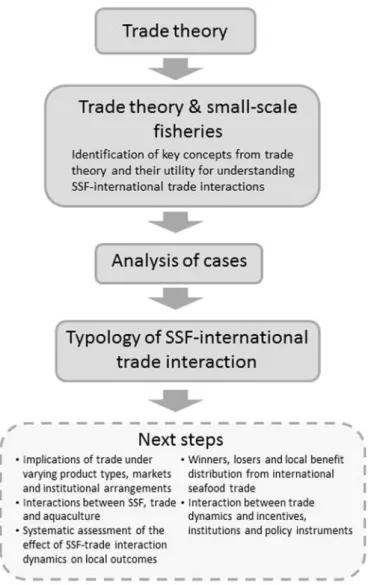
The paper begins by elaborating on some features of interest when examining how trade interacts with local production, drawing on literature from thefields of trade dynamics, and using examples from fisheries and forestry (Fig. 1). Next a systematic analysis of cases is conducted based on these key features to ex-amine if patterns can be identified in how SSF connect to and interact with international seafood trade. Summarizing thefi nd-ings an emerging typology of SSF-trade interaction dynamics and associated outcomes is presented. This typology, and the im-plications of it for the social and ecological sustainability of SSF, is discussed in the context of current policy debates. Avenues for further research on the interplay between SSF and trade are also identified.
2. Dynamics of international trade–a look at theory
Multiple factors drive international trade, including differences across countries and regions in terms of technologies, resource endowments, preferences, institutions, market structures etc.[24], but over the years the weight that trade theory has given to these (individually or in combination) has shifted. Below this theoretical evolution is briefly summarized, highlighting key features
emerging as important in determining international trade devel-opment and structure, and linking these to observable character-istics of international seafood trade. This is done to distill a set of key features of trade theory to be used for further analyzing the interaction dynamics between SSF and international seafood trade. The neoclassical trade theory which dominated thinking for most of the 20th century focused heavily on the notion of com-parative advantage [22,24]. Simply put, comparative advantage embodies the idea that countries or regions import goods which they are (relatively) poor at producing and export those which they excel at producing. While modified over time, the basic idea still holds and is generally observable infisheries trade: countries endowed with richfisheries resources exploit their resources and trade them on international markets [1]. After WWII, attention shifted from comparative advantage to economies of scale and models of monopolistic competition see[23,24]for an overview of trade development theory. Monopolistic competition is a type of imperfect competition where producers sell products that are differentiated from each other and therefore cannot be considered perfect substitutes [25]. This is frequently observed in seafood trade, as products are often differentiated between producers, such as Alaska versus Scottish salmon, and between wild versus farmed products. Eco-labeling and other forms of certification are another form of differentiation. Differentiation in the fisheries sector is generally associated with various forms of tariffs which increase as a product becomes more refined and/or differentiated,
creating asymmetries in economic gain from seafood trade be-tween countries exporting primarily raw material and those ex-porting differentiated and refined products. These tariffs, along with market-based approaches, such as eco-certification, rules of origin and hygiene standards (all representing examples of dif-ferentiation), can be important tools for shiftingfishing industry behavior, but can also function as a direct trade barrier for coun-tries (i.e. mostly developing nations) who cannot afford to pay the costs associated with compliance measures of these schemes [26,27].
Two ideas relating to differentiation represented major ad-vances in trade theory and these are relevant for understanding which features to examine when attempting to analyze seafood trade dynamics and its impacts. First, commodities differentiation was a major leap in explaining and understanding the structure of world trade because it helped explain why similarly endowed countries (with equivalent capital/labor ratios) trade with each other when theory predicts that trade should not take place due to similar factor endowments[24]. The theory of differentiated pro-ducts also explains why the richest countries in the world trade more with each other than with developing countries who would seem to have the comparative advantage of lower labor costs. [23,24]. Second, much of the neoclassical approach to trade was based on the assumption that all individuals and countries re-spond to trade incentives in similar ways. Today it is accepted that foreign trade will invariably benefit some and harm others [24,28,29] but the effects of this are still poorly understood. As Helpman (2011:148) notes,“product differentiation andfirm het-erogeneity introduce new channels of gains from trade but the extent of these gains is highly uncertain”.
In the early 2000s the effects of differentiation were further explored by [30] to capture observations that firms differ sub-stantially in productivity and engagement in foreign trade[31–33]. This new research, with a focus onfirm heterogeneity, predicted that firms who enjoy a relatively high productivity before the opening up of a market will be more able to profit from the new exporting opportunities presented by trade liberalization. These firms are more likely to engage in export while continuing to supply products for the domestic market. Firms with a lower re-lative productivity are unlikely to be able to support the extra costs of entering the export market and will continue to supply only domestic consumers. Trade liberalization means that foreign competition is allowed to enter the domestic market. This in-creased competition will therefore, theoretically, force the smallest firms, and those with the lowest productivity to exit the business [30,32]. From afisheries perspective this means that while overall product output from thefisheries sector may rise [24]the com-petition resulting from trade liberalization can also be detrimental for small-scale producers, their employment and social welfare [13,34,35]. The ease with which labor canflow in and out of a sector (often termed labor market friction) is also instrumental for understanding the effects of trade liberalization on small-scale producers in the differentiated product market sector. If labor mobility is high this should reduce the cost of hiring, making the sector more productive on the world market[24,25]. However, for fisheries livelihoods, where people may be unable or unwilling to change occupation due to low skills, sunken costs or other socio-cultural barriers [36] mobility is likely to be low and to affect competitiveness, particularly in settings with low alternative em-ployment opportunities.
In recent decades, foreign investment has also come to play an increasingly important role in determining how international markets interact with local production systems. Investment by exporting companies in local supply sources may benefit local producers, while foreign investment by international companies sourcing in other countries may introduce new competition, but
also new opportunities, in those areas (see [24] for review). However, studies have shown that foreign direct investment (FDI) in resource rich countries often do not generate the many positive spill-over effects (e.g. technology transfer, job creation) otherwise often associated with FDI[37]. In afisheries context this means that understanding how foreign investment is deployed in relation to SSF can be critical in understanding how the local system in-teracts with international trade.
The multiple strands of trade theory briefly reviewed here can help shed light on the dynamics of SSF–international trade inter-actions. The following section outlines how a few key features derived from this review were used for analysis of a sample of SSF from around the world.
3. Methodology
3.1. Key features of international trade and their importance for SSF-trade interaction dynamics
Based on the brief review of trade theory above four key fea-tures emerge as highly relevant for understanding of how inter-national trade interacts with local production (export, import, trade barriers and foreign investment). These provide a theoreti-cally grounded base on which to base the subsequent analysis of SSF–international trade interactions to (1) understand the inter-action dynamics and (2) identify any patterns of these dynamics across cases (Fig. 1). Below follows a brief elaboration on how each can be interpreted in the fisheries sector and how it was con-ceptualized for interpretation across cases.
In terms of international seafood tradefish can eitherflow into, or out of, afisheries system. The direction offishflow is therefore a critical determinant of the interaction dynamics of a particular fishery with international trade. Relating back to the theory above
exportoffish suggests a SSF will exhibit differentiation in the gains from international trade across the actors involved in thefishery [30,32], such that larger and more productive producers will gain from trade while smaller producers often lose out. In the context of SSF large producers are represented by industrial (or semi-in-dustrial operations) [38].On the other hand, import of fish or fisheries products would be theoretically predicted to increase competition among actors in thefishery with potentially negative impacts on income, and traditionalfishing modes as well as un-equal wealth distribution in the fisheries due to primarily price pressures[24,33]. Fisheries scholars have drawn attention to the latter [39]but a systematic assessment of it in relation to other trade interaction dynamics is still lacking. Each case fishery was therefore examined with regard to the direction offishflow (im-port/export) represented by the dominant trade dynamic.
Trade barriers and restricted market access can prevent SSF, particularly in less developed nations, from developing industries based on refined products rather than simply supplying raw ma-terial for processing overseas [27], see also,[40]for comparison with forest products but the relative benefits of upgrading in the fisheries commodity chain and the effects on fisheries sustain-ability is hotly debated[41,42]and thus warrants more examina-tion. Each case was therefore evaluated based on the degree to which trade barriers and reduced market access appeared to play a significant role in how the casefishery connected to international markets.
SSF interacted with global the international seafood trade.
3.2. Identification, selection and coding of cases
Cases were identified, selected and coded in a two-stage pro-cess.Step oneconsisted of a literature search, carried out in Google Scholar and ISI Web of Knowledge based on a set of key word combinations (Table A1). All abstracts were assessed for relevance to the analysis. Cases were included on the basis of three criteria; (1) a case had to describe one (or several) small scalefisheries that in some way are (directly or indirectly) connected to an interna-tional seafood market; (2) a case had to describe key aspects of how the small-scale fishery interacted with the international seafood trade; (3) a case had to examine (to some degree) both social and ecological aspects of the small-scalefisheries systems at a regional/local geographical scale. Small-scalefisheries were de-fined as “traditional fisheries using relatively small amount of capital and energy, relatively small fishing vessels, but varying from gleaning or a one-man canoe in poor developing countries, to more than 20-m. trawlers, seiners, or long-liners in developed ones[38].
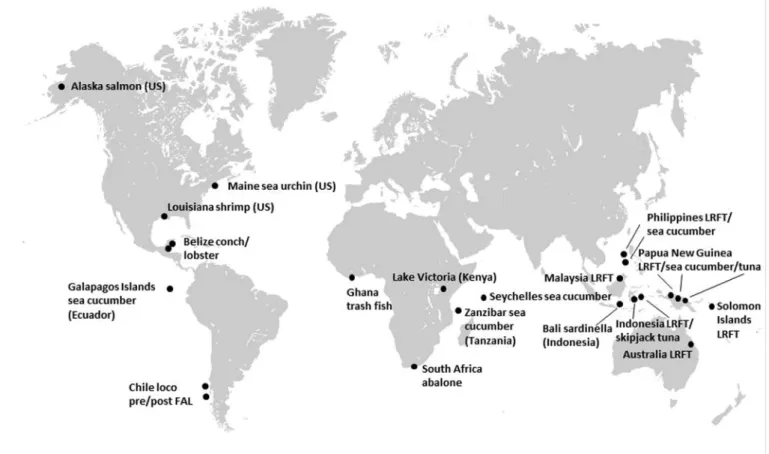
Cases which lacked sufficient information on the background and evolution of thefishery and related trade, the principal ways in which the localfishery engaged with international trade, or on changes in the environment, socio-economic conditions and in-stitutions were discarded. For detailed description of case identi-fication procedures, seeAppendix A. A total of 24 cases were in-cluded for analysis (Fig. 2) and 31 papers were included for coding in step two. A full list of cases, including supporting papers coded for each case, is found inTable A2.
Step twoinvolved coding of all papers remaining after the se-lection process. First coding was done with respect to the key features of international trade outlined above. Based on the
existence of these features the overall dynamics of each case were qualitatively evaluated and compared to discern any pattern in how individual SSF interact with international seafood trade.
Second, each case was coded for local level outcomes related to the international trade of the particular seafood in focus. Out-comes refer to effects, observed at the level of a local SSF, and inferred by the case authors as a consequence of the observed connectivity to international seafood trade. This second coding procedure was iterative in nature such that new codes were added as they appeared in the cases. After all cases had been coded once the list of codes was reviewed and very similar codes consolidated. All cases were then coded once again based on thefinalized code list. Thisfinal list of codes included; trends of declining, sustained or increasing fish stocks, trends of destructive fishing practices (often associated with collateral damage on habitats/coral reefs), trends in employment opportunities infisheries sector, trends in conflicts occurrence amongfisheries actors, levels of debt among fishers, local food insecurity/Food security impacts negative through prices, trends infishing production costs, trends in in-come/profits among fishers, trends in health issues associated withfishing, general assessment of poverty alleviation impact of fish trade (as assessed by case authors). All coding was done using Atlas.ti qualitative data analysis software. For a more detailed description of the indicators used in the coding of outcomes please refer toTable A3(Appendix A).
4. Results
4.1. An emerging typology of how SSF interact with international seafood trade
A systematic examination and comparison of cases with regard
to key features of international trade reveals how several of these features co-exist and interact resulting in complex dynamics of interaction between global seafood markets and SSF. On the basis of this pattern a typology comprised of three distinct types of SSF– trade interaction dynamics–‘Market export’,‘Market competition’,
and‘Market spillover’is proposed (Fig. 3).
4.1.1. Type 1: Market export
‘Market export’ represents a type in which dynamics are dominated by the direct export of a SSF product for the interna-tional market. In 18 of the 24 reviewed cases (75%) seafood export was the primary mode of interaction with international seafood trade. In some cases the opportunity to export locally harvested fish occurred specifically in conjunction with liberalization po-licies, such as the locofishery in Chile and the Nile perchfishery in Lake Victoria[43–45]. For many developing nations trade liberal-ization has been a condition for receiving foreign aid[43]and local fisheries have thus become exposed to international trade as a consequence of aid policies. In other cases the connection to the international market appeared independent of liberalization when market actors arrived in search of new sourcefisheries to supply existing and/or growing foreign markets (e.g. all the sea cucumber and live reeffish trade (LRFT)fisheries covered here) c.f.[46].
Foreign investment plays a key role in the‘Market export’ dy-namics by fueling investment in extractive technologies and/or processing capacity, and thus potentially contributing to an in-crease in scale and speed of exploitation offisheries resources. The live reeffishfisheries in Indonesia, Malaysia and the Philippines reviewed here are a good example. Thesefisheries generally ex-hibit a two-phase progression[47]. First, large foreign-owned or joint venture purpose-built live reeffish catcher vessels employing non-local fishers, and using cyanide as the main catch strategy appear. These operations are characterized by relatively high overheads. Thus, they target the highest value fish and require large volumes offish to be profitable. The highfishing pressure and the systematic use of cyanide to remove the target species result in significant overfishing of the targetfish and usually col-lateral damage to the reefs. As populations of the highest valuefish dwindle, the vessels move on to new areas. With the departure of the more capital-intensive operators, the second phase usually involves small- to medium-scale operators, often local business persons, taking over[47].
In summary, the ‘Market export’ type is characterized by an initial profitability driven by high demand from international markets[48]. This results in increased incentives to exploit and often attracts newfishers into thefishery. In some cases, especially where institutional capacity is low, this leads to overexploitation
(e.g. in the Chilean case of locofishery before the new Fisheries Law (Chile loco pre FAL), Maine sea urchin, Belize conch and lob-ster, most LRFT and sea cucumber fisheries with Australia as a notable exception) and the viability of thefishery may decline due to the resultant drop in catch per unit effort and mounting costs (Chile loco pre FAL and Lake Victoria)[16]. In some casesfishers substitute declining stocks of one species with new ones (e.g. Zanzibar sea cucumber) thus contributing to a pattern of se-quential exploitation across species.
Kurien [5]and de Schutter[17]argue that under conditions of
strong economic incentives from international trade opportunities, fish exports can also result in reduced availability offish or seafood for local consumers. This is sometimes observed when foodfish locally consumed is introduced to an export market, such as the Lake Victoria case (see also[49]. It can drive up prices for the same product on the local market indirectly impacting the prices of other fish that are dietary substitutes and complements in local consumption. Iffish, or specific species offish, are important for local food security and not easily substituted for economic, cultural or logistical reasons export can create negative effects on local and particularly poor populations, generally sensitive to price due to low incomes[13]. But exports are also often targeted at species which are not traditionally consumed (such as sea cucumbers and sea urchins in most non-Asian countries, e.g. Zanzibar, Galápagos and Maine cases), or species which become accessible through new technologies and therefore do not have a traditional local market [50]. In such cases local food security may be virtually unaffected, while effects are more likely to relate to exploitation rates and effects on stocks and the local environment, either through collateral habitat damage or ecological cascades resulting from the removal of the target species, if effective regulations are not in place[51]. Finally, in cases where some level of processing is developed locally export markets can provide new employment opportunities for local residents, but tariff and non-tariff trade barriers, including difficulties in meeting the stringent hygiene and sanitation standards demanded by importing countries, affect the ability of SSF to export their products and introduce large uncertainties in market access over time which have to be dealt with [17,44]. An illustration of this is Lake Victoria, where strin-gent hygiene standards imposed by, among others, the EU (EU Directive on Hygiene 91/493/EEC) on fish processed for export resulted in an EU import ban. To rapidly deal with the reduced access plant managers began to sell an increasing proportion of fish frames tofish meal plants to avoid accumulation of frames polluting the processing facility. A side effect of this is the drasti-cally reduced availability of fish frames for local markets and consumers at the same time as demand for the frames have
continued to rise[44].
4.1.2. Type 2: Market competition
The dynamics characterizing the‘Market competition’type are dominated by an inflow offisheries products into the local SSF through international trade, creating competitive dynamics. This competition stems from difficulty in differentiating between pro-ducts of the same species (beyond e.g. the quality of handling), and from the relatively large number of substitutes for any given species and thus lower price elasticities. Although export of locally produced fish may still occur in a Market competition case a dominant influence of import on local social–ecological dynamics is a defining feature. Furthermore, tariffs and other trade barriers certainly are important in determining which commodities are exported and which are imported but the information available in the cases did not allow more in-depth analysis of the role of trade barriers in this dynamic.
Three cases were categorized as‘Market competition’, exhibiting a netflow offish into the system through foreign imports (Alaska salmon, Louisiana shrimp, and Bali sardinella fishery during La Niña periods). The Alaskan and Louisianafisheries are similar in that they are both dominated by independent owner/operators with relatively small vessels[52,53]. Both cater to a market that is global in scale where competition for market shares is high and as a resultfishers in SSF like the two described here are vulnerable to fierce competition from foreign producers with lower production costs who drive down global prices. In the Louisiana shrimp fishery the competition is primarily from Asian producers (many of which are aquaculture based) with lower production costs[53], and for Alaskan salmonfishers (who are dependent on the natural fluctuations of the salmon runs) the main competitor is the sal-mon farming industry which is able to produce a consistent quality of fresh salmon–specified to order by size and cut–at any time during the year and at a low price. Although production on individual salmon farms may be affected by disease, storms, and marine mammal predation, the operation of multiple sites in various countries results in an even and predictable production for the global market in which local SSF are also competing[21]. The Bali sardinella case is slightly different as thefishery was primarily developed for export and initially benefitted from productive local conditions and high global demand. During El Niño seasons this fishery generally experiences a glut while La Niña periods are as-sociated with sardine scarcity. To deal with this fluctuation in supply local processing plants, import frozen sardines and fi sh-meal bulk from abroad during La Niña periods[54]. Both the im-portedfish meal and sardines are generally cheaper than the lo-cally caught sardinella and as a result have driven down prices for local fishers and are driving some fishers out of the fishery permanently.
As evident from these cases, impacts of this competition are both direct through commodity flows and more indirect, largely through effects onfish prices as well as labor costs and employ-ment. Fisheries actors in the three cases representing this inter-action type (Table 1) all share the experience of dealing withfierce competition from foreign suppliers. This influences the profi t-ability offisheries operations for small-scale actors through a cost-price crunch phenomenon[53]squeezingfishers, processors and small traders out of business and underminingfishing as a liveli-hood option. In Alaskafishers have responded by diversifying their livelihoods or even retiring from the industry.
While not observed in the cases reviewed for this study, others have noted situations wherefish imports can also benefit poorer local consumers by stabilizing or reducingfish prices [2,5]. Bell
et al. [20] also outline how, in countries in which small-scale
fishing is not historically abundant, increased imports of fish coupled with investments infish processing by foreign interests to
supply foreign markets can simultaneously improve food avail-ability locally through spill-over into local markets. Such benefits are even more likely if government programs in the processing country have policies that specifically aim to redirect some fish products from export to local markets. Fish imports may thus at times result in increased employment opportunities for local processors and distributors and increased food availability but can simultaneously negatively affect localfishers who receive lower prices for their catch depending on the price elasticity of the species in focus[13]. This indicates the potentially significant role of foreign investment, and the interplay between such invest-ments, imports and government policies, in determining outcomes related to the‘Market competition’dynamics. But it also shows that a sharp line between the‘Market import’and ‘Market spillover’
may at times be hard to draw.Table 2 Table 1
Classification of cases into SSF–trade interaction types. Percentages indicate pro-portion of cases falling into each category.
1. Market export (75%) 2. Market competition (12%)
3. Market spill-over (25%)
Case Case Case
Lake Victoria (Kenya) Louisiana shrimp (US) Papua New Guinea tuna
Galápagos sea cucumber Alaska salmon (US) Philippines LRFTa Chile Loco pre FAL Bali sardinella
(Indonesia)a
Malaysia LRFTa
Chile Loco post FAL Indonesia LRFTa Maine sea urchin Ghana trashfish Zanzibar Sea cucumber Indonesia skipjack
tuna Papua New Guinea LRFT
Salomon Islands LRFT Australia LRFT Papua New Guinea sea
cucumber
Philippines sea cucumber Seychelles sea cucumber Belize conch
Belize lobster South Africa abalone Philippines LRFTa Malaysia LRFTa Indonesia LRFTa Bali sardinella (Indonesia)a
FAL¼1991 Fisheries and Aquaculture Law. LRFT¼Live reeffish trade.
a¼
case is categorized under multiple typologies.
Table 2
Key trade features of the trade interaction typology.
Type Trade features Market export
Market competition
Market spillover
Export of seafood ✔ ✔
Import of seafood ✔ ?
Foreign investment ✔ ✔
Existence of trade barriers affecting market access
? ? ?
Outcomes
Unsustainable exploitation þ –– þ Environmental degradation þ –– þ
Job creation þ – ––
Conflict þ –– þ
Debt amongfishers þ –– ––
Local prices þ – ––
Costs offishing –– þ ––
Economic returns þ/– – – Health issues related to
fishery
–– –– –
4.1.3. Type 3: Market spillover
While export and import of fisheries resources are obvious ways in which SSF connect to global seafood markets, the third type proposed–‘Market spillover’–deals with a dynamic not al-ways evident atfirst glance. This type is characterized by situa-tions where SSF dynamics are not driven directly by export or import of seafood from a particularfishery, but through spillover effects from anotherfishery, in turn connected to global trade[55]. As noted by Liu et al.[56,57]this type of spillover effect has often been neglected in attempts to understand globalization effects and social and environmental interlinkages between different geo-graphic regions, through for example trade. Yet the implications of spillover dynamics for SSF can be significant and thus deserves its own treatment. Spill-over is often conceived as a positive side-effect on other economic sectors[58]but this paper assumes that the spill-over effects (sensu Liu et al. 2013) can be both positive and negative depending on the sector in focus.
‘Market spillover’is observed in a number of the cases reviewed
(Table 1) and can be categorized into two broadly distinguishable
categories based on primary spillover effects on the SSF in focus; i) effects on existing small-scalefisheries operations directly and ii) effects on SSF dynamics through introduction of new technology orfishing practices.
Thefirst category is exemplified here by the case of Ghanaian trashfishfishery. In this case many small-scalefishers have vir-tually stopped‘seek and capture’fishing in favor of trading with industrial trawlers for their‘trashfish’bycatch. Thefish is trans-ferred at sea to small canoes for onward sale on land. This reduces wastage of by-catch and has provided an important supply offish to local markets as well as improved nutritional status and food security, especially in inland areas[59]. A downside of these op-erations, however, is the observed competition experienced by the small-scale fishers who perceive trawlers to be a threat to the environment and their livelihood[60]as well as habitat damage and direct conflicts overfishing areas. Similar conflicts overfi sh-eries resources are evident in Indonesia between local coastal tuna boats and foreign (mainly Philippine) tuna vessels[61]and in the Indian Ocean where Chinese tuna vessels reducefish available for localfishers and lower the prices of canning-grade albacore tuna to the detriment offishers in neighboring states[62,63]. It is evi-dent from these examples that the knock-on effects of a related fishery being connected to export markets can be the competition that is often created byfleets exploiting this market opportunity and those catering to a more local (even subsistence) market.
Evidence of the second category is found in Papua New Guinea (PNG), where spillover effect consists of impacts on the local fishery and marketing system through the introduction of an in-dustrial fishery and associated establishment of local processing plants that process tuna for export. In PNG government policy has been to capture value from tuna resources by shifting from‘first’to
‘second’-generation access agreements where the national fi sh-eries agency offers foreign fishing firms favorable tuna fishing terms (e.g. no access fee and long-term fishing security) in ex-change for onshore investments in tuna processing plants[64]. Although aimed at creating jobs and economic development op-portunities for the benefit of PNG, underspecified government interpretations of what constitutes development and follow-up assessments, as well as exploitative behavior observed among firms involved in the access agreements have led to secondary, spillover, effects on local SSF. These include squeezing out of local fishers andfish markets, thus changing livelihood and marketing opportunities for local fishers. Though it is difficult to quantify ecological change in this sector, local actors argue that industrial fishing is reducing the tuna resource base and that industrial fishing and processing activities are also harming nearshore reef fisheries [64]. Further knock-on effects with largely social
implications for the local communities include the growing pros-titution linked to the tuna boats associated with the processing plants.
The dynamic associated with the introduction of newfishing practices is also evident in the live reeffishfisheries of Philippines, Indonesia, and Malaysia. These cases illustrate how new extractive technologies are initially introduced at a larger industrial scale through the interplay between export market opportunities and foreign investment (described under‘Market export’)[47], but over time these practices are adopted at the scale of the SSF with subsequent effects on social dynamics (e.g. credit arrangement betweenfishers and traders) and ecological conditions[65].
In summary, thefisheries falling within the ‘Market spillover’
type are all characterized by having their internal social–ecological dynamics altered indirectly by spillover effects from another fishery which is connected to international trade. The cases ex-amined here suggest that seafood export in thefishery from which spillover is generated is a key characteristic of this dynamic, in combination with foreign investments fueling this export through investment in extractive technology and processing, similar to what has been described under‘Market export’.
5. Discussion
This typology of interaction dynamics between global seafood trade and SSF centers on how SSF interact with global seafood trade. By focusing on a set of key features of international trade (import/export dynamics, foreign investment, and trade barriers and market access) and analyzing how these give rise to specific patterns of interaction between SSF and international seafood trade this paper suggests it can serve as a simple heuristic to capture essential dynamics of SSF connecting to global markets. To exemplify its use one could, very simplified, note that ‘Market export’dynamics suggests a likelihood of increasing prices and an increased effort with possible negative consequences for stocks depending on the state and enforcement of property rights and fisheries management effectiveness[15], while‘Market competi-tion’ suggests the opposite should happen as people are out-competed and leave thefishery in the absence of mitigating fac-tors that lower costs, such as subsidies, rapid technological pro-gress, or increased investment in more cost-competitive vessels. Cases exhibiting‘Market spill-over’, on the other hand, are prone to experience negative spill-over effects of collateral ecosystem damage and declining stocks from industrial operations, but other both positive and negative social and economic effects are ob-served depending on context.
It is important to recognize that the trade features used as an analytical lens for examination of cases are deduced from a review of relevant trade theory andfisheries literature, while the typology is inductively derived from this analysis. As such trade features do not map on to the three types in a one-to-one relationship, but each type is the outcome of a combination of trade features in-teracting. This may explain why trade barriers and market access does not feature prominently in the proposed typology, even though recent trade models suggest they do play a role in de-termining which actors gain access to international markets [30,32,66]and analysis shows trade barriers to be critical in de-termining trade patterns at a more aggregate scale[27].
frames of governance and markets are often not well aligned[2].
Felixson et al. [67]aptly illustrate this complexity by showing how
New Englandfishers’income was affected by subsidized Canadian imports. However, the measures to counterbalance this through trade tariffs threatened to drive upfisher incomes which would lead localfishers tofish harder to earn even more, eventually re-ducing stocks to potentially unsustainable levels if sufficient reg-ulation is not in place. This demonstrates how interactions be-tween trade measures and localfisheries dynamics (social, eco-nomic, and environmental) can create feedback dynamics that are both difficult to anticipate and analyze in simple terms. Hence, resource managers andfisheries governance actors face new and distinct challenges in trying to account for global trade dynamics in currentfisheries governance systems. The typology presented here does not provide a template for how to do this but can pro-vide a heuristic to guide evaluation of the type of dynamics in-fluencing a particular SSF and hence an indication of some of the potential outcomes to be expected. Understanding trade–SSF in-teractions is unlikely to provide a singular solution but can help in identifying dynamics which underpin the creation of winners and losers from market connections and assess the complexity of trade policies to address this[24]. The example from New England above also highlights the interplay between trade and subsidies[68,69] which is a vast topic not dealt with here. How it interacts with the typology is an area that should be further explored.
Certification is often held up as a way to address negative im-pacts of trade in local systems. However, the dynamics captured in each of the types outlined above highlight that this may only hold true under certain conditions. For example, under‘Market export’
dynamics certification schemes may be a useful option to steer the development towards more socially and environmentally sus-tainable trajectories by connecting globally distributed consumers to local source fisheries and using supply chain structures to promote sustainable practices through product specification. For
‘Market spill-over’cases certification could have similar beneficial impacts if schemes were designed to explicitly take account of negative spill-over effects. However, under ‘Market competition’
dynamics certification may not automatically be beneficial or economically feasible for local producers unless schemes can be designed so as to ensure price premium for small marginalized actors, possibly preventing them from ‘racing to the bottom’
through ever increasing effort and destructivefishing methods. An more nuanced understanding of the different types of interactions between international seafood trade and SSF should aid in the development of certification strategies which can be targeted to incentivize continual improvement of SSF[70,71].
The three types of SSF–trade dynamics appear to result in multiple and diverse outcomes. In other words there is not a singular outcome associated with a particular type. Nonetheless, some broad patterns can be discerned. For example,‘Market ex-port’and‘Market spillover’appear to be strongly associated with unsustainable exploitation, environmental degradation and com-monly also conflicts around thefisheries resource. In‘Market ex-port’cases it was more common to also observe high levels of debt amongfishers (e.g. live reeffish cases, sea cucumberfisheries in Galapagos and Zanzibar, but also lobsterfisheries in Maine and Belize), and in some situations also indications of wealth accu-mulation among trade actors rather than in the capture sector (e.g. Lake Victoria, LRFT in Indonesia and Philippines, and Zanzibar sea cucumberfishery) c.f.[72]. These patterns offisher debt and trader wealth are sure linked but the complex dynamic of this inter-relationship is beyond the scope of this analysis and has been explored in more detail elsewhere e.g.[73–75]. At a general level economic returns tofishers and other market actors in these cases therefore varies depending on the particular market structure and wealth capture dynamic of the case. But while economic returns
may differ across the value chain in‘Market export’cases, a more general trend is towards increased employment opportunities as well as rising local prices for the export commodities in focus. This contrasts starkly with‘Market competition’cases which generally exhibited increasing competition between domestic and foreign produced products, falling local prices of the imported commodity with negative effects on economic returns to (primarily)fishers and loss of income and employment opportunities as a result (Alaskan salmon, Louisiana shrimp, and Bali sardinella).
Thus broadly distinguishable patterns of effects can be identi-fied across the various types presented here. However, the scope of this paper does not allow us to address the drivers influencing this diversity in outcomes – that is the underlying factors likely to affect how SSF trade dynamics examined here translate into local social–ecological outcomes, such as institutional capacities, vul-nerabilities of species targeted, characteristics of the market and the demand driving the trade, etc.[2,46]. For a more in-depth treatment of this topic see Crona et al.[3]. However, some inter-esting patterns emerge from the limited sample in this paper, which may warrant further attention. First, it is noteworthy that two of the three cases of‘Market competition’occur in the USA. This may be expected given knowledge of the higher labor and production costs of developed countryfisheries but the Bali Sar-dinella examples also shows that writing market competition off as largely developed country issue may be too simplistic. Large amounts of seafood are traded from developing to developed countries[76] but a significant amount is also imported to de-veloping countries as processed products (e.g. canned sardines). In cases where this import directly interferes with market pre-ferences and thus price of locally sourcedfish‘Market competition’
is potentially also a developing country phenomenon. Another factor driving the‘Market competition’is the fact that both Alas-kan salmon and Louisiana shrimps are wild capture commodities which are under increasing competition from aquaculture pro-duction. Second, half of the cases exhibiting‘Market export’ dy-namics are high value invertebratefisheries. Data presented here does not allow more than speculation about the reasons for this, but the fact that most of thesefisheries, as well as the live reeffish fisheries also in this category, cater to exclusive niche markets suggests the strong economic incentive provided by exploiting a high value market segment may be driving these dynamics.
The typology as proposed here has scope for refinement. For one, some cases exhibit overlap in membership in the three types depending on when in the historical development of thefishery one focuses the attention. In addition, the three types of dynamics comprising the typology also mutually influence each other. For example, in the Pacific, small-scale longliners compete on the global tuna market with large-scale Asian longliners (Market competition). At the same time the spill-over effect of declining stocks resulting from Asian longline catches (Market spill-over) thus co-occurs with direct competition between these actors on the export market[62]. The analysis and emerging typology pre-sented should therefore be seen as afirst step towards uncovering the diversity of ways in which globalized markets interact with SSF. In the same way that international trade was originally un-derstood in oversimplified terms of merely competitive advantage, so researchers and policy actors concerned with SSF risk a homogenous and oversimplified understanding of the implications of trade[4]. There is an urgent need to understand the diverse mechanisms behind effects of global trade on SSF and the typology proposed here offers afirst overview of some of the key dynamics at play.
arrangements. While case selection for this paper was preceded by an extensive search (seeAppendix A) the selection process may have missed cases leading to the exclusion of potentially im-portant dynamics thus not captured here. The rapid growth of aquaculture also introduces further complexity in how SSF are affected by trade as farming activities are linked tofisheries and fisheries resources in multiple ways[8,77,78]. Furthermore, from a policy perspective there is a need to investigate how these dif-ferent dynamics result in outcomes for livelihoods, food security, environmental sustainability, and economic performance in var-ious contexts. Political economists will also be interested in who the winners and losers from international trade are at the local level and how benefits from this trade are distributed (across the harvesting sector, supply chain, and within households). Finally a better grasp of how incentives, institutions and policy instruments such as certification, trade agreements, foreign direct investment, aid and development interact with trade dynamics is imperative to be able to promote policies that align goals of poverty alleviation, food security, employment and environmental sustainability in small-scalefisheries in the long run.
Acknowledgments
Funding for this paper was provided through a core grant by MISTRA to the Stockholm Resilience Center. The lead author (and EAB) were also funded by the Erling-Persson Foundation, through the Global Environmental Dynamics and the Biosphere program at the Royal Swedish Academy of Science. Input by remaining au-thors were supported by David and Lucile Packard Foundation (XB), Conicyt FB 0002 and Milenio Initiative NC 120086 (SG), and the Young International Scientist Fellowship Grant no. 2012 Y1ZA0010 under UNEP-IEMP (AK). Any opinions,findings or re-commendations expressed in this material are those of the author (s) and do not necessarily reflect the views of U.S. NOAA Fisheries or the other funding agencies. Finally, thank you to Mark Sanc-tuary for pointing us in the direction of relevant aspects of trade theory during early stages of this work.
Appendix A. Supplementary material
Supplementary data associated with this article can be found in the online version at http://dx.doi.org/10.1016/j.marpol.2015.11. 016.
References
[1]FAO, The state of World Fisheries and Aquaculture, Food & Agriculture Orga-nization of the United Nations, Rome, 2014 2014.
[2] M.D. Smith, C.A. Roheim, L.B. Crowder, B.S. Halpern, M. Turnipseed, J. L. Anderson, et al., Sustainability and Global Seafood, Science 327 (2010) 784–786,http://dx.doi.org/10.1126/science.1185345.
[3] B.I. Crona, T. Van Holt, M. Petersson, T.M. Daw, E. Buchary, Using social– eco-logical syndromes to understand impacts of international seafood trade on small-scalefisheries, Global Environ. Change 35 (2015) 162–175,http://dx.doi. org/10.1016/j.gloenvcha.2015.07.006.
[4] C. Béné, R. Lawton, E.H. Allison, Trade matters in thefight against poverty: narratives, perceptions, and (lack of) evidence in the case offish trade in Africa, World Dev. 38 (2010) 933–954,http://dx.doi.org/10.1016/j. worlddev.2009.12.010.
[5]J. Kurien, Responsible Fish Trade and Food Security, Food and Agriculture Organization of the United Nations, Rome, 2005.
[6]HLPE, Sustainable Fisheries and Aquaculture for Food Security and Nutrition, A report by the High Level Panel of Experts on Food Security and Nutrition of the Committee on World Food Security, Rome, 2014.
[7] Hannesson, R., Effects of Liberalizing Trade in Fish Fishing Services and In-vestment in Fishing Vessels 2001.
[8] Deutsch, L., Troell, M., Limburg, K., Huitric, M., Global trade offisheries
products. Implications for marine ecosystems and their services, in: T. Köllner (Ed.), Ecosystem Services and Global Trade of Natural Resources, 2011. [9]A.K. Dragun, C.A. Tisdell (Eds.), Sustainable agriculture and environment:
globalisation and the impact of trade liberalisation, Edward Elgar Pub, Chel-tenham, UK , Northampton, MA, 1999.
[10] E.F. Lambin, H.J. Geist, E. Lepers, Dynamics of Land-Use and Land-Cover Change in Tropical Regions, Annual Review of Environment and Resources. 28 (2003) 205–241,http://dx.doi.org/10.1146/annurev.energy.28.050302.105459. [11] P. Meyfroidt, T.K. Rudel, E.F. Lambin, Forest transitions, trade, and the global displacement of land use, PNAS 107 (2010) 20917–20922,http://dx.doi.org/ 10.1073/pnas.1014773107.
[12] C. Schmitz, A. Biewald, H. Lotze-Campen, A. Popp, J.P. Dietrich, B. Bodirsky, et al., Trading more food: Implications for land use, greenhouse gas emissions, and the food system, Global Environ. Change 22 (2012) 189–209,http://dx.doi. org/10.1016/j.gloenvcha.2011.09.013.
[13]T. Bostock, P. Greenhalgh, U. Kleith, Policy Research-Implications of Liberal-ization of Fish Trade for Developing Countries, Natural Resource Institute, Chatham, UK, 2004.
[14] Virdin, J., Gardiner, P., van Santen, G., Savingfish andfisheries : towards sus-tainable and equitable governance of the globalfishing sector, The World Bank, 2004.〈http://documents.worldbank.org/curated/en/2004/05/5724050/ saving-fish-fisheries-towards-sustainable-equitable-governance-global-fish ing-sector〉(accessed June 25, 2014).
[15]J.A. Brander, M.S. Taylor, International trade and open-access renewable re-sources: the small open economy case, Can. J. Econ. 30 (1997) 526. [16] B.R. Copeland, M.S. Taylor, Trade, Tragedy, and the Commons, Am. Econ. Rev.
99 (2009) 725–749,http://dx.doi.org/10.1257/aer.99.3.725.
[17] de Schutter, O., The right to food, Report presented at the 67th Session of the United Nations General Assembly, A/67/268, 2012.〈http://www.srfood.org/ images/stories/pdf/officialreports/20121030_fish_en.pdf〉.
[18] V.M. Kaczynski, D.L. Fluharty, European policies in West Africa: who benefits fromfisheries agreements? Marine Policy. 26 (2002) 75–93,http://dx.doi.org/ 10.1016/S0308-597X(01)00039-2.
[19] D. Pauly, R. Watson, J. Alder, Global trends in worldfisheries: impacts on marine ecosystems and food security, Philos. Trans. R. Soc. B: Biol. Sci. 360 (2005) 5–12,http://dx.doi.org/10.1098/rstb.2004.1574.
[20] J.D. Bell, M. Kronen, A. Vunisea, W.J. Nash, G. Keeble, A. Demmke, et al., Planning the use offish for food security in the Pacific, Mar. Policy 33 (2009) 64–76,http://dx.doi.org/10.1016/j.marpol.2008.04.002.
[21]R. Naylor, J. Eagle, W. Smith, Response of Alaskanfishermen to aquaculture and the Salmon crisis, in: W.W. Taylor, M.G. Schechter, L.G. Wolfson (Eds.), Globalization: Effects on Fisheries Resources, Cambridge University Press, Cambridge ; New York, 2007.
[22] Ricardo, D., On the Principles of Political Economy, and Taxation., Har-mondsworth: Pelican Books [text of the third edition, 1821; original edition, 1817], 1971.
[23] Ciuriak, D., Lapham, B.J., Wolfe, R., Collins-Williams, T., Curtis, J.M., Firms in International Trade: Towards a New New Trade Policy, Social Science Research Network, Rochester, NY, 2011.〈http://papers.ssrn.com/abstract¼1814226〉
(accessed August 30, 2014).
[24] E. Helpman, Understanding Global Trade, Harvard University Press, Boston, 2011, accessed August 30, 2014.
[25] P. Krugman, Scale Economies, product differentiation, and the pattern of trade, Am. Econ. Rev. 70 (1980) 950–959.
[26] Jonell, M. Phillips, M., Rönnbäck, P., Troell, M., Eco-certification of Farmed Seafood: Will it Make a Difference?-Springer, Ambio. 42 (2013). pp. 659–674. [27] C.A. Roheim, J.G. Sutinen, Trade and marketplace measures to promote
sus-tainablefishing practices, International Centre for Trade and Sustainable De-velopment and the High Seas Task Force, Geneva, Switzerland, 2006. [28] D. Rodik, The Globalization Paradox: Why Global Markets States, and
De-mocracy Can’t Coexist? OUP, Oxford, 2011.
[29] K.F. Scheve, M.J. Slaughter, What determines individual trade-policy pre-ferences? J. Int. Econ. 54 (2001) 267–292,http://dx.doi.org/10.1016/ S0022-1996(00)00094-5.
[30] M.J. Melitz, The impact of trade on intra-industry reallocations and aggregate industry productivity, Econometrica 71 (2003) 1695–1725.
[31]F. Ghironi, M.J. Melitz, Tradeflow dynamics with heterogeneousfirms, Am. Econ. Rev. 97 (2007) 356–361.
[32] F. Ghironi, M.J. Melitz, International Trade and Macroeconomic Dynamics with Heterogeneous Firms, National Bureau of Economic Research, Cambridge, Massachusetts (2004), p. 2014 , accessed August 30.
[33] M.J. Melitz, S.J. Redding, Heterogeneous Firms and Trade, National Bureau of Economic Research, Cambridge, Massachusetts (2012), p. 2014 , accessed August 30.
[34] S. Ponte, J. Raakjær, L. Campling, Swimming upstream: market access for africanfish exports in the context of WTO and EU negotiations and regulation, Dev. Policy Rev. 25 (2007) 113–138,http://dx.doi.org/10.1111/
j.1467-7679.2007.00362.x.
[35] UNEP, Integrated assessment of trade liberalization and trade related policies, A country study onfisheries sector in Senegal., Geneva (2002).
[36] T.M. Daw, J.E. Cinner, T.R. McClanahan, K. Brown, S.M. Stead, N.A.J. Graham, et al., Tofish or not tofish: factors at multiple scales affecting Artisanalfishers’ readiness to exit a decliningfishery, PLoS One 7 (2012) e31460,http://dx.doi. org/10.1371/journal.pone.0031460.
10.1111/j.1467-7679.2004.00255.x.
[38] FAO, Fisheries and Aquaculture topics. Small-scale and artisanalfisheries., (2005).〈http://www.fao.org/fishery/topic/14753/en〉.
[39]J.L. Anderson, F. Asche, S. Tveterås, Worldfish markets, in: R.Q. Grafton, R. Hilborn, D. Squires, D. Tait, M. Williams (Eds.), Handbook of Marine Fish-eries Conservation and Management, Oxford University Press, Oxford, 2010. [40] H.J. Geist, E.F. Lambin, Proximate causes and underlying driving forces of
tropical deforestation, BioScience 52 (2002) 143,http://dx.doi.org/10.1641/ 0006-3568(2002)052[0143:PCAUDF]2.0.CO;2.
[41]OECD, Globalization and Fisheries and Aquaculture, Opportunities and Chal-lenges, OECD, Paris, France, 2010.
[42]U.R. Sumaila, C. Bellmann, A. Tipping, Fishing for the future: trends and issues in globalfisheries trade. Background Paper for the E15 Expert Group on Oceans, Fisheries and the Trade System (First draft), ICTDS, International Centre for Trade and Sustainable Development, World Economic Forum, Geneva, 2014.
[43] Abila, R.O., Fish Trade and Food Security: Are They Reconcilable in Lake Vic-toria? In Report of the Expert Consultation on International Fish Trade and Food Security 2003. Casablanca, Morocco, 27–30 January 2003.
[44] Abila, R.O., Jansen, E.G., From local to global markets. Thefish exporting and
fishmeal industries of Lake Victoria: structure, strategies and socio-economic impacts in Kenya., in: Socio-Economics of the Lake Victoria Fisheries. Report (IUCN), No. 2, World Conservation Union (IUCN), Nairobi (Kenya). Eastern Africa Regional Office, Naiorobi, Kenya, 1997.〈https://portals.iucn.org/library/ efiles/edocs/1997-082.pdf〉.
[45] S. Gelcich, T.P. Hughes, P. Olsson, C. Folke, O. Defeo, M. Fernández, et al., Na-vigating transformations in governance of Chilean marine coastal resources, Proc. Natl. Acad. Sci. USA 107 (2010) 16794–16799,http://dx.doi.org/10.1073/ pnas.1012021107.
[46] H. Eriksson, H. Österblom, B. Crona, M. Troell, N. Andrew, J. Wilen, et al., Contagious exploitation of marine resources, Front. Ecol. Environ. 13 (2015) 435–440,http://dx.doi.org/10.1890/140312.
[47] C. Thorburn, The house that poison built: customary marine property rights and the live foodfish trade in the Kei Islands, Southeast Maluku, Dev. Change 32 (2001) 151–180,http://dx.doi.org/10.1111/1467-7660.00200.
[48] S. Tveterås, F. Asche, M.F. Bellemare, M.D. Smith, A.G. Guttormsen, A. Lem, et al., Fish is food-the FAO’sfish price index, PLoS One 7 (2012) e36731,http: //dx.doi.org/10.1371/journal.pone.0036731.
[49]A. Gordon, C. Finegold, C.C. Crissman, A. Pulis, Fish Production, Consumption, and Trade in Sub-Saharan Africa: A Review Analysis, World Bank and WorldFish Centre, Penang, Malaysia, 2013.
[50]A. Oosthuizen, W.H.H. Sauer, C.J. Augustyn, Developing a policy and opera-tional protocol for the formation of new commercialfisheries in South Africa, Afr. J. Mar. Sci. 29 (2007) 393–401.
[51] R.S. Steneck, T.P. Hughes, J.E. Cinner, W.N. Adger, S.N. Arnold, F. Berkes, et al., Creation of a gilded trap by the high economic value of the Maine lobster
fishery, Conserv. Biol. 25 (2011) 904–912,http://dx.doi.org/10.1111/ j.1523-1739.2011.01717.x.
[52] B. Mansfield, Rules of privatization: contradictions in neoliberal regulation of north pacificfisheries, Ann. Assoc. Am. Geogr. 94 (2004) 565–584,http://dx. doi.org/10.1111/j.1467-8306.2004.00414.x.
[53] B. Marks, The political economy of household commodity production in the Louisiana Shrimpfishery, J. Agrar. Change 12 (2012) 227–251,http://dx.doi. org/10.1111/j.1471-0366.2011.00353.x.
[54] Kaye, M., Boom but mostly bust:fighting over sardines in Indonesia’s Bali Strait (Part II), Mongabay.org Special Reporting Initiatives. (2014).〈http:// news.mongabay.com/2014/0718-sri-kaye-tale-of-two-fish-part-two.html〉
(accessed August 31, 2014).
[55]J.-P. Platteau, The dynamics offisheries development in developing countries: a general overview, Dev. Change 20 (1989) 565–597.
[56] J. Liu, H. Mooney, V. Hull, S.J. Davis, J. Gaskell, T. Hertel, et al., Systems in-tegration for global sustainability, Science (2015), http://dx.doi.org/10.1126/ science.12588321258832–1258832.
[57] J. Liu, V. Hull, M. Batistella, R. DeFries, T. Dietz, F. Fu, et al., Framing Sustain-ability in a Telecoupled World, Ecol. Soc. (2013), http://dx.doi.org/10.5751/ ES-05873-180226.
[58] A.J. Dyck, U.R. Sumaila, Economic impact of oceanfish populations in the globalfishery, J Bioecon. 12 (2010) 227–243,http://dx.doi.org/10.1007/ s10818-010-9088-3.
[59] F.K.E. Nunoo, J.O. Boateng, A.M. Ahulu, K.A. Agyekum, U.R. Sumaila, When trashfish is treasure: the case of Ghana in West Africa, Fish. Res. 96 (2009) 167–172,http://dx.doi.org/10.1016/j.fishres.2008.10.010.
[60] CEMARE, The Management of Conflict in Tropical Fisheries (R7334), 2001.
〈http://r4d.dfid.gov.uk/pdf/outputs/R7334r.pdf〉.
[61]N. Naamin, C.P. Mathiews, D. Monintja, Studies of Indonesian tunafisheries, Part 1: Interactions between coastal and offshore tunafisheries in Manado and Bitung, North Sulawesi, in: R.S. Shomura, J. Majkowski, R.F. Harman (Eds.), Status of Interactions of Pacific Tuna Fisheries in 1995, FAO, Rome, 1996. [62]L. Campling, E. Havice, Update on South Pacific Albacore crisis, FFA Trade Ind.
News 7 (2014).
[63]L. Campling, E. Havice, Price crisis for canning grade albacore, FFA Trade Ind. News 6 (2013).
[64] E. Havice, K. Reed, Fishing for development? Tuna resource access and in-dustrial change in Papua New Guinea, J. Agrar. Change 12 (2012) 413–435, http://dx.doi.org/10.1111/j.1471-0366.2011.00351.x.
[65] Sadovy, Y., Donaldson, T.J., Graham, T.R., McGilvray, F., Muldoon, G.J., Phil-lips, M.J., et al. While stocks last: the live reef foodfish trade Asian Develop-ment Bank, Manila, Philippines 2003.
[66] J. Rodrigue, O. Soumonni, Deforestation, foreign demand and export dynamics in Indonesia, J. Int. Econ. 93 (2014) 316–338,http://dx.doi.org/10.1016/j. jinteco.2014.03.004.
[67]T. Felixson, P.G. Allen, D.A. Storey, An econometric model of the market for fresh New England groundfish with emphasis on the role of Canadian imports, Northeastern J. Agric. Resour. Econ. 16 (1987) 2014 , accessed August 31. [68] U.R. Sumaila, D. Pauly, Allfishing nations must unite to cut subsidies, Nature
(2007), http://dx.doi.org/10.1038/450945a945–945.
[69] U.R. Sumaila, A. Khan, R. Watson, G. Munro, D. Zeller, N. Baron, et al., The world trade organization and globalfisheries sustainability, Fish. Res. 88 (2007) 1–4,http://dx.doi.org/10.1016/j.fishres.2007.08.017.
[70] P. Foley, B. McCay, Certifying the commons: eco-certification, privatization, and collective action, Ecol. Soc. (2014), http://dx.doi.org/10.5751/ ES-06459-190228.
[71] F. Micheli, G. De Leo, G.G. Shester, R.G. Martone, S.E. Lluch-Cota, C. Butner, et al., A system-wide approach to supporting improvements in seafood pro-duction practices and outcomes, Front. Ecol. Environ. 12 (2014) 297–305,http: //dx.doi.org/10.1890/110257.
[72]T. Bjorndal, A. Child, L. Audun (Eds.), Value chain dynamics and the small-scale sector: policy recommendations for small-scalefisheries and aquaculture trade, Food and Agriculture Organization of the United Nations, Rome, 2014. [73] B. Crona, M. Nyström, C. Folke, N. Jiddawi, Middlemen, a critical
social-eco-logical link in coastal communities of Kenya and Zanzibar, Mar. Policy 34 (2010) 761–771,http://dx.doi.org/10.1016/j.marpol.2010.01.023.
[74]J.-P. Platteau, J. Murickan, E. Delbar, Technology, Credit and Indebtedness in Marine Fishing—a Case Study of Three Fishing Villages in South Kerala, Hin-dustan Publishing Company, Dehli, 1985.
[75]J.-P. Platteau, A. Abraham, An inquiry into quasi-credit contracts: the role of reciprocal credit and interlinked deals in small-scalefishing communities, J. Dev. Stud. 23 (1987) 461–490.
[76]FAO, The State of the World Fisheries and Aquaculture, FAO Fisheries and Aquaculture Department, Food and Agriculture Organization of the United Nations, Rome, 2010.
[77]L. Cao, R. Naylor, D. Leadbitter, M. Metian, M. Troell, Z. Wenbo, China’s aquaculture and the world’s wildfisheries, Science 347 (2015) 133–135. [78] R.L. Naylor, R.J. Goldburg, J.H. Primavera, N. Kautsky, M.C.M. Beveridge, J. Clay,