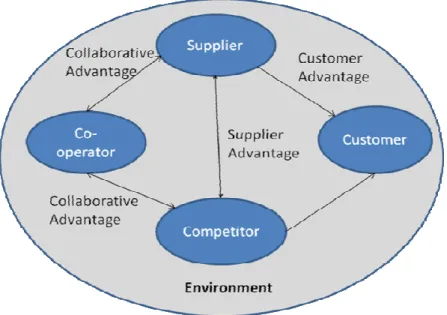
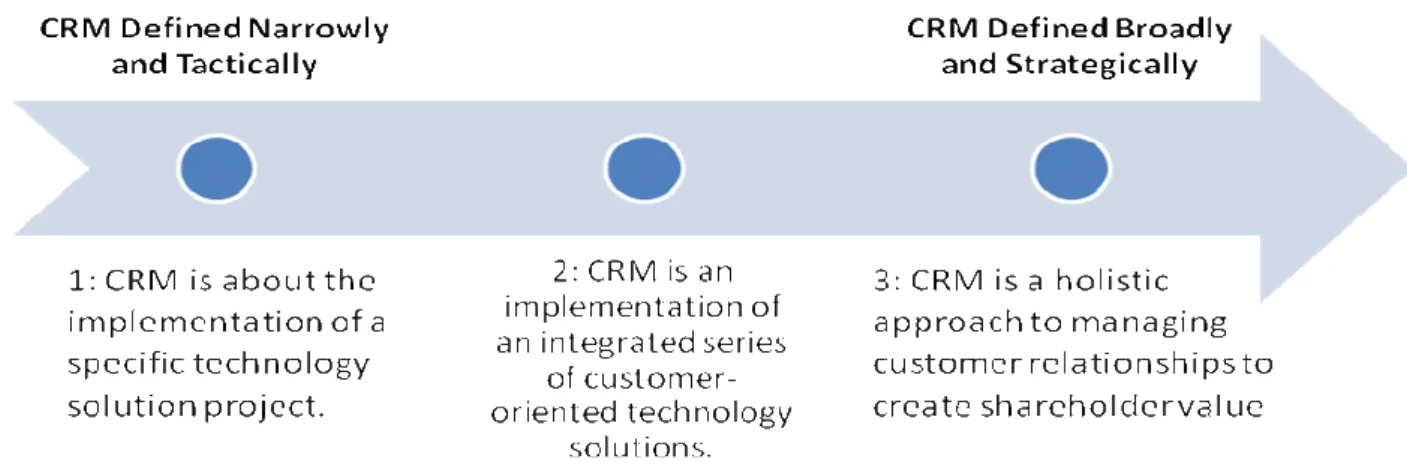
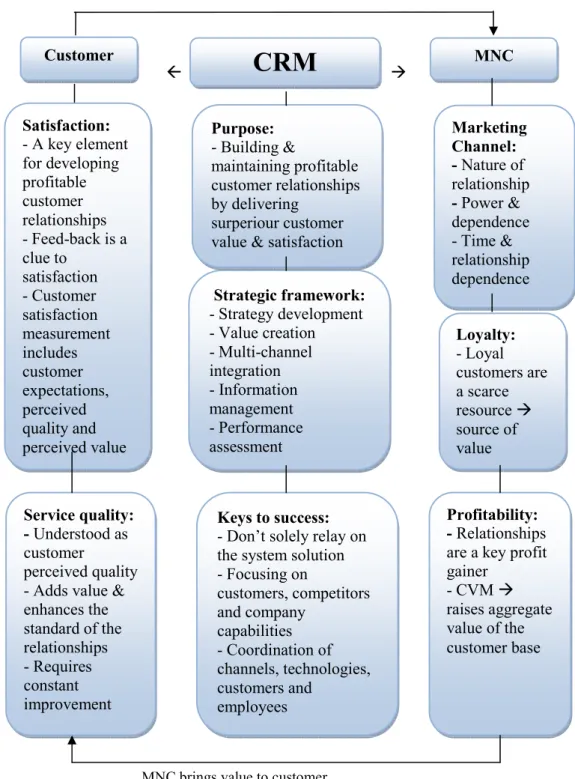
CRM Tool & Philosophy
– The Clue to a Customer-Centric
Organization
Author(s): Amanda LindströmKarina Polyakova
Growth through Innovation & International Marketing
Tutor: Hans Jansson
Subject: Business Administration Level and semester: Master's thesis, Spring 2010
This thesis is focused on studying Customer Relationship Management (CRM) tool and philosophy implementation and how it develops a customer-centric view within organizations. Nowadays mutually advantageous customer relationship is the main asset of the contemporary businesses and CRM is the clue to creating this type of relationship. The purpose of this research is to study successful businesses where CRM tool and philosophy were implemented and how they contributed to the management of the companies. Through this analysis the benefits of the tool can be identified and the road map for its integration can be performed.
Theoretical framework regarding marketing channel relationships, importance of dual customer value creation and customer value management, relationship marketing as the basis for CRM development, and strategic framework of the phenomenon have been considered. Besides that, the current position of the case company, Volvo Construction Equipment Region International, on the roadmap of the CRM implementation has been evaluated and analyzed. These steps have been taken in order to answer the main research question of the thesis, namely “How can an MNC become a more customer centric company by helping its dealers to implement a CRM system?
Several conditions have been identified in the thesis in order the companies could implement the CRM tool and philosophy successfully. The study provides recommendations, which guide the companies on the way to a customer-centric view through the integration of CRM in its business processes.
Key Words: Customer-Centricity, Channel Management, Customer Value, Customer Relationship Management, Relationship Dependency, Loyalty, Profitability, Segmentation, Roadmap, Implementation, Success Measurement
iii
We would like to thank everyone who contributed to this thesis and gave us an opportunity to get this valuable learning experience.
First of all, we are very thankful to Volvo Construction Equipment, Region International for providing us with a chance to write this thesis for their company. Special gratitude is expressed to Lars-Gunnar Larsson for assigning this interesting topic for the work and supporting us during the course of doing research and conducting interviews. Also, we would like to thank Mikael Thörngren for being always available and helpful during the study.
Furthermore, we express our appreciation to Volvo CE dealers, who participated in this research, for their involvement and interest in the topic, and for helping us with the study. Especially, we would like to thank Karen Costello, who provided us with very useful information for the research and supported us a lot.
We would like to express our special gratefulness to our supervisor Professor Hans Jansson for his trust to us and giving us an opportunity to work on this challenging task. His guidance, assistance, and feedback have been of great value throughout the entire writing process.
Finally, we are very thankful to our friends for their support and to our colleagues for their helpful feedback and discussions during the seminars.
……… ………..
List of Figures ... vi
List of Abbreviations ... vii
1. Introduction ... 2
1.1 Background ... 2
1.2 Case Company – Volvo Construction Equipment Region International ... 3
1.3 Research Problem ... 4 1.3.1 Research Background ... 4 1.3.2 Problem Definition ... 5 1.4 Purpose ... 7 1.5 Thesis Outline ... 8 2. Methodology ... 10 2.1 Scientific Approach ... 10 2.2 Research Strategy ... 11
2.3 Selection of Case Study ... 12
2.3.1 Convenience Sampling ... 13 2.3.2 Snowball Sampling ... 13 2.3.3 Unique Sampling ... 13 2.4 Data Collection ... 14 2.4.1 Primary Sources ... 14 2.4.2 Secondary Sources ... 16 2.5 Quality of Research ... 16 2.5.1 Internal Validity ... 17 2.5.2 External Validity ... 18 2.5.3 Reliability ... 19 3. Theoretical Framework ... 21 3.1 Marketing Channels ... 21
3.1.1 The nature of marketing channel relationships... 23
3.2 Customer value ... 26
3.2.1 Customers as an asset ... 28
3.2.2 Definition of Customer Value Management (CVM) ... 30
3.2.3 CVM cycle ... 30
3.2.4 Creating customer value through customer satisfaction and service quality... 32
3.3 Relationship Marketing ... 37
3.4 CRM ... 43
3.4.1 Strategic Framework for CRM ... 46
3.4.2 Potential Pitfalls and Unknowns in CRM Implementation ... 50
3.5 Summary ... 53
4. Empirical Study ... 56
4.1 Volvo CE Region International within Volvo Group ... 56
4.2 Project Implementation ... 57
4.2.1 Before Starting the Project ... 57
4.2.2 Organizational Readiness ... 58
4.2.3 Volvo CE’s Current Position on the Roadmap ... 60
v
4.2.7 Meeting the Challenges ... 69
4.2.8 Learning to Avoid Pitfalls ... 72
4.2.9 Benefits of Working with CRM ... 75
4.2.10 Measuring Success ... 77 4.3 Marketing Issues ... 79 4.3.1 Channel Relationships ... 79 4.3.2 Customer Relationships ... 79 4.3.3 CRM in Marketing ... 80 5. Analysis ... 84 5.1 Marketing Channels ... 84 5.2 Customer Value ... 86 5.2.1 Customer as an asset ... 86 5.2.2 CVM ... 87 5.3 CRM ... 89 5.3.1 Strategic Framework... 89
5.3.2 Pitfalls and Unknowns ... 94
6. Conclusion ... 98
6.1 Research sub-question 1 ... 98
6.2 Research sub-question 2 ... 100
6.3 Research sub-question 3 ... 102
6.4 Main research question ... 104
7. Recommendations ... 106
7.1 Develop Effective Channel Management ... 106
7.2 Identify Benefits and Costs to the Dealers ... 107
7.3 Develop a Proper Implementation Strategy ... 109
7.4 Develop a Success Measurement System ... 112
8. Areas for Further Research ... 115
8.1 Owned and Independent Dealership Management... 115
8.2 Success Measurement Systems ... 115
8.3 Benchmarking ... 115
8.4 CRM Solution for Diverse Markets ... 116
Bibliography ... 117 Appendix ... II
Appendix 1 – Questionnaire for Volvo CE Region International, Management ... II Appendix 2 - Questionnaire for Volvo CE Region International, Dealers ... III
List of Figures
Figure 1: Basic types of case study designs ... 12
Figure 2: Theoretical framework ... 21
Figure 3: A typology of vulnerability scenarios in marketing channels ... 25
Figure 4: CVM cycle ... 30
Figure 5: Integrating quality, customer service and marketing ... 37
Figure 6: Strategic triangle ... 40
Figure 7: Collaborative advantage ... 41
Figure 8: The CRM continuum ... 47
Figure 9: From customer acquisition to strategic CRM ... 49
Figure 10: Theoretical framework, developed ... 53
Figure 11: 360 degree view model ... 60
Figure 12: The evolution process of CRM ... 61
Figure 13: The CRM roadmap for Volvo TC ... 74
vii
B2B Business to Business BRIC Brazil, Russia, India, China
CRM Customer Relationship Management CVM Customer Value Management DMS Dealer Management System KPI Key Performance Indicator MIE Market-Intelligent Enterprise MNC Multinational Corporation LDS Local Dealer System LTV Lifetime Value
SFA Sales Force Automation
TOD Targets for Operational Development TQM Total Quality Management
Volvo CE Volvo Construction Equipment Volvo TC Volvo Truck Company
Introduction
This chapter introduces the case company followed by an overview of the case that has been studied. After that the main objectives are presented, as well as the introduction to the research topic. Next the research problems are covered and the purpose of the research stated.
2
1.1 Background
The current market situation demands a customer centric approach from the company. To increase the knowledge about the customers is important in order to build and establish favourable relationships. Good relationships with customers are the basis for successful partnerships. The increased possibilities to access information make it possible to target the customers in a more proactive and systematic way.
Due to the globalization and internationalization, international companies compete at an ever more aggressive way. The globalization has led to several opportunities and access to new buyers, but at the same time increased the number of competitors. Simultaneously the customer’s expectations have raised and they have become more demanding. In order to make it possible for companies to deliver what the customers expect, they need to know their needs and wants.
Experiencing current crisis situation a Multinational Corporation (MNC) is in a need to act proactively in order to improve its operations and to increase its competiveness. It is possible only if all company representatives, including dealers, change their vision and become more customer-centric. This new approach incorporates better population management by dealers in order to increase sales and achieve better service. It should be combined with a more planned and proactive sales process in order to create higher hit rate and spend less time. It can be accomplished by acquiring more knowledge about customers and spreading it to personnel at the dealerships and by minimizing administration via improved performance metrics in the sales process. The best solution for reaching these goals can be implementation of Customer Relationship Management (CRM) tool and philosophy. In this context, the term philosophy implies focusing all company’s business activities on creating mutually advantageous relationships with the customers as well as implementing a shared view on CRM throughout the entire organization.
CRM system has derived from the Contact Management in the 1980s. The main purpose of CRM is to improve the relationships between a company and a customer. The system is a part of a business strategy and it organizes the effective use of company’s recourses in the
strategy, the system serves for redesigning the business function, recombining the work flow, and upgrading the satisfaction degree to appeal to the customer, in order to gain profit.
The research will be done on a case study, where Volvo CE Region International is the case company. In the following section the case company will be represented.
1.2 Case Company – Volvo Construction Equipment Region International
Volvo Group is the world’s leading supplier of commercial transport solutions providing products such as trucks, buses, construction equipment, drive systems for marine and industrial applications as well as aircraft engine components. The Group offers financial services to its customers as well. The Volvo Group has about 100,000 employees, production facilities in 19 countries, and sales activities in 180 countries. Quality, safety and environmental care are the core values within Volvo Group and they are essential components of the corporate culture.
Volvo Construction Equipment (CE) is a part of Volvo Group. Volvo CE is the world’s largest manufacturer of articulated haulers and wheel loaders as well as one of the world’s largest manufacturers of excavation equipment, road development machines and compact construction equipment. The headquarter (HQ) of Volvo CE is located in Brussels, in Belgium. The main global competitors in the market are Caterpillar, Komatsu and Hitachi Construction Machinery.
There are four regional departments within Volvo CE, which are Region America, Region Asia, Region Europe and Region International. This thesis focuses on Region International, which consists of approximately 400 employees including the Volvo-owned dealerships. The HQ of Region International is located in Eskilstuna, in Sweden. The region is divided into sub-regions and represents approximately 100 markets in Latin America, Africa, Russia, Ukraine, Belarus, Middle East, Turkey, Central Asia and Oceania.
Volvo CE Region International reaches its customers worldwide through independent dealer partners in most of the markets. In Russia, Turkey and Morocco Volvo CE has owned
4
directly to customers (Volvo CE Region International, 2010a).
1.3 Research Problem
1.3.1 Research Background
In Region International Volvo CE is represented by 66 dealer partners, six dealer candidates, and Volvo owned dealers in Russia, Turkey and Morocco. The size of the dealer companies varies from five to several hundred employees. In these companies Volvo CE is usually the major part of business but not the total. Volvo CE has promoted dealer partnerships with active processes for sales and after-sales for some ten years.
However, the years 2003 to 2008 were characterized by 30 percent annual volume growth and lack of machine inventory. It means that the dealers were “order-takers”. Moreover, the dealer sales and after-sales organizations normally do not cooperate well. It results in incorrect forecasts from dealers even if it is two weeks before actual end customer order. And in general, customer and prospect knowledge is rather weak within the dealer companies.
To improve the situation described above, Volvo CE believes that implementation of CRM philosophy and tool will boost sales and increase customer satisfaction. The system is aimed to provide relevant and valuable information about the customers for the departments of marketing, sales, management, customer support, and logistics/finance. Further, the benefits the listed departments get from the CRM tool are identified.
Marketing:
• Possibility to make selections on the customer base for targeted offers and activities • Better follow-up of campaign results
• Know customers hobbies, favorite TV/Radio programs, newspapers
Sales:
• A complete picture of the customer covering both conducted and planned commercial activities as well as machine park, service-jobs and order status.
• CRM should indicate to after-market which customers that are “hot prospects”, in order to safeguard sales opportunities
Management:
• Consolidated customer overview • Planning and monitoring of activities • Improved reporting and analysis tools
Customer support:
• Consolidated customer overview: Volvo machine park is key • Planning and monitoring of activities
• Improved reporting and analysis tools
• Possibility to make selections on the customer base for targeted offers and activities what requires high information quality
Logistics/finance:
• Possibility to retrieve a sales forecast directly from CRM
• Reduce manual work by having CRM, generate more documents automatically and use CRM as a channel towards sales instead of e-mails
• Possibility for Finance to ‘black-list’ customers in CRM
1.3.2 Problem Definition
In this section the main research question and the research sub-questions, deriving from the main question, are represented. Since the MNCs have moved their focus from product to the customers, a customer-centric view is now a strong competitive advantage for every company. Being customer-centric means prioritize the customers and their needs in a company’s business strategy. CRM is customer-centric by its nature, therefore implementation of the CRM tool and philosophy within the company’s dealers will increase its competitiveness on the market. Therefore, the main research question is formulated as follows:
6
In order to answer the main research question three sub-questions have been identified. The first two sub-questions are based on the idea that the development of the customer-centric view within the company creates dual value both for the company and for its customers. The third sub-question regards the issue of motivating MNC’s dealers to implement CRM, since it is an expensive and time-consuming process.
The assumption is that while using CRM, dealers will be more aware of their customers what can help them to meet their needs and preferences. As a result perceived service quality can be improved and customer satisfaction can be increased. This is the value the customers get from the MNC.
This question helps to understand how the use of a CRM tool makes it easier for the MNC’s dealers to attain new customers, to retain existing customers and to enhance their loyalty what results in sales increase. This is the value the MNC gets from its customers.
Research sub-question 1
How can an MNC bring more value to its customers with the help of a CRM tool & philosophy?
Research sub-question 2
How can an implementation of a CRM tool & philosophy by the dealers deliver more customer value to an MNC?
Main research question
How can an MNC become a more customer centric company by helping its dealers to implement a CRM system?
Since an implementation of CRM is a complicated and time consuming task, an MNC needs to find strong motivators in order to convince its dealers to employ the tool and philosophy.
1.4 Purpose
Considering all the information above, the main purpose of this research can be identified as studying businesses where CRM tool and philosophy were implemented and how they contributed to the management of the companies. Through this analysis the benefits of the tool can be studied thoroughly and the road map for its integration can be identified. Collected information and its detailed analysis will help to create a framework for a CRM implementation in Volvo CE, Region International.
Research sub-question 3
8
1.5 Thesis Outline
6.
Conclusion • MNC brings value to customers• Customers deliver value
to MNC • MNC motivates its dealers • MNC becomes customer centric
5.
Analysis • Channel relationships • Customer value • CRM4.
Empirical study • Volvo CE Region International within Volvo Group • Project implementation • Marketing issues3.
Theoretical framework • Marketing channels • Customer value • Relationship marketing • CRM • Summary2.
Methodology • Scientific Approach • Reserach strategy • Data Collection • Quality of reserach• Selection of case study
1.
Introduction
• Background & case
company • Research questions • Purpose • Deliminations
7.
Recommendations • Develop effective channel management• Identify costs & benefits
• Implementation strategy
• Success Meaurement
8.
Areas for future research
• Owned & independent
dealership management • Success measurement systems • Benchmarking • CRM for diverse markets
Methodology
The purpose of this chapter is to present and justify the methods used in the research. First, the scientific approach is introduced, followed by the case study as a research study. Afterwards, data collection including primary and secondary sources is discussed. Also, the sampling types used in the research are presented. The methodology chapter will end with a discussion of quality of research.
10
2. Methodology
2.1 Scientific Approach
Three scientific approaches can be identified for conducting a research. They are exploratory, descriptive, and explanatory approaches. Since this study is focused on description, assessment and evaluation of an MNC’s use of CRM tool, as well as on future recommendations for implementation of the system, both descriptive and explanatory approaches can be applied for this research.
The purpose of the descriptive approach is applying existing theories and models for the description of the phenomenon, which has been explored previously. In this thesis the descriptive approach is used in the theoretical framework and empirical study. In both parts the existing theories has been tested on the case and the empirical finding are described.
The explanatory approach is used for testing cause-and-effect relationships. It helps to understand how the factors are interrelated and what influence they have on each other. In order to relate empirical finding to the studied theories and to explain this relationship, the explanatory approach is used in the final part of the thesis where conclusions and recommendations are presented (Scholz & Tietje, 2002).
While doing research, different methods of scientific reasoning can be used. According to Yin (2009) scientific reasoning can be inductive, deductive, and abductive. In this study an abductive research approach has been chosen. Dubois & Gadde (2002) describe the abductive research approach as systematic combining, which is characterized by continuous movement between the theoretical framework and the empirical findings. Using the inductive reasoning a researcher collects information and based on it develops a new theory, whereas deductive reasoning means testing already existing theories. The deductive method is used to explain specific case based on the theory, and inductive method is used mainly for the findings and analysis. Moreover, the authors outline that continuous movement between the theoretical framework and the empirical study is suitable when accomplishing case studies since it contributes to deeper understanding and insights of theory as well as an empirical phenomenon that can be gained by case studies. An abductive approach is useful if the researcher’s purpose is to find out new things, variables and relationships. At the same
time, the abductive research method gives a possibility to adopt existing theories and to generate appropriate models for solving the problem being studied in the thesis.
Furthermore, the researchers distinguish between quantitative and qualitative research methods. According to Merriam (1998) the way the data is collected and analyzed is influenced by the chosen method. In case a researcher tries to predict and control events based on some pattern, the quantitative method should be used. If the purpose of the study is to get into the insight of the problem and to find the solutions, then the qualitative method is more appropriate. In order to conduct quantitative research surveys and systematic reviews are used, while for qualitative research observations and in-depth interviews are the main tools.
Since the objective of the thesis is to understand the problem and develop a theory, the qualitative method is preferred. The method helps to understand how various factors within the study are interrelated. It also helps to combine subjective and objective information, which is necessary in assessing and evaluating the problem solution. The data collected in the course of the case study cannot be quantified and statistically analyzed, what is another reason for the chosen method.
2.2 Research Strategy
Yin (2003) describes several ways of doing a social science research and one of these is the case study. Experiments, surveys, histories and an archival analysis are other ways of doing a social science research. A case study is a way to explore an empirical subject by following a set of pre-specified activities and procedures. Generally, case study is the favored strategy when “how” or “why” questions are applied. Moreover, the case study is appropriate when the purpose is to understand a complex contemporary phenomenon that cannot be controlled. The case study method permits researchers to maintain the holistic and meaningful characteristics of real-life events.
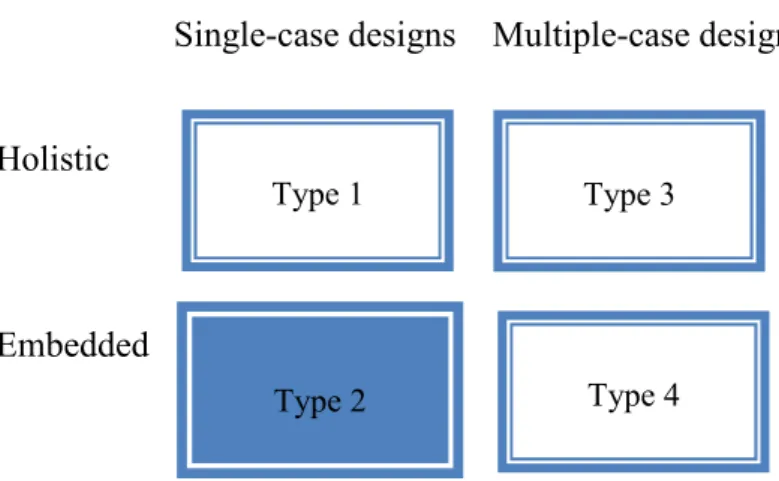
The case study can be divided into four basic types of design. Yin (2003) makes a distinction between single-case and multiple-case designs. A single case study is related to a single experiment, which means that this approach is suitable when studying only one case.
12
The focus of this thesis is put only on one specific company, Volvo CE Region International. Consequently, a single case design has been applied. Furthermore, the case study can be divided into embedded and holistic. In an embedded case study analysis is either concerned with more than one unit or provided with different perspective of the investigation. The holistic case study has only one unit of analysis for each case. This research has been defined as an embedded case study since the study will be analyzing multiple sampling units (Yin, 2003). Subsequently, this study has been categorized as a single case embedded design.
Single-case designs Multiple-case design
Holistic
Embedded
Figure 1: Basic types of case study designs, Yin (2003)
2.3 Selection of Case Study
Merriam (1998, p. 60) describes that within every study the researcher needs “to consider where to observe, when to observe, whom to observe and what to observe. In short, sampling in field research involves the selection of a research site, time, people and events”. The most suitable sampling strategy is non-probabilistic and the most frequent used form is purposive or purposeful sampling. The objective of purposeful sampling is the investigator’s interest in discovering, understanding, and gaining insight into the subject, and therefore it is necessary to choose a sample form which as much as possible can be learned. Merriam (1998) presents different data sampling types within the purposeful sampling. The most commonly used types are typical, unique, maximum variation, convenience, snowball, chain and network sampling.
Type 2 Type 1
Type 4 Type 3
2.3.1 Convenience Sampling
This is the most common sampling method and the reason for it is its convenience. The data is collected from the population representatives who are conveniently available. The selection is usually based on time, money, location, and availability (Merriam, 1998). The main disadvantage of this method is lack of credibility, as the sample obtained might be not representative. Yet this method was selected for the research due to time constraints and fund limits. The first interviews conducted at Volvo CE involve internal contact persons as reaching them is the most convenient and essential to establish contacts with them. Convenience sampling is also used to gain access to dealers, as contacts are provided by the company representatives. In order to increase credibility of the study other sampling methods are also employed.
2.3.2 Snowball Sampling
According to Merriam (1998) snowball sampling involves asking each contributor to refer to other contributor that might have knowledge about the research topic and be helpful for the study. Such chain referral process allows reaching populations which are difficult to get access to while using other methods. The process is rather simple and cost-efficient. In comparison to other sampling techniques snowballing requires little planning. Among the disadvantages of this method the following can be listed: little control over the sampling method, representativeness of the sample is not guaranteed, and there is sampling bias as the obtained sample might be only a subgroup of the entire population. In spite of these drawbacks this method is chosen for the purpose to reach more persons and gain more valuable information from them.
2.3.3 Unique Sampling
Unique sampling is based on unique rare attributes or occurrences of the phenomenon of interest (Merriam, 1998). As far as the studied phenomenon (CRM) is implemented only by two owned dealers of Volvo CE in Region International, these dealers are the unique sample. Only they posses useful information about the tool and its implementation and can provide unique facts about it.
14
2.4 Data Collection
In order to understand the studied case more deeply, it is advised to use several sources of data collection. Yin (2003) argues that six sources of evidence can be used for a proper case study. These sources are: documentation, archival records, interviews, direct observations, participant observations, and physical aircrafts. The use of the multiple sources of evidence allows a researcher to cover a wider range of historical, attitudinal, and behavioral issues. This thesis is based on documentation and interviews as the main sources of evidence. Documentation is valid for its stability, unobtrusiveness, exact data, and broad coverage. The main weakness of this data source is its accessibility. Interviews are also widely used in case studies, as they give an opportunity to focus on the case study topic directly and provide insightful information on sensitive topics. However, the data collected via interviews might be biased due to poorly constructed questions or poor/incorrect recall of information. Besides, direct informal observation is relied on in order to provide additional information about the topic being studied. This method is widely used in studying new technologies in order to understand the actual use of the technology and the potential problems. The use of various data sources creates data triangulation and gives an opportunity to come up with more convincing and accurate findings and conclusions in a case study. In order to increase the validity of the study both primary and secondary sources are used. These sources of data are described below.
2.4.1 Primary Sources
Primary data is information collected directly from first-hand experience. This information is unique to the particular researcher and case study and is unavailable to others before it is published. Primary data is collected through interviews and observations (Merriam, 1998). According to Yin (2003) interviews are the most important sources of case study information. They can provide exact answers to the research questions. In case studies interviews most commonly have open-ended nature. This type of interviews gives an opportunity to ask key respondents about the facts and opinions about certain subjects. The respondents can provide insights into some events and give propositions for further inquiries. As far as most of the case studies are about human affairs, interviews become essential sources of case study evidence. However, being verbal reports only, interviews might be a concern for the problems of bias, poor recall, and poor or inaccurate articulation.
In this thesis the primary data is collected through interviews with employees and management at Volvo CE Region International and representatives from Volvo CE international dealers. The interviews are semi-structured and open-ended in nature. The semi-structured interviews are the most suitable for collecting general information and enhancing the understanding of the general case. The qualitative approach gives the respondents an opportunity to elaborate on the questions and receive information about other possible interviewees. Open interviews have its purpose to increase the understanding of the specific process in the case company. These interviews are unstructured and intend to guide an interviewee by the topic but not to ask specific questions (Merriam, 1998).
In this thesis both personal interviews and phone interviews have been conducted. Phone interviews save time as well as financial resources. However, due to inability to see the respondent, information provided during the interview might be rather biased. Since the respondent is not visible, a phone call is more abstract than a talk between four eyes and the body language is missed out (Jacobsen, 1993).
In a course of research, eleven interviews have been carried out. Among the interviewees there were both owned and independent dealers. Besides, Volvo CE management was interviewed, as well as consultants working for Volvo Group and independently shared their knowledge. Phone interviews have been conducted with Volvo CE’s independent dealer in Chile as well as owned dealers in Russia and Turkey. In Chile, Nelson Venegas (Commercial Manager), Jorge Rios (Marketing Manager) and Rodrigo Galleguillos (Salesman) contributed to the research. During the interview with Chile, Rodrigo Konda (Global Key Accounts in Latin America), assisted as a translator. In Russia, Andrei Beskibalov (Functional CRM Manager & External consultant) shared his experience and knowledge in working with the system. For the Turkish market, Ebru Celkan (CRM Manager) and Tolga Polat (Customer Support Area Manager) together with Eda Ertur (Customer Support Administrator) in a joint interview, contributed to the study. Personal interviews have been held with Karen Costello (Sales & Software Manager, Volvo IT) and Michael Thörngren (IS/IT Program Manager, Volvo CE Region International). The questionnaire has been answered via e-mail as well, by Jarmo Söderlund (representing Volvo CE’s independent dealer in Finland) as well as by Lars-Gunnar Larsson (Vice President Business & Quality Development, Volvo CE Region International).
16
In addition to the interviews a direct observation of a CRM conference held by Karen Costello has been attended as well as an online meeting with the Target for Operational Development (TOD) leaders representing owned dealers in Turkey and Russia, and independent dealers in Latin America. Moreover, participation in a webinar with Lineservice’s consultant Alexandr Timofeev in Russia has also been attended. This observations and studies provide general background knowledge for the research. In order to increase the reliability of observational evidence multiple observers make an observation (Merriam, 1998).
2.4.2 Secondary Sources
Secondary data is information collected previously for other purposes and is not case-specific. However, it can be relevant to the studied problem. It is useful for gaining general knowledge on the subject. Secondary data is less expensive and less time-consuming to gather than primary data. It can be found in journals, magazines, books, documentation, and on the Internet. Secondary data is divided into internal and external data. The internal information is found within the case-company and includes administrative reports, proposals, annual reports, and some other documents published within the company. The external data is collected from various media sources and not necessarily relates to the case-company or to the case being studied. In this study both internal and external sources of data are used. Internal data is the basis for understanding the problem and evaluating how deep the subject has been already studied. External sources are especially used in the theoretical framework in order to gain information on specific topics, which is impossible to get from internal sources. The use of secondary data is expected to raise the validity of the thesis, which is discussed later on (Merriam, 1998).
2.5 Quality of Research
Qualitative research is often criticized for the lack of validity and reliability, which are cornerstones of any research. This criticism derives from the relative freedom and lack of structure and rigor characteristics of the qualitative research methods (Ruyter & Scholl, 1998). In order to ensure the validity and reliability in the qualitative research it is vital to conduct the investigation in an ethical manner. According to Merriam (1998) validity and
reliability can be accomplished through careful attention to a study’s conceptualization and the way in which the data were collected, analyzed, and interpreted as well as the way in which the findings are presented. Yin (1990) suggests evaluating three criteria: internal validity, external validity, and reliability.
2.5.1 Internal Validity
In a quantitative sense validity is referred to as the correctness of the research constructs integrated in the project. Qualitative research, in contrast, cares about the issue how to collect information in a way that optimal “operationalization” is achieved at a later stage in the study. In-depth insight of the qualitative research gives an opportunity to achieve accurate use of the research constructs. Thus, the validity of qualitative research is primarily concerned with the fact that constructs are strongly supported within the real-life context. The significance of the results is related to the respondents’ everyday reality (Ruyter & Scholl, 1998).
According to Merriam (2009) internal validity handles the question of how research findings manage to match the reality. Furthermore, in every research internal validity depends on the meaning of reality. Covering an objective “truth” or “reality” is not possible for the qualitative researchers, although in order to increase the internal validity the author states six basic strategies: prolonged engagement, triangulation, peer examination, member checks, negative case analysis and audit trail. In this study triangulation, member checks and peer examination have been applied to shore up the internal validity.
Triangulation characterizes the usage of various investigators, sources or methods to validate the findings. Merriam (2009) refers to four types of triangulation: the use of multiple methods, multiple sources of data, multiple investigators, or multiple theories to confirm emerging findings. In this thesis mainly multiple methods of data collection and multiple sources of data will be used in order to provide consistent data that match the reality as understood by the respondents. When findings from an interview can be checked against observations and documents, the triangulation has been employed by various methods of data collection. Triangulation assumes using multiple sources of data in order to compare and double-check data that has been collected during observations at different times or in
18
different places, or from the interviews with people who have different perspectives, or from follow-up interviews with the same people.
Member checks is another strategy that has been used after conducting the interviews in order to assure that everything from the respondent has been understood correctly. Member checks is a procedure when data and interpretations are sent back to the original person in order to see whether the results are reasonable. The participants should be familiar with the interpretations or suggest how to better capture their viewpoints. Peer examination has also been employed in this process to a certain extent, since master thesis students during seminars have commented on similar problems and solutions they have recognized. The validity of the thesis has been improved by utilizing triangulation, peer examination, and member checks (Merriam, 2009).
2.5.2 External Validity
According to Merriam (1998) external validity concerns whether the findings of a study can be applied to other situations and how generalizable the results are. In order to enhance external validity three different strategies can be applied. These are rich, thick description, typically or modal category and multisite designs. Within the first strategy, rich thick description, the purpose is to provide enough description so that readers will be able to decide how equivalent their situations is in comparison to the research situation and thus whether findings can be transferred. Regarding the typically or modal category, the main idea is to describe how typical the issue is so that receivers can make comparisons related to their own situations. By using a multisite design, numerous sources that maximize variety has been applied in order to increase the usage of the results to a wider range of readers.
Regarding this study, time constraints and sample size can create concerns on the external validity of the research. However, it can be argued that industrial equipment companies operate in more or less the same way. Therefore, the results gained from the study of Volvo CE, as a case company, can be valid for the other companies in the same industry as well.
2.5.3 Reliability
According to Merriam (1998) reliability concerns to what extent the findings and conclusions can be replicated. Furthermore, it is the consistency between the data collected and the result found that makes a study reliable. Reliability is based on the presumption that there is one particular reality and by studying it frequently the same results will be found.
The reliability of qualitative research, in terms of comparability of reproducibility, is often put under discussion because of the systematic approach, which reduces reliability of qualitative research. However, it can be argued that this type of approach is needed in order to get a closer in-sight on the points of research interest. A systematic operation can be achieved by linking research results to theoretical models and concepts. Besides, the reliability of qualitative data can be based on accurate description of the steps taken in the collection and analysis of data, so that other researchers could trace back the original research design (Ruyter & Scholl, 1998).
In order to ensure reliability of the performed study, the information gained in the course of research has been supported by supplementary data and checked with the respondents. All the interviews have been conducted by two interviewers and recorded to guarantee that the interviewees’ answers are interpreted in a right way and are understood correctly. Moreover, the interviews have been held with the respondents taking the same level positions, to guarantee that they have similar understanding of the problem and experience of dealing with it. Consultations with the experienced field personnel proved the appropriateness of the gathered information. For the reason of avoiding errors and reducing bias, each step of the research has been documented and described in detail. Besides, theoretical framework has been a basis for the research questions and collection of valuable information.
Theoretical
Framework
This chapter covers the main theories involved in the research. First, the nature of relationships in marketing channels is described; second, the issues regarding creation and delivery of customer value are introduced. Relationship marketing is the next topic for discussion. Finally, the CRM tool and philosophy are overviewed.
3. Theoretical Framework
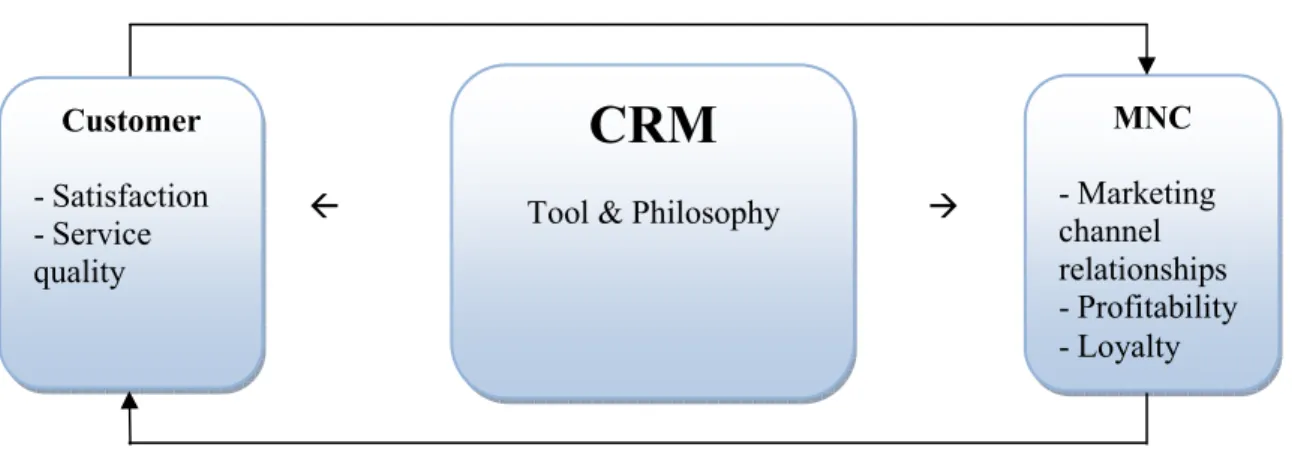
The model below represents discussed topics and connects them to each other.
ß à
Figure 2: Theoretical Framework (Lindström & Polyakova, 2010)
3.1 Marketing Channels
Marketing channels are the routes to markets, which are used in order to sell product and service to consumers and business buyers everywhere in the world. Coughlan et al. (2006, p. 2) give the following definition of a marketing channel:
“A marketing channel is a set of interdependent organizations involved in the process of making a product or service available for use or consumption”.
This definition has some explications. First, it points out that a marketing channel is a set of interdependent organizations. It is not only one firm but rather several entities involved in the business. Each channel member depends on the other to perform their jobs. Also, the definition states that running a business channel is a process, but not an event; distribution takes time and when the sale is already made the relationships with the buyer are not ended. Finally, the purpose of the marketing channel is to satisfy the end-users, no matter if they are consumers or business buyers. A manufacture who sells through distributors, retailers, or wholesalers, who in turn sell to customers, is tempted to think that it generated sales and satisfied customers. However, the definition argues otherwise. It is crucial that all channel
CRM
Tool & Philosophy Customer - Satisfaction - Service quality MNC - Marketing channel relationships - Profitability - Loyalty Customer Value Customer Value22
members focus their attention on end-users. The marketing channel is often viewed as a key strategic asset of a manufacturer (Coughlan et al., 2006).
Suppliers, producers and final customer of industrial products are linked together through channels. Channel participants serve a key role in order to achieve efficient and timely movement of goods, services as well as market intelligence. A strong channel network requires many years of constant attention to develop and maintain. However, it usually serves as an effective market barrier to competitors. Channel participants give important market information, negotiating, product availability as well as after-sales support for the buyer (Mahin, 1991).
Coughlan et al. (2006) argue that work of the channel includes the performance of several marketing flows. It means that all processes done by different channel members at different time points flow through the channel rather than are performed. Some of the flows may move forward through the channel (physical possession, ownership, and promotion), while other move up the channel from the end-user (ordering and payment). Such flows as negotiation, financing, and risking can move in either direction or be engaged in by pairs. The value-added activity of the channel is the flow of information. Information flows between every possible pair of channel members in both directions.
Several remarks can be mentioned at this point. First, the flows may be managed in different ways for different parts of company’s business. For example, spare-part distribution is usually handled by a third-party distributor who is not involved in the distribution of original products. In this situation, the channel manager may prefer to represent original equipment and spare parts separately because they are part of important but different flows in moving product to the market. Second, not every channel member needs to participate in every flow. Efficiently operating channel focuses on the specialization in the performance of channel flows. However, specialization increases interdependencies in channels, and therefore requires close cooperation and coordination in channel operations. And third, a manufacturer must either take responsibility for all channel flows itself or shift it to various intermediaries in the channel. This leads to the important issue of channel design and management: members in the channel management can be eliminated or substituted, but the flows performed by these members cannot be eliminated (Coughlan et al., 2006).
Due to intense competition, slower growth and expanding price pressure in the markets, the nature of relationships between manufactures and distributors is changing. With the increase of non-price competition traditional marketing channel tools (guarantees of availability, credit terms or sales promotions) are becoming less effective. In the manufacture-distributor dyad service quality becomes the main success factor. Providing quality service has become a clue to establishing and facilitating communication, conflict-solving and commitment, which is the key to strong channel relationships. Channel service quality is a power base for the behaviors of channel partners. Especially it concerns international channels because of high financial risks on behalf of manufacturers due to long shipment distances, diversity in channel levels, and time zones. Besides, in international channel environment manufacturers have less control over service levels (Ruyter et al., 1996).
Industrial goods and services can reach the market through four different channel alternatives. The first one is via a direct channel, the second is through an indirect channel, the third alternative is a captive channel and the forth option is a combination channel. In the direct channel it is the manufacturer’s sales force that has the responsibility for completing all channel work without any help from independent intermediaries. An indirect channel, on the other hand, indicates that a manufacture employs independent intermediaries to unite the buyer and the seller. In a captive channel, the manufacture manages its own network of distribution outlets. A combination channel means that a combination of different channels is used. The selection of channels is based on an evaluation of many factors such as customer size, order size, product complexity, and purchasing frequency or situation (Mahin, 1991).
3.1.1 The nature of marketing channel relationships
There are several theoretical perspectives for understanding marketing channel phenomena. Ruyter et al. (1996) focus on political economy paradigm and the relationship marketing paradigm. These approaches involve such issues as long-term manufacture-distributor relationships and the power-dependence balance. High degree of partnerships involves interdependence, which is not evenly balanced. The concepts of power and dependency are essential for channel relationships. In order to create dependence in marketing channels different types of power base are used. The distinction is made between coercive (rewards
24
bases. Coercive power base is grounded on the idea that a manufacturer can provide rewards to distributors, or is able to correct if distributors fail to meet the demands. It is aimed at influencing actual behavior. Whereas non-coercive power base is founded on the belief that supplier has special knowledge and conditions to propose that are not accessible from other manufacturers.
Another research is focused on two distinct approaches that influence channel relationships. These approaches are behavior and economic. From the behavior point of view the relationships between manufacturers and dealers are a political struggle in which power and dependence of each party control the behavior of others. While economic approach views relationships as a search to allocate distribution responsibilities and role performance tasks in a way when costs are minimized and profits are maximized. A common base for both approaches is that relationships are created and maintained as a result of interdependence between channel members. Thus little is known about the influence of economic and behavioral interactions on channel relationships. Economic struggles can impact the way products and services are valued, and dependency of parties influences channel relationships. For example, if a manufacturer is not able to fill orders accurately, meet promised delivery dates or stick to shipping instructions, then he has little influence on dealer decisions. On the other hand, if a vendor provides steady order cycle and meets delivery dates, dealers are able to minimize stock outs and customer dissatisfaction. It can be encouraging for dealers to surrender a portion of their autonomy to the manufacturer in exchange for quality logistics. In order to understand the interdependence between parties the author suggests analyzing economic and behavioral factors simultaneously (Gassenheimer, 1996).
Young & Wilkinson (1989) focused their study on the role of trust and co-operation in marketing channels. They came to the conclusion that in dealer-manufacturer interactions trust is based on overall relationships rather than on particular episodes. The base for these relationships is satisfactory performance over time. Also, trust is developed in situations where it has an opportunity to emerge naturally, not regulated by contracts or written rules. However, trust is not inevitable in trading relationships and it is not the basis for operation. Co-operation always presents in ongoing relations and it is often perceived as co-ordination of actions by the parties involved.
Svensson (2002) states that in marketing channel the relationships are very vulnerable due to time and relationship dependencies. Time-dependence is explained by chronological or sequential dependence between companies’ business activities in marketing channels. Relationship dependence refers to the communication factors influencing interaction process between companies in marketing channels. Considering both components the author gives the following definition of vulnerability construct in marketing channels:
“Vulnerability is a condition that is CAUSED by time-and relationship-dependencies in a company's business activities in marketing channels. The degree of vulnerability may be interpreted as proportional to the degree of time-and relationship-dependencies, and the negative consequence of these dependencies, into a company's business activities towards suppliers and customers” (Svensson 2002, p. 323).
Based on the inductive approach Svensson (2002) proposes a typology of vulnerability scenarios, which is represented by the following figure:
Figure 3: A typology of vulnerability scenarios in marketing channels, Svensson (2002)
Since vulnerability is caused by the dependence between companies’ business activities, time- and relationship-dependencies are necessary foundations of vulnerability in a marketing channel context. The time-dependence dimension consists of temporary and permanent dependencies. Temporary dependencies are short-term and permanent dependencies are long-term. Relationship dependencies are represented by unilateral and the bilateral components. Unilateral dependency is interpreted by the fact that only one of the companies in a business relationship depends on the other, whereas bilateral dependency is represented by mutual dependence.
26
The underlying dimensions create a matrix of four cells with a vulnerability scenario in each cell. Each of the scenarios has unique characteristics. For example, the elastic vulnerability scenario assumes that a company depends on temporary and unilateral factors in the interface with its customers or sub-contractors. It means that a company has to cope with a high dependence level and short-term dependence in the upstream activities. This scenario is probable for duopolistic or oligopolistic marketplace. Non-elastic scenario is characterized by permanent and bilateral dependencies, what means that a company is involved in low dependence level and a long-term dependence. And it also might occur in duopolistic or oligopolistic environment. A more or less monopolistic market can cause the static vulnerability scenario (permanent and unilateral dependencies), when a company is exposed to high dependence level and long-term dependence. It is more likely to appear in a situation when a company’s dependence on its sub-contractors is high and it has few replaceable or alternative sub-contractors available, therefore its flexibility is restricted. It also can be characterized by the lack of entrepreneurial inertia and limited company’s power in terms of negotiation. For a competitive marketplace the dynamic vulnerability scenario is the most common. In this case companies have to manage both low dependence level and short-term dependence; therefore they are characterized by temporary and bilateral factors. Due to temporary and mutual dependence this scenario type is the most favorable from the buyer’s perspective. The mutual dependence creates an increased interest between the companies. Additionally, a company can choose new sub-contractors and replace them more easily.
Ideally, companies should maintain dynamic vulnerability scenario in the interface with their customers, while in the interface with their sub-contractors static scenario would be the most preferable. As a result, the four types of vulnerability scenarios are double-edged because companies need to strive for engaging in different forms of dependence with its customers and sub-contractors. For this reason, the scenario type should be judged either from buyers’ or suppliers’ perspective (Svensson, 2002).
3.2 Customer value
The process of understanding, creating and delivering value to targeted business markets and customers is called business market management. Business markets are characterized by firms, institutions, or governments that obtain goods and services for their own use or for
resale beside other products and services to other firms, institutions, or government. Value is a cornerstone in business market management. Value is the worth in monetary terms of all the market offerings that a customer firm receives. To be able to create and deliver customer value and to know where resources and capabilities have the greatest potential, it is important to have a complete understanding of customer requirements, preferences, and purchasing processes (Anderson & Narus, 2004). Christopher et al. (2002, p. 20) define customer value as “the ratio of perceived benefits to the perceived sacrifice that is involved”. Relationships are built on a sustained basis, which involves creation and delivery of superior customer value. The value-creation process consists of three key elements; the value the costumer receives, the value organization receives and maximizing the lifetime value of desirable customer segments.
The most important part of value creation is careful market segmentation since it allows tailoring the offer to the needs of specific segments. As already mentioned, customer segmentation is important when targeting relevant offers and value propositions to specific groups. However, it is also critical to be aware of the existing profitability of customer segments and understand the potential profitability of those segments in order to improve customer lifetime value (Christopher et al., 2002).
The market-intelligent enterprise (MIE) has to ask two questions: what does my customer value and what is the value of my customer? This information is needed for strategically use of customers (and prospects) and segmentation of them, or, using a metaphor, finding the right dance music for each partner. The necessary data flows into organization from various sources both within and outside the organization. These sources are customer information from transactions (purchase frequency or credit information), the sales force (competitive information, corporate challenge, and philosophy), call centers, sales promotions, survey data and the Internet. The organization performs statistical analysis of a customer’s industry value, company share, affinity, and lifetime value. Based on the results the company refines products and services according to the needs of the most profitable segments and develops strategies for acquiring new customers and building customer loyalty. The MIE uses data to determine customers’ long-term profitability. An organization takes a long-term view of customers projecting current spending over the life of the relationship with the customer. In this way consumers’ spending and loyalty can be maximized (Brown, 2000).
28
Nowadays, marketing strategies in successful companies are characterized by clearly defined and strongly communicated value proposition. The content of a value proposition is a summary of all the arguments why a customer should buy the company’s product or service. Christopher et al. (2002) refers to a developed framework called value delivery sequence. The foundation of the value delivery sequence is the idea that customers buy promises of satisfaction and they only purchase products because they are of some value to them. Additionally, the value delivery sequence represents the business from the customer’s point of view rather than as a range of internally-oriented functions. The process is characterized by three key steps which are; choose the value, provide the value and communicate the value. At the initial stage, choose the value, companies have to understand changing customer needs and how well the competition meet those needs. The second stage involves the development of a product/service package that creates clear and superior value. The last stage, communicate the value, concerns different aspects of promotional activity that is necessary in order to persuade customers that the offered values are better than the competitors.
3.2.1 Customers as an asset
Many companies lose focus on customer retention and maintaining relationships and concentrate on acquiring new customers. Although new customers keep the numbers up, economic potential is weak, since the growth within the existing customer base is limited. Brown (2000) explains that keeping existing customers is more profitable than attracting new ones because during the normal development of a customer relationship, the cost to market and sell to these customers’ declines, and the potential for gross margin improvement increases. The loyal customers usually focus not on the price alone but see the relationships with a company as “value for money” and act as advocates for the company helping to attract new customers.
According to Christopher et al. (2002) it has been recognized that existing customers are easier to sell to and are frequently more profitable. At the same time, it is critical to take existing customers for granted and instead focusing on attracting new customers. Generally, companies spend too much resources on obtaining customers and too little on keeping them. In order to maintain the relationships it is important to apply different strategies to new and existing customers. It is also of great importance to highlight the great impact the customer
retention has on the profitability. The research showed that it costs about five times more to win a new customer instead of keeping the existing one. Many companies seem to understand the importance of customer retention, although just a small number measure the economic value of their customer retention strategies. A vital component of relationship marketing is giving value to customers and at the same time getting value from them.
Recognition and focus on lifetime value have a positive impact on customer retention and, as a result, reduces acquisition cost. Retention rate is used to measure customer turnover and is significant for the creation of value. Research has shown that increase in retention rate from 80 to 90 percent doubles customer lifetime from five to ten years. Longevity creates value (Brown, 2000).
According to Pease (2001) recently business managers have recognized that products, marketing campaigns and even sales channels are short-lived and therefore move their focus on customer relationships as a key profit gainer. It was proved that a five percent increase in customer retention results in a 25-95 percent increase in company profits. There are many reasons for such boost. Loyal customers are a scarce resource; however they are a source of value. In order to acquire this asset, companies have to set maximizing customer value as a measured and clear goal. Through a transition from product- or campaign-centric to customer-centric marketing the emphasis on prolonging the lifetime value of the customer base has increased.
Evans (2002) argues that there are two complementary approaches to exploiting customer value. The first approach measures how much value a customer or a group of customers bring to an organization. This information can be used, for example, in targeted marketing campaigns. Identifying high and low-value customers, companies can work on increasing high-value customers’ loyalty by making them special offers, and also marketers can put an effort into promoting low-value customers to high-value customers level. The second approach identifies value perceived by customers of company’s goods or services. If this value is higher than the perceived value that competitors offer, then a firm has a chance to succeed on the market. However, if customers do value competitor’s offering more, a company has to work on its competitiveness. These approaches ensure that both sides of a business relationship gain added value.
30
3.2.2 Definition of Customer Value Management (CVM)
Pease (2001, p.1) defines customer value management (CVM) as “managing each customer relationship with the goal of achieving maximum lifetime profit from the entire customer base”. CVM gives companies an opportunity to gain benefits from the economics of loyalty by escalating retention, decreasing risk, and amortizing acquisition costs over a long period of time. Even though the purpose of CVM is to raise the aggregate value of the customer base, this can be achieved customer by customer. Of course, not every customer is profitable, however each must be managed to increase profit in general. In this case management can be focused on identifying which customers bring the least profit, and working on development and retention of other customers. CVM focuses not on managing marketing campaigns but on managing profitability of each individual customer during the whole period of the relationship. In order to make this shift companies need to develop analytical and operational capabilities. If they manage this transformation, it is reasonable to expect increased profits for years to come.
3.2.3 CVM cycle
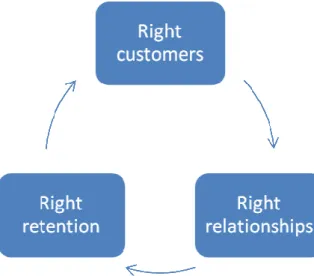
Pease (2001) argues that CVM is cyclical and this cycle consists of three stages: right customers (acquisition), right relationships (development), and right retention (keeping valuable customers). Each of these stages naturally feeds the next to maximize customer value.
Right customers
The CVM cycle starts with acquiring the most valuable customers for the business. These are customers who potentially will return to the company over a long time. The acquisition costs must be paid back, and it is proved that the break-even period is a year or more. Companies cannot aimlessly acquire customers without exploring their long-term value. Customers do not have equal value to the company, and those who are profitable for one company might be unprofitable for the competitors of this company.
The acquisition of new customers involves high costs, therefore effective CVM requires analytical capabilities to identify loyal and profitable customers for one specific company. A deep analysis of the existing customer base is the best source of intelligence. Such analysis should reveal invisible characteristics and trends influencing the value. Some customers might be treated as low-value customers because they make only small purchases, however the analysis of purchase frequency may show that these customers have made small purchases every week during ten years and their value for the company is much higher that it was expected. Thorough analysis helps to understand who are the best customers and why and to identify potential profitable customers. Examining the time and channels of joining the company by the customers can be beneficial as well. It helps to define which acquisition strategies should be repeated and which result in money loss (Pease, 2001).
Right relationships
Even with the best selected customers, managers need to develop relationships that bring value. For any business, right relationship is the one that maximizes customer’s lifetime value. Pease (2001) offers a simplified view of customer lifetime value:
Lifetime Value (LTV) = purchase size x frequency x duration
This equation shows that the goal of CVM is to increase the size and frequency of purchases and extend the time during which the purchases are made. As far as the duration of relationships cannot be measured until it is over, loyalty measures can help to predict the longevity of the relationships. Customers tend to engage in long-term relationships with the companies that manage to satisfy their needs and to respond in a right way if the needs change.