CANCER SCREENING BENEFITS AND HARMS: NEWS COVERAGE AND PROVIDER PERCEPTIONS
Emily A. Elstad
A dissertation submitted to the faculty of the University of North Carolina at Chapel Hill in partial fulfillment of the requirements for the degree of Doctor of Philosophy in the
Department of Health Behavior.
Chapel Hill 2014
ABSTRACT
Emily A. Elstad: Cancer Screening Benefits and Harms: News Coverage and Provider Perceptions
(Under the direction of Noel T. Brewer)
Background. Cancer screening poses both potential benefits and potential harms to patients. This dissertation explored news coverage and provider perceptions of screening by comparing colonoscopy, which results in net benefit for many adults, to the prostate-specific antigen (PSA) testing, which may do more harm than good.
Methods. Study 1 data came from a 2012 survey of clinicians (n=126) from 24 family/internal medicine practices in North Carolina. Analyses examined clinicians’ perceptions of screening benefits and harms and potential mediators of the relationship between screening test and clinicians’ likelihood estimates. Study 2 data came from a content analysis of articles on PSA testing or colonoscopy in the top 10 U.S. print newspapers. Analyses examined whether newspapers’ portrayal of screening changed after the 2008 U.S. Preventive Services Task Force recommendation changes.
TABLE OF CONTENTS
LIST OF TABLES………...vii
LIST OF FIGURES………viii
CHAPTER 1: SPECIFIC AIMS………1
CHAPTER 2: INTRODUCTION………..4
Public Health Challenge ... 4
Prostate and Colorectal Cancer Screening Recommendations ... 6
Prostate Cancer Screening with the PSA Test ... 7
Colorectal Cancer Screening with Colonoscopy ... 9
Dual Process Models... 10
The Availability Heuristic ... 11
Likelihood Perceptions ... 14
Role of the Media... 15
Comparison of PSA Testing to Colonoscopy ... 19
Explanation of Dissertation’s Conceptual Model ... 20
CHAPTER 3: CLINICIANS’ PERCEPTIONS OF THE BENEFITS AND HARMS OF PROSTATE AND COLORECTAL CANCER SCREENING (Paper 1)………..23
Introduction ... 23
Methods... 26
Results ... 31
COLORECTAL CANCER SCREENING SINCE THE 2008 USPSTF
RECOMMENDATION CHANGES (Paper 2)………...44
Introduction ... 44
Methods... 46
Results ... 51
Discussion ... 55
CHAPTER 5: DISCUSSION………. .66
Gist of Screening... 66
Harms of Screening... 69
Benefits of Screening ... 71
Future Research ... 74
Conclusion ... 76
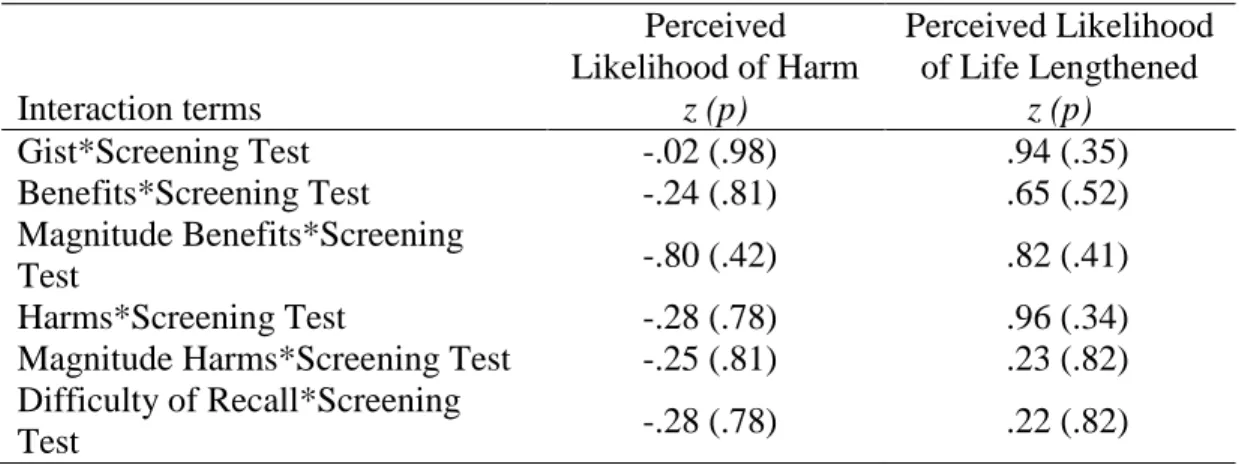
APPENDIX A: MODERATION ANALYSIS………77
APPENDIX B: SURVEY INSTRUMENT……….78
LIST OF TABLES Table 1: Similarities and Differences between the PSA Test
and Colonoscopy (for a 70-year-old Man)...5
Table 2: Demographic Characteristics of Clinicians ...40
Table 3: Frequency of Mentions and Mean Magnitude of PSA Testing and Colonoscopy Benefits and Harms ...41
Table 4: Proportion of Clinicians Who Listed Harms from Screening ...42
Table 5: Clinicians’ Evaluation of PSA and Colonoscopy ...42
Table 6: Characteristics of Newspaper Articles...60
Table 7: Harms and Benefits of PSA Testing and Colonoscopy Mentioned in Newspaper Articles ...61
Table 8: Changes in Newspaper Coverage of PSA Testing and Colonoscopy over Time, 2005–2012 ...62
Table 9. Online Supplement A: Top 10 U.S. Print Newspapers by Daily Circulation, August 2012 ...64
Table 10. Online Supplement B: Average magnitude of PSA Testing and Colonoscopy Benefits and Harms as Rated by Clinicians ...65
Table 11: Valence of Expert and Lay Gist by Screening Test ...69
LIST OF FIGURES
Figure 1: Conceptual model of Aim 1 ...21
Figure 2: Conceptual model of Aim 2 ...22
Figure 3: Relationship between screening test and perceived likelihood ...44
Figure 4: Flow diagram ...63
CHAPTER 1: SPECIFIC AIMS
Currently, three quarters of the preventive services graded by the U.S. Preventive Services Task Force have possible or clear harms that outweigh benefits (1), yet many of these preventive services are delivered at rates in excess of recommendations (2-4). Overuse of potentially harmful screenings can lead to adverse patient outcomes, excess health care costs, and non-ideal patient care. Yet little is known about what leads clinicians to
recommend potentially harmful screening tests.
There are several explanations for why some information comes to mind more easily than other information. In some cases, easily remembered information may reflect real risk (18) and therefore be the most appropriate information upon which to base decisions. However, easily recalled information may reflect what makes an emotional impact (19) or what the news media emphasizes (20,21). While the benefits of cancer screening have received substantial attention in the medical literature, media, and even from the U.S. postal service (22), the harms of cancer screening have received less exposure (23). Indeed, media coverage of cancer screening benefits and harms is frequently unbalanced, inaccurate or biased (23-25). Understanding the degree and framing of screening harms coverage in the media may speak to the availability of harms for the general public, including clinicians.
The objectives of this dissertation are twofold: First, to determine whether the
availability of harms and benefits correlates with clinicians’ perceived likelihood of harm for two screening tests that vary substantially in their ratio of benefits to harms; and second, to characterize news media coverage of these cancer screening harms and benefits from 2005-2012. In this dissertation, I pursue the following specific aims:
Aim 1a. Describe clinicians’ perceptions of the benefits and harms of screening for prostate and colorectal cancer.
Aim 2a. Describe newspapers’ portrayal of the benefits and harms of screening for prostate and colorectal cancer from 2005-2012.
CHAPTER 2: INTRODUCTION Public Health Challenge
Cancer screening poses both potential benefits and potential harms to patients. Cancer screening can be beneficial, lengthening lives by reducing cancer-related morbidity and mortality. For example, regular screening for colorectal cancer has contributed to reducing the age-adjusted mortality rate for colorectal cancer from approximately 34 deaths among men and 25 deaths among women per 100,000 in 1975 by almost half to approximately 19 deaths among men and 13 deaths among women per 100,000 in 2010 (27,28). However, cancer screening can also result in harms from over- and inappropriate use. For example, screening for prostate cancer with the prostate-specific antigen (PSA) test can result in bleeding and hospitalization from follow-up biopsies, and incontinence, impotence, and even death from treatment (e.g., prostatectomy) for cancer that may never cause harm. Clinicians’ recommendations are instrumental in shaping patients’ screening decisions (29-31), yet we know little about how clinicians arrive at their evaluations of the likelihood of benefit or harm from screening. Further, media coverage of cancer screening benefits and harms is frequently unbalanced, inaccurate or biased (23-25), but how the news has portrayed screening benefits and harms in recent years is unknown.
benefit for many adults (32); to prostate cancer screening with the PSA test, which results in net harm for the majority of men (33) (Table 1). PSA testing and colonoscopy are the two most common screening tests that men receive, and they have diametrically opposed ratings by the U.S. Preventive Services Task Force (USPSTF): For a 70-year old man, colonoscopy is an “A”-rated service reflecting clear benefit, whereas PSA testing is a “D”-rated service reflecting net harm. There are qualitative differences between the harms of PSA testing and colonoscopy, making the comparison a complex one; however, comparing real screening tests will yield more clinically meaningful results than comparing hypothetical tests.
Table 1.
Similarities and Differences between the PSA Test and Colonoscopy (for a 70-year-old Man)
PSA Test Colonoscopy
2012 USPSTF rating
“D”-rating for all men
(recommendation against regular screening with the PSA test)
“A”-rating (recommendation that adults aged 50-74 be screened every 10 years with colonoscopy) Main public
health concern
Overuse Appropriate use
Screening involves
Simple blood test Burdensome preparation involving diet changes, laxatives; internal exam for polyp detection and removal
Harm concern
“Screening cascade” Test itself & prep for test
Most relevant harms
Physical
Blood test o Bruising Biopsy
Treatment
o Impotence,
incontinence, vascular events, death
Psychological
False positives, overdiagnosis
o Worry, anxiety Financial Strain
Opportunity Costs
Work or health opportunities missed
Hassle
Unnecessary follow up and treatment
Prep for colonoscopy o Pain, discomfort Psychological
Annoyance or fear of prep for test
Financial Strain Opportunity Costs
Work or health opportunities missed Hassle
Unnecessary follow up and treatment
Prostate and Colorectal Cancer Screening Recommendations
In 2008, the USPSTF recommended against PSA testing for men over 75 (“D” grade) and maintained their “I” grade for all other men, indicating insufficient evidence to assess the test’s benefits and harms (34). Then in May 2012, the USPSTF recommended against using the PSA test for screening purposes altogether (“D” grade for all men), concluding that while many men are harmed by the PSA test, few, if any, benefit (33). In 2008, the USPSTF released a new recommendation for colorectal cancer screening. They recommended that adults between ages 50-75 receive screening for colorectal cancer with colonoscopy, sigmoidoscopy, or fecal occult blood testing (FOBT). They also recommended against routine colorectal cancer screening in adults ages 76-85 (“C” grade) and against screening altogether in adults over 85 (“D” grade) (32).
Physicians (35) and play a central role in whether Medicare covers screening services (36). While not all organizations’ guidelines completely align with the USPSTF recommendations, a recent survey found that 90% of clinicians believe the USPSTF recommendations to be very or extremely influential in their screening recommendations (37), and the USPSTF recommendations continue to be the strongest influence on primary care physicians’ screening recommendations related to prostate cancer screening (38). Differing somewhat from USPSTF recommendations, the American Cancer Society recommendations state that the decision whether to get a PSA test should be an informed decision made by the patient in consultation with his doctor (39). The American Urological Association, which until May 2013 recommended routine screening with the PSA test, now recommends shared decision making for men ages 55-69 and screening at intervals no more frequent than every two years. Their new recommendation now also recommends against PSA screening altogether for men under 40 and against routine screening for men ages 40-55, men older than 70, or men whose life expectancy is less than 10-15 years (40).
Prostate Cancer Screening with the PSA Test
In 2003, the PSA test was more common than colorectal cancer screening with
publication of the results of large clinical trials showing net harm of PSA (44,45) or
recommendation changes. The testing rates for men aged 40 to 49 years, 50 to 59 years, and 60 to 64 years were 12.1%, 32.7%, and 42.7%, respectively, in 2001 versus 15.7%, 34.2%, and 42.0%, respectively, in 2011, based on medical claims data (46).
Screening overuse occurs when patients receive screening at intervals more frequent than is recommended. Overuse of the PSA test can lead to a “screening cascade” of harms for patients. An overwhelming 80% of positive PSA test results are false-positives (44), which are associated with negative psychological effects such as worry and anxiety (47,48), and increased additional testing (49). Such additional testing usually involves a biopsy, and roughly one third of men who have prostate biopsy experience pain, fever, bleeding,
Overdiagnosis and overtreatment of prostate tumors through PSA testing also pose potential harms. Overdiagnosis occurs when individuals with cancer that would remain asymptomatic for the rest of their lives receive screening and subsequent treatment that does not benefit them. Clinicians and their patients frequently elect to treat cases of
screen-detected cancer, but given our current inability to distinguish tumors that will remain harmless from those that are deadly, many patients will not benefit from this treatment (51,54). Instead, many men who will never become symptomatic are subjected to the harms of treatment. Of those men whose screen-detected cancer would have been later identified without screening, most experience the same outcome (i.e., non-lethal disease) and are, therefore, subjected to these harms for a much longer period of time (55,56). One recent study found that PSA testing was associated with large increases in the number of men overdiagnosed with and unnecessarily treated for prostate cancer (57). In addition to leading to possible harm and non-ideal patient care, PSA testing results in excess health care costs. For example, the annual cost of PSA screening in the U.S. is at least $3 billion, much of this paid for by Medicare and the Veteran’s Administration (58).
Colorectal Cancer Screening with Colonoscopy
procedures (59). Serious complications, including death or adverse events such as major bleeding, diverticulitis, severe abdominal pain, and cardiovascular events requiring hospitalization occur in an estimated 25 per 10,000 procedures (60).
Overdiagnosis of colorectal cancer occurs when people over the age of 85 who have a short life expectancy are screened, even though they cannot benefit from the screening, or when the colonoscopy procedure detects and removes polyps. Overuse of colonoscopy occurs when surveillance and colonoscopy occur at more frequent than recommended
intervals. While underuse of screening for colorectal cancer screening has been reported (i.e., when individuals in the appropriate age range of 50-74 do not receive screening every 10 years) (61,62), several studies found that colonoscopies were administered to some patients more frequently than recommended and without sufficient indication (i.e., for surveillance only) (62-65). Specifically, one large study of Medicare patients found that 33% of those aged 80 or older received a repeated colonoscopy within 7 years (65). Another study found that thirty-five percent of clinicians recommended colonoscopy at intervals more frequent than every 10 years (66).
Dual Process Models
(68). Certain heuristics involve System 1 thinking (69) while others are conscious and deliberative in nature and are thus the domain of System 2 (70).
Another dual process theory that may help explain clinician risk perception is Fuzzy Trace Theory (FTT), which holds that people have two ways that they remember events and facts (71). They can recall the precise “verbatim” information, but this information fades quickly over time. More enduring is “gist” memory for the underlying meaning or meanings that people ascribe to the event or fact. Individuals generally prefer and rely upon vague “gist” information even when they can remember specific details or verbatim information (71). Reyna has defined “gist-based thinking” as “the distillation of meaning of past experiences into an intuitive, bottom-line interpretation” (Reyna, 2008, 852). Thus, a clinician may store verbatim or quantitative information about screening harms in her mind (e.g., specific probabilities such as “my patient has a 2 in 1000 chance of experiencing a harm”), but the gist information (e.g., “my patient’s chance of experiencing harm is remote”) will ultimately be what drives her decision to recommend screening. Indeed, health care professionals and other experts commonly rely on gist, more so as experience and training increase (72-75)
The Availability Heuristic
values, (3) simplifying the weighting of cues, (4) integrating less information, and (5) examining fewer alternatives. Another explanation for the functioning of the availability heuristic comes from Kahneman and Frederick, who propose that heuristics of judgment involve attribute substitution, a psychological process whereby the individual substitutes an easily calculated attribute for a more complex or uncertain one (8). Thus, when individuals estimate the size of a category or frequency of an event, they frequently rely upon an impression of the ease with which instances of that category or event come to mind.
Over the past thirty years, a large body of experimental research has linked the availability heuristic with an individual’s assessment of outcomes. In perhaps the most well-known of these studies, Tversky and Kahneman demonstrated biases of availability by showing that categories of information whose instances are easily retrieved seem more numerous than categories of equal frequency whose instances are less retrievable (7). In one experiment in which study participants were shown lists of men’s and women’s names, the inclusion of famous names of one particular gender lead to increased frequency estimates for names in this gender (9). In another experiment, Tversky and Kahneman found that
Availability can be operationalized in two ways: as the sheer number of instances of a category one can recall (9,82,83), and as the subjective ease of recalling those instances, which has also been described as “accessibility” (83-86). As I will be testing both availability constructs in my dissertation, to avoid confusion, I will refer to the number of instances of a category clinicians recall as “number of benefits/harms” (87) and the experienced ease of recall with which these instances are brought to mind as “subjective ease of recall.”
While it may seem that subjective ease of recall is reliant upon recalled content, these two variables frequently function independently, which has been demonstrated by the
attenuation of subjective ease of recall when the informational value of recalled content is called into question (88-91). However, with two sets of letters, Kahneman clearly and simply demonstrates the independence of recalled content and the subjective ease of recall (2012):
XUZONLCJM TAPCERHOB
Kahneman notes that when we look at these two sets of letters, we know without coming up with any instances, that one set contains many more possibilities for constructing words than the other. Thus, subjective ease of recall is different from recalled instances of a category, though they may act in concert under some conditions. Several researchers have added to this finding by exploring how numerosity affects the availability heuristic. Beyth-Marom and Fischhoff found that frequency estimates of a category were correlated with two “direct measures of availability”: time to produce first instance and number of instances in the first five seconds. They also found that exhaustively listing instances of a category led to
Importantly for this study, the number of cases an individual is asked to list influences frequency estimates. Schwarz and his colleagues found that if asked to retrieve four examples of a case, subjective ease of recall will be high, leading people to estimate the frequency of that case as higher. However, when asked to retrieve 12 examples, subjective ease of recall is lower, leading to the conclusion that the frequency of that case is lower (89). As described in greater detail in the Methods section of this proposal, the number of harms we asked clinicians to recall was an important consideration, given that this variable has the potential to influence both subjective ease of recall and estimation of harm.
Likelihood Perceptions
Research has documented the availability heuristic in various constructs relevant to probability or likelihood judgments. Tversky and Kahneman originally demonstrated the effect of the availability heuristic on recalled set size/frequency of occurrence (9). A survey of Midwestern residents showed that those with high recall for antidepressant direct-to-consumer advertising tended to estimate the prevalence of depression higher than those with low ad recall (20). Lichtenstein and colleagues (1978) reported that their subjects' estimates concerning the relative frequencies of death from various causes were directly correlated with the extent of past personal experiences involving each class of lethal event (98). Personal experience has been used as a proxy for availability (99,100), though evidence suggests that personal experience is a separate concept from availability, and that the
relationship between personal experience and risk perception is mediated by subjective ease of recall (101-103).
Availability, and variables similar to availability such as personal experience, influence judgments of the likelihood of future events as well (104). For example, using personal experience as a proxy for availability, Gana and colleagues (2008) found that female students who had personal experiences with breast cancer overestimated their own risks of getting breast cancer in the future (100). As well, clinicians overestimate disease likelihood based on how well they can recall instances of that disease (16,17).
Role of the Media
is emphasized in the news media (20,21). By emphasizing certain topics and events, the news media plays a significant role in shaping—and sometimes distorting—availability and risk perceptions (21,98,106). For example, Lichtenstein et al. (1978) observed that people’s median estimated frequency was higher for risks for which newspaper coverage was more extensive, irrespective of the true risk. They found that study participants overestimated the likelihood of sensational or vivid causes of death such as botulism, tornado, flood, homicide, motor vehicle deaths and cancer, while underestimating more common but undramatic causes of death such as diabetes, stroke, and heart disease. One possible explanation the authors offer is that sensational events become more durable memories (“gist” memories) that are more easily retrieved than undramatic events.
The availability cascade and availability heuristic may be inextricably intertwined with another heuristic of judgment: the affect heuristic (112,113). Antonio Damasio observed that emotions play a critical role in shaping decisions, and thoughts that are especially laden with emotion come to mind with greater ease than thoughts that are unemotional, which can lead to errors of judgment (114-118). Different emotions can vary in their influence on risk judgments (119,120).
News media coverage frequently skews towards poignancy, novelty and stories that elicit an emotional response from readers (121,122) as these qualities draw and keep peoples’ attention. Because media coverage stresses highly improbable risk in an effort to captivate audiences, it may distort the public’s perceptions of risk. Recent research indicates that media may most strongly influence risk perception through affect (e.g., emotions such as dread (123)) (121). Thus, for example, if the media sensationalizes the potential benefits of cancer screening or presents them alongside emotion-laden testimonials, consumers may more easily access thoughts of those benefits than thoughts of the potential harms.
If cancer screening harms are under-, or mis-represented in the media, this may make the harms of cancer screening more difficult for clinicians to call to mind. Moreover,
disproportionate exposure of certain topics by the media (such as a disproportionate focus on benefits of screening) may result in persistent, systematic biases that interfere with decision making, especially as individuals may be unable to correct for biases even when specifically instructed to avoid them (98).
About half of the U.S. population is exposed to some form of news media on a daily basis (132). Thus, understanding the degree and framing of screening harms coverage in the news media may speak to the availability of harms information for the public. While print newspapers are not the form in which most Americans consume news (133), research on mass media frequently uses newspapers as proxies for all news media (134,135) as
cancer screening for this study.
Comparison of PSA Testing to Colonoscopy
In Aim 1, I test whether the availability of harms and benefits information differs by screening test, comparing a screening test with net harm (PSA testing) to one with net benefit for many adults (colonoscopy). In particular, I hypothesize that harms information is likely to be more available for PSA testing relative to colonoscopy, leading to greater perceived likelihood of harm for PSA testing. I have chosen the PSA test as a proxy for a screening test with a low benefit-to-harm ratio for several reasons. First, it is perhaps the most well-known example of an inefficacious cancer screening test. Moreover, there is good evidence that the harms of PSA testing outweigh its benefits and it has a corresponding “D” rating from the USPSTF. Conversely, I have chosen colonoscopy as a proxy for a screening test with high benefit-to-harm ratio given that it is the reference standard test for colorectal cancer, and it has a diametrically opposed “A” rating from the USPSTF for adults ages 50-75. This comparison of prostate cancer screening to colorectal cancer screening is an interesting and important one given that screening rates for these tests are comparable to each other and relatively high, and despite net harm of PSA testing, clinicians continue to order the test. This comparison will allow me to provide evidence of low availability or knowledge of harms as one explanation for why clinicians persist in ordering the PSA test, contributing to our understanding of the problem of overuse and over-recommendation of the PSA test.
controversial one for colonoscopy in the same year, I assess changes in mentions of harms/benefits and gist before and after 2008. Colonoscopy articles are likely to be predominantly “pro” screening with greater discussion of benefits, and I do not expect the gist or presentation of harms/benefits to change over time for colonoscopy articles. The reason for this assumption is that there has been no emergent evidence or controversial (newsworthy) recommendation changes for colonoscopy during the same time period. Taken together, this research will provide a better understanding of two important predictors of screening behavior by exploring how the news media portrays, and how clinicians perceive, the benefits and harms of prostate and colorectal cancer screening.
Explanation of Dissertation’s Conceptual Model
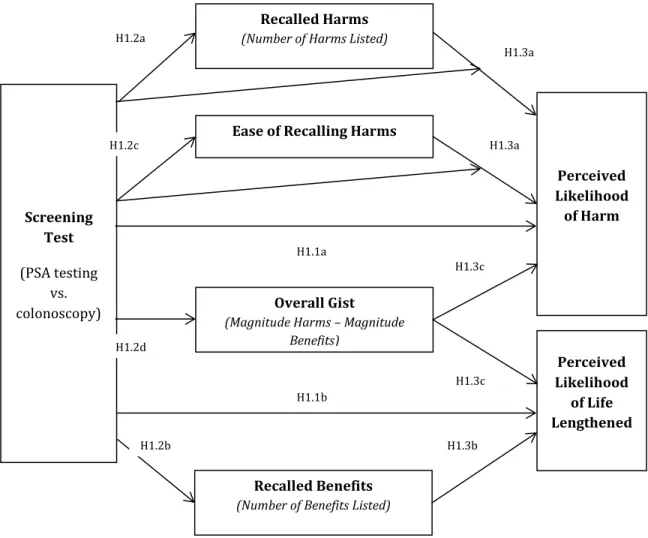
As depicted in Figure 1 below, Aim 1 of my dissertation examines whether cancer screening test predicts clinicians’ perceived likelihood of harm, and whether the availability of harms—operationalized as number of harms listed and the subjective ease of recall— mediates this relationship. Per the request of my dissertation committee, I will also test whether: 1) screening test moderates the relationship between availability and perceived likelihood of harm; 2) number of benefits listed mediates the relationship between screening test quality and perceived likelihood of life lengthened; and 3) “overall gist” (defined as the summed magnitude of benefits minus the summed magnitude of harms) mediates the relationship between screening test and both perceived likelihood of harm perceived and likelihood of life lengthened.
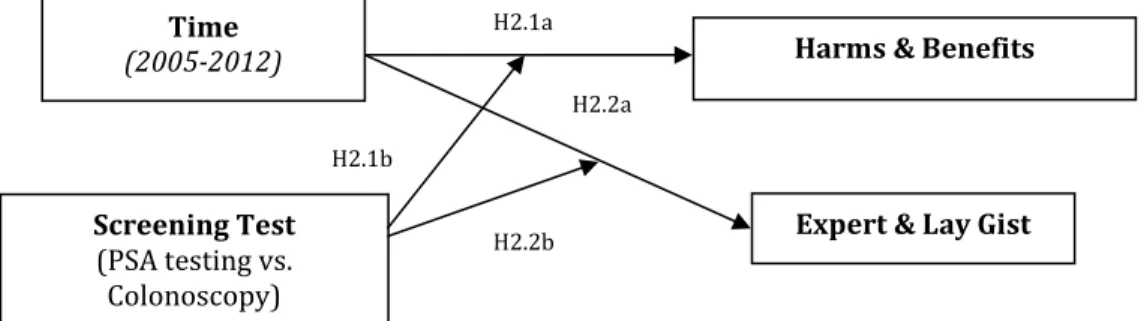
effect of time on mentions of harms/benefits and on expected expert and lay gist in newspapers. Findings from Aim 2 will not directly explain the findings from Aim 1. The Aim 2 findings will, however, provide us with a better understanding of the scope of news media coverage of screening harms and the social context within which harms information is made “available” to the public, and within which clinicians make screening-related decisions.
Figure 1. Conceptual model of Aim 1
Screening Test
(PSA testing vs. colonoscopy)
Recalled Harms
(Number of Harms Listed)
Ease of Recalling Harms
Overall Gist
(Magnitude Harms – Magnitude Benefits)
Recalled Benefits
(Number of Benefits Listed)
Perceived Likelihood
of Harm
Perceived Likelihood
of Life Lengthened
H1.1a
H1.1b
H1.2b H1.2c
H1.2a
H1.3a
H1.3a
H1.3b H1.2d
H1.3c
Figure 2. Conceptual model of Aim 2
Time
(2005-2012)
Screening Test (PSA testing vs.
Colonoscopy)
Harms & Benefits
Expert & Lay Gist
H2.1a
H2.2a
H2.1b
CHAPTER 3: CLINICIANS’ PERCEPTIONS OF THE BENEFITS AND HARMS OF PROSTATE AND COLORECTAL CANCER SCREENING (Paper 1)
Introduction
Cancer screening poses both potential benefits and potential harms to patients. It can lengthen life and increase quality of life by reducing cancer-related morbidity. However, cancer screening can result in harms from the screening procedure itself and from
overdiagnosis and unnecessary follow up and treatment (139). Clinicians’ recommendations are instrumental in shaping patients’ screening decisions (29-31), yet we know little about clinicians’ perceptions of screening benefits and harms or how they arrive at their
perceptions of the likelihood of benefit or harm from screening. These kinds of perceptions and likelihood judgments are a useful focus of research because they play an important role in theories of decision making (140) and health behavior (141).
To understand how clinicians formulate these perceptions and likelihood judgments, it is helpful first to know that people often do not use calculated, rational decision strategies (5,6) but instead rely upon quick, intuitive, automatic strategies, sometimes called heuristics, to make decisions under uncertainty (7). Laypeople and experts, including clinicians,
disease if they can more easily recall details about it. Researchers frequently operationalize availability of information in two ways: as the number of instances of a particular type of information that participants can recall (9,82,83) and as the subjective ease of recalling those instances (83,85,86). By this reasoning, clinicians who recall more benefits of screening with greater perceived ease may also perceive a greater likelihood of benefit from screening.
Another possibility is that clinicians may perceive the benefits and harms of screening as a gestalt, again more so as expertise increases (72-75). According to fuzzy trace theory, memories of precise, verbatim information (e.g., specific probabilities such as “my patient has a 2 in 1000 chance of experiencing a harm”) fade quickly over time; more enduring is gist memory, or the bottom-line meaning ascribed to an event (e.g., “my patient’s chance of experiencing harm is remote”) (71). Individuals generally rely upon gist information, even when they can remember verbatim information (71), and they may base likelihood estimates on gist impressions rather than disease prevalence (145). Clinicians’ gist of screening may manifest as an overall impression of net benefit or harm, which takes into account both the number of benefits and harms and the magnitude of those benefits and harms (146). Thus, if clinicians have a negative gist of screening (i.e., they ascribe greater total magnitude to harms than benefits), they may judge the likelihood of harm from screening to be higher. Similarly, if they have a positive gist of screening, they may judge the likelihood of benefits from screening to be higher.
efficacy screening test that has been shown to result in net benefit in adults ages 50-75 and reduces colorectal cancer mortality (147,148), and national recommendations suggest its use for that age group (32,147,148). The second screening test we chose was PSA testing, which has been shown to lead to net harm, and national screening recommendations discourage the test (149) or recommend it only conditionally (39,40).
The study had two distinct but complementary aims. First, we sought to describe clinicians’ perceptions of the specific benefits and harms of our two chosen screening services, including the number and perceived magnitude of benefits and harms they could call to mind. Second, we sought to understand how clinicians arrive at their perceptions of the likelihood of life lengthened or harm from screening. We predicted that clinicians would perceive the likelihood of harm to be greater and likelihood of life lengthened to be lower for a screening test with harms that outweigh benefits (PSA testing) relative to a screening test with benefits that outweigh harms for many adults (colonoscopy). We had two competing hypotheses about mediators of this association. Our availability hypothesis was that
lengthened to be lower for PSA relative to colonoscopy if their gist of colonoscopy was more positive than their gist of PSA testing.
Methods
Participants
Eligible participants were clinicians from 24 family medicine or internal medicine practices in a North Carolina university-affiliated, practice-based research network. In fall 2012, practices in the network employed a total of 155 practicing clinicians: 127 medical doctors, three doctors of osteopathic medicine, 16 physician assistants and 12 nurse practitioners. We excluded registered nurses (n=19) and clinical support nurses (n=2) because they did not have their own panel of patients. We recruited clinicians through practice representatives (e.g., chief medical officers, practice managers) at their monthly meeting in September 2012.
Procedures
Practice representatives distributed the study surveys to clinicians in their practices. The study packet included a $20 bill as an incentive to complete and return the survey (150). Clinicians received reminders after two days and one, five, and seven weeks. The
institutional review board of the University of North Carolina approved the study protocol and materials.
understanding clinicians’ cancer risk perceptions. A significant benefit of using them is that they allow for standardization across clinicians (151,152). We counterbalanced the order of questions on screening tests by randomly assigning clinicians to one of two questionnaire conditions in which prostate or colorectal cancer screening vignettes and questions appeared first. The hypothetical patient for PSA testing was Mr. Morton, a 70-year old white male with good cognitive status, no fatal disease, no family history of prostate cancer, no previous prostate findings or abnormal PSA tests, and a normal PSA test result two years ago. The hypothetical patient for colonoscopy was Mr. Lewis, a 70-year old white male with good cognitive status, no fatal disease, no family history of colon cancer, no risk factors or history of polyps, and a normal colonoscopy result ten years ago.
Measures
Outcomes
Perceived likelihood of harm. The survey measured perceived likelihood of harm with the question, “Think of 100 healthy patients, like Mr. Morton [Mr. Lewis] age 70, whom you screen with the PSA test [colonoscopy] and find an elevated PSA of 8.0. [a 1.0 cm adenomatous polyp that is removed]. You continue to follow them for the next 10 years. Having the PSA test [colonoscopy] will lead to at least moderate physical harm at some point over the next 10 years for how many of these men?” Response options were 0, 1-10, 11-20, 21-30, 31-40, 41-50, 51-60, 61-70, 71-80, 81-90, and 91-100 men out of 100 men.
next 10 years. At the end of 10 years, how many of these men do you think will have had their lives lengthened by having had the PSA test [colonoscopy]?” Response options were 0, 1-10, 11-20, 21-30, 31-40, 41-50, 51-60, 61-70, 71-80, 81-90, and 91-100 men out of 100 men.
Mediators
Number of Benefits. Studies of the availability heuristic commonly operationalize availability by summing the number of instances of a category a participant can recall (9,82,83). Thus, we measured availability as the number of benefits of PSA testing
[colonoscopy] with the question, “list as many benefits from PSA testing [colonoscopy] as you can think of for Mr. Morton [Mr. Lewis], a 70-year old patient.” Clinicians could list up to seven benefits, a number deemed adequate by clinicians on the study team. We instructed clinicians to use only the lines they needed. Previous research has shown that providing a qualifier of this sort can cancel out any effects of enhanced or diminished difficulty of recall (153).
Number of Harms. The survey measured the number of harms of PSA testing
[colonoscopy] with the question, “list as many harms from PSA testing [colonoscopy] as you can think of for Mr. Morton [Mr. Lewis], a 70-year old patient.” Clinicians could again list up to seven harms.
screening?” Response options were: not at all (coded 0), somewhat, moderately, very, and extremely difficult (coded 4).
Magnitude of Benefit [Harm]. For each benefit [harm] that clinicians listed, the survey asked them to “indicate how large you believe that benefit [harm] would be.”
Response options were almost no benefit [harm] to patient (coded as 1), small benefit [harm], moderate benefit [harm], and large benefit [harm] (coded as 4) (154,155). We calculated the magnitude of benefit [harm] as the sum of the ratings of each benefit [harm] a clinician listed.
Gist. We created a variable to capture the gist of each screening test and to put benefits and harms into a common “scale,” allowing us to compare harms and benefits. We separately summed the magnitude ratings of listed harms and the magnitude ratings of listed benefits. For each test, we then calculated gist as the summed magnitude of benefits minus the summed magnitude of harms (146). A positive gist score indicated that a clinician listed more benefits with greater magnitude than harms, whereas a negative gist score indicated that a clinician listed more harms with greater magnitude than benefits.
Demographics
The survey assessed demographic characteristics of clinicians including sex, age, race, ethnicity, medical credentials, and years in medical practice.
Data Analyses
ASH) independently categorized harms clinicians listed into five categories (physical effects, psychological effects, financial strain, opportunity costs, and hassle (i.e., sometimes
unnecessary difficulties associated with complex requirements of testing and treatment)) informed by the taxonomy of screening harms proposed by Harris and colleagues (139). Inter-rater reliabilities for each category were good (Cohen’s kappa>.80).
Paired t-tests compared the mean number of PSA testing harms clinicians listed to the mean number of PSA testing benefits. We repeated this test for colonoscopy and for the magnitude sum scores, perceived likelihood of harm, and perceived likelihood of life lengthened. We used paired t-tests to compare mean PSA testing benefits to mean
colonoscopy benefits. We repeated this analysis for harms, subjective difficulty of recall, magnitude sum scores for benefits and harms, gist, likelihood of harm, and likelihood of life lengthened. McNemar tests compared the frequency of mentions of each benefit and harm category between PSA test and colonoscopy.
Some clinicians did not list benefits or harms on the survey, possibly due to the extra burden of doing so. As a result, up to 19% of values were missing for the number and
The main outcome measures were clinicians’ perceived likelihood of harm and life lengthened from screening. We used generalized estimating equations that accounted for repeated measurements to examine whether perceived likelihood of harm differed by screening test (PSA vs. colonoscopy). We report the results of regressions using z statistics. We repeated this analysis to assess the association between screening test and perceived likelihood of lengthening life. In separate models, we then tested several potential mediators of these associations: number of harms and benefits and subjective difficulty of recall (availability hypothesis); gist (fuzzy trace hypothesis); and additional gist components (perceived magnitude of benefit and perceived magnitude of harm). We used a causal steps approach to mediation (159). Consistent with that approach, we tested: (1) the associations described above; (2) whether screening test predicted potential mediator variables; (3) whether mediator variables predicted likelihood estimates statistically controlling for
screening test; and (4) whether the effect of screening test on likelihood estimates attenuated after controlling for the effect of gist and gist components on likelihood estimates in separate models (159). In each model, we controlled for the order in which clinicians viewed
questions on each screening test. We conducted Sobel tests to establish whether reductions in the association in step 4 were attributable to the mediators. We conducted all analyses in SAS (160) using two-tailed tests and a critical alpha of .05.
Results
PSA testing
The benefits of PSA testing that clinicians most frequently mentioned were early detection and treatment (72%) and psychological effects (e.g., peace of mind) (37%) (Table 3). The most frequently listed harms were unnecessary treatment (56%), psychological effects (e.g., anxiety) (53%), and follow-up procedures (47%). Many clinicians listed at least one physical harm of PSA testing (70%) and many listed at least one psychological harm (68%). However, fewer clinicians recognized hassle (56%) or financial strain (13%). No clinicians listed opportunity costs of PSA testing (e.g., missing work, distraction from other important healthy activities). Most clinicians (90%) listed a PSA testing harm from at least one category from the Harris et al. taxonomy of screening harms (139), and 65% listed harms in at least two categories. Few clinicians cited PSA testing harms from more than three categories of the taxonomy (Table 4).
Clinicians listed more harms than benefits of PSA testing (M =3.03 vs. 1.57, p<.001). The summed magnitude of PSA harms was greater than the summed magnitude of PSA benefits (M=8.92 vs. 7.16, p<.001). On average, difficulty of recalling harms was low (M=0.42, SD=0.26). Mean PSA testing gist indicated that clinicians listed more harms with greater magnitude than benefits (M= -4.12, SD=5.56). Clinicians estimated that getting a PSA test was more likely to harm men than to lengthen their lives (M =4.41 vs. 2.70, p<.001) (Table 5).
Colonoscopy
perforation (58%), discomfort of preparing for the procedure (21%), and psychological effects (e.g., anxiety) (21%) (Table 3). Most clinicians listed at least one physical harm of colonoscopy (95%), but fewer clinicians recognized psychological harms (29%), hassle (24%), financial strain (19%), or opportunity costs (4%). Most clinicians (88%) listed a colonoscopy harm from at least one category from the taxonomy of screening harms (139), and 44% listed harms in at least two categories. Few clinicians cited colonoscopy harms from more than three categories (Table 4).
Clinicians listed more harms than benefits of colonoscopy (M=2.82 vs. 2.02, p<.001). The summed magnitude of colonoscopy benefits was greater than the summed magnitude of harms (M=8.06 vs. 4.75, p<.001). On average, difficulty of recalling harms was low
(M=0.44, SD=0.24).Mean colonoscopy gist indicated that clinicians listed more benefits with greater magnitude than harms (M=0.94, SD=4.87). Clinicians estimated that receiving a colonoscopy was more likely to lengthen life than to cause harm (M =4.27 vs. 2.45, p<.001) (Table 5).
PSA testing vs. colonoscopy
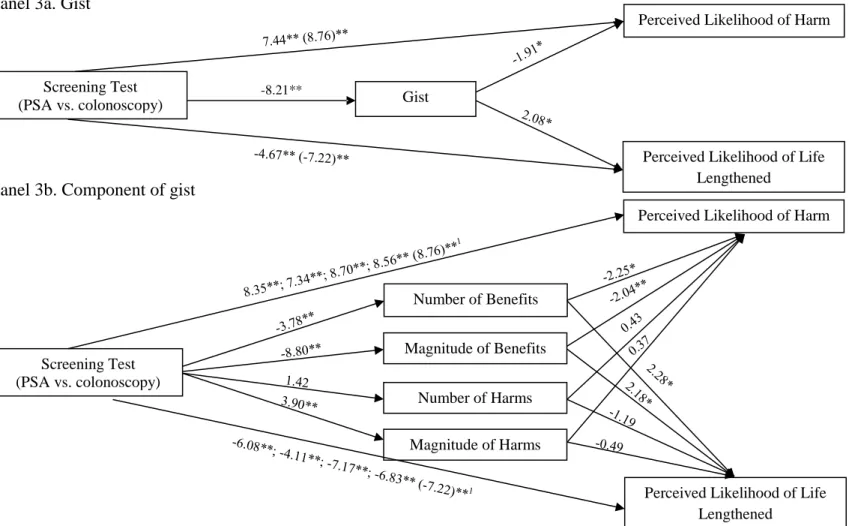
As predicted, clinicians perceived higher likelihood of harm (z=8.76, p<.001) and lower likelihood of life lengthened (z= -7.22, p<.001) for PSA testing relative to
colonoscopy. Clinicians’ gist of screening was more negative for PSA testing relative to colonoscopy (z= -8.21, p<.001). Considering the components of gist, the summed magnitude of harms clinicians listed was greater (z=3.90, p<.001) and the summed magnitude of
not perceive the number of harms (z=1.42, p=.16) or the difficulty of recall (z= -.32, p=.90) to be different between screening tests (Table 5, Figure 3).
Mediation Analyses
We used separate mediation models to test our two competing mediation hypotheses (availability vs. fuzzy trace theory). Specifically, mediation models tested whether: (1) screening test predicted perceptions of likelihood; (2) screening test predicted potential mediator variables; (3) mediator variables predicted likelihood estimates statistically controlling for screening test; and (4) the effect of screening test on likelihood estimates attenuated after controlling for the effect of gist and gist components on likelihood estimates in separate models. The above section, “PSA testing vs. colonoscopy,” shows the results for steps 1 and 2 and indicates that gist and number of benefits were potential mediators. Number of harms and difficulty recalling harms were not candidate mediators, because they failed in step 2 (i.e., were not associated with perceptions of likelihood). We ran additional analyses to examine whether magnitude of benefits were mediators for the sake of
completeness, although they were only indirectly part of our mediation hypothesis (as components of gist). Results for the third and fourth steps of the mediation analyses are below.
Effects of Potential Mediators on Perceived Likelihood of Harm
indicated that gist mediated the relationship between screening test and perceived likelihood of harm from screening (z= -.25, p<.05). Furthermore, the Sobel test showed that the number of benefits (z=.17, p<.05) and magnitude of benefit (z=.25, p<.001) also mediated this relationship. There were no mediation effects of the number of harms, magnitude of harms, or difficulty of recall.
Effects of Potential Mediators on Perceived Likelihood of Life Lengthened
In a model that controlled for gist, clinicians estimated that fewer men would have their life lengthened from PSA testing than colonoscopy (z= -4.67, p<.001) (Figure 3). The Sobel test indicated that gist mediated the relationship between screening test and perceived likelihood of life lengthened (z=.41, p<.05). Furthermore, the Sobel test showed that the number of benefits (z= -.26, p<.05) and magnitude of benefits (z= -.37, p<.05) also mediated this relationship. Similar to our findings for perceived likelihood of harm, we found no mediation effects of the number of harms, magnitude of harms, or difficulty of recall.
Discussion
Clinicians’ perceptions of the likelihood that screening will help or harm play an important role in shaping their screening recommendations. Findings suggest that clinicians are aware of the potential harms of screening, but that they had low awareness of the
Out study is consistent with previous studies showing that clinicians recognize the importance of communicating the harms of cancer screening (161-163), but our study provides new evidence that clinicians can identify some screening harms with ease. As a group, clinicians listed harms from all categories of the screening cascade identified in the Harris taxonomy (139). For PSA testing, clinicians listed mostly psychological harms of testing (e.g., anxiety, false positives), physical harms of distal follow up procedures (e.g., impotence, incontinence), and hassle of unnecessary testing and procedures, suggesting that these types of PSA harms are most available for clinicians. For colonoscopy, clinicians listed mostly physical harms related to the procedure itself (e.g., discomfort of preparation,
perforation, bleeding), suggesting that physical harms of colonoscopy are most available for clinicians. However, individual clinicians were less likely to list the full scope of screening harms. Few clinicians listed more than two harms of any type. As well, few clinicians enumerated anything beyond physical harms of colonoscopy, and fewer mentioned financial strain or opportunity costs for either screening test. Clinicians may either be unaware of these latter harms, or they may perceive them to be trivial and not worth enumerating for
themselves or their patients. These findings suggest that, if the full spectrum of harms are important to screening decisions (e.g., for populations that experience net harm from a particular screening test), messages to clinicians should emphasize the full scope of harms (139).
colonoscopy, clinicians perceived early detection and treatment and saving lives were the most important benefits, and that early detection and treatment was the most available benefit. This finding is not surprising given that the primary goal of cancer screening is to reduce deaths due to cancer, thereby increasing patients’ length of life, as well as curtailing the development of symptomatic metastatic disease (32,149). However, fewer clinicians listed the psychological benefits of screening (e.g., peace of mind) or enumerated longevity, preventing cancer, ruling out cancer, or having more information. Developing a parallel framework of screening benefits similar to the taxonomy of screening harms developed by Harris and colleagues (139) and testing it to determine patients’ values for various benefits could help researchers understand screening benefits, facilitate comparison to screening harms, and ultimately facilitate decision making.
Interestingly, breaking gist down into its component parts, we found that clinicians’ perceptions of screening benefits played a mediating role, but harms did not. This finding deserves further exploration, as it diverges from past research showing that harms
information alters risk perception but benefits information does not (173-175). It may be that, for clinicians, benefits are more congruent than harms with thinking about screening tests. In other words, clinicians as a group may associate screening with benefits in a categorical, gist-like way. This finding suggests that messages to clinicians to decrease over-recommendation of screening may need to focus on benefits rather than harms. Future research on the role of gist-based thinking in decision making should assess whether patients and providers
formulate risk perceptions in this gist-like way. For example, it is possible that risk perceptions about certain typically beneficial behaviors such as screening elicit benefits-based decisions while typically harmful actions like drug use might elicit decisions benefits-based upon harms but not benefits.
Strengths of our study are the rigorous study design and high response rate. Although the sample size may seem modest to some (n=126), this is a reasonably large sample
did not measure clinicians’ ease of recalling benefits due to limited space on the
questionnaire, preventing us from comparing clinicians’ ease of recalling harms to benefits. Findings are from an academic group of clinicians who may be better informed than the average clinician. Future research should establish whether the findings that we reported here generalize to other populations of clinicians and to beliefs about cancer screening tests delivered solely to women. We acknowledge that results from our hypothetical vignettes may differ from clinicians’ reactions to real life patients that occur under time pressure and
complex circumstances. We also acknowledge the need to replicate findings with vignettes that vary the characteristics of hypothetical patients and assess additional screening tests.
Table 2.
Demographic Characteristics of Clinicians (n=126)
%
Women 38
Race
Asian 11
Black or African American 10
White 76
Other 2
Refused 1
Hispanic 3
Degree
MD 79
DO 2
NP 8
PA 11
Age in Years, Mean (SD, Range) 45 (10, 29-69)
Table 3.
Frequency of Mentions and Mean Magnitude of PSA Testing and Colonoscopy Benefits and Harms
Listed for PSA
(%)
Listed for Colonoscopy
(%)
Magnitude Rating for PSA
(Mean)
Magnitude Rating for Colonoscopy
(Mean)
Harms
Bleeding 1 13* 2.67 2.60
Discomfort of “Prep” for Colonoscopy - 21 - 2.17
False Negatives 4 5 2.75 3.00
False Positives 28 6* 2.92 3.20
Financial Cost 0 19* 2.06 2.40
Follow-up Procedures 47 10* 3.11 2.67*
Impotence 19 - 3.20 -
Incontinence 21 - 3.41 -
Increased Mortality 3 4 4.00 3.69
Overdiagnosis 28 8* 3.48 2.67*
Pain 13 13 2.71 2.08
Perforation - 58 - 3.48
Psychological Effects (e.g., Anxiety) 53 21* 2.83 2.38
Unnecessary Treatment 56 11* 3.43 2.64*
Benefits
EarlyDetection/Treatment 72 74 3.02 3.81*
Knowledge/Having More Information 8 9 3.11 2.90
Lifesaving/Reduced Mortality 12 13 3.23 3.33
Longevity 12 21* 2.75 3.87*
Prevent Cancer 3 12* 2.20 3.68*
Psychological Effects (e.g., Peace of Mind) 37 18* 2.81 2.95
Rule out cancer 3 7* 2.00 3.13*
Note. Clinicians rated the magnitude of benefit [harm] on a four-point scale ranging from “almost no benefit [harm] to patient” (coded as 1) to “large benefit [harm] to patient” (coded as 4). - = not applicable
* p<.001.
Table 4.
Proportion of Clinicians Who Listed Harms from Screening
1
Categories are based on the Harris et al. taxonomy of harms (139). *p<.05, **p≤.001
Table 5.
Clinicians’ Evaluation of PSA and Colonoscopy
PSA Mean (SD)
Colonoscopy Mean (SD)
Gist -4.12 (5.56) 0.94 (4.87)*
Number of Harms 3.03 (1.52) 2.82 (1.45)
Number of Benefits 1.57 (0.72) 2.02 (1.22)*
Summed Magnitude of Harm 8.92 (4.70) 7.16 (3.91)*
Summed Magnitude of Benefit 4.75 (2.65) 8.06 (3.95)*
Subjective Difficulty of Recall 1.42 (0.76) 1.44 (0.74)
Likelihood of Harm 4.41 (2.29) 2.45 (1.47)*
Likelihood of Life Lengthened 2.70 (1.74) 4.27 (2.62)*
Note. Gist was the summed magnitude of benefits minus the summed magnitude of harms. *p<.001.
PSA Testing (%)
Colonoscopy (%) Taxonomy category1
Physical harm 70 95
Psychological harm 68 29*
Financial strain 13 19**
Opportunity cost 0 4
Hassle 56 24
All 5 categories 0 0
Any 4 categories 3 5
Any 3 categories 30 16*
Any 2 categories 65 44*
Any 1 categories 90 88
Figure 3. Relationship between screening test and perceived likelihood Panel 3a. Gist
Panel 3b. Component of gist
Note. Numbers are z statistics from separate mediation models controlling for survey order. 1
Effect of screening test on likelihood perceptions controlling for number of benefits; magnitude of benefits; number of harms; magnitude of harms. Main effects in parentheses.
≤.001. Screening Test (PSA vs. colonoscopy)
Perceived Likelihood of Harm
Perceived Likelihood of Life Lengthened
Gist
Magnitude of Benefits
-8.21**
8**
Screening Test (PSA vs. colonoscopy)
Perceived Likelihood of Harm
Perceived Likelihood of Life Lengthened
Number of Harms
Magnitude of Harms Number of Benefits
CHAPTER 4: HAVE SCREENING HARMS BECOME NEWSWORHTY? NEWS COVERAGE OF PROSTATE AND COLORECTAL CANCER SCREENING SINCE
THE 2008 USPSTF RECOMMENDATION CHANGES (Paper 2) Introduction
Cancer screening recommendations have changed substantially in recent years. In 2008, the U.S. Preventive Services Task Force (USPSTF) changed its recommendations on prostate cancer screening. While they again concluded that evidence was insufficient to determine the balance of benefits and harms of prostate cancer screening in men ages 50 to 75 (“I grade”), they newly concluded that screening men over 75 resulted in net harm and recommended against routinely screening these men (“D grade”) (34). In 2012, the USPSTF further amended its recommendation based on evidence from two major trials (176,177), recommending against routine prostate cancer screening with the prostate-specific antigen (PSA) test for men regardless of age (178). The USPSTF also revised its recommendations on colorectal cancer screening in 2008. They reiterated recommendations that all adults age 50-75 regularly screen for colon cancer; however, they also newly recognized that the
It is important to monitor news coverage of screening recommendations given the potential of the media to influence consumer behavior (188). In the past, media coverage of cancer screening has focused on benefits, under-emphasizing harms (23,25,124,126). Imbalanced cancer screening coverage can increase patient information-seeking (189,190) and screening uptake (108,191); however, imbalanced coverage can also increase screening uptake in age groups not normally recommended to receive screening, with no added benefit in cancer outcomes (192).
This study sought to establish whether newspapers’ portrayal of screening harms and benefits changed after the release of the 2008 USPSTF recommendations. It compared newspaper coverage of PSA testing and colonoscopy, allowing us to juxtapose a
controversial screening test that has disputed effectiveness (PSA testing) (178) with a well-accepted screening test widely considered to be effective (colonoscopy) (147,148). We expected mentions of PSA testing harms to increase and mentions of PSA testing benefits to decrease in the years following the 2008 recommendation change. This hypothesis was based on the premise that newspapers would describe why the Task Force judged the test’s harms to outweigh its benefits for men over 75. We also expected newspapers to increasingly discuss PSA testing harms as the results of two large trials of the effects of prostate cancer screening on cancer-related mortality became available (44,45,176) leading up to the 2012 USPSTF recommendation against routine PSA testing in all men. We expected that mentions of harms and benefits in colonoscopy articles would not change because the USPSTF
Methods
Identifying articles
Newspapers frequently set the agenda for other news formats and thus their content may influence and reflect news from other news sources (136,137). We conducted a
quantitative content analysis of news coverage in the top 10 U.S. newspapers with the highest daily circulation (Online Supplement A) as they are the most read and arguably the most influential newspapers in the U.S. To identify relevant articles, we used four databases: Lexis Nexis (Daily News [New York], LA Times, New York Post, New York Times, San Jose Mercury News, USA Today, and Washington Post); Newspaper Source Plus (Wall Street Journal), America’s News (Chicago Sun-Times); and ProQuest Digital Microfilm (Chicago Tribune). We searched for (1) prostate or colon/colorectal, (2) cancer, and (3) screening or synonyms for screening. With Lexis Nexis, for example, the Boolean search string was ((prostate OR colorectal OR colon) AND cancer AND (screen! OR “prostate specific antigen” OR PSA OR P.S.A. OR colonosop! OR detect! OR diagnos! OR test! OR prevent! OR surveillance)).
relevant (e.g., articles addressing benign prostatic hypertrophy, cancer treatment or
vaccination to prevent cancer) or were not a news article (e.g., advertisements, obituaries). We also excluded articles that: addressed screening tests for prostate cancer other than PSA testing (e.g., experimental tests, digital rectal exam) and screening tests for colorectal cancer other than colonoscopy (e.g., virtual colonoscopy, fecal occult blood testing,
sigmoidoscopy); mentioned prostate or colorectal cancer screening only in passing; or discussed screening only generally (e.g., using several screening tests as exemplars).
Measures
We developed a standardized coding instrument using an iterative process. To pilot test the instrument, two coders (EE, JL) each coded three prostate and three colorectal cancer screening articles, then reviewed and discussed their findings. The coders repeated this process until they reached agreement and revised the coding instrument accordingly. Then, to assess reliability of coding, both coders independently assessed 40 articles (~10% of the corpus). We calculated reliability using Krippendorf’s alpha (193) and included variables with α.80 (193). One author then coded the remaining articles (EE).
The coding instrument included a list of potential harms and benefits generated by 112 primary care clinicians in a previous study (37). Examples of harms included false-positive tests, psychological effects such as worry or stress, unnecessary treatment, physical complications such as pain, bowel perforation, impotence, or incontinence, and
mention of benefit). We included an “other” category to capture any harms or benefits that were not on our list.
Number of harms and benefits. We counted the number of harms and benefits mentioned in each article. Inter-coder reliability was α=.99 for the number of harms and α=.83 for the number of benefits.
Expected Lay Gist. We created a variable to capture the gist that lay readers might be expected to take away from articles in terms of whether articles gave the overall impression that a person should or should not be screened with PSA/colonoscopy. To determine whether the expected lay gist was positive, negative, or neutral towards screening, coders weighed the way the issues were presented through the use of anecdotes, emotion, memorable quotes, or convincing quantitative evidence leaning in one direction. Since article length varied considerably, coders coded the article lede, defined as the headline and first ten sentences thereafter. However, most consumers read less than half of news articles (194), and the positive or negative projection of an article lede is strongly correlated with the projection of the entire article (195). Thus, coding the article lede was unlikely to misrepresent the valence of the complete article. Expected lay gist was coded -1 for negative toward screening, 0 for neutral, and 1 for positive. Inter-coder reliability for expected lay gist was α=.85.
a magnitude to each benefit and harm mentioned in articles corresponding to the mean clinician rating in this previous study (Online Supplement B). For each test, we then
calculated expert gist as the magnitude of benefits minus the magnitude of harms mentioned in the article. A positive expert gist score indicated that an article discussed benefits with greater magnitude than harms, while a negative expert gist score indicated that an article discussed harms with greater magnitude than benefits.
Other variables. We coded the year the article was published (2005-2012). We coded two other variables that could influence the outcome variables: article length (in words) and the newspaper that published the article.
Data Analysis
For PSA articles, we compared mean harms to mean benefits using paired t-tests. We repeated the same analysis for colonoscopy articles. We then compared mean benefits in PSA articles to mean benefits in colonoscopy articles using independent samples t-tests and
repeated the analysis for harms. We compared the frequency of mentions of each harm and benefit between articles on PSA and articles on colonoscopy using chi-square tests. We used one-sample t-tests to determine whether expected lay gist and expert gist were positive or negative.
We tested several predictions from our hypothesis. To test a prediction that mentions of harms of PSA testing would increase after the release of the 2008 USPSTF
Since the USPSTF released their recommendations in August 2008 for prostate and October 2008 for colorectal cancer screening, and we did not want to capture proximal news coverage of one but not both of the recommendations, we chose to set a conservative “breakpoint” at the end of 2008. Thus, we created two continuous variables to represent Time Period 1 (2005-2008) and Time Period 2 (2009-2012). We used the same piecewise regression approach to test a second prediction, that mentions of PSA benefits and colonoscopy harms and benefits would not change appreciably in either time period. We also used this approach to examine changes in the valence of articles’ expected expert and lay gist. We predicted that the valence of lay and expert gist in PSA articles would not change in the first time period but would be more negative after 2008, and that there would be no changes in gist for colonoscopy articles in either time period.
Results
Of 8,248 articles we identified, 7,840 were not relevant to our research question or were not a news article (e.g., obituary or advertisement) (Figure 4). Of the 408 remaining articles, we excluded 121 because they used two or more screening tests as exemplars (n=48), because they did not feature screening as the main topic (n=36), or because they addressed a different type of prostate or colorectal cancer screening test other than PSA or colonoscopy (n=37), leaving 287 articles in the analytic sample.
Over three-quarters of the articles addressed PSA testing (n=222) while about one quarter addressed colonoscopy (n=65) (Table 6). This inequality in proportion of
colonoscopy versus PSA articles existed before (PSA n=101, colonoscopy n=32) and after (PSA n=121, colonoscopy n=33) the 2008 recommendation change. The mean article length was 615 words (SD=424), and each year had about equal numbers of articles, with the most articles appearing in 2011 (18%) and the fewest in 2005 (9%). A quarter of the articles were published in the Daily News (NY), 22% in the New York Times, and 17% in the Chicago Sun-Times. The fewest articles appeared in the New York Post (1%) and San Jose Mercury News (4%).
PSA testing articles
PSA testing articles mentioned a mean of 2.83 benefits (SD=.12). The most
impotence, overdiagnosis, unnecessary treatment, incontinence, harms of follow up procedures, psychological harms (e.g., worry, anxiety), and false positive tests (Table 7).
PSA articles mentioned more harms than benefits (mean harms per article=3.67, SD=.25 vs. mean benefits per article=2.83, SD=.12; p<.01). On average, the gist a lay person might get from PSA articles was positive (mean=.18, SD=.06; p<.01), but the gist an expert might get was negative (mean= -2.01, SD=.78, p=.01).
Colonoscopy articles
Colonoscopy articles mentioned a mean of 2.97 benefits (SD=.22). The most
commonly mentioned benefits of colonoscopy were diagnosis/detection, lifesaving/reduction in mortality, preventing cancer, and early treatment (Table 7). Four percent of colonoscopy articles specifically mentioned the word “harm” (or a synonym). Colonoscopy articles mentioned a mean of 1.06 harms (SD=.21). The most commonly mentioned colonoscopy harms were financial cost, discomfort of “prep,” bowel perforation, unnecessary treatment, bleeding, and harm from follow-up procedures (Table 7).
PSA testing articles compared to colonoscopy articles
Articles about PSA mentioned more harms, on average, than articles about
colonoscopy (M=3.67 vs. 1.06 harms; p<.01). Thirty-five percent of PSA articles specifically used the word “harm” (or a synonym) compared to only 4% of colonoscopy articles (p<.001) (Table 7). Most of the specific harms that were mentioned appeared more often in articles about PSA testing, and the harms with the largest difference between PSA and colonoscopy articles were overdiagnosis and overtreatment (both p<.001). The mean number of benefits mentioned in PSA articles did not differ from the mean number of benefits mentioned in colonoscopy articles (PSA M=2.83, colonoscopy M=2.97; p=.25). The word “benefit” (or a synonym) appeared more frequently in PSA articles (34% vs. 13%, p<.001). Mentions of most types of benefits did not differ by screening test. However, articles mentioned the benefits of preventing cancer more often for colonoscopy and convenience more often for PSA (both p<.001).
The gist that a lay person might get from articles about colonoscopy was more positive than for PSA testing articles (colonoscopy M=.78, PSA M=.18; p<.001). The gist an expert might get from the articles was also more positive for colonoscopy articles
(colonoscopy M=5.17, PSA M= -2.01; p<.001).
Changes over time