T
AKING THEL
EAD ONT
RADE: L
EGISLATIVEP
ARTICIPATION,
E
FFECTIVENESS ANDS
TRATEGY INF
OREIGNT
RADEP
OLICYRobert Galantucci
A dissertation submitted to the faculty of the University of North Carolina at Chapel Hill in partial fulfillment of the requirements for the degree of Doctor of Philosophy in the Department of Political Science.
Chapel Hill 2015
Approved by:
Layna Mosley
Thomas Oatley
Timothy McKeown
Justin Gross
ABSTRACT
ROBERT GALANTUCCI: Taking the Lead on Trade: Legislative Participation, Effectiveness and Strategy in Foreign Trade Policy.
(Under the direction of Layna Mosley)
This dissertation examines international trade policy in the United States. Each of the four chapters addresses a theoretical or empirical weakness in the existing literature on trade policy, with a particular focus on Congressional behavior. Broadly, the chapters en-gage two key themes. Chapters 1 and 2 consider how changes to key political institutions affected legislative participation and effectiveness in the issue area. Chapters 3 and 4 ex-plore underlying influences on legislators’ positions on trade policy, and identify several overlooked drivers of Congressional behavior.
Chapter 2 similarly highlights continuity in legislative trade politics. Legislative re-organization in the 1970s is often identified as the point at which key trade committees “lost control over trade policy.” In this chapter, I demonstrate that the power hierarchy, in many ways, remains intact. Through a quantitative analysis of legislative effectiveness in the post-war period, I find that many of the traditionally powerful players in trade policy retained their clout. These legislators – who, for example, serve on key committees or who enjoy seniority or leadership status within Congress – are far more likely to see their trade policy legislative proposals make it further along in the legislative process. Additionally, beyond standard measures of legislative effectiveness (i.e., bill success), these legislators have also increasingly exerted influence on policy through various oversight mechanisms.
Chapters 3 and 4 focus on identifying several often-overlooked influences on legislative behavior on trade policy. The extant literature frequently explores the underlying determi-nants of legislators’ posture on particular policy proposals. This line of scholarship, for ex-ample, examines how constituency economic characteristics, campaign contributions and macroeconomic shifts influence elected representatives’ stances on trade policy.1 Chapter 3 identifies another important influence on trade-related behavior: inter-legislator connec-tions. Although legislative behavior is, of course, largely shaped by factors such as con-stituency interests, the policymaking process takes place in an environment characterized by repeated interaction, reciprocity and a host of other group-based dynamics. Through an ERGM (network) analysis of cosponsorship behavior on trade legislation in several con-gresses, I highlight the ways in which these network effects can influence support for trade policy proposals.
Chapter 4 considers another important influence on legislative behavior on trade. In par-ticular, I examine economic interdependence as a driver of trade and exchange rate policy
1Chapter 5 contains an analysis of how these considerations impact legislators’ support for import
choice. Here, I focus on the pivotal U.S.-China bilateral relationship. I show that extensive U.S. reliance on the Chinese economy serves to constrain Congressional behavior. Al-though many industries and legislators voice concerns about China’s efforts to artificially reduce the relative value of its currency, legislators recognize the potential implications of taking aggressive action against China. An exchange rate conflict – one that would spill over into trade policy, and possibly investment policy as well – would impose severe costs on both economies. A statistical analysis of legislators’ support for currency realignment bills reveals that such considerations are reflected in Congressional behavior. Legislators whose constituencies rely on the Chinese economy were more likely to oppose currency re-alignment legislation, while legislators whose constituencies primarily compete with China supported the bills at a higher rate.
ACKNOWLEDGMENTS
I have been very fortunate to receive a great deal of feedback on this project over the last several years. Portions of this research were presented at seminars and workshops at UNC - Chapel Hill and Duke University, and many participants offered helpful comments. Members of UNC’s political science faculty have been generous with their time and com-ments on numerous occasions. I am especially indebted to the members of my dissertation committee. Layna Mosley, Thomas Oatley and Tim McKeown were especially influential in guiding my research, and provided insights related to this projects and several others.
TABLE OF CONTENTS
1 ACTIVITY OR ABDICATION? PATTERNS OF CONGRESSIONAL
PARTICIPATION IN TRADE POLICY . . . 1
2 STILL FOLLOWING THE LEADERS: INSTITUTIONAL POWER &
EFFECTIVENESS IN TRADE POLICYMAKING . . . 34
3 INTERNATIONAL COMMERCE & INSTITUTIONAL CONNECTIONS:
CONGRESSIONAL NETWORKS AND FOREIGN TRADE POLICY. . . 69
4 THE REPERCUSSIONS OF REALIGNMENT: US-CHINA
INTERDEPENDENCE AND EXCHANGE RATE POLITICS . . . 113
5 A EVALUATING LEGISLATORS TRADE PRIORITIES
LIST OF TABLES
1.1 Cosponsorships, by party . . . 15
1.2 Models of Bill Sponsorship . . . 20
1.3 Models of USTR-Congress Consultations . . . 24
2.1 Dependent Variables. . . 41
2.2 Legislative Activity/Outcomes, by Committee . . . 44
2.3 Legislative Success, by Ways Means Service . . . 45
2.4 Models of Legislative Effectiveness . . . 47
2.5 Centrality - Legislation and Enacted Bills . . . 55
2.6 Trade-Related Activity - Ways Means Chairs vs. Chamber Average . . . 68
3.1 Bill (Co)sponsorship Summary Statistics. . . 82
3.2 Logit Models of Cosponsorship . . . 94
3.3 Network Models of Cosponsorship . . . 96
3.4 Network Models of Cosponsorship . . . 97
4.1 Descriptive Statistics and Data Sources . . . 129
4.2 Currency Reform for Fair Trade Act (111th Congress) . . . 131
4.3 Currency Exchange Rate Oversight Reform Act (112th Congress). . . 132
4.4 CRFTA/CERORA - Disaggregated Contribution Data. . . 135
4.5 Interest Group Realignment Legislation Preferences . . . 150
LIST OF FIGURES
1.1 Trade Policy: Bills and Budgets . . . 4
1.2 Trade Bills & Delegation Status, by Congress . . . 14
1.3 Proportion of Bills Devoted to Trade . . . 22
2.1 Predicted Probabilities . . . 49
2.2 Trade Bill (Co)sponsorship Network; 103rd House. . . 52
2.3 Sponsorship Network - Passed Trade Bills, 103rd Cong . . . 53
3.1 Trade Bill Cosponsorship Distributions . . . 83
3.2 Trade Bill Network; 110th Senate . . . 90
3.3 Reciprocity - A Cross-Issue Comparison. . . 99
3.4 103rd House - True vs. Simulated Networks . . . 102
3.5 110th Senate - True vs. Simulated Networks . . . 103
3.6 Network Density - Trade vs. Social Welfare. . . 111
3.7 Regional Trade Bill Cosponsorship Patterns. . . 112
4.1 Effect of Key Independent Variables - Posterior Distribution Plots. . . 134
5.1 Import Regulations . . . 160
5.2 Predicted # of Cosponsorships, by Import-Export Orientation . . . 169
1 ACTIVITY OR ABDICATION? PATTERNS OF CONGRESSIONAL PARTICIPATION IN TRADE POLICY
Studies of modern U.S. trade politics often focus on Congressional delegation of poli-cymaking authority to the executive. The most well-known delegation came with passage of the Reciprocal Trade Agreements Act (RTAA) in 1934, where Congress granted the president authority over tariff negotiations (Hiscox 1999; Baily, Goldstein and Weingast 1997). The negotiating authority was renewed 11 times, and the president maintained this power into the 1960s. In the 1970s, a new procedural vehicle, called “fast track” or “trade promotion” authority, was created. In some ways, this grant of authority was even more broad, as it allowed the executive to negotiate international trade agreements that covered regulation in areas extending well beyond tariff policy.
Delegation did not just relate to trade agreement negotiations. Congress also transferred a great deal of day to day authority over temporary trade protection (D¨ur and De Bi´evre 2005). Administrative agencies, such as the International Trade Administration and the International Trade Commission were permitted to take steps to limit foreign import com-petition, for example, by permitting temporary duties on imports that threatened domestic injury.
of congressional authority and interest in the foreign trade area”?1
At first glance, there appears to be some truth to these claims. Figure 1.1 shows the number of trade bills enacted over time. During the post-WWII period there is a steady decline in the number of trade bills passed in Congress. During this same period, there was a sharp expansion of the executive’s role in trade policy. The bottom portion of the figure illustrates the budget growth of the three key agencies that comprise the execu-tive/administrative trade apparatus. These data certainly appear to be consistent with the notion that Congress was seeing its role in trade policy being replaced by the executive branch.
These data, however, fail to tell the whole story. In this chapter, I argue that Congress has continued to remain heavily involved in trade policy and, by many measures, legislative activity on trade policy has even increased. By examining a wide scope of legislative activity we can see that Congress continues to remain active, notwithstanding substantial delegation.
To more systematically consider legislative participation, I conduct a statistical anal-ysis of congress-wide bill sponsorship rates. I find that delegation of trade policymaking authority to the executive actually has a positive relationship with the introduction of trade legislation in Congress. These results are consistent even when controlling for a host of other political and economic factors that influence the salience of trade policy as an issue area. I also conduct a statistical analysis of the factors that lead to increased presidential-congressional consultations on trade policy; this supplemental analysis confirms my key hypotheses regarding the complementary nature of the executive-legislative efforts in the isuse area.
The analysis here leads to several important conclusions. As an initial matter, these findings demonstrate that delegation does not amount to a renunciation of authority and
Figure 1.1: Trade Policy: Bills and Budgets
Data on bill passage are from the Congressional Bills Project, and agencies budgets are drawn from the annual accounts of the U.S. budget (available at http://fraser.stlouisfed.org/publication/?pid=54). Early figures for the Commerce Department’s allocation for international trade related activities are not directly comparable from year to year. Prior to the formation of the ITA and its immediate predecessors, Commerce’s trade operations were scattered across a number of sub-departments.
interest in the area of trade policy. Even the U.S. trade politics literature that rejects the no-tion that the president entirely dominates trade policymaking often relegates Congressional involvement to one of limited “fire alarm” oversight. This approach, however, risks un-derstating levels of legislative attention to the issue area. Congress is actually more active during periods when authority had been delegated. As such, delegation is hardly designed to enable a Congressional retreat from the issue area.
behavior when studying trade policy. Many studies of congressional activity rely on snap-shots of legislative behavior; relying on this type of data, however, does not fully allow us to appreciate the level of activity to trade across Congresses. This research contributes to the recent efforts that have begun exploring non-roll call participation in trade policy (Allee and Miler 2013; Caddel 2014; Gulloty and Goldstein 2014).
Finally, I find substantial support for a number of prominent macro-level explanations for legislative behavior on trade. Factors such as the business cycle, and the role of trade in the national economy, prove to influence Congressional activity. Political considera-tions, such as divided government, also play a meaningful role in influencing sponsorship patterns. These results, then, identify the most paramount influences on trade-related leg-islative behavior, while also accounting for the substantial variation in the rate at which different Congresses participate in the policy area.
This chapter is organized as follows. In the next section, I consider the development of delegation in U.S. trade policy; I discuss several major changes to key trade policy institutions, and present some preliminary data on Congressional behavior. From there, I turn to a more systematic examination of legislative attention by examining bill sponsorship patterns over time. In the following two sections, I present my research design and data, and then discuss the results from my statistical models. Finally, I conclude and discuss the broader implications of my findings.
Delegation and Executive Expansion
Two major trends might lead us to expect a diminishing role for Congress in trade policy: delegation to the executive branch, and a corresponding increase in the size of the executive branch trade apparatus.
chair of the House Ways and Means Committee, the Administration secured passage of the McKinley Tariff Act. Although the Act permitted the president to reduce/raise tariffs, the aggregate effect of the legislation was a sharp increase in trade protection (Pastor 1980: 75; Smith, Shedd and Murrill 2013; Tucker and Wallach 2009). The Act was opposed by the more free trade oriented Democrats. One member of Congress, Rep. Benton McMillin (D-Tenn.), staunchly opposed the proposal, declaring that the executive delegation contained in the bill “was a cowardly surrender of the highest prerogative of the House. The bill gave the president power not exercised by the Czar of Russia.” (Daily Globe 1890). Upon re-gaining power in the legislature, Democrats revoked the tariff negotiating authority; when their majorities slipped, however, similar provisions concerning delegation were reestab-lished in the context of the Dingley Tariff of 1897. In 1922, the Fordney-McCumber Tariff also permitted executive control over large portions of the country’s tariff policy.
As these various grants of authority illustrate, delegation on trade policy was not an entirely novel development of the 1930s. These earlier grants, however, were limited in scope, and often specifically provided for negotiating power over a fairly circumscribed range of products.
The trend towards substantial delegation, however, took off in earnest in 1934 with the Reciprocal Trade Agreements Act. In the debate surrounding the RTAA, Senator Arthur Vandenburg of Michigan complained that the bill would entitle “Washington bureaucrats” to “identify so called ‘inefficient industries’ and to put them out of business by their fiat” (Haggard 1988: 112). Initially, this skepticism was shared by many other legislators, par-ticularly in the then-protectionist Republican Party. Despite these critiques, Congress re-newed the president’s authority to negotiate reciprocal trade agreements on many occasions over the next several decades.
logrolling could generate a highly inefficient, protectionist national trade policy (see, e.g., Schattsneider 1934). Additionally, at the international level, a failure to have more cen-tralized trade policy coordination might undermine the prospects for agreements between the U.S. and its trade partners. That is, an executive might be unable to strike an agree-ment if a trade partner was not confident that the negotiated deal would be acceptable to Congress. As Cordell Hull, Secretary of State, and one of the most ardent proponents of free trade in the early 20th century, reflected in his memoirs, “no American Senate had ever approved a trade treaty negotiated by the Executive which materially reduced tariffs” (Haggard 1988: 108). Delegating authority to the executive to negotiate an agreement, and limiting Congress’s ability to override any such agreement, could make international trade agreements far more likely.
Second, many scholars have asserted that a major reason for the extensive delegations starting in the 1930s was specifically to reduce the immense amount of time that legislators were forced to spend on trade policy. Hundreds of pages of tariff legislation and countless hearings had, from many perspectives, become an unacceptable burden on Congressional resources (Bailey, Goldstein and Weingast 1997: 312; Goldstein 1993: 144).
In recent debates over the proper role for Congress in trade policy, the same concerns arose. Congress is regularly faced with considering bills on extremely specific topics, such as a bill on the appropriate tariff rate for a single product, such as the chemical “1,3-Dimethyl-2-imidazolidinone.” This kind of bill often has implications primarily for a single industry, or in many cases even a single firm. Advocating for reform, in 2009 Senator Jim DeMint [R-SC] noted that “It’s just ridiculous for hundreds of congressmen and senators every three years to be dealing with these [pieces of tariff legislation.] I can’t really pro-nounce the chemicals and everything. We dont know anything about this stuff, and there is no reason why this should be a political process.” (Lewis 2009).
in 1962). These were eventful years in terms of trade policymaking; in the eleven years following the passage of the RTAA, for instance, 32 reciprocal trade agreements were ne-gotiated (Destler 1986: 10).
The scope of congressional delegation changed in tandem with changes to the pre-vailing mechanisms of restricting trade. Tariff barriers and other border measures did not remain the most important obstacles to trade during the latter half of the 20th century. In the wake of the steep cuts in tariffs that accompanied the early GATT rounds, nontariff barriers (NTBs) to trade began to present a greater obstruction to international commerce.2 Accordingly, a new variant of executive trade authority was created to facilitate interna-tional negotiations on NTBs as well. This new delegation took the form of “fast track” or “trade promotion authority” (TPA), and was first embodied in the Trade Act of 1974. Under these provisions, the executive was permitted to negotiate trade agreements that implicated a wide range of domestic laws. Potential changes included modifications to customs valu-ation, antidumping laws, intellectual property rights, foreign investment regulvalu-ation, trans-parency rules and labor rights protections. In short, a broader scope of policies could be negotiated by executive branch officials, even including policy areas that are fairly tan-gential in their relationship to traditional trade policy. After the executive negotiated such an agreement, Congress was obligated to vote up or down on the deal, without amend-ment. Such delegation, once again, led many opponents to wonder whether Congress had effectively forfeited its role in trade policy. Representative James Burke [D-MA], argu-ing against the Trade Act, asserted that “the delegation of authority to the President was a ’domestic Gulf of Tonkin resolution”’ (quoted in Pastor 1980).
Just as the tariff negotiating authority contained in the RTAA was repeatedly granted to the president, TPA was also renewed on multiple occasions. Although the shape of the delegation changed over time, the trend is clear. As Robert Pastor has explained, “one can follow a distinct, consistent, and clear line from the 1934 Trade Act to its 1974 successor 2Though, some industries, such as textiles and agriculture, retained protection through traditional trade
in the desire by the Congress . . . for empowering the President to negotiate first bilateral and then multilateral agreements” (Pastor 1980: 191).
In addition to delegations relating to trade agreement negotiations, institutional shifts also enhanced the executive’s role in administering temporary trade protection. The need for temporary stop-gap measures to protect industries harmed by competition is an impor-tant part of U.S. trade law, and these concerns were recognized in early domestic “trade remedies” programs, such as the Antidumping Act of 1921 (Irwin 2005). Antidumping procedures permit domestic industries to petition the Department of Commerce seeking temporary duties on foreign products that enter the U.S. market at “less than fair value.” When these inexpensive foreign products cause harm to domestic producers, a duty is im-posed.3 Here too was an example of the executive branch playing an increasingly important
role in day-to-day trade politics, especially in the 1970s as the use of administrative pro-tection rose sharply (Irwin 2005).
Distressed firms and industries in the U.S. have also obtained temporary trade protec-tion through other administrative avenues. For instance, “escape clause” acprotec-tions permitted petitioners to seek a variety of relief (tariffs, quotas, adjustment assistance) to offset surges in imports from trade partners.4 Beyond these general safeguards, there are similar avenues
available for firms harmed by trade with China or countries with which the U.S. has a free trade agreement. Rather than lobbying members of Congress to introduce and pursue pas-sage of favorable trade legislation – a highly uncertain and lengthy process – firms could increasingly turn to administrative agencies for relief from import competition.
3For a petition to be pursued by Commerce, the International Trade Commission (ITC), a separate
quasi-judicial federal agency, must determine that the offending imports are causing material injury to domestic producers. Assuming that this stage results in an affirmative finding, then the calculation of the appropriate dumping rate is conducted by the International Trade Administration (ITA), within the Commerce Depart-ment. The ITA calculates a duty that is sufficient to offset the dumping of foreign products, i.e., the difference between the “fair value” and the actual price of the imported goods being sold in the U.S. (Another adminis-trative form of protection, referred to as a countervailing duty, is obtained in a similar fashion, and is designed to offset subsidies received by foreign producers.).
4As with antidumping petitions, a petitioner must receive a favorable ruling from the ITC prior to
Taken together, these shifts demonstrate a greater role for the executive and related institutions. Competitive industries that sought to open foreign markets, or disadvantaged industries that desired protection from foreign competition, would increasing interact with executive/administrative agencies. The days of legislators hashing out trade policy on a product-by-product basis was generally past.
In many ways, the various efforts to delegate would seem to pose a threat to Con-gressional control over trade policy. While Congress was vested with the Constitutional authority “to regulate commerce with foreign nations” and to “lay and collect taxes [and] duties,” related powers were increasingly exercised by the executive. As Stephen Haggard explains, “by delegating its authority, the Congress allowed new organizational interests and centers of expertise to develop within the executive,” and, as a result “[e]xecutive in-fluence over trade policy was obviously strengthened” (Haggard 1988: 108). Concerns regarding the executive’s power relative to that of Congress have consistently been raised by many industries and legislators (Haggard 1988: 112; Pastor 1980; Holmer and Belo 1992; Hiscox 1999; Conley 1999).
the tariff schedule. Finally, the USTR handles the negotiations of trade agreements on be-half of the executive, and also administers a number of programs designed to enforce trade agreements and open foreign markets. The position was created in the 1960s and was, at the time, known as the Special Trade Representative. Previously, these functions had largely been served by State Department officials. As Figure 1.1 demonstrates, these three trade institutions have grown rapidly since their inception. Over the last 50 years, the missions of each of the three agencies have expanded substantially, and their budgets have grown accordingly.
Beyond the sharp increase in the number of employees responsible for trade-related activities within these government units, the executive has been active in other ways as well. For example, in the post-WWII period there has been an increase in the number of executive orders on trade. In the 1950s the executive issued 8 trade-related orders, and in the following decade, there was a jump up to 22. In 70s, 80s and 90s, the average number of executive orders per decade was in the upper 30s.5
Presidential proclamations on trade policy also increased substantially. Rottinghaus and Maier (2007), for example, argue that the increased use of presidential proclamations from the 1970s to the mid-2000s is consistent with an increasingly “unilateral” presidency. On trade policy, they conclude, “Congress has authorized the president to oversee these policy elements, energizing presidential power in that area” (2007: 342).
In every decade since the key delegations of authority contained in the RTAA, there have been dramatic warnings regarding the fate of Congress’s evaporating role in setting trade policy. In 1940, during a debate over whether the RTAA should be extended, Senator Treadway vigorously opposed the continuation of tariff negotiating authority. He lamented the fact that the delegation had resulted in a number of trade agreements being negoti-ated and implemented without Congressional consent, asking,“Why should the Congress of the United States sit idly by and abdicate its constitutional authority over treaties and
the regulations of foreign trade while foreign legislative bodies continue to exercise that prerogative” (Cong. Rec 1940: 1886).
In the 1950s, industry interests also called for a reassertion of congressional control over the tariff. A textile information service report laid out the key goals of the industry’s trade association, highlighting that the U.S. must “Restore effective congressional control over trade policy” and push for the “Elimination of State Department domination of trade policy.” (Cong. Rec. 1958, 1792). Many other industries similarly urged that the State Department was too insulated from industry concerns, and that a Congressional reassertion of power was necessary. In 1962, as Congress debated the Trade Expansion Act, Represen-tative Moorehead [R-OH], argued against the trade negotiating authority, explaining that he did not “see any justification for the Congress to abdicate its power for so drastic a program as the President is proposing.” In fact, he continued, “I believe legislation is required that will recover some of the control over trade policy that Congress has already given away.” (Com. Rpt. 1962, 3033).
As the president’s increased role in trade policy continued into the 1970s and 80s, a new set of questions emerged as to whether Congress’s authority was being infringed upon. The precise form of the delegation changed with the advent of trade promotion authority, but this grant of authority allowed a wide scope of policies to be negotiated as part of a trade agreement. Trade promotion authority extended the president’s ability to negotiate trade agreements to cover “domestic” issue areas well beyond the realm of traditional trade policy. As a result, a greater number of legislators saw their jurisdiction impinged by proposed trade agreements.
labeling requirements, product standards, customs procedures, subsidies and a host of other related policies.
Controversy over delegation to the executive remains controversial in 21st century trade policy. In 2007, the AFL-CIO, for example, lobbied against delegation, urging that “Congress must act now to reassert its voice and control over trade policy.” (Comm. Rtp. 2007: 46). Robert Matsui [D-CA], a House Democrat, critiqued Trade Promotion Author-ity, noting that even in spite of his free trade orientation, he feared that Congress might “concede to the Executive Branch its constitutional authority over foreign commerce and domestic law without adequate assurances that Congress will be an active participant in the process.” He warned, “Congress should be a partner, not a mere spectator or occasional consultant to the process.” To what extent were his fears regarding executive authority jus-tified? Has the continued expansion of the executive branch served to replace legislative activity in trade?
Patterns in Trade Policy
Despite the countless warnings of presidential dominance, an initial look at several indicators of Congressional activity reveals that the growth of the executive branch did not diminish legislators’ level of participation in the policy area. In many ways, Congress actually dedicated increasingly large portions of its time to legislation relating to trade policy.
delegated authority.
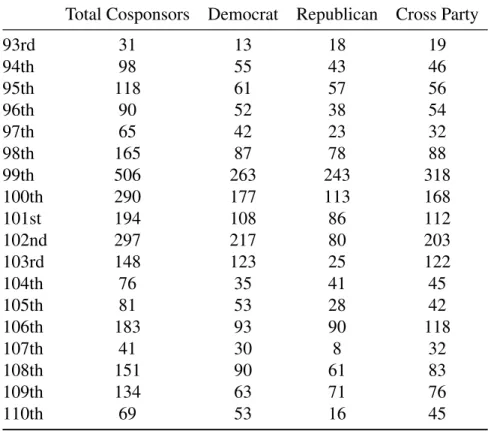
We see similar fluctuations in terms of cosponsorship behavior as well. See Table 1.1. In the Senate, from the 93rd to the 111th Congress, the total number of cosponsors on trade legislation per congress ranged from a low of 182 to a high of 811. In the House, during this same period, figures ranged from 729 to 3141. Although these figures do not cover as extensive a time period as the data on sponsorship, they hardly suggest a Congres-sional retreat from the issue area. As above, executive authority did not lead to legislative inaction.6
Table 1.1: Cosponsorships, by party
Total Cosponsors Democrat Republican Cross Party
93rd 31 13 18 19
94th 98 55 43 46
95th 118 61 57 56
96th 90 52 38 54
97th 65 42 23 32
98th 165 87 78 88
99th 506 263 243 318
100th 290 177 113 168
101st 194 108 86 112
102nd 297 217 80 203
103rd 148 123 25 122
104th 76 35 41 45
105th 81 53 28 42
106th 183 93 90 118
107th 41 30 8 32
108th 151 90 61 83
109th 134 63 71 76
110th 69 53 16 45
The table shows the number of cosponsorships on all trade regulating bills in the subject congress.
6Additionally, the rise in legislative activity starting in the mid 1970s also coincides with a greater use of
In short, although there are fluctuations over time,7 the data reveal an unquestionable upward trend in activity since the 1940s. Taken together, these data suggest that even when trade agreement negotiating authority and trade protection had increasingly become the purview of the executive, Congressional activity levels remained high. There have been fluctuations in Congressional attention to trade, to be sure, but these patterns certainly do not represent a declining interest in the issue area. In the next section, I conduct a more systematic analysis of the relationship between executive delegation and patterns of Congressional activity on trade policy.
Research Design
To consider the relationship between Congressional activity on trade policy and execu-tive delegation, I examine over a century of bill sponsorship. The period under considera-tion ranges from 1901-2013, and covers the 57th-112th Congresses.
The dependent variable in the analysis is the number of trade-related bills sponsored in each House or Senate, measured as a share of total bills introduced in the congress. To as-certain the number of trade-related bills, I relied on the ProQuest Congressional database. The database attributes “key terms” to each bill sponsored during the period under consid-eration. For each congress, I have included all bills that include terms directly related to trade policy measures.8 The dependent variable in the Senate models has a mean value of
approximately .033, and ranges from .001 to .220. In the House, the mean value for the variable is .026, and ranges from .001 to .182.9
7I explore the economic and political factors that drive these fluctuations in greater depth below.
8These criteria captured all bills that were characterized with the following: “import”; “export”; “tariff”;
”trade agreement”; ”foreign trade.”
9Sponsorship constitutes an ideal, and widely used, measure of legislative attention to trade policy. As
The independent variables in the analysis relate to the key drivers of Congressional interest in trade. The first two variables relate to the prevailing institutional setting in the congress in question. DELEGATIONis coded as 1 in a congress when the executive branch
has been granted trade negotiating authority. As noted above, the first major delegation of authority in the 20th century came with the RTAA in 1934. Although it was renewed many times subsequently, for several stretches there was a gap in this delegation (Cooper 2014). The authority lapsed during the late 1960s and first half of the 1970s, until it was renewed in 1975. This delegation lasted until 1994, ending with the conclusion of the Uruguay Round Agreement, and the creation of the WTO. For the next seven years, efforts to renew TPA were unsuccessful; key committees in Congress often voiced objections to the legislation, or, in the rare cases where TPA made it to the floor, Congress ultimately voted against the bills. In 2002, TPA was renewed once again for a period of 5 years, and President George W. Bush made trade agreement negotiation a significant portion of his legislative agenda, using the authority to negotiate a host of agreements. When this grant lapsed in 2008, it was not extended for the next seven years. At the time of this writing, a high profile debate is ongoing in Congress over the propriety of granting TPA to the Obama administration, as many legislators are concerned with the implications of greater trade with major European and Asian economies.
DIVIDED GOVT is coded as one in any instance where a single party did not control
both the presidency and the chamber under consideration. Divided government may lead to a more active Congress as legislators seek to restrain or critique the trade policy preferences of a president from the opposing party. When the president (the agent of trade policy delegation) is not sufficiently attentive to Congressional demands, we can expect greater activity from the legislature, i.e., the principal (Lohmann and O’Halloran 1994; O’Halloran 1994).
the congress in session. This variable accounts for the anticipated negative association be-tween GDP growth an attentiveness to trade policy. Trade policies – in particular, trade policies designed to support vulnerable business interests – are likely to garner more atten-tion during downswings in the business cycle (see, e.g., McKeown 1984; Gallarotti 1985). I also include TRADE SHARE, which is calculated as the proportion of the U.S. economy that is devoted to international trade. This variable, which steadily increases during the time period under consideration, controls for the likely positive association between trade’s importance to the U.S. economy and Congressional attention to the issue area. Finally, I include TRADEDEFICIT. This variable accounts for the current account as a share of GDP, as large account imbalances are often hypothesized to fuel concerns over trade policy.
Results and Discussion
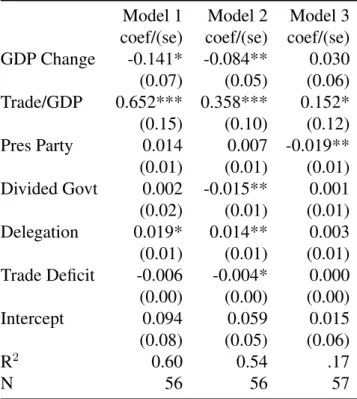
My models provide evidence consistent with my expectations. Congressional attention to trade does not decline with greater executive activity in the area, as many standard expla-nations would anticipate. In fact, Congressional attention actually increased during periods of delegation. A variety of economic factors also drove chamber-wide levels of attention to trade policy. The results are contained in Table 1.2
There is no evidence of executive participation replacing congressional activity in trade policy. In fact, the coefficient on DELEGATION is actually positive and statistically
sig-nificant in both Models 1 and 2. The coefficient is sigsig-nificant at the .10 threshold in the Senate, and at .05 in the House.10 The models demonstrate that congressional activity
increases during periods of delegation, even while controlling for a host of other key influ-ences on participation rates. This finding runs directly counter to a number of theories of principal-agent dynamics in trade policy. First, counter to the expectations of many legis-lators and commentators, legislative activity on trade policy is not simply subsumed by the
10Given that the effective N for these models is quite low, a finding of statistical significance at the .10
executive during periods of delegation. If executive empowerment was designed to reduce legislative burden, it appears to have had the opposite effect. Similarly, delegation does not appear to operate as a mechanism through which legislators can insulate themselves from the pressures of interest groups (see also Hiscox 1999; Goldstein and Gulotty 2015). After all, legislators takemorepositions (as measured by bill sponsorships) once substantial trade policy authority has been delegated.
Before turning to the other variables, it is worth exploring this counter-intuitive finding a bit more. One potential explanation for the positive relationship between DELEGATION
and sponsorship might be that Congress ramps up its activity in the wake of a legislative-executive battle surrounding delegation. In other words, because extending (or renewing) trade negotiation authority is often a highly contentious fight in U.S. trade policy, one might surmise that Congress is simply increasing its activity immediately after such an event to demonstrate a commitment to protecting domestic producers. However, in a robustness check, I included a dummy variable denoting the two Congresses following a grant of negotiating authority. Inclusion of such a term does not alter the reported results in any meaningful way. As such, the increase in Congress activity during periods of delegation is not simply a function of a brief post-delegation uptick in activity. Rather, there is a decisive positive relationship between delegation and rates of legislative activity.11
This finding is not purely a function of my primary focus on bill sponsorship. In Model 3, I used the number of trade-related Congressional hearings as the count for my dependent variable. There was no statistically significant association (in either direction) between delegation status and levels of congressional attention to trade while using this alternative measure. In an unreported model, I also experimented with another dependent variable denoting the number of trade bills enacted into law in each Congress. Again, there was
11I also ran the models while focusing exclusively on the post-war period. Doing so substantially reduced
Table 1.2: Models of Bill Sponsorship
Model 1 Model 2 Model 3 coef/(se) coef/(se) coef/(se)
GDP Change -0.141* -0.084** 0.030
(0.07) (0.05) (0.06)
Trade/GDP 0.652*** 0.358*** 0.152*
(0.15) (0.10) (0.12)
Pres Party 0.014 0.007 -0.019**
(0.01) (0.01) (0.01)
Divided Govt 0.002 -0.015** 0.001
(0.02) (0.01) (0.01)
Delegation 0.019* 0.014** 0.003
(0.01) (0.01) (0.01)
Trade Deficit -0.006 -0.004* 0.000
(0.00) (0.00) (0.00)
Intercept 0.094 0.059 0.015
(0.08) (0.05) (0.06)
R2 0.60 0.54 .17
N 56 56 57
Models 1-3 are OLS models.
* indicates significance at p<0.10; ** at p<0.05; *** at p<0.01.
no statistical relationship between delegation and bill enactments.12 Taken together, these findings undermine the “burden reduction” and “political insulation” arguments as to why Congress chooses to grant trade policy functions to the executive.
The results with respect to DIVIDED GOVT were largely consistent with explanations
about congressional-executive tension leading to increased activity on trade. In the House (Model 2), there was a positive and statistically significant relationship between divided government and bill sponsorship. This finding suggests that the propensity of Congress to voice its concerns regarding trade policy increases when the sitting president is from a different party. In the Senate model, there was no relationship, and the variable was not close to reaching statistical significance.
12As noted above, a glance at the number of trade bills enacted into law over time shows a downward
Other variables in the models generally performed as expected. GDP GROWTHhad a negative and statistically significant relationship with trade bill sponsorship (p-value<.01). Trade policy is often hypothesized to take on increase importance, and thus attract more attention, in difficult economic environments. This expectation plays out during the pe-riod under consideration, as economic growth was associated with a reduction in trade bill sponsorship rates.
TRADE SHARE also had the anticipated relationship with trade policy activity. The coefficient was positive and statistically significant at the .01 level in Models 1/2. As inter-national commerce came to represent a larger and larger share of the U.S. economy, trade policy represented a larger portion of Congressional activity.
To consider the substantive effects of my key variables, I calculated predicted proba-bilities. First, I calculate the predicted proportion of bills dedicated to trade policy, while changing the value of DELEGATION and holding all other variables at their means. The resulting change to Congressional behavior was substantial: during periods of delegated authority, the proportion of Congressional bills devoted to trade policy was nearly double that of periods where trade negotiating authority was not in place. In practice, this amounts to the proportion of trade bills increasing from 4 percent, to approximately 8 percent, of all bills introduced in a hypothetical congress.
The other variables had important substantive effects as well. A one-standard deviation increase to GDP GROWTH, for example, led to a 30 percent decline in the number of trade bills sponsored. Figure 1.3 provides a visual presentation of the effects of DELEGATION
and GDP GROWTH.
Not surprisingly, as trade became an increasingly important component of the U.S. economy, trade policy was a more common subject of Congressional bill introductions. A one standard deviation increase to TRADE SHAREled to nearly a 100 percent increase in
Figure 1.3: Proportion of Bills Devoted to Trade
Although I have focused on the Senate model for the calculations thus far, these vari-ables had comparable effects regardless of whether the predicted probability calculations are based on the Senate (Model 1) or the House (Model 2). As noted above, divided gov-ernment had a statistically significant and positive effect in the House. Accordingly, I calculated the substantive effect of this variable, based on Model 2. Divided government led to a 50 percent increase in the number of bills sponsored.
An Examination of Executive-Legislative Consultations
In the preceding analysis, the results suggest that Congressional participation in trade policy actually rose during periods when the executive was active in the issue area. An-other way to examine this same dynamic is to assess patterns of consultations between the executive branch and the legislature. To do so, I conduct a statistical analysis relying on new data covering USTR consultations with Congress.
The dependent variable is a count of the number of USTR consultations with Congress during the month under consideration. The time period runs from January 2000 to Febru-ary 2015, spanning various economic environments as well as two different presidential administrations. As above, I anticipate that when the executive branch steps up its activity in trade, it must lead to a corresponding increase in Congressional involvement. Specifi-cally, the executive (agent) must more frequently consult the legislature (principal). Given the count outcome, I run a negative binomial model for the analysis.
The model bears out my expectations, and the results are contained in Table 1.3. The key independent variable, FTA VALUE, is a proxy for the current importance of the
ex-ecutive’s trade negotiating agenda. The variable is measured as the combined GDP of all countries with which the U.S. had ongoing formal trade negotiations during the year-in-question. This variable is designed to account for both the number of ongoing negotiations, as well as the potential economic impact of the proposed agreements.
The coefficient on FTA VALUEis positive and statistically significant at the .01 thresh-old. As the trade negotiating activity of the president increased, Congress was far more involved in the process.
The performance of the other variables was largely consistent with expectations. GDP CHANGE, measuring the period-to-period change in national GDP, was negative and
liberalization during economic downturns. DIVIDED GOVTwas also negative and statisti-cally significant. This constitutes a departure from the above models, where this variable was positive. However, this result is not unexpected in this context. During periods of divided government, it may be more difficult to aggressively pursue trade agreements alto-gether, thus decreasing the overall need for inter-branch consultations.
Table 1.3: Models of USTR-Congress Consultations
Model 1 coef/(se)
FTA VALUE 0.390***
(0.04)
DIVIDEDGOVT -0.186***
(0.07)
GDP CHANGE -0.102***
(0.02)
CONG. RECESS -0.615***
(0.12)
INTERCEPT 4.075***
(0.06)
AIC 1626.78
N 182
Model 4 is a negative binomial model.
Conclusion
This chapter has demonstrated that Congress remains active in trade policy in spite of the growing role of the executive in foreign trade policy. The trade policy literature regularly treats delegation and the expansion of the executive branch trade apparatus as potential substitutes for Congressional action. Commentators also suggest that legislators strategically avoid the issue area as a matter of position avoidance or operational efficiency. In contrast to these narratives, I show that delegation has not amounted to a renunciation of legislative attention to the issue area. Importantly, these findings do not apply exclu-sively to sponsorship activity, which is often viewed largely as position taking behavior. Congress does not hold fewer trade-related hearings or enact fewer laws during periods of delegation. Additionally, executive-legislative consultations increased when the executive branch’s trade agenda was at its most ambitious; under these conditions, the USTR met more regularly with Congressional officials.
These findings are consistent with a number of recent studies that have highlighted the continued engagement of Congress in U.S. trade politics. For example, research has em-phasized that legislators remained responsive to economic constituencies in the wake of delegated authority (Goldstein and Gulotty 2015). Other research has noted that legislators are heavily involved in the policy making process even when standard indicators of leg-islative behavior would seem to suggest otherwise (see, e.g., Allee and Miler 2014; Caddel 2014).
increasingly sponsor legislation as a critique of executive action or inaction. These expla-nations receive preliminary support in light of my analysis of consultation data. Future research might usefully evaluate these explanations through a micro-level analysis of be-havior focusing on individual legislators or policy proposals. As a preliminary matter, how-ever, the consultations model demonstrates that Congressional involvement in the process constitutes more than mere “signaling.”
References
Adler, E. Scott and John Wilkerson, Congressional Bills Project: (1973-2012), NSF 00880066 and 00880061.
Arnold, R. Douglas. 1990. The Logic of Congressional Action. New Haven: Yale Univer-sity Press.
Bagwell, Kyle and Robert W. Staiger. 1995 Protection and the Business Cycle. National Bureau of Economic Research Discussion Paper No. 5168.
Bailey, Michael, and David W. Brady. 1998 Heterogeneity and Representation: The Senate and free trade. American Journal of Political Science 42(2):524-544.
Bailey, Michael A., Judith Goldstein, and Barry R. Weingast. 1997. The Institutional Roots of American Trade Policy. World Politics 49(3):309-338.
Baldwin, Robert E., and Christopher S. Magee. 2000. Congressional Trade Votes. Wash-ington, DC: Institute for International Economics.
Baldwin, Robert. 1984. “The Changing Nature of U.S. Trade Policy since World War II,” in R.E. Baldwin and A.O. Krueger (eds), The Structure and Evolution of Recent U.S. Trade Policy, Chicago: University of Chicago Press.
Baumgartner, F.R. and Jones, B.D. 1993. Agendas and Instabilities in American Politics, Chicago: University of Chicago Press.
Beaulieu, Eugene. 2002. The Stopler-Samuelson Theorem Faces Congress, Review of In-ternational Economics 10(2):33754.
Bernhard, William, and Tracy Sulkin. 2013. Commitment and Consequences: Reneging on Cosponsorship Pledges in the U.S. House. Legislative Studies Quarterly, forthcom-ing.
Broz, J. Lawrence and Michael Brewster Hawes. 2006. Congressional Politics of Financ-ing the International Monetary Fund. International Organization 60, (2): 367-399.
Caddel, Jeremy. 2014. Domestic Competition over Trade Barriers in the U.S. International Trade Commission, International Studies Quarterly, 58(2):260-268.
Conley, Richard S. 1999. Derailing Presidential Fast-Track Authority: The Impact of Con-stituency Pressures and Political Ideology on Trade Policy in Congress. Political Re-search Quarterly 52(4): 785-799.
—. 1998. Constituencies, Congress, and US Trade Policy, in Alan V. Deardorff and Robert M. Stern, Constituent Interests and U.S. Trade Policies (University of Michigan Press, pp. 93-108.
Dutt, P., and Mitra, D. 2005. Political Ideology and Endogenous Trade Policy: An Empiri-cal Investigation. Review of Economics and Statistics 87 (1). 59-72.
Ehrlich, S.D. 2007. Access to Protection: Domestic Institutions and Trade Policy in Democracies. International Organization 61 (3), 571-605.
Epstein, D., and O’Halloran, S. 1996. The Partisan Paradox and the U.S. Tariff, 1877-1934. International Organization 50 (2), 301-324.
Fenno, Richard F., Jr. 1973. Congressmen in Committees. Boston: Little, Brown.
Fiorina, Morris. 1974. Representatives, Roll Calls, and Constituencies. Lexington, MA: D.C. Heath.
Fordham, Benjamin O., and Timothy J. McKeown. 2003. Selection and Influence: Interest Groups and Congressional Voting on Trade Policy. International Organization 57(3): 519-549.
Fordham, Benjamin O. 2008. Economic interests, party, and ideology in early cold war era U.S. foreign policy. International Organization 52(2):359-395.
Galantucci, Robert. 2014. The Repercussions of Realignment: United States-China Inter-dependence and Exchange Rate Politics. International Studies Quarterly, forthcoming.
Gallarotti, Giulio M. 1985. Toward a Business-Cycle Model of Tariffs. International Orga-nization 39(1):155-187.
Gilligan, Michael. 1997. Empowering Exporters: Reciprocity, Delegation, and Collective Action in American Trade Policy. Ann Arbor: University of Michigan Press.
Gartzke, Erik, and J. Mark Wrighton. 1998. Thinking Globally or Acting Locally? Deter-minants of the GATT Vote in Congress. Legislative Studies Quarterly 23 (1): 33-55.
Goldstein, Judith, and Robert Gulotty. Forthcoming. America and Trade Liberalization: The Limits of Institutional Reform (with Gulotty) International Organization.
Grossman, Gene M., and Elhanan Helpman. 1994. Protection for Sale. American Eco-nomic Review 84(4):833-850.
Hainmueller, Jens, and Michael J. Hiscox. 2006. Learning to Love Globalization: Edu-cation and Individual Attitudes Toward International Trade. International Organization 60(2):469-498.
Hall, Richard L. 1996. Participation in Congress. New Haven, CT: Yale University Press.
Harbridge, Laurel. 2009. Bipartisanship in a Polarized Congress. Stanford University.
Hiscox, Michael J. 2002a. International Trade and Political Conflict. Princeton: Princeton University Press.
—. 2002b. Interindustry Factor Mobility and Technological Change: Evidence on Wage and Profit Dispersion across U.S. Industries, 1820 and 1990, Journal of Economic His-tory, 62(2): 383-416.
—. 1999, The Magic Bullet? The RTAA, Institutional Reform, and Trade Liberalization, International Organization, 53(4): 669-98.
Hertherington, M. J. 2001. Resurgent Mass Partisanship: The Role of Elite Polarization. American Political Science Review 95(3):619-31.
Howell, William G., and Jon C. Pevehouse. 2007. Congressional checks on presidential war powers. Princeton, NJ: Princeton University Press.
Irwin, Douglas A. 2005. The Rise of U.S. Antidumping Activity in Historical Perspective, The World Economy 28: 651-668.
Karol, David. 2007. Does constituency size affect elected officials’ trade policy prefer-ences? Journal of Politics 69(2):483-494.
Kessler, Daniel, and Keith Krehbiel. 1996. Dynamics of cosponsorship. American Politi-cal Science Review 90(3):555-566.
Knetter, Michael and Thomas Prusa. 2000. Macroeconomic Factors and Anti-Dumping Filings: Evidence from Four Countries. National Bureau of Economic Research Dis-cussion Paper No. 8010.
Studies Quarterly 28: 225-46 .
Lewis, Finlay. 2009. “Tariffs Spur New Look At Congress’ Trade Duties.” CQ Weekly (December 28): 2932-33.
Lindsay, James M. 1994. Congress and the Politics of U.S. Foreign Policy. Baltimore, MD: The Johns Hopkins University Press.
—. 1992-1993. Congress and foreign policy: Why the hill matters. Political Science Quar-terly 107(4):607-628.
Lohmann, Susanne, and Sharyn O’Halloran. 1994. Divided Government and U.S. Trade Policy: Theory and Evidence. International Organization 48(4):595-632.
Magee, Stephen P. and William A. Brock and Leslie Young. 1989. Black hole tariffs and endogenous policy theory: Political economy in general equilibrium. Cambridge: Cambridge University Press.
Mansfield, E.D., and Busch, M.L. 1995. The Political Economy of Nontariff Barriers: A Cross-National Analysis. International Organization 49 (4), 723-749.
Mansfield, Edward D., and Mutz, Diana C. 2009. Support for Free Trade: Self-Interest, So-ciotropic Politics, and Out-Group Anxiety. International Organization 63(3):425-457.
Mayda, A.M., and Rodrik, D. 2005. Why are Some People (and Countries) More Protec-tionist than Others? European Economic Review 49 (6), 1393-1430.
Mayhew, David. 1974. Congress: The electoral connection. New Haven, CT: Yale Univer-sity Press.
McKeown, Timothy J. 1984. Firms and Regime Change: Explaining the Demand for Pro-tection. World Politics 36(2):215-233.
Milner, H.V., and Judkins, B. 2004. Partisanship, Trade Policy, and Globalization: Is There a LeftRight Divide on Trade Policy? International Studies Quarterly 48 (1), 95-120.
Milner, Helen V. and B. Peter Rosendorff. 1997. Democratic Politics and International Trade Negotiations: Elections and Divided Government as Constraints on Trade Liber-alization. Journal of Conflict Resolution vol.41 no.1 (February 1997): 117-146.
Nollen, Stanley D., and Dennis P. Quinn. 1994. Free Trade, fair trade, strategic trade, and protectionism in the U.S. Congress, 1987-88. International Organization 48 (3): 491-525.
Oatley, Thomas. 2010. Real Exchange Rates and Trade Protectionism. Business and Poli-tics 12(2):1-17.
O’Halloran, Sharyn. 1994. Politics, Process and American Trade Policy. Ann Arbor: Uni-versity of Michigan Press.
O’Rourke, K.H., and Sinnott, R. 2002. The Determinants of Individual Trade Policy Pref-erences: International Survey Evidence. In S.M. Collins D. Rodrik (eds.) Brookings Trade Forum. Washington, DC: Brookings Institution, pp. 157-206.
Pastor, Robert. 1980. Congress and the Politics of U.S. Foreign Economic Policy, 19291976, Berkeley: University of California Press.
Roberts, Jason M. 2007. The Statistical Analysis of Roll-Call Data: A Cautionary Tale. Legislative Studies Quarterly XXXII (3):341-60.
Rogowski, Ronald. 1987. Trade and the Variety of Democratic Institutions. International Organization 41(2):203-223.
—. 1989. Commerce and Coalitions: How Trade Affects Domestic Political Alignments. Princeton, NJ: Princeton University Press.
Rocco, Michael S. and Stacy B. Gordon. 2010. The Position-Taking Value of Bill Spon-sorship in Congress. Political Research Quarterly 63(2):387-397.
Schiller, Wendy J. 2006. Building careers and courting constituents: U.S. Senate represen-tation 1889-1924. Studies in American Political Development 20(2):185-97.
—. 2000. Partners and Rivals: Representation in U.S. Senate Delegations. Princeton, NJ: Princeton University Press.
—. 1995. Senators as Political Entrepreneurs: Using Bill Sponsorship to Shape Legislative Agendas. American Journal of Political Science 39: 186-203.
Schwab, Susan C. 1993. The omnibus trade and competitiveness act of 1988: the end of an era in U.S. trade policy? Ph.D. diss., George Washington University.
Simmons, B.A. 1994. Who Adjusts?: Domestic Sources of Foreign Economic Policy Dur-ing the Interwar Years. Princeton, NJ: Princeton University Press.
Sulkin, Tracy. 2011. The Legislative Legacy of Congressional Campaigns. New York: Cambridge University Press.
—. 2005. Issue Politics in Congress. New York: Cambridge University Press.
Strahan, Randall. 1990. New Ways and Means: Reform and Change in a Congressional Committee. University of North Carolina Press.
Sussman, Glen and Byron W. Daynes. 1995. The Impact of Political Ideology on Con-gressional Support for Presidential Policy Making Authority: The Case of Fast-Track. Congress and the Presidency 22: 141-153.
Talbert, Jeffery C., and Matthew Potoski. 2002. Setting the legislative agenda: The dimen-sional structure of bill cosponsoring and floor voting. Journal of Politics 64(3):864-891.
Taylor, A. B., West, S. G., and Aiken, L. S. 2006. “Loss of power in logistic, ordinal logistic, and probit regression when an outcome variable is coarsely categorized,” Edu-cational and Psychological Measurement, 66:228-239.
Tosini, S. C., and Edward Tower. 1987. The Textile Bill of 1985: The determinants of congressional voting patterns. Public Choice 54(1):19-25.
Western, Bruce and Simon Jackman. 1994. “Bayesian Inference for Comparative Re-search,” American Political Science Review 88(2):412-423.
Wilson, Rick K., and Cheryl D. Young. 1997. Cosponsorship in the U.S. Congress. Leg-islative Studies Quarterly 12(1):25-43.
Woon, Jonathan. 2009. Issue Attention and Legislative Proposals in the U.S. Senate. Leg-islative Studies Quarterly 34:2954.
Daily Globe. “Trade a Chaos,” Boston Daily Globe, Sept. 28, 1890.
Cooper, William. 2014. Trade Promotion Authority (TPA) and the Role of Congress in Trade Policy. Congressional Research Service Report.
Jones, Vivian. 2012. Miscellaneous Tariff Bills: Overview and Issues for Congress. Con-gressional Research Service Report.
Brandon Rottinghaus and Elvin Lim. 2009. “Proclaiming Trade Policy: Presidential Uni-lateral Enactment of Trade Policy.” American Politics Research 37 (6): 1003-1023.
U.S. Congress, House Committee on Ways and Means. 1934. Trade Agreements Act: Hearings, 73rd Congress, 2d sess., pp. 5-6.
Smith, Jane M., Daniel T. Shedd, and Brandon J. Murrill. 2013. Why Certain Trade Agree-ments Are Approved as Congressional-Executive AgreeAgree-ments Rather Than Treaties. Congressional Research Service.
2 STILL FOLLOWING THE LEADERS: INSTITUTIONAL POWER & EFFECTIVENESS IN TRADE POLICYMAKING
Several key developments in the 1970s are largely credited with upsetting the traditional power structure of Congressional trade politics. As tariff rates dropped and trade policy be-came increasingly concerned with non-tariff barriers to trade, the underlying jurisdictional claim of Ways and Means was undermined. The committee originally derived its trade pol-icy authority as a function of its responsibility for revenue bills, which includes most tariff legislation. However, modern trade policy began to implicate a far wider set of policy areas and congressional committees. These other committees began making a play for much of the jurisdiction of Ways and Means, and in many cases the inter-committee conflict was acute (Destler 1995; Gibson 2000; Nivola 1993). Taken together, these changes led many commentators to conclude that “trade policy had become less ‘controllable’ in Congress” (Nelson 2007; see also Destler 1995). No longer, they observed, could a small number of dominant legislators control trade policy outcomes by virtue of their positions and status within the institution.
In this chapter, I argue that there is substantial continuity in Congressional leadership on trade. Although the unrivaled power of the old guard of trade policymakers was challenged in the 1970s, much of the earlier power structure remains in place. First, I argue that key power brokers – such as committee members/chairs, party leaders and legislators with seniority – are still overwhelming likely to be the most effective legislators within the trade policy arena. Second, I emphasize that in many cases members of Congress simply saw their means of influence change. In particular, Congressional leaders often retained close supervisory roles over trade regulation, even where their ability to dominate the lawmaking process was challenged.
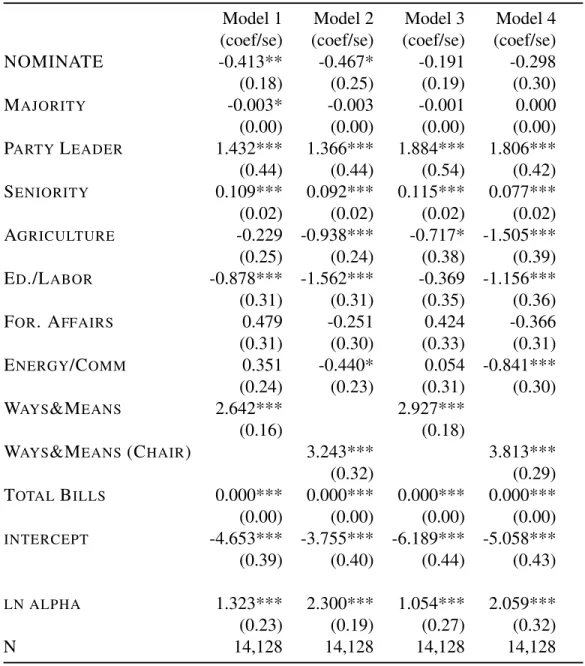
success. Legislators in these positions were more likely to see their bills reported out of committee and passed into law; they were also more likely to garner support from their colleagues on their policy proposals. Other institutional considerations, such as serving in party leadership positions or being a member of the majority party, also proved to be determinative of legislative success. Importantly, these factors were powerful predictors of legislative effectiveness in both the pre and post-reform era.
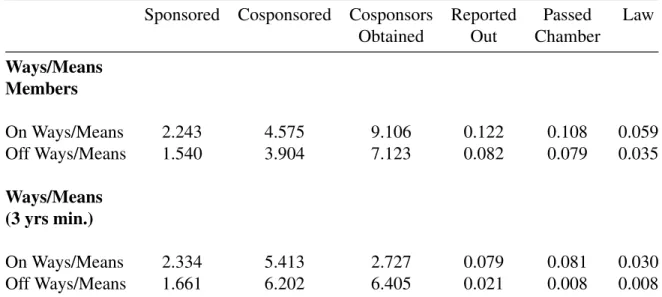
Additionally, beyond introducing and seeking passage of legislation, there are a host of formal and informal roles that key legislators can play in the policymaking process. Mem-bers of Ways and Means, for example, are far more likely to be involved and influential in representing constituents’ interests in consultations with the executive and administrative/quasi-judicial venues.
These findings demonstrate that legislators can have vastly different roles throughout the various stages of the legislation process. To the author’s knowledge, this is the only effort to provide a quantitative and systematic examination of legislative leadership in trade policy across an extended period of time.
This chapter proceeds as follows. In the next section, I briefly discuss the existing literature on legislators’ participation in the trade policymaking process, and describe the limitations associated with these research designs. In the following section, I explain how a more comprehensive treatment of the legislative process can allow us to better identify legislative effectiveness in the issue area; in this section, I also lay out my primary hypothe-ses. In the following section, I describe my research design and data. Finally, I turn to a discussion of the results and conclude.
Congressional Leadership on Trade Policy
In the pre-reform committee system, a series of powerful Ways and Means chairs essen-tially preempted any efforts at trade policymaking that did not meet their approval. Wilbur Mills, who chaired the committee from 1958 to 1974 was so powerful, for example, that other members complained that being on the committee was like being “on the tail of Mills’ comet” (quoted in Pastor 1980: 151). He maintain such centralized control that other com-mittee members often knew little about proposed pieces of legislation and did not even have the means to acquire the information (Pastor 1980: 155). Although Mills was noto-rious for his tight grip on trade policy, a similar description could be applied to previous chairs of Ways and Means (and Finance in the Senate). The clout of these legislators was enshrined in the titles of many general tariff bills in the late 1800s and early 1900s. The Payne-Aldrich Tariff of 1908, Underwood-Simmons Tariff of 1913 and the Fordney Mc-Cumber Act of 1922, for example, bore the name of the chairs of the Ways and Means and Finance committees (Eckes 1995: 104). Even earlier pieces of tariff legislation contained the name of the Ways and Means chair (see, e.g., the “Morrill,” “Dingley,” “McKinley” tariffs).
As trade policy became less about tariffs, and more about the wide variety of non-tariff barriers to trade, the underlying jurisdictional claim of Ways and Means was undermined. The committee originally derived its trade policy authority as a function of its chief respon-sibility for revenue bills – which includes most tariff legislation. But as tariff rates dropped and non-tariff barriers to trade expanded, trade legislation began to implicate a wider set of congressional committees.1 One commentator described the changes,
Now the cast of characters and the agendas they were trying to advance were becoming longer because of the new, more complicated policy requirements and because of increased staff support and opportunities for political aggran-dizement. Participation spread to include the House Energy and Commerce Committee (domestic content, certification standards), the House Foreign Af-fairs and Senate Foreign Relations committees (foreign loans, exports con-trols), the Judiciary committees (antitrust reciprocity), the banking committees
1Additionally, during the post-war period, international institutions increasingly limited the extent to
(financial services, foreign investment, the Export-Imports Bank), the agricul-ture committees (farm trade), the armed services committees (procurements codes), and so forth. (Nivola 1993).
In short, other committees started to encroach on the jurisdiction of Ways and Means (Destler 1995; Gibson 2000). These developments would serve to challenge the power of members serving on key committees, and more generally undermined the prerogatives of senior legislators.
Although several scholars have highlighted the potential implications of such major changes for trade policymaking, the existing literature has done little to systematically ex-amine these effects. Nor has there been any systematic efforts to identify the most powerful legislators in the policy area. Studies of legislative behavior on trade policy typically exam-ine how a host of member and constituency-level characteristics drive thedirectionof trade preferences. For example, these studies examine the ways in which trade policy behavior is influenced by state economic profiles (Krehbiel 1993; Bailey, Goldstein and Weingast 1997; Gilligan 1997; Rogowski 1987; Busch and Reinhardt 1999; Pincus 1975; Coughlin 1985; Allen and Hopkins 1997; Tosini and Tower 1987), the role of PAC contributions and interest group activity (Grossman and Helpman 1994; Hall and Deardorff 2006; Gawande and Bandyopadhyay 2000; Gawande and Hoekman 2006), and ideology and partisanship (Nollen and Quin 1994; Whalen and Whalen 1990; Baldwin 1984). These considerations are critical to identifying legislators’ posture on trade liberalization, but do not provide much insight into legislative effectiveness.
Among these 15 legislators were 7 hardline free traders, while 8 regularly voted for in-tervention in the economy. Despite having relatively consistent voting records on trade, however, these legislators were not among the most active or effective in terms of initiating legislation. In fact, they introduced fewer bills than their less hardline colleagues, and their bills were no more likely to make it out of committee or into law.2 In short, even legislators
who are consistent in terms of their support for particular trade policies are not necessarily better at obtaining favorable policies.
The trade policy literature has done little to explore legislative leadership or effective-ness in the issue area. And, because of an empirical focus on roll call voting, it is not currently well-positioned to do so. In the sections that follow, I present a number of hy-potheses regarding legislative effectiveness, and propose various empirical strategies for examining these expectations.
Legislative Effectiveness in the Trade Policy Process
There is wide variation across legislators in terms of their ability to see their bills re-ported out of committee, passed in the chamber and signed into law. Holding a number of key positions within Congress can increase their likelihood of success.
Membership on committees of jurisdiction can make legislators effective sponsors for a number of reasons. Legislators on these committees have additional information on policy proposals, and their exposure to the issues gives them a greater level of expertise in the policy area under consideration (Krehbiel 1991). Importantly, these legislators are also able to participate in hearings, where industry and government experts offer testimony to identify the interests at stake. They also see the various markups of a bill to identify how legislation has progressed, and are present for the committee or subcommittee debate on legislation (see generally, Hall 1987, 1996; Evans 1991; Fenno 1973 for discussions of
2The same is true when examining legislators’ pro-business rankings, based on the numerical score
congressional committee membership and participation in constructing legislation).3 These opportunities reduce costs associated with participation, and increase their comparative effectiveness in the area (e.g., Evans 1991; Hall 1996; Allee and Miler 2013).4
Legislators regularly stress the importance of obtaining allies on key committees if proposed legislation is to have any chance of success. Like any legislation, most trade bills never make it out of committee. To overcome this hurdle, sponsors of trade bills actively seek out the support of members of Ways and Means. In fact, in many cases where MCs are unsuccessful in obtaining the support of key committee members, potential bills may not be proposed in the first instance.
Archival materials from several legislative offices reveal the importance of such con-siderations. For example, during an effort to introduce a bill to amend the Trade Act’s an-tidumping provisions, one legislative aide asserted “The bill is drafted, and we are presently attempting to obtain cosponsors. Our objective is to introduce it with as many from the [Ways and Means Committee] as we can get.” In another instance, an aide advised his legislator that he was unable to amass sufficient support from committee members, and “without their [the committee’s] blessing, no real point in even offering it on the floor.”5 Given the demonstrated importance of these committee members to the legislative process, I anticipate that they will be the most effective sponsors of trade legislation.6
Although legislative reform presented some challenges to key players on Ways and
3The importance of getting key committee members on board is, of course, not lost on interest groups
as well. Frequently, they target committee members with communications and political contributions. This includes targeting members of the committee in general, with a special emphasis on committee/subcommittee chairs and ranking members (Grier and Munger 1986, 1991; Gwande and Hoeckman 2006).
4There are also a host of expectations associated with serving on Ways and Means. As Destler (1998:
98) notes, members of Ways and Means have a greater interest, and additional pressure, to legislate on trade-related issues when compared to non-committee members in the chamber (see also Destler 2005).
5Documents on file with author.
6Researchers have relied on various measures of relative legislative “success” (see, e.g., Matthews 1960;