Alexander Kolding Borum
May, 2017
A
ddressing Challenges to United Na�ons Peacekeeping
Opera�ons Through the Involvement of Private Military
Security Companies
© Alexander Kolding Borum
All rights reserved. No part of this report may be reproduced and/or published in any form by print, photo print, microfilm or any other means without prior written permission from the author. All images are subject to the licenses of their respective owners.
Cover photo: Senegalese UNPOL Officers patrol the streets of Gao, 1200 KM North of Bamako, Mali. Photo MINUSMA/Marco Dormino
Cover design by Nadja Elnef
Adv. MSc. Thesis
International Relations and Diplomacy
By Alexander Kolding Borum
S1690280
Leiden UniversitySupervised by Peter van Ham
Netherlands Institute of International Relations Clingendael
May 22, 2017
1
0.1 Abstract
Being met with immense operational challenges and lack-lustre commitments from
developed nations, UN peacekeeping operations struggle to fulfil the high
expectations pushed upon it from a global populace seeking human security. This
study addresses such challenges by suggesting a controversial venue for bridging
security gaps and enabling more efficient peacekeeping operations, namely the
private security industry. Through a wider historical context and a review of its
contemporary usage, this study argues that the private sector does indeed hold the
ability to off-set many of the operational challenges present in 21st century
peacekeeping, and while not the ideal solution, it is a viable one. The study argues that
by adhering to external guidelines on best-practices and enforcing such self-regulatory
mindsets on the industry, then they, in conjunction with organisational oversight
mechanisms and leadership, will be able to step in, where the system falls short.
2
0.2 Preface
My interest in the private security industry has, to a large extent, been ingrained in me
for the last seven years. Ever since my deployment to Helmand, Afghanistan as part of
the Danish ISAF commitments where I, for the first time, encountered and worked
alongside PMSCs. Through these experiences, I have grown increasingly interested in
explaining what I initially believed to be an anomaly in contemporary security, but that
I by now, have gained a more comprehensive understanding and justification for. The
private security sector has thus become a recurring topic in my academic career,
addressed from various angles and perspectives, and at this time it has become an
interesting tool to be used in addressing other another passionate topic of mine,
namely Human Security.
Naturally the process of working on this extensive study has been arduous as limited
time and great ambitions have paved the way for ever-increasing stress levels. Luckily,
I have benefited greatly from a vast support structure who in each their own way has
cheered me on, offered guidance or simply provided solid intellectual sparring during
the process. As such I would like to thank my supervisor Peter van Ham (The
Clingendael Institute) for enabling me to have such a high level of ownership and
independence under his, at times quite critical, guidance. Ragnhild Drange (Faculty of
Governance and Global Affairs) for always having time for a coffee and a motivational
talk. Stef Wittendorp (Institute of Security and Global Affairs) for confirming that my
hunches on the changes in UN discourse was indeed significant and in turn, how I
should address this topic. Nadja Elnef for letting me exploit her vast design skills. My
parents, Annelise Borum and Jørgen Kolding, who has always supported me in my, at
times risky, endeavours. My siblings, Rebekka, Asger, Kristoffer and William who have
always had my back. My thesis study-buddies Carl Tobias Reichert and Nicholas Welsh
who have always been good for academic sparring and occasional procrastination. The
KV Foundation in Denmark who has supported my academic efforts here at Leiden
University and lastly friends from across the world who have cheered me on from the
side-line. Without your combined efforts, I am sure this project would not have been
3
0.3 Table of Content
0.1 Abstract ... 1
0.2 Preface ... 2
0.3 Table of Content ... 3
0.3.1 List of Figures ... 4
1. Introduction ... 5
1.1 Research Problem ... 7
1.2 Research Design ... 8
1.3 Theoretical Framework ... 11
1.3.a Outsourcing of security ... 11
1.3.b Shifting UN views on PMSCs ... 13
1.3.c The Problem of PMSCs ... 13
1.3.d PMSCs as Force Multipliers ... 15
2. Historical Context... 16
2.1 A Mercenary Culture ... 16
2.2 United Nations, A Fledgling Security Provider ... 18
2.3 Analysis ... 24
3. Changes in UN stance ... 25
3.1 Shifting United Nations Views ... 26
3.1.1 Key takeaways from WGM Reports 1995-2015 ... 27
3.1.2 Summary findings of WGM Reports ... 30
3.2 United Nations, Subcontracting and PMC usage ... 31
3.2.1 United Nations & the role of Contractors ... 34
3.2.1.a Force Protection ... 34
3.2.1.b Combat Support, Combat Service Support and Consultancy ... 36
3.3 Analysis ... 38
4. Challenges, UN Operations and PMC Potential ... 39
4.1 Obstacles for United Nations Peacekeeping Operations ... 42
4.1.1 Challenges... 44
4.1.1.a Rapid Response Capabilities ... 45
4.1.1.b Personnel Capacities & Operational Support ... 46
4.1.1.c Material Requirements ... 47
4.2 What can the private sector offer ... 48
4.2.1 Interim PMC Peacekeepers ... 49
4.2.1.a The Case of Executive Outcomes ... 49
4.2.1.a.1 Angola ... 52
4.2.1.a.2 Sierra Leone ... 53
4.2.1.a.3 The End of Executive Outcomes ... 55
4.2.2 PMCs as a Supplement to Peacekeepers ... 55
4.2.2.a The Case of Military Professional Resources Incorporated ... 57
4.2.2.a.1 Former Yugoslav Republics ... 58
4.2.2.a.2 Beyond the Yugoslav Wars ... 60
4
5. The Problem of PMSCs ... 65
5.1 The Blackwater Incident ...65
5.2 The Abu Ghraib Scandal ...66
5.3 Further cases of PMC abuse ...67
5.4 Misc. Peacekeeper cases...68
5.5 Analysis ...69
6. Results ... 72
7. Conclusion ... 73
Bibliography ... 75
Appendices ... 84
Appendix I – Categorizations & Concepts in WGM Reports on mercenary activities ...84
Appendix II – Overview of UN Procurements, data-mined totals ...88
Appendix III – Overview of DOD Contractors Q3-08 to Q2-17 ...89
0.3.1 List of Figures
Figure 1 - Top 10 TCCs 2000-2017 (IPI, 2017) ... 20Figure 2 - Global TCC Overview (IPI, 2017) ... 21
Figure 3 - Global Support for Military Defence (WIN/Gallup, 2015) ... 23
Figure 4 - UN Expenditures, security services, 2000-2015 (UNOPS, 2000-2015) ... 32
Figure 5 - UN personnel commitments, 2000-2015 ... 33
Figure 6 – DOD Contractors in IQ, AF, 2008-2017 (U.S CENTCOM, 2008-2017) ... 41
Figure 7 - UN Operational Fatalities, 1949-2015 (UNDPKO, 2017) ... 43
Figure 8 - Overview of conflict occurrences 1990-2015 (Croicu & Sundberg, 2015) ... 44
Figure 9 - Corporate holdings, SRC/BHG, (Pech, 1999) (Singer, 2007) ... 51
Figure 10 - Model of Combat Balance Theory (Fitzsimmons, 2013) ... 64
Figure 11 - Timeline of Sexual Abuse cases pr. year (Cohen & Nordås, 2014) ... 69
5
1.
Introduction
During the 1998 Ditchley Foundation Lecture, Secretary-General of the United
Nations; Kofi Annan stated
“…Some have even suggested that private security firms, like the one which
recently helped restore the elected President to power in Sierra Leone, might play a role in providing the United Nations with the rapid reaction capacity it needs. When we had need of skilled soldiers to separate fighters from refugees in the Rwandan refugee camps in Goma, I even considered the possibility of engaging a private firm. But the world may not be ready to privatize peace.”
(UNDPI, 1998)
The world, in 1998, might have not been ready to privatize peace, but much has
changed in the nineteen passing years since Kofi Annan contemplated the potential
that he saw in the involvement of the private military company Executive Outcomes,
in Sierra Leone during the mid-nineties. In contemporary conflicts, we have seen the
private sector establish itself as an indispensable partner for conventional military
forces, to whom it provides a vast array of security related services. With this
widespread involvement, it has only become natural to consider the validity of
large-scale integrations of private contractors into UN peacekeeping operations, to off-set
some of the key challenges that 21st century peacekeeping is plagued by. This notion
has become the overarching theme for this study as it establishes a utilitarian
argument stating that the privatization of peace might not be the best available
solution, but rather a viable solution that, while being a lesser evil, would stay off an
even greater evil; doing nothing at all.
This study initially provides a historical context for how ingrained the private security
industry has been in western history, displaying how the ebb and flow of nationalism
in Europe coincides with the disappearance of the historical mercenaries and the
emergence of the modern private military security companies. At the same time the
historical context uncovers that growing expectations of the UN as a security provider,
along with increasingly hard conflict environments are exacerbated by asymmetric
6
with the ongoing crisis of nationalism in the developed world, where the general
populace is unwilling to fight and to support military endeavours. With an
understanding of where the general challenges stem from and how the private sector
fits into the wider security context, this study reveal interesting developments in UN
organizational discourse and more importantly, in its actions. through a time-based
study and through data-mining official UN procurement reports, this study establishes
an increasing openness towards private sector inclusion in security related roles
through UN reports on this topic, and further through data-mining we can establish
that the UN is already reliant on private security contractors to maintain its operations.
Such results pave the way for a study of the key operational challenges we find to UN
peacekeeping, and in turn uncover how the private sector has already proven
track-records in fulfilling such specific security gaps. Naturally, as the title alludes, this study
does acknowledge that the private sector is indeed not the most optimal solution, as
further commitments from western powers would be preferable. This notion is
partially tied to the many problems that have been experienced with private
contractors in past conflicts. Such concerns are investigated and briefly compared to
similar cases involving peacekeeping forces, before addressing how such concerns can
be alleviated and minimized.
This overall approach is unique in the sense that addresses several critiques of
contemporary literature on the topic of private security, notably by avoiding a US/UK
centric focus, investigating outsourcing beyond the state, and not focusing entirely
specific aspects such as the regulation, control and accountability of contractors (van
Meegdenburg, 2015). Instead this study is intended to provide a holistic approach to
an unconventional and complex topic, addressing multiple important facets in a
7
1.1 Research Problem
As the introduction alludes, then this study will seek to prescribe the use of
non-conventional forces as a potential solution for several operational challenges present
in 21st century peacekeeping operations. Conventional solutions have so far proven
unviable due to a general lack of political will to ensure that contemporary
peacekeeping operations has access to the full range of personnel and material that it
needs. As such this thesis will present an unconventional solution in the form of a
utilitarian argument for outsourcing efforts in UN interventions. This central argument
can be defined under an overarching research question:
RQ Under what conditions, and to what extent can the integration of Private
Military Security Companies into a United Nations peacekeeping framework
provide a viable solution to key operational challenges, notably regarding
capacity building and the rapid-response difficulties that the contemporary
operational structures suffers from?
To better address such a complex question, four distinct arguments form the
hypothetical framework in an effort to segment the research question into more
approachable sub-topics.
HP1 Progressive changes in the rhetoric’s and actions of the United Nations is a
positive indicator for a systemic shift towards the possibility of employing and
deploying private security contractors in United Nations peacekeeping
operations
HP2 The inclusion of Private Military Security Companies in the operational
frameworks for United Nations peacekeeping can facilitate clear-cut rapid
response capabilities.
HP3 Private Military Security Companies would be able to fill key capacity gaps in
United Nations Peacekeeping operations.
HP4 Key concerns for private sector inclusion can be off-set by adhering to strict
oversight mechanisms, comprehensive codes of conduct and international
standards for best practices in a transparent and regulated contractual
8
1.2 Research Design
The scope of, and approach towards, the overarching research question would
indicate a prescriptive research framework, supported heavily by descriptive and
explanatory means to firmly provide the necessary information to fully encompass the
vast and complex nature of the topic, and provide an explanation of how
developments related to private sector inclusion has come to pass.
The thesis itself is based around four core discussions. The first outlines the historical
context for mercenary culture in western history and the role of the UN as a security
provider until contemporary history. This is followed by discussion and analysis of how
the UN has changed not only its rhetoric, but also its actions when it comes to
outsourcing security to the private security industry. A natural follow-up to this
discussion comes in the form of a utilitarian study of the challenges facing the UN that
would warrant private sector inclusion, and in turn, what potential the private sector
has when it comes to fulfilling security gaps for the UN. Lastly, the thesis addresses
numerous concerns over what implications the privatization of warfare and
peacekeeping might have with an overview and discussion of key scandals entailing
private actors in recent conflicts, and as a comparable measure, discusses similar cases
related to UN peacekeeping forces. Furthermore, this chapter will also discuss
appropriate developments in terms of ensuring that such events will not take place in
the form of basic regulatory approaches. Each discussion will, for the sake of continuity
and interrelated topics, contain short sub-analyses focused on answering the
hypothetical framework in the form of the specific central agreements illustrated
earlier.
The overall method of addressing these topics has been a qualitatively driven yet
quantitatively supported approach, but as the quantitative date has been approached
primarily using methods tied to data visualisation rather than quantitative modelling
then, despite the proximity, it cannot be truly claimed to be mixed methods. In this
setting, qualitative research is in this context defined as an interpretive research
toolset that attempts to capture a holistic overview of social phenomenon (Creswell,
2003). Comparatively, quantitative research is defined as a statistical research method
where patterns can be distinguished through interpretation of large-sum data
9
known, is a simplified approach to quantitative research where, in lieu of complex
modelling, quantitative data is simply used to facilitate easily accessible overviews
through visual means (Mann, 2012).
The overarching research design of this study is, at its core, a case study focusing on
private sector inclusion into UN Peacekeeping operations, with supportive external
case studies of outsourcing in conventional conflicts. Robert K. Yin explains
case-studies as an inquiry of an empirical nature, seeking to address a contemporary
phenomenon within a wider real-life context, often in cases where the interlinks
between phenomenon and context are not entirely obvious and where multiple
sources or layers of evidence are used (Yin, 2009). Due to the scope and scale of this
case, it has been divided into the four central discussions mentioned earlier,
addressing key facets of an otherwise complicated topic in a segmented manner. This
approach of dividing the overarching topic into smaller individual segments has the
added benefit of enabling a much clearer research approach to dealing with the
diverse range of hypotheticals in an empirical manner, using tailored theoretical
approaches to help uncover motivations, contexts or patterns that an observatory
study would unable to discern. This approach can be regarded as a multiple-case
design, as inclusiveness towards complimentary, countering or supplementary cases
beyond our primary case increases the validity and robustness of the overall study
(Zainal, 2007). This approach also addresses a key concern about single-case studies
lacking in soundness due to the issues of reproducing results and to the narrow
research focus. To off-set this, a multi-case study has been chosen, as important data
regarding PMSC inclusion is found outside of the UN paradigm that constitutes the
primary case study (Yin, 2009).
To a large extent this study is focused around compiling data from contemporary
sources through reviews of the extensive literature on the overall topic of PMSCs. This
topic as an academic field can still be considered to have a fledgling status, as discourse
on the topic is relatively new, and has taken years to gain its contemporary
momentum. Early studies conducted by Herbert Howe and Kevin O’Brien, focusing on
mercenary activates in Sub-Saharan Africa, paved the way for academic and
professional approaches to an ever-expanding field, as outsourcing of war has become
10
In contemporary times, notably in the post-war on terror era, important scholars in
the field of private security and their role in contemporary security such as Peter W.
Singer, Christopher Kinsey and David Isenberg have all cemented their positions as
leading scholars on the field by providing exhaustive and highly-respected studies of
the contemporary iteration of mercenary culture, inclusive of the wider historical
context of mercenary activities. (Singer, 2007) (Kinsey, 2006) (Isenberg, 2008). More
specialized studies have naturally also been carried out, such as Scott Fitzsimmons and
Molly Dunigan’s research onto the theoretical and technical value of private sector inclusion vis-à-vis overall military effectiveness in complex public-private partnerships
(Dunigan, 2011). Others, such as Rita Abrahamsen and Michael C. Williams, have
instead focused on establishing well-rounded analytical frameworks of the industry’s
impact on international relations theory perspectives and its impacts on globalization
and on notions of sovereignty; balance of power; and state functions (Abrahamsen &
Williams, 2010). Naturally, considering the controversial nature of PMSCs, the field
also retains several highly critical scholars such as Deborah Avant and Åse G. Østensen
who argue against any notion of integration into peacekeeping frameworks. Such
critique, while valid, does share characteristics with similar concerns over
conventional peacekeeping forces, a fact that this study seeks to address to gain a
more coherent perspective of the practical effects than a more focused study would
reveal (Avant, 2005) (Østensen, 2011).
While a qualitatively driven approach is central to this study, namely in the form of a
vast review of applicable literature, supportive measures have been taken to add
further depth to the study. Critical discourse analysis has been conducted, reviewing
official UN reports to the General Assembly on the use of mercenaries. This analysis
has been entirely focused on bridging categorization efforts of non-state actors in
conflicts (namely mercenaries, private military security contractors or foreign fighters),
all categorizations used by the UN working group on the use of mercenaries. Through
this study, key defining attributes have been data-mined from the reports in a
qualitative format, and held against a wider social context to extrapolate meanings.
This method is described in detail under the discussion on changing UN views in Ch. 3.
11
as much as possible in order to further support qualitative claims and create a more
substantial overall discussion.
When considering sources, a clear effort has been put on maintaining a balance
between primary and secondary sources. Notably, the use of primary sources has been
paramount to understanding the UN as a key stakeholder in this study, as this firmly
outlines the operational paradigm appropriate for private sector inclusion in UN
operations, and further provides the best possible overview of the contemporary
status of UNDPKO operations. Such sources are all first-hand sources, obtained
through official channels, namely in the form of reports. While these sources have all
been of immense value, secondary sources in the form of applicable literature,
scholarly works, news segments and private sector data have enabled a much higher
level of analytical depth, and have uncovered several central concepts that primary
sources alone could have not provided. This wide approach ensures a higher degree
of construct validity, as the inclusion of a wide range of sources enables a level of
generalizability in cases of similar phenomena (in this case, PMSCs), which positively
affects the overall quality of the study (Leung, 2015).
1.3 Theoretical Framework
Several theoretical frameworks are applied during this study, namely to address and
reason for key conceptual questions that guide the overarching study of PMSCs and
their interlink with state- and organisational security. Furthermore, applying multiple
theories enables us to better understand the responses that we have seen in different
stakeholders, and to better comprehend the obstacles and enabling factors of private
sector inclusion in both conventional and peacekeeping operation.
1.3.a Outsourcing of security
When considering the topic of the privatization of warfare in a contemporary context,
then it is only natural to turn to the realist paradigm of international relations. Realist
theories are often state-centric approaches, where the concepts of power and
sovereignty are paramount. Power can be defined in different manners, and a
12
“the means by which a state or other actor wields or can assert actual or potential influence or coercion relative to other states and non-state actors because of the political, geographic, economic and financial, technological, military, social, cultural, or other capabilities it possesses” (Viotti & Kauppi, 2013, p. 202).
However, as we are specifically discussing power within international structures, using
non-state actors as power facilitators, then it quickly becomes clear that conventional
realist theories are too limited when it comes to acknowledging the complex
international system. As such, this study will follow the notions of Keohane’s modified structural realism, an adapted form of neorealism that is more applicable to the overall
context of this study (Keohane, 1986). In modified structural realism, we find a more
open realist approach to dealing with non-state actors in the international system. In
it, it is acknowledged that states are indeed the primary actors on the international
stage, but that they are by no means alone, as international organisations and other
non-state actors play important secondary roles (Keohane, 1986). When it comes state
interests under Keohanes framework, then it is assumed that states are rational
unitary actors, pursuing national interests. Such interests are however affected by the
international system and further by internal factors such as public opinion. Such
factors however, do not shape state behaviour, rather behaviour is shaped by the
anarchic nature of the international system. A further important notion under
Keohanes framework is the approach to power, where it is assumed that states will
attempt to maximize military power, but it is acknowledged that states also maintain
an interest in pursuing alternate types of power, such as soft or smart power (Keohane,
1986). This framework forms a basis for understanding the overall theoretical
background for pursuing outsourcing efforts in the contemporary security paradigm,
and is further supported by the economic theory of rational choice. Rational choice is
a fitting supplement to modified structural realism as an explanatory factor that can
assist in providing a reasoning for outsourcing efforts made by states by entering such
a context into a utility-maximizing framework (Janoska, 2012). This framework would
indicate an effort by states to ensure maximum gains from the least possible
investment, a notion that is of use when considering the impact of public opinion on
13
1.3.b Shifting UN views on PMSCs
Over time, the United Nations has shifted its views on what has historically been
considered as mercenary activities in conflicts, and in doing so has attempted to
distinguish between different types of actors falling within this framework. These
actors, be they mercenaries, private military security contractors or foreign fighters,
are thus eventually clearly separated from one-another and addressed in each their
own manner. This change has, to a large extent, been facilitated by external actors,
namely states and private actors. For states, the effects of military downsizing in the
post-cold-war era have adversely affected their ability to engage in conflicts, and as
illustrated in later chapters, this has shaped a culture where military outsourcing is
common place and necessary. The private sector, motivated by profit, has helped in
shaping these changes, positioning themselves so that they might fulfil systemic
military gaps in various conflict settings. This shift in social context can to a large
degree be explained through regime theory, a theory seeks to explain the motivation
for establishing norms and values that coincide with state interests based on
contextual changes (Stoyanov, 2012). Stephen D. Krasner argues
“Changes in principles and norms are changes of the regime itself. When norms and principles are abandoned, there is either a change to a new regime or a disappearance of regimes from a given issue-area” (Krasner, 1998, p. 188).
This explanation thus fits with the conceptualization of shifting state capabilities and
state interests in retaining a high level of military readiness and power. Further, this
can be helpful in explaining why the UN has been forced to adopt an open policy
towards private sector security, despite its initial reluctance.
1.3.c The Problem of PMSCs
Several challenges present themselves when considering the implications of
outsourcing security, particularly in UN peacekeeping. Such concerns can largely be
tied to two theoretical concepts, namely Max Webers theory on the monopoly of
violence and the Augustinian ideas of just war theory. The Weberian principle behind
the monopoly of violence is to a large extent tied to the sovereignty of states and the
14
“Today, however, we have to say that a state is a human community that (successfully) claims the monopoly of the legitimate use of physical force within a given territory” (Weber, 1919, p. 1)
This principle is often taken out of context and is used as an argument for states being
the only actors able to wield legitimized force. This is however a misconception, as
Weber further states
“Specifically, at the present time, the right to use physical force is ascribed to other institutions or individuals only to the extent to which the state permits
it” (Weber, 1919, p. 1)
This addendum is of importance, as it opens up for non-state actors being empowered
by states to wield legitimate force on its behalf; a notion that is important both for UN
operations and for legitimizing private contractors in an otherwise state-centric
environment. Legitimacy also ties in with the Augustinian notions of just war theory, a
military tradition that frames the necessary components for the right to go to war (jus
adbellum) and the right conduct of war (jusinbello). In this study, the focus is directly
linked to UN peacekeeping operations, engagements that, sanctioned by the global
community, must follow the highest levels of jus ad bellum by nature (Elshtain, 1991).
However, when considering the implications and concerns over private sector
inclusion into UN operations, the key notion of jus in bello becomes challenged. These
challenges stem from the core principles of jus in bello, namely the concepts of
proportional military response and military methods of evil (malum in se), that could
be challenged by private contractors (Elshtain, 1991). In this sense, just war theory
thus becomes directly tied to agency theory; a theoretical framework that explains the
relationship between principals (hiring entities/structures), and agents (actors who are
hired to provide to produce or facilitate a service for its host). In this context, the
concept of the principal-agent problem lies at the core of the discussion as it addresses
the underlying self-interests of both principal and agent, self-interests that are at times
miss-matched and can thus produce results that are not in the interest of the
governing body (Vaubel, 2006). This theory serves as a supplement to both the
Weberian notions of the monopoly of violence and the Augustinian principles of just
15
respond to conflict events in manner that is not in the interest of its principals, and
thus constitute a breach of the core principals of jus in bello.
1.3.d PMSCs as Force Multipliers
Two core theories are applied to uncover and explain the force multiplying effects that
are commonly tied to private sector integrations, into already well-established military
structures. The primary theory used will be Scott Fitzsimmons normative theory of
military performance, a constructivist approach to explaining efficiency through a
focus on norms and culture, and secondly his approach to neorealist combat balance
theory, focusing more keenly on pragmatic aspects of efficiency (Fitzsimmons, 2013).
Both theories are applied to this study under the precondition that all UN
peacekeeping operations will, by nature, be asymmetric. Asymmetric warfare can be
defined as
“the use of innovative strategies, tactics and technologies by a weaker state or a sub-state adversary that are intended to avoid the strengths and exploit the
potential vulnerabilities of a larger and technologically superior opponent. This
includes two aspects. Firstly, the selective use of weapons or military resources
by a state or sub-state group to counter, deter, or possibly defeat a numerically
or technologically superior force; and secondly, the use of diplomatic and other
non-military resources or tactics by a state or sub-state group to discourage or
constrain military operations by a superior force” (Dixit, 2010)
The challenges and prospects of asymmetric warfare are acknowledged in UN
frameworks as a reality of contemporary peacekeeping operations, and while the UN
acknowledges that it is unable to address all associated challenges, namely regarding
counter-terrorism, it still finds itself increasingly embedded in counter-insurgency
16
2.
Historical Context
The employment of soldiers of fortune throughout history has been a natural way of
supplementing or bolstering conventional, national forces. Before the advent of true
national militaries, such solutions were both practical and necessary, as retaining vast
professional armies were an economic burden that states could seldom bear. While
Levée en masse was an alternative option, it did not always provide the well trained
and well equipped troops that at times were necessary for the successful conduct of
warfare. In this sense, history has repeated itself, and while we now no longer speak
of Swiss Pikemen, German Landsknechts or Italian Condotteri, we speak of the private
military establishment, where corporate warriors are eager to engage in peacekeeping
operations and conflicts on behalf of states and international organisations. This is an
industry that might, once again, bolster and supplement both national and
transnational armies in wars of values and beliefs instead of wars for resources and
territory.
2.1 A Mercenary Culture
While the inclusion of mercenary forces has been a recurring theme throughout
ancient history, it is sensible to look at the way that they have ingrained themselves in
the military history of the western world. A key period of interaction was the
late-medieval, early-renaissance period, where images of (often romanticized) mercenary
companies roaming European battlefields come to mind. These companies, often
resembling modern day private military companies, provided well-trained specialists,
unique battlefield solutions and capabilities not retained by conventional troops and
their auxiliary forces. The golden age of mercenaries can largely be found in the period
between the Treaty of Brétigny in 1360 and the Peace of Westphalia in 1648. The
peace accords struck at Brétigny saw the end of the Hundred Years War, and with this
peace came gradual improvements to revenue generation through enhanced tax
systems in mainland Europe. This revenue, alongside a budding sense of national
identity, saw increasing changes in the ability of European rulers to retain and employ
forces, firstly through the establishment of military cores of national forces, but
further, in times of war, by having the option of employing vast cadres of trained
17
to enforce the military aspirations set by their employers (Homila, 2012). These
developments thus gave way for the Free Companies, large groups of trained
professionals who were willing to risk life and limb in search for monetary gains. Such
troops found themselves in an ideal environment to offer such services, as both wealth
and conflicts were plentiful in Europe. These irregular bands of mercenaries slowly
gave way to more uniform and specialized troops, following the examples of the Swiss
Pikemen. The Swiss Reisläufer, or Swiss mercenaries were, to a large extent, a
by-product of efforts to ensure the longevity of the Swiss federated cantons (Singer,
2007). Here, each canton was tasked with producing effective units of militiamen, who
unlike traditional militias would be well-trained, uniform and able to operate freely
within a predetermined strategic framework. For the Swiss, this meant the adoption
of the Pike, a long type of spear that was cheap, easy to use and enabled multiple rows
of troops to fight simultaneously in well-drilled, tightly packed formations resembling
the Greek Phalanx. This development, enforced by strict discipline, meant that the
Swiss were soon discovered to be an admirable foe on the battlefield, as their
hedgehog styled formations enabled them to take on both infantry and cavalry
formations much larger than their own, and defeat them with only limited losses. This
is most notable in the battles of Sempach and Näfels, where outnumbered Swiss
Pikemen defeated Austrian armies up to four times their own size. Soon after, the
Swiss cantons garnered increasing interest from foreign rulers interested in employing
militia units across the European theatre (Singer, 2007). This gave way for an organized
mercenary industry, where entire militias would uproot and migrate to nations across
the continent and would, for a time, come to dominate the battlefields they set foot
on. Other nations did however take notice of such events, and sought to emulate the
Swiss mercenary endeavours. With Hapsburger support, areas of Germany and Austria
followed suit, and paved the way for the famous Landsknecht culture. The
Landsknechts would eventually come to surpass their Swiss predecessors as they,
compared to the Pikemen, sought to create a more versatile and adaptable fighting
force that would – based on battlefield conditions and technological developments - acclimate to changes at a much higher rate than the tried-and-true tactics of the
Pikemen. This form of mercenary culture saw a heavier reliance on providing
18
and commanders alongside rank-and-file infantry. Despite the more complex solutions
provided by the Landsknechts, they were unable to retain their domination of the
conduct of war in Europe. Societal developments would eventually force them into
obsolesce as national armies took to the battlefields of Post-Westphalian Europe
(Homila, 2012) (Singer, 2007).
The treaty of Westphalia meant more than a cessation of the Thirty Years' War. It also
shifted the European continent towards an era of national identity, where personal
empire building gave way to sovereign states, entitled to maintain their internal affairs
in the manner they saw fit without the meddling of foreign powers. Naturally,
sovereignty is a concept that must be enforced and protected, first and foremost
through a monopoly of violence, but further through the development and
maintenance of power to deter the great unknowns beyond national borders (Singer,
2007). These sentiments, alongside technological advances in military hardware,
paved the way for conscripted national armies. Through these developments, states
could produce vast citizen armies with relative ease, motivated by ideas of nationalism
and meagre wages instead of pure monetary gains. A natural result of the advent of
national armies was that mercenary companies saw their market value dwindle, and
the massive industry could no longer sustain itself. Instead they found themselves put
on the backburner, and would for a time serve less prestigious roles, often covert in
nature, as proxies or supplements to conventional forces. Such was the case with
Hessian mercenaries deployed to the American colonies by the British during their war
of independence, as the British Empire simply lacked the available manpower to divert
its own forces to the American theatre. The sporadic use of on-demand mercenary
forces would continue in such a manner for a few hundred years, until the 1990s
eventually brought mercenaries into the limelight once again, and pave the way for a
second renaissance of mercenary culture (Singer, 2007) (Homila, 2012).
2.2 United Nations, A Fledgling Security Provider
With the mercenary industry on the backburner, the western world changed
immensely over the coming centuries, and with two world wars and countless military
engagements across the world, society was bound to develop and adapt to the new
19
community through the League of Nations, the predecessor for the modern day United
Nations, whose founding principle was to ensure and maintain world peace. While it
is hard to claim that the league, or later the UN, have been able to reach this lofty goal,
the UN has become a de facto implementer of globally sanctioned interventions,
addressing threats to international peace in both inter- and intra-state conflicts. As a
global actor, the UN does not maintain its own peacekeeping forces; rather it is entirely
reliant on Troop Contributing Countries (TCCs), who donate personnel and material at
the request of the United Nations Security Council for each specific operation.
Traditionally, such operations have had limited mandates for enforcing peace, putting
a focus on peacekeeping through presence rather than through the threat of violence.
Early missions retained Hammarskjöldian ideals, with a strong foundation in peace
through presence, relying on the prestige and status of the global community to avoid
escalations of conflicts by simply being present in conflict zones. This approach often
meant strict rules of engagement, where peacekeeping forces would be hard-pressed
to even consider the use of force in self-defence, much less in the protection of others
(Findlay, 2002). Over time, these ideals would be forced to give way for more
substantial mandates, mandates that enabled peacekeepers to intervene, though only
with the minimum level of force required, to ensure security and peace within their
areas of responsibility. This initially meant adherence to strict situational rules of
engagement that would ensure minimal and reluctant use of force in scenarios
requiring UN intervention (Findlay, 2002). Such limited mandates eventually proved to
be incompatible with the developing security threats within UN operational
frameworks, resulting in a gradual shift towards more robust mandates that enabled
more substantial responses to rising threats and operational challenges. As outlined in
documents such as the 1992 report by UN Secretary-General Boutros Boutros-Ghali
“An Agenda for Peace: Preventive Diplomacy, Peacemaking and Peace-keeping”, these mandates added an extended focus on increasing the capabilities of UN peacekeepers
through the use of military force, and defined more clearly the necessity for peace
enforcement units who, with better training and heavier military hardware, were able
to ensure compliance with ceasefire agreements and peace accords (UNSG, 1992).
Such considerations have paved the way for a concept known as robust peacekeeping,
20
necessary development to firstly ensure the effectiveness of UN interventions, and
secondly as a necessary approach to filling the UN’s credibility gap (Tardy, 2011). This reliability gap has to a large extent been exacerbated through some of the more
noticeable UN failures to provide human security in instances such as the Rwandan
Genocide and the Srebrenica massacre. This meant that, to many stakeholders, the UN
had proven itself to be an incapable actor when it came to providing the fundamental
levels of security that its peacekeeping forces were intended to supply (Tardy, 2011).
As one might expect, such sentiments adds a dimension of pressure on the UN to
improve in terms of capabilities, but also in terms of capacity, to avoid widening the
gap of credibility. However, in contemporary operations, such endeavours have met
with several key obstacles, namely an asymmetric burden on developing nations when
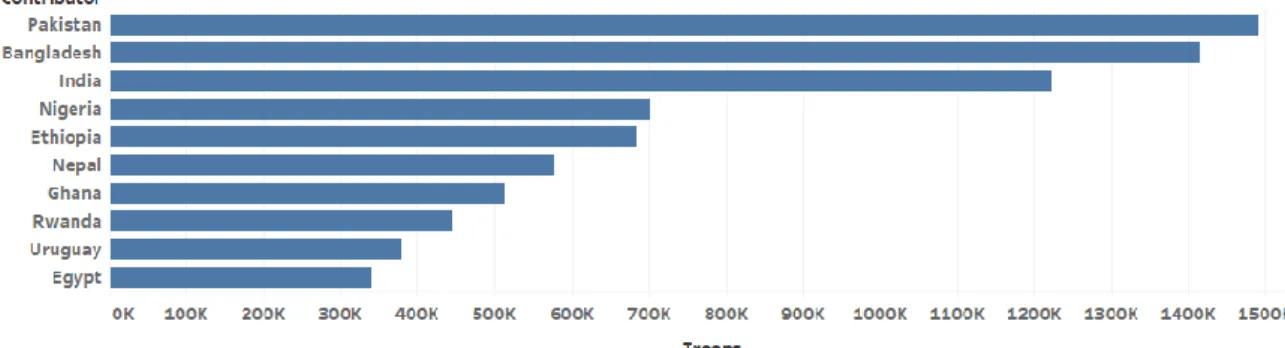
it comes to providing peacekeeping forces (IPI, 2017). This inequality is abundantly
clear when considering that the top ten TCCs in the period 2000-2017 are all
developing nations, while the western world’s contributions are meagre; as can be noted in Figure 1 below and in Figure 2 on the following page.
FIGURE 1 - TOP 10 TCCS 2000-2017 (IPI, 2017)
Figure 1 visualizes the large-scale contributions provided by key developing nations,
namely in South Asia and Africa, where Pakistan, Bangladesh, India and Nepal stand
out as key contributors for UN operations. When looking further at the global
contributions in Figure 2, the asymmetric levels of contributions become quite clear,
22
Data on troop contributions to peacekeeping operations does retain a high level of
correlation with what could be considered a crisis of nationalism in the western world,
and with it, severe implications when it comes to engaging in conflicts based on both
tangible and intangible interests. Such an implication can be noticed in a 2015
WIN/Gallup study, focusing on the willingness of citizens from 64 countries to actively
engage in defending their home-countries from external aggression (WIN/Gallup,
2015). Across the study, an average of 61% stated a willingness to act, with a notably
higher willingness to fight in non-western nations (avg. 68%) compared to western
nations (avg. 35%). Naturally, this statistical framework is based around a tangible
concept of direct national defence against an aggressive external force, a notion that
has an immediate impact on both personal and national interests (WIN/Gallup, 2015).
However, when considering the crisis on nationalism in a wider UN context, then it is
only sensible to draw parallels from the tangible concepts of national defence, to more
intangible concepts such as engaging in conflicts based on norms and values around
the globe. In such settings, personal motivation for entering conflicts are likely to
suffer similar or worse levels of support, notably since the direct impacts of remote
conflicts, from a western perspective, are unlikely to be substantial. With a relatively
high reluctance to serve in conflict scenarios, it is not unsurprising that we can notice
a correlative schism when considering the visualized data in Figure 2 and 3 on the
following page. In such a comparison, the top TCCs clearly display higher levels of
nationalism vis-à-vis the willingness to act in national defence, while lower levels of
willingness are typically found with the lesser contributors. Such figures also lend
credence to common concerns over western involvement in UN operations, where
national interests to a large extent must overlap with UN operations. This comes into
play through several inhibiting variables typically tied to political, economic and
security concerns. With low levels of domestic support, only minor impacts on national
security and an increasing gap between UN compensation and the costs of training
and arming troops for UN missions, it is can only be anticipated that we meet heavy
reluctance in contributing to UN operations, unless such operations overlaps further
with national interests. Such rationalizations are further supported by the higher levels
of engagement that southern European nations display, as several UN missions
overlap with historical ties, national interests and stronger security implications
23
24
With such a framework in mind, ample opportunity has emerged for a second
renaissance of mercenary culture, where non-state actors can re-enter the security
paradigm and fill security gaps that conventional forces are unable or unwilling to fill.
In conventional conflicts, this has been a growing trend since the private security
sector stepped into the limelight, when private military companies such as Executive
Outcomes were engaged in the conflicts of Sierra Leone and Angola in the 1990s. Since
then, the private sector has established themselves firmly as potential security
providers who could provide greatly needed solutions, positions which the UN is
seeking to fulfil.
2.3 Analysis
History has a way of repeating itself, and when considering what we could call the
second renaissance for mercenary culture, it is interesting to draw a number of
parallels between the historical context and contemporary developments. A key
parallel is the notion that the concept of nationalism has a correlation with the
integration of mercenary culture. As illustrated in the historical context, the rise of
nationalism and national identity in Europe became a nail in the coffin for the
mercenary companies of the era, while in contemporary history, we see a
re-emergence of its modern iteration correlating with the crisis of nationalism. From a
modified structural realist perspective, states have a clear interest in power, but as
noted, state interests are shaped by different variables, and one such variable is public
opinion (Keohane, 1986). In this sense, Figure 3 provides us with a road-map for public
opinion on the general willingness to engage in conflicts. With this in mind, we can
correlate the general levels of unwillingness with military downsizing, and we are left
with results that would indicate a mismatch between national and public interest.
Public opinion thus shapes state interests by limiting it, and states, who pursue power,
will have to adjust to these limitations by whatever means are available to them. This
paves the way for a rational choice model where states must seek to maximize the
utility value of the investments they make in their pursuit of maximizing relative
power, and to this end, the outsourcing of war becomes a cost-effective option.
Through such endeavours, limited defence budgets can be directed at providing for
25
operations can be outsourced to the private sector. The same rationale could be used
in UN settings, where western nations could be presented with an alternative to the
oft declined requests for troop contributions by offering to become sponsors of private
entities who are able to provide valuable contributions to UN missions. Such an option
would provide a lower contributional threshold for states that find themselves unable
to commit forces to UN operations, but who still wishes to contribute to fulfil their
international obligations.
3.
Changes in UN stance
The United Nations has historically taken a staunch stance against what they consider
mercenary involvement in conflicts. This resistance has largely been the focal point of
the UN Working Group on the use of mercenaries as a means of violating human rights
and impeding the exercise of the right of peoples to self-determination (WGM) under
the Office of the High-Commissioner for Human Rights. Despite this stance, the UN
does in fact employ private military security companies, primarily in force protection
roles both inside and outside of United Nations Department of Peacekeeping
Operations (UNDPKO) frameworks. These actions, alongside a noticeable shift in
rhetoric and several systemic needs in humanitarian operations, establish a firm basis
for an argument for ripeness, when we consider private sector inclusion as a potential
solution for addressing operational challenges in peacekeeping missions.
The central idea of ripeness is a concept borrowed from negotiations theory, where
timing and necessary preconditions pave the way for finding possible solutions to
disputes. The theory is largely tied to the realization of both stakeholders being
engaged in a mutually hurting stalemate from which the possibility of a positive
outcome deteriorates with the threat of a catastrophic failure or breakdown on the
horizon (Zartman, 2000). In such scenarios, stakeholders will find themselves
committed to a conflict from which escalations and withdrawals will be too costly to
engage in, and where remaining in a painful deadlock is likewise inadvisable due to the
sustained costs of such efforts (Zartman, 2008). Through a cost-benefit analysis of the
situation, both parties will thus realize that the best hope for an acceptable outcome
26
an optimal solution. In this instance, the theory will not be applied to negotiations
framework, but rather to a policy and decision making framework, exploring how key
stakeholders are engaged in a mutually hurting stalemate, and how notable
preconditions for engaging the private security sector vis-à-vis peacekeeping
operations has become a valid compromise.
3.1 Shifting United Nations Views
To a large extent, the UN, and notably the UN secretariat, attempts to keep the touchy
subject of PMC inclusion within its organizational framework as a “don’t ask, don’t tell”
topic (Pingeot, 2012). Such a stance naturally impedes on the ability to uncover any
notion of an official UN stance on the topic. However, when considering the WGM
under OHCHR, then we are able to find a key organizational stakeholder when it comes
to maintaining the wider UN stance on the use of private contractors (Pingeot, 2012).
To explore these changes in the UN stance towards private security, it is appropriate
to study the WGM reports facilitated to the UN General Assembly on the topics of
mercenaries, private military security companies, and in recent years, the concept of
foreign fighters. The study of these reports has been conducted by applying critical
discourse analysis (CDA) to core segments of the texts. The objective of CDA is to
perceive language as a social practice, as part of a wider contextual framework. This
means a coupling of the textual structures of the WGM reports to the social context
that lays a foundation for the discourse itself. CDA as a method can be addressed in a
wide range of manners tailored to the individual case-studies. In Juraj Horváth’s report
on Obamas political speeches, Teun A van Dikj, a renowned scholar in this field, states
“(CDA) is obviously not a homogenous model, nor a school or a paradigm, but
at most a shared perspective on doing linguistics, semiotic or discourse
analysis” (Horváth, 2009, p. 45)
A notable aspect of CDA that distinguishes it from other approaches to text and speech
analysis is its focus on critical aspects tied to the social context of the discourse. In a
critical analysis, one goal is specifically to underline connections and correlations,
which are not always transparent, to a wider social framework. In this application, the
27
stance, with a wider institutional or international context. This context, namely in the
form of key events and developments, helps to shape the discourse of the working
group, in some cases out of necessity, and in others by simply shifting the focus of the
working group.
This critical analysis of WGM reports to the UN General Assembly will focus on the
terminology and associations used in categorizing the non-state actors within its
framework. In doing so, it is possible to extrapolate a shifting, over-time, perspective.
These changes in categorizations are further supported by report specific arguments
and claims, while being held against the wider social-context of the central thematic
of the reports. This approach to CDA is largely based on the framework provided by
Norman Fairclough, as he outlines key aspects that must be addressed, namely
internal- and external relations. Internal relations are tied to the internal meaning of
the text in the form of vocabulary and grammar, while external relations are tied to
the wider context for which the discourse fits. Due to the specific focus of this analysis,
namely the focus on categorizations and context, this analysis will focus on persuasive
declarations as a means for internal relations, while external relations will focus on
appropriate shifts in social structures, practices and events (Fairclough, 2012). For
further details on this analysis, please see Appendix 1.
3.1.1 Key takeaways from WGM Reports 1995-2015
Initial reports on mercenary activities to the UN General Assembly can to a large extent
be considered as providing staunch opposition to any notion of mercenary
involvement in conflicts. It is important to note that the social context shifts across a
structural line between A/50/390 of 1995 & A/55/334 of 2000 when compared to later
reports, as the initial reports were largely facilitated by the special rapporteur on the
use of mercenaries Mr. Enrique Bernales Ballesteros, while later reports were
facilitated by a dedicated working group. Both initial reports share a common
approach to vilifying mercenary forces, linking them to a several concepts of organized
crime, terrorism and aggression (UNGA, 1995) (UNGA, 2000). A/50/390 is almost
entirely focused on mercenary activities, establishing a key stance against the
re-emergence of mercenary culture through the involvement of the well-known PMC
28
a mention of an emergence of foreign fighters in the form of Mujahidin fighters
participating in the then conflict in the republic of Bosnia and Herzegovina, but initially
suggests excluding such a concept from the working groups focus unless it is tied to
motivations related to personal gain. However, the report does not address the
emerging private security sector in any way, using simply the negatively laden word
‘mercenary’ as a catch-all term for any such concepts. A key notion in the report is also the explicit goal of preventing the recruitment and usage of mercenary forces in
conflicts, a notion that is largely tied to the negative connotations of the term
‘mercenary’ in the report (UNGA, 1995).
In the following report A/55/334 from 2000, the recurring topic of mercenary activities
remains predominant, and once again reiterates several negative traits focusing on the
linkages between mercenaries and organized crime. It does however include a further
range of transgressions associated with mercenary activities, namely regarding
terrorism, destabilization efforts against legitimate states and the forcible control of
natural resources in conflict theatres. It also clearly notes that mercenary forces
should be considered a human security risk that works against peace, political stability,
law and democracy. This report does mention the emerging concept of PMSCs,
underlining that private actors make up an important role in contemporary security,
but warning that they must not be allowed to replace inherited state functions.
Furthermore, the report links PMSCs to mercenary activities, but unlike conventional
mercenaries, it does not suggest an elimination of the industry, rather it advices the
creation of legal norms and for increased regulation (UNGA, 2000).
In A/61/341 from 2006, the distinct concepts of mercenaries and PMSCs become an
increasing focus for the working groups’ efforts. For both concepts, the report suggests that clear definitions must be made to avoid any overlap between what it considers
two separate forms of non-state security actors. Mercenary forces are still tied to a
growing range of criminal offences encompassing further forms of human rights
violations, and for all intents and purposes the report maintains its stance against the
recruitment and usage of any such forces. For PMSCs, the report acknowledges the
heavy reliance of UN institutions on PMSCs for addressing its security needs, and
29
accountability, regulation and oversight. The increased demands for legal measures to
regulate the industry correlates with the establishment of the Swiss initiative, a
measure by the International Committee of the Red Cross and the Swiss Government
to establish a framework approach to addressing the outsourcing of security functions
to the private sector. This was necessary precaution, as the industry had become
connected to human rights violations in Iraq, and these events had underlined the lack
of accountability in such instances (UNGA, 2006).
Report A/65/325 from 2010 does, to a large extent, lean on the newly released results
of the Swiss Initiative, namely in the form of the Montreux Document and the
International Code of Conduct for Private Security Providers. These documents
present a framework for best practices and proper conduct for states, organizations
and the industry itself, fitting well with the ever-increasing reliance on private security
in conventional conflicts and UN frameworks (a fact that the report severely
underlines). The report provides only brief mentions of mercenary activities, linking
the recruitment of mercenaries to PMSCs and noting ongoing issues with mercenary
activities being a destabilizing factor, notably in Africa. Its main focus is, however,
PMSCs, an industry that by this point has become so ingrained in security that it warns
of overdependence on private actors, an overdependence that erodes the state
monopoly of force and continuously has proven a challenging target for regulation and
oversight. Such a level of dependence is not only tied to state actors, as the report
clearly addresses the UNs own reliance on such forces, advocating a strong
system-wide policy on outsourcing security. In this context, an inter-agency network was being
created in the reporting year to establish a firm UN stance on the privatization of
security functions for its operations. This approach is reconfirmed not to seek the
elimination of private sector security in UN operations, as the UN Department of
Safety and Security argues that the organizational security needs are impossible to
meet without outsourcing key functions to private actors. However, while this is an
organizational need that must be met, the report warns against the possible effect
that such approaches might have for the organizations image (ICRC-FDFA, 2008)
30
In A/70/330 from 2015, the clear focus has shifted entirely away from the concept of
PMSCs, and almost exclusively focuses on the concept of foreign fighters vis-à-vis the
ongoing conflicts in the middle-east, notably in Iraq and Syria. The report still
addresses the notions of mercenaries, linking them briefly to their recruitment into
PMSCs, but retains a focus on the criminal links that mercenary forces has to terrorism
and organized crime. Despite a brief mention of mercenary activities, the report is
dedicated to the returning concept of foreign volunteers, transnational insurgents and
mujahidin fighters entering inter- and intra-state conflicts, a concept known from the
Yugoslav Wars and in Afghanistan. The report takes a dualistic approach to the
re-emergence of this concept, acknowledging that foreign fighters may contribute to the
right of peoples to self-determination, but that its observations of on-going conflicts
would seem to indicate an overall impediment of human rights. Such impediments of
human rights are tied to several gross violations and aspects of organized crime,
largely linked to a radicalization of warfare and several illicit methods for incentivizing
or funding their operations in conflicts (UNGA, 2015).
3.1.2 Summary findings of WGM Reports
When taking a birds-eye-view over the WGM reports studied in the period of
1995-2015, it becomes quite clear that the overall stance against the basic notion of
outsourcing security has shifted immensely across the study period. Initial reports
paint a highly negative picture of anything related to mercenary activities, including
the emerging private security sector. But over time it becomes clear that the WGM,
despite an inability to firmly classify the distinct types of non-state security actors,
increasingly remains open towards the notions of such outsourcing. This must
however be held against a wider context, where societal developments in not only
states, but the UN itself, necessitate the inclusion of the private sector to meet specific
security needs. This is further underlined by inter-agency discussions on the topic,
where notable internal actor in the UN, the UNDSS, quite adamantly insists that
without private security contractors, the department would quickly find itself
hard-pressed to provide the necessary security for UN delegations, installations and
operations. This notion is further addressed in the most recent 2016 report A/71/318,