Research Paper
IMPLEMENTATION OF LEAN MANUFACTURING IN
COMPUTER INTEGRATED ENVIRONMENT
Rahul1 and J. S. Kaler2
Address for Correspondence
1
M.Tech. Scholar, Department of Mechanical Engineering, Sri Sai College of Engineering & Technology, Badhani (Pathankot) India,
2
Professor and M.Tech. Co-ordinator, Department of Mechanical Engineering, Sri Sai College of Engineering & Technology, Badhani (Pathankot) India
ABSTRACT
In this competitive era, manufacturing enterprises struggle to adopt cost-effective manufacturing systems. Overview of the recent manufacturing enterprises shows that successful global manufacturing enterprises have distributed their manufacturing capabilities over the globe. The successes of global manufacturing enterprises depend upon the adaptation of appropriate manufacturing technologies like computer integrated manufacturing (CIM) and worldwide integration of their product development processes along with the concepts of lean manufacturing so that their corporate goals are achieved. CIM is a strategy that helps to improve the performance of a manufacturing firm by integrating various areas of manufacturing where as lean ideas are the tools that cause work tasks in a process to be performed with minimum of non-value adding activities. It focuses on customer needs by delivering the requirement at less time, with high quality and at cheaper cost by eliminating hidden waste. This study addresses the productivity improvement of a globally collaborating enterprise having its plants at diverse locations, by implementing various lean tools which results in improved system and surrounding performance.
KEYWORDS: Lean manufacturing, CIM, 5S, Kaizen, Cycle time. 1. INTRODUCTION
In the fifties of twentieth century, Toyota Production System (TPS) introduced the principles of lean manufacturing in Japan. Lean Manufacturing is a pool of practices, methodologies and tools, which leads to greater cost reductions and efficiencies improvements. In the area of material handling/scheduling/ production control, companies can expect the improvements like significant reduction of inventory levels, reduction of storage space, better material handling manpower
utilization, better material and information flow, higher production output, improved quality, less scrap, reduction in manpower requirements, reduction in changeover and set-up down time, safer work environment etc.
LM is a manufacturing concept which aims at not only reducing but finally eliminating all forms of non-value adding work in any production system. Lean manufacturing is viewed as a five-step process: defining customer value, defining the value stream, making it flow, pulling from the customer back and striving for excellence. The continuous improvement aspect of lean is becoming the compelling force for researchers to explore it further for products and machine tools designing.
In order to improve overall productivity & customer value, LM is now renowned for its focus on reduction of the original Toyota eight types of wastes [3]. These identified wastes in TPS are:
• Overproduction (production ahead of demand) • Transportation (moving products not actually
required to perform processing)
• Waiting (waiting for the next production step) • Inventory (all components, work-in-progress
and finished product not being processed) • Motion (walking or moving of people or
equipment more than what is required to perform processing)
• Over processing (due to poor tool or poor product design creating activity)
• Defects (the effort involved in inspecting for and fixing defects)
• Unused or unutilized creativity.
Whereas computer integrated manufacturing (CIM) is the use of computer systems to integrate a manufacturing enterprise. CIM provides the tools to enable the use of organizational concepts such as Total Quality Management, Continuous Improvement, Concurrent Engineering, Design for Manufacturability, Design for Assembly and back-to basics concept of “Do it right the first time” [11] to improve productivity, flexibility, agility, leanness, inter operability etc. of the enterprise along with cost reduction and quality improvement of the product to remain competitive in the global market. The integration of the CIM technology brings the following benefits:
• Increased flexibility towards introduction of new products.
• Improved accuracy and quality in the manufacturing process.
• Improved quality of the products.
• Control of data flow among various units & maintenance of user library for system wide data.
• Reduction of lead times which generates a competitive advantage.
• Streamlined manufacturing flow from order to delivery.
• Creation of a truly interactive system that enables manufacturing functions to communicate easily with other relevant functional units.
• Accurate data transferability among the manufacturing plant or subcontracting facilities at in plant or diverse locations. • Faster responses to data-changes for
manufacturing flexibility.
• Easier training and re-training facilities. So the lean production refers to approaches initially developed by Toyota that focuses on the elimination of waste in all forms. Lean has been extremely successful in large high volume manufacturers and there is an utmost need of improvement in the
effectiveness of the CIM technology through the lean manufacturing tools.
2. LITERATURE REVIEW
Gupta A. and Kundra T.K. (2012) focussed lean design process of a product and machine tool. They reviewed on evolutionary aspect of leanness from manufacturing to design stage, concepts and practices being followed till date by the industrialists, researchers and academicians in applying lean tools and techniques in the design of product and machine tools along with the methods to measure the lean improvements in the systems.
Jyothi V.E. and Rao K.N. (2012) focussed the result of immense research work on the implementation of agile software development in coordination with lean Kanban which facilitates continuous improvement. They portray the key practices of iterative agile and lean Kanban and also focused on the approaches that can be considered to reduce the defect rate in the software development and increase the productivity. Increased productivity, return on investment and decreased defect rate are the major concerns in now-a day. Agility created revolution in various fields of software development especially in mobile based applications and internet-based applications development because of the improved quality of the software product.
Xu X. (2012)discussed the essential features of cloud computing with regard to the end-users, enterprises that use the cloud as a platform, and cloud providers themselves. Two types of cloud computing adoptions in the manufacturing sector have been suggested, manufacturing with direct adoption of cloud computing technologies and cloud manufacturing- the manufacturing version of cloud computing. Cloud computing has been in some of key areas of manufacturing such as IT, pay-as-you-go business models, production scaling up and down per demand, and flexibility in deploying and customizing solutions. In cloud manufacturing, distributed resources are encapsulated in to cloud services and managed in a centralized way. Clients can use cloud services according to their requirements. Cloud users can request services ranging from product design, manufacturing, testing, management, and all other stages of a product life cycle.
Kumar R.D. And Thyla P.R. (2011) described how the Value stream mapping and other suit of lean tools can be used to map the current state of the production line & design a desired future. They addressed several strategies to eliminate wastes on shop floor & carried evidence of genuine advantage when applying lean at shop floor.
Rahman M.N.A. et al (2010)discussed5S practice as one of the technique to improve quality environment, health and safety at the workplace. Evaluation of 5S practice can be done through implementation of 5S audit at each division in the company which enables each company to identify the potential level of quality improvement and at the same time can analyze their ability and weakness of each division in the company.
Ramnath B.V. et al (2010) described to provide a background on lean manufacturing, present an overview of manufacturing wastes and introduce the tools and techniques that are used to transform a company into a high performing lean enterprise.
Value stream mapping is a main tool used to identify the opportunities for various lean techniques. The focus of the lean manufacturing approach is on cost reduction by eliminating Non- Value added activities. This map is used to identify sources of waste and to identify lean tools for reducing the waste. To eliminate the wastes found from the current state map Kanban system is suggested for pre machining section and single piece flow concept is suggested for machining section.
Titu M.A. et al (2010) focussed Kaizen methods as ‘internationally acknowledged as methods of continuous improvement, through small steps, of the economical results of companies. The small improvements applied to key processes will generate the major multiplication of the company’s profit, while constituting a secure way to obtain the client’s loyalty/fidelity. The Kaizen management represents a solid, strategic instrument, with a view to reach and surpass the company’s objectives. The “5S” technique represents a fundamental technique which allows the enhancement of efficiency and productivity, while ensuring a pleasant organizational climate.
Upadhye N. et al (2010)discussed issues of medium size manufacturing enterprises and present a case to demonstrate the improvements achieved in an Indian mid size auto component’s manufacturing unit after the implementation of LMS. MSMEs play an important role in Indian economy and with the liberalization facing tremendous challenges, but their strength lies in the competitiveness of their products in the world market. Lean manufacturing system (LMS) is characterized by shorter product development and manufacturing lead-time, team based work organizations, low setup/changeover times, multifunctional workers and JIT deliveries from few reliable suppliers. But the concepts of LMS are not well adopted in MSMEs. LMS as a manufacturing strategy can help a MSME to improve its processes and align it to the requirements of its customers. LMS has a set of tools and techniques; the choice is situation specific.
Vendan S.P. and Sakthidhasan K. (2010) addressed the application of lean manufacturing concepts to the continuous production sector with a focus on the motor manufacturing industry & to investigate how lean manufacturing tools can be adapted from the discrete to the continuous manufacturing environment. They stated that lean manufacturing as a leading manufacturing paradigm applied in many sectors and the implementation of lean philosophy through layout modification. The fundamental focus of lean production is the systematic elimination of non-value added activity and waste from the production process. The implementation of lean principles and methods results in improved system and surrounding performance.
Khamis N. et al (2009)explored the practical use of the 5S Checklist for environment, housekeeping and health, as well as safety improvement purposes at two manufacturing organizations. The main objective of is to assess the implementation of 5S and development of the 5S Activity Checklist in manufacturing companies. In addition, factors that may act as constraints to the implementation of the 5S activity and possible solutions for the industries
are also identified through observation and evaluation of the improved environmental performance.
Karkoszka T. and Honorowicz J., (2009) aimed at motivating the legitimacy of implementation of Kaizen system – the philosophy conducting to the continuous improvement of processes and products by the responsibility of all workers. They found that kaizen idea should have positive influence on areas outside department of employee, surpass the level of ordinary scope of duties of employee, be characterised by high level of practicality, what means that employee has devoted a lot personal time and energy to achieve effective implementation and obtain the results exceeding desired ones; correct functioning of kaizen system should be confirmed by statistics of implementation.
Jensen S.H. and Jensen K.H. (2007) demonstrated how the implementation of Lean Manufacturing can be approached, illustrated by comparing and analyzing two distinct companies and their different approach to start-up the implementation of Lean Manufacturing. The two industrial companies are a small company employing 40 people and a medium sized company employing 630 people (40 to 50 people are employed in the present department). The start-up phase is a decisive step to achieve success when implementing Lean in the company.
Michalska J. and Szewieczek D. (2007) introduced the way of implementing the 5S methodology in the company. They stated that introducing the 5S rules bring the great changes in the company, for example: process improvement by costs’ reduction, increasing of effectiveness and efficiency in the processes, maintenance and improvement of the machines’ efficiency, safety increasing and reduction of the industry pollution, proceedings according to decisions. The 5S methodology permits to analyse the processes running on the workplace. The 5S is the methodology of creation and maintaining well organized, clean, high effective and high quality workplace.
Mohanty R.P. et al (2006) presented the gaps between the lean principles and practices. Some pertinent propositions were put forth to enrich the knowledge base of professionals to make the implementation process more pragmatic and robust in the long run and for furtherance of empirical research. They directed that to strengthen the lean system movement and its robustness as an approach to coping with future economic and market conditions, we have to enrich the professional practice.
Masood T. and Khan I. (2004) emphasized the significant role of Computer Integrated Manufacturing (CIM) to the national economy & productivity improvement. Today’s industry competes in a truly international marketplace. Efficient transportation networks have created a “world market” in which we participate on a daily basis. For any industrial country to compete in this market, it must have companies that provide economic high-quality products to their customers in a timely manner. The importance of integrating product design and process design to achieve a design for production system cannot be overemphasized. However, even once a design is finalized, manufacturing industries must be willing to
accommodate their customers by allowing last-minute engineering-design changes without affecting shipping schedules or altering product quality. 3. Research Methodology
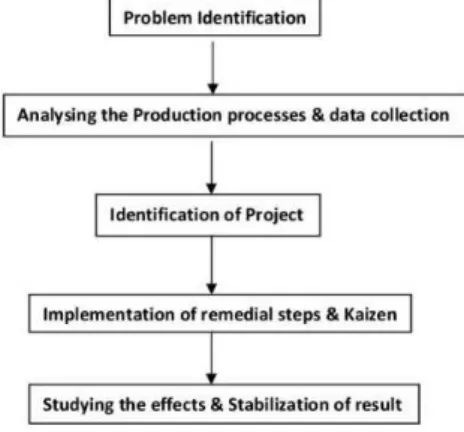
In past, various research and articles have been published on lean manufacturing & its implementation and they suggests various methods for implementation of lean. The first step of this study is to conduct comprehensive literature review in order to collect information on fundamental lean principles. After that the process analysis is carried out by collecting data from various enquiries with shop floor experts & directly participating in measuring the time involved in various machining processes. Following are the steps designed to implement the lean manufacturing (Fig. 3) for this project:
Fig. 3 Research Methodology
After identifying the project, the various lean tools like standardized work, 5S, visual control, kaizen etc. are deployment which work around certain types of problems and highlighted the underlying cause of many problems. Then, a future state map is developed to implement lean through the elimination of the root causes of waste and process improvements, minimizing several non-value added activities such as bottlenecking time, setup change time, downtime etc.
3.1 Problem identification
For the implementation of lean, an industry has been taken which is the largest manufacturer of automotive parts for passenger car and utility vehicle market in India. Its collaborator and partner is the market leader in Korea & Japan and in the recent past announced a merger with Toyota machine works. Its customers include major vehicle manufactures in India, as well as through its network of overseas joint-venture partners. The group also has a strategic position in Fuji Autotec, Europe - which has subsidiaries in Brazil, France, Sweden and the Czech Republic. The group is committed to expansion of its products range and clientele by continuous investment in research and development. It has the manufacturing facility at diverse locations & exports high quality precision products to USA, Europe and Japan. The Group boasts the world’s largest precision forging enterprise, by the World Economic Forum as a top– performing Global Growth Company; a recipient of the prestigious ISO, TS, Deming Award in 2003, it received the TPM Excellence award in 2007, with latest technology & best quality of products.
All the manufacturing processes (like casting, machining, machining etc.) & production system are performed with the use of CNC machines and highly automated techniques. After discussion with the
management and through study of production processes, a current state map is drawn to view how things are actually operated on the production shop floor. Following are the causes of low productivity (as shown below in Ishikawa diagram fig. 3.1):
Fig. 3.1 Ishikawa diagram showing the causes for low Productivity of the plant
Causes are usually grouped into categories to identify these sources of variation in Ishikawa diagram. The categories include: people; methods; equipment; materials; measurement and; environment.
3.2 Analysing the production processes and Data collection
The company has its facilities in vast area of manufacturing processes like casting, machining, assembly, painting etc. Machining process of a particular component was selected for the project as it is the bottleneck area. The machining operations (of project focus area) are performed in five steps on five consecutive CNC machines. The sequence and the tools for machining are as given below:
• Facing & centring (on m/c F-11): with Facing & centring tool
• Turning I- Serration side (on m/c F-12): with 4 tools as:
• Roughing tool, Finishing tool, Radius groove tool, Penta groove tool
• Serration & Heat code punching (on m/c I-37): b/w two Rollers
• Turning II- Gear side (on m/c F-14): with Roughing & Finishing tool
• Grinding (on m/c F-15)
After machining operation, the component moves to another production line for further processing like gear cutting, hardening, crack detection & inspection purpose. After the final inspection, it moves to another plant for assembly. But during the machining, there is more downtime due to various reasons. Below table (fig. 3.2) shows the plant downtime data for one month of production- machining line:
Fig. 3.2 Machine downtime 3.3 Identification of Project
While this project sought to address the sources of waste, which cause productivity loss. According to the physical survey & analysis of plant, downtime is the major problem that causes production loss and hence creates bottlenecks in process flow. The main causes of plant downtime are shown in the ‘cause and effect’ diagram below:
Fig. 3.3.1 Cause & Effect diagram showing different causes of plant downtime
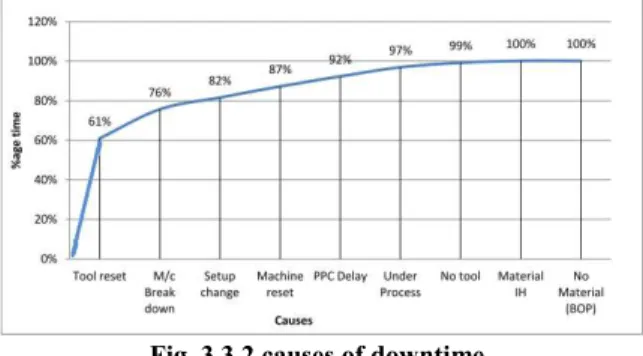
It is observed that the machines remain idle for long period which causes production loss. The loss of production pulls the enterprise back, reduced profit & hence increased bottlenecks. The production targets get difficult to achieve, the commitment of the enterprise to customer is not accomplished and hence the reputation of company is tarnished. The reasons for plant downtime are shown in the fig. 3.3.2 below:
Fig. 3.3.2 causes of downtime
As shown in the 80-20 Pareto chart below, the first two causes i.e. Tool reset and machine breakdown amounts to 22% of the total causes for the 76% of the total plant downtime. The results of this cause & effect analysis resembles to the 80-20 Pareto principle where 20% malfunctioning manufacturing resources create 80% problems.
Figure showing below cause & effect chart (Considering main cause i.e. Tool re-set which causes 60% of the total downtime).
Hence Tool re-set is the major cause that affects productivity loss directly and this is our project focus.
4. IMPLEMENTATION OF THE REMEDIAL STEPS & KAIZEN
Lean manufacturing was first implemented by Toyota, in what was termed the ‘Toyota Production System’ (TPS). TPS was an ideology that sought to eliminate waste by producing only what was wanted by customers.
The major LM tools that helped to achieve the results in the project include:
4.1 Standardization of process: The tool change-over process is standardized in order to reduce the changeover time. The length of time that should be required to set up a given machine or operation and run one part, assembly, batch or end product through that operation. It is a technique to analyze and reduce resources needed for equipment setup, including exchange of time, tools and dies.
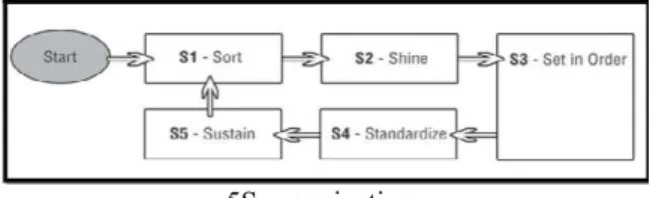
4.2 Workplace organization- 5S: A methodology for organizing, cleaning, developing, and sustaining a productive work environment. Improved safety, ownership of workspace, improved productivity & improved maintenance are some of the benefits of 5S program.
5S organization
In Japanese, 5S is the short form of five words (as shown in fig. 4.2 above) which present the concept of good maintenance. The 5S practice is seen as an effective technique that can improve housekeeping, environmental performance, health and safety standards in an integrated holistic way, while ensuring a pleasant organizational climate.
4.3 Kaizen: The Kaizen starts in the best Japanese management practices and is dedicated to the improvement of productivity, efficiency, quality and, in general, of business excellence involving everyone- managers and workers. All over the world, the Kaizen techniques have been particularly distinguished as the best methods of performance improvement within companies because the implementing costs for Kaizen are minimal.
Kai (Change) + Zen (Good / to better)
i.e. Change for betterment or Continual improvement. 4.4 Training of operators: The people aspect of lean is very important and many times over-looked as lean is about people and performance. Most manufacturing processes require people to work with high skill & knowledge for complicated dimensioning and quality aspects. Training plays an important role for process improvement in an organization. There may be certain losses that are caused due to lack of knowledge. The operators should be provided training time to time for productivity, safety and quality features. There should be the certain competitions & evaluation programmes based on product features that will attract people to work effectively. So the trainings are the most effective & cheapest tool to achieve best quality and enhanced productivity for any organization.
4.5 Standardized work or line balancing: As the word line balancing explains itself, it is the used to set balance between man, machine and work to be
performed, with optimum utilization of the resources. There should be no idle or waiting time for both man & machine and the work should flow smoothly. Line balancing is the strategy used in the allocation of resources and work schedule to the workers involved, thereby minimising discrepancies arising from unusual services times & idle times. This time is used in determining machine requirements and labour requirements.
5 STUDYING THE EFFECTS & STABILIZING THE RESULTS
5.1Reduction of the tool change-over time of CNC machine:
Problem: The tool change-over is the major cause of production downtime. Out of all causes, 60% of time is wasted in tool setup change on the CNC machine F-12.
Reason: Four inserts are used for machining the component i.e. roughing, finishing, radius grooving & grooving. The bottleneck is the time taken for tool change-over which is not standardized and operator is taking more time (up to 30 min. per change-over) in tool changing.
Solution: After regular analysis, it was concluded that the roughing insert need three changes but the remaining all 3 insert is changed single time in an 8 hours shift. The reasons for roughing insert to change frequently are the insert wear out and insert damaged. Thus tool change-over process was standardized through time study for changing both roughing & finishing inserts.
Fig. 6.1 Observation chart of plant downtime
Saving: Reduced the time for tool changing up to 5% and an overall reduction of downtime up to 4%. Thus the reduced wastage of time lead to the increased production and hence the productivity is improved.
Fig. 5.3 Tool reset time reduction
5.2Implementation of Seiso i.e. Shine or cleanness (major constituent of 5S):
Seiso lays stress on regular cleaning that helps to identify and eliminate sources of disorder so that the cleanliness of the workplace is maintained. Cleaning is a daily activity and at the end of each shift, the work area is cleaned up and everything is restored to its place. During cleaning the cleanness of machine, workplace and floor; tightness of equipment; cleanness of lines, pipes, sources of light are checked.
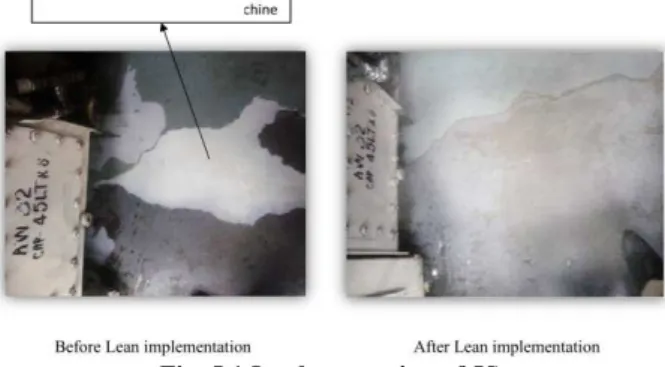
Major problem prevailing on shop floor: Wastage of coolant causing the shop floor dirty.
Reason: During machining on CNC machine F-12, for the chip removal from chip collection tray, the operator pulls chip outward with shovel which creates a gap between chip collection tray and coolant tank. The chip after machining falls directly in the coolant tank and hence causes the level of coolant high. Therefore the coolant overflows from the tank & spreads around the machine (as shown in the fig. 5.1 below).
Fig. 5.1 Implementation of 5S
Solution: In order to prevent the coolant over flow, two stoppers have been welded below chip collection tray that avoids the chip tray to come outward. Saving: By preventing the wastage of coolant, following benefits are achieved:
• Saving in the coolant expenditure.
• Making the work environment safe which saves the work loss & accident compensation. • Manpower saving in removing and cleaning
the coolant from shop floor.
• Maintaining the company’s safety rules and hence its reputation.
5.3 Implementation of Kaizen:
Kaizen – continual improvement by the small steps – should be realised due to each employee’s involvement which should proceed without any additional investment or through small investments. It should be through the improvement of the processes and the employees’ performance only. Kaizen applied to key processes will generate the major multiplication of the company’s profit by finding and eliminating waste in machinery, labour or production methods.
Problem: Another cause for low productivity is the wastage of time due to chip formation. During machining on CNC machine F-12, continuous chip produce which gets collected near work rest and the operator have to remove them manually at regular intervals.
Reason: Continuous chip formation cause wastage of time and hence productivity loss. The softness of material is the single reason that cause continuous chip and this can be prevented by increasing the hardness of material during heat treatment process only.
Fig. 5.2 Implementation of Kaizen
Solution: The hardness of material increased in heat treatment process that causes intermittent chip formation so that the chip does not get collected. The chips after machining get dropped in the chip collection tray itself and operator need no efforts to remove them manually.
Saving: Eliminated the wastage of time in removing chip. The production increased and hence the productivity.
5.4 Machine operator related discrepancies: Problem: Another reason for low productivity is machine operator related issue. The operators are not filling the production data sheet hourly and also he is not giving exact data. Therefore the upper management is not able to receive exact data (i.e. hourly production in pieces, machine downtime, tool re-set time, number of tools used etc.).
Reason: The reason behind production data sheet not filling hourly is simply that the machine operator adjusts whole day production at the end of shift. He shows the machine downtime according to the time wasted by him for various avoidable activities. Solution: Training provided to machine operator and instructed to fill the data sheet hourly and to produce exact data. Supervisor was asked for regular verification.
Saving: This general step helps to eliminate idle time for both machine & operator. Now there is no option for operator to adjust shift production and hence exact data can be generated.
6 CONCLUDING REMARKS
In this study, implementation of lean manufacturing was successfully instituted in computer integrated environment at an automotive MNC industry. The goal to reduce machine downtime, wastages & non-value adding activities make possible to the increased productivity. The machine downtime is reduced up to 5% and the wastages are eliminated. The studies addresses that the upper management must stay engaged and constantly challenge employees to improve and develop higher value adding work as a team for the successful implementation of lean. Thus as long as discipline is maintained, the lean tools continue to work and expose new opportunities for improvement.
REFERENCES
1. Battini D, Faccio M, Persona A, Sgarbossa F.
"supermarket warehouses": Stocking policies
optimization in an assembly-to-order environment. International Journal of Advanced Manufacturing Technology.2010;50 (5-8):775-88.
2. Bhasin S and Burcher P. Lean viewed as a philosophy.
Journal of manufacturing technology management. 2006;17(1):56-72.
3. Dimitrov D and Saxer M. Productivity Improvement in
Tooling Manufacture through High Speed 5 Axis Machining, Procedia CIRP 1 2012 277 – 82.
4. Gupta A and Kundra TK. A review of designing
machine tool for leanness. Indian Academy of Sciences. 2012;37(2):241–59.
5. Huang G.Q., Wright P.K., Newman S.T. (2009),
Wireless manufacturing: a literature review, recent developments, and case studies, International Journal of Computer Integrated Manufacturing, Vol. 22, No. 7, 579–594.
6. Huang G.Q., Zhang Y.F., Jiang P.Y. (2008),
RFID-based wireless manufacturing for real-time
management of job shop WIP inventories, Int J Adv Manuf Technol (2008) 36:752–764.
7. Jensen S.H., Jensen K.H. (2007): Implementing of lean
manufacturing in SME companies, International
Manufacturing Systems, Brasov, 25 – 26 October 2007, Vol. 8, nr. 3a(21a), November, 2007, pages 305 - 308.
8. Jyothi V.E., Rao K.N., (2012), Effective
Implementation of Agile Practices – In coordination with Lean Kanban, International Journal on Computer Science and Engineering, Vol. 4 No. 01 January 2012.
9. Karkoszka T., Honorowicz J., (2009), Kaizen
philosophy a manner of continuous improvement of processes and products, Journal of Achievements in Materials and Manufacturing Engineering, Volume 35, Issue 2, pages 197 - 203.
10. Khamis N., Rahman M.N.A., Jamaludin K.R., Ismail
A.R., Ghani J.A., Zulkifli R., (2009), Development of 5S Practice Checklist for Manufacturing Industry, Proceedings of the World Congress on Engineering 2009 Vol. I, pages 978 – 988.
11. Kumar S.B., Abuthakeer S.S., (2012), Implementation
of lean tools & techniques in an automotive industry, Journal of Applied Sciences, 12(10): 1032-1037, 2012.
12. Masood T. and Khan I. (2004), Productivity
Improvement through Computer Integrated
Manufacturing in Post WTO Scenario, National Conference on Emerging Technologies 2004.
13. Michalska J., Szewieczek D., (2007), The 5S
methodology as a tool for improving the organisation,
Journal of Achievements in Materials and
Manufacturing Engineering, Volume 24, Issue 2, pages 211 – 214, October 2007.
14. Mohanty R.P., Yadav O.P. and Jain R. (2006),
Implementation of Lean Manufacturing Principles in Auto Industry, XIMB Journal of Management.
15. Ngai W.T. (2010), RFID technology and applications in
production and supply chain management, International Journal of Production Research, Vol. 48, No. 9, 1 May 2010, 2481–2483.
16. Nordin N., Deros B.M., Wahab D.A., (2010), A Survey
on Lean Manufacturing Implementation in Malaysian
Automotive Industry, International Journal of
Innovation, Management and Technology, Vol. 1, No. 4, pages 374 – 380.
17. Rahman M.N.A., Khamis N.K., Zain R.M., (2010),
Implementation of 5S Practices in the Manufacturing Companies: A Case Study, American Journal of Applied Sciences 7 (8): 1182-1189, 2010.
18. Kumar R.D. And Thyla P.R. (2011), Transformation of
lean manufacturing by an automotive component manufacturing company, International Journal of Lean Thinking Volume 2, Issue 2 (December 2011).
19. Ramnath B.V., Elanchezhian C. and Kesavan R.
(2010), Application of Kanban system for
implementing lean manufacturing (a case study), Journal of Engineering Research and Studies, JERS/Vol. I/Issue I/July-Sept. 2010/138-151.
20. Titu M.A., Oprean C. and Grecu D., (2010), Applying
the Kaizen Method and the 5S Technique in the Activity of Post-Sale Services in the Knowledge-Based Organization, Proceedings of the International Multi conference of engineers & computer scientists 2010, Vol. III, pages 978 - 988, Hong Kong.
21. Upadhye N., Deshmukh S.G., Garg S., (2010), Lean
manufacturing system for medium size manufacturing enterprises: an Indian case, International Journal of Management Science and Engineering Management, 5(5): 362-375, 2010.
22. Vendan S.P., Sakthidhasan K., (2010), Reduction of
Wastages in Motor Manufacturing Industry, Jordan Journal of Mechanical and Industrial Engineering, Volume 4, Number 5, Pages 579 – 590.
23. Xu X. (2012), from cloud computing to cloud
manufacturing, Robotics and Computer-Integrated Manufacturing 28 (2012) 75–86.