Evaluation of a peer mentoring program for early career
gerontological nursing faculty and its potential for application to
other fields in nursing and health sciences
Abraham A. Brody, RN, PhD, GNP-BCa,b,*, Linda Edelman, PhD, MPhil, RNc, Elena O. Siegel, PhD, RNd, Victoria Foster, PhD, RNe, Donald E. Bailey Jr, PhD, RN, FAANf, Ashley Leak Bryant, PhD, RN-BC, OCNg, and Stewart M. Bond, PhD, RN, AOCNh
aHartford Institute for Geriatric Nursing, New York University College of Nursing, New York, NY bJames J Peters Bronx VA Medical Center, Bronx, NY
cHartford Center for Geriatric Nursing Excellence, University of Utah School of Nursing, Salt Lake
City, UT
dBetty Irene Moore School of Nursing at the University of California, Davis, Sacramento, CA eClayton State University School of Nursing, Morrow, GA
fDuke University School of Nursing, Durham, NC
gUniversity of North Carolina at Chapel Hill School of Nursing, Chapel Hill, NC hBoston College Connell School of Nursing, Chestnut Hill, MA
Abstract
Background—As the retirement rate of senior nursing faculty increases, the need to implement new models for providing mentorship to early career academics will become key to developing and maintaining an experienced faculty.
Purpose—This evaluation of a peer mentorship program for predoctoral and postdoctoral gerontological nurses examined its efficacy, utility, and potential for improvement.
Methods—A web-based survey was developed, implemented, and completed by 22 mentees and 17 mentors (71% and 61% response rates, respectively) as part of the evaluation.
Discussion—The peer mentorship program was found to be valuable by both mentors (64.7%) and mentees (72.7%) in helping mentees further develop their careers and networks and providing mentors with supported mentorship experience.
Conclusion—The peer mentorship program could serve as a model for other professional organizations, academic institutions, and consortiums to enhance and extend the formal vertical mentorship provided to early academic career individuals.
*Corresponding author: Abraham A. Brody, New York University College of Nursing, Hartford Institute for Geriatric Nursing, 433
HHS Public Access
Author manuscript
Nurs Outlook
. Author manuscript; available in PMC 2018 March 05.Published in final edited form as:
Nurs Outlook. 2016 ; 64(4): 332–338. doi:10.1016/j.outlook.2016.03.004.
A
uthor Man
uscr
ipt
A
uthor Man
uscr
ipt
A
uthor Man
uscr
ipt
A
uthor Man
uscr
Keywords
Mentoring; Peer mentorship; Gerontological nursing; Leadership; Professional development; Faculty
Introduction
The Building Academic Geriatric Nursing Capacity (BAGNC) program, which was funded through the generosity of the John A Hartford Foundation, was created in 2000 to prepare the next generation of expert gerontological academic leaders and researchers (Franklin et al., 2011). The program included a substantial funding commitment for 2-year predoctoral Patricia G. Archbold Scholarships and postdoctoral Claire M. Fagin Fellowships. Alumni of the BAGNC predoctoral and post-doctoral programs developed a formal alumni group in 2010. In 2011, the alumni formed a Peer Mentoring Committee and developed a Peer Mentoring Program described in detail elsewhere (Bryant et al., 2015). The Peer Mentoring Program used the framework developed by McBride (2011) and the “mentoring forward” peer mentoring model (Byrne & Keefe, 2002) to enhance new scholars’ and fellows’ experience in the program through peer mentoring from program alumni just a few years ahead of them in their career. In addition, an underlying intent was to support the development and expansion of robust professional networks between new scholars and fellows and program alumni, providing them with an additional sounding board outside their home institutions. Details regarding the actual expectations of mentors and mentees are described elsewhere (Bryant et al., 2015). This article (a) describes the evaluation of the first 3 years of the Peer Mentoring Program, (b) examines areas of need for sustaining the program into the future based on the experiences of mentors and mentees, and (c) discusses the program’s applicability to other fields within nursing and beyond.
Background
The need for pre-doctoral, post-doctoral, and early career faculty to have professional development opportunities is recognized as key to growth and success across academic health disciplines, including nursing (Boyden, 2000; Drummond-Young et al., 2010), pharmacy (Brock et al., 2014), and medicine (Sambunjak, Straus, & Marusic, 2006). Academic career success requires faculty with expertise in effectively juggling teaching/ mentoring, research, clinical practice and service role expectations as applicable to
appointment series (e.g., tenure track, clinical track, and so forth), while producing a steady stream of publications. This is particularly true in academic nursing where a shortage of senior and midcareer faculty due to an aging and retiring faculty (American Association of Colleges of Nursing, 2014), heightens the need for early career individuals to mature more quickly and become mentors themselves. Therefore, professional development programs need to provide early career faculty with tools and support to develop expertise in teaching, research and practice, as well as prepare them for academic leadership roles.
Effective early career development has generally required institutional commitment, including allocations of resources and senior faculty to support, promote, and role model best practices and institutional values. Early career individuals who are formally mentored
A
uthor Man
uscr
ipt
A
uthor Man
uscr
ipt
A
uthor Man
uscr
ipt
A
uthor Man
uscr
by senior faculty enjoy a host of advantages over faculty without formal mentoring, including faster career advancement and higher job satisfaction (American Association of Colleges of Nursing, 2014). Most formal mentoring relationships have included more senior faculty mentoring early career faculty, reflecting a vertical mentoring approach. However, with the shortage of experienced faculty in nursing, maintaining stable and effective vertical mentorship as the sole form of mentorship may become untenable. Thus, there is a
significant need to develop different models for supporting early career individuals that transcend the traditional vertical mentoring models.
To augment the vertical mentoring provided within the BAGNC pre-doctoral and post-doctoral fellowship programs, fellowship alumni created a Peer Mentoring Program. A model for the growth and development of nurse leaders (McBride, 2011) served as a guide during the development of the Peer Mentoring Program. McBride’s model for mentoring and leadership development centers around the mentor-mentee relationship. The mentor model has values that contribute to the successful launching of a career within the academic home and the profession. Over the course of 15 years, Dr. McBride refined the model with strategies focused on stages of the individual’s career and the associated developmental tasks. The model, informed by Dr. McBride’s work as a faculty member, dean, and leader of several career development and mentorship programs in nursing, has been instrumental in the development of 248 BAGNC program nurse leaders and scholars that participated in the program’s annual leadership meetings and organized mentor-mentee meetings. There are five stages in the model by McBride (2011): Preparation; Independent Contributions; Development of Home Settings; Development of Field/Health Care; and The Gadfly Period. Two stages of the model—Preparation and Independent Contributions—served as the basis for the Peer Mentoring Program, with the mentee-focused development tasks associated with each stage of the model used to guide specific components of the Peer Mentoring Program. During the Preparation stage, the focus is on developing a knowledge base through research designed to advance the nursing profession; during the Independent Contributions stage, the focus is on working independently as well as interdependently with nursing colleagues and interprofessional scholars in activities such as building their own research teams, securing external funding, and disseminating peer-reviewed publications (McBride, 2011). Activities related to the Preparation stage include mentored presentations, publication reviews, and membership in professional organizations. Mentors help the mentee outline career goals and encourage problem solving. Across phases, another skill highlighted by McBride as
important to the development of academic nursing success and related competent functioning within an individual’s organization focuses on emotional intelligence, which reflects a person’s understanding of their own feelings as well as the emotions of others. Mentors help the mentee navigate the organization and the profession, facilitating introductions and helping open doors for the mentee (McBride, 2011).
The purpose of this program evaluation was to describe the experience, efficacy, and value of the Peer Mentoring Program for mentees and mentors, as well as areas for improvement.
A
uthor Man
uscr
ipt
A
uthor Man
uscr
ipt
A
uthor Man
uscr
ipt
A
uthor Man
uscr
Methods
A survey was developed and administered to evaluate the Peer Mentoring Program and describe the overall mentoring experience of the BAGNC alumni, now referred to as legacy members of the National Hartford Center for Gerontological Nursing Excellence
(NHCGNE). Only those results related to evaluation of the Peer Mentoring Program are presented here. In addition to demographic variables, the evaluation section included six questions regarding the efficacy of the program, as well as three open-ended, qualitative questions to gain further understanding of potential improvements to the program and additional comments about the program’s utility.
Participants
The overall mentorship survey was administered to the 133 BAGNC alumni who were members of the alumni group at the time of administration. Those eligible to complete the peer mentorship evaluation portion of this survey included all former peer mentors (28) and mentees (31). Three of these individuals had served as both a mentee and mentor.
Survey Administration
Surveys were administered through Qualtrics, a web-based survey system, over a 1-month period in late August to late September 2014. Individual emails were sent to each individual, and automatic reminders were sent every week for 3 weeks to those individuals who had not yet completed the survey. Each email contained an individualized link to prevent an
individual from completing the survey more than once; however all survey data were entered and maintained anonymously. The University of Utah institutional review board reviewed this program evaluation, which did not collect private information and declared it exempt from review because it did not meet the definition of human subjects research as defined by the Department of Health and Human Services (45 Code of Federal Regulations [CFR] 46.102[d] and [f]).
Results
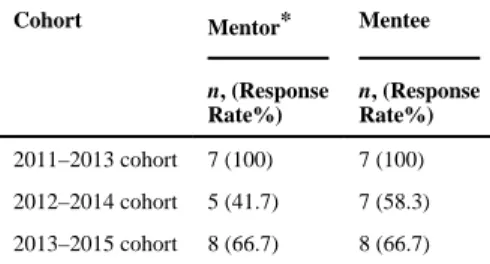
Twenty-two of 31 peer mentees (71%) and 17 of 28 (61%) peer mentors completed the survey. Two of the three individuals (67%) who had served as both a peer mentor and peer mentee responded. The number of respondents across the three cohorts was similar;
however, the within-cohort response rates varied for both mentors and mentees (see Table 1). Characteristics of the sample can be found in Table 2. Mentors on average had 8 years of experience; however, there was a wide range (1–16 years). Most mentors had academic positions, having moved primarily into tenure-track faculty roles after the BAGNC program.
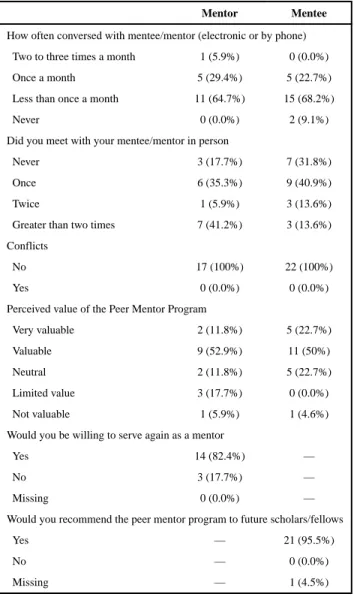
The survey also measured process outcomes and perceived program effectiveness (see Table 3). Most mentees conversed with their mentor either less than once a month or once a month, indicating a limited time commitment for both. Two of the mentees indicated that they never met with their mentor either electronically or in person, although it is unclear why this occurred as no qualitative responses were made regarding this lack of contact. Seven of the mentors and three of the mentees stated they met more than twice and had significant electronic contact. These pairs commented that they had developed highly
A
uthor Man
uscr
ipt
A
uthor Man
uscr
ipt
A
uthor Man
uscr
ipt
A
uthor Man
uscr
effective collaborative relationships, leading to publications or presentations together. However, why some pairings were so highly effective whereas others were not was not elucidated through the survey.
Overall, 64.7% of mentors and 72.7% of mentees found the program to be valuable or very valuable, though more mentees rated the program as valuable than mentors. In addition, all except one (due to missing data) of the mentees indicated willingness to be a part of the program again, and fewer, although still a substantial percentage of mentors (82.4%) responded that they would be willing to serve again as a mentor. Of the three mentors who indicated they would not want to serve again in the program, two indicated time limitations and one indicated not having further interest in external mentorship at that time as they were formally mentoring early career faculty and students at their own institution. One individual stated that peer mentoring was a good stepping-stone in the transition as an early career faculty.
Conflicts within the peer mentoring process were also evaluated. In developing the program, one priority was to ensure the peer mentor did not interfere or serve as a conflict point with the primary mentor of the scholar/fellow (Bryant et al., 2015). No respondents indicated that a conflict had developed during this program.
When examining the open-ended questions, the primary suggestion for improvement by mentors focused on adding more structure with clearer program expectations and definition of how the peer mentor role differentiates from the primary mentor. Mentor respondents suggested this topic be discussed and facilitated by the Peer Mentoring Committee during the initial virtual meeting with mentors and mentees. The mentees identified facilitating mentor-mentee introductions and encouraging mentees to proactively engage their mentors as areas for suggestions for improvement. Both groups also mentioned setting goals at the start of their relationship. Mentees stated that the program had increased the scope of their network, improved their ability to work at a distance in teams, and provided them an opportunity to learn more about research activities and experiences at other institutions.
Discussion
Formal and informal mentoring programs are common in academic settings to support the development and success of early career faculty (Bussey-Jones et al., 2006; Jacelon, Zucker, Staccarini, & Henneman, 2003; Johnson, Hastings, Purser, & Whitson, 2011; Morrison-Beedy, Aronowitz, Dyne, & Mkandawire, 2001; Santucci et al., 2008) and are important in academic gerontological nursing to promote the recruitment, development, and retention of qualified gerontological nursing faculty (Maas et al., 2006). The BAGNC Alumni Peer Mentoring Committee developed the Peer Mentoring Program to supplement the formal faculty-scholar/fellow mentoring relationship and enhance the experience of BAGNC scholars and fellows. The need for this program was identified based on past experiences of the alumni, who felt a support network and greater connection between past and current scholars and fellows would assist current scholars in socializing to the program, allow them to further expand their network, and create opportunities to receive feedback from those outside the formal mentorship structure at their home institution.
A
uthor Man
uscr
ipt
A
uthor Man
uscr
ipt
A
uthor Man
uscr
ipt
A
uthor Man
uscr
Consistent with the framework by McBride (2011) and the definition of peer mentoring provided by Dennison (2010), in which more experienced individuals assist those with less experience, it was believed that peer mentors who had been BAGNC scholars and/or fellows themselves would share their experiences with the new scholars and fellows, help them navigate the program, and provide insight into their experiences during and after program completion.
The Peer Mentoring Program was designed as an informal mentorship program, whereas the faculty-scholar/fellow relationship was a formal vertical mentoring relationship. McLaughlin (2010) distinguishes between formal mentoring which involves assigned mentor/mentee relationships and informal mentoring in which mentoring relationships develop between individuals. Although peer mentors and mentees were ultimately assigned by the Peer Mentoring Committee, mentees had a role in identifying and selecting their peer mentors, and mentors were able to accept or decline serving as an individual’s peer mentor. The scope of the peer mentor role and the peer mentor/mentee relationship was to be cocreated by the mentor/mentee pair (Bryant et al., 2015). By combining the peer mentorship program with the formal mentoring provided in the BAGNC program, it was believed that a collaborative mentoring model would result in pooling of information and shared support between the informal and formal programs, thus empowering both the mentor and mentee (National League for Nursing, 2006). Our evaluation found, however, that while both mentors and mentees enjoyed that the program was more lateral and informal, they also wished for more structure. Providing structure must be carefully balanced with the intent of keeping the relationship informal.
Overall, most mentors and mentees found the peer mentorship program to be valuable for enhancing their skills, research socialization, and expanding their network; key elements of becoming successful early career faculty. This outcome supports the value of peer
mentoring, with peer mentors tending to have more experience than mentees but not so much so that they were removed from the scholar/fellow role and experience. This
corresponds well with other studies about peer mentoring, which had been shown to support success in academic missions as well as work-life balance (Bussey-Jones et al., 2006). The more recently shared experience of the peer mentor, who had on average 8 years of post-doctoral experience likely contributed to this success.
Peer mentoring programs can be very beneficial in assisting mentees in career satisfaction, leadership, and professional and personal development. Mentored faculty engage in scholarly activities much more than those who are not mentored (National League for Nursing, 2006). In addition, peer mentoring can help transition mentees to the mentoring process (Welch, Jimenez, Walthall, & Allen, 2012). This program provided mentorship experiences to early career faculty and post-docs, as well as relevant, meaningful and current advice to those even earlier in their career. Our findings support the importance of peer mentoring programs that are extremely important at a time when a significant proportion of the nursing faculty workforce will retire in coming years (Fang & Bednash, 2014) and the need to train faculty to become mentors earlier in their career takes on a more prescient role.
A
uthor Man
uscr
ipt
A
uthor Man
uscr
ipt
A
uthor Man
uscr
ipt
A
uthor Man
uscr
Program Enhancements
Mentoring for successful mentee outcomes requires the inclusion of a diverse and talented group of mentors. These findings elucidate the benefits and pitfalls of peer mentoring within the Peer Mentoring Program. In the following section, three strategies are proposed to sustain and enhance our program framework to strengthen the gerontological nursing workforce through academic scholarship and leadership.
One theme from our findings is the need to develop a more systematic, structured process for peer mentors. In response to the open-ended questions about program improvement, both peer mentors and mentees indicated that they would like for the Peer Mentoring Program to be more structured. Peer mentors, in particular, expressed a need for clearer expectations regarding the mentor role and the mentor/mentee relationships. Multiple authors have suggested that for peer mentoring to be successful there must be clear expectations and consensus regarding mentor and mentee roles, responsibilities, and relationships (Colvin & Ashman, 2010; Hall, Draper, Smith, & Bullough, 2008; Shelley, 2008; Storrs, Putsche, & Taylor, 2008). Hall et al. (2008) report that without clear roles and responsibilities, peer mentors have difficulty maintaining self-efficacy. Benefits of a structured mentoring model are mutually agreed on goals, expectations, responsibilities, and discussion of potential barriers (Dennison, 2010). Specific programmatic components are recommended for supporting a fruitful and successful peer mentoring relationship, including identifying explicit and clear goals important to the mentee and mentor and developing a plan to achieve those goals. These components allow a mutually rewarding informal relationship to be established and maintained by providing the additional structure identified by the mentors and mentees.
A second strategy is to expand the existing Peer Mentoring Program. In 2015, the alumni group was folded into the NHCGNE. The NHCGNE, a rapidly expanding national organization of nursing schools and programs with more than 60 member institutions, is a perfect structure for growing and disseminating the Peer Mentoring Program. The intent is to deliver the program to early career individuals including gerontological faculty, pre-doctoral students, and postdoctoral fellows at NHCGNE member institutions. The committee will be able to use the additional resources of the NHCGNE for facilitating more communication within the program including online discussion forums where mentors can initiate group discussions focused on best practices in mentoring, work with new member schools to identify mentoring needs for novice faculty, and match those needs to resources and mentors within NHCGNE.
Third, the committee will seek to expand this program to new faculty who are prepared in doctor of nursing practice (DNP) programs. Preparation of doctorally prepared nurses has accelerated since the 2004 approval of the DNP and The Future of Nursing report calling for the doubling of doctorally prepared nurses by 2020 (Institute of Medicine, 2010). DNP graduates account for most of this growth. Smeltzer et al. (2015) reported increasing numbers of DNP graduates in faculty positions and that these faculty were more likely to be engaged in evidence-based clinical practice improvement projects focused on the care of older adults than research studies (Smeltzer et al., 2015). The likelihood that DNP-prepared gerontological nursing faculty will be expected to move their work into funded research
A
uthor Man
uscr
ipt
A
uthor Man
uscr
ipt
A
uthor Man
uscr
ipt
A
uthor Man
uscr
indicates a niche for peer mentoring in which more established DNP and research faculty serve as part of a mentoring team invested in the academic success of the novice faculty member.
Expansion to Other Nursing Specialties and Disciplines
Although this program has been focused on enhancing mentoring in geriatric nursing, the structure of the program and lessons learned are equally applicable to other areas of nursing as well as other health care fields, including but not limited to medicine; pharmacy; social work; and physical, occupational, and speech therapies. There is a clear need across health care disciplines to provide both vertical and lateral peer mentoring. By providing lateral mentoring that crosses institutional boundaries, individuals early in their academic career are provided opportunities to expand their networks, be exposed to a diversity of thought and methodology, and become aware of different career opportunities and/or collaborations. These types of programs can potentially be set up through specialty societies, professional education organizations, consortiums of schools (similar to the NHCGNE), or other like-minded organizations. Furthermore, although there is some manpower required for setting up the programs and hosting them, there are limited costs associated with the programs themselves as the mentors and mentees are all volunteers. The only significant costs incurred by the all-volunteer Peer Mentoring Committee are related to: (a) committee conference call costs, (b) webinars, which are held initially to introduce individuals to the program and at least quarterly thereafter for peer mentors to improve their mentoring capabilities, and (c) copies of mentor materials such as the book, The Growth and Development of Nurse Leaders (McBride, 2011), the program has distributed to each peer mentor to use both personally and to assist them in their role as a peer mentor.
Limitations
There were several limitations in this program evaluation. First, although response rates were overall high, the sample size was small, which limited our ability to examine how demographic factors might effect outcomes. Second, the evaluation was succinct by design to evaluate the key elements of the program, which limited our ability to more fully understand certain findings. For instance, we were not able to clarify why some individuals never contacted their peer mentor or did not find the program valuable. Third, the program was limited to a high performing group of externally funded individuals in the BAGNC program, and thus, there is limited knowledge of how the program will change as it is opened up to additional early career individuals.
Conclusion
Peer mentoring is a valuable experience for both the mentor and mentee in that it provides early career individuals with mentoring experience, and helps mentees develop professional networks, research collaborations, and diversity of thought. The NHCGNE Peer Mentoring Program will serve as a resource and benefit for member schools of the NHCGNE as an effective avenue for providing upcoming geriatric nursing academicians and researchers an opportunity to obtain lateral mentoring. Furthermore, the evaluation of the first 3 years of this program shows there is significant potential for the program to be expanded within the
A
uthor Man
uscr
ipt
A
uthor Man
uscr
ipt
A
uthor Man
uscr
ipt
A
uthor Man
uscr
NHCGNE, as well as a model for other areas of nursing and health care fields, thus improving the mentoring and potential success of early career researchers and academics at the predoctoral, postdoctoral, and faculty level.
Acknowledgments
The authors would like to acknowledge the John A Hartford Foundation for its generous funding of this program, and the administrative support provided by the National Hartford Center of Gerontological Nursing Excellence.
References
1. American Association of Colleges of Nursing. Nursing faculty shortage fact sheet. 2014. Retrieved from http://www.aacn.nche.edu/media-relations/FacultyShortageFS.pdf
2. Boyden KM. Development of new faculty in higher education. Journal of Professional Nursing. 2000; 16(2):104–111. [PubMed: 10748572]
3. Brock T, Assemi M, Corelli R, El-Ibiary S, Kavookjian J, Martin B, Judmon K. A non traditional faculty development initiative using a social media platform. American Journal of Pharmaceutical Education. 2014; 78(5):105. [PubMed: 24954945]
4. Bryant AL, Aizer Brody A, Perez A, Shillam C, Edelman LS, Bond SM, Siegel EO. Development and implementation of a Peer Mentoring Program for early career gerontological faculty. Journal of Nursing Scholarship. 2015; 47(3):258–266. [PubMed: 25808927]
5. Bussey-Jones J, Bernstein L, Higgins S, Malebranche D, Paranjape A, Genao I, Branch W. Repaving the road to academic success: The IMeRGE approach to peer mentoring. Academic Medicine. 2006; 81(7):674–679. [PubMed: 16799297]
6. Byrne MW, Keefe MR. Building research competence in nursing through mentoring. Journal of Nursing Scholarship. 2002; 34(4):391–396. [PubMed: 12501744]
7. Colvin JW, Ashman M. Roles, risks, and benefits of peer mentoring relationships in higher education. Mentoring & Tutoring: Partnership in Learning. 2010; 18(2):121–134.
8. Dennison S. Peer mentoring: Untapped potential. Journal of Nursing Education. 2010; 49(6):340– 342. [PubMed: 20210287]
9. Drummond-Young M, Brown B, Noesgaard C, Lunyk-Child O, Maich NM, Mines C, Linton J. A comprehensive faculty development model for nursing education. Journal of Professional Nursing. 2010; 26(3):152–161. [PubMed: 20488424]
10. Fang D, Bednash GD. Attrition of full-time faculty from schools of nursing with baccalaureate and graduate programs, 2010 to2011. Nursing Outlook. 2014; 62(3):164–173. [PubMed: 24564921] 11. Franklin PD, Archbold PG, Fagin CM, Galik E, Siegel E, Sofaer S, Firminger K. Building
academic geriatric nursing capacity: Results after the first 10 years and implications for the future. Nursing Outlook. 2011; 59(4):198–205. [PubMed: 21757074]
12. Hall KM, Draper RJ, Smith LK, Bullough RV. More than a place to teach: Exploring the
perceptions of the roles and responsibilities of mentor teachers. Mentoring & Tutoring: Partnership in Learning. 2008; 16(3):328–345.
13. Institute of Medicine. The future of nursing: Leading change, advancing health. Washington, DC: The National Academies Press; 2010.
14. Jacelon CS, Zucker DM, Staccarini JM, Henneman EA. Peer mentoring for tenure-track faculty. Journal of Professional Nursing. 2003; 19(6):335–338. Retrieved from http://
www.ncbi.nlm.nih.gov/pubmed/14689389. [PubMed: 14689389]
15. Johnson KS, Hastings SN, Purser JL, Whitson HE. The Junior Faculty Laboratory: An innovative model of peer mentoring. Academic Medicine. 2011; 86(12):1577–1582. [PubMed: 22030756] 16. Maas ML, Strumpf NE, Beck C, Jennings D, Messecar D, Swanson E. Mentoring geriatric nurse
scientists, educators, clinicians, and leaders in the John A. Hartford Foundation Centers for Geriatric Nursing Excellence. Nursing Outlook. 2006; 54(4):183–188. [PubMed: 16890036] 17. McBride, AB. The growth and development of nurse leaders. New York: Springer Pub. Co.; 2011.
A
uthor Man
uscr
ipt
A
uthor Man
uscr
ipt
A
uthor Man
uscr
ipt
A
uthor Man
uscr
18. McLaughlin C. Mentoring: What is it? How do we do it and how do we get more of it? Health Services Research. 2010; 45(3):871–884. [PubMed: 20337731]
19. Morrison-Beedy D, Aronowitz T, Dyne J, Mkandawire L. Mentoring students and junior faculty in faculty research: A win-win scenario. Journal of Professional Nursing. 2001; 17(6):291–296. [PubMed: 11712114]
20. National League for Nursing. Position statement. New York, NY: National League of Nursing Press; 2006. Mentoring of nurse faculty.
21. Sambunjak D, Straus SE, Marusic A. Mentoring in academic medicine: A systematic review. JAMA. 2006; 296(9):1103–1115. [PubMed: 16954490]
22. Santucci AK, Lingler JH, Schmidt KL, Nolan BA, Thatcher D, Polk DE. Peer-mentored research development meeting: A model for successful peer mentoring among junior level researchers. Academic Psychiatry. 2008; 32(6):493–497. [PubMed: 19190294]
23. Shelley RE. Mentoring peer mentors: Mentor education and support in the composition program. Composition Studies. 2008; 36:51–79.
24. Smeltzer SC, Sharts-Hopko NC, Cantrell MA, Heverly MA, Nthenge S, Jenkinson A. A profile of U.S. nursing faculty in research- and practice-focused doctoral education. Journal of Nursing Scholarship. 2015; 47(2):178–185. [PubMed: 25641233]
25. Storrs D, Putsche L, Taylor A. Mentoring expectations and realities: An analysis of metaphorical thinking among female undergraduate protegés and their mentors in a university mentoring programme. Mentoring & Tutoring: Partnership in Learning. 2008; 16(2):175–187.
26. Welch JL, Jimenez HL, Walthall J, Allen SE. The women in emergency medicine mentoring program: An innovative approach to mentoring. Journal of Graduate Medical Education. 2012; 4(3):362–366. [PubMed: 23997883]
A
uthor Man
uscr
ipt
A
uthor Man
uscr
ipt
A
uthor Man
uscr
ipt
A
uthor Man
uscr
A
uthor Man
uscr
ipt
A
uthor Man
uscr
ipt
A
uthor Man
uscr
ipt
A
uthor Man
uscr
ipt
Table 1
Cohort Responses
Cohort Mentor* Mentee
n, (Response Rate%)
n, (Response Rate%)
2011–2013 cohort 7 (100) 7 (100)
2012–2014 cohort 5 (41.7) 7 (58.3)
2013–2015 cohort 8 (66.7) 8 (66.7)
*
A
uthor Man
uscr
ipt
A
uthor Man
uscr
ipt
A
uthor Man
uscr
ipt
A
uthor Man
uscr
ipt
Table 2
Characteristics of Mentors and Mentees
Characteristics Mentor Mentee
Had been an Archbold Scholar 3 (17.7%) 12 (54.6%)
Had been a Fagin Fellow 8 (47.1%) 7 (31.8%)
Were both a Archbold Scholar and Fagin Fellow 6 (35.3%) 3 (16.6%)
Mean years since completion of PhD 8.2 (range 1–16; SD 4.5) —
First position post PhD
Tenure track faculty 11 (64.7%) —
Clinical faculty 3 (17.6%) —
Post doc 2 (11.8%) —
Clinical research setting 1 (5.9%) —
Type of mentor/mentee
Scholar 10 (58.8%) 12 (54.5%)
Fellow 6 (35.3%) 10 (45.5%)
A
uthor Man
uscr
ipt
A
uthor Man
uscr
ipt
A
uthor Man
uscr
ipt
A
uthor Man
uscr
ipt
Table 3
Process and Outcome Measures
Mentor Mentee
How often conversed with mentee/mentor (electronic or by phone)
Two to three times a month 1 (5.9%) 0 (0.0%)
Once a month 5 (29.4%) 5 (22.7%)
Less than once a month 11 (64.7%) 15 (68.2%)
Never 0 (0.0%) 2 (9.1%)
Did you meet with your mentee/mentor in person
Never 3 (17.7%) 7 (31.8%)
Once 6 (35.3%) 9 (40.9%)
Twice 1 (5.9%) 3 (13.6%)
Greater than two times 7 (41.2%) 3 (13.6%)
Conflicts
No 17 (100%) 22 (100%)
Yes 0 (0.0%) 0 (0.0%)
Perceived value of the Peer Mentor Program
Very valuable 2 (11.8%) 5 (22.7%)
Valuable 9 (52.9%) 11 (50%)
Neutral 2 (11.8%) 5 (22.7%)
Limited value 3 (17.7%) 0 (0.0%)
Not valuable 1 (5.9%) 1 (4.6%)
Would you be willing to serve again as a mentor
Yes 14 (82.4%) —
No 3 (17.7%) —
Missing 0 (0.0%) —
Would you recommend the peer mentor program to future scholars/fellows
Yes — 21 (95.5%)
No — 0 (0.0%)