BOOKS ABOUT MUSIC IN RENAISSANCE PRINT CULTURE: AUTHORS, PRINTERS, AND READERS
Samuel J. Brannon
A dissertation submitted to the faculty of the University of North Carolina at Chapel Hill in partial fulfillment of the requirements for the degree of Doctor of Philosophy
in the Department of Music in the College of Arts and Sciences.
Chapel Hill 2016
Approved by: Anne MacNeil Mark Evan Bonds Tim Carter
ABSTRACT
Samuel J. Brannon: Books about Music in Renaissance Print Culture: Authors, Printers, and Readers
(Under the direction of Anne MacNeil)
This study examines the ways that printing technology affected the relationship between Renaissance authors of books about music and their readers. I argue that the proliferation of books by past and then-present authors and emerging expectations of textual and logical coherence led to the coalescence and formalization of music theory as a field of inquiry. By comparing multiple copies of single books about music, I show how readers employed a wide range of strategies to understand the often confusing subject of music. Similarly, I show how their authors and printers responded in turn, making their books more readable and user-friendly while attempting to profit from the enterprise. In exploring the complex negotiations among authors of books about music, their printers, and their readers, I seek to demonstrate how printing technology enabled authors and readers to engage with one another in unprecedented and
meaningful ways.
I aim to bring studies of Renaissance music into greater dialogue with the history of the book. Renaissance books about music combine text, sound, and image in ways that resonate with contemporary developments in literary, philosophical, and scientific books. I show that
ACKNOWLEDGEMENTS
It is a pleasure to recognize those individuals and institutions that have supported this project. I have received constant support from various organizations within the University of North Carolina at Chapel Hill—the Graduate School, the Department of Music, and the Program in Medieval and Early Modern Studies allowed me to conduct research across the globe, provided time and space to think, and contributed generous research and financial assistance at several critical junctures. A Charles Montgomery Gray Fellowship from the Newberry Library allowed me to complete a large portion of research on their significant collection of Renaissance books about music. An Alvin H. Johnson AMS 50 Dissertation Fellowship from the American Musicological Society afforded me the opportunity to complete this project unencumbered by other distractions.
facilitated access to materials at the Biblioteca del Conservatorio “Benedetto Marcello” while the library was under renovation. Elisabetta Caldelli (Biblioteca Vallicelliana) and Samantha
Gilchrist (Special Collections, University of Glasgow Library) provided detailed bibliographical assistance through correspondence. Susan Clermont (Music Division, Library of Congress), David Peter Coppen (Sibley Music Library, Eastman School of Music, University of Rochester), and Carla Zecher (Newberry Library) helped to shepherd me through the enormous collections at their respective libraries. Here at the University of North Carolina at Chapel Hill, Emily Kader and Kathleen Monahan, both of the Special Collections Library, provided generous access to the University’s rare books and directed my attention to some interesting uncataloged finds. Diane Steinhaus and Carrie Monette, both of the Music Library, provided reference assistance, answered innumerable queries, and made helpful suggestions at several stages.
A number of scholars and friends provided invaluable advice. I was the fortunate recipient of kind critiques on early drafts of chapters from several graduate-student colleagues, particularly Molly Barnes, Megan Eagan, Matthew Franke, and Oren Vinogradov. I am
My dissertation advisor, Anne MacNeil, has gone above and beyond in seeing this project from its initial inception in a seminar paper through to completion. I am thankful for her instinctive ability to sense when I needed space to work, for prodding me gently along the process, and for several final pushes as this project drew to completion.
TABLE OF CONTENTS
LIST OF TABLES ... xi
LIST OF FIGURES ... xii
LIST OF ABBREVIATIONS ... xiv
LIST OF LIBRARY SIGLA ... xvi
NOTE ON REFERENCES AND TRANSCRIPTIONS...xx
CHAPTER ONE: INTRODUCTION ...1
Books about music and incipient print culture ...5
Materializing theory, theorizing materiality ...20
Chapter overviews ...32
CHAPTER TWO: AUTHORS ...35
The evolution of music theory books as printed objects ...37
Framing devices: Title pages, colophons, and visual decoration ...38
Organizational devices: Indices, textual segmentation, and marginal annotation ...48
Taming the printed beast: Lusitano, Vicentino, and Danckerts ...57
Lusitano’s “Regina coeli” (1551) and Introduttione (1553) ...57
Vicentino’s L’antica musica (1555) ...67
Danckerts’s manuscripts ...74
Crafting Zarlino’s legacy ...91
CHAPTER THREE: PRINTERS ...105
Book design in Renaissance books about music...106
Basic elements of book design ...107
The scholastic page ...114
The humanistic page ...118
The dialogic page ...123
Section summary ...129
The struggle for score format ...131
Marketing music theory ...149
Market segmentation at Rome and Venice ...150
Cross-promotion and product bundling in Franceschi’s Zarlino editions ...165
Conclusion ...177
CHAPTER FOUR: READERS ...179
Patterns in ownership ...182
Octavo format ...184
Quarto format ...186
Folio format ...191
Bibliographical format and scholarly value ...195
Patterns in book-use ...196
Textual marks...199
Musical marks ...210
Customizations ...216
Silent reading and musical examples ...221
Iconic function ...223
Textual function ...230
Digestive function ...237
Demonstration ...241
Conclusion ...248
CHAPTER FIVE: CONCLUSION...250
APPENDIX ONE: BOOKS IN THE LIVES OF MUSIC THEORISTS ...262
Ghiselin Danckerts (c. 1510–1567) ...262
Franchinus Gaffurius (1451–1522) ...271
Heinrich Glarean (1488–1563) ...282
Vicente Lusitano (c. 1520–after 1561) ...290
Oratio Tigrini (1541–1591) ...299
Nicola Vicentino (1511–c. 1576) ...309
Gioseffo Zarlino (1517–1590) ...317
APPENDIX TWO: THE DISSEMINATION OF MUSIC THEORY IN PRINT ...326
APPENDIX THREE: EARLY OWNERS, READERS, AND REFERENCES ...335
LIST OF TABLES Table
1.1 Production of books about music throughout Europe by decade ...9
1.2 European cities producing the most books about music, 1474–1609 ...11
2.1 Illustrative material in part two of Ghiselin Danckerts’s manuscripts ...84
2.2 Summary of editions of Gioseffo Zarlino, Le istitutioni harmoniche ...92
3.1 One classic example of proportional page design ...109
3.2 Music treatises published at Rome during the 1550s...152
3.3 Selected single-composer prints of Amadino and Vincenti ...160
4.1 Contemporary reading list in a copy of Heinrich Faber, Compendiolum musicae (1575) ...219
4.2 Binder’s volume of music treatises belonging to Abraham Ursinus ...220
A1.1 Structure and contents of Danckerts’s manuscripts at I-Rv, Ms. R56 ...266–268 A1.2 Single-author publications of Franchinus Gaffurius ...276
A1.3 Single-author publications of Oratio Tigrini ...301
A1.4 Single-author publications of Nicola Vicentino ...313
A1.5 Surviving books owned by Gioseffo Zarlino ...319
LIST OF FIGURES Figure
2.1 Portrait of Pietro Aaron ...44
2.2 Title page of Heinrich Glarean, Dodecachordon (1547) ...46
2.3 Excerpt from Vicente Lusitano, “Hic est Michael” ...61
2.4 Excerpt from Vicente Lusitano, “Regina caeli” ...62
2.5 Excerpt from Vicente Lusitano, Introduttione facilissima (1553) ...67
2.6 Ghiselin Danckerts’s partial gamut, first draft ...87
2.7 Ghiselin Danckerts’s scalar genera, second draft ...87
2.8 Ghiselin Danckerts’s scalar genera, third draft ...88
2.9 Comparison of title pages to Gioseffo Zarlino, Istitutioni harmoniche (1573) and Dimostrationi harmoniche (1571)...95
2.10 Comparison of page layouts in Gioseffo Zarlino, Istitutioni harmoniche (1558 and 1573) ...97
3.1 The scholastic page ...116
3.2 The humanistic page ...119
3.3 The dialogic page ...124
3.4 Another example of the dialogic page ...126
3.5 Woodcut polyphonic musical example ...133
3.6 Transcription of figure 3.5 ...134
3.7 Woodcut demonstration of two-voice counterpoint ...136
3.8 Run-in musical examples using single-impression moveable musical type ...139
3.9 Inset polyphonic musical example ...139
3.10 Score and tablature made from single-impression moveable musical type ...140
3.12 Illustration of rules for counterpoint using nested single-impression
moveable musical type ...143
3.13 Illustration of rules for counterpoint using single-impression moveable musical type and copperplate engravings ...144
3.14 Error corrected by overprinting ...145
4.1 Excerpt from a liber amicorum attached to a copy of Martin Agricola’s Musica instrumentalis deudsch (1572) ...187
4.2 Two modes of reading in Geoffrey Whitney’s A Choice of Emblemes (1586) ...198
4.3 Three manicules in a copy of Giovanni Maria Lanfranco’s Scintille di musica (1533) ...201
4.4 Anonymous manuscript annotations to the Guidonian integer sequence ...205
4.5 Portrait of the “active scholar” ...207
4.6 Anonymous hand-coloration and unfinished drawing ...208
4.7 Traces of unintended uses in Thomas Morley’s Introduction (1597)...209
4.8 Solmization syllables and organ tablature added to a musical example ...211
4.9 Bar lines added to a musical example ...212
4.10 Numerals between staves and bar lines added to a musical example ...214
4.11 A canon rewritten in barred score format ...215
4.12 Nicola Vicentino’s examples of the imperfect fifth ...229
4.13 Possible solutions to figure 4.12 ...229–230 4.14 Nicola Vicentino’s textless example of the diatonic genus ...243
4.15 Transcription of figure 4.14 ...244–246 A1.1 Franchinus Gaffurius seated at the organ ...278
A1.2 Franchinus Gaffurius teaching a group of schoolboys ...279
A1.3 Franchinus Gaffurius teaching a group of students ...280
LIST OF ABBREVIATIONS
cent. century/centuries compl. complete
ed./eds. edition/editions
EDIT16 Censimento nazionale delle edizioni italiane del XVI secolo, Istituto Centrale per il Catalogo Unico delle Biblioteche Italiane e per le Informazioni Bibliografiche, http://edit16.iccu.sbn.it/
endp. endpaper/endpapers (the free leaf of paper the conjugate of which is pasted to the inside front or back cover)
fl. floruit (approximate time of an individual’s activity)
flyl. flyleaf/flyleaves (leaves at the front or back of a volume that are neither endpapers nor supplied by the printer)
fol. folio/folios illeg. illegible
ISTC Incunabula Short Title Catalogue, The British Library, http://www.bl.uk/catalogues/istc/
l./ll. line/lines
ℓ./ℓℓ. leaf/leaves (a sheet or part of a sheet composed of two pages, a recto and verso) m./mm. measure/measures
no. number
p./pp. page/pages
r recto (the front of a leaf)
RISM Répertoire International des Sources Musicales. References beginning with dates are to series B/I, Recueils imprimés XVIe–XVIIe siècles, ed. François Lesure
s.d. sine dato (no date of publication given) s.l. sine loco (no place of publication given)
s.n. sine nomine (no name of printer or publisher given)
sig. signature/signatures (the letter assigned to a gathering, typically by sequence) t.p. title page
USTC Universal Short Title Catalogue, http://ustc.ac.uk/index.php/search v verso (the back of a leaf)
VD16 Verzeichnis der im deutschen Sprachbereich erschienenen Drucke des 16. Jahrhunderts, BibliotheksVerbund Bayern,
LIST OF LIBRARY SIGLA
A-Gu Universitätsbibliothek (Graz, Austria)
A-Wn Österreichische Nationalbibliothek (Vienna, Austria) B-Ac Koninklijk Conservatorium (Antwerp, Belgium)
B-Bc Bibliothèque du Conservatoire royal de musique de Bruxelles (Brussels, Belgium) B-Gu Universiteitsbibliotheek (Ghent, Belgium)
B-Lc Bibliothèque du Conservatoire royal de musique de Liège (Liège, Belgium) CH-BEsu Universitätsbibliothek (Bern, Switzerland)
CH-Sk Archives du chapitre de la Cathédrale (Sion, Switzerland) CH-SGs Stiftsbibliothek (St. Gallen, Switzerland)
CH-SO Historische Musiksammlung, Zentralbibliothek (Solothurn, Switzerland) CH-Zz Musikabteilung, Zentralbibliothek (Zurich, Switzerland)
CZ-Bm Moravské zemské muzeum, oddělení dějin hudby (Brno, Czech Republic) D-B Musikabteilung, Preußischer Kulturbesitz, Staatsbibliothek zu Berlin
(Berlin, Germany)
D-DI Studienbibliothek (Dillingen an der Donau, Germany)
D-HAu Universitäts- und Landesbibliothek, Sachsen-Anhalt (Halle, Germany) D-Mbs Musiksammlung, Bayerische Staatsbibliothek (Munich, Germany)
D-Mu Universitätsbibliothek, Ludwig-Maximilians-Universität (Munich, Germany) D-OB Bibliothek, Benediktinerabtei (Ottobeuren, Germany)
D-Sl Württembergische Landesbibliothek (Stuttgart, Germany) D-W Herzog August Bibliothek (Wolfenbüttel, Germany) E-Bbc Biblioteca de Catalunya (Barcelona, Spain)
E-Msi Biblioteca de San Isidoro, Universidad Complutense (Madrid, Spain) E-SA Archivo y Biblioteca de la Catedral de Salamanca (Salamanca, Spain) F-ASOlang Bibliothèque musicale François Lang (Asnières-sur-Oise, France) F-Pm Bibliothèque Mazarine (Paris, France)
F-Pn Bibliothèque nationale de France (Paris, France) F-TLm Bibliothèque Municipale (Toulouse, France) GB-Cfm Fitzwilliam Museum (Cambridge, UK)
GB-Cjc St. John’s College, Cambridge University Library (Cambridge, UK) GB-Cu Cambridge University Library (Cambridge, UK)
GB-Gu University Library (Glasgow, UK) GB-Lbl The British Library (London, UK) GB-Lcm Royal College of Music (London, UK) GB-R University of Reading Library (Reading, UK) I-Ac Fondo Antico, Biblioteca Comunale (Assisi, Italy)
I-Bc Museo Internazionale e Biblioteca della Musica (Bologna, Italy) I-Bu Biblioteca Universitaria (Bologna, Italy)
I-Fc Biblioteca del Conservatorio di Musica “Luigi Cherubini” (Florence, Italy) I-Fm Biblioteca Marucelliana (Florence, Italy)
I-Fn Biblioteca Nazionale Centrale (Florence, Italy) I-Fr Biblioteca Riccardiana (Florence, Italy)
I-FOc Biblioteca Comunale Aurelio Saffi (Forlì, Italy) I-LOcl Biblioteca Comunale Laudense (Lodi, Italy)
I-Mc Biblioteca del Conservatorio Statale di Musica “Giuseppe Verdi” (Milan, Italy) I-MOe Biblioteca Estense (Modena, Italy)
I-OS Biblioteca Musicale “Giuseppe Greggiati” (Ostiglia, Italy) I-Rc Biblioteca Casanatense (Rome, Italy)
I-Rn Biblioteca Nazionale Centrale (Rome, Italy)
I-Rsc Biblioteca del Conservatorio “Santa Cecilia” (Rome, Italy) I-Rv Biblioteca Vallicelliana (Rome, Italy)
I-Rvat Biblioteca Apostolica Vaticana (Vatican City, Italy) I-TVd Biblioteca Capitolare del Duomo (Treviso, Italy) I-Vas Archivio di Stato (Venice, Italy)
I-Vc Biblioteca del Conservatorio “Benedetto Marcello” (Venice, Italy) I-Vgc Biblioteca della Fondazione Giorgio Cini (Venice, Italy)
I-Vnm Biblioteca Nazionale Marciana (Venice, Italy) NL-Au Universiteitsbibliotheek (Amsterdam, Netherlands) NL-Uu Universiteitsbibliotheek (Utrecht, Netherlands) P-Ln Biblioteca Nacional de Portugal (Lisbon, Portugal)
US-AAu Music Library and Special Collections, University of Michigan (Ann Arbor, MI) US-Bp Music Department, Boston Public Library (Boston, MA)
US-Cn Newberry Library (Chicago, IL)
US-CAh Houghton Library, Harvard University (Cambridge, MA)
US-CHH Wilson Library, University of North Carolina at Chapel Hill (Chapel Hill, NC) US-DMurl David M. Rubenstein Rare Book and Manuscript Library, Duke University
(Durham, NC)
US-DN Music Library, North Texas State University (Denton, TX) US-I Carl A. Kroch Library, Cornell University (Ithaca, NY)
US-LAuc William Andrews Clark Memorial Library, University of California (Los Angeles, CA)
US-NH Yale University Libraries (New Haven, CT)
US-NYp New York Public Library for the Performing Arts (New York City, NY) US-NYq Paul Klapper Library, Queens College of the City University
(New York City, NY)
US-PHu University of Pennsylvania Libraries (Philadelphia, PA)
US-R Sibley Music Library, Eastman School of Music, University of Rochester (Rochester, NY)
US-Wcm Music Division, Library of Congress (Washington, D.C.) US-Ws Folger Shakespeare Library (Washington, D.C.)
NOTE ON REFERENCES AND TRANSCRIPTIONS
In the interest of space, all references are given in shortened form; full citations may be found in the bibliography. Page references to books printed before 1800 follow the pagination or foliation employed by the books themselves. Signatures (e.g., “sig. A1v”) refer to the specific pages of gatherings in books with absent or inconsistent pagination or foliation. Following bibliographical convention, signatures with duplicate letters are reduced simply to a number and single letter (e.g., “Aa” becomes “2A” and “bbb” becomes “3b”). The Greek letter pi (π) is assigned to a preliminary gathering that is unsigned or signed non-alphabetically; the Greek letter chi (χ) is assigned to an unsigned gathering that interrupts or follows a sequence of gatherings signed alphabetically. Multiple gatherings in these locations follow the convention for signatures with duplicate letters: e.g., sig. 2π1v is the verso of the first leaf of the second preliminary gathering; sig. 3χ4r is the recto of the fourth leaf of the third interpolated gathering. Page or folio numbers given in brackets are implied; for example, p. [102] refers to the unnumbered page that appears overleaf the page numbered 101.
punctuation, diacritical marks). In both kinds of transcriptions, the vertical bar ( | ) indicates the location of a line break; a double vertical bar ( || ) indicates a line break with additional
intervening whitespace. Square brackets indicate the addition of material not found in the
original text (clarifications of meaning, descriptions of typographical features such as ornaments, borders, rules, illustrations, etc.) Where no source of a translation is identified, the translation is my own.
CHAPTER ONE: INTRODUCTION
In 1474, the Venetian scribe Filippo de Strata issued a memorandum to the Doge of Venice,
Nicolò Marcello. Johannes Gutenberg’s “ars scribendi artificialiter” had arrived there in 1469
from Germany and Rome, touching off an economic boom in the book trade. Only five years
later, Filippo offered a bleak assessment of the situation:
Indeed, writing, which brings in gold for us, should be respected and held to be nobler than all goods, unless she has suffered degradation in the brothel of the printing presses. She is a maiden with a pen, a harlot in print…This is what the printing presses do: they corrupt susceptible hearts. Yet the (let us say) silly asses do not see this, and brutes rejoice in the fraudulent title of teachers, exalting themselves with a song like this (be so good as to listen): “O good citizens,
rejoice: your city is well stuffed with books. For a small sum men turn themselves into doctors in three years. Let thanks be rendered to the printers!” Any
uncultured person without Latin bawls these things. I propose a very different song: “Never has the city had so small a number of books as at this time, or even of people wanting books.” The printing presses are giving us a city without cash and without a heart. If you are the kind of person who expects light to come to you out of darkness, then it will come to you from printed books.1
Of course, an ulterior motive lurked behind Filippo’s misguided attempt to persuade Venetian
authorities to ban printed books and their makers from the city: the corrupting influence of the
medium aside, printed books were bad news for scribes unwilling to embrace technological
change. Filippo’s letter unwittingly bears witness to the irrevocable impact of printing
technology on communication, knowledge, and learning during the Renaissance.
In this dissertation, I assess the relationship between Renaissance books about music and
the dissemination of printing technology. By “books about music,” I mean printed books that
explore substantially the topic of music in any kind of discursive or literary framework (treatise,
dialogue, letters, primer, method, poetry, etc.). This definition includes both entire works
devoted to the subject of music and extended discussions of music in books ostensibly about
other subjects. This definition does not encompass brief discussions of, or passing references to,
music in longer works, although I do consider these from time to time in this dissertation. For
example, I do not consider either Francesco Spinacino’s Intabulatura de lauto libro primo
(RISM 15075) or John Day’s The Whole Booke of Psalmes (1562) to be books about music simply because they include short primers on playing the lute or on singing the psalms. Instead, I
view both of these as “books of music,” by which I mean printed books consisting entirely or
mostly of musical texts, whether destined for performance, study, or some other use. Although I
consider books about music and books of music to be separate classes of music books, during the
Renaissance there existed a mutually dependent relationship between them; this is an important
theme I pursue in this dissertation.
I argue that Renaissance books about music as material artifacts provide extensive
evidence of intense interactions among their producers, distributors, and consumers. This thesis
challenges a number of assumptions common in music scholarship: (1) that books in general, and
books about music in particular, are neutral vehicles for containing ideas, and that the medium is
distinct from the messages they transmit; (2) that printing technology ossified patterns of textual
nature of authorship and the process of writing was divorced from concerns about the
dissemination and reception of the works that resulted. Books about music have yet to play a
significant role in the literature on music and print culture during the Renaissance. I show,
however, that books about music provide far greater evidence of use and reader engagement than
books of music and thus are important sources for studying the history of all kinds of music
books during the Renaissance. The primary category of evidence that I consider is the
bibliographical analysis of the material condition of surviving copies of Renaissance books about
music. Over the course of three years, I conducted an international survey of Renaissance books
about music at a number of major repositories. By comparing multiple copies of single books
about music, I show how readers employed a wide range of strategies to understand the often
confusing subject of music. Similarly, I show how authors and printers responded in turn,
making their books more readable and user-friendly while attempting to profit from the
enterprise. In exploring the complex negotiations among writers about music, their printers, and
their readers, I seek to demonstrate how printing technology enabled authors and readers to
engage with one another in unprecedented and meaningful ways.
These attempts to diagnose and to solve the unique challenges of writing and reading
about music constitute a critical and little-examined chapter in the history of the book. This
dissertation contributes to a growing body of literature that integrates early-modern music and
print culture into a rich and more general historical context. My research complements previous
scholarship through close attention to the material condition of surviving exemplars, which
testify to developments in the reading practices of professional musicians and lay audiences
during the sixteenth century. Similarly, this dissertation contributes to discussions of the
within the wider marketplace of print. Renaissance books about music combine text, sound, and
image in ways that resonate with contemporary developments in literary, philosophical, and
scientific books. I show that Renaissance writers about music grappled early on with issues that
also plagued (and continue to vex) authors in all fields: engaging unknown and distant readers,
writing clearly about difficult subjects, and publishing timely and commercially viable texts. The
introduction of textual and paratextual features by authors, technical innovations by printers, and
heavy annotations by readers all demonstrate each party reaching out across the page to the
others.
I propose that these interactions occurred by means of a communications circuit, a
concept first theorized by Robert Darnton and refined by scholars such as Thomas R. Adams and
Nicholas Barker, Roger Chartier, and Adriaan van der Weel.2 The communication circuit is “a general model for analyzing the way books come into being and spread though society” (67).
The path of the circuit follows the possession of textual artifacts, from authors, editors,
publishers, printers, shippers, booksellers, binders, and finally to readers. At the center, shaping
the entire process, are three overarching and overlapping factors: the intellectual, economic, and
political frameworks in which books existed (68). The most important feature of this model is its
circularity, the necessity of individuals to assume multiple roles as producers, distributors, and
consumers of texts. Darnton argues that awareness of this cyclic process prompted specific
reactions from individuals, changes to their behavior, which are the proper subject of the history
of printed books:
2 Darnton, “What is the History of Books?” (subsequent page references given parenthetically in-text); Adams and
It [the communications circuit] transmits messages, transforming them en route, as they pass from thought to writing to printed characters and back to thought again. Book history concerns each phase of this process and the process as a whole, in all its variations over space and time and in all its relations with other systems, economic, social, political, and cultural, in the surrounding
environment…But the parts do not take on their full significance unless they are related to the whole, and some holistic view of the book as a means of
communication seems necessary if book history is to avoid being fragmented into esoteric specialization, cut off from each other by arcane techniques and mutual misunderstanding. (67)
At the core of this dissertation are analyses of three central figures in the communication circuit
surrounding Renaissance books about music: the author, the printer, and the reader. My goal is to
capture something of the dynamism inherent in these roles—that is, I hope not only to show what
it meant to be an author, printer, or reader of books about music during the Renaissance, but also
to show how authors acted as publishers and readers; how printers acted as authors and readers;
and how readers acted as authors and publishers. In this chapter, I provide an introduction to
Renaissance books about music themselves, surveying their geographical and chronological
dissemination, their general content, and their historical development. I then turn to a review of
the literature on Renaissance writings about music and print culture. Finally, I provide a
summary of each chapter and trace the lines of argument that connect these chapters.
Books about music and incipient print culture
At the time of Filippo de Strata’s letter, music was making only its first tentative steps into the
world of commercial printing. Before the emergence of Ottaviano Petrucci’s press at Venice
around 1500, musical notation and discussions of music appeared in a small number of printed
percent of the estimated total of 28,000 incunabular editions.3 The direct reach of these books to the public was negligible, because the majority (213 editions) were books of liturgical music
destined not for lay readers or musicians, but for the libraries of cathedrals, parishes,
monasteries, convents, and courts—and possibly a few collectors.
The remaining fifty-seven music incunabula were books about music. These and their
early sixteenth-century counterparts were the first music books to reach a wider public.4 Scholars have yet to consider that printed books about music shaped public perceptions of music and
conditioned the marketplace for printed music, even before it was available to most readers. Prior
to the dissemination of printing technology, the subject of musical practice (as distinguished
from the study of music as a member of the quadrivium) was studied by few non-musicians;
rather, serious discourse about musical practice circulated within the limited sphere of its
practitioners and their patrons.5 With the dissemination of printing technology arrived the possibility of writing about music for a literate public—for novices and experts, for students and
teachers, for amateurs and professionals, and most importantly for readers distant and unknown.
Over a fifty-year period, roughly from 1480 to 1530, writers about music learned to embrace this
new opportunity.6 The best such books of this period—Franchinus Gaffurius’s Practica musicae (1496) and Pietro Aaron’s Toscanello in musica (1523), for example—became the first classics
of music literature, consistently reprinted and widely read throughout the sixteenth century. It
3 Duggan, Italian Music Incunabula, 15. The ISTC (based on holdings in the British Library) has a total of 29,244 records, which include around 1,000 cinquecentine formerly believed to be incunabula.
4 Lee, “Giovanni Maria Lanfranco’s Scintille di musica,” 1–13 offers a useful sketch of the growth of music theory in print before 1530.
5 Blackburn, “Music Theory and Musical Thinking after 1450”; Herlinger, “Music Theory of the Fourteenth and Early Fifteenth Centuries”; and Judd, Reading Renaissance Music Theory, 17–31.
6 The documents presented in Jeppesen, “Eine musiktheoretische Korrespondenz”; and Blackburn et al.,
should also be emphasized that, until the birth of modern musical scholarship during the
eighteenth and nineteenth centuries, knowledge of ancient and medieval music theory was
filtered significantly through the lenses of Renaissance books about music, which were the first
to consider significantly the history of musical theory and practice.7
The barriers to enjoying these books were the same as for any other: basic literacy, at first
in Latin and later in the vernacular; and access to books themselves, whether owned or
borrowed. Admittedly, for many these were not insignificant challenges.8 Depending on the book in question, another barrier was musical literacy, the ability to read and understand musical
notation. During the course of the Renaissance, the number of standalone books designed to
teach the fundamentals of musical literacy grew rapidly. Twenty-five books devoted entirely to
this subject appeared before 1500, representing almost half of the incunabular books about
music; over half of this subset are first editions and reprints of five foundational works on
reading and singing both plainchant and mensural music.9 This period also witnessed the publication of the first printed dictionary of musical terminology, Johannes Tinctoris’s
Terminorum musicae diffinitorium (c. 1495).10 The overall purpose of such books was to
promote musical literacy and basic knowledge of the subject. Tinctoris expresses this desire in
the dedication of the Terminorum to Beatrice of Naples (1457–1508):
7 DeFord, “The First Historical Musicologist?”
8 Richardson, Printing, Writers and Readers, 108–111.
9 13 editions total: Bonaventura of Brescia, Regula musicae planae (4 editions, 1497–1500; 18 sixteenth-century reprints); Guillaume Guerson, Utilissime musicales regulae (1 edition, 1495; 11 sixteenth-century reprints); Hugo von Reutlingen, Flores musice (3 editions, 1488–1492; no sixteenth-century reprints); Michael Keinspeck, Lilium musice plane (4 editions 1496–1500; 1 sixteenth-century reprint); and the anonymous Cantorinus seu compendium musices (1 edition, 1499; 8 sixteenth-century reprints).
Wherefore, being a student of the most liberal art, and the noblest among the mathematical arts, namely divine music, and believing it very useful to define its terms both in principle and in detail, by which the things concerning it being understood, those who practice it may the more readily grasp its nature and its particulars, I have published the present little book, which is called with reason a dictionary of music.11
Promoting musical literacy and knowledge of the subject had the benefit of removing what must
have been a major obstacle to approaching more technically-oriented books about music. Indeed,
books about music worked alongside short primers such as Spinacino’s on playing the lute
(reprinted in all of Petrucci’s books of lute intabulations) in order to make books of music
accessible to new readers.
The corpus of Renaissance books about music—unlike many other contemporary fields
of book production, including books of music—affords a comprehensive overview. Such an
overview is possible only now through the completion of a number of significant bibliographical
projects such as RISM, various national bibliographies such as EDIT16 and VD16, and online
union catalogs such the ISTC and USTC. During the period from 1474 to 1609, 979 editions of
516 different books about music were printed in 112 cities.12 The size of this corpus is large enough to permit meaningful statistical analysis of its geographical and chronological
11 Tinctoris, Dictionary of Musical Terms, 3. “Quamobrem artis liberalissimae ac inter mathematicas honestissimae: videlicet divinae musicae studiosus: nunc a substantia, nunc ab accidenti suos diffinire terminus utilissimum existimans: quibus intellictis de ea acturi facilius et naturam eius et suarum partium comprehendant, praesens opusculum quod rationabiliter diffinitorium musicae dicetur.” Tinctoris, Terminorum (c. 1495), sig. a2r.
12 My method for deriving these figures is given in the prefatory note to appendix two. This period is circumscribed
distribution, which is discussed here and summarized in appendix two. The books themselves
also are consistent enough in topic and approach to characterize their historical development,
which is discussed later in this section.
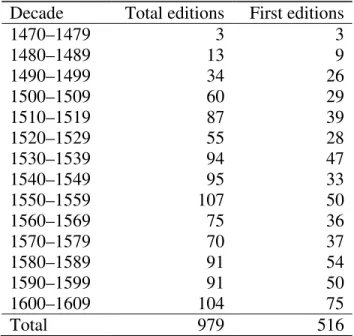
Table 1.1 analyzes patterns of production by decade during this period.13 One clearly sees the general growth of production from the 1470s through the 1550s, with an increase in the
number editions for nearly every decade; after 1550 growth levels off, with a more-or-less
consistent level of production through the end of the period. There are two exceptions to these
general trends, the 1520s and the 1560s, which witnessed temporary cessations of production of
books about music in Augsburg, Basel, Leipzig, Milan, Paris, Rome, Strasbourg, and
Wittenberg. This was a reflection of trends in the wider book trade that resulted from prolonged
religious and political conflict.14 The most dramatic illustration of the effects of conflict on the
13 For similar statistical surveys of the production of books of music, see Bautier-Regnier, “L’édition musicale
italienne”; Carter, “Music Publishing in Italy”; and Pompilio, “Editoria musicale.”
14 Pettegree, The Book in the Renaissance, 203–225 and 249–69.
Table 1.1. Production of books about music throughout Europe by decade.
Decade Total editions First editions
1470–1479 3 3
1480–1489 13 9
1490–1499 34 26
1500–1509 60 29
1510–1519 87 39
1520–1529 55 28
1530–1539 94 47
1540–1549 95 33
1550–1559 107 50
1560–1569 75 36
1570–1579 70 37
1580–1589 91 54
1590–1599 91 50
1600–1609 104 75
book trade was the Sack of Rome in 1527. The Sack devastated the city’s robust printing
industry, leading to a depression in the city’s book trade in general, and the trade in music books
in particular, that lasted for nearly twenty years.15 Incidentally, both the 1520s and the 1560s witnessed increased production in Nuremberg and Venice, the twin centers of the trade in books
about music during the Renaissance.
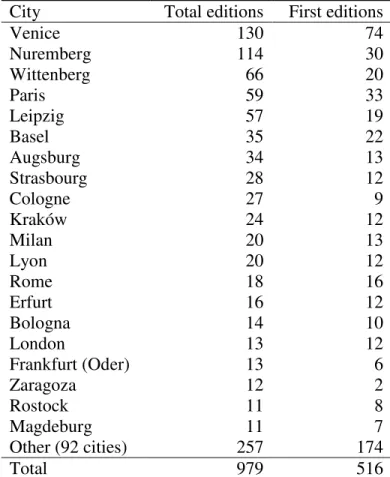
Table 1.2 analyzes patterns of production by city during this period. Most cities with
active presses produced books about music only sporadically. Ninety-two cities produced fewer
than eleven books about music each and only a third of the books produced in these cities were
first editions. That the total output of these cities accounts for only a quarter of the total
production points up the importance of the most active cities. Three-quarters of all Renaissance
books about music were printed in only twenty cities, the most productive of which were
important trade hubs and centers of intellectual activity: Venice, Nuremberg, Wittenberg, Paris,
Leipzig, Basel, and Augsburg.
At least with respect to books about music, the emphasis on Venice in scholarship on
music printing is justified. Books about music printed at Venice handily outnumber their
counterparts printed in other European cities. Venice was also the first market to maintain an
uninterrupted output, producing at least one edition during every five-year interval starting in
1480. The production in Venice’s closest competitor, Nuremberg, is consistent starting only in
1530. Every other major center of production saw intermittent bursts of activity, typically related
to a single printer or publisher (e.g., the firm of Georg Rhau accounts for 59 of Wittenberg’s 66
editions). This pattern emerges even more clearly when one considers the production of first
editions—the seventy-four first editions printed at Venice rival the total production of most
cities. These first editions are dispersed evenly among the catalogs of thirty-six different
Venetian printers. The Venetian market for books about music was also the most diverse,
attracting many different kinds of readers by publishing books on a wide range of musical topics.
Other major markets adhered rigidly to the publication of books with niche audiences. For
example, most of the books about music printed at Nuremberg and Wittenberg were designed for
schoolboys; those printed at Paris were designed for university students; and those printed at
Basel were designed for scholars. In contrast, books about music printed at Venice were
Table 1.2. European cities producing the most books about music, 1474–1609. The cities named here produced at least 11 total editions; each city listed under “Other” produced fewer than 11 total editions.
City Total editions First editions
Venice 130 74
Nuremberg 114 30
Wittenberg 66 20
Paris 59 33
Leipzig 57 19
Basel 35 22
Augsburg 34 13
Strasbourg 28 12
Cologne 27 9
Kraków 24 12
Milan 20 13
Lyon 20 12
Rome 18 16
Erfurt 16 12
Bologna 14 10
London 13 12
Frankfurt (Oder) 13 6
Zaragoza 12 2
Rostock 11 8
Magdeburg 11 7
Other (92 cities) 257 174
designed for these audiences and others, including professional musicians, amateur musicians,
and interested non-musicians.
The importance of any given center of production does not consist solely in its total
number of editions. The number and proportion of first editions—including works that were both
newly-composed and new-to-the-press—helped to define the character of local markets for
books about music. For example, Nuremberg was preoccupied with the publication of reprints,
releasing only thirty first editions (out of 114 editions total, about a quarter), all of them destined
for schoolboys. Paris produced half as many total editions as Nuremberg, but a greater number of
first editions (33 of 59 editions). Most centers with a middling level of production (between 11
and 20 total editions) released mostly new works. Upon closer examination, one sees that
printers in these markets catered to local authors in way that printers in larger markets did not—
for example, despite their small outputs, Bologna, Milan, and Rome present detailed pictures of
highly localized approaches to printing and publishing books about music.
What did Renaissance books about music discuss? Such books comprise an astounding
array of topics, some old, some new. As various scholars have noted, this topical variety makes it
difficult, if not impossible, to trace the history of Renaissance music theory in chronological
terms.16 Rather, it proves expedient to trace various theoretical strands, noting their development and representative works. Broadly speaking, Renaissance writers about music maintained the
ancient bifurcation of musical knowledge into musica speculativa and musica practica. The
former treated of the philosophical foundations of music as a member of the quadrivium,
exploring the theory of number comparison mythically derived by Pythagoras and systematized
16 Dahlhaus, “Was heisst ‘Geschichte der Musiktheorie’?” famously noted that music theory resists its own history.
by Boethius. The latter concerned the application of these precepts to musical sound,
encompassing a great variety of topics ranging from the division of the monochord to musical
composition. During the mid-sixteenth century two noteworthy topics arose outside this broad
intellectual framework: instruction in musical performance and musical aesthetics.
The first printed books about music concerned musica speculativa, which underwent a
dramatic transformation during this period. Although the inherited medieval tradition of
Boethian number theory derived from Pythagoras remained a central topic, writers gradually
reexamined it in response to broader intellectual shifts. Late fifteenth-century and early
sixteenth-century texts, such as Franchinus Gaffurius’s Theoricum opus musice discipline (1480)
and Sebald Heyden’s De arte canendi (1537), largely viewed musica speculativa as the familiar
study of canonics (abstract mathematical ratios and proportions) and harmonics (their
manifestation in musical intervals). These theorists viewed musica speculativa as essential
components of philosophical study and as preliminaries to practical music-making. More
practically-oriented writers signaled the waning importance of ancient and medieval views on
music by mentioning them only briefly, or by dispensing with them altogether.
Late-sixteenth-century writers, especially those with a more scientific or mathematical orientation, began to
reinvigorate Boethian number theory; Johannes Kepler’s Mysterium cosmographicum (1596), in
particular, redirected popular attention to the concept of musica universalis. Responding to
developments in mathematics and astronomy, such writers argued for both physical and
metaphysical connections between canonics and harmonics, between number and sound.17 In
short, the development of musica speculativa paralleled the transformation of the other quadrivia
(geometry, astronomy, and arithmetic) into early-modern science and mathematics.
It has often been noted that the sixteenth century witnessed the first flowering of writings
about musica practica.18 An important argument of this dissertation is the centrality of printing technology to this process, which required general increases in rates of musical literacy and in
public interest in the subject. During this period, the number and complexity of practical topics
within the study of music greatly increased. In spite of the heterogeneous and imprecise pictures
they paint of musical practice, these books enabled Renaissance readers to understand how music
was made. In addition to inculcating the rudiments of notation and singing, Renaissance books
about music considered a wide range of topics, focusing especially on counterpoint, mode, and
mensuration.
Counterpoint—the study of crafting polyphony—is the most frequently-encountered
subject in Renaissance books about music. Among the 516 first editions published during this
period, over a third discuss counterpoint substantively. The basic necessity of understanding
counterpoint accounts for its prevalence as a subject of study; counterpoint allowed musicians to
understand how composers assembled polyphonic textures and helped them to improvise new
parts to preexisting music. Renaissance counterpoint treatises witness a basic tension between
theorists of notated counterpoint (e.g., Aaron, Vicentino, and Zarlino) and improvised
counterpoint (e.g., Lusitano, Santa Maria, and Montanos). No shortage of scholarly confusion
has arisen from casual slippages between the two in discussions of counterpoint, especially in
earlier writers like Gaffurius and Tinctoris.19 A number of texts, Giovanni Maria Lanfranco’s Scintille di musica (1533) being a prominent example, suggest a messier and more intimate
18 Jeppesen, “Eine musiktheoretische Korrespondenz,” 3 argues that the sixteenth century saw the first “craze for music theory” (“der sozusagen musiktheoretischen Wut”).
relationship between improvised counterpoint and composition that scholars have begun to
explore in the past decade.20
The subject of mode formed another fundamental part of a musician’s training. In
essence, mode partitioned musical space into discrete segments of pitches with their own
distinctive characteristics. Most Renaissance writers about mode (e.g., Gaffurius, Lanfranco,
Morley) continued to embrace the medieval eight-fold system, with pairs of authentic and plagal
modes on four finals (D, E, F, and G). Heinrich Glarean’s Dodecachordon (1547) introduced a
twelve-mode system, with pairs of modes on six finals (D, E, F, G, A, and C). Gioseffo Zarlino’s
Le istitutioni harmoniche (1558) disseminated Glarean’s system more widely, aided in the
process by the works of his followers, Francisco de Salinas’s De musica libri septem (1577),
Oratio Tigrini’s Il compendio della musica (1588) and Lodovico Zacconi’s Prattica di musica
(1592). The pattern of modal expansion was extended further in the fourteen-mode system of
Illuminato Aiguino da Brescia’s Il tesoro (1581), which added six irregular modes to the
traditional eight. Even within individual camps about the number of mode, partisans disagreed
over a number of related issues. Glarean and Zarlino mostly agree on the affects accorded to the
modes, but disagree on their constitution, whether by species of octaves or by conjunctions of
species of fourths and fifths.21 The classification of the diatessaron into diatonic, enharmonic, and chromatic genera sparked lively discussion throughout the sixteenth century, most vividly in
the debate between Nicola Vicentino and Vicente Lusitano; this debate is recounted in appendix
one and is examined intensively in chapters two through four. Indeed, the entire pitch system,
from the largest level of the gamut to the smallest level of the comma, received unprecedented
20 Cumming, “Renaissance Improvisation and Musicology” provides a useful survey of literature on the subject.
attention during this period. A great deal of discussion appeared in the pages of printed books, in
which readers recorded their responses, which in turn occasioned the writing of new books.
Mensuration uniquely bridged musica speculativa and musica practica, as it involved
both the study of proportions and musical notation. Nearly every sixteenth-century practical text
included at least a few chapters on mensural systems (time, mood, and prolation) and gave a few
musical examples. Sebald Heyden’s De arte canendi (1537) is viewed often as the culmination
of Renaissance mensural systems, particularly in the emphasis accorded to the tactus;
nonetheless, recent scholarship has problematized its relationship to the general development of
mensural theories.22 The picture that emerges from a survey of mensuration texts during the Renaissance is one of striking variety; while most authors agree on the perfect and imperfect
divisions of time, and the major and minor division of prolation, the precise interpretations and
performances of actual mensural music vary.23 This overall diversity points toward the study of mensuration as an activity that brought together the differing interests of theorists and
performers: composition and performance, numbers and proportions, and notation and
interpretation. General interest in mensuration should be viewed as a response to the puzzles of
polyphonic music that many readers faced for the first time; whether in books of or about music,
performing mensural music relied on an ability to parse and regulate time, sometimes in highly
unusual ways. The most practically-minded theorists, especially Vicentino and Tigrini, focused
on the needs of such readers, dismissing mensural subtleties as vestigial features of outmoded
systems.
22 DeFord, Tactus, Mensuration, and Rhythm, 144–179.
The Renaissance also witnessed the first outpouring of books of vocal and instrumental
instruction. Martin Agricola’s Musica instrumentalis deudsch (1529) was an early book on
instrumental technique and was read by many sixteenth-century students at German Latin
schools. Many of the most revealing primary sources on counterpoint, mode, and mensuration
are properly performance manuals: Silvestro Ganassi dal Fontego’s Opera intitulata Fontegara
(1535), Tomás de Santa María’s Libro llamado arte de tañer fantasia (1565), Vincenzo Galilei’s
Fronimo (1568), William Bathe’s A Briefe Introduction to the Skill of Song (c. 1596), Adriano
Banchieri’s Conclusioni nel suono dell’organo (1609), and Francisco de Montanos’s Arte de
canto llano (1594). Conversely, many texts ostensibly about other topics, such as Vicentino’s
L’antica musica (1555) and Lanfranco’s Scintille di musica (1533), yield significant insight into
performance practice and organology. One particular subset of works on performance explored
the subject of text underlay, a perennial concern for modern editors. Most printed books that
considered the subject do so in isolated chapters (e.g., Zarlino’s Istitutioni and Lanfranco’s
Scintille); a few manuscript sources explore the subject more extensively, Gaspar Stoquerus’s De
musica verbali libri duo (c. 1570) being the most notable.24 All of these texts point up the
precarious nature during this period between the various component subject matters of musica
practica.
One final topic, prompted by the conjunction of speculative and practical matters,
deserves brief mention—music criticism and aesthetics. During the Renaissance, for the first
time, readers encountered classifications of composers and compositions into consistent
categories (good/bad or ancient/modern).25 One also encounters extended discussion of
individual compositions, describing their musical features and aesthetic qualities with technical
language (e.g., throughout Glarean’s Dodecachordon). Although to my knowledge there are no
single primary sources related exclusively to the criticism or aesthetics of music during the
Renaissance, increasingly they became important preoccupations for theorists.26 Printing
technology aided in this process: as the technical vocabulary for describing music and as the
volume of theoretical discourse increased, writers began to prioritize their allegiances to
theoretical lineages over traditional systems of thought, which contributed to the breakdown of
the distinction between speculative and practical theories of music. During the second half of the
sixteenth century, a third category of music emerged called musica poetica, which saw aesthetics
as a means of reconciling speculative and practical thought. Such texts as Gallus Dressler’s
Praecepta musicae poetica (manuscript dated 1563), Sethus Calvisius’s Melopoiia (1592), and
Joachim Burmeister’s Musica poetica (1606) drew comparisons between musical composition
and oratory, suggesting ways of composing, performing, and analyzing music with reference to
codified sets of rhetorical figures. Another significant observation is that—although the separate
publication of speculative and practical texts persisted during the Renaissance—one finds for the
first time speculative and practical topics treated in the same volume: for example, Gioseffo
Zarlino’s Le istitutioni harmoniche (1558), Francisco de Salinas’s De musica libri septem
(1577), and Pietro Cerone’s El melopeo y maestro (1613). As Bartolomeo Ramis de Pareia put it
in Musica practica (1482): “Here we do not undertake only to teach philosophers or
25 For overviews of this subject, see Owens, “Music Historiography”; and Palisca, Humanism, 1–22. Higgins, “Musical ‘Parents’ and Their ‘Progeny’” traces the correlation of these categories to lineages of student–teacher relationships during the middle and late sixteenth century.
mathematicians; anyone, provided he has learned the rudiments of grammar, will understand our
books. Here mouse and elephant can swim together, Daedalus and Icarus can fly together.”27 Ramis’s gambit speaks to a concern common among Renaissance writers about music, an
explicit desire to establish a wide audience for their books. I argue in this dissertation that writers
leveraged printing technology to achieve this end of public discourse about music. In the
chapters that follow, I will show that the reasons for this were manifold. Printed books were
economically advantageous: notwithstanding the drawbacks signaled early on by Filippo de
Strata, they were cheaper to manufacture and potentially more directly profitable for authors than
manuscripts; and they spread more widely and more rapidly along trade and shipping routes than
one-off manuscripts delivered by authors and scriptoria. Printed books also were commodities
that conferred authority and prestige on their writers and publishers, which helped writers to
achieve a variety of career goals: securing jobs and patronage, improving their professional
standings, and staking out longer-lasting legacies. This also was true about luxury manuscripts,
but to a lesser degree, as printed books about music were more firmly rooted in the matrix of
commerce. In order to acquire audiences, makers of books about music needed to balance
intellectual, literary, and professional priorities against the economic imperative to sell books. I
propose here that the ultimate success of any given book about music was characterized by a
satisfactory balancing of these competing factors. That is, such books about music fulfilled at
once the various needs of their authors, printers, and readers. But there was no reliable formula
for success. Sometimes it resulted merely from a fortuitous confluence of individuals and
personalities; other times, it resulted from trial-and-error or calculated strategy. Such books also
accomplished many different aims, whether in the form of runaway sales or the pure
achievement of seeing a book into print, or something else in between. In sum, I suggest that a
book’s success stemmed from its ideal positioning within the communications circuit. The net
effect of the communications circuit was that the proliferation of books by past and then-present
writers, combined with emerging reader expectations of textual and logical coherence, led to the
coalescence and formalization of music theory as a field of inquiry.
Materializing theory, theorizing materiality
With this project, I aim to bring studies of the theory and practice of Renaissance music into
greater dialogue with the history of the book. My emphasis here is on dialogue between these
areas of study, which have developed in relative isolation from each other. The likely reason for
this is the nature of musical notation, a forbidding non-alphabetic text; put simply, books of
music require specialist knowledge to read and understand in ways that books on other subjects
do not.28 I propose that Renaissance books about music offer fertile points of connection between musicology and the history of the book. This exchange goes both ways: on the one hand, books
about music provide a book-historical perspective on musical culture; on the other hand, books
about music allow musicological perspectives to assume greater prominence in the history of the
book. Conceiving of books about music as artifacts of a material culture is the key to this
exchange. It is precisely the uniquely hybrid qualities of books about music—their juxtaposition
of text, image, and music; their constant shifting between different modes of sensory
engagement; and their broad range of didactic functions—that suggest new ways of thinking
about materiality with regard to both musicology and book history. In this section, I survey the
relevant literature in these two fields, indicating how my research contributes to them, and
pointing to ways that books about music can harmonize them.
The impact of printing on Renaissance musical culture is one of the pioneer fields of
musicology.29 Extensive reference works such as RISM and the catalogs of individual printers
represent the culmination of extended bibliographical research on musical sources.30 Enabled by the synoptic views in such enumerative bibliographies, musicologists in recent decades have
considered the intersections of music and the concept of print culture.31 Similarly, interest in the history of the book and analytical bibliography has resulted in studies that consider printed books
of music as material objects.32
Writings about music occupy a precarious position within this literature. As early as
1932, books about music were considered in a separate class from books of music: “The question
of music in the fifteenth-century book has a double aspect. There are books about music, and
book which contain musical compositions.”33 One finds echoes of this view as late as 1995: “[The emphasis of this book] deliberately excludes from consideration both theoretical works
and liturgical books, two large categories of material which often include printed musical
29 Because the literature on music printing during the Renaissance is so vast, I cite here only those studies most
relevant to the exact points I wish to make.
30 Bernstein, Music Printing; Boorman, Ottaviano Petrucci; Duggan, Italian Music Incunabula; Heartz, Pierre
Attaingant; Lewis, Antonio Gardano. I mention here only the most recent and most significant bibliographical studies; many Renaissance music printers have received extensive scholarly treatments.
31 Blackburn, “Printing Contract”; Boorman, “Early Music Printing”; Fenlon, Music, Print and Culture; and the essays in van Orden, Music and the Cultures of Print.
32 Boorman, “A Case of Work and Turn”; Lewis, “The Printed Music Book in Context”; Owens, “You Can Tell a Book by Its Cover”; van Orden, Materialities; and van Orden, Music, Authorship, and the Book.
notation…These two kinds of books are in general quite separate from music itself.”34 Indeed, this was a sixteenth-century distinction; in his Libraria (1550), Antonfrancesco Doni lists over
one hundred books of music, sorted by author, number of voices, and genre. Almost as an
afterthought, Doni tacks on at the end a handful of “libri diversi composti”—that is, books about
music.35 This distinction, however useful, excludes from consideration a significant quantity of
evidence concerning the impact of music printing on Renaissance culture. There are dozens of
copies of the most historically-significant books about music, which are inversely proportional to
the few surviving copies of important books of music. Furthermore, I demonstrate that the
audience for books about music was broad and that their readers viewed them as books truly to
be used, reading and rereading them, and most importantly writing in them.
A number of scholars have worked to establish a cultural context for Renaissance music
theory, sketching out the world in which writers about music worked. These studies are less
concerned with presenting definitive, all-encompassing interpretations of texts than with
providing multiple avenues for considering writers about music and their works. These contexts
can take many forms. For example, the treatises of Glarean and Zarlino have elicited very
different interpretations that emphasize alternately the influence of humanism, religion, literary
traditions, and sociopolitical institutions.36 Russell E. Murray’s article on Nicolò Burzio’s biography uses newly-recovered details about his travels to situate Burzio’s Musices opusculum
34 Fenlon, Music, Print and Culture, 2.
35 Doni, La libraria (1550), sig. F6v. For the historical and methodological problems presenting in Doni’s book, see Haar, “The Libraria of Antonfrancesco Doni.” Chapter five of this dissertation considers the books about music cited in Doni’s Libraria.
(1487) within various local traditions.37 Similarly, Colleen Reardon’s monograph on Agostino Agazzari explores how the demands of his positon as maestro di cappella at the Siena Cathedral
shaped his theories in the early seventeenth century.38 Several scholars have noted that the category of “music theorist” was fluid, often overlapping with other categories such as
“composer,” “linguist,” “historian,” “mathematician,” and “scientist.”39 Thomas Christensen
suggests that this occupational confusion is a reflection of the discursive fuzziness of theorizing
about music, which he views “as a social act in which elements of performance and memory
elude the fixation of textual codification.”40 Jessie Ann Owens has argued similarly that the terms “theory,” “theorist,” and “treatise”—terms prevalent in musical scholarship—need
significant refining so as not to paper over important distinctions in books about music: “Instead
of catch-alls like ‘theorist’ or ‘theory,’ we need to find words that are specific to the particular
activity and reflect the character of the audience and social function of the text(s) under
consideration.”41
This dissertation answers several calls for the study of the impact of printing technology
on Renaissance music theory. Owens notes that, although Renaissance music theory matured as a
subject in the pages of printed books, the specific context of print culture has not yet played a
considerable role in the history of Renaissance music theory.42 Building on Owens’ arguments,
37 Murray, “New Documentation.”
38 Reardon, Agostino Agazzari.
39 Borgerding, “Preachers, Pronunciato, and Music”; Bray, “Music and the Quadrivium”; Fenlon, “Gioseffo Zarlino”; and Strauss, Historian in the Age of Crisis.
40 Christensen, “Fragile Texts, Hidden Theory,” 207.
C. Matthew Balensuela has called for the study of “the way in which the technology of printing
changed the content of music theory texts.”43 Christensen similarly highlights a need for greater methodological reflection on the materiality of music-theoretical discourse: “Printed books can
make, order, and constrain knowledge. The book is not always an innocent transmitter of facts;
rather, print sometimes can determine and delimit what is appropriate knowledge that can be
contained within its discursive borders—constraints that have varied over time or genre of
publication.”44 I also aim to consolidate the diverse perspectives of a handful of studies that address this and related subjects. These include, for example, studies of the iconographical
significance of title pages and historiated initials.45 Tim Carter has noted the close association of certain music theorists with music printers.46 Bonnie J. Blackburn has explored the subject of
publishing in the voluminous correspondence of the music theorist Giovanni Spataro.47
Similarly, a recent essay Bernhard Kölbl paints a detailed picture of Glarean’s involvement in
the printing and publishing of his Dodecachordon by comparing stop-press corrections with
Glarean’s manuscript notes in his personal copy.48 A recent collection of essays edited by Iain
43 Balensuela, “Ut hec te figura docet,” 108.
44 Christensen, “Fragile Texts, Hidden Theory,” 198.
45 Haar, “The Frontispiece”; and Lopez-Pelaez Casellas, “Sobre la capital iluminada.”
46 Carter, “Artusi, Monteverdi, and the Poetics of Modern Music.” See also Carter, “Cerberus Barks in Vain”; and
Carter, “E in rileggendo poi le proprie note.”
47 Blackburn, “Publishing Music Theory.” See also Blackburn et al., Correspondence.
Fenlon and Inga Mai Groote considers broadly the role of books and print culture in the life and
works of Heinrich Glarean.49
The most substantial study on the subject to date is Cristle Collins Judd’s Reading
Renaissance Music Theory: Hearing with the Eyes (2000), which explores the ways that music
printing “betokened an irreversible change in the interplay of music theory, practice, printed
repertories, and communities of readers.”50 Judd’s wide-ranging book examines the textual and repertorial sources for the musical examples in a number of seminal theoretical treatises,
showing how music printing afforded theorists unprecedented access to entire repertories of
music. Although not couched in such terms, Judd’s book provides an excellent illustration of the
effects of Darnton’s communication circuit within Renaissance music theory. That is, her book
focuses on the changes in authorship that resulted from writers about music becoming self-aware
as consumers and readers of printed music. Judd’s research suggests many avenues for further
study of the nature of Renaissance books about music. This dissertation complements Judd’s
work by addressing two of these. First, I emphasize the importance of non-authorial readership in
shaping the development of Renaissance music discourse. What was the social function of books
about music after they left the printer’s shop? How did writers about music adapt to the prospect
of writing for new and unknown audiences? Second, I locate Renaissance books about music
within a material culture wherein form and content are inextricably linked in the production of
meaning. Inspired by Judd’s early advocacy of a materialist approach within musicology, I
propose a conceptual shift away from considering texts as transmitters of ideas and toward
examining books as material objects. In what ways did authors and printers communicate