Research Article
Adaptive Central Force Optimization Algorithm
Based on the Stability Analysis
Weiyi Qian,
1Bo Wang,
1and Zhiguang Feng
21College of Mathematics and Physics, Bohai University, Jinzhou 121000, China
2College of Information Science and Technology, Bohai University, Jinzhou 121000, China
Correspondence should be addressed to Weiyi Qian; [email protected]
Received 15 October 2014; Revised 20 February 2015; Accepted 26 February 2015
Academic Editor: Farhang Daneshmand
Copyright © 2015 Weiyi Qian et al. This is an open access article distributed under the Creative Commons Attribution License, which permits unrestricted use, distribution, and reproduction in any medium, provided the original work is properly cited.
In order to enhance the convergence capability of the central force optimization (CFO) algorithm, an adaptive central force optimization (ACFO) algorithm is presented by introducing an adaptive weight and defining an adaptive gravitational constant. The adaptive weight and gravitational constant are selected based on the stability theory of discrete time-varying dynamic systems. The convergence capability of ACFO algorithm is compared with the other improved CFO algorithm and evolutionary-based algorithm using 23 unimodal and multimodal benchmark functions. Experiments results show that ACFO substantially enhances the performance of CFO in terms of global optimality and solution accuracy.
1. Introduction
Consider the following global optimization problem:
max 𝑓 (𝑥)
subject to 𝑥 ∈ Ω = {𝑥 ∈ 𝑅𝑁𝑑| 𝑅min≤ 𝑥 ≤ 𝑅max} , (1)
where 𝑓(𝑥) : Ω ⊂ 𝑅𝑁𝑑 → 𝑅 is a real-valued
bounded function and𝑅min,𝑅max, and𝑥are𝑁𝑑-dimensional continuous variable vectors. Such problem arises in many applications, for example, in risk management, applied sci-ences, and engineering design. The function of interest may be nonlinear and nonsmooth which makes the classical optimization algorithms easily fail to solve these problems. Over the last decades, many nature-inspired heuristic opti-mization algorithms without requiring much information about the function became the most widely used optimization methods such as genetic algorithms (GA) [1], particle swarm optimization (PSO) [2], ant colony optimization (ACO) [3], cuckoo search (CS) algorithm [4], group search optimizer (GSO) [5], and glowworm swarm optimization (GSO1) [6]. These search methods all simulate biological phenomena. Different from these algorithms, some heuristic optimiza-tion algorithms based on physical principles have been developed, for example, simulating annealing (SA) algorithm
[7], electromagnetism-like mechanism (EM) algorithm [8], central force optimization (CFO) algorithm [9], gravitational search algorithm (GSA) [10], and charged system search (CSS) [11]. SA simulates solid material in the annealing process. EM is based on Coulomb’s force law associated with electrical charge process. GSA and CFO utilize New-tonian mechanics law. CSS is based on Coulomb’s force and Newtonian mechanics laws. Unlike other algorithms, CFO is a deterministic method. In other words, there is not any random nature in CFO, which attracts our attention on the CFO algorithm in this paper.
CFO, which was introduced by Formato in 2007 [9], is becoming a novel deterministic heuristic optimization algorithm based on gravitational kinematics. In order to improve the CFO algorithm, Formato and other researchers developed many versions of the CFO algorithm [12–23]. In [12,13], Formato proposed PR-CFO (Pseudo-Random CFO) algorithm. The improved implementations are made in three areas: initial probe distribution, repositioning factor, and decision space adaptation. Formato presented an algorithm known as PF-CFO (Parameter Free CFO) in [14,15]. PF-CFO algorithm improves and perfects the PR-CFO algorithm in the aspect of the selection of parameter. Mahmoud proposed an efficient global hybrid optimization algorithm combining the CFO algorithm and the Nelder-Mead (NM) method in Volume 2015, Article ID 914789, 10 pages
[16]. This hybrid method is called CFO-NM. An extended CFO (ECFO) algorithm was presented by Ding et al. by adding the historical information and defining an adaptive mass in [17] where the convergence of ECFO algorithm was proved based on the second order difference equation.
In aforementioned CFO algorithms, two updated equa-tions were used: one for a probe’s acceleration and the other for its position. In the probe’s position updated equation which is established based on the laws of motion, the velocity is defined as zero. But the velocity has influence on the exploring ability of the CFO algorithm. Therefore, in this paper, we introduce the velocity in the probe’s position updated equation, which leads us to build a velocity updated equation like the CSS algorithm. Since the weight which can balance the global and local search ability is an important parameter in many heuristic algorithms, we introduce weight in probe’s position updated equation. If the value of weight is too large, then the probes may move erratically, going beyond a good solution. On the other hand, if weight is too small, then the probe’s movement is limited and the optimal solution may not be reached. Therefore, an appropriate dynamically changing weight can improve the performance of the heuristic algorithm. However, in most of the heuristic algorithms, the changing weight was selected empirically according to the characteristics of the problems without theoretical analysis. The gravitational constant has the same effect on the weight in CFO algorithm. Hence, this paper will further investigate the weight and gravitational constant settings by employing the geometry-velocity stability theory of discrete time-varying dynamic systems. Based on the above discussion, an adaptive CFO (ACFO) algorithm is proposed in this paper.
To the best of our knowledge, there is no research on stability analysis of the CFO algorithm till now. In this paper, the stability of the ACFO algorithm is analyzed based on discrete time-varying dynamic systems theory. Based on the stability analysis of the proposed algorithm, we explore the weight and gravitational constant settings.
The rest of this paper is organized as follows.Section 2
will present the basics of the CFO algorithm and review the state of the art concerning the algorithm. InSection 3, we propose an adaptive central force optimization. Some numerical results are given to test the performance of the proposed algorithm in Section 4. Finally, we have some conclusions about the proposed algorithm.
2. Central Force Optimization
CFO solves problem(1)based on the movement of probes through the decision space (DS) along trajectories computa-tion by utilizing the gravitacomputa-tional analogy. The DS is defined byΩ = {(𝑥1, 𝑥2, . . . , 𝑥𝑁𝑑) | 𝑅min𝑖 ≤ 𝑥𝑖≤ 𝑅max𝑖 ,1≤ 𝑖 ≤ 𝑁𝑑}. In CFO, a group of probes are represented as potential solutions, and each probe𝑝 is associated with position vector 𝑅𝑝(𝑡) and acceleration vector𝐴𝑝(𝑡)at time step𝑡. The position of each probe is initialized by a variable initial probe distribution formed by deploying𝑁𝑝/𝑁𝑑probes uniformly on each of the probe lines parallel to the coordinate axes and intersecting at a point alongΩ’s principal diagonal, where𝑁𝑝is the total
number of initial probes. The initial acceleration vectors are usually set to zero. During search process, the acceleration and position of probe𝑝are updated as
𝐴𝑝𝑖(𝑡) = 𝐺
𝑁𝑝
∑
𝑘=1
𝑘 ̸=𝑝
𝑈 (𝑀𝑘(𝑡) − 𝑀𝑝(𝑡)) (𝑀𝑘(𝑡) − 𝑀𝑝(𝑡))𝛼
⋅ (𝑅
𝑘
𝑖 (𝑡) − 𝑅𝑝𝑖 (𝑡))
𝑅𝑘(𝑡) − 𝑅𝑝(𝑡)𝛽,
(2)
𝑅𝑝𝑖 (𝑡 +1) = 𝑅𝑝𝑖 (𝑡) +1 2𝐴
𝑝
𝑖 (𝑡) Δ𝑡2, (3)
where𝐺is the gravitational constant;𝑀𝑗(𝑡) = 𝑓(𝑅𝑗(𝑡))is the fitness value at probe𝑗’s(𝑗 = 1,2, . . . , 𝑁𝑝)position at time step𝑡;𝛼and𝛽are the parameters;𝑖 (𝑖 =1,2, . . . , 𝑁𝑑)is the coordinate number;𝑈(⋅)is the unit step function;
𝑈 (𝑧) ={{ {
1, 𝑧 ≥0
0, else; (4)
Δ𝑡is the unit time step increment; define‖𝑅𝑘(𝑡) − 𝑅𝑝(𝑡)‖ =
√∑𝑁𝑑
𝑖=1[𝑅𝑖𝑘(𝑡) − 𝑅𝑝𝑖(𝑡)]2. The probe generated by (3)may be
beyond the DS. If the coordinate 𝑅𝑝𝑖(𝑡 + 1) of the probe
𝑅𝑝(𝑡 +1)is less than𝑅min
𝑖 , then it is assigned to be
𝑅𝑝𝑖 (𝑡 +1) = 𝑅𝑖min+ 𝐹rep[𝑅𝑝𝑖 (𝑡 −1) − 𝑅min𝑖 ] . (5)
If𝑅𝑝𝑖(𝑡 +1)is greater than𝑅max𝑖 , then
𝑅𝑝𝑖 (𝑡 +1) = 𝑅max𝑖 − 𝐹rep[𝑅min𝑖 − 𝑅𝑝𝑖 (𝑡 −1)] , (6)
where 𝑅𝑖min and 𝑅max𝑖 are the minimum and maximum values for𝑖th component of the decision variable.𝐹repis the reposition factor which starts at an arbitrary initial value
𝐹initial
rep <1 and is incremented by an arbitrary amountΔ𝐹rep
at each iteration. If𝐹rep ≥ 1, then it is reset to the starting value. In order to improve convergence speed, the DS size is adaptively reduced around the best probe𝑅best. The DS’s boundary coordinates are reduced as follows:
𝑅min𝑖 = 𝑅min𝑖 +1
2[𝑅best− 𝑅
min
𝑖 ] ,
𝑅max𝑖 = 𝑅max𝑖 −1
2[𝑅
max
𝑖 − 𝑅best] .
(7)
The termination criterion is that iterations reach their max-imum limit𝑁𝑡. We also terminate the CFO algorithm early if the difference between the average best fitness over𝑞steps (including the current step) and the current best fitness is less than 10−6.
In order to improve the CFO algorithm, Formato pro-posed modifications to CFO algorithm, namely, PR-CFO [12, 13]. The steps of PR-CFO algorithm [13] are shown as follows;
For𝛾 = 𝛾startto𝛾stopbyΔ𝛾
(a.1) compute initial probe distribution with distri-bution factor𝛾;
(a.2) compute initial fitness matrix; select the best probe fitness;
(a.3) assign initial probe acceleration; (a.4) set initial𝐹rep= 𝐹repinit.
For𝑡 =0 to𝑁𝑡(or earlier termination criterion)
(b) update probe positions using(3); (c) retrieve errant probe using(5)and(6);
(d) calculate fitness values; select the best probe fitness;
(e) compute accelerations using(2); (f) increment𝐹repbyΔ𝐹best;
if𝐹rep>1 then𝐹rep= 𝐹repmin; End If
(g) if𝑡MOD 10 = 0, then
shrinkΩaround best probe using(7); End If
Next𝑡
(h) reset Ω’s boundaries to their starting values before shrinking.
Next𝛾
Next𝑁𝑝/𝑁𝑑.
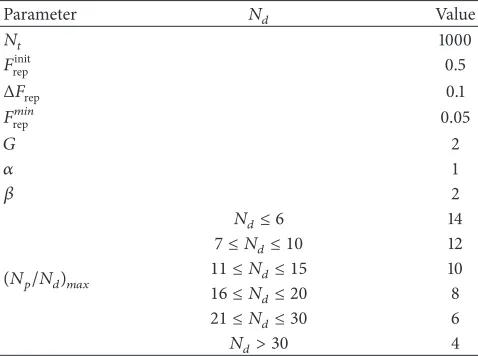
PR-CFO is further modified in order to create an algorithm known as PF-CFO (Parameter Free CFO) [14, 15]. This version is almost identical to PR-CFO and compensates for the number of parameters that must be chosen by fixing a wide array of internal parameters at specific values [19]. The values of parameters borrowed from [19] that are used in PF-CFO algorithm can be seen inTable 1.
3. Adaptive Central Force
Optimization Algorithm
Qian and Zhang [23] proposed an adaptive central force optimization algorithm. In [23], the time Δ𝑡 in (3) was updated based on the fitness value compared with the average fitness value. In this paper, we introduce adaptive weight in position update equation, adaptive gravitational constant in acceleration update equation and the velocity update formula. The weight and gravitational constant are
Table 1: The values of parameters that are used in PF-CFO algorithm.
Parameter 𝑁𝑑 Value
𝑁𝑡 1000
𝐹init
rep 0.5
Δ𝐹rep 0.1
𝐹𝑚𝑖𝑛
rep 0.05
𝐺 2
𝛼 1
𝛽 2
(𝑁𝑝/𝑁𝑑)𝑚𝑎𝑥
𝑁𝑑≤6 14
7≤ 𝑁𝑑≤10 12
11≤ 𝑁𝑑≤15 10
16≤ 𝑁𝑑≤20 8
21≤ 𝑁𝑑≤30 6
𝑁𝑑>30 4
updated based on this stability analysis of a discrete time-varying dynamic system. In ACFO algorithm, the position, acceleration, and velocity of probe𝑝are updated as follows:
𝑅𝑝𝑖 (𝑡 +1) = 𝑅𝑝𝑖 (𝑡) + 𝜔𝑝(𝑡) 𝑉𝑖𝑝(𝑡) Δ𝑡 +1 2𝐴
𝑝
𝑖(𝑡) Δ𝑡2, (8)
𝐴𝑝𝑖(𝑡 +1) = 𝐺𝑝(𝑡 +1)
𝑁𝑝
∑
𝑘=1
𝑘 ̸=𝑝
𝑈 (𝑀𝑘(𝑡 +1) − 𝑀𝑝(𝑡 +1))
⋅ (𝑀𝑘(𝑡 +1) − 𝑀𝑝(𝑡 +1))𝛼
⋅(𝑅
𝑘
𝑖 (𝑡 +1) − 𝑅𝑝𝑖 (𝑡 +1))
(𝐷𝑝𝑘)𝛽 ,
(9)
𝑉𝑖𝑝(𝑡 +1) = 𝑅
𝑝
𝑖 (𝑡 +1) − 𝑅𝑖𝑝(𝑡)
Δ𝑡 , (10)
where𝜔𝑝(𝑡)is the weight;𝐺𝑝(𝑡) is a gravitational constant at probe𝑝’s position at iteration𝑡;Δ𝑡 = 1;𝛼and𝛽are the parameters;𝑖 (𝑖 =1,2, . . . , 𝑁𝑑)is the coordinate number; and
𝐷𝑝𝑘is defined as follows:
𝐷𝑝𝑘={{ {
𝑑𝑝𝑘, if 𝑑𝑝𝑘≥ 𝑎
𝑎, if 𝑑𝑝𝑘< 𝑎, (11)
where𝑑𝑝𝑘 is the Euclidian distance between two probes,𝑝 and𝑘, and𝑎is a radius constant.
Let
𝜑𝑘(𝑡) = 𝑈 (𝑀
𝑘(𝑡) − 𝑀𝑝(𝑡)) (𝑀𝑘(𝑡) − 𝑀𝑝(𝑡))𝛼
(𝐷𝑝𝑘)𝛽
,
𝜑 (𝑡) =
𝑁𝑝
∑
𝑘=1
𝑘 ̸=𝑝
𝜑𝑘(𝑡) .
It is clear that 𝜑𝑘(𝑡) and 𝜑(𝑡) are nonnegative. By (8), (9), and(10), the position and velocity updated equations can be written as follows:
𝑅𝑝𝑖 (𝑡 +1) = (1−1 2𝐺 𝑝(𝑡) 𝜑 (𝑡)) 𝑅𝑝 𝑖 (𝑡) + 𝜔𝑝(𝑡) 𝑉𝑖𝑝(𝑡) +1 2𝐺 𝑝(𝑡)∑𝑁𝑝 𝑘=1 𝑘 ̸=𝑝 𝜑𝑘(𝑡) 𝑅𝑘𝑖(𝑡) ,
𝑉𝑖𝑝(𝑡 +1) = −1 2𝐺 𝑝(𝑡) 𝜑 (𝑡) 𝑅𝑝 𝑖 (𝑡) + 𝜔𝑝(𝑡) 𝑉𝑖𝑝(𝑡) +1 2𝐺 𝑝(𝑡)∑𝑁𝑝 𝑘=1 𝑘 ̸=𝑝 𝜑𝑘(𝑡) 𝑅𝑘𝑖(𝑡) . (13)
Equations(13)are written in matrix form as follows:
(𝑅
𝑝
𝑖 (𝑡 +1)
𝑉𝑖𝑝(𝑡 +1)) = ( 1−1
2𝐺 𝑝(𝑡) 𝜑 (𝑡) 𝜔𝑝(𝑡) −1 2𝐺 𝑝(𝑡) 𝜑 (𝑡) 𝜔𝑝(𝑡)) ( 𝑅𝑝𝑖 (𝑡) 𝑉𝑖𝑝(𝑡)) +1 2𝐺 𝑝(𝑡) (( ( 𝑁𝑝 ∑ 𝑘=1 𝑘 ̸=𝑝 𝜑𝑘(𝑡) 𝑅𝑘 𝑖 (𝑡) 𝑁𝑝 ∑ 𝑘=1 𝑘 ̸=𝑝 𝜑𝑘(𝑡) 𝑅𝑘 𝑖 (𝑡) ) ) ) . (14) Let
𝑥 (𝑡 +1) = (𝑅
𝑝
𝑖 (𝑡 +1)
𝑉𝑖𝑝(𝑡 +1)) ,
𝑔 (𝑡, 𝑥 (𝑡)) = (1−
1 2𝐺 𝑝(𝑡) 𝜑 (𝑡) 𝜔𝑝(𝑡) −1 2𝐺 𝑝(𝑡) 𝜑 (𝑡) 𝜔𝑝(𝑡)) ( 𝑅𝑝𝑖 (𝑡) 𝑉𝑖𝑝(𝑡)) +1 2𝐺 𝑝(𝑡) (( ( 𝑁𝑝 ∑ 𝑘=1 𝑘 ̸=𝑝 𝜑𝑘(𝑡) 𝑅𝑘𝑖(𝑡) 𝑁𝑝 ∑ 𝑘=1 𝑘 ̸=𝑝 𝜑𝑘(𝑡) 𝑅𝑘𝑖(𝑡) ) ) ) . (15)
Equation(14) can be expressed as a discrete time-varying dynamic system as follows:
𝑥 (𝑡 +1) = 𝑔 (𝑡, 𝑥 (𝑡)) , 𝑡 =1,2, . . . . (16)
Lemma 1 (see [24]). Let𝑥(𝑡+1) = 𝑔(𝑡, 𝑥(𝑡))be a discrete
time-varying dynamic system; if𝑔(𝑡, 𝑥(𝑡))satisfies the condition
𝑔(𝑡,𝑥(𝑡))𝜐≤V(𝑡) ‖𝑥 (𝑡)‖𝜐+ 𝑐, (17)
under a certain vector norm‖ ⋅ ‖𝜐, then the system is
geometry-velocity stable in the bounded set𝐿 = {𝑥 | ‖𝑥‖𝜐 < 𝑐/(1− 𝜗)},
where𝑐is constant and0≤V(𝑡) ≤ 𝜗 <1.
Cui and Zen presented a selection of the parameters in PSO algorithm based on Lemma 1 in [24]. Now we analyze the stability of ACFO algorithm and give a selection of weight and gravitational constant based onLemma 1.
If‖⋅‖𝜐inLemma 1is considered as an infinite norm, then we have 𝑔(𝑡,𝑥(𝑡))∞≤
(1−
1 2𝐺 𝑝(𝑡) 𝜑 (𝑡) 𝜔𝑝(𝑡) −1 2𝐺 𝑝(𝑡) 𝜑 (𝑡) 𝜔𝑝(𝑡)) ∞ ‖𝑥 (𝑡)‖∞ +1 2𝐺 𝑝 (𝑡) ( ( ( 𝑁𝑝 ∑ 𝑘=1 𝑘 ̸=𝑝 𝜑𝑘(𝑡) 𝑅𝑘 𝑖(𝑡) 𝑁𝑝 ∑ 𝑘=1 𝑘 ̸=𝑝 𝜑𝑘(𝑡) 𝑅𝑘 𝑖(𝑡) ) ) ) ∞ . (18)
Since𝐺𝑝(𝑡)is a nonnegative finite number for any𝑡and
𝑓(⋅)is a bounded function, we assume that𝐺𝑝(𝑡) ≤ 𝐺and
‖𝑓(⋅)‖ ≤ 𝑀 =max𝑥∈Ω|𝑓(𝑥)|. Thus, we can obtain
0≤ 𝑈 (𝑀𝑘(𝑡) − 𝑀𝑝(𝑡)) (𝑀𝑘(𝑡) − 𝑀𝑝(𝑡))𝛼≤ 𝑀𝛼. (19)
By(11), one has𝐷𝑝𝑘≥ 𝑎. Therefore, we have𝜑𝑘(𝑡) ≤ 𝑀𝛼/𝑎𝛽. Thus, 1 2𝐺 𝑝 (𝑡) ( ( ( 𝑁𝑝 ∑ 𝑘=1 𝑘 ̸=𝑝 𝜑𝑘(𝑡) 𝑅𝑘𝑖 (𝑡) 𝑁𝑝 ∑ 𝑘=1 𝑘 ̸=𝑝 𝜑𝑘(𝑡) 𝑅𝑘𝑖 (𝑡) ) ) ) ∞ ≤ 1 2𝐺 𝑁𝑝 ∑ 𝑘=1 𝑘 ̸=𝑝 𝜑𝑘(𝑡) 𝑅𝑘𝑖 (𝑡) ≤ 1 2𝐺 𝑁𝑝 ∑ 𝑘=1 𝑘 ̸=𝑝 𝜑𝑘(𝑡)𝑅𝑘𝑖(𝑡)
≤ (𝑁𝑝−1) 𝑀
𝛼
2𝑎𝛽
⋅ max
1≤𝑖≤𝑁𝑑{max{𝑅
max
𝑖 ,
−𝑅min𝑖 }}.
(20) In addition,
(1−
1 2𝐺 𝑝(𝑡) 𝜑 (𝑡) 𝜔𝑝(𝑡) −1 2𝐺 𝑝(𝑡) 𝜑 (𝑡) 𝜔𝑝(𝑡)) ∞
≤max{1−1 2𝐺
𝑝(𝑡) 𝜑 (𝑡)
+ 𝜔𝑝(𝑡) ,
−12𝐺
𝑝(𝑡) 𝜑 (𝑡)
+ 𝜔𝑝(𝑡)} .
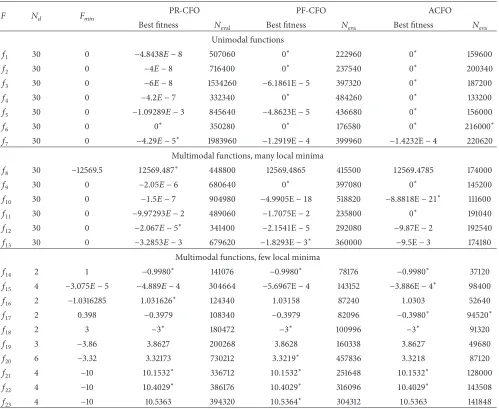
Table 2: Comparison of ACFO with RP-CFO and RF-CFO.
𝐹 𝑁𝑑 𝐹𝑚𝑖𝑛 PR-CFO PF-CFO ACFO
Best fitness 𝑁eval Best fitness 𝑁eva Best fitness 𝑁eva
Unimodal functions
𝑓1 30 0 −4.8438𝐸 − 8 507060 0∗ 222960 0∗ 159600
𝑓2 30 0 −4𝐸 − 8 716400 0∗ 237540 0∗ 200340
𝑓3 30 0 −6𝐸 − 8 1534260 −6.1861E−5 397320 0∗ 187200
𝑓4 30 0 −4.2𝐸 − 7 332340 0∗ 484260 0∗ 133200
𝑓5 30 0 −1.09289𝐸 − 3 845640 −4.8623E−5 436680 0∗ 156000
𝑓6 30 0 0∗ 350280 0∗ 176580 0∗ 216000∗
𝑓7 30 0 −4.29𝐸 − 5∗ 1983960 −1.2919E−4 399960 −1.4232E−4 220620
Multimodal functions, many local minima
𝑓8 30 −12569.5 12569.487∗ 448800 12569.4865 415500 12569.4785 174000
𝑓9 30 0 −2.05𝐸 − 6 680640 0∗ 397080 0∗ 145200
𝑓10 30 0 −1.5𝐸 − 7 904980 −4.9905E−18 518820 −8.8818E−21∗ 111600
𝑓11 30 0 −9.97293𝐸 − 2 489060 −1.7075E−2 235800 0∗ 191040
𝑓12 30 0 −2.067𝐸 − 5∗ 341400 −2.1541E−5 292080 −9.87E−2 192540
𝑓13 30 0 −3.2853𝐸 − 3 679620 −1.8293E−3∗ 360000 −9.5E−3 174180
Multimodal functions, few local minima
𝑓14 2 1 −0.9980∗ 141076 −0.9980∗ 78176 −0.9980∗ 37120
𝑓15 4 −3.075𝐸 − 5 −4.889𝐸 − 4 304664 −5.6967E−4 143152 −3.886E−4∗ 98400
𝑓16 2 −1.0316285 1.031626∗ 124340 1.03158 87240 1.0303 52640
𝑓17 2 0.398 −0.3979 108340 −0.3979 82096 −0.3980∗ 94520∗
𝑓18 2 3 −3∗ 180472 −3∗ 100996 −3∗ 91320
𝑓19 3 −3.86 3.8627 200268 3.8628 160338 3.8627 49680
𝑓20 6 −3.32 3.32173 730212 3.3219∗ 457836 3.3218 87120
𝑓21 4 −10 10.1532∗ 336712 10.1532∗ 251648 10.1532∗ 128000
𝑓22 4 −10 10.4029∗ 386176 10.4029∗ 316096 10.4029∗ 143508
𝑓23 4 −10 10.5363 394320 10.5364∗ 304312 10.5363 141848
Set𝑐 = ((𝑁𝑝−1)𝑀𝛼/2𝑎𝛽)max1≤𝑖≤𝑁𝑑{max{𝑅max𝑖 , −𝑅min𝑖 }}. If
max{1−1 2𝐺
𝑝(𝑡) 𝜑 (𝑡)
+ 𝜔𝑝(𝑡) ,−12𝐺
𝑝(𝑡) 𝜑 (𝑡)
+ 𝜔𝑝(𝑡)} ≤ 𝜃 <1,
(22)
then byLemma 1, system(16)is geometry-velocity stable in the bounded set𝐿 = {𝑥 | ‖𝑥‖∞≤ 𝑐/(1− 𝜃)}.
By(22), one has 0< (1/2)𝐺𝑝(𝑡)𝜑(𝑡) <1. If 0< (1/2)𝐺𝑝(𝑡)
𝜑(𝑡) <0.5, that is, 0< 𝐺𝑝(𝑡) <1/𝜑(𝑡), then(1/2)𝐺𝑝(𝑡)𝜑(𝑡) +
𝜔𝑝(𝑡) < 1− (1/2)𝐺𝑝(𝑡)𝜑(𝑡) + 𝜔𝑝(𝑡) ≤ 𝜃; that is, 0< 𝜔𝑝(𝑡) ≤
(1/2)𝐺𝑝(𝑡)𝜑(𝑡) + 𝜃 −1. If 0.5 ≤ (1/2)𝐺𝑝(𝑡)𝜑(𝑡) < 1, that is, 1/𝜑(𝑡) ≤ 𝐺𝑝(𝑡) < 2/𝜑(𝑡), then 1− (1/2)𝐺𝑝(𝑡)𝜑(𝑡) + 𝜔𝑝(𝑡) ≤
(1/2)𝐺𝑝(𝑡)𝜑(𝑡) + 𝜔𝑝(𝑡) ≤ 𝜃; that is, 0 < 𝜔𝑝(𝑡) ≤ 𝜃 −
(1/2)𝐺𝑝(𝑡)𝜑(𝑡).
From the above discussion, in order to guarantee the geometry-velocity stability of system(16), parameters𝜔𝑝(𝑡) and𝐺𝑝(𝑡)are selected as follows:
𝐺𝑝(𝑡) = 2
𝜑 (𝑡)rand(0,1) ,
𝜔𝑝(𝑡) =
{ { { { { { { { { { { { { { { { { { { { {
(1
2𝐺
𝑝(𝑡) 𝜑 (𝑡) + 𝜃 −1)rand(0,1) ,
if 0< 𝐺𝑝(𝑡) < 1
𝜑 (𝑡), (𝜃 −1
2𝐺
𝑝(𝑡) 𝜑 (𝑡))rand(0,1) ,
if 1
𝜑 (𝑡)≤ 𝐺𝑝(𝑡) <
2
𝜑 (𝑡),
(23)
should not contain any random nature. Therefore, we take parameters𝜔𝑝(𝑡)and𝐺𝑝(𝑡)as follows:
𝐺𝑝(𝑡) =min{2, 𝜇 2
𝜑 (𝑡)} , (24)
𝜔𝑝(𝑡) = { { { { { { { { { { { { { { { { { { { { {
𝜂 (1
2𝐺
𝑝(𝑡) 𝜑 (𝑡) −0.1) ,
if 0< 𝐺𝑝(𝑡) < 1
𝜑 (𝑡), 𝜂 (0.9−1
2𝐺
𝑝(𝑡) 𝜑 (𝑡)) ,
if 1
𝜑 (𝑡)≤ 𝐺𝑝(𝑡) <
2
𝜑 (𝑡),
(25)
where𝜇and𝜂are two constants between 0 and 1.
The specific iterative steps of ACFO algorithm are listed as follows.
For𝑁𝑝/𝑁𝑑=2 to(𝑁𝑝/𝑁𝑑)maxstep size is 2. For𝛾 = 𝛾startto𝛾stopbyΔ𝛾
(a.1) compute initial probe distribution with distri-bution factor𝛾;
(a.2) compute initial fitness matrix; select the best probe fitness;
(a.3) assign initial probe’s accelerations and velocities; (a.4) set initial𝐹rep= 𝐹repinitand𝐺init.
For𝑡 =0 to𝑁𝑡(or earlier termination criterion)
(b) compute weights using(25); (c) update probe positions using(8); (d) retrieve errant probe using(5)and(6);
(e) calculate fitness values; select the best probe fitness;
(f) update gravitational constant using(24); (g) compute accelerations using(9)and velocities
using(10);
(h) increment𝐹repbyΔ𝐹best; if𝐹rep>1 then𝐹rep= 𝐹repmin; End If
(i) if𝑡MOD 10 = 0, then
shrinkΩaround best probe using(7); End If
Next𝑡
(l) reset Ω’s boundaries to their starting values before shrinking.
Next𝛾 Next𝑁𝑝/𝑁𝑑.
In ACFO algorithm, the initial acceleration and velocities vectors are set to zero and ⃗𝑒 = ∑𝑁𝑑𝑘=10.01 𝑘⃗𝑒, where 𝑘⃗𝑒 is the unit vector along the𝑘-axis.
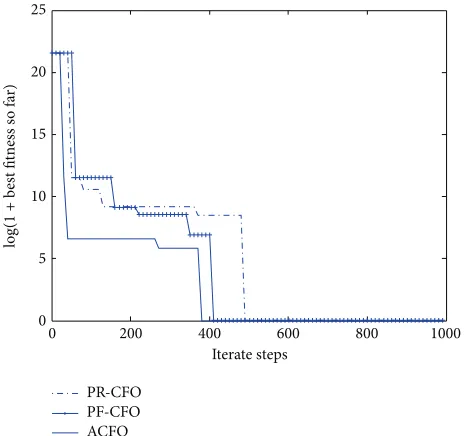
0 200 400 600 800 1000
0 2 4 6 8 10 12 14
Iterate steps
PR-CFO PF-CFO ACFO
log(
1+
be
st
fit
ness s
o fa
r)
Figure 1: Convergence curves of three algorithms on𝑓1.
0 200 400 600 800 1000
0 10 20 30 40 50 60 70
Iterate steps
log(
1+
be
st
fit
ness s
o fa
r)
PR-CFO PF-CFO ACFO
Figure 2: Convergence curves of three algorithms on𝑓2.
4. Numerical Experiments
In this section, the performance of ACFO algorithm is compared with the existing algorithms, GSO, GA, PSO, PR-CFO, PF-PR-CFO, CFO-NM, and EPSO, using a suite of the former twenty-three benchmark functions provided in [25]. In ACFO algorithm, internal parameters 𝛾start = 0 and
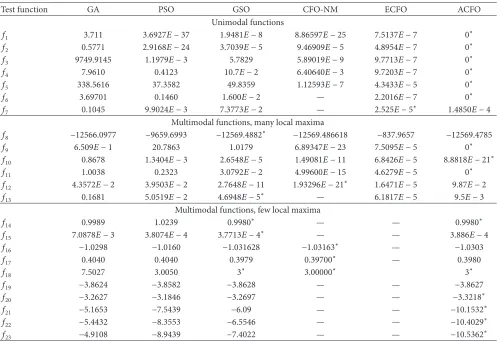
Table 3: Comparison of ACFO with GA, PSO, GSO, CFO-NM, and ECFO.
Test function GA PSO GSO CFO-NM ECFO ACFO
Unimodal functions
𝑓1 3.711 3.6927𝐸 − 37 1.9481𝐸 − 8 8.86597𝐸 − 25 7.5137𝐸 − 7 0∗
𝑓2 0.5771 2.9168𝐸 − 24 3.7039𝐸 − 5 9.46909𝐸 − 5 4.8954𝐸 − 7 0∗
𝑓3 9749.9145 1.1979𝐸 − 3 5.7829 5.89019𝐸 − 9 9.7713𝐸 − 7 0∗
𝑓4 7.9610 0.4123 10.7𝐸 − 2 6.40640𝐸 − 3 9.7203𝐸 − 7 0∗
𝑓5 338.5616 37.3582 49.8359 1.12593𝐸 − 7 4.3433𝐸 − 5 0∗
𝑓6 3.69701 0.1460 1.600𝐸 − 2 — 2.2016𝐸 − 7 0∗
𝑓7 0.1045 9.9024𝐸 − 3 7.3773𝐸 − 2 — 2.525𝐸 − 5∗ 1.4850𝐸 − 4
Multimodal functions, many local maxima
𝑓8 −12566.0977 −9659.6993 −12569.4882∗ −12569.486618 −837.9657 −12569.4785
𝑓9 6.509𝐸 − 1 20.7863 1.0179 6.89347𝐸 − 23 7.5095𝐸 − 5 0∗
𝑓10 0.8678 1.3404𝐸 − 3 2.6548𝐸 − 5 1.49081𝐸 − 11 6.8426𝐸 − 5 8.8818𝐸 − 21∗
𝑓11 1.0038 0.2323 3.0792𝐸 − 2 4.99600𝐸 − 15 4.6279𝐸 − 5 0∗
𝑓12 4.3572𝐸 − 2 3.9503𝐸 − 2 2.7648𝐸 − 11 1.93296𝐸 − 21∗ 1.6471𝐸 − 5 9.87𝐸 − 2
𝑓13 0.1681 5.0519𝐸 − 2 4.6948𝐸 − 5∗ — 6.1817𝐸 − 5 9.5𝐸 − 3
Multimodal functions, few local maxima
𝑓14 0.9989 1.0239 0.9980∗ — — 0.9980∗
𝑓15 7.0878𝐸 − 3 3.8074𝐸 − 4 3.7713𝐸 − 4∗ — — 3.886𝐸 − 4
𝑓16 −1.0298 −1.0160 −1.031628 −1.03163∗ — −1.0303
𝑓17 0.4040 0.4040 0.3979 0.39700∗ — 0.3980
𝑓18 7.5027 3.0050 3∗ 3.00000∗ 3∗
𝑓19 −3.8624 −3.8582 −3.8628 — — −3.8627
𝑓20 −3.2627 −3.1846 −3.2697 — — −3.3218∗
𝑓21 −5.1653 −7.5439 −6.09 — — −10.1532∗
𝑓22 −5.4432 −8.3553 −6.5546 — — −10.4029∗
𝑓23 −4.9108 −8.9439 −7.4022 — — −10.5362∗
system. The stopping condition is that iterations reach their maximum limit𝑁𝑡. We also early stop the ACFO algorithm if the difference between the average best fitness over 30 steps (including the current step) and the current best fitness is less than 10−6.
In Table 2, 𝐹, 𝑁𝑑, 𝑓min, and 𝑁eval stand for the test function, the dimension of decision space, the optimum minimum value for each function, and the total number of function evaluations, respectively. The statistical data in
Table 2for RP-CFO and RF-CFO are reproduced from [13] and [15], respectively. The best fitness is the optimum maxi-mum (note the negative of each of the benchmark functions). The set of twenty-three benchmark functions are divided into unimodal functions (𝑓1to𝑓7), multimodal functions (𝑓8to
𝑓13), and low-dimensional multimodal functions (𝑓14to𝑓23).
Table 3summarizes the obtained optimum minimum results which are compared with other optimization algorithms, such as GA, PSO, GSO, CFO-NM, and ECFO. The statistical data for CFO-NM and ECFO is from [16,17] while the other statistical data is from [5]. In Tables 2 and 3, the star ∗ denotes that the numerical result is the best one among all the comparative algorithms. InTable 3, the symbol “—” means that the problem is not calculated in the original references.
From Table 2, it is clearly seen that the ACFO algo-rithm yields significantly better performance than PR-CFO
algorithm on benchmark functions 𝑓1–𝑓5. But the ACFO algorithm has a worse result on 𝑓7 and same result on
𝑓6compared to PR-CFO algorithm. From the comparisons between ACFO algorithm and PF-CFO algorithm, we can find that ACFO algorithm performs better than PF-CFO algorithm on𝑓3and𝑓5and obtains the same results yielded by PF-CFO algorithm on 𝑓1, 𝑓2, 𝑓4, 𝑓6, and 𝑓7. But it should be noted that both the ACFO and PF-CFO algorithm can obtain optimum minimum value of 𝑓1, 𝑓2, 𝑓4, and
𝑓6.
The set of benchmark functions𝑓8–𝑓13 are multimodal functions with many local minima. From Table 2, we can see that the ACFO algorithm outperforms PR-CFO and PF-CFO algorithm except functions 𝑓8, 𝑓12, and𝑓13, but PR-CFO and PF-PR-CFO algorithm are superior to APR-CFO algorithm on benchmark function 𝑓8 by a very small percentage of
6.683𝐸 − 07and6.285𝐸 − 07, respectively.
The other set of benchmark functions 𝑓14–𝑓23 are low dimensions multimodal functions. From the comparison shown inTable 2, it can be obviously seen that the best fitness generated by ACFO, PR-CFO, and PF-CFO algorithm are almost the same on𝑓14–𝑓23.
0 200 400 600 800 1000 0
2 4 6 8 10 12
Iterate steps
log(
1+
be
st
fit
ness s
o fa
r)
PR-CFO PF-CFO ACFO
Figure 3: Convergence curves of three algorithms on𝑓3.
0 200 400 600 800 1000
0 0.5 1 1.5 2 2.5 3 3.5 4 4.5 5
Iterate steps
log(
1+
be
st
fit
ness s
o fa
r)
PR-CFO PF-CFO ACFO
Figure 4: Convergence curves of three algorithms on𝑓4.
In Table 3, we can clearly see that the ACFO algo-rithm outperforms GA, PSO, GSO, CFO-MN, and ECFO algorithms on test functions 𝑓1–𝑓7. The only exception is function 𝑓7 in which the ECFO algorithm is superior to ACFO algorithm. It is seen that, for test functions 𝑓8–𝑓13, ACFO algorithm performs better than GA and PSO algo-rithms except function 𝑓12. In addition, ACFO algorithm outperforms GSO, CFO-NM, and ECFO on functions𝑓9–𝑓11. For functions 𝑓14–𝑓23, we can also find that the ACFO algorithm generates better results than the GA and PSO. The only exception is function 𝑓15 in which the ACFO algorithm yields a similar result compared to PSO. From the comparisons between ACFO and GSO algorithm, we can see
0 200 400 600 800 1000
0 5 10 15 20 25
Iterate steps
log(
1+
be
st
fit
ness s
o fa
r)
PR-CFO PF-CFO ACFO
Figure 5: Convergence curves of three algorithms on𝑓5.
0 200 400 600 800 1000
0 2 4 6 8 10 12
Iterate steps
log(
1+
be
st
fit
ness s
o fa
r)
PR-CFO PF-CFO ACFO
Figure 6: Convergence curves of three algorithms on𝑓6.
that the ACFO algorithm outperforms GSO algorithm on functions𝑓20–𝑓23 and has similar results to GSO algorithm on functions𝑓14–𝑓19. In addition, ACFO algorithm has also similar result to CFO-NM algorithm on functions𝑓16–𝑓18. From the comparisons between ACFO and other algorithms, it is found that the ACFO algorithm performs better than the other algorithms.
0 200 400 600 800 1000 0
1 2 3 4 5 6 7 8
Iterate steps
log(
1+
be
st
fit
ness s
o fa
r)
PR-CFO PF-CFO ACFO
Figure 7: Convergence curves of three algorithms on𝑓7.
hence has a higher convergence rate. According toFigure 7, ACFO and PR-CFO algorithms have similar convergence rates, but ACFO algorithm has good convergence rate com-pared with PF-CFO algorithm.
5. Conclusion
This paper presents ACFO algorithm which enhances the convergence capability of the CFO algorithm. The ACFO algorithm introduces a weight and updates the equation that generates the probe’s position. Based on the stability theory of discrete time-varying dynamic systems, we define adaptive weight and gravitational constant. In order to test ACFO algorithm performance, ACFO algorithm is compared with improved CFO algorithms and other state-of-the-art algorithms. The simulation results show that the ACFO is better than other algorithms.
Conflict of Interests
The authors declare that there is no conflict of interests regarding the publication of this paper.
Acknowledgments
The authors would like to thank the editor and anonymous referees for their valuable comments and suggestions which improved this paper greatly. This work is partly supported by the National Natural Science Foundation of China (11371071) and Scientific Research Foundation of Liaoning Province Educational Department (L2013426).
References
[1] J. Holland,Adaptation in Natural and Artificial Systems, Univer-sity of Michigan Press, Ann Arbor, Mich, USA, 1975.
[2] J. Kennedy and R. C. Eberhart, “Particle swarm optimization,” inProceedings of the IEEE International Conference on Neural Networks, vol. 4, pp. 1942–1948, Perth, Australia, December 1995.
[3] M. Dorigo, M. Birattari, and T. Stutzle, “Ant colony optimiza-tion,”IEEE Computational Intelligence Magazine, vol. 1, no. 4, pp. 28–39, 2006.
[4] X.-S. Yang and S. Deb, “Engineering optimisation by cuckoo search,”International Journal of Mathematical Modelling and Numerical Optimisation, vol. 1, no. 4, pp. 330–343, 2010. [5] S. He, Q. H. Wu, and J. R. Saunders, “Group search optimizer: an
optimization algorithm inspired by animal searching behavior,” IEEE Transactions on Evolutionary Computation, vol. 13, no. 5, pp. 973–990, 2009.
[6] K. N. Krishnanand and D. Ghose, “Glowworm swarm optimi-sation: a new method for optimising multi-modal functions,” International Journal of Computational Intelligence Studies, vol. 1, no. 1, pp. 93–119, 2009.
[7] N. Metropolis, A. W. Rosenbluth, M. N. Rosenbluth, A. H. Teller, and E. Teller, “Equation of state calculations by fast computing machines,”The Journal of Chemical Physics, vol. 21, no. 6, pp. 1087–1092, 1953.
[8] S. I. Birbil and S.-C. Fang, “An electromagnetism-like mecha-nism for global optimization,”Journal of Global Optimization, vol. 25, no. 3, pp. 263–282, 2003.
[9] R. A. Formato, “Central force optimization: a new metaheuristic with applications in applied electromagnetics,” Progress in Electromagnetics Research, vol. 77, pp. 425–491, 2007.
[10] E. Rashedi, H. Nezamabadi-Pour, and S. Saryazdi, “GSA: a gravitational search algorithm,”Information Sciences, vol. 179, no. 13, pp. 2232–2248, 2009.
[11] A. Kaveh and S. Talatahari, “A novel heuristic optimization method: charged system search,”Acta Mechanica, vol. 213, no. 3-4, pp. 267–289, 2010.
[12] R. A. Formato, “Pseudorandomness in central force optimiza-tion,” Computing Research Repository, http://arxiv.org/abs/ 1001.0317.
[13] R. A. Formato, “Pseudorandomness in central force optimiza-tion,”British Journal of Mathematics & Computer Science, vol. 3, no. 3, pp. 241–264, 2013.
[14] R. A. Formato, “Parameter-free deterministic global search with central force optimization,” Computing Research Repository, http://arxiv.org/abs/1003.1039.
[15] R. A. Formato, “Parameter-free deterministic global search with simplified central force optimization,” inAdvanced Intelligent Computing Theories and Applications, vol. 6215 ofLecture Notes in Computer Science, pp. 309–318, Springer, Berlin, Germany, 2010.
[16] K. R. Mahmoud, “Central force optimization: Nelder-Mead hybrid algorithm for rectangular microstrip antenna design,” Electromagnetics, vol. 31, no. 8, pp. 578–592, 2011.
[17] D. Ding, D. Qi, X. Luo, J. Chen, X. Wang, and P. Du, “Conver-gence analysis and performance of an extended central force optimization algorithm,”Applied Mathematics and Computa-tion, vol. 219, no. 4, pp. 2246–2259, 2012.
[18] R. A. Formato, “Improved cfo algorithm for antenna optimiza-tion,”Progress In Electromagnetics Research B, vol. 19, pp. 405– 425, 2010.
[20] G. M. Qubati and N. I. Dib, “Microstrip patch antenna opti-mization using modified central force optiopti-mization,”Progress in Electromagnetics Research B, vol. 21, pp. 281–298, 2010. [21] R. A. Formato, “Central Force Optimization with variable initial
probes and adaptive decision space,”Applied Mathematics and Computation, vol. 217, no. 21, pp. 8866–8872, 2011.
[22] R. C. Green II, L. Wang, and M. Alam, “Training neural networks using central force optimization and particle swarm optimization: insights and comparisons,”Expert Systems with Applications, vol. 39, no. 1, pp. 555–563, 2012.
[23] W. Qian and T. Zhang, “Adaptive central force optimization algorithm,”Computer Science, vol. 39, no. 6, pp. 207–209, 2012 (Chinese).
[24] Z. H. Cui and J. C. Zen,Particle Swarm Optimization, Science Press, Beijing, China, 2011.
Submit your manuscripts at
http://www.hindawi.com
Hindawi Publishing Corporation
http://www.hindawi.com Volume 2014
Mathematics
Journal ofHindawi Publishing Corporation
http://www.hindawi.com Volume 2014
Mathematical Problems in Engineering
Hindawi Publishing Corporation http://www.hindawi.com
Differential Equations International Journal of
Volume 2014
Hindawi Publishing Corporation
http://www.hindawi.com Volume 2014 Hindawi Publishing Corporationhttp://www.hindawi.com Volume 2014
Hindawi Publishing Corporation
http://www.hindawi.com Volume 2014 Mathematical PhysicsAdvances in
Complex Analysis
Journal ofHindawi Publishing Corporation
http://www.hindawi.com Volume 2014
Optimization
Journal ofHindawi Publishing Corporation
http://www.hindawi.com Volume 2014
Combinatorics
Hindawi Publishing Corporation
http://www.hindawi.com Volume 2014 International Journal of
Hindawi Publishing Corporation
http://www.hindawi.com Volume 2014
Journal of
Hindawi Publishing Corporation
http://www.hindawi.com Volume 2014
Function Spaces
Abstract and Applied Analysis
Hindawi Publishing Corporation
http://www.hindawi.com Volume 2014
International Journal of Mathematics and Mathematical Sciences
Hindawi Publishing Corporation http://www.hindawi.com Volume 2014
The Scientific
World Journal
Hindawi Publishing Corporationhttp://www.hindawi.com Volume 2014
Hindawi Publishing Corporation
http://www.hindawi.com Volume 2014
Discrete Dynamics in Nature and Society Hindawi Publishing Corporation
http://www.hindawi.com Volume 2014
Hindawi Publishing Corporation
http://www.hindawi.com Volume 2014
Discrete Mathematics
Journal ofHindawi Publishing Corporation
http://www.hindawi.com Volume 2014 Hindawi Publishing Corporationhttp://www.hindawi.com Volume 2014