“Stepping up the Ladder in Safety”: An Interpretative Phenomenological
Analysis of how LGB Clients Experience Their Therapists’ Sexual
Orientation
Tsabika Bafiti
a, Maria Viou*
a, Prodromos Tarasis
a[a] Training and Research Institute for Systemic Psychotherapy, Athens, Greece.
Abstract
Relevant literature has explored the issue of disclosure of Lesbian, Gay and Bisexual (LGB) therapists to heterosexual or LGB clients. But how do homosexual or bisexual clients understand and experience their therapist’s heterosexual orientation, known or assumed, in relation to the therapeutic alliance and the therapeutic process? In this qualitative study, we used the Interpretative Phenomenological Analysis to examine eight semi-structured interviews with LGB clients in a family-oriented therapy in Greece. Analysis revealed two themes of higher order, each having three subordinate themes depicting the client’s experience of the therapist’s sexual orientation: 1. Focus on the therapist’s sexual orientation: (a) as a hypothesis (b) as a factor of acceptance (c) as a factor of professional capability and 2. Focus on other therapist features: (a) gender (b) personality traits (c) practice of professional role. The therapist’s sexual orientation or the one perceived by the client was not a neutral issue in therapy and the cultivation of the therapeutic relationship but was only one part of the process. The way all these issues were processed and approached by clients was related to their personal history and phase of therapy. Suggestions for future research include conducting a research on clients from different therapeutic perspectives since it was carried out only on participants in long-term systemic family therapy.
Keywords: Interpretative Phenomenological Analysis, therapist’s sexual orientation, therapeutic relationship, LGB clients, family therapy
The European Journal of Counselling Psychology, 2018, Vol. 7(1), 211–223, doi:10.5964/ejcop.v7i1.139 Received: 2017-01-19. Accepted: 2018-09-15. Published (VoR): 2019-01-09.
*Corresponding author at: 22-24, Portarias Str., 11523 Athens, Greece. E-mail: [email protected]
This is an open access article distributed under the terms of the Creative Commons Attribution License (https://
creativecommons.org/licenses/by/3.0/), which permits unrestricted use, distribution, and reproduction in any medium, provided the original work is properly cited.
Therapist’s Sexual Orientation
The therapist’s sexual orientation is an important part of therapy, especially when working with lesbian, gay and bisexual clients. According to Guthrie (2006), the therapist’s sexuality or the one perceived by clients does not constitute a neutral issue in therapy as a therapist’s disclosure might have an impact on various levels of the process and affect the client. Hence, the therapist’s sexual orientation issue has been mainly addressed in liter-ature with a focus on homosexual/bisexual therapists and the dilemma of whether and how to disclose their sexual orientation to lesbian, gay, bisexual or straight clients (see Russell, 2006; Carroll, Gauler, Relph, & Hutchinson, 2011; Guthrie, 2006; Moore & Jenkins, 2012). All research evidence points to issues of complexity and relativity that occur in these cases of disclosure as to whether it is intentional or unintentional, suggesting that there is no right or wrong answer and that each case should be treated separately. However, as in every case of a therapist’s self-disclosure, therapists should always carefully consider the implications of disclosure on the therapeutic process as it might have both facilitative and impeding effects to therapeutic relationships (see Audet & Everall, 2010; Levitt et al., 2015).
In reference to heterosexual orientation, there are particular guidelines provided by the American Psychological Association to therapists working with lesbian, gay and bisexual clients (APA, 2012). To be more specific, heter-osexual therapists are encouraged to reflect on and understand their personal prejudices and biases when working with homosexual clients and to be informed and trained on issues related to homosexuality. This con-stant flow of information seems to be important so that differences related to sexual orientation are not overval-ued or devaloverval-ued by therapists (Androutsopoulou & Economou, 2005; Bernstein, 2000; Green, 1996), taking into account the effects of stigma on LGB orientations (Kelleher, 2009). Also, in the field of family therapy, studies of lesbian and gay family relations offer new perspectives in traditional family therapy norms challenging many of its assumptions and showing how important it is to deepen the clients' understanding of lived experiences (Green, 1996).
Therapist’s Sexual Orientation as a Criterion for Choosing a Therapist
Also, research has shown that some homosexual clients choose homosexual therapists because they think this choice will make them feel at ease, safe and accepted and that it will help them develop their sense of self-acceptance (Galgut, 2005; Jones & Gabriel, 1999). Other research has shown that homosexual clients prefer heterosexual therapists in order to avoid sexual attraction (Ryden & Loewenthal, 2001) and to openly express negative thoughts about homosexuality (Mair, 2003). Finally, some clients don't wish to know their therapist’s sexual orientation, hence such disclosure of their sexual orientation can only take place after careful thinking and processing (Guthrie, 2006).
Other Features of Therapy
Although, as mentioned above, the therapist’s sexual orientation is not considered an impartial issue in therapy, most evidence shows that there are other parameters and features of therapy that are very important when working with homosexual/bisexual clients. For example, factors such as the therapist's knowledge about their clients’ difficulties which are related to homosexuality (Jones, Botsko, & Gorman, 2003), the view of homosex-uality as non-pathological (Pixton, 2003) and the quality of the therapeutic relationship (Lebolt, 1999), all seem to play an important role for an effective therapy when working with LGB clients.
How Clients Understand and Process Their Therapist’s Sexuality
ho-mosexual/bisexual client and another is how this experience is related to the therapeutic relationship and proc-ess.
Aim of the Study
The aim of our research was to “give voice” and understand in depth how homosexual/bisexual clients experi-ence their relationship with a heterosexual therapist. We focused on the personal and subjective understanding of a therapist’s sexual orientation as perceived, imagined or understood by clients. Our qualitative study’s spe-cific research questions were: 1) How do homosexual/bisexual clients experience their relationship with a heter-osexual therapist? 2) How does a therapist’s sexual orientation relate to clients' perception of the therapeutic relationship and process?
Method
The method we used was the Interpretative Phenomenological Analysis (IPA). This qualitative research method focuses on the way people give meaning to their lives based on their lived experiences (Smith et al., 1999) and tries to develop a rich and in depth understanding of the perspectives of participants, with an interpretive ac-count (Smith, Flowers, & Larkin, 2009; Smith & Osborn, 2003). Hence, the understanding of the experience is phenomenological in the sense that it not only focuses on the experience per se, but it is also interpretative as the researcher tries to interpret and make sense of the individual account of a person who tries to interpret themselves (Smith et al., 2009). Also, this approach takes into account issues of complexity and relativity while understanding that individual accounts are embedded in the social and cultural context in which they are gener-ated (Larkin, Watts, & Clifton, 2006). Finally, IPA, as a form of qualitative research, creates and enhances links between research and clinical practice (see McLeod, 2001). In a number of qualitative inquiries that used IPA on both clients’ and therapists’ accounts (Friel, 2016; Tapson, 2016; Thompson & Cooper, 2012), the results enriched theory and could be applied to counselling and therapeutic practice.
Procedure
Participants were informed of the confidentiality procedures and they all read and signed their informed consent prior to the interviews. Research questions were open, focusing on the participants’ personal accounts and al-lowing their inner experience to be expressed. The interview questions reflected the process by focusing on the concepts of meaning and understanding. Also, emphasis was given to probing questions about the issues of time, space and embodiment; for example, by asking how the clients’ experience changed over time and in the context of therapy (e.g. individual or group therapy) and whether they could mention a somatic experience or feeling.
Materials
Participants
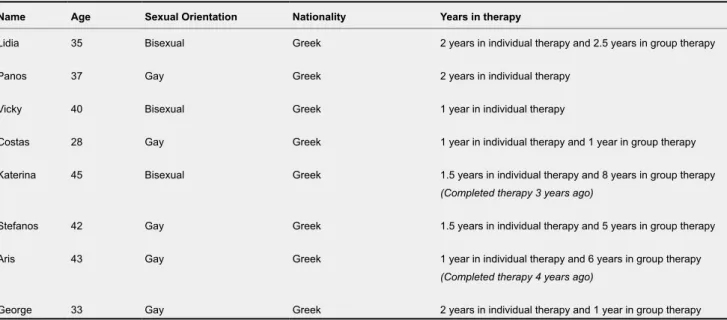
The participants recruited came from the researchers’ professional network and two out of the three research-ers were their actual therapists. However, the interviews were organised in such a manner so that a therapist would not interview one of his clients. Participants were also informed that their therapist would not have ac-cess to the recordings and that their personal information would be changed for anonymity reasons. Eight peo-ple in total were interviewed; five of them were male and three female, five gay men and three bisexual women and their age ranged between 28-45 years old (see also Table 1). They were all in long term systemic family-oriented therapy but in different stages of the therapeutic process. None of the participants started therapy in order to address their sexuality. The specific initial concerns are not mentioned here for anonymity reasons in order to avoid identification of the clients.
Table 1
Participants
Name Age Sexual Orientation Nationality Years in therapy
Lidia 35 Bisexual Greek 2 years in individual therapy and 2.5 years in group therapy
Panos 37 Gay Greek 2 years in individual therapy
Vicky 40 Bisexual Greek 1 year in individual therapy
Costas 28 Gay Greek 1 year in individual therapy and 1 year in group therapy
Katerina 45 Bisexual Greek 1.5 years in individual therapy and 8 years in group therapy
(Completed therapy 3 years ago)
Stefanos 42 Gay Greek 1.5 years in individual therapy and 5 years in group therapy
Aris 43 Gay Greek 1 year in individual therapy and 6 years in group therapy
(Completed therapy 4 years ago)
George 33 Gay Greek 2 years in individual therapy and 1 year in group therapy
Analysis
A line by line data analysis revealed individual themes at the same time, maintaining a sense of the whole, while a cross-case analysis captured the interconnected high-ordered and lower-ordered themes that will be presented in this article. The researchers reflected on their own experiences and were aware that their percep-tions could only be partially bracketed from their analysis of the data (Smith et al., 2009). A separate analysis from the three researchers was conducted and the themes presented here were developed through discussion and negotiation. Specifically, their effort to reassure the research’s quality was based on the guidelines of
Results
The analysis revealed two high order themes each connected to three subordinate themes, briefly presented in
Table 2.
Table 2
Findings Summarized
High order themes / Subordinate themes
Number of participants endorsing the specific theme
Focus on the therapist’s sexual orientation 8 out of 8
The therapists’ sexual orientation as an assumption. 8 out of 8 The therapists’ sexual orientation as a factor of acceptance. 8 out of 8 The therapist’s sexual orientation as a factor of capability 6 out of 8
Focus on other therapist features 8 out of 8
Therapist’s gender 7 out of 8
The therapists’ personality attributes 8 out of 8 Therapist's enactment of the professional role 6 out of 8
Both first-order and secondary-order themes will be presented in more detail in the following section.
Focus on the Therapist’s Sexual Orientation
This specific theme refers to the different ways clients processed and experienced their therapist’s sexual orien-tation. Most clients had a prefixed idea or assumption about their therapist’s sexual orientation that did not seem to play an important role either in the process of selecting a therapist or in the therapeutic relationship. However, this assumption seemed to be an important factor of acceptance and for some, a factor that was rela-ted to therapeutic capability. Three distinct factors that were identified as secondary order themes are presen-ted below:
The Therapist’s Sexual Orientation as an Assumption
This theme reflects different assumptions and thoughts that clients have about the therapist’s sexual orienta-tion. All clients seemed to have questioned or made a hypothesis about the therapist’s sexuality. However, the way each of them processed and tackled with this assumption differed.
Lidia had a prefixed idea before meeting her therapist that he would be gay, since there is a stereotype that men psychotherapists are usually homosexual. This assumption seems to have changed after their first meet-ing, showing that the therapist’s sexual orientation becomes less important over time. Hence, although sexual orientation initially was an issue for Lidia, this changed when other therapeutic factors came to the surface.
Lidia:“Well yes…When I first went to therapy, I assumed that he was gay because of the subject and the fact that very few men are therapists. Nevertheless, I went to the session with this thought in mind…This was before the session, but after it was finished I was not sure after all... I actually did not care and just delved into my issues.”
men-tioned above, play a role at the beginning of therapy in a phase where a therapeutic relationship has not been established yet. Also, Stefanos seems to be concerned with other people’s sexual orientation, including his therapist’s, in an effort maybe to accept his own.
Stefanos:“I knew that she was married and had a child before going to therapy, but I don’t think we are much different because of that… However, I did wonder about the male therapist’s sexuality be-cause of the existing stereotype that people working in theoretical professions such as psychology and philosophy are usually gay (…) I always wonder about the sexuality of people I meet. I don’t know why I am interested in that kind of information, it isn’t gossip though.”
The Therapist’s Sexual Orientation as a Factor of Acceptance
This sub-theme reveals how the clients’ perception of a therapist’s sexuality is related to the issue of being ac-cepted by the therapist, as well as to self-acceptance and understanding of sexuality as part of a person’s iden-tity:
For example, Vicky said her therapist’s non-judgmental reaction regarding her sexuality was very important to her indicating that she was expecting and was actually afraid of a different reaction. For LGB clients, including Vicky, the acceptance of one’s sexual identity is a very serious issue. She seemed prepared to see a negative reaction on her therapist’s face when she “came-out”. However, her therapist’s acceptance was the initial step towards building a strong therapeutic relationship:
Vicky:“Well, for me, what matters most is for the other person to be heterosexual, open-minded and accepting. When I told my therapist that I am bisexual, I did not see any grimace on his face. He reac-ted as if it was the most natural and normal thing in the world and that was enough…”
Also, Costas expressed how his therapist’s acceptance changed his beliefs about straight people and added to his self-acceptance. This indicates the importance of his internalized fear of rejection because of his sexual identity:
Costas:“The fact that two straight persons had no problem at all with gay people helped me under-stand that not all straight people are homophobic and to accept myself even more.”
The Therapist’s Sexual Orientation as a Factor of Capability
Vicky refers to her therapist’s sexual orientation and, more specifically, to the perceived heterosexual orienta-tion as a factor of capability since she believes that being homosexual might cause a therapist to be subjective and influenced by his own issues. This indicates that an internalized stereotype of homosexuality is related to the therapeutic relationship but in a reversed way than we might have expected.
Vicky:“I don’t mean to sound racist, but I think that if the other person is straight then they are more objective and open-minded (…) because homosexuality is something that is repressed, and, in my mind, therapists are human beings like everyone else, so they might as well express some kind of weakness.”
Katerina:“I wanted her to be happy and in love; I did not care if she would be in a relationship with a man or a woman, she was a role model to me (…). However, if she was a lesbian, she could have her own issues and difficulties to deal with… I don’t know, maybe I also felt safe that being straight she would not have any sexual feelings for me and vice versa.”
Focus on Other Therapist Features
This second higher order theme focused on and referred to other attributes of the therapist that interviewees considered important in the therapeutic process and in cultivating a strong therapeutic alliance. These attributes were the therapists’ gender, their personality traits and the ways they act in their professional role.
Therapist’s Gender
Most clients had a preference on the therapist's gender and also acknowledged it to be an important factor in the therapeutic process and the relationship with their therapist. However, the way each client thought of gen-der influenced their choices related to their personal history.
To start with, Panos focused on specific female or male features. In this case, we see stereotypes about gender being expressed that are related to issues of capability or personality:
Panos: “Well, women are more accepting; I wanted my therapist to be a woman since both myself and all of my friends have opened up firstly to girls. I think it is in the human nature to open up to women since they are more understanding (…) I like the fact that she has masculine features, and this has nothing to do with sleeping with women. Some masculine features involve being honest and straight-forward.”
Stefanos focused on his relationship with women, but also on his difficulty to open up to a man about his sex-uality. In this case, although we can identify gender stereotypes regarding homophobia, we can also see that the choice of the therapist’s gender is related to Stefanos’s personal history and relationship with women in his life:
Stefanos:“If my therapist was a guy, I would not open up so easily about my sexuality. I think that men are much more homophobic than women and I am much more cautious. I can open up to women and talk about many things, but on the same time they also upset me. I seem to form intense relationships with women.”
The Therapist’s Personality Attributes
This sub-theme focused on specific personality traits that clients considered important in the process and their relationship with the therapist such as humour, morality and stability.
For example, Costas thought that a therapist's calmness and other personality features were important to him. All these features were related to the admiration he seemed to feel when talking about his therapist and could also have been a part in the process of building a secure therapeutic alliance:
help people. She has ethics; she is moral and a well-educated person with goodness and many values and virtues.”
Lidia mentioned that humour and other features were very important in making her feel comfortable and talk about her thoughts and feelings. She acknowledged how the fact that her therapist had some extra pounds made her feel like he was a human she could relate to. This was also part of the therapeutic relationship:
Lidia:“It helps me that my therapist has a sense of humour. I could not do without humour. And I will tell you something else that might come across as strange: it helps me that he has a few extra pounds, because I feel comfortable talking about things and that he can understand me. I feel more at ease.”
Katerina stressed how important her therapist's empathic characteristics were for her, among other traits as well:
Katerina:“I liked that she expressed authentic emotions and showed her affection, empathized with the other person, shared some of her own stuff and did not act as a cold professional persona (…) She seemed to like what she did (…) She is an open-minded person; she accepted other people's differen-ces and protected me even from my own self. I also loved her sense of humour.”
Therapist's Enactment of the Professional Role
This sub-theme refers to the different ways clients process the therapist’s professional role and the different ways in which this influences the therapeutic process.
For example, Katerina mentioned that she appreciates the fact that her therapist sets boundaries without being too rigid, as well as the way she handles the coexistence of many clients in a group. This shows how bounda-ries together with empathy can create a safe place, a safety net in the therapeutic context in which the thera-peutic relationship could flourish:
Katerina:“I like that she sets boundaries. She shows professionalism, but at the same time allows me to go crazy (…). What also helped me was that she cared for other people in the group as well. In the beginning it was hard, but after a while that made me feel safe and understand that she is a good per-son… She does not leave someone behind. I appreciated her because she helped the other members as well and I learned not only from her sayings but her actions as well.”
Panos also referred to the issue of flexible boundaries:
Panos:“I appreciated that she was not cold but professional. I would not have liked it if a therapist was strict and set very rigid boundaries. She does set boundaries and gives me a context, which is impor-tant but not that rigid ones.”
Metaphorical Images
the alliance with the therapist, the feeling of security in therapy, the personality of the therapist and her profes-sional role. Two of them are illustrated below:
George: “I don’t know why, but it just crossed my mind; it's like the therapist holds a ladder and I am
stepping up the steps while she is holding it for me.”
Interviewer: “And how do you feel?”
George: “I feel insecure, but then I look down, I see her and I feel better and safer that she is there to
hold the ladder for me.”
Costas: “Therapy is like giving birth; even though our parents bring us to this world and we are their
biological children, therapists and therapy itself can help you learn how to live, to discover what life is all about and at the same time discover yourself. I think a therapist is like a parent who brings you to life emotionally.”
Discussion
The analysis of the research material showed two higher order themes, each including three sub-themes: 1. Focus on the therapist’s sexual orientation: (a) as an assumption, (b) as a factor of acceptance (c) as a factor of capability and 2. Focus on other therapeutic attributes: (a) the therapist’s gender (b) the therapist’s personali-ty attributes (c) the therapist’s practice of the professional role.
The findings of our research reveal the diversity, complexity and wealth of the LGB clients’ experiences related to a therapist’s sexual orientation. These findings are in accordance with Guthrie (2006) who highlighted that a therapist’s sexual orientation is not a neutral issue in therapy and has an impact on the therapeutic process. More specifically, our analysis showed that the therapist’s orientation might be perceived and processed as a question and hypothesis, as a factor of acceptance and/or therapeutic capability, especially in the early phases of therapy. In some cases, the known or assumed heterosexual orientation of a therapist seemed to be connec-ted with both a greater self-acceptance and a therapeutic capability.
Also, our analysis highlighted the fact that, although for clients the relationship with their therapist could en-hance their self-acceptance (Galgut, 2005), the therapist’s sexual orientation was not an initial criterion of choice. In some cases, the non-explicit disclosure of therapists’ sexual orientation, whether homosexual or het-erosexual, seemed to be helpful for some clients as they expressed their wish “not to know” supporting also Guthrie's point of view (Guthrie, 2006).
The study’s findings also agree with the current literature, stressing the importance of a therapist’s knowledge and information about issues and difficulties related to homosexuality (see, for example, Jones, Botsko, & Gorman, 2003; Bernstein, 2000; Spiliotis, Brown, & Coyle, 2011), a non-pathological view of homosexuality (see Pixton, 2003) and the quality of the therapeutic relationship (see, for example, Lebolt, 1999). Furthermore, one very important feature related to the clients' experience of the process and the therapeutic relationship is their therapist's gender, which seems to contribute to an initial judgment regarding their competency while the meaning attached to it depends on the clients' experience and history (Harris & Busby, 1998).
confi-dence and respect. Some of these features have already been identified in other researches (see, for example,
Hilsenroth, Cromer, & Ackerman, 2012). The current analysis highlighted additional characteristics and person-ality traits of therapists that contributed to the therapeutic relationship. These were: humour, morality, calmness and stability. Also, another feature that seems to be important for all clients is the way a therapist enacts and conducts their professional role with the most important of all being the setting of boundaries in the therapeutic context. The perception of these attributes as most helpful highlights the importance of a therapist’s “human identity” that makes him a person with specific personality attributes who accepts, empathises and enacts their professional role.
At this point, the situated character of our study should be acknowledged. It is a research conducted in Greece, positioned in a specific historical and social context reflecting particular ideas about counselling, psychotherapy and sexual orientation. The social and national context, cultural ideologies and socially induced stressful condi-tions for LGB people seem to play an important role in the way LGB issues are being experienced and under-stood (see, for example, Kelleher, 2009).
Finally, it should be mentioned that our choice of a semi-structured rather than an open-ended interview sched-ule had possible constraints on the data provided by the research. But we made this choice because of the specific topic’s sensitivity, and because we wanted to have a specific focus on the interviews and help the par-ticipants speak freely about their therapist’s assumed orientation. However, we acknowledge that this decision restricted the richness of information that could be provided if the participants were given the opportunity to delve into and speak freely of their experience.
Implications for Counselling and Future Research
signifi-cance of the therapeutic alliance and treating each case separately taking into account the history of the client, the personal importance attached to the issue of sexual orientation and the specific phase of therapy.
Furthermore, our findings showed that this information might be processed in a different way, depending on the client’s phase of therapy. More specifically, in a more advanced phase of therapy or after completion of therapy, the clients seemed to be able to incorporate in a more coherent framework not only their own sexual orientation as one part of their identity but also process the therapist’s orientation as a small part of their identity. Also, the clients who were in a more advanced phase of therapy seemed to be reflecting on the experiences of therapy in a more holistic and synthetic manner. However, since the number of participants was small, we suggest fur-ther research on the subject in order to understand more thoroughly the diversity of the clients’ experiences in different therapeutic phases.
Finally, this study highlighted the complexity and richness of the LGB clients’ experiences, which are related to their therapist’s perceived or known sexual orientation. In future research, it would be interesting to explore the lived experiences of heterosexual clients with therapists who have a different sexual orientation. Also, since all the participants were in a long-term systemic family therapy, we suggest that further research could focus on clients being offered different therapeutic perspectives.
Funding
The authors have no funding to report.
Competing Interests
The authors have declared that no competing interests exist.
Acknowledgments
We would like to thank our colleague Dr. Athena Androutsopoulou for her comments on an earlier version of the manuscript.
References
American Psychological Association. (2012). Guidelines for psychological practice with lesbian, gay, and bisexual clients.
The American Psychologist, 67(1), 10-42. doi:10.1037/a0024659
Androutsopoulou, A., & Economou, E. (2005). Where to? Myths and realities in the therapy orientation of gay and lesbians. In C. Katakis & A. Androutsopoulou (Eds.), 'With a map and a compass': Narratives of systemic psychotherapy (pp. 166-189). Athens, Greece: Hellinika Grammata.
Audet, C. T., & Everall, R. D. (2010). Therapist self-disclosure and the therapeutic relationship: A phenomenological study from the client perspective. British Journal of Guidance & Counselling, 38, 327-342. doi:10.1080/03069885.2010.482450
Bernstein, A. C. (2000). Straight therapists working with lesbians and gays in family therapy. Journal of Marital and Family Therapy, 26, 443-454. doi:10.1111/j.1752-0606.2000.tb00315.x
Elliott, R., Fischer, C. T., & Rennie, D. L. (1999). Evolving guidelines for publication of qualitative research studies in psychology and related fields. British Journal of Clinical Psychology, 38, 215-229. doi:10.1348/014466599162782
Friel, J. A. (2016). What detoxifies shame in integrative psychotherapy? An interpretative phenomenological analysis.
British Journal of Psychotherapy, 32, 532-546. doi:10.1111/bjp.12246
Galgut, C. (2005). Lesbians and therapists – The need for explicitness. Counselling and Psychotherapy Journal,16, 11-27. Retrieved from http://www.cgalgut.bacp.co.uk/publications.html
Green, R.-J. (1996). Why ask, why tell? Teaching and learning about lesbian and gays in family therapy. Family Process, 35, 389-400. doi:10.1111/j.1545-5300.1996.00389.x
Guthrie, C. (2006). Disclosing the therapist’s sexual orientation: The meaning of disclosure in working with gay, lesbian, and bisexual patients. Journal of Gay & Lesbian Psychotherapy, 10, 63-77. doi:10.1300/J236v10n01_07
Harris, S. M., & Busby, D. M. (1998). Therapist physical attractiveness: An unexplored influence on client disclosure.
Journal of Marital and Family Therapy, 24, 251-257. doi:10.1111/j.1752-0606.1998.tb01081.x
Henretty, J. R., Berman, J. R., Currier, J., & Levitt, H. M. (2014). The impact of counselor self disclosure on clients: A meta-analytic review of experimental and quasi-experimental research. Journal of Counseling Psychology, 61, 191-207. doi:10.1037/a0036189
Hilsenroth, M. J., Cromer, T., & Ackerman, S. (2012). How to make practical use of therapeutic alliance research in your clinical work. In R. A. Levy, J. S. Ablon, & H. Kaechele (Eds.), Psychodynamic psychotherapy research: Evidence-based practice and practice-based evidence (pp. 361–380). New York, NY, USA: Springer.
Jones, M. A., Botsko, M., & Gorman, B. S. (2003). Predictors of psychotherapeutic benefit of lesbian, gay, and bisexual clients: The effects of sexual orientation matching and other factors. Psychotherapy, 40, 289-301.
doi:10.1037/0033-3204.40.4.289
Jones, M. A., & Gabriel, M. A. (1999). Utilization of psychotherapy by lesbians, gay men, and bisexuals: Findings from a nationwide survey. The American Journal of Orthopsychiatry, 69, 209-219. doi:10.1037/h0080422
Kelleher, C. (2009). Minority stress and health: Implications for lesbian, gay, bisexual, transgender, and questioning (LGBTQ) young people. Counselling Psychology Quarterly, 22, 373-379. doi:10.1080/09515070903334995
Larkin, M., Watts, S., & Clifton, E. (2006). Giving voice and making sense in interpretative phenomenological analysis.
Qualitative Research in Psychology, 3, 102-120. doi:10.1191/1478088706qp062oa
Lebolt, J. (1999). Gay affirmative psychotherapy: A phenomenological study. Clinical Social Work Journal, 27, 355-370. doi:10.1023/A:1022870129582
Levitt, H. M., Minami, T., Greenspan, S. B., Puckett, J. A., Henretty, J. R., Reich, C. M., & Berman, J. S. (2015). How therapist self-disclosure relates to alliance and outcomes: A naturalistic study. Counselling Psychology Quarterly, 29, 7-28. doi:10.1080/09515070.2015.1090396
Moore, J., & Jenkins, P. (2012). ‘Coming out’ in therapy? Perceived risks and benefits of self-disclosure of sexual orientation by gay and lesbian therapists to straight clients. Counselling & Psychotherapy Research, 12, 308-315.
doi:10.1080/14733145.2012.660973
Pixton, S. (2003). Experiencing gay affirmative therapy: An exploration of clients’ views of what is helpful. Counselling Psychology Review, 3, 211-215. doi:10.1080/14733140312331384372
Russell, G. M. (2006). Different ways of knowing: The complexities of therapist disclosure. Journal of Gay & Lesbian Psychotherapy, 10, 79-94. doi:10.1300/J236v10n01_08
Ryden, J., & Loewenthal, D. (2001). Psychotherapy for lesbians: The influence of therapist sexuality. Counselling Psychology Review, 1, 42-52. doi:10.1080/14733140112331385248
Smith, J. A., Flowers, P., & Larkin, M. (2009). Interpretative phenomenological analysis: Theory, method and research. Thousand Oaks, CA, USA: Sage.
Smith, J. A., Jarman, M., & Osborn, M. (1999). Doing interpretative phenomenological analysis. In M. Murray & K. Chamberlain (Eds.), Qualitative health psychology: Theories and methods (pp. 218–240). London, United Kingdom: Sage.
Smith, J. A., & Osborn, M. (2003). Interpretative phenomenological analysis. In J. A. Smith (Ed.), Qualitative psychology: A practical guide to research methods (pp. 51-80). London, United Kingdom: Sage.
Spiliotis, D., Brown, D., & Coyle, A. (2011). The psychotherapeutic tales of five gay men in Greece. Psychology of Sexualities Review, 2, 25-40. Retrieved from http://epubs.surrey.ac.uk/24897/
Tapson, C. (2016). Counselling and professionalism: A phenomenological analysis of counsellor experience. The European Journal of Counselling Psychology, 4, 148-165. doi:10.5964/ejcop.v4i2.51