SOME ADDITIONAL NOTES ON THE STATUS OF NATURA 2000
HABITATS FROM OLTENIA (ROMANIA)
RĂDUȚOIU DANIEL1*,ȘTEFĂNESCU DRAGOȘ-MIHAIL1, NICOLAE ION1 1University of Craiova, Biology Department, 15, Libertăţii Street, 200583 *Corresponding author, e-mail:[email protected]
Keywords: habitats, Natura 2000, sites, Oltenia, Romania.
ABSTRACT
Based onthe numerous field trips made in various Natura 2000 sites within the territory of Oltenia, there were collected data that were then processed in the laboratory. After analysing the data, there were found some differences between the field reality and what is mentioned in the standard sheet of the respective areas.
The data presented in this paper make reference to certain habitats fromOltenia, habitats thateither cover a reduced surface (9420 Alpine Larix decidua and/or Pinuscembra forests; 3230 Alpine rivers and their ligneous vegetation with Myricariagermanica; 6210* Semi-natural dry grasslands and scrubland facies on calcareous substrates (Festuco-Brometalia)) or are not encountered, although they are mentioned in the standard sheet of certain areas (40C0* Ponto-Sarmatian deciduous shrubs; 91Q0 Western Carpathian calcicolous Pinussylvestris forests).
INTRODUCTION
The intense study of habitats began after 2000, following the introduction of Natura 2000 network in Romania. Habitats of Romania (Doniţă & al. 2005) and Interpretation Manual of European Union habitats in Romania (Gafta & Mountford 2008) represented the most important books for any student who had to study Natura 2000 habitats in a particular area of the country.
Few experts achieved research studies on the habitats of Oltenia (Niculescu L. & al. 2015; Răduțoiu, 2015; Răduțoiu & al., 2015; Bușe Dragomir 2014, 2015; Răduțoiu & Ștefănescu, 2014, Răduțoiu& Marinescu, 2014).
MATERIAL AND METHODS
Based on the data from the specialized literature, there were made numerous field trips to identify correctly the vegetation characterizing thestudied habitats.
The characterization of the typical vegetation of each habitat was performed taking into account the national literature (Sanda V. & al. 1980, Sanda V. & al. 2001, Sanda V., 2002, Sanda & al. 2007).
The codes and the description of the habitat types correspond to NATURA 2000 and the Romanian system of classification (Doniţă & al., 2005; Doniţă & al., 2006, Gafta & Mountford, 2008).
RESULTS AND DISCUSSIONS
The presence on smaller surfaces than those specified in the standard sheets of the protected areas or the mention of certain uncharacteristic Natura 2000habitats within different sites on the territory of Oltenia, required the specification of certain issues that reflect the reality on the ground.
6210* Semi-natural dry grasslands and scrubland facies on calcareous substrates (Festuco-Brometalia)
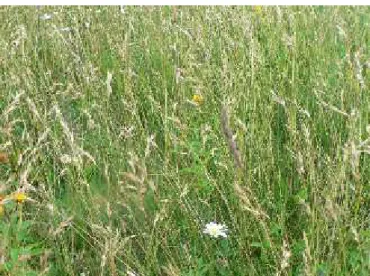
The dry grasslands falling within this habitat have a poor representation in Oltenia. Within the areas where they were identified, they present a rich and varied flora composition (Fig. 1). They form a real mosaic of plant associations.
The vegetation of this habitat belongs toDanthonio - Brachypodietumpinnati Soo (1946) 1947. In the areas where such grasslands develop, they are used as hayfields and, then,in autumn, they are grazed. In those areas where irrational grazing is practiced, it was observed thatDanthoniaalpinadisappeared, its place being taken byFestucarupicola.
Fig. 1.Physiognomy of this habitat within Racoviţasettlement (orig.)
The association prefers gentle slopes with northern or northwesternexposure. Along with Danthoniaalpine, there areconstantly met the followingspecies: Festucarupicola,Brachypodiumpinnatum,Koeleriamacrantha,Briza
media,Trifoliummontanum, Festucavalesiaca, Lotus corniculatus,Trifoliumcampestre, Genistellasagitallis, Chamaecytisusalbus, Dorycniumherbaceum,Polygala major, Salvia pratensis, Thymus glabrescens, Plantago media, Asperulacynanchica, Achilleamillefolium, Leucanthemum vulgare(Fig. 2).
Fig. 2.Aspect of the phytocoenoses of this association within Cerna Sat settlement (orig.)
while in others, where it has a continuous development, it is not mentioned (ROSCI0239 -Tarnovu Mare - Latoriţa).
The increased heterogeneity and low constancy of the species included in the composition of this habitat are mainly due to the repeated floods that occur during the growing season, by which new species are brought, while others are eliminated.
Due to the root system of the plants characteristic to this habitat, which is very well developed, the vegetation of these places plays a major role in stabilizing the alluvia, thereby contributing to the vegetation succession on the riverbank.
The vegetation characteristic to this habitat belongs to the association Salicipurpureae - MyricarietumMoor 1958 (Gafta& Mountford 2008).
The areas covered byphytocoenosesedified by Salix purpurea and Myricariagermanicaare locatedfrom the sub-Carpathian hills to the middle of the boreal level of the sites North of Western Gorj, North of Eastern Gorj and Târnovu Mare - Latorița. They prefer the gravel areas of the floodplains of mountain valleys. As well as all the phytocoenosesthat prefer these places, they manifest a strong pioneering character. The modification of the floristic composition is induced by the numerous floods that occur during the year.
In the area Târnovul Mare –Latoriţa, this habitat had a very good representation in the years 2013-2014, but, in the summer of 2014, because offlash floods, the area of this habitat reduced considerably. This phenomenon was observed both along the valley of the RepedeaStream and that of theLatoriţa River.
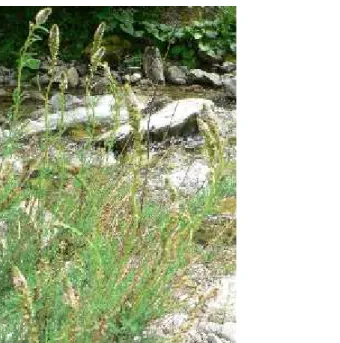
Salix purpurea has a better representation at lower altitudes and Myricariagermanicawithin beech forests (Fig. 3).
Fig. 3. Detail of a specimen ofMyricariagermanicaon the Valley of the RepedeaStream (orig.)
91Q0 Western Carpathian calcicolousPinussylvestris forests
This habitat is edified by one of the oldest tree species in our flora. Tens of thousands of years ago,in the forests of Romania and Central Europe, the dominant species was the Scots pine (Pinussylvestris). This is proven by pollen analyses conducted by specialists over time.
small surfaces (eg. TheCernaOlteţului Valley, next toStânişoara Peak, on the slope withwestern exposure).
The lack of valuable specimens in these areas enables us to say that, in these forests, there were made either cuttings and, in this case, present forests are remnants of the old ones, or are plantations made in the 80s, plantations that grow well in the climatic conditions registered in the region.
The absence from the floristic composition of the species that give the name of the two associations (Sesleriorigidae - PinetumsylvestrisCsűröset al. 1988 andDaphnoblagayanae - PinetumsylvestrisColdeaetPop 1988) that characterize the vegetation of this habitat in the entire country (Gafta& Mountford, 2008), make us mention that this habitat cover a limited surface in Oltenia. Besides the classical sites mentioned in specialized literature in this part of the country, this habitat covers only small emerging surfaces. The analysis of the floristic composition enables us to say that, within the sites from Oltenia (except for the surfaces located within Cozia Massif) this habitat is an artificial habitat, resulting from the plantation of the dominant species.
9420 AlpineLarix deciduaand/orPinuscembraforests
In the Alps, this habitat is characteristic tothe subalpine zone and rarely develops in the zone of spruce-fir forests. In most cases,Larix decidua or Pinuscembraare the dominant species in these forests. The two species can form pure or mixed forests and can be associated withPiceaabies.
In Romania, this habitat is rare, being concentrated in five relict centres, some of them being located at much lower altitude. It is about Ceahlău, Ciucaş, Bucegi, Latoriţa and Trascău (the northern part–Vidolm and Piatra Secuiului) Mountains, respectivelyMare (Big) Mountain (Scăriţa-Belioara) (Fărcaş& al., 2013,Merce 2013).
All natural larch forests from our country are conditioned by the occurrence of limestone or calcareous conglomerates.
Besides larch, in the aforementioned areas, there also appear spruce, silver fir, beech, birch, mountainmaple.
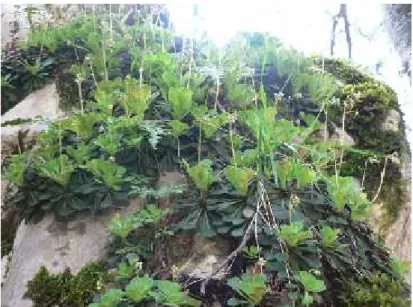
In all locations, the herbaceous layer is characterized by the presence of Saxifragacuneifolia subsp. robusta (Fig. 4) together with an interesting mix of species characteristic to calcareous grassland, as well as acidophilus species such as the CarpathianSesleriarigida.
In Romania,Larixdecidua forestscover about 30,000 hectares, most of them being plantations grown from seeds imported from Austria (Stănescu, 1979). Only about 4,500 ha are considered natural.
The larch forest from the site includes a natural protected area of national interest corresponding IUCN category IV. It is on the right side of theLatoriţa River, at an altitude between 800 and 1,350 m. This is one of 6 natural larch locations in Romania, as mentioned byGh. Ploaie(2012).
These forests also resulted from plantations made decades ago when clearcutting was practiced in the area. In some bibliographic sources, it isalso mentioned Pinuscembrain these areas, but we did notidentify it. Perhaps it grew in the area before the clearcutting made in the 80s (data reported orally by the forester who watches these forests). It usually grows on strongly inclined western slopes.
40C0* Ponto-Sarmatian deciduous shrubs
These are shrubs that develop well in dry areas. Their extension and coenotic-structural diversification is determined by soil and strongly influenced by human activity.
In "Oltenia Forest Steppe", this habitat is mentioned, but it was not identified in the field, either here or in the western part of the country.The shrubs of this site have a different vegetation compared to the areas in Dobrogea, where there is also found this habitat, but their landscape is typical to the steppe. There, the vegetation is edified by the associations Asphodelinoluteae-Paliuretumand Rhamnocatharticae-Jasminietumfruticantis,associations thatare not present withinOltenia.
In all Natura 2000 sites where this habitat is mentioned, it has to be specified that Olteniashrubs belong to the following categories: R3122Ponto-Pannonic blackthorn (Prunusspinosa) shrubs and hawthorn (Crataegusmonogyna) (40A0 *), Emerald priority habitat.
CONCLUSIONS
The habitats analysed in the present paper belong to all types of vegetation in Romania: arboreal (9420 AlpineLarix decidua and/orPinuscembraforests in the mountainous region, 91Q0 Carpathian relict calcicolous Pinussylvestris forests), shrub (3230 Alpine rivers and their ligneous vegetation with Myricariagermanica, 40C0 * Ponto-Sarmatian deciduous shrubs) and herbaceous (6210 * Semi-natural dry grasslands and scrubland facies on calcareous substrates (Festuco-Brometalia)).
9420 and 91Q0 habitats are rare or their presence is uncertain in certain areas of Oltenia; 3230 covers small surfaces in various protected areas, surfaces that have a different physiognomy conditioned by the places where they vegetate and by the climatic conditions during the year; 40C0* does not cover any surface within the territory of Oltenia considering the characteristic vegetation of this habitat, whilein case of the habitat 6210*, taking into account its reduced surfaces in various Natura 2000 sites on the territory of Oltenia,there are requiredurgent measures to facilitate the expansion of these grasslands.
BIBLIOGRAPHY
1. Bușe Dragomir Luminita, Niculescu Mariana. 2015. Physiological particularities of hygrophilous plants from Domogled-Cerna Valley NationalPark Analele Universităţii din Craiova, seria Agricultură – Montanologie – Cadastru Vol. XLV (1): 51-56,
http://anale.agro-craiova.ro/index.php/aamc/index
3. Doniţă, N., Popescu, A., Paucă-Comănescu, M., Mihăilescu, S., Biriş I.-A. 2005.Habitate din România, Edit. Tehnică Silvică Bucureşti. 496 pag.
4. Doniţă, N., Popescu, A., Paucă-Comănescu, M., Mihăilescu, S., Biriş I.A. 2006. Habitatele din România. Modificări conform amendamentelor propuse de România şi Bulgaria la Directiva Habitate (92/43/EEC), Edit. Tehnică Silvică, Bucureşti.
5. Gafta, D., Mountford, O. (coord.), 2008. Manual de interpretare a habitatelor Natura 2000 din România, Edit. Risoprint, Cluj-Napoca.
6. Fărcaş Sorina, Tanţău I. & Turtureanu P.D. 2013. Larix decidua Mill. in Romania: current and past distribution, coenotic references, and conservation status. Contrib. Bot. XLVIII: 39-50.
7. Merce O. 2013.Specific management measures for the forest habitats 9410 and 9420.Journal of Horticulture, Forestry and Biotechnology, Vol. 17(2): 264- 267.
8. Niculescu L., Niculescu M., Soare R. & Bonea D. 2015. Plant communities characteristic for the mountainous and subalpine springs and streams in the Parâng Mountains (Southern Carpathians), Romania. Journal of Environmental Protection and Ecology 16, no. 4: 1364-1370.
9. Ploaie Gh. 2012. Munţii Căpăţânii. Ghidturistic. Edit. Conphys, Rm. Vâlcea, 246 pag.
10. Răduțoiu D. & Ştefănescu M. 2014. Site of vascular flora Târnovu Mare – Latoriţa Vâlcea -Romania. Annals of the University of Craiova. Seria Biologie, Horticultură, Tehnologia prelucrării produselor agricole, Ingineria Mediului. Vol. XIX (LV): 563-570.
11. Răduțoiu D. & Marinescu E. 2014. Study of hygrophilous vegetation from Târnovu Mare-Latoriţa, Vâlcea - Romania. Annals of the University of Craiova. Seria Biologie, Horticultură, Tehnologia prelucrării produselor agricole, Ingineria Mediului. Vol. XIX (LV): 571-576.
12. Răduțoiu D. 2015. The conservation status of grassland habitats belonging to protected areas from Oltenia ‘Natura 2000’ site, Romania. Not. Sci. Biol. 7 (4): 430-434.
13. Răduțoiu D., Ştefănescu M. & Păunescu C. 2015. About the aquatic and paludous habitats from Oltenia (Romania). Annals of the University of Craiova. Seria Biologie, Horticultură, Tehnologia prelucrării produselor agricole, Ingineria Mediului. Vol. XX (LVI): 589-594.
14. Sanda V. & al. 1980. Cenotaxonomia şi corologia grupărilor vegetale din România. Stud. Com. (24) Supliment Ştiinţele Naturii Muzeul Brukenthal: 171 pag. Sibiu.
15. Sanda V., Popescu A. & Stancu Daniela Ileana. 2001. Structura cenotică şi caracterizarea ecologică a fitocenozelor din România. 359 pag. Edit. CONPHIS, Bucureşti.
16. Sanda V. 2002. Vademecum ceno structural privind covorul vegetal din România. 331 pag. Edit. Vergiliu. Bucureşti.
17. Sanda V., Răduţoiu D., Barabaş N., Claudia Biţă-Nicolae, Irina Blaj-Irimia. 2007.Breviar fitocenologic(partea III-a). Edit. Sitech. Craiova. 286 pag.
18. Sanda V., Răduţoiu D., Burescu P., Irina Blaj-Irimia. 2007. Breviar fitocenologic(partea IV-a). Edit. Sitech. Craiova. 244 pag.