250
AROMA PROFILE OF YOUNG WINES FROMTĂMÂIOASĂ ROMĂNEASCĂ
VARIETY (
VITIS VINIFERA
)GROWN IN DRĂGĂŞANI VENEYARD –
ROMANIA
STOICA FELICIA1, MUNTEAN CAMELIA1, BĂDUCĂ CÎMPEANU C.1, ROTARU IULIA1
1
University of Craiova, Faculty of Horticulture, Department Horticulture & Food Science Corresponding author e-mail: [email protected]
Key words: wine, aroma profile, volatile compounds, clone, Tămâioasă românescă variety
ABSTRACT
Aroma profile of three different wines from Tămâioasă românească variety and the clones of this variety were analyzed in order to characterize and differentiate them. There were found a total of 16 volatile compounds. Monoterpenes, alcohols, ethyl esters and aldehydes were determined by gas chromatography-mass spectrometry (GC-MS).
The results showed that Tămâioasă românească 104 Dg wine had the highest concentration of volatile compounds. Monoterpenes, linalool, terpineol, geraniol and nerol were detected in all three wines but the most aromatic wine was all Tămâioasă românească 104 Dg.
INTRODUCTION
Flavour composition plays a significant role in the quality of a wine. The flavour of wine is composed of volatile compounds, which are responsible especially for the aroma (Schreier, 1979).Following the advances achieved through the development and utilization of modern analytical techniques, investigating the origin of wine aroma has become a topic of increasing interest in recent years. Wine flavor can be varietal, fermentative or from ageing (Selli, S. et al., 2006; Jiang, B. & Zhang, Z., 2010), the aroma profile depending on the grape variety, ripeness, yeast activity, etc. Being a beverage with one of the most complex volatile profile, wine contains approximately 800 aroma compounds, mainly alcohols, esters, acids, carbonylic and terpenic compounds, in concentration from hundreds of mg/L to μg/L, or even ng/L (Popescu R. et al., 2014).
Many authors have studied the volatile composition of different grapes and wines (Gunata et al., 1985; Ferreira et al., 2000; Oliveira et al., 2004; Vilanova & Sieiro, 2006, Stoica F. 2008). Quantitative aroma profiling of wine can be seen as an important issue for the wine industry, taking into account the need to have a simple and reproducible analysis method to distinguish wines of different varietal origins, as a possible substitute for
traditional method of wine tasting that requires years of practice.
251
The aim of this work was to define the major volatile compounds of young wines produced from romanian variety Tămâioasă românească (in fact two clones of Tămâioasă românească (synonym Tămâioasă albă de Drăgăşani) variety named Tămâioasă românească 104 Dg and Tămâioasă românească 36 Pt. in Drăgăşani vineyard and to identify the most odour-active compounds.
MATERIAL AND METHOD Grape sample
Two Romanian Vitis vinifera grape clones of Tămâioasă românească variety - synonim Tămâioasă albă de Drăgăşani, traditional grapes for vineyard (Tămâioasă românească 104 Dg and Tămâioasă românească 36 Pt) from hilly areas of Oltenia - România were considered in this study. The variety clones, from the 2014 vintage, were grown in the same conditions in the vineyards Drăgăşani.
Vineyard conditions and wine making
The grapes were collected in 2014 from Drăgăşani Vineyard, stretching mainly to the West and North of Drăgăşani town, parallel to the Olt River, over a length of about 65 km., being processed by Faculty of Horticulture Craiova, Department of Horticulture and Food science laboratory according to general wine making techniques. The Drăgăşani vineyard, stretches between the Getic Subcarpathian Mountains and the Romanian Plain in the South and Southwest, lying between the parallel 44 ° 30'-44 ° 55 'north latitudes and the meridians 23 ° 55'-24 ° 15' eastern Longitidine.
Drăgăşani Vineyard, a traditional and oldest Romanian wine making region, having similar pedo-climatic conditions with Toscana region (Italy):average altitude of 340 m, mean annual temperature around 10.8°C,1576 hours real isolation during vegetation, an active thermal balance of 3316 °C, precipitation of 385 mm during the vegetation and index of oenoclimatic aptitude 4757. Sun exposure is optimal from April to October, with long and sunny autumns and without any climate excesses.
Chemicals and standard physicochemical analysis
Standards of volatile aroma compounds were purchased from Merck (Darmstadt, Germany) and Fluka (Buchs, Switzerland). Dichloromethane (99.8%) and sodium sulphate (99%) were supplied by Kemika (Zagreb, Croatia). Pure deionised water was obtained from an Elix 3 purification system (Millipore, Bedford, MA, USA).
Analytical method
All samples were analyzed using gas chromatography and following the method used by the Laboratory of the Department of Horticulture and Food science and the laboratory of National Institute for Cryogenics and Isotopic Technologies (I.C.S.I. Rm. Valcea).
Sample preparation
Minor volatile compounds of the wine samples were liquid-liquid extracted and analyzed using gas-chromatography coupled with mass spectrometry (GC/MS). 100mL of wine sample was extracted 3 times with10/5/5 mL of dichloromethane, for 20 min, at 600 rpm. The organic extract was dried and concentrated to a volume of 1.5 mL [5]. Carbonyl compounds were derivated with PFBOA (ortho-2,3,4,5,6-pentafluorobenzyl-ortho-hydroxilamine), as described by Ţârdea C., 2007
GC/MS analysis
252
up to 70 to 150°C with 27°/ min., stand 2 minutes, climb 2000C, stand 2 minutes, climb to 240°C with 20°C/min. and stands 6 min. He carrier gas (1.2ml / min). Injection volume is 1 µL. The identification was made by comparing the retention times of standards from the calibration curve.
RESULTS AND DISCUSSIONS
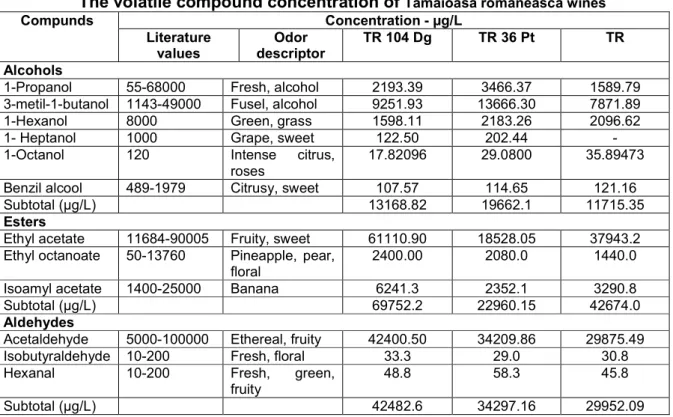
The volatile compound concentrations (exception of terpenic compounds) were analyzed from three romanian Vitis vinifera grape clones of Tămâioasă românească variety- (TR) namely Tămâioasă românească 104 Dg (TR 104 Dg) and Tămâioasă românească 36 Pt (TR 36 Pt). The results are presented in table 1.
Table 1
The volatile compound concentration of Tămâioasă românească wines Compunds Concentration - µg/L
Literature values
Odor descriptor
TR 104 Dg TR 36 Pt TR
Alcohols
1-Propanol 55-68000 Fresh, alcohol 2193.39 3466.37 1589.79
3-metil-1-butanol 1143-49000 Fusel, alcohol 9251.93 13666.30 7871.89
1-Hexanol 8000 Green, grass 1598.11 2183.26 2096.62
1- Heptanol 1000 Grape, sweet 122.50 202.44 -
1-Octanol 120 Intense citrus,
roses
17.82096 29.0800 35.89473
Benzil alcool 489-1979 Citrusy, sweet 107.57 114.65 121.16
Subtotal (µg/L) 13168.82 19662.1 11715.35
Esters
Ethyl acetate 11684-90005 Fruity, sweet 61110.90 18528.05 37943.2
Ethyl octanoate 50-13760 Pineapple, pear, floral
2400.00 2080.0 1440.0
Isoamyl acetate 1400-25000 Banana 6241.3 2352.1 3290.8
Subtotal (µg/L) 69752.2 22960.15 42674.0
Aldehydes
Acetaldehyde 5000-100000 Ethereal, fruity 42400.50 34209.86 29875.49
Isobutyraldehyde 10-200 Fresh, floral 33.3 29.0 30.8
Hexanal 10-200 Fresh, green,
fruity
48.8 58.3 45.8
Subtotal (µg/L) 42482.6 34297.16 29952.09
Alcohols
Alcohols represented the largest group in terms of the number and concentration of aroma compounds identified in all three wines, followed by esters and fatty acids. The subtotal concentrations of alcohols in the three wines were in the 130,900.2–256,309.2 μg/L range. The composition of alcohols differed both quantitatively and qualitatively between the wines.
Alcohols are formed from the degradation of amino acids, carbohydrates, and lipids (Antonelli, A. et al., 1999). The composition of alcohols differed both qualitatively and quantitatively among the three wines. This volatile fraction was mainly composed of 1 propanol and isobutyl alcohol; these alcohols had concentrations>2000 μg/L and>9,000 μg/L, (and existed in at least one of the wines studied).
In Tămâioasă albă de Drăgăşani (TR) wine, 1-propanol were absent.Significant quantities of 1-octanol and benzyl alcohol are found in Tămâioasă românească 36 Pt (TR 36 Pt) and Tămâioasă albă de Drăgăşani (TR) wines.
Comparing the values obtained in this study with the ones in literature (table 1) it can be observed that the alcohol content is at the lower limit of the values reporte from literature, without exception.
253
Originating mainly from yeast metabolism during fermentation, being also found in small amounts in the grape, the esters are considered to be the major contributor to the aroma of young wine. Acetic esters result from acetyl-CoA reaction with superior alcohols. On the other hand, ethyl esters of fatty acids are enzyme produced during yeast fermentation and from acyl-CoA ethanolysis, formed during fatty acids synthesis or degradation. Their concentration depends on several factors like yeast type, fermentation temperature, aeration and sugars content. The majority of the esters are formed at the beginning of fermentation, their concentration varying in a small proportion during wine maturation (Popescu R. et al., 2014).
There were also significant differences in the type and amount of esters present in the three wines. In general, the number and proportion of esters in TR 104 Dg wine were higher than those of TR 36 Pt and TR.
Although their amounts differed in the three wines, ethyl acetate, isoamyl acetate, ethyl lactate and ethyl octanoate were the major esters found in the aroma compounds (Jiang, B. & Zhang, Z., 2010).
Aldehydes
The content of aldehydes, formed in wine through yeast metabolism of amino acids and from enzymatic oxidation of unsaturated fatty acids, varied between 29,9 (Tămâioasă albă de Drăgăşani) and 42,4 ((Tămâioasă românească 104 Dg) mg/L. Acetaldehyde was the most abundant compound with concentrations.
The concentrations of aldehydes in the studied wines are similar to the ones reported in literature(table 1).The differences in volatile compounds concentrations between the samples from this study and literature values can be justified by the difference in the preparation method, place of origin for the wine and year of harvest (Popescu R. et al., 2014).
Table 2
The terpenic compounds concentration of Tămâioasă românească wines Compunds Concentration - µg/L
Literature values
Odor descriptor
TR 104 Dg TR 36 Pt TR
α-terpineol 4-150 Rose, honey 2630.10 2120.4 2300.6
Linalool 5-200 Fruity, citric 980.3 820.1 870.8
Geraniol 0-100 Floral 660.7 590.2 650.7
Nerol 0-100 Flowery 275.8 844.7 155.5
Subtotal (µg/L) 4546.9 4375.4 3977.6
Monoterpenes
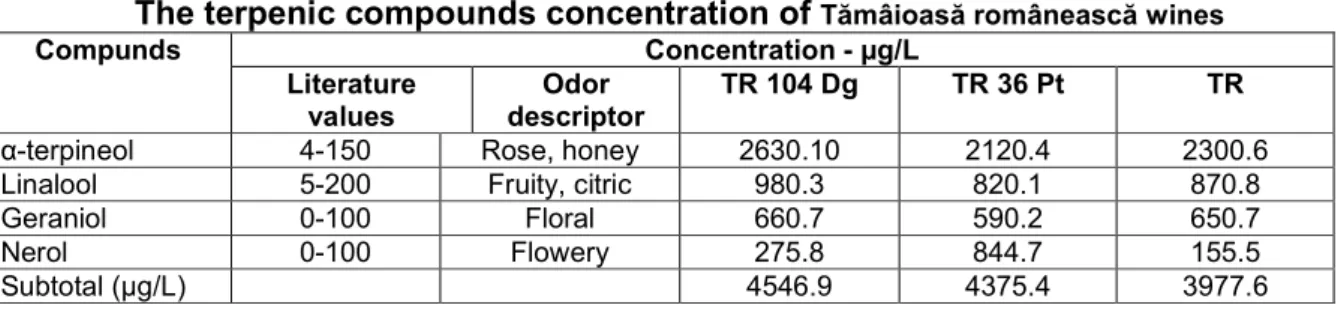
Terpene compounds belong to the secondary plant constituents, of which the biosynthesis begins with acetyl-coenzyme A (CoA) (Vilanova. et al., 2013). Monoterpenenic alcohols like linalool, geraniol, nerol, citronellol and α-terpineol are known to be important compounds in grape berries, and are responsible for floral notes in the aromatic grape varieties Muscat who including Tămâioasă românească, Sauvignon and Gewürztraminer.
Found in grapes and wines in free and bonded state, terpens are plant constituents whose biosynthesis begins with acetyl-CoA. Bonded forms have a glycoside group, like glucose, arabinose, ramnose and apiose, being non-volatile. On the other hand, grape varieties containing β-glycosidases can free terpens from the bounded forms during normal wine making conditions. In the analyzed samples there were identified four terpens, linalool, terpineol, geraniol, nerol present in all three wines but in different quantities. The richest wine in terpenic compounds is Tămâioasă românească 104 Dg.
254
This work shows the first study on volatile compounds of young wines from two romanian Vitis vinifera grape clones of Tămâioasă românească variety (Tămâioasă românească 104 Dg, Tămâioasă românească 36 Pt) from hilly areas of Oltenia – România. In this study, a total of 30, 9, 9 and 12 volatile compounds were identified and quantified in Tămâioasă românească wines. The three young wines analyzed were characterized by the presence of higher levels of higher alcohols, esters and terpenic compounds.
All three wines have the same aromatic profile, in their composition are all four analyzed terpenic compounds. However, from a sensory point of view, the aroma of wines differs significantly. Thus, the Tămâioasă românească and the Tămâioasă românească, Dg. 104 wine has a hint of rose and honey, subtle but very persistent. Wines of TR 36 Pt have a much more intense aroma of linden flowers but not very persistent.
BIBLIOGRAPHY
1. Antonelli, A.; Castellari, L.; Zambonelli, C.; Carnacini, A,. 1999. Yeast influence on volatile composition of wines.J. Agric. Food Chem., 47, 1139–1144.
2.Berna, A.Z., Trowell, S., Clifford, D., Cynkar, W. & Cozzolino, D., 2009. Geographical origin of Sauvignon blanc wines predicted by mass spectrometry and metal oxide based electronic nose. Anal. Chem. Acta 648, 146-152.
3.Bueno, J.E., Peinado, R., Moreno, J., Medina, M., Moyano, L. & Zea, L., 2003.
Selection of volatile aroma compounds by statistical and enological criteria for analytical differentiation of musts and wines of two grape varieties. J. Food Sci. 68, 158-163.
4. Cichi D. D., D,C Costea, 2008- Soiuri de viţă-de-vie cultivate şi cultivabile în România,
Editura Arves
5.Falcao, L.D., Revel, G., Rosier, J.P., Bordignon, L.M.T., 2008. Aroma impact components of Brazilian Cabernet Sauvignon wines using detection frequency analysis GC-olfactometry. Food Chem. 107, 497-505.
6.Ferreira, V., López, R., Cacho, J.F., 2000. Quantitative determination of the odorants of young red wines from different grape varieties. J. Sci. Food Agric. 80, 1659-1667.
7.Gunata, Y.Z., Bayonove, C.L., Baumes, R.L., Cordonnier, R.E., 1985. The aroma of grapes. I. Extraction and determination of free and glycosidically bound fractions of some grape aroma components. J. Chromatograph. A 331, 83-90.
8.Hejavec, S., Jeromel, A., Da Silva, A., Orlic, S., Redzepovic, S., 2007. The quality of white wines fermented in Croatian oak barrels. Food Chem. 100, 124-128.
9. Jiang, B., Zhang, Z., 2010. Volatile compounds of young wines from Cabernet Sauvignon, Cabernet Gernischet and Chardonnay varieties grown in the Loess Plateau Region of China. Molecules 15, 9184-9196.
10. Oliveira, J.M., Araújo, I., Pereira, O.M., Maia, J.S., Amaral, A.J., Maia, M.O., 2004.
Characterization and differentiation of five “Vinhos Verdes” grape varieties on the basis of monoterpenic compounds. Anal. Chim. Acta 513, 269-275.
11. Popescu R., Costinel D, Ionete R.E, Stegarius D.I., Marinescu A.C., Tudorache A., 2014. Aroma Profile of Young Wines from Ten Native and Foreign Varieties Grown in Romanian,Rev. Chim., no.2, vol. 65, 168-173
12. Preston, L.D., Block, D.E., Heymann, H., Soleas, G., Noble, A., Ebeler, S.E., 2008.
Defining vegetal aromas in Cabernet Sauvignon using sensory and chemical evaluations. Am. J. Enol. Vitic. 59, 137-145.
255
14.Selli, S., Canbas, A., Cabaroglu, T., Erten, H., Gunata, Z., 2006- Aroma components of cv. Muscat of Bornova wines and influence of skin contact treatmentFood Chem., No.3, vol.94, p. 319-326
15. Schreier, P., 1979. Flavor composition of wines: a review. CRC Crit. Review Food Sci. Nutr. 12, 59-111.
16.Stoica Felicia, Muntean Camelia, Băducă C., Popescu MitroiI., 2014 - Differences in Muscat Wine Aroma Composition Depending Maceration and Fermentation Processes, Romanian Biotechnological Letters, Vol. 20, No2,10343-10351
17. Stoica Felicia, 2008 – Vinuri aromate şi semiaromate în podgoria Drăgaşani. Tradiţie, tehnologie şi perspective, Editura Universitaria, Craiova
18. Tao, Y., Wang, H., Zhang, L., 2008. Volatile compounds of young Cabernet
Sauvignon red wine from Chagli County (China). J. Food Comp. Anal. 21, 689-694.
Ţârdea, C., 2007. Chemistry and analysis of wine, Ion Ionescu de la Brad Publishing, 1170-1172.
19. Vilanova, M., Sieiro, C., 2006. Determination of free and bound compounds in Albariño wine. J. Food Comp. Anal. 19, 694-697.