Protection Guarded Secrecy Sustain Access Manipulate
Procedure Intended for Relational Data
Dr. D. Srujan Chandra Reddy1, Y.Siva Parvathi2
#1 Department of CSE, PBR Visvodaya Institute of Technology & Science, Kavali.
#2 student, M.Tech (C.S.E) and Department of CSE, PBR Visvodaya Institute of Technology & Science, Kavali.
Abstract:
Access control systems safeguard the touchy information's from unauthenticated clients. Be that as it may, when touchy information's is given and a Privacy Protection Mechanism (PPM) is not set up, an approved client can even now surrender the protection of a man prompting interesting disclosure. A PPM can utilize concealment and speculation of social information to anonymize and fulfil protection need, e.g., k-secrecy and l-differing qualities, against exceptional and trait disclosure. In any case, security is accomplished at the expense of accuracy of approved information. In this paper, we propose a productive access control strategy. The protection saving techniques characterize determination things accessible to parts while the security need is to fulfil the k-obscurity or l-differences. An extra thing that should be fulfilled by the PPM is the imprecision headed for every determination thing. The systems for workload-mindful anonymization for specific determination things have been talked about in the papers. The issue of fulfilling the precision requirements for various parts has not been concentrated on some time recently. We propose technique for anonymization calculations and show experimentation that the proposed methodology full fills imprecision limits for more authorisation. Information security problems unit of measurement a lot of reworking into indispensable for a number of applications. Access administration instruments provide insurance to our touchy business knowledge from undesirable consumer. Plus and knowledge sharing is additional and essential piece of our day by day life and business. Primarily investigation within the knowledge making ready or data processing with sub house of information security is imprecisely organized into access administration examination and data protection investigation. Every assumes basic half in knowledge security therewith we've coordinated these techniques to support our security on relative knowledge. Abuse security defensive part we are going to add up and smother our relative knowledge to anonymized and fulfil protection wants against character and characteristic discourse act. We've not completely combination these procedures anyway we've collectively given more security by abuse cryptography that wasn't blessing in past framework.
I. Introduction:
just approved inquiry predicates on touchy information. The protection safeguarding module anonymizes the information to meet security necessities and imprecision imperatives on predicates set by the entrance control system. Yet, it has a few impediments, for example, User's doesn't have proficient protection and precise requirements. Framework not ready to recover information in altered way. Framework doesn't give security to information which propelled me to chip away at this. An exactness compelled protection protecting access control component, showed in Fig.[1](Arrows speak to the course of data stream), is proposed. The protection insurance instrument guarantees that the security and precision objectives are met before the touchy information is accessible to the entrance control component. The consents in the entrance control arrangement are in view of choice predicates on the QI properties. The arrangement manager characterizes the consents alongside the imprecision destined for every consent/question, client to-part assignments, and part to authorization assignments [7].The imprecision bound data is not imparted to the clients in light of the fact that knowing the imprecision bound can bring about damaging the protection prerequisite. The protection security system is obliged to meet the security prerequisite alongside the imprecision headed for every authorization.
While Accessing data from database, the idea of imprecision bound is presented in every entrance from database to take care of the issue of where insignificant level of resilience is characterized for every entrance question. Present workload mindful anonymization strategies minimize the imprecision total for all question/consent. The idea of fulfilling the precision limitation for individual authorizations in an approach or workload has not been mulled over some time recently. Exactness compelled protection protecting access control component significant in the workload–aware anonymization. The idea of nonstop information distributed has been additionally examined. Numerous entrance control components are there to manage social database. Part based Access Control that permits characterizing authorization on item in view of parts in an association.
II. Related Work:
Access control instruments for databases permit inquiries just on the approved piece of the database. Predicate based fine-grained access control has further been proposed, where client approval is constrained to predefined predicates. Implementation of access control and protection strategies has been considered. Notwithstanding, considering the communication between the entrance control systems and the security assurance components has been missing. As of late, Chaudhuri et al. have contemplated access control with protection systems. They utilize the meaning
of differential protection whereby irregular clamor is added to unique question results to fulfil security imperatives. They have not considered the exactness limitations for authorizations. We characterize the security necessity regarding k-namelessness. It has been demonstrated by Li et al. [6] that subsequent to inspecting, k-obscurity offers comparable protection ensures as those of differential security. The proposed exactness obliged protection safeguarding access control structure permits the entrance control chairman to indicate imprecision requirements that the security assurance instrument is obliged to meet alongside the security prerequisites. The difficulties of security mindful access control are like the issue of workload-mindful anonymization. In our examination of the related work, we concentrate on question mindful anonymization. For the cutting edge in k-secrecy systems and calculations, we allude the peruser to a late study paper [3]. Workload-mindful anonymization is initially concentrated on by LeFevre et al. [5] They have proposed the Selection Mondrian calculation [4], which is an alteration to the avaricious multidimensional dividing calculation Mondrian. In their calculation, in view of the given inquiry workload, the ravenous part heuristic minimizes the whole of imprecision for all questions. Iwuchukwu and Naught on have proposed a Rþ-tree based anonymization calculation. The creators outline by trials that anonymized information utilizing one-sided Rþ-tree in view of the given inquiry workload is more precise for those inquiries than for a fair-minded calculation. Ghinita et al. have proposed calculations in view of space filling bends for k-namelessness and l-differences [10]. They likewise present the issue of exactness obliged anonymization for a given bound of satisfactory data misfortune for every comparability class [8]. Correspondingly, Xiao et al. [9] propose to add clamour to inquiries as indicated by the measure of the questions in an offered workload to fulfil differential protection. Limits for inquiry imprecision have not been considered. The current writing on workload-mindful anonymization has a center to minimize the general imprecision for a given arrangement of inquiries. Anonymization with imprecision limitations for individual inquiries has not been examined some time recently. We take after the imprecision meaning of LeFevre et al.and present the requirement of imprecision headed for every inquiry in a given question work. IV. Problem Statement:
define selection predicates available to roles while the privacy requirement is to satisfy the k anonymity or l-diversity. Imprecision bound constraint is assigned for each selection predicate. K anonymous Partitioning with Imprecision Bounds (kPIB) is used to estimate accuracy and privacy constraints. Role-based Access Control (RBAC) allows defining permissions on objects based on roles in an organization. Top Down Selection Mondrian (TDSM) algorithm is used for query workload-based anonymization. The Top Down Selection Mondrian (TDSM) algorithm is constructed using greedy heuristics and kd-tree model. Query cuts are selected with minimum bounds in Top-Down Heuristic 1 algorithm (TDH1). The query bounds are updated as the partitions are added to the output in Top-Down Heuristic 2 algorithm (TDH2). The cost of reduced precision in the query results is used in Top-Down Heuristic 3 algorithm (TDH3). Repartitioning algorithm is used to reduce the total imprecision for the queries.
The following problems are identified from the existing system:
• Static data based access control model • Cell level access control is not supported • Imprecision bound estimation is not optimized • Fixed access control policy model
IV.Privacy-Preserving Access Control Model For Relational Data
Organizations collect and analyse consumer data to improve their services. Access Control Mechanisms (ACM) is used to ensure that only authorized information is available to users. Sensitive information can still be misused by authorized users to compromise the privacy of consumers. The concept of privacy-preservation for sensitive data can require the enforcement of privacy policies or the protection against identity disclosure by satisfying some privacy requirements. In this paper, we investigate privacy-preservation from the anonymity aspect. The sensitive information, even after the removal of identifying attributes, is still susceptible to linking attacks by the authorized users. This problem has been studied extensively in the area of micro data publishing [3] and privacy definitions, e.g., k-anonymity, l-diversity and variance l-diversity. Anonymization algorithms use suppression and generalization of records to satisfy privacy requirements with minimal distortion of micro data. The anonymity techniques can be used with an access control mechanism to ensure both security and privacy of the sensitive information. The privacy is achieved at the cost of accuracy and imprecision is introduced in the authorized information under an access control policy. We use the concept of imprecision bound for each permission to define a threshold on the amount of imprecision that can be tolerated. Existing workload aware anonymization techniques [5] minimize the imprecision aggregate
for all queries and the imprecision added to each permission/query in the anonymized micro data is not known. Making the privacy requirement more stringent results in additional imprecision for queries. The problem of satisfying accuracy constraints for individual permissions in a policy/workload has not been studied before. The heuristics proposed in this paper for accuracy-constrained privacy-preserving access control are also relevant in the context of workload aware anonymization. The anonymization for continuous data publishing has been studied in literature [3]. In this paper the focus is on a static relational table that is anonymized only once. To exemplify our approach, role-based access control is assumed. The concept of accuracy constraints for permissions can be applied to any privacy-preserving security policy, e.g., discretionary access control. Example 1 (Motivating Scenario). Syndromic surveillance systems are used at the state and federal levels to detect and monitor threats to public health [7]. The department of health in a state collects the emergency symptoms, etc from county hospitals daily. Generally, each daily update consists of a static instance that is classified into syndrome categories by the department of health. Then, the surveillance data is anonymed and shared with departments of health at each county. An access control policy that allows the roles to access the tuples under the authorized predicate, e.g., Role CE1 can access tuples under Permission P1. The epidemiologists at the state and county level suggest community containment measures, e.g., isolation or quarantine according to the number of persons infected in case of a flu outbreak. According to the population density in a county, an epidemiologist can advise isolation if the number of persons reported with influenza are greater than 1,000 and quarantine
if that number is greater than 3,000 in a single day. The anonymization adds imprecision to the query results and the imprecision bound for each query ensures that the results are within the tolerance required. If the imprecision bounds are not satisfied then unnecessary false alarms are generated due to the high rate of false positives. The contributions of the paper are as follows. First, we formulate the accuracy and privacy constraints as the problem of k-anonymous Partitioning with Imprecision Bounds (k-PIB) and give hardness results. Second, we introduce the concept of accuracy-constrained privacy-preserving access control for relational data. Third, we propose heuristics to approximate the solution of the k-PIB problem and conduct empirical evaluation.
VI.Experimental Evaluation
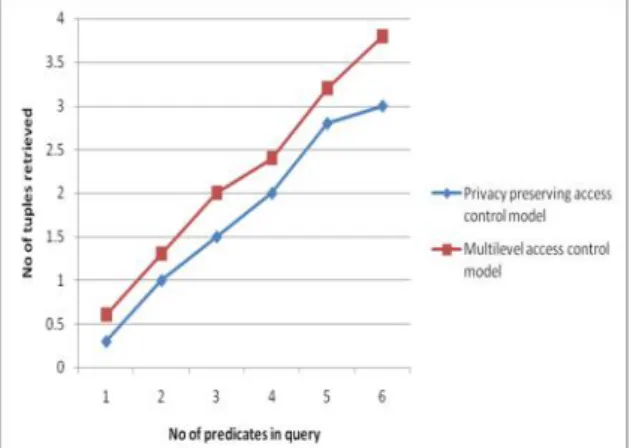
access control model and the multilevel access control model are used to show the experimental results. The Fig.2 shows the experimental result. The Fig:3 shows that the number of tuples retrieved by the query given is increased with the increase in the predicates of the query.
Fig 1: Accuracy-constrained privacy-preserving access control mechanism.
The blue line shows the number of tuples retrieved when the number of predicate is one, two, and three with three predicates in privacy preserving access control module. The red line shows the number of tuples retrieved by the queries with multiple predicates in multilevel access control model. It clearly shows that the proposed method performs better than the previous methods in terms if number of tuples retrieved.
Fig 2. Experimental results on number of query predicates and number of tuples retrieved
Fig 3 . History of search in February
VI. Heuristics for partitioning
Starting with the whole tuple space the nodes in the kd-tree are recursively divided till the partition size is between k and 2k. The leaf nodes of the kd-tree are the output partitions that are mapped to equivalence classes in the given table. In the partitions are split along the median. Consider a partition that overlaps a query. If the median also falls inside the query then even after splitting the partition, the imprecision for that query will not change as both the new partitions still overlap the query. In this heuristic, the proposed system proposes to split the partition along the query cut and then choose the dimension along which the Imprecision is minimum for all queries. If multiple queries overlap a partition, then the query to be used for the cut needs to be selected. The queries having imprecision greater than zero for the partition are sorted based on the imprecision bound and the query with minimum imprecision bound is selected. The intuition behind this decision is that the queries with smaller bounds have lower tolerance for error and such a partition split ensures the decrease in imprecision for the query with the smallest imprecision bound. If no feasible cut satisfying the privacy requirement is found, then the next query in the sorted list is used to check for partition split. If none of the queries allow partition split, then that partition is split along the median and the resulting partitions are added to the output after compaction. Improving the number of Queries satisfying the imprecision bound In module, the query imprecision slack is defined as the difference between the query bound and query imprecision. This query imprecision slack can help satisfy queries that violate the bounds by only a small margin by increasing the imprecision of the queries having more slack. The margin by which queries violate the bounds .In this repartitioning step, It considers only the first two groups of queries that fall within 10 percent and 10-25 percent of the bound only and these queries are added to the Candidate Query set (CQ), while all queries satisfying the bounds are added to the query set SQ. The output partitions are all the leaf nodes in the kd-tree. For repartitioning, it only considers those pairs of partitions from the output that are siblings in the kd-tree and have imprecision greater than zero for the queries in the candidate query set. VIII. Conclusion:
The proposed system proposes the application specific anonymization.
Future Work
The proposed system plan to extend the proposed privacy-preserving access control to incremental data and cell level access control.
IX. References:
[1] Bertino E. and Sandhu .(2005),“Database
Security-ConceptsApproaches, and allenges,”IEEE
Trans.Dependable and Secure Computing, vol. 2, no. 1, pp. 2-19.
[2] Chaudhuri S. et al (2011), “Database Access
Control & Privacy: Is There a Common Ground?”
Proc. Fifth Bien- nial Conf. Innovative Data Systems Research (CIDR), pp. 96-103.
[3] Fung B. et al (2010), “Privacy-Preserving Data
Publishing: A Survey of Recent evelopments,”
ACM Computing Surveys, vol. 42, no. 4, article 14, 2010.
[4] Ghinita G. et al (2009),“A Framework for
Efficient Data Anonymization Under Privacy and
Accuracy Constraints,”ACM Trans. Database
Systems, vol. 34, no. 2, article 9.
[5] Li N. et al (2011), “Provably Private Data
Anonymization: Or, k-Anonymity Meets
Differential Privacy,” Arxiv preprint
arXiv:1101.2604.
[6] LeFevre K. et al (2008), “WorkloadAware
Anonymization Techniques for Large-Scale
Datasets,” ACM Trans. Database Systems, vol. 33,
no. 3, pp. 1-47.
[7] Rizvi S. et al (2004), “Extending Query
Rewriting Techniques for Fine-Grained Access
Control,” Proc. ACM SIGMOD Int’l Conf.
Management of Data, pp. 551-562.
[8] Zahid Pervaiz and Walid G. Aref (2014),
“Accuracy - Constrained Privacy-Preserving Access Control Mechanism for Relational Data”
IEEE Transactions On Knowledge And Data Engineering, Vol. 26, No. 4.
[9] S. Chaudhuri, T. Dutta, and S. Sudarshan, “Fine
Grained Authori- zation through Predicated
Grants,” Proc. IEEE 23rd Int’l Conf. Data Eng., pp.
1174-1183, 2007.
[10] K. Browder and M. Davidson, “The Virtual Private Database in oracle9ir2,” Oracle Technical
White Paper, vol. 500, 2002.
Guide Profile:
Dr.D. Srujan Chandra Reddy, Assoc .Professor, Department Of CSE, Pbr Visvodaya Institute of Technology & Science, Kavali.
Student Profile: