18
IP BASED DATA EXCHANGE USING CENT OS
Mr.P.Arun Prakash Ms.S.Kayalvili
PG Scholar Assitant Professor
Department of CSE, Department of CSE,
Velalar College of Engineering, Velalar College of Engineering,
Thindal,Erode-638052,India. Thindal,Erode-638052,India.
Email: [email protected] Email: [email protected]
ABSTRACT: This project Network Telephony, is used to make free calls and messaging through intranet.It may be used in institutions and companies to avoid their intercom billing.It is based on Client-Server system.
I.INTRODUCTION 1.1 LOCAL AREA NETWORK
A local area network (LAN) is a computer
network that interconnects computers within a
limited area such as a home, school, computer
laboratory, or office building, using network
media. The defining characteristics of LANs, in
contrast to wide area networks (WANs), include
their smaller geographic area, and non-inclusion
of leased telecommunication lines.
A design goal will be to keep management
traffic off the production network, to eliminate the
possibility that it could be intercepted in transit.
Ideally, would configure each device with a
physical port on the management VLAN. If this
is not possible because of physical or other
limitations, management should be encrypted.
In practice, the concept was marred by
proliferation of incompatible physical layer and
network protocol implementations, and a
plethora of methods of sharing resources.
Typically, each vendor would have its own type
of network card, cabling, protocol, and network
operating system.
The network operating system named CentOS (Community
Enterprise Operating System) is a Linux
distribution that attempts to provide a free,
enterprise-class, community-supported computing
platform which aims to be functionally compatible
with its upstream source. As of versions 5.10 and
6.5, CentOS officially supports x86-64 and x86
architectures with Physical Address Extension
(PAE) is a beta release is expected to be
available for the Power PC architecture.
RHEL is available only through a paid
subscription service that provides access to
19 support. The product is largely composed of
software packages distributed under free software
licenses and the source code for these packages is
made public by Red Hat. CentOS developers use
Red Hat's source code to create a final product very
similar to RHEL. Red Hat's branding and logos are
changed because Red Hat does not allow them to
be redistributed. CentOS is available free of charge.
Technical support is primarily provided by the
community via official mailing lists, web forums,
and chat rooms.
Red Hat but aspires to be more public,
open, and inclusive. Red Hat employs most of the
CentOS head developers, the CentOS project itself
relies on donations from users and organizational
sponsors. A new CentOS version is released
approximately and each CentOS version is
periodically updated to support newer hardware.
The results in a secure, low-maintenance, reliable,
predictable and reproducible Linux environment.
The topology has been defined at building
security into our network elements and
configurations. Design calls for segmenting the
network into subnets based on function and,
possibly, location. By implementing routing at the
at the network core, segments are isolated into
individual broadcast domains. This improves
performance and also improves security by
preventing sniffing based attacks between
segments.
II.PROBLEM DESCRIPTION
2.1 EXISTING SYSTEM
Existing work with telephony is the field of technology involving the development of communication services. Telephony’ in Networks is referred as
Network Telephony. In existing system, we
need to get the intercom service and VOIP
based services from vox, Lingo, BSNL, skype
etc. To get this service we must pay some
amount for the service depends upon our needs.
Fig.2.1 Public Switch Telephone Network
2.1 DRAWBACKS OF THE EXISTING SYSTEM
In existing system only voice calls can be made.
The server can be managed easily by using the Web browser.
Creating intercom
20 lines incur cost and rent is to be
paid for intercom
Connection.
2.2. PROPOSED SYSTEM
In proposed system, an intercom connection is created freely by using the intranet itself.
It doesn’t incur any cost for making calls
.
In this system,voice call, videocall and conference call on both voice and video call can be made.
III. COMPARITIVE STUDY
FEATURES LAND LINE -
INTERCOM
IP BASED DATA EXCHANGE
VOICE CALL
VIDEO CALL
CONFERENCE CALL
INSTANT MESSENGING
EVENT SCHEDULING
E-MAIL SERVER
MONTHLY RENTAL
Table 3.1 Comparision Table
IV.SYSTEM MODEL
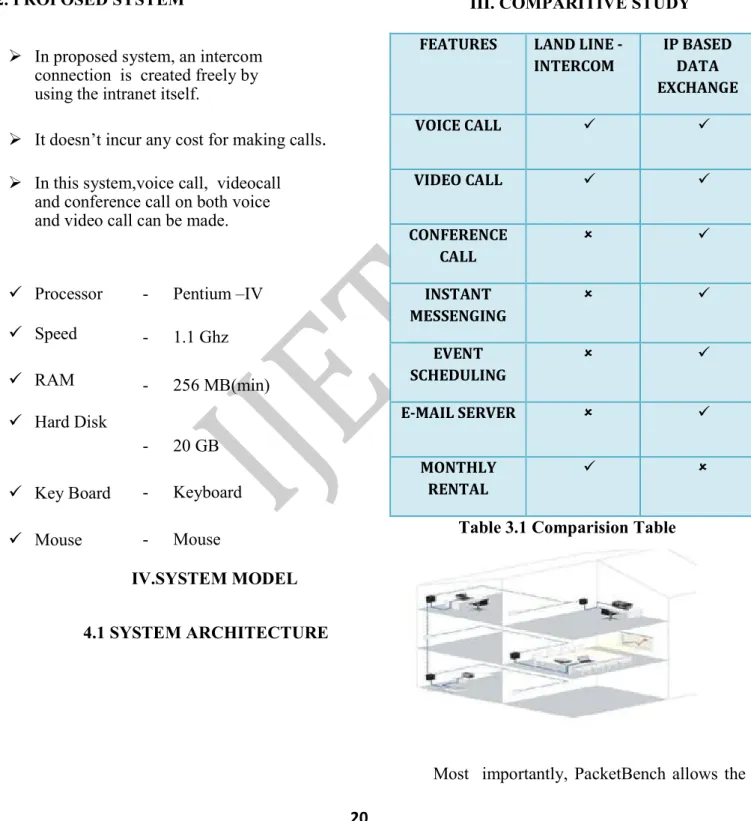
4.1 SYSTEM ARCHITECTURE
Most importantly, PacketBench allows the Processor - Pentium –IV
Speed - 1.1 Ghz
RAM - 256 MB(min)
Hard Disk
- 20 GB
Key Board - Keyboard
21 collection of workload information on a
perpacket basis. Rather than examining
averaged metrics, we can explore the
detailed processing of each packet and
explore the differences between
individual packets. This is important for
network processing The software used
on the server side is the Cent OS and
client side windows 7. The
programming languages used for the
coding are shell, My SQL, Python and
PHP.
V.RESULTS
5.1 System Dashboard-Representing System Resources, Hard Drives &
Process Status
5.2 System Network-Representing Network Parameters
5.4 Agenda_Calendar-Representing Event Detail’s
5.5 Agenda_Address Book- Representing User Detail’s.
VI.CONCLUSION
One challenging problem of paying rent for
intercom usage communication is highly reduced
in this proposed work through LAN
22 information through the Local Area Network
without any intercom billing. The land-line
inter-com is carried out using the video calling,
conference call, e-mail, instant messenger & fax
server. The internet based information sharing
improves the data transfer rate with the minimal
processing time.
REFERENCES
[1] Miroslav Sveda., “Design
Experience with Routing SW and Related
Applications,”
The Tenth International Conference on Networks., 2011
[2] Ramaswamy Ramaswamy., Ning Weng.,
Tilman Wolf.,
“Analysis of network processing workloads,”
Journal of Systems Architecture., Elsevier journal., 2009
[3] Sangjae Lee., Byung Gon
Kim., “Factors affecting the
Volume 2 - Issue 5, May 2015
23
[4] Stratos Keranidis., Dimitris Giatsios.,
Thanasis Korakis., Iordanis Koutsopoulos., Leandros
Tassiulas., Thierry Rakotoarivelo., Max Ott., Thierry
Parmentelat.,
“Experimentation on end-to-end performance aware
algorithms in the federated environment of the
heterogeneous PlanetLab and
NITOS testbeds,” Computer
Networks, Elsevier journal., 2014
[5] T. Rakotoarivelo, M. Ott, G. Jourjon, I.
Seskar, OMF: a control and management framework
for networking testbeds, SIGOPS Oper. Syst. Rev. 43