238
HALYOMORPHA HALYS STÅL (HETEROPTERA: PENTATOMIDAE)
A NEW PEST FOR THE OLTENIA AREA
MITREA ION1, STAN RALUCA 2
; 1University of Craiova, Faculty Of Horticulture; 2PhD University Of Craiova, Faculty Of Horticulture *Corespondingauthor: [email protected]
Keywords: Halyomorpha halys, invasive species, host plants
ABSTRACT
The marmorated Stinkbug (Halyomorpha halys) is an invasive, polyphagous
species, native from Asia,spreading to both the U.S. and on the European Continent. It is a extremely dangerous species because as a result of the feeding process, on the host plant will appear scars, discoloured areas, deformed fruits, seeds or pods or abortion of the flowering buds, thus leading to a decrease in the quality of the fruit.
This pestwas first seen in the „Al. Buia” Botanical Garden, as an adult on the
Hybiscus syracus L., Paulownia tomentosa Thunb., Buxus sempervirens L., Prunus cerasifera Ehrh.,Solidago canadensis L. species.
On the species Buxussem pervirens L. and Paulownia tomentosa ThunbIt has been found
that it support the complete development of the species from egg to adult. Currently,
Halyomorpha halys is found in all green spaces in Craiova.
INTRODUCTION
The marmorated Stinkbug (Halyomorpha halys) is part of the Hemiptera order,
Heteroptera suborder, Pentatomidae family, Halyomorpha genus. The bug originates in Asia (China, Japan, Korea and Taiwan) (Lee D.H. et al., 2013).
Invasive species, managed to occupy new areas in the world, in the USA it has been seen since 1996, but confirmed its presence in 2001(Hoebeke E.R., Carter M.R., 2003), it is still present in 42 American states and in two Canadian states (Fogain R., Graff S., 2011).
In Europe has been reported for the first time in Switzerland (Wermelinger B. and co., 2008; Gariepy T.D. et al., 2014), in Germany (Heckmann R., 2012), in Greece (Milonas P.G., Partsinevelos G.K., 2014), France (Callot H., Brua C., 2013), Italy (Maistrello L. et al, 2013), Hungary (Vétek et. al. 2014),. Romania (Macavei et al. 2015), Russia (Vetek et al., 2014), Serbia (Šeat 2015), Austria (Rabitsch & Friebe 2015), Bulgaria (Simov N., 2012), Spain (Dioli et. al. 2016), Slovakia (Hemala&Kment, 2017), in 2017 in
Halyomorpha halys Croatia (Šapina et al. 2018 cited by Rot M. et al., 2018), Georgia
(Gapon, 2016).
MATERIAL AND METHOD
The species has been monitored between May-October 2019 in the “Al. Buia” Botanical Garden, “Nicolae Romanescu” Park, “Mihai Bravu” Garden and “Tineretului” Park through visual observation.
239
transported to the Entomology laboratory of the Faculty of Horticulture, the individuals
collected belonging to the species Halyomorpha halysStål.
RESULTS AND CONCLUSIONS
This pest it was first observed in the “Al Buia” Botanical Garden, in the adult stage
on the species Hybiscus syracus L., Paulownia tomentosaThunb, later being found in the
egg stage on the species Buxus sempervirens L, Paulownia tomentosaThunb., Solidago
canadensis L., Amorpha fruticosa L. but also in the nymph stage on the following
species:Cercis siliquastrum L., Robinia pseudoacacia L.,Cornus sanguinea L., Fraxinus
excelsior L., Celtis australis L., Malus domestica Borkh., Liriodendron tulipifera L., Pyracantha coccinea M. Roem, Morus alba L.,Inula helenium L., Helianthus tuberosus L., Prunus cerasifera Ehrh.
This species can be easily recognized because the adults have a specific brown or grayish dorsal coloration, with dense and dark punctuation, as the size varies between 12 and 17 mm (Rot et al. 2018). The antennae, legs and edges of the abdomen have alternating white and dark stripes (Figure 1).
Figure 1.Adult of Halyomorpha halys Orig.
The eggs are laid in-group (20-25 each group), on the underside of the leaves, their colour is light green becoming white (Hoebeke E.R., Carter M.R., 2003; Rice K.B. et al., 2014). After hatching, larvae go through five stages of development (Medal J. et al.,, 2013).
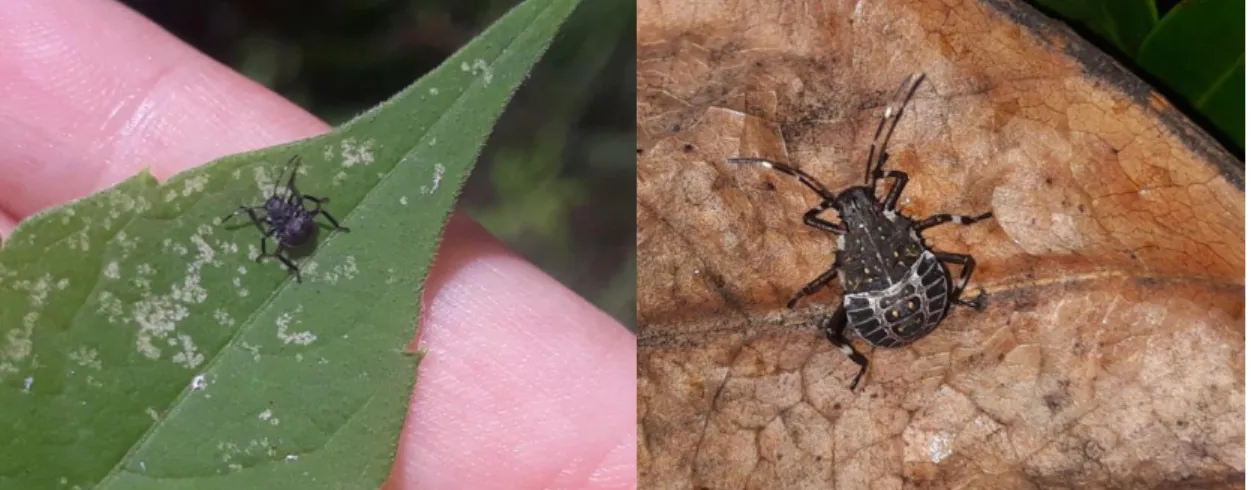
New born larvae have black head and orange abdomen (Figure 2), in the second stage are black with black abdomen and reddish spots, have spikes on the lateral of their heads and pronotum, and in the last two stages of development it can be observed a
white stripe on the tibia (Rice K.B. et al., 2014; Wermelinger B. et al., 2008) (Figure 3 and
4).
240
Figure 2. New born larvae of Halyomprpha halys, stageI , orig.
Figure 3.Halyomorpha halys nymphs (left- second stage, right- third stage) orig.
241
The marmorated stinkbug is an extremely polyphagous invasive species with more than 100 reported host plants (Bergmann et al. 2016).
Prefers different species of fruit trees and shrubs like : Prunus armeniacaL., Prunu
savium L., Prunus persica L.,Prunus domestica L., Malus spp., Pyrus spp., Citrus spp.,
Morus spp., Diospyros spp., Rubus spp., Vitis vinifera L (Haye et al. 2015), as well as
horticulture crops such as:Solanum lycopersicum L., Capsicum anuum L., Solanum
melongena L., (Kuhar T.P. et al., 2012), Zea mays L., Helianthus annuus L., Sorghum bicolour L., Triticum aestivum L., Gossypium hirsutum L., Humulus lupulusL., Phaseolus vulgaris L., Pisum sativum L .; trees and bushes (Acer spp., Salix spp., Buddleja davidii
L., Paulownia tomentosa Thunb., Pyracantha coccinea M. Roem., Lonicera spp., Syringa
spp., Hibiscus spp., Cryptomeria spp.,)( Rice K.B. et al, 2014; Wermelinger B. et al.,
2008).
The damages are produced by both nymphs and adults, as result of the feeding process may appear scars, discoloured areas, deformed fruits, seeds or pods (Leskey et al., 2009; Kuhar et al., 2012; Rice et al. 2014),leading to low quality of fruits, abortion of the flowering buds, some plants can be affected in long term (Haye et al. 2015).
After 14 years since its initial settlement in the USA, H. halys became one of the
most important pests, causing loss of more than 37 million dollars in the apple crops from the Mid-Atlantic region (United States Apple Association 2010 cited by Haye et al 2015)
CONCLUSIONS
Extremely polyphagous species, attacking both fruit trees, shrubs as well as herbaceous plants, the damages caused by this pest as a result of feeding process are dark-brown spots on the surface of the attacked organs, affecting its quality.
The species Buxussempervirens L. and Paulownia tomentosaThunb. can tolerate
the complete development of the species from egg to adult. Currently the species is found on all green spaces in Craiova.
Particular importance should continue to be given on monitoring the species for limiting the spreading and the damages caused in crops and green spaces, in order to achieve effective treatments to combat this species.
BIBLIOGRAPHY
Callot H., Brua, C., 2013, Halyomorphahalys (
Stål
al, 1855), la Punaisediabolique, nouvelle espèce pour la faune de France (HeteropteraPentatomidae). L’Entomologiste 69:69–71;
Bergmann E. J., Venugopal P. D., Martinson H. M., Raupp M. J., Shrewsbury P. M.,
2016. Host Plant Use by the Invasive Halyomorphahalys (Stål) on Woody Ornamental
Trees and Shrubs PloS ONE 11 (2): 1-2;
Dioli P., Leo P., Maistrello L., 2016. Prime segnalazioni in Spagna e in Sardegnadella specie alienaHalyomorphahalys(Stål, 1855) e note sullasuadistribuzione in Europa (Hemiptera, Pentatomidae) Revistagaditana de Entomología, Volumen VII núm. 1 (2016):539-548;
Fogain R., Graff, S., 2011, First records of the invasive pest, Halyomorphahalys
(Hemiptera: Pentatomidae), in Ontario and Quebec. J.Entomol. Soc. Ont. 142:45–48.
Gariepy T. D., Haye, T., Fraser, H., Zhang, J., 2014, Occurrence, genetic diversity, and
potentialpathways of entry of Halyomorphahalys in newlyinvaded areas of Canada andSwitzerland.Journal of pest science, 87(1):17-28;
242
Haye T., Gariepy T., Hoelmer K., Rossi JP., Streito JC., Tassus X., Desneux N., 2015,
Range expansion of the invasive brown marmorated stinkbug, Halyomorphahalys: an increasing threat to field, fruit and vegetable crops worldwide, J Pest Sci 88:665–673;
Heckmann R., 2012 - Ersternachweis von halyomorphahalys (Stål, 1855)(Heteroptera: Pentatomidae) fürdeutschland. Heteropteron 36:17–18;
Hemala V., Kment P., 2017. First record of Halyomorphahalysand mass occurrence of
Nezaraviridulain Slovakia.Plant Protection Science Vol. 53, 2017, No. 4: 247–253
Hoebeke E.R., Carter, M.E., 2003, Halyomorphahalys (Stål) (Heteroptera: Pentatomidae):
a polyphagous plant pest from Asia newly detected in North America. Proc.Entomol. Soc. Wash.105:225–237;
Kuhar T.P., Kamminga, K.L., Dively, G.P., Hooks, C.R.R., Hamilton, G., Herbert, D.A., 2012, ThePest Potential of Brown Marmorated Stink Bug onVegetable Crops. Plant Health Prog. Online;
Lee D.-H., Short, B.D., Joseph, S.V., Bergh, J.C., Leskey, T.C., 2013, Review of the
Biology,Ecology, and Management of Halyomorphahalys(Hemiptera: Pentatomidae) in China, Japan, andthe Republic of Korea. Environ. Entomol. 42:627–641;
Leskey TC, Short BD, Wright SE, Brown MW (2009) Diagnosis and variation in appearance of brown stink bug (Hemiptera: Pentatomidae) injury on apple. J EntomolSci 44:314–322;
Macavei, LI., Bâetan, R., Oltean, I., Florian, T., Varga, M., Costi, E., Maistrello, L. 2015, First detection ofHalyomorphahalysStål,A new invasive species with a high potential
of damage on agricultural crops in Romania,LucrăriŞtiinţifice,Universitatea de ŞtiinţeAgricoleşiMedicinăVeterinară "Ion Ionescu de la Brad" Iaşi, SeriaAgronomie, 58 (1), 105–108.
Maistrello L., Bariselli, M., Dioli, P., 2013, Trovataunacimiceesoticadannosaneifrutteti
(Halyomorphahalys).Agricoltura 6: 67–68.
Medal J., Smith, T., Cruz, A.S., 2013 - Biology of the Brown Marmorated Stink Bug Halyomorphahalys (Heteroptera: Pentatomidae) in the Laboratory. Fla. Entomol. 96:1209– 1212.
Milonas P.G., Partsinevelos, G.K., 2014, First report of brown marmorated stink bug
HalyomorphahalysStål al (Hemiptera: Pentatomidae) in Greece.EPPO Bull. 44:183–186.
Simov, N., Langourov, M., Grozeva, S. &Gradinarov, D. (2012) New and Interesting Records of Alien and Native True Bugs (Hemiptera: Heteroptera) in Bulgaria.
Actazoologicabulgarica, 64(3), 241–252.
Rabitsch W., Friebe G. J., 2015. From the west and from the east? First records of Halyomorphahalys(Stål, 1855) (Hemiptera: Heteroptera: Pentatomidae) in Vorarlberg and Vienna, Austria. BeiträgezurEntomofaunistik, 16: 126–129.
Rice K.B., Bergh, C.J., Bergmann, E.J., Biddinger, D.J., Dieckhoff, C., Dively, G., Fraser, H., Gariepy, T., Hamilton, G., Haye, T., Herbert, A., Hoelmer, K., Hooks, C.R., Jones, A., Krawczyk, G., Kuhar, T., Martinson, H., Mitchell, W., Nielsen, A.L., Pfeiffer, D.G., Raupp, M.J., Rodriguez-Saona, C., Shearer, P., Shrewsbury, P., Venugopal, P.D., Whalen, J., Wiman, N.G., Leskey, T.C., Tooker, J.F., 2014, Biology, Ecology, and
Management of BrownMarmorated Stink Bug (Hemiptera:Pentatomidae). J. Integr. Pest Manag.5, A1–A13.
Šeat, J. (2015) Halyomorphahalys(Stål, 1855) (Heteroptera: Pentatomidae) a new invasive species in Serbia. Actaentomologicaserbica, 20, 167–171
ROT M., DEVETAK M., CARLEVARIS B., ŽEŽLINA J., ŽEŽLINA I., 2018, First Record Of Brown Marmorated Stink Bug(HalyomorphaHalys(Stål 1855)) (Hemiptera:Pentatomidae) In Slovenia, ActaEntomologicaSlovenica, Vol. 26, št. 1: 5–12
243
description of the genitalia of both sexes. Zootaxa 3780 (1): 194–200.
https://doi.org/10.11646/zootaxa.3780.1.8
Wermelinger B., Wyniger, D., Forster, B., others, 2008, First records of an invasive bug