using Trusted Execution
Sinisa Matetic1, Karl W¨ust1, Moritz Schneider1, Kari Kostiainen1, Ghassan Karame2, and Srdjan Capkun1
1 ETH Zurich, Switzerland
[email protected] 2 NEC Labs, Germany
Abstract. Decentralized blockchains offer attractive advantages over traditional payments such as the ability to operate without a trusted au-thority and increased user privacy. However, the verification of blockchain payments requires the user to download and process the entire chain which can be infeasible for resource-constrained devices, such as mo-bile phones. To address such concerns, most major blockchain systems support lightweight clients that outsource most of the computational and storage burden to full blockchain nodes. However, such payment verifica-tion methods leak considerable informaverifica-tion about the underlying clients, thus defeating user privacy that is considered one of the main goals of decentralized cryptocurrencies.
In this paper, we propose a new approach to protect the privacy of lightweight clients in blockchain systems like Bitcoin. Our main idea is to leverage commonly available trusted execution capabilities, such as SGX enclaves. We design and implement a system called Bite where enclaves on full nodes serve privacy-preserving requests from lightweight clients. As we will show, naive serving of client requests from within SGX enclaves still leaks user information. Bite therefore integrates several privacy preservation measures that address external leakage as well as SGX side-channels. We show that the resulting solution provides strong privacy protection and at the same time improves the performance of current lightweight clients.
1
Introduction
Since its inception in 2008, Bitcoin has fueled considerable interest in decentral-ized currencies and other blockchain applications. The main goals of blockchains include a distributed trust model and increased user privacy. Several other blockchain platforms, such as Ethereum [1], leverage the same open or permis-sionless model as Bitcoin, while platforms like Hyperledger [2], Ripple [3] and R3 [4], enable closed or permissioned blockchains.
including them in connected blocks. This process imposes heavy requirements on bandwidth, computing, and storage resources of blockchain nodes that need to fetch all transactions and blocks issued in the blockchain, locally index them, and verify their correctness against all prior transactions. For instance, a typical Bitcoin installation requires more than 160 GB of storage today, and the sizes of popular blockchains are growing fast (e.g., Bitcoin’s blockchain grew over 60% in the last 14 months) [5,6]. This makes usage of blockchains infeasible on resource-constrained clients like mobile devices.
Lightweight clients and privacy.To address such heavy resource require-ments, most open blockchain platforms supportlightweight clients, targeted for devices like smartphones, that only download and verify a small part of the chain. E.g., the Bitcoin community provides the BitcoinJ [7], PicoCoin [8] and Elec-trum [9] clients implementing the Simple Payment Verification (SPV) mode [10], where the clients connect to a full node that has access to the complete blockchain and can assist the client in transaction confirmation. Transactions contain inputs and outputs that are bound toadresses owned by users. As the full node has to learn all transactions issued and received by the requesting client to verify their correctness, such action obviously violates user privacy.
To improve user privacy, several clients supportfilters(e.g., Bitcoin’s BIP37 [11] and Ethereum’s LES [12]). The goal of filters is to allow the client to define an anonymity set in an attempt to hide its real addresses from the full node. For instance, Bitcoin’s BIP37 supports Bloom filters [13] that allow the client to define a set of transactions, with false positives, that are requested from the full node. Essentially, this approach presents a trade-off between communication efficiency and privacy: a Bloom filter that returns many false positives provides a larger anonymity set but requires more communication. Although such filters can be configured to be efficient, recent studies have shown that in practice they offer almost no privacy [14]. Consequently, none of the current lightweight clients provides adequate privacy protection with practical performance overhead.
Our solution. The main goal of this work is to improve the privacy of Bitcoin lightweight clients without compromising their performance. To reach this goal, we combine techniques from several separate fields, including trusted computing, private information retrieval and side-channel protection. We stress here that a naive composition would result in a poor trade-off between privacy and performance. The primary problem that we solve in this paper is how to combine known and new techniques such that the resulting solution provides strong privacy, good performance and easy adoption at the same time.
The starting point of our solution is to leverage commonly available trusted computing capabilities, such as Intel SGX enclaves [15], on full nodes. SGX enables the execution of protected applications, calledenclaves, in isolation from any untrusted software such as the OS and protects the integrity of enclave execution and the confidentiality of enclave data.
from clients. However, the usage of trusted computing alone does not solve our problem. SGX prevents an adversary that controls malicious software, such as the OS, on the full node from directly accessing enclave’s memory or reading sealed storage. However, secret-dependent access patterns to external storage, such as transaction databases, can reveal the client’s address to the adversary. Additionally, recent research has shown that SGX can be susceptible to software-based side-channel attacks, where malicious software on the same platform infers secret-dependent data access patterns or control flow in the enclave by monitor-ing usage of shared hardware-resources, such as caches [16,17,18,19], or memory management events like paging [20].
With such enclave leakage in mind, we design twoBite variants. Our first variant is calledScanning Windowand its operation is similar to the current SPV clients that verify transactions using block headers and Merkle paths received from the full node. To prevent leakage through external data access patterns, we design a customized chain access mechanism that hides the client’s transac-tions and the relatransac-tionship between the size of the response and the number of read blocks. Our second variant is called Oblivious Database and it allows the client to verify the amount of coins associated with its addresses by querying a specially-crafted version of the unspent transaction output (UTXO) database. To prevent leakage from database accesses, we leverage a well-known Oblivious RAM (ORAM) algorithm [21] to hide access patterns to an encrypted storage. This second variant allows even lighter lightweight clients that no longer need to download and verify Merkle paths.
To prevent software-based side-channels, we adopt protections from recent SGX research. The basic building block for our control-flow hiding is the cmov instruction [22] that enables building oblivious execution of branches. To pre-vent leakage from data accesses we adopt additional defenses, such as iterating over the entire data structure when an element is accessed based on the pro-tected client address. In our use case, full nodes need to process large blockchain databases to serve client request, and thus straightforward usage of known SGX side-channel protection systems, such as [23,24,25,26], would result in either excessive performance overhead or imperfect side-channel protection. Instead of using such systems directly, we carefully pick low-level primitives and apply them at critical points in our system.
Results. We show that our solution improves both the privacy and per-formance of current lightweight clients. In both of our variants, the external data access patterns are independent of the protected client address. The side-channel protections in the Oblivious Database variant also make the enclave’s memory accesses (both code and data) independent of the address, thus pre-venting leakage caused by known SGX side-channels [16,17,18,19,20,27]. While similar protections can also be used for the Scanning Window variant, they im-pose a high overhead, which is why we recommend using Oblivious Database if side-channels are a concern.
if specific SGX processors would be completely broken (e.g., through physical attacks), our solution provides no improvement in users’ privacy, but importantly also no degradation in users’ security. That is, usage of Bite on fully broken SGX does not enable double spending or stealing of users’ wallets or coins.
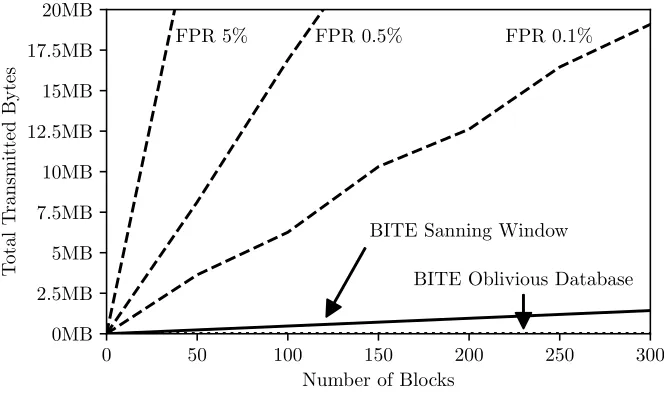
In terms of performance, the Oblivious Database variant reduces both pro-cessing times and bandwidth consumption drastically. For example, transaction search for 10 addresses accounts only for 750ms of processing time and a 12 kB message size. In Scanning Window, processing times are comparable to the cur-rent SPV mode, but bandwidth is reduced significantly. For 200 blocks, Scanning Window accounts for 3.9s of processing time and 0.95MB message size, while current SPV mode accounts for 2.1s of processing time and 35.01MB message size.
We argue that Bite emerges as the first practical solution that provides strong privacy protection for lightweight Bitcoin clients like mobile devices. Our solution can be integrated into existing full nodes and lightweight clients with minor modifications to the existing software. WhileBiteis designed for Bitcoin, we stress that it finds direct applicability in various other blockchain platforms as well. We plan on releasing the full implementation of our solution online as open source.
Contributions.To summarize, in this paper we make the following main contributions:
– Novel approach.We propose leveraging commonly available trusted execu-tion capabilities of SGX enclaves for improved lightweight Bitcoin client privacy.
– New system.We design and implement a system calledBite that carefully combines a number of known and new private information retrieval and side-channel protection techniques to prevent information leakage.
– Evaluation. We show that our solution significantly improves both privacy and performance of current clients. We argue thatBiteis the first practical way to provide strong privacy for lightweight Bitcoin clients.
The remainder of this paper is organized as follows. Section 2 describes our problem and Section 3 outlines our approach. Section 4 explains the details of our system Bite. Section 5 covers security analysis and Section 6 provides performance results. We discuss directions for future work in Section 7, review related work in Section 8, and conclude in Section 9. For readers unfamiliar with SGX and ORAM, we provide brief introductions in Appendices A and B, respectively.
2
Problem Statement
2.1 Bitcoin Lightweight Clients
Bitcoin [10] is the first and still most popular cryptocurrency based on blockchain technology. It enables users to perform payments by issuing transactions. While Bitcoin enables execution of a simple scripting language, regular Bitcoin transac-tions generally transfer Bitcoins (BTC) from one or more transaction inputs to one or more outputs. Each of the outputs is bound to anaddressthat is derived from a user’s public key. A user that knows the corresponding private key will then be able to spend the Bitcoin contained in the transaction output.
When a user wants to perform a payment, she creates a transaction that contains inputs, outputs, and the signatures that allow her to spend the inputs. Subsequently, the transaction is propagated to all nodes using a peer-to-peer network created by the system’s participants. Miners, a special type of nodes, collect valid transactions into blocks and solve a hash-based Proof-of-Work puz-zle to make the contained transactions hard to revert. A miner that successfully finds a valid Proof-of-Work for a candidate block, broadcasts the block to all other nodes, who then verify its correctness and include it in their copy of the blockchain if valid.
In order to verify transactions, Bitcoin users, or clients, need to store the full history of all Bitcoin transactions. This approach puts a heavy load on client implementations in terms of network and storage, and as a consequence, makes transaction confirmation on mobile clients infeasible. To address this concern, the original Bitcoin paper proposed a solution calledSimplified Payment Verification (SPV) [10]. In this technique, lightweight clients store only block headers, check their Proof-of-Work puzzles and then request their own transactions and the Merkle paths that are needed to verify their presence in the blocks from a full node that stores the entire chain.
Improvement proposal BIP 37 [11] introduced Bloom filters [13] that allow a lightweight client to request a subset of all transactions to preserve some privacy without needing to download all transactions for each block. A Bloom filter [13] is a probabilistic data structure that consists of a set of hash functions and a bit array where each bit is set to one if one of the hash functions hashes one of its inputs to the index of the bit in the array. This data structure allows checking if a value is contained in the filter by hashing the value with each of the hash functions and checking whether the corresponding bit is set. If this is not the case, the value was not an input. If it is the case, however, the valuemight have been an input or it could be a false positive. The false positive rate can be set by the creator of the filter.
positive rate is higher, the client will receive more irrelevant transactions, in an attempt to hide her true addresses with a larger anonymity set.
2.2 Limitations of Known Solutions
The use of Bloom filters to receive Bitcoin transactions from an assisting full node inherently creates a trade off between performance and privacy. If a client increases the false positive rate she receives more transactions which provides increased privacy, as any of the matching addresses could be her real addresses, but it also means that she needs the network capacity to download all of these transactions. In the extreme cases, the filter matches everything, i.e., the client downloads the full blocks, or the filter only matches the client’s addresses, i.e., she has no privacy towards the full nodes.
In addition, Gervais et al. [14] have shown that the use of Bloom filters in Bitcoin lightweight clients leaks more information than was previously thought. In particular, they showed that if the Bloom filter only contains a moderate number of addresses, the attacker is able to guess addresses correctly with high probability. For example, with 10 addresses the probability for a correct guess is 0.99. They also show that, even with a larger number of addresses, the attacker is able to correctly identify a client’s addresses with high probability if she is in possession of two distinct Bloom filters from the same client (e.g., due to a client restart). Hearn [28] later expanded on why solving these issues is hard (e.g., need for resizing). Furthermore, it is likely that an attacker using additional de-anonymization heuristics, such as the ones described in [29,30], could further increase the probability to guess correctly.
Finally, a lightweight client cannot be sure that she receivesall transactions that fit her filter from a full node. While the full node cannot include faulty transactions in the response, as this would be detected by the client when re-computing the Merkle root, the client cannot detect whether she has received all requested transactions. This problem can be solved by requesting transactions from multiple nodes, which again imposes more network load on the client.
2.3 Requirements
The high-level goal of this paper is to develop a solution that provides better privacy for lightweight clients without compromising their performance. More precisely, our solution should meet the following requirements:
R1 Privacy.Lightweight clients should be able to verify that their transactions are confirmed on the blockchain or check the amount of coins associated with their addresses without revealing their addresses to the potentially untrusted entity that controls the assisting full node.
R2 Completeness. The verification process should guarantee that no valid transactions have been omitted.
3
Our Approach
The main idea behind our approach is to leverage commonly available Trusted Execution Environments (TEEs) such as Intel’s SGX enclaves [31,15] running within full nodes to provide a privacy-preserving verification service to lightweight clients. Besides increased privacy, trusted execution can enable better perfor-mance in terms of reduced processing and bandwidth, and guarantee complete-ness of received responses.
In short, SGX provides a set of security enhancements in the processor that allow creation of small applications, called enclaves, whose data confidentiality and execution integrity is protected from any malicious software running on the same platform, including the OS. In particular, all enclave memory is encrypted by the CPU whenever it leaves the processor package which prevents the OS from directly accessing enclave’s memory (see Appendix A for more details).
A simple way to leverage SGX would be a solution, where the lightweight client sends its wallet private key to an enclave on the assisting full node. Using the wallet key, the enclave can perform any operation on behalf of the user, including transaction verification. However, such simple solution has a critical drawback. If the used enclave is compromised, the adversary can steal all user’s coins. Such approach might give the owners of full nodes an undesirable economic incentive to break their own SGX processors, e.g., using physical attacks.
To avoid such incentives, we choose a different approach. In our solution, when a client needs to verify a transaction or check the amount of coins associ-ated with the user’s addresses, the client connects to one of the full nodes that supports our service. The client performs remote attestation and establishes a secure channel to the enclave. Then, the lightweight client sends the addresses that the user is interested in to the enclave. The enclave obtains all the required verification information from the locally stored blockchain or custom unspent transactions database (UTXO) and sends back a response to the client that can verify it. Importantly, the client’s private key is never shared with the enclave which enables safe adoption of our solution.
We envision two types of deployment for our system. In the first example deployment, a well-recognized company could provide such a verification service. In the second example, any volunteer currently running a Bitcoin full node could adopt our extension and start providing the service to lightweight clients. In both cases, to incentivize deployment by the full nodes, the service could be ran in return of some small renumeration (i.e., verification fees).
3.1 System Model
Full Nodes
FN1
FN3
FNn
FN2
Lightweight Clients
LC2
LC1
LCn
…
…
…
…
secure Enclave E
Original full node
BC
UTXO enclave UTXO
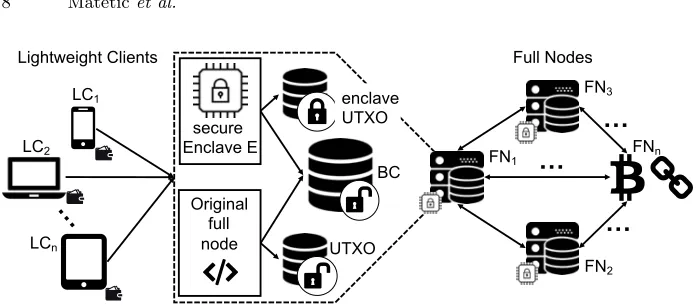
Fig. 1:System model.Lightweight clients request transaction verification ser-vice from enclaves hosted on full nodes.
maintains a specially-crafted version of the UTXO, calledenclave UTXO, in an encrypted (sealed) form.
In SGX, enclave memory is limited to 128MB. Although swapping mem-ory pages is supported (swapping requires expensive encryption and integrity verification [32]), the complete blockchain (BC) and the database of unspent transaction outputs (UTXO) are significantly larger than the enclave’s memory limits (160GB or more). Therefore, these databases are stored on local persistent storage such as disk outside enclave’s memory.
3.2 Adversary Model
We consider an adversary who controls the OS and any other privileged software on the full node. For example, when the verification service is provided by a com-pany, the adversary could be a malicious administrator or an external attacker who has remotely compromised the OS on the full node. If the service is provided by an unknown volunteer, the adversary could be a malicious volunteer.
Since the adversary controls the OS, she can schedule and restart enclaves, start multiple instances, and block, delay, read, or modify all messages sent by enclaves, either to the OS itself or to other entities over the network.
We assume that the adversary cannot break the hardware security enforce-ments of Intel SGX. That is, the adversary cannot access processor-specific keys (e.g., attestation or sealing key) and she cannot access enclave’s runtime memory that is encrypted and integrity-protected by the CPU. (Although we consider SGX trusted, in Section 5 we discuss enclave compromise and show that our solution can handle it gracefully.)
3.3 Challenges
Secure and practical realization of our approach under the defined attacker model involves several technical challenges.
Leakage through external accesses. Since the adversary controls the OS, she can observe access patterns to any external resources, such as files or databases stored on the disk. Although externally stored data can be sealed (encrypted by the CPU such that only the same enclave can decrypt), the OS may be able to infer information about the accessed element by observing access patterns to individual records, such as files or database entries.
Similarly, enclaves rely on the OS to perform communication operations which allows it to infer information about the communication patterns of the enclave. Even if messages are encrypted by the enclave, the message sizes, fre-quency and destination can leak information to the OS.
Leakage through side channels.The SGX architecture can also be suscep-tible tointernal leakage. While Intel acknowledges the possibility of side-channel attacks on enclaves [33], they consider it out of scope for the SGX adversary model. However, recent research shows that such attacks are practical and need to be taken into account. For example, by monitoring usage of shared hardware resources, such as CPU caches, the OS may be able to mount software-based side-channels and infer secret-dependent data and code accesses inside the en-clave’s memory [16,17,18,19]. In SGX, the memory management is left to the untrusted OS, and therefore the OS may also be able to infer enclave’s secrets by monitoring the memory pages that the enclave requests from the OS [20]. Re-searchers have also demonstrated side-channel attacks using the CPU’s branch prediction functionality [27] and speculative execution (the Spectre attack) [34]. Known side-channel attacks can be classified with respect to which memory content is targeted. Code monitoring can identify secret-dependent execution paths, that is, control flow. Data access monitoring can identify secret-dependent data object usage. Branch prediction attacks [27] target execution paths, while most demonstrated cache attacks target data accesses [16,17,18,19], although cache attacks can target control-flow as well.
4
Bite System
In this section we present a system calledBitethat realizes the above approach securely and addresses the aforementioned challenges. In particular, we present two variants of the same approach that serve slightly different purposes.
where its transactions are placed have been extended with a sufficient number of valid blocks (e.g., six).
Our second variant is calledOblivious Database and it can be seen as a com-pletely new verification mode for lightweight clients. In this variant, the enclave on full node maintains a specially-crafted version of the unspent transaction out-puts (UTXO) database and when a client sends a verification request, it checks for the presence of client’s outputs in this database using oblivious database ac-cess (ORAM [21]) and responds accordingly. Such verification allows the client to check how many coins is currently associated to its addresses, with significant performance improvements over SPV.
In both variants, the client performs remote attestation on the used enclave and establishes a TLS connection to it. We note that current lightweight clients communicate with the full nodes without encryption. Existing full node function-ality, such as participation in the P2P network and mining, remain unaffected. Therefore, our system can be seen as a simple add-on to existing full nodes. For clients, payment execution remains unchanged. Payment verification requires minor additions (attestation and TLS) when Scanning Window variant is used or slightly bigger changes when Oblivious Database variant is used.
4.1 Scanning Window Variant
In our first variant, we want to improve the privacy of the current SPV verifi-cation mode. When a client needs to verify transactions, it constructs a request that specifies the addresses of interest and the last block that it has in its internal state and sends that to the secure enclave residing on the full node. The enclave reads the locally stored blockchain database using a custom scanning technique that normalizes the relationship between response sizes and actually accessed data to hide the data/block access patterns and ensure client privacy. Figure 2 shows the operation of this variant, and we describe the details as follows:
Initialization and continuous operation.
(a) On initialization the Full Node F Nj connects to the P2P Bitcoin net-work (a-1) and downloads the full blockchain (a-2). Similarly, the locally stored blockchain database is updated for each new blocks that is appended to the chain (i.e., as new blocks are received over the P2P network).
req(adr,my_last_block)
search trough blocks for LC’s request using Scanning Window
establish secure communication
2
information request for addresses of interest
3
P2P communication
authentication, TLS connection
5
update blockchain unchanged full node
normal operation
co
nt
in
uo
us
Lightweight Client LCi Full Node FNj
…
Full Node FNnattestation
BC
2
1
a
1
4
6
return request information about transactions
res((trx_info,merkle_path) || block_header)
BC get block headers from my_last_block
- for blocks containing client addresses add transaction info and the merkle tree path
- for blocks without client addresses add block header
verify transactions, Merkle Tree paths
Enclave Ej Enclave En
acquire latest block header from the P2P Bitcoin network
b
Fig. 2:Scanning Window operation.Lightweiwght client establishes a secure connection to an enclave on full node and sends a request that contains its address and last known block. The enclave scans a number of blocks from the locally stored complete chain and prepares a response whose size is proportional to the number of scanned blocks.
of this process are minor and easily met even by clients with severe resource con-straints.3
Client request handling.Clients perform transaction verification as fol-lows:
(1) The Lightweight Client LCi performs attestation with the secure Enclave Ej residing on the full nodeF Nj.
3
(2) If the attestation was successful, the Lightweight Client LCi establishes a secure communication channel to the EnclaveEj using TLS.
(3) The Lightweight Client LCi sends a request containing the addresses of interest and a block number that specifies how deep in the chain transactions should be searched for verification. Typically, this number would be saved from the previous interaction with a full node or in the case of the first transaction verification the number could roughly match the date when the client started using Bitcoin.
(4) The Enclave Ej starts scanning its locally stored copy of the blockchain (BC) for the requested address and range of blocks using a scanning technique described in detail below.
(5) In preparation of the response, the EnclaveEjdoes the following: for blocks containing client addresses it adds the full transaction information and the under-lying Merkle tree path to the response, while for blocks without client addresses it only adds the block header.
(6) The Lightweight ClientLCiverifies that (i) the received block headers match its internal state and (ii) the received transactions and Merkle Tree paths match to the block headers. The client considers such received transactions as confirmed (assuming that they are sufficiently deep in the chain). The client updates its in-ternal state regarding the latest verified block number and closes the connection to the enclave.
Block scanning details. As explained in Section 3.3, enclave execution can leak information in various ways. For example, if our solution would simply return each matching transaction (and the corresponding Merkle Tree) in the specified range of blocks, based on the size of the response the adversary could deduce how much information of interest for the client was contained within the scanned blocks. Over a period of time, by tracking requests and response sizes, the adversary could gain significant information about the client’s addresses and transactions.
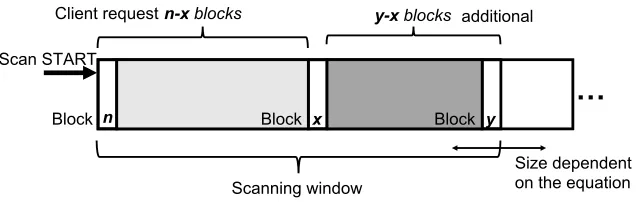
We address such leakage by using a tailor-made block scanning scheme. The main goal of the scheme is to fully hide the ratio between the response size (that indicates the number of transactions returned to the client) and the number of scanned blocks. When this ratio is constant, the adversary cannot deduce any meaningful information from the response size.
Block x
Scan START
n
n-x blocks
y y-x blocks
Scanning window
Size dependent on the equation
Client request additional
…
Block Block
Fig. 3: Block reading in Scanning Window. Depending on the number of requested blocks (up to x) and the number of matching transaction in them, our scanning technique read potentially extraneous blocks (up toy) to keep the ratio between the read blocks and the response message size constant.
i.e., if after scanningn−xblocks r≤(n−x)∗t, we pad the response size such thatr= (n−x)∗t. The exact size of the threshold is empirically determined in Section 6.
Side-channel protection. The scanning technique described above pre-vents leakage from externally observable response sizes. However, if the adver-sary is able to mount a high-granularity digital side-channel attacks (e.g., one that allows her to observe execution paths with instruction-level granularity), the adversary will be able to determine the transactions that were accessed, and thus infer the client’s addresses.
To make our system more robust against such attacks, we optionally add side-channel protections at the expense of performance (cf. Section 6). To protect against timing leakage we compute the Merkle path for all transactions in each of the scanned block in contrast to only computing the path for the transactions of client’s interest. For protection against control-flow side channels we make use of thecmov assembly instruction to hide execution paths.cmov is a conditional move such that “If the condition specified in the opcode (cc) is met, then the source operand is written to the destination operand. If the source operand is a memory operand, then regardless of the condition, the memory operand is read” [22]. This allows us to replace branches from our code resulting in the same control flow with no leakage.
The same technique is also used in previous side-channel protection solutions like Raccoon [23]. However, since using such a side-channel defense system di-rectly would incur an extremely high performance overhead in our particular setting (due to large amounts of accessed blockchain data), we customize these techniques to our setting. Specifically, we apply the following modifications, as per Figure 4:
Block
tm … e.g. 20 kB
Response 1 MB
e.g. 500 kB
…
…
… …
…
n*t n=100 t=5 kB
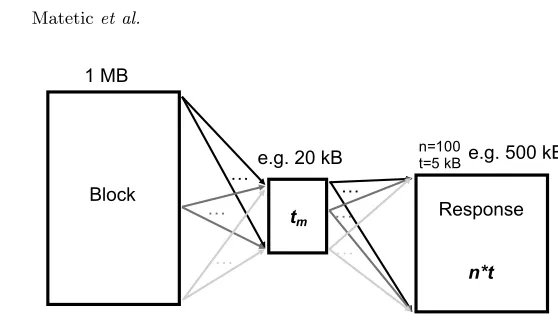
Fig. 4: Oblivious copying in Scanning Window.The data is copied in an oblivious fashion from the block to a temporary array, i.e., every transaction is conditionally moved usingcmovto every possible destination. The data contained in the temporary array is then copied to the response in an oblivious fashion, again usingcmovto conditionally copy everything to all possible locations in the response.
request the remaining transactions in another request (from the flagged block until the end of the initially specified block).
(ii) For each block, we allocate a temporary array of sizetm(see Figure 4), where tmis a threshold that specifies the maximum data per block, as opposed to the thresholdtthat specifies the average data per block. While the block is parsed, each transaction is moved to the temporary array in an oblivious fashion, i.e., we use thecmovinstruction to conditionally move each word of each transaction to every entry in the array. This means that for every transaction we access every entry in the array and since the same instruction is used for each possible copy – independent of whether the data is actually copied – even an attacker with an instruction level view of the control flow cannot determine which data is actually copied. After processing the block, the temporary array is traversed and all entries are copied to the response array (see Figure 4). This is again done in an oblivious fashion, i.e., each entry is copied conditionally using the cmov instruction to every possible position in the response array.
This method of copying transactions from the block to the response is required to efficiently keep the data accesses oblivious. Specifically, for a block of size m, a temporary array of size tm and nrequested blocks, this method requires
O(m·tm+tm·n·t) operations instead of O(m·n·t) operations when naively copying the data in an oblivious fashion from the block to the response directly. Since tm is usually much smaller than m and n·t, this method is in practice orders of magnitude faster, in relation to the data copy in oblivious fashion.
4.2 Oblivious Database Variant
preser-vation (namely, the block number that specifies how deep the chain should be searched does not leak). The main idea behind this variant is to allow lightweight clients to send requests containing addresses of their interest and directly receive information regarding unspent outputs, without the need to verify block headers and Merkle tree paths.
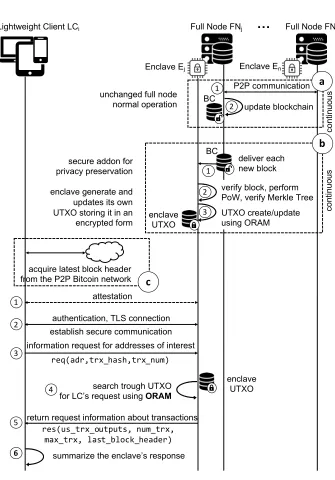
In order to achieve such verification, a new indexed database of unspent transactions (denoted asenclave UTXO) is created and searched for every client request using an Oblivious RAM algorithm. Figure 5 shows the operation of this variant, and we describe the details as follows:
Initialization and continuous operation.
(a) Similar to a standard full node, on initialization the full nodeF Njconnects to the peer-to-peer network and downloads and verifies the entire blockchain. After initialization, when new blocks are available in the peer-to-peer network, F Nj downloads and verifies them.
(b) During initialization Enclave Ej reads the locally stored blockchain and verifies each block. The enclave builds its own enclave UTXO database that is a special version of the original structure present in standard full nodes. In particular, this UTXO set is encrypted on the disk as sealed storage, indexed for easy and fast access depending on the client request, and accessed using ORAM to prevent information leakage through disk accesses. After initialization, the enclave updates this UTXO using ORAM when new blocks are available in the locally stored blockchain.
(c) As in the Scanning Window variant, the client obtains the latest block head-ers from the peer-to-peer network.
Client request handling.Clients perform transaction verification as fol-lows:
(1) The Lightweight ClientLCiperforms an attestation with the secure Enclave Ej residing on the full nodeF Nj.
(2) LCi establishes a secure communication channel to the Enclave Ej using TLS.
search trough UTXO for LC’s request using ORAM
establish secure communication 2
information request for addresses of interest 3
authentication, TLS connection
5
Lightweight Client LCi Full Node FNj
…
Full Node FNnattestation
1
verify block, perform PoW, verify Merkle Tree UTXO create/update using ORAM 2
3 BC
enclave UTXO
deliver each new block
co
nt
in
uo
us
b
secure addon for privacy preservation
enclave generate and updates its own UTXO storing it in an encrypted form
1
req(adr,trx_hash,trx_num)
4
enclave UTXO
return request information about transactions
res(us_trx_outputs, num_trx, max_trx, last_block_header)
6
Enclave Ej Enclave En
P2P communication
update blockchain unchanged full node
normal operation
co
nt
in
uo
us
BC 2
1
a
summarize the enclave’s response acquire latest block header
from the P2P Bitcoin network
c
Fig. 5: Oblivious Database operation. Lightweight client sends a request containing its address and the last transaction to an enclave on full node. Enclave queries a specially-constructed version of the UTXO database using ORAM and provides a response back to the client.
(4) The EnclaveEj reads the enclave UTXO database to get the unspent trans-action output information in respect to the client’s request.Ej uses ORAM and the previously created index to access the enclave UTXO in an oblivious fashion. (5) In preparation of the response,Ej includes the relevant information as ex-plained in step (3), which encompasses the currently included and maximum number of unspent transactions found for a specific address. When these num-bers match, the LCi knows that she has received all the unspent outputs of a specific address. The enclave additionally includes the block hash of the last known block from the local blockchain (longest chain). With this information the client can deduce whether the enclave has been served with the latest block and that the enclave’s database is fully updated. Responses are always of constant size, i.e., shorter responses are padded and if a response is too large, the client is informed of missing outputs, such that she can later retrieve the rest of the outputs (e.g., from a different node). The size of the response is chosen such that it accommodates the majority of responses.
(6) The Lightweight ClientLCican summarize the unspent transaction outputs received from the EnclaveEj. The enclave guarantees completeness in terms of transaction confirmation and the current state of the chain, so the client does not have to perform any additional checks by herself. Successful update of the client’s internal state results in the connection termination between the enclave and the client.
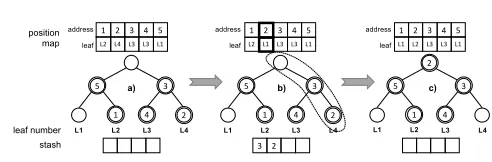
Oblivious Database details.In this variant, we use an ORAM algorithm called Path ORAM [21] to protect data access patterns of our enclaves. For read-ers unfamiliar with this algorithm, we provide a brief description in Appendix B. Database Initialization.The ORAM database is initialized by creating dummy buckets on disk and filling theposition map with randomized entries. Thestash is also filled with dummy chunks. After that the ORAM database is fully ini-tialized and can be used to add new unspent outputs from the blockchain. To ensure that the enclave always uses the latest version of the sealed enclave UTXO database, SGX counters or rollback-protection systems such as ROTE [35] can be used.
Database Update.When a new Bitcoin block is added, the enclave first verifies the proof of work. It then extracts all transaction inputs and outputs and bundles them by address. For each address found in the block, the UTXO database entry is requested and then updated with the new information. If too many entries are added, resulting in the chunk getting too big, the chunk is split into two and the index is updated to reflect the changes made to the UTXO database. All accesses are performed using the ORAM algorithm and, therefore, do not leak any information about the access patterns.
Database Access.Accesses to the ORAM database follow the normal proce-dure described in [21] and in Appendix B.
leakage of the code access patterns, specifically, execution paths in theif state-ments when the stash, indexes and the position map is being accessed. This would leak the exact address which is used to search for the unspent transac-tions in the internal database.
To remedy internal leakage, we deploy several mechanisms that protect our code and execution. First, when accessing the security critical data structures, specifically, the position map, stash, and the indexes containing information about which chunks contain unspent transactions of a certain Bitcoin address we pass over them entirely in the memory to hide the memory access pattern. Second, to hide the execution paths we remove all branching in the code that accesses these data structures and deploy the cmov assembly instruction (see Section 4.1). Observation of the control flow and memory access does not leak whether the operation performed by the enclave was a read or a write, and since there is a single control flow without creating multiple branches depending on the condition, we effectively hide the execution and thus protect this variant from internal leakage in full. This protection mechanism has negligible performance overhead (see Section 6).
5
Security Analysis
In this section, we provide an informal security analysis. First, we analyze our solution with respect to our adversary model where SGX security enforcements cannot be broken. In particular, we show that our solution ensures confidentiality of the requested client addresses, as the attacker cannot infer the requested address from disk access patterns, response sizes, side-channels, or a combination thereof. Second, we discuss implication of potential SGX compromise and show that our solution can handle such cases gracefully.
5.1 External Leakage Protection
to guess correctly which ORAM block was accessed is equal to that of a ran-dom guess, as shown in [21]. As the responses always have a constant size, the adversary cannot learn anything from response sizes either.
5.2 Side-channel Protection
Most known side-channel attacks on SGX provide imperfect data-access or control-flow traces and require many repetitions to filter out noise [16,17,18,19]. InBite, queries from legitimate clients cannot be replayed due to the authenticated TLS channel and since the enclave is either stateless across power cycles or protected against rollback. The adversary can create his own client and send requests to the enclave, but this will not result in any advantage against legitimate clients. For these reasons, mounting side-channel attacks againstBiteis more challeng-ing than performchalleng-ing side-channel attacks against enclaves in general. To analyze our solution against future adversaries that may be able to mount more pre-cise side-channels, below we consider the worst case scenario, i.e., side-channel attacks that obtain perfect data access and control flow traces from enclave’s execution.
Scanning Window.To harden our Scanning Window variant against side-channels, we provide optional protections that incur significant performance penalty. When the enclave scans through both the temporary array and the final response array in their entirety, it performscmovoperations for all possible transactions. This allows us to replace branches in our code with a single in-struction resulting in the same control flow with no leakage to the attacker since all data is accessed and the same operation is executed every time.
Oblivious Database. For our Oblivious Database variant we always in-clude side-channel protections to our solution, since the performance overhead is negligible. When accessing the security critical data structures such as stash, indexes and the position map, we pass over them entirely to hide the memory access pattern. Second, to hide the execution paths, we remove all branching in the code that accesses these data structures and replace them withcmov assem-bly instructions (see Section 4.2). Observation of the control flow and memory access does not leak whether the operation performed by the enclave was a read or a write, and since there is a single control flow without creating multiple branches depending on the condition, we effectively hide the execution path and thus protect this variant from internal leakage in full.
5.3 Completeness
In the Scanning Window variant, the client herself performs the verification of the blocks, Merkle paths and transactions based on the information received from the full node and can compare the hash of the latest block to its local view of the chain to ensure completeness of the response. In the Oblivious Database variant, the enclave performs all verifications for the client. To ensure completeness, the client can compare the received response to its local view of the chain.
5.4 Implications of a full SGX break
Our adversary model assumes that side-channel leakage from enclave’s execu-tion may happen, but the adversary cannot fully break SGX, i.e., the adversary cannot read all enclave’s secrets and modify its control flow arbitrarily. However, SGX was never intended to provide tamper resistance against physical attacks and recent research has demonstrated that platform vulnerabilities like Spec-tre [37] and Meltdown [38] can be leveraged to extract attestation keys from SGX processors [39]. Therefore, it becomes relevant to ask howBitehandles a full SGX compromise.
In the Scanning Window variant, the client only loses the privacy protections provided by our system and all of his funds remain secure. Since the client still performs Simple Payment Verification, the security is otherwise not affected and our system provides the same guarantees as current lightweight clients, i.e. a node may omit transactions, but cannot steal funds or make a client falsely accept a payment.
In the Oblivious Database variant, a compromised enclave could make the client accept false payments by sending invalid UTXOs. However, we argue that this will not be a realistic threat since it would require the client to sell some goods or service to the provider of the node, i.e. this is not a realistic issue for most users. Merchants that see a full break of SGX as a realistic threat can instead use the Scanning Window variant. Additionally, such an attack would be easily detectable after the fact and result in loss of reputation of the provider of our service and would thus likely only be profitable for high value transactions for which most merchants would probably run a full node.
We conclude thatBite can provide as much security and privacy as tradi-tional lightweight clients even given a full break of SGX. This is in contrast to the naive solution of storing the clients’ private keys in the enclave and using it as a remote wallet.
6
Performance Evaluation
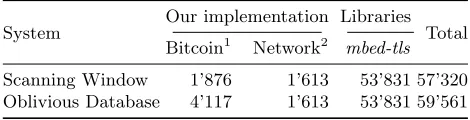
Table 1: Trusted Computing Base in LOC. System
Our implementation Libraries Total Bitcoin1 Network2 mbed-tls
Scanning Window 1’876 1’613 53’831 57’320 Oblivious Database 4’117 1’613 53’831 59’561
1Processing the Bitcoin blockchain. 2
Parsing responses from the client over TLS.
6.1 Implementation Details
The centerpiece of the Scanning Window and Oblivious Database system vari-ants is an original blockchain parser. For TLS connections we use the mbed-tls library from ARM [40]. A comparison between the two systems in terms of Trusted Computing Base is shown in Table 1. We differentiate between the code that is used for communication (Networkin Table 1) and the code for processing the blockchain (Bitcoin in Table 1).
Scanning Window. The implementation of Scanning Window is very small (around 3.5k lines of code withoutmbed-tls) since it only involves scanning the blockchain and does not have to keep state. The network code including the mbed-tls library contributes the most to the TCB with over 96%. In order to keep the scanning time per block constant for all requests, the enclave does the same work for matching and non-matching transactions.
The message size per block is calculated to allow for around 5 transactions per block. We believe that this is a reasonable choice that satisfies common usage patterns for lightweight client users. Fornincluded andN total transactions in the block, an upper bound for the Merkle path size isn∗log(N) and each entry in the Merkle path is 32 bytes long. This results in an approximate upper bound of 2.2kB for N = 4000, the current limit in Bitcoin. As of today (March 2018) the average transaction size is around 500 bytes, therefore, a message size per block of 5kB is enough to fit around 5 transactions (5∗500B + 2200B<5kB). If more or larger transactions are found, following from Section 4, the enclave scans more blocks of the blockchain until the message size is big enough.
Oblivious Database. The implementation of Oblivious Database is more complex than Scanning Window and contains around 5.7k lines of code without mbed-tls. Contrary to the Scanning Window variant, the enclave has to keep state and store a large UTXO set on disk. At the time of writing, the size of the UTXO set (indexed by Bitcoin address) is around 4GB. The bucket size for ORAM is set toZ = 4 so one bucket contains 4 chunks.
0 1 2 3 4 5 6 7 8 9 10 11 12 13 14 15 Number of Unspent Outputs
0% 25% 50% 75% 100%
P
ercen
t
of
all
Addresses
95% 98%
86.3%
5.7%
2.2% 1.2% 0.7%
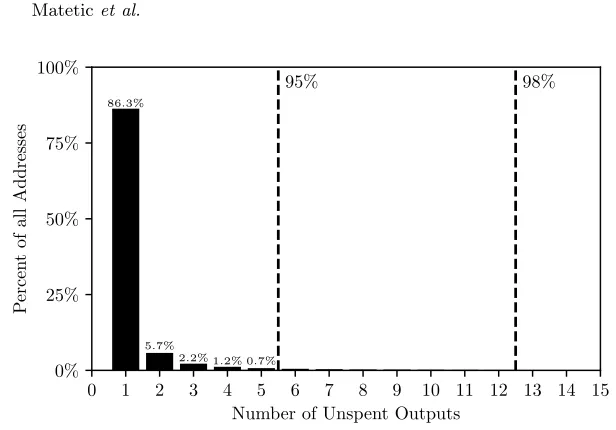
Fig. 6: Distribution of the number of unspent transaction outputs per active address in the Bitcoin network.
outputs, the outputs are stored in multiple chunks. Assuming an average output size of 100B, one ORAM read can return up to 320 outputs for one address. The outputs are grouped by the receiving address and then ordered alphabetically. This is necessary in order to keep the size of the index small enough to fit in the enclaves memory. In the worst case we store the lower and upper limits for addresses (20B) and transaction hashes (32B) for every ORAM block resulting in a maximum of 218∗(32B∗2 + 20B∗2)≈26MB.
To set the message size, we analyzed the typical unspent outputs per active address in the Bitcoin network (Figure 6) and settled on 12 average outputs per request, resulting in around 1.2kB. This size is big enough to accommodate for more than 98% of all Bitcoin addresses currently in use.
We plan to release the code of our implementation online.
6.2 Performance Results and Comparison
In this section, we evaluate both variants of Biteand compare them to current SPV protocols. Note that in all our data points, the TLS handshake times are omitted. Matetic et al. [41] report around 100ms for a new handshake and<10ms for TLS session resumption using mbed-tls in SGX. We do not evaluate the performance of a client since the client-side storage and network overhead are insignificant.
0 50 100 150 200 250 300 Number of Blocks
0s 1s 2s 3s 4s 5s 6s
Time
FPR0.1% FPR0.5% FPR5%
BITE Scanning Window Current SPV (Bloom Filter) BITE Oblivious Database
(a) Server time comparison between Scanning Window, Oblivious Database and current SPV protocols using bloom filters. Note that the connection speed is assumed to be infinite.
0 50 100 150 200 250 300
Number of Blocks 0MB
2.5MB 5MB 7.5MB 10MB 12.5MB 15MB 17.5MB 20MB
T
otal
T
ransmitted
Bytes
FPR 0.1% FPR 0.5%
FPR 5%
BITE Oblivious Database BITE Sanning Window
(b) Bandwidth comparison between Scanning Window, Oblivious Database and current SPV protocols using bloom filters.
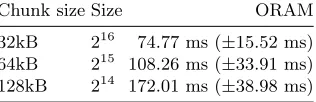
Table 2: ORAM access times for various chunk sizes and the corresponding size (number of entries) needed to store the entire UTXO set. Time measurement averaged over 1000 runs.
Chunk size Size ORAM
32kB 216 74.77 ms (±15.52 ms) 64kB 215 108.26 ms (±33.91 ms) 128kB 214 172.01 ms (±38.98 ms)
Table 3: Processing time per block with oblivious execution for Scanning Window depending on the number of requested blocks and the temporary size, averaged over 100 blocks.
tm
5kB 10kB 20kB
Nr
of
Blo
cks
50 0.6s (±0.2s) 1.2s (±0.5s) 2.6s (±0.9s) 100 0.7s (±0.2s) 1.3s (±0.5s) 2.7s (±0.9s) 150 0.7s (±0.2s) 1.4s (±0.5s) 2.7s (±0.9s) 200 0.7s (±0.2s) 1.4s (±0.5s) 2.8s (±0.9s) 250 0.7s (±0.2s) 1.4s (±0.5s) 2.9s (±0.9s) 300 0.7s (±0.2s) 1.5s (±0.5s) 3.0s (±0.9s)
Scanning Window. In the Scanning Window variant, our approach is sim-ilar to the original SPV procedure. Both systems let the client request filtered blocks which results in scanning the blockchain. Previous work show that Intel SGX imposes significant overhead for copying buffers (reading files) across the trust boundaries [32].
Figure 7a shows the time needed to filter blocks by Scanning Window and current SPV protocols. We report an overhead of around 100% (in total the time is 5.3s) in comparison to Bloom filters with a false prositive rate of 0.1% (2.65s) to 0.5% (2.7s). Note that the measurements in Figure 7a do not account for the network speed. A device with a decent 4G connection that operates at 100Mbit/s requires additionally around 5s to retrieve 300 blocks with the current SPV protocol and a 0.1% false positive rate. For even higher false positive rates, i.e., 0.5% (the default value ofBitcoinJ), an SPV client synchronizes in additionally around 8s. Our systems are not significantly impacted by the limited bandwidth of 4G. The synchronizing time for Scanning Window rises by 0.1s to around 5.4s (and Oblivious Database stays constant at 0.5s). Our systems can reduce the required bandwidth because no false positives have to be included to fool the attacker.
Table 4: Update time for the ORAM of Oblivious Database solution averaged over 100 measurements.
Blocks ORAM update time
1 78.5s (±13.6s) 3 112.5s (±19.8s) 6 146.7s (±19.8s)
Scanning Window with side-channel protection.Oblivious execution and memory access adds a significant overhead to Scanning Window. All branches have to be taken and all in-memory structures have to be touched in their en-tirety to hide access patterns. The merkle tree has to be recomputed for every block aswell but since generating a merkle tree for the average bitcoin block takes 6.5ms this does not contribute significantly to the runtime of the side-channel free Scanning Window.
Table 3 shows the time per block for various number of blocks requested and tm size. Highertm allows to cope with some blocks that have a lot of relevant transactions while others do not, since it limits the amount of transactions of a single block that can be included in a response. Note that the blocks vary in size, and thus the time per block fluctuates a lot leading to a high standard deviation. Synchronizing 300 blocks withtm= 10kB takes around 7.3 minutes corresponding to an overhead of approximately 100x.
7
Discussion
Usage models and long-term privacy. Lightweight clients can useBitein different ways and the chosen usage model can have implications on the clients’ long-term privacy.
For example, in what we consider non-recommended usage, the client (i) performs payment verification requests only when the payment appears in the ledger, (ii) always uses the same full node for verification, and (iii) only uses a single or few Bitcoin address. If all of the above conditions are met, although the adversary controlling the full node does not learn the client’s address from a single verification request, he might be able tocorrelate the timing of the verifi-cation request events and the Bitcoin addresses visible in the ledger at roughly at the same time, and thus construct a set of candidate addresses that may belong to the served client. We acknowledge that our solution cannot eliminate this type of correlation completely. However, we stress that such correlation would require long-term tracking of verification requests from the adversary and that the same limitation applies to any lightweight client payment verification scheme.
Inrecommended usage of our solution, the client (i) uses different full nodes for payment verification, (ii) regularly uses fresh Bitcoin addresses (e.g., using an HD wallet [43]), and (iii) introduces unpredictability to the timing pattern of payment verification requests like a small number of extra requests at random points in time. If the client follows such a usage model, the above mentioned correlation becomes very difficult.4
Large responses. Some client requests might result in a larger response than our defined threshold for message size. As our performance analysis shows, the number of these requests is almost negligible and represents truly a minority of the complete set of transactions in the blockchain. However, our mechanism still allows these types of request with the distinctive factor that the client would have to request them in batches. For example, if a client in the Scanning Window variant requests transactions for 10 of his addresses from the last 300 blocks using the full-side-channel protection, there might be more transactional data then the 300∗t kB message size. In this case, the enclave sets a flag indicating there is more information to be delivered. After receiving the response, the client can repeat the request with the defined flag and receive the rest of the information. The protocol operates in the same way, thus no distinction between these two requests can be observed by the attacker. However, the attacker can see that the request is repeated and infer that the specific client has more transactions of interest in the designated blocks. To mitigate this problem one could obfuscate the IP address or change to another enclave for finishing the request.
4
Deployment models. We consider two deployment models. In the first model, a verifiable company can run our solution as a service offering lightweight clients privacy. In the second model, any full node operator, or a volunteer, can operate our solution. In both deployment models we presume that multiple, or even all nodes, will support this solution. and the scalability depends on that number. One single node can only support around 10000 lightweight clients, and the overall success depends on the supply, demand and acceptance of such ser-vice. Such different deployments can enable different authentication models. In the first option, the company could use a PKI which would allow the lightweight clients to recognize which specific enclave they are communicating with. In the second option the clients only know that they are connecting to a correctly attested enclave, but they cannot make distinction between different enclaves. Since successful attestation guarantees expected enclave execution, our solution’s privacy properties hold in both cases, unless Intel SGX is broken. We discuss SGX compromise in Section 5.
Denial of service.A malicious user might attempt denial of service (DoS) by asking for a very long scan window — incurring large processing times for full nodes and thus making the service momentarily unavailable for other clients. DoS (and spam) are common in systems where there is no significant cost in-volved (e.g., sending 1M emails is practically free) and hard to prevent when introduction of fees is hard. In our setting, one could easily remedy such denial of service attacks by applying fees based on the nature of the request. Large bal-ance updates for lightweight clients would incur higher costs than just frequent updates, thus limiting the attacker from performing ”free” DoS attacks.
Unbounded enclave memory.The performance of our system is mostly bounded by the slower disk operations. However, in case that future versions of SGX architecture would allow more enclave memory (i.e., currently the limit is 128MB without the expensive page swapping) ranging up to the RAM limit on the residing platform, one could keep the UTXO database and all other security critical data in the memory and not on the disk, similar to recently proposed SGX-based in-memory database systems like EnclaveDB [44].
8
Related Work
In this section, we review related work that can be classified into two main categories: Bitcoin lightweight client privacy and SGX information leakage pro-tection.
8.1 Bitcoin Lightweight Client Privacy
information leaked by the use of Bloom filters in Bitcoin poses a serious privacy risk and can in many cases enable the identification of client addresses [14]. Hearn – who introduced Bloom filters to Bitcoin – later addressed the issues [28], expanded on them, and discussed the difficulties of solving them.
To overcome this privacy issue, Osuntokun et al. recently proposed modifi-cations to Bitcoin nodes and lightweight clients that move the application of the filter to the client [45]. In their protocol, full nodes create a filter (with a low false positive rate) for the set of all transactions in a block. A lightweight client then fetches the filter from one or more full nodes and can then check whether the block contains transactions that she is interested in. If that is the case, the client will request the full block from any node.
While this approach likely provides more privacy than the protocol using Bloom filters, it still suffers from a number of shortcomings. First, the gained privacy largely depends on the client behavior and how well the client is con-nected to different entities. If the client does not request the filter headers from multiple entities5 and uses another entity to then request the blocks, she can be easily tricked into revealing her addresses by using forged filters as follows: A node can prepare a filter that matches half of all addresses and send it to the client. If the client requests the block, at least one of her addresses lies within that set, otherwise all of her addresses lie in the other half. The node can then continue reducing the possible set using a binary search approach by sending modified filters for the following blocks, which allows bitwise recovery of all client addresses. Second, depending on how often a transaction is of interest to the client, she might end up downloading the full blockchain after all. Since the client always either requests the full block or nothing at all, she will download almost every block if a large fraction of blocks contain at least one transaction that is of interest.
Other research on Bitcoin privacy shows that using different heuristics, large parts of the Bitcoin transaction graph can be deanonymized [29,30]. These tech-niques are, however, orthogonal to the problem of lightweight client privacy and thus out of scope for our work.
8.2 SGX Leakage Protection
During the last few years, the research community has studied information leak-age from SGX enclaves extensively and proposed a number of defenses. In this section we explain why none of the existing systems solves our problem directly and which prior systems use similar protective primitives as our solution.
The previous work that is probably closest to our solution is a system called Raccoon [23] that addresses both internal and external information leakage for both code and data accesses. For control-flow obfuscation, Raccoon uses taint analysis to determine execution paths that should be hidden and transforms enclave code such that it executes extraneous decoy paths to hide the enclave’s
5
actual control flow. The basic building block for such control-flow obfuscation is the cmov instruction that we use as well. Raccoon also uses Path ORAM to hide external secret-dependent data accesses and “streaming” over data struc-tures (i.e., accessing every element) in the internal enclave memory. The main difference between Raccoon and our solution is that by tailoring our implemen-tation, we avoid the need for taint analysis and extra decoy paths enabling a more efficient solution.
Other related systems include Cloak [24] that prevents cache leakage us-ing hardware-based transactional memory features in processors; ZeroTrace [25] that provides a library for data structures that are protected using ORAM; DR.SGX [26] that randomizes and periodically re-randomizes all data locations in enclave’s memory with cache-line granularity; and, T-SGX [46] and Deja Vu [47] that detect and prevent side-channel attacks based on repeated inter-rupts. The main limitation of Cloak is that it requires hardware features that are not available on all SGX CPUs and it only protection cache-based leakage. ZeroTrace is limited to data access protection and it does not prevent leakage from secret-dependent control flow. DR.SGX is also limited to data accesses and imposes high performance overhead when configured to prevent all leakage. T-SGX and Deja Vu are limited to attacks that perform repeated interrupts (subset of known attacks).
Recently published Oblix [48] presents a new ORAM algorithm that is de-signed specifically for SGX. We use well-known Path ORAM, but our solution is agnostic to the used ORAM algorithm and we could easily replace Path ORAM with another algorithm.
9
Conclusion
References
1. Ethereum, 2018.
2. Elli Androulaki, Artem Barger, and et. al. Hyperledger Fabric: A Distributed Op-erating System for Permissioned Blockchains. arXiv preprint arXiv:1801.10228v1, 2018.
3. Ripple, 2018. 4. R3, 2018.
5. Blockchain.info, 2018. 6. Etherscan.io, 2018. 7. BitcoinJ, 2018. 8. PicoCoin, 2018. 9. Electrum, 2018.
10. Satoshi Nakamoto. Bitcoin: A peer-to-peer electronic cash system, 2008.
11. Mike Hearn and Matt Corallo. Connection bloom filtering. Bitcoin Improvement Proposal, 2012.
12. Light Ethereum Subprotocol (LES), 2018.
13. Burton H Bloom. Space/time trade-offs in hash coding with allowable errors. Communications of the ACM, 1970.
14. Arthur Gervais, Srdjan Capkun, Ghassan O Karame, and Damian Gruber. On the privacy provisions of bloom filters in lightweight bitcoin clients. InComputer Security Applications Conference. ACM, 2014.
15. Victor Costan and Srinivas Devadas. Intel SGX explained. InCryptology ePrint Archive, 2016.
16. Ferdinand Brasser, Urs M¨uller, Alexandra Dmitrienko, Kari Kostiainen, Srdjan Capkun, and Ahmad-Reza Sadeghi. Software Grand Exposure: SGX Cache Attacks Are Practical. InWOOT. USENIX, 2017.
17. Ahmad Moghimi, Gorka Irazoqui, and Thomas Eisenbarth. Cachezoom: How sgx amplifies the power of cache attacks. In Cryptographic Hardware and Embedded Systems. Springer, 2017.
18. Johannes G¨otzfried, Moritz Eckert, Sebastian Schinzel, and Tilo M¨uller. Cache attacks on intel sgx. InEuropean Workshop on Systems Security. ACM, 2017. 19. Michael Schwarz, Samuel Weiser, Daniel Gruss, Cl´ementine Maurice, and Stefan
Mangard. Malware Guard Extension: Using SGX to Conceal Cache Attacks, 2017. http://arxiv.org/abs/1702.08719.
20. Yuanzhong Xu, Weidong Cui, and Marcus Peinado. Controlled-channel attacks: Deterministic side channels for untrusted operating systems. InSP. IEEE, 2015. 21. Emil Stefanov, Marten Van Dijk, Elaine Shi, Christopher Fletcher, Ling Ren,
Xi-angyao Yu, and Srinivas Devadas. Path oram: an extremely simple oblivious ram protocol. InCCS. ACM, 2013.
22. OpCodes: CMOV, 2018.
23. Ashay Rane, Calvin Lin, and Mohit Tiwari. Raccoon: Closing digital side-channels through obfuscated execution. InUSENIX Security, 2015.
24. Daniel Gruss, Julian Lettner, Felix Schuster, Olya Ohrimenko, Istvan Haller, and Manuel Costa. Strong and Efficient Cache Side-Channel Protection using Hardware Transactional Memory. InUSENIX Security, 2017.
25. Sajin Sasy, Sergey Gorbunov, and Christopher Fletcher. Zerotrace: Oblivious mem-ory primitives from intel sgx. InNDSS, 2017.
27. Sangho Lee, Ming-Wei Shih, Prasun Gera, Taesoo Kim, Hyesoon Kim, and Mar-cus Peinado. Inferring fine-grained control flow inside sgx enclaves with branch shadowing. InUSENIX Security, 2017.
28. Mike Hearn. Bloom filter privacy and thoughts on a newer protocol, 2015. 29. Elli Androulaki, Ghassan O Karame, Marc Roeschlin, Tobias Scherer, and Srdjan
Capkun. Evaluating user privacy in bitcoin. InFinancial Cryptography and Data Security. Springer, 2013.
30. Sarah Meiklejohn, Marjori Pomarole, Grant Jordan, Kirill Levchenko, Damon Mc-Coy, Geoffrey M Voelker, and Stefan Savage. A fistful of bitcoins: characterizing payments among men with no names. InInternet Measurement Conference. ACM, 2013.
31. Intel. Intel Software Guard Extensions - Developer Zone. Website, 2017.
32. Sergei Arnautov, Bohdan Trach, Franz Gregor, Thomas Knauth, Andre Martin, Christian Priebe, Joshua Lind, Divya Muthukumaran, Dan O’Keeffe, Mark Still-well, et al. Scone: Secure linux containers with intel sgx. InOSDI, 2016.
33. Intel. Intel Software Guard Extensions developer guide, 2016.
34. Guoxing Chen, Sanchuan Chen, Yuan Xiao, Yinqian Zhang, Zhiqiang Lin, and Ten H Lai. Sgxpectre attacks: Leaking enclave secrets via speculative execution. arXiv preprint arXiv:1802.09085, 2018.
35. Sinisa Matetic, Mansoor Ahmed, Kari Kostiainen, Aritra Dhar, David Sommer, Arthur Gervais, Ari Juels, and Srdjan Capkun. ROTE: Rollback Protection for Trusted Execution. USENIX Security, 2017.
36. Adil Ahmad, Kyungtae Kim, Muhammad Ihsanulhaq Sarfaraz, and Byoungyoung Lee. OBLIVIATE: A Data Oblivious File System for Intel SGX, 2018.
37. Paul Kocher, Jann Horn, Anders Fogh, , Daniel Genkin, Daniel Gruss, Werner Haas, Mike Hamburg, Moritz Lipp, Stefan Mangard, Thomas Prescher, Michael Schwarz, and Yuval Yarom. Spectre attacks: Exploiting speculative execution. In 40th IEEE Symposium on Security and Privacy (S&P’19), 2019.
38. Moritz Lipp, Michael Schwarz, Daniel Gruss, Thomas Prescher, Werner Haas, Anders Fogh, Jann Horn, Stefan Mangard, Paul Kocher, Daniel Genkin, Yuval Yarom, and Mike Hamburg. Meltdown: Reading kernel memory from user space. InUSENIX Security, 2018.
39. Guoxing Chen, Sanchuan Chen, Yuan Xiao, Yinqian Zhang, Zhiqiang Lin, and Ten H. Lai. Sgxpectre attacks: Leaking enclave secrets via speculative execution. CoRR, abs/1802.09085, 2018.
40. ARM Limited. mbedTLS (formerly known as PolarSSL), 2015.
41. Sinisa Matetic, Moritz Schneider, Andrew Miller, Ari Juels, and Srdjan Capkun. DELEGATEE: Brokered Delegation Using Trusted Execution Environments. In USENIX Security, 2018.
42. Peter Todd. python-bitcoinlib, 2018.
43. Pieter Wuille. Hierarchical deterministic wallets. Bitcoin Improvement Proposal, 2012.
44. Christian Priebe, Kapil Vaswani, and Manuel Costa. Enclavedb: A secure database using sgx. InSP. IEEE, 2018.
45. Olaoluwa Osuntokun, Alex Akselrod, and Jim Posen. Client side block filtering. Bitcoin Improvement Proposal, 2017.
46. Ming-Wei Shih, Sangho Lee, Taesoo Kim, and Marcus Peinado. T-SGX: Eradicat-ing controlled-channel attacks against enclave programs. InNDSS, 2017.
48. Pratyush Mishra, Rishabh Poddar, Jerry Chen, Alessandro Chiesa, and Raluca Ada Popa. Oblix: An efficient oblivious search index. InSP. IEEE, 2018. 49. Rafal Wojtczuk and Joanna Rutkowska. Attacking SMM memory via Intel CPU
cache poisoning. Invisible Things Lab, 2009.
50. Bernhard Kauer. OSLO: Improving the Security of Trusted Computing. In USENIX Security, 2007.
51. J Alex Halderman, Seth D Schoen, Nadia Heninger, William Clarkson, William Paul, Joseph A Calandrino, Ariel J Feldman, Jacob Appelbaum, and Edward W Felten. Lest we remember: Cold-boot Attacks on Encryption Keys. Communica-tions of the ACM, 2009.
52. Intel SGX, Ref. No.: 332680-002, 2015.