119
EVALUATION OF THE GENETIC DIVERSITY OF ALLIUM
ASCALONICUM LANDRACES BASED ON MOLECULAR MARKERS
POPESCU SORINA*, CIULCA SORIN, SUMALAN RADU, BOTAU DORICA, BOLDURA OANA- MARIA
Banat's University of Agricultural Sciences and Veterinary Medicine “King Michael I of Romania” from Timișoara * Email: [email protected]
Keywords: Allium ascalonicum, molecular diversity, ISSR markers
ABSTRACT
The aim of the research was to identify Allium ascalonicum land races with a good yield due to their morphological traits, with good adaptation capacity, with different genetic background, as a first step in identification of a suitable source for the production of secondary metabolites. Therefore 16 shallot landraces collected from different areas of Timis county were evaluated from phenotypic and molecular point of view. Thus the height, diameter, weight and bulb shape index were determined. For genetic fingerprint 8 ISSR (Inter Simple Sequence Repeats) markers were used. The extracted DNA was amplified with the specific primers, the fragments were separated by agarose gel electrophoresis and analyzed with the VisionWorks®LS, (UVP, England) software. 178 amplified fragments were
registered, with an average of 22.25/primer, of which 174 were polymorphic (97.75% polymorphism). The matrix of similarity and the dendrogram were established based on UPGMA (Unweighted Pair Group Method
with Arithmetic Mean) analysis. A considerable genetic diversity between landraces with different ecologic origin was observed, indicating that they have different genetic mechanisms for the yield traits and adaptation to the specific environmental conditions of the area. All the obtained results allowed the identification of local land races with a high production capacity which had different genetic background (Dolat 126a, Sanmartinu S. and Rudna 101.) Therefore the posibility to recognize genotypes with distinct secondary metabolites content it was increased.
INTRODUCTION
The Allium genus contains hundreds of species with the largest spread in the temperate climate which has traditionally been used as food but can also have therapeutic applications. They have an antioxidant activity due to the sulphur compounds and other bioactive metabolites as polyphenols and phytosterols (Nencini et. Al. 2007; Vlase et al. 2012). Many of these species among which Allium ascalonicum (shallot) have shown antifungal and antibacterial properties (Yin and Tsao, 1999: Amin and Kapadnis, 2005; Mohammadi-Motlagh et al. 2011).
Our previous researches focused on collection and characterization of horticultural land races, traditionally cultivated in isolated villages from the West part of Romania showed that shallot have been found in a large number of households.
120
areas, as well as their own production capacity and quality attributes (Murariu et al., 2008).
Therefore, as a first step in identification of a suitable source for the production of secondary metabolites it was of great interest to identify Allium ascalonicum land races with a good yield due to their morphological traits, with good adaptation capacity, which has different genetic background.
To evaluate the genetic fingerprint, ISSR (Inter Simple sequence Repeats) markers were used because they amplify more regions from the genomes generating a different number of fragments. The primers specific for ISSR are generally 16-25 nucleotide lengths with multiple loci as target regions, especially located in the microsatellite sequences (Zietkiewicz et al., 1994). The microsatellite-type repeats used as primers may be di, tri, tetra or
penta-nucleotides, most often anchored at the 3 'or 5' end with 1 - 4 bases prolonged in the regions flanking the microsatellite region (Reddy et al., 2002)..
Although the ISSR generally behaves as dominant markers, which is a disadvantage, they have a widespread use in genetic mapping and population genetics studies because they require small amounts of DNA considering they are based on the PCR reaction and do not require prior sequencing studies, just like SSR (Single Sequence Repeats) markers. These markers have provided reliable results in the evaluation of the genetic diversity for horticultural plants such as potato (Prevost et al., 1999), chestnut (Casasoli et al., 2001), mulberry (Vijayan et al., 2003), clematis (Gardner and Hokanson, 2005), strawberry (Debnath et al., 2008), bilberry (Botau et. al., 2014) or even onion (Son et al., 2012).
MATERIALS AND METHODS
For phenotipical and molecular analysis 16 Allium ascalonicum land races were used, encoded according to their collection place: Dolaț 126 a (white), Dolaț 126 r (red), Dolaț 198, Dolaț 244, Dudestii Vechi 10, Foeni 343, Giera 06, Livezile 498, Rudna 101, Rudna 124, Rudna 304, Toager, Toager 207, Toager 29, Uivar 305 and Uivar 30c.
Working methods
For phenotipically analysis the height, diameter, weight and bulb shape index were determine, the obtained data being statistically evaluated.
For molecular analysis 8 ISSR (Inter Simple Sequence Repeats) markers were used.
First, the DNA was extracted from shallot bulbs based on modified Doyle and Doyle method (Doyle and Doyle, 1987). It was necessary to supplement the extraction solution with 2-mercaptoethanol to break down the proteins disulfide bonds.
Each DNA samples were
spectophotometrically analyzed at 230, 260 and 280 nm, to determine the concentration and quality (Nanodrop 8000, Thermoscientific). If the concentrations were high, they were all diluted to 100ng/μl.
For amplification, in the first step a bulk of the extracted and diluted DNA samples was amplified with 20 ISSR primers and the ones which generated the most clear and discernable fingerprints were selected, namely UBC 807 - 5’(AG)8T3’; UBC 834 - 5’(AG)8YT3’;
UBC 836- 5’(AG)8YA 3’, UBC 810 – 5’ (GA)8T 3’. UBC 811- 5’(GA)8C 3’, A 12 –
5’
(GA)6CC3’; UBC 818- 5’(CA)7G 3’; A 13- 5’
121
All of the selected primers were used in series to amplify each DNA samples. PCR was carried out in a final volume of 25 μl containing 100 ng of DNA template, using GoTaq Green Master Mix (Promega, USA);
The amplification program consisted of a first denaturing step for 5 min at 95°C, followed by 45 cycles of denaturation at 95°C for 45 sec, annealing at 55°C for 45 sec and extension at 72°C for 2 min, the final step of extension at 72°C for 5 min, according to literature data.
The amplified fragments were separated by 1.5 agarose gel electrophoresis and analyzed with the VisionWorks®LS, (UVP, England) software. Then, they were aligned for all the individuals according to their size and scored with 1 for presence and 0 for absence. The dendrogram was assessed from a set of variables using DendroUPGMA software. The program calculated a similarity matrix and transformed similarity coefficients into distances and made a clustering using the Unweighted Pair Group Method with Arithmetic mean (UPGMA) algorithm.
RESULTS AND DISCUSSIONS
The shallot samples were collected from the already mentioned locations. From each one a number of at least 10
bulbs were evaluated by measuring the height, diameter, weight and shape index (Table 1).
Table 1
The average values for the bulb traits for shallot land races
No. Land race code Height (cm) Diameter (cm) Weight (g) Shape index
1 Dolat 126a 5,45+0,15 6,90+0,10 88,76+2,58 0,79+0,01
2 Dolat 126r 6,00+0,46 4,27+0,07 49,71+4,05 1,41+0,11ab
3 Dolat 198 3,50+0,29 3,60+0,10 25,11+4,80 0,97+0,06
4 Dolat 244 3,93+0,18 4,17+0,23 36,15+3,64 0,95+0,08
5 Foieni 343 4,70+0,15 3,57+0,03 42,56+3,51 1,32+0,06
6 Giera 6 5,70+0,65 3,67+0,03 53,51+5,83 1,55+0,17
7 Livezile 498 4,47+0,07 3,87+0,13 40,96+1,71 1,16+0,04
8 Rudna 101 6,50+0,40 3,85+0,15 81,43+5,58 1,69+0,17
9 Rudna 124 5,13+0,23 4,20+0,15 53,89+2,29 1,23+0,09
10 Rudna 304 4,50+0,17 3,40+0,10 40,67+0,80 1,33+0,09
11 Sanmartinu S. 180 5,90+0,10 4,45+0,15 82,47+4,72 1,33+0,07
12 Uivar 305 5,40+0,40 4,00+0,50 52,25+3,23 1,36+0,07
13 Uivar 306 4,40+0,10 3,75+0,25 39,85+2,73 1,18+0,11
14 Toager 1 3,67+0,17 3,43+0,07 24,18+2,99 1,07+0,04
15 Toager 29 4,97+0,27 3,87+0,13 50,79+5,89b 1,28+0,05
16 Toager 207 3,97+0,15 3,73+0,13 29,98+3,65 1,06+0,02
Referring to the diameter of the bulbs, the studied land races showed variation amplitude of 3.50 cm associated with a medium to large inter-genotypes variability (20.23%), with the limits between 3.40 cm for Rudna 304 and 6.90
122
variability, with values ranging from 3.50 for Dolat 198 population and 6.50 for Rudna 101. Thus, the Rudna 101 population showed a significantly higher bulb height than most other populations except for the following: Dolat 126a, Dolat 126r, Giera 6, Rudna 124, Sanmartin S. 108 and Uivar 305. Low values of this trait were recorded for populations: Dolat 198, Dolat 244, Toager 1 and Toager 207.
In terms of bulb weights, the studied populations showed a very high variability (39.64%), associated with amplitude of 64.58 g. The Dolat 126a population had the highest value of bulb weight, statistically assured compared with the other populations. A large bulb weight was also observed for the populations: Sanmartinu S. 108 and Rudna 101, with average values of this trait over 80 g. The lowest values of bulb weight were recorded in the populations: Toager 1, Dolat 198 and Toager 207, with values up to 30 g.
Considering the phenotypic similarity of the 16 shallots populations, their dendrogram was established by the cluster average (groups) method. It was composed of two main clusters, one represented only by the Dolat 126a population, which showed an average phenotypic diversity of about 42% relative to other populations. The second cluster comprised three subclusters: the first one composed from nine populations with an average similarity of approx. 96% compared to the other seven populations, comprising subgroups of populations with higher values (Dolat 1262, Giera 6, Rudna 124, Toager 29 and Uivar 305) or lower (Foieni 343, Rudna 304, Livezile 498 and Uivar 306); the second subcluster consists of small flattened bulbs populations (Dolat 198, Dolat 244, Toager 1 and Toager 207) with a similarity of approximately 96.5%; the third subclass includes the Rudna 101 and Sanmartin S populations, with large
bulbs, with an average similarity of approximately 93%.
It was pointed out that there was no precise correlation between the morphological traits and the collection place, but it was possible to identify the land races with the higher productivity, namely Dolat 126a, Sanmartinu S. and Rudna 101. Considering that the purpose of the research was to identify local populations with high productivity, but not very genetically close, the next step was the genetically fingerprint based on ISSR markers.
For each collected sample the genomic DNA was extracted and the quality and concentration were determined spectophotometrically. All samples had an OD 260/280 ratio around the 1.8-1.9 range, therefore they were considered to be of adequate quality. Their concentration was very high, therefore all were diluted to 100 ng / μl.
To select the ISSR markers which generate clear, detectable fingerprint 20 primers were used. The primers generating the best results, namely UBC807, UBC834, UBC836, UBC810, UBC811, UBC 818, A 12, A 13, were used in amplification reactions with all of DNA samples. To illustrate these investigations the results obtained after the amplification with UBC 810 and A 13 primers was shown (Fig. 1). Similar images were obtained for all of the other six primers.
The visualized fragments for each genotype were analyzed, recorded in order of dimensions: loci 1-19- primer UBC 807, loci 1-28 primer UBC 810, loci 1-32 primer UBC 811, loci 1-34 primer UBC 834 loci 1- 25- primer UBC 836 loci 1-19- primer A12 loci 1-22- primer A 13, loci 1-20- primer UBC 818.
123
Fig. 1. Analysis by 1.5% agarose gel electrophoresis of the products resulting from amplification with the
primer UBC 810 (GA)8T [a] and A13 (GT)6CC [B]
1-Dolaț 126 a (white), 2- Dolaț 126 r (red), 3-Dolaț 198, 4-Dolaț 244, 5-Sanmartinu S., 6-Foeni 343, 7-Giera 06, 8-Livezile 498, 9-Rudna 101, 10-Rudna 124, 11-Rudna 304,
12-Toager, 13-Toager 207, 14-Toager 29, 15-Uivar 305 and 16-Uivar 30c.,
17- 100bp DNA ladder (ThermoFisfer Scientific)
Considering all the eight ISSR markers used in this study, a number of 178 fragments were amplified, with an average of 22.25 alleles/primer, most of them being different, with a rate of 97.75% polymorphism.
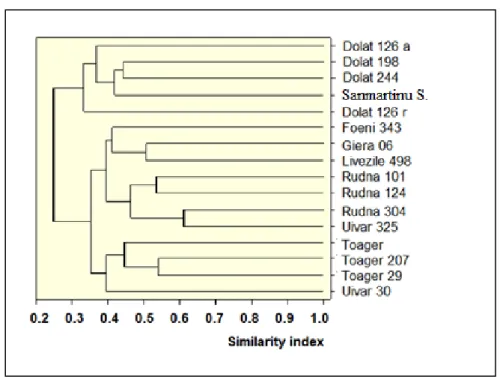
The statistically evaluation based on Unweighted Pair Group Method with Arithmetic mean (UPGMA) algorithm established the similarity matrix and dendrogram (Fig. 2).
A
124
Fig. 2 The dendrogram of the shallot landraces based on the average clusters method for the ISSR markers
Therefore, the largest genetic diversity was observed between land races: Dolat 126r - Uivar 305 (83.05%); Dolat 244 - Toager 29 (81.63%); Dolat 126r - Toager 207 (80.34%), emphasising that these genotypes have a very different genetic background. The highest level of similarity (61.11%) was found among the populations of Rudna 304 and Uivar 305, followed by 54.05% between Toager 29 and Toager 207 populations.
Considering the previous classification it was observed that Rudna 304 showed the highest average diversity (approximately 61.30%) compared to the rest of the land races, followed by Rudna 101 (36.59%) and Toager 207 (35.23%). The respective populations are grouped into two clusters with an allelic diversity of about 25% between them.
The first cluster included four Dolat populations together with the Sanmartinu S., which owned approximately 35% common alleles for these primers. The second cluster is composed of two sets of populations, with a genetically diversity of about 65%. The first set is more comprehensive and consists
of three populations of Rudna, along with those of Foieni, Giera Livezile and Giera, which are genetically similar to about 40%. In the second set are included three populations of Toager alongside Uivar.
A considerable genetic diversity between landraces with different ecologic origin was observed, indicating that they have different genetic mechanisms for the yield traits and adaptation to the specific environmental conditions of the area.
125
Table 2
Variance analysis for the shallots land races in terms of ISSR fragments
No. Land race name Between groups Inside the groups F test
SP GL SP GL
1 Dolat126 a 1,861 1 39,920 176 8,20**
2 Dolat 126 r 0,048 1 44,250 176 0,19
3 Dolat 198 0,209 1 41,055 176 0,90
4 Dolat 244 0,164 1 39,280 176 0,73
5 Dudestii Vechi 10 2,454 1 34,355 176 12,57**
6 Foeni 343 10,938 1 26,680 176 72,16**
7 Giera 06 7,001 1 33,095 176 37,23**
8 Livezile 498 14,541 1 25,555 176 100,15**
9 Rudna 101 17,587 1 22,189 176 139,50**
10 Rudna 124 10,631 1 27,375 176 68,35**
11 Rudna 304 20,073 1 20,022 176 176,45**
12 Toager 9,318 1 31,385 176 52,25**
13 Toager 207 16,005 1 22,742 176 123,86**
14 Toager 29 10,028 1 28,719 176 61,46**
15 Uivar 305 12,917 1 25,089 176 90,61**
16 Uivar 30c 7,362 1 31,020 176 41,77**
All the obtained results allowed the identification of local land races with a high production capacity which had different genetic background (Dolat 126a,
Sanmartinu S. and Rudna 101.) Therefore the posibility to recognize genotypes with distinct secondary metabolites content it was increased.
CONCLUSIONS
ISSR markers have been found to be suitable for assessing variability in shallot analyzed genotypes. The high number of fragments fall them in the high polymorphic markers category.
The dendrogram allowed the assessment of the degree of inheritance, underlining that, in general, the
geographical neighborhood placed the genotypes in closed subclusters, underlining the common origin.
Based on these results it was possible to select genotypes with different genetic background to be used in future breeding programs.
BIBLIOGRAPHY
1. Amin M., Kapadnis B.P., 2005, Heat stable antimicrobial activity of Allium ascalonicum against bacteria and fungi. Indian J Exp Biol. ;43: 751–754
2. Botău D., Bolda V., Popescu S., Boldura O., 2014, The genetic variability evaluated with molecular markers on the bilberry tissue lines, Scientific Bulletin. Series F. Biotechnologies, Vol. XVIII : 11-14 3. Casasoli M., Mattioni, C.,
Cherubini M. and Villani F., 2001,
A genetic linkage map of European chestnut (Castanea sative Mill.) based on RAPD, ISSR and isozyme markers. Theor. Appl. Genet. 102: 1190-1199
126
5. Doyle J. J., Doyle J. L.. 1987, A rapid DNA isolation procedure for small quantities of fresh leaf tissue. Phytochemical Bulletin 19: 11–15
6. Gardner, N. and Hokanson, S.C., 2005, Intersimple sequence repeat fingerprinting and genetic variation of Clematis cultivars and commercial germplasm. HortScience 40: 1982-1987
7. Mohammadi-Motlagh H-R., Mostafaie A., Mansouri K., 2011, Anticancer and anti-inflammatory activities of shallot (Allium ascalonicum) extract. Arch Med Sci: AMS.;7(1):38–44.
8. Murariu M., Murariu D., Haș V., 2010, Studiul unor populații locale vechi de porumb din Nordul Moldovei și transilvania, N. I.N.C.D.A. Fundulea, Vol.. LXXVIII, NR. 2, Genetica și Ameliorarea Plantelor, pag. 41-53
9. Nencini, C., Cavallo F., Capasso A., Franchi G.G., Giorgio G., Micheli L.,2007, Evaluation of antioxidative properties of Allium species growing wild in Italy. Phytother. 21, 874–878
10. Prevost. A., and Wilkinson, M.J., 1999, A new system of comparing PCR primers applied to ISSR fingerprinting of potato cultivars. Theor. Appl. Genet. 98:107-112
11. Reddy, P. M., Sarla, N. and Siddiq, E. A, 2002, Inter simple sequence repeat (ISSR) polymorphism and its application in plant breeding. Euphytica 128: 9-17
12. Son J.-H., Park K-C., Lee S-I., Kim J-H., Kim N-S., 2012, Species relationships among Allium species by ISSR analysis, Horticulture, Environment, and Biotechnology, Vol. 53, Issue 3: 256–262
13. Vijayan K. and Chatterjee, S. N. 2003. ISSR profiling of Indian cultivars of mulberry (Morus spp.) and its relevance to breeding programs. Euphytica 131:53-63 14. Vlase L, Parvu M., Parvu
E.A., Toiu A., 2012, Chemical constituents of three Allium species from RomaniaMolecules. 18(1):114-27
15. Yin M.C., Tsao S.M., 1999, Inhibitory effect of seven Allium plants upon three Aspergillus Species. Int J Food Microbiol., 49: 49–56.
![Fig. 1. Analysis by 1.5% agarose gel electrophoresis of the products resulting from amplification with the primer UBC 810 (GA) 8 T [a] and A13 (GT) 6 CC [B]](https://thumb-us.123doks.com/thumbv2/123dok_us/8066506.2136500/5.892.89.684.72.804/analysis-agarose-electrophoresis-products-resulting-amplification-primer-ubc.webp)