Enhancing Performance of Data Access by using Cooperative Caching
in Disruption Tolerant Networks
Shaik Khadar Basha1, Mr.P.V.N.N Durga Prasad2 1M.Tech (CSE), Gudlavalleru Engineering College, A.P., India.
2Assistant Professor, Dept. of Computer Science & Engineering, Gudlavalleru Engineering College, A.P., India.
Abstract An interruption tolerant system (DTN) is a system outlined so that transitory or irregular correspondences issues, restrictions and peculiarities have the slightest conceivable antagonistic effect Disruption tolerant systems (DTNs) are described by low hub thickness, flighty hub portability, and absence of worldwide system data. The vast majority of ebb and flow research endeavors in DTNs concentrate on information sending, however just work constrained has been done on giving productive information access to portable clients. In this paper, we propose a novel way to deal with bolster agreeable reserving in DTNs, which empowers the sharing and coordination of stored information among different hubs and decreases information access delay. Our fundamental thought is to purposefully reserve information at an arrangement of system focal areas (NCLs), which can be effectively gotten to by different hubs in the system. We propose an effective plan that guarantees fitting NCL choice taking into account a probabilistic choice metric and directions numerous storing hubs to upgrade the tradeoff between information availability and reserving overhead. Broad follow driven recreations demonstrate that our methodology altogether enhances information access execution contrasted with existing plans.
Keywords — Cooperative caching, disruption tolerant networks, data access, network central locations, cache replacement
I. INTRODUCTION
DTN works utilizing distinctive sort of methodology than TCP/IP for bundle conveyance that is stronger to disturbance than TCP/IP. DTN depends on another trial convention called the Bundle Protocol (RFC 5050). The Bundle Protocol (BP) sits at the application layer of some number of constituent virtual worlds, shaping a store-and-forward overlay system. BP works as an overlay convention that connections together numerous subnets, (for example, Ethernet-based LANs) into a solitary system.Interruption tolerant systems (DTNs) [14] comprise of cell phones that get in touch with one another entrepreneurially. Because of the low hub thickness and flighty hub versatility, just discontinuous system availability exists in DTNs, and the consequent trouble of keeping up end-toend correspondence connections makes it important to utilize "carryand-forward" routines for information transmission. Samples of such systems incorporate gatherings of people moving in a fiasco recuperation zones, military front lines, or urban detecting applications [11]. In such systems, hub portability is misused to let versatile hubs convey information as transfers and
The key issue is, in this way, how to decide the fitting transfer determination procedure. Despite the fact that sending plans have been proposed in
to a focal hub may be included for reserving, and we guarantee that well known information are constantly reserved closer to the focal hubs through element reserve substitution taking into account inquiry history. Our nitty gritty commitments are recorded as tails: We add to an effective way to deal with NCL determination in DTNs in light of a probabilistic choice metric. The chose NCLs accomplish high risks for brief reaction to client inquiries with low overhead in system stockpiling and transmission. We propose an information access plan to probabilistically arrange different storing hubs for reacting to client questions. We moreover streamline the tradeoff between information openness and reserving overhead, to minimize the normal number of stored information duplicates in the system. We propose an utility-based store substitution plan to powerfully conform reserve areas taking into account question history, and our plan accomplishes great tradeoff between the information openness and access delay.
II. PROPOSED APPROACH
A Bloom channel is a space-effective probabilistic information structure, brought about by Burton Howard Bloom in 1970, that is utilized to test whether a component is an individual from a set. False positive matches are conceivable, yet false negatives are not, in this manner a Bloom channel has a 100% review rate. At the end of the day, a question returns either "potentially in set" or "certainly not in set". Components can be added to the set, yet not evacuated (however this can be tended to with an "including" channel). The more components that are added to the set, the bigger the likelihood of false positives. Sprout proposed the strategy for applications where the measure of source information would require an illogically huge measure of memory if "customary" blunder free hashing procedures were connected. He gave the illustration of a hyphenation calculation for a lexicon of 500,000 words, out of which 90% take after straightforward hyphenation rules, yet the staying 10% require costly circle gets to recover particular hyphenation designs. With adequate center memory, a blunder free hash could be utilized to wipe out all pointless circle gets to; then again, with restricted center memory, Bloom's strategy utilizes a littler hash region yet at the same time disposes of most superfluous gets to. For instance, a hash range just 15% of the size required by a perfect blunder free hash still wipes out 85% of the plate gets to, a 85–15 type of the Pareto guideline (Bloom (1970)
An example of a Bloom filter, representing the set { x, y, z }. The colored arrows show the positions in the bit array that each set element is mapped to. The element w is not in the set { x, y, z}, because it hashes to one bit-array position containing 0. For this figure, m = 18 and k = 3.
Bloomier filters
Chazelle et al. (2004) designed a generalization of Bloom filters that could associate a value with each element that had been inserted, implementing an associative array. Like Bloom filters, these structures achieve a small space overhead by accepting a small probability of false positives. In the case of "Bloomier filters", a false positive is defined as returning a result when the key is not in the map. The map will never return the wrong value for a key that is in the map.
III.PROBLEMSTATEMENT
A common technique used to improve data access performance is caching, i.e., to cache data at appropriate network locations based on query history, so that queries in the future can be responded with less delay. Although cooperative caching has been studied for both web-based applications and wireless ad hoc networks to allow sharing and coordination among multiple caching nodes. The average inter-contact time in the network is reduced and enables efficient access on data with shorter lifetime. Ratio of data access is reduced.
IV. LITERATURE SURVEY:
THE AUTHOR, [1]A. Balasubramanian, B. Levine, and A. Venkataramani, " DTN Routing as a Resource Allocation Problem," Proc. ACM SIGCOMM Conf. Applications, Technologies, Architectures, and Protocols for Computer Comm., pp. 373-384, 2007. In this paper, we propose a novel way to deal with bolster agreeable storing in DTNs, which empowers the sharing and coordination of reserved information among various hubs and diminishes information access delay. Our essential thought is to deliberately store information at an arrangement of system focal areas (NCLs), which can be effectively gotten to by different hubs in the system. We propose a proficient plan that guarantees suitable NCL choice in view of a probabilistic choice metric and directions different reserving hubs to advance the tradeoff between information openness and storing overhead. Broad follow driven reproductions demonstrate that our methodology fundamentally enhances information access execution contrasted with existing plans.
V. RELATEDWORK
information sending plans [9], [12], [2]. The previously stated measurements for transfer determination can be connected to different sending systems, which vary in the quantity of information duplicates made in the system. While the most traditionalist methodology [2] dependably keeps a solitary information duplicate and Spray-and-Wait [1] holds a settled number of information duplicates, most plans progressively decide the quantity of information duplicates. In Compare-and-Forward [12], a hand-off advances information to another hub whose metric worth is higher than itself. Assignment sending [13] lessens sending expense by just sending information to hubs with the most astounding metric. Information access in DTNs, then again, can be given in different ways [16]. Information can be scattered to suitable clients in view of their advantage profiles [18]. Distribute/subscribe frameworks [6], [5] were utilized for information scattering, where social group structures are generally misused to decide specialist hubs. In different plans [14], [2] without specialists, information things are gathered into predefined channels, and are spread in view of clients' memberships to these channels. Storing is another approach to give information access. Agreeable storing in remote specially appointed systems was examined in [15], in which every hub reserves go by information in view of information prominence, so that questions later on can be reacted with less postpone. Storing areas are chosen by the way among all the system hubs. Some exploration endeavors [7], [11] have been made for reserving in DTNs, however they just enhance information openness from framework system, for example, WiFi access focuses (APs) [11] or Internet [7]. Distributed information sharing and access among portable clients are for the most part disregarded. Conveyed determination of storing arrangements for minimizing information access postponement has been contemplated in DTNs [9], [13], accepting streamlined system conditions. In [9], it is expected that every one of the hubs get in touch with one another with the same rate. In [3], clients are falsely parceled into a few classes such that clients in the same class are indistinguishable. In [1], information are purposefully reserved at proper system areas with non specific information and inquiry models, yet these storing areas are resolved taking into account worldwide system learning. Similarly, in this paper, we propose to bolster agreeable storing in a completely dispersed way in DTNs, with heterogeneous hub contact examples and practices.
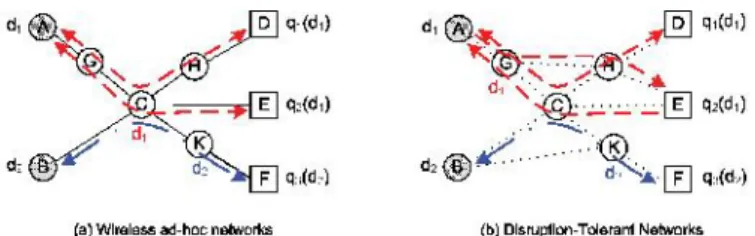
A requester questions the system for information access, and the information source or storing hubs answer to the requester with information in the wake of having gotten the inquiry. The key distinction between reserving systems in remote specially appointed systems and DTNs is outlined in Fig. 1. Note that every hub has constrained space for storing. Something else, information can be stored all over, and it is inconsequential to outline diverse reserving procedures. The configuration of reserving system in remote specially appointed systems profits by the presumption of existing end-toend ways among portable hubs, and the way from a requester to the information source stays unaltered amid information access much of the time. Such supposition empowers any middle hub on the way to reserve the go by information. For instance, in Fig. 1a, C advances all the three
questions to information sources An and B, furthermore advances information d1 and d2 to the requesters. If there should be an occurrence of constrained reserve space, C stores the more mainstream information d1 in light of inquiry history, and also information d2 are stored at hub K. By and large, any hub could store the go by information by chance. Nonetheless, the viability of such an accidental reserving system is genuinely weakened in DTNs, which don't accept any determined system network. Since information are sent by means of deft contacts, the question and answered information may take distinctive courses, and it is troublesome for hubs to gather the data about inquiry history and settle on storing choice. For instance, in Fig. 1b, in the wake of having sent question q2 to A, hub C loses its association with G, and can't reserve information d1 answered to requester E.
Fig. 1. Caching strategies in different network environments. Data d1 generated by node A are requested by nodes D and E, and d2 generated by node B are requested by node F. A solid line in (a) between nodes indicates a wireless link, and a dotted line in (b) indicates that two nodes opportunistically contact each other.
Hub H which advances the answered information to E does not store the go by information d1 either in light of the fact that it didn't record inquiry q2 or considers d1 less well known. For this situation, d1 will be honed at hub G, and subsequently needs more time to be answered to the requester. Our essential answer for enhance reserving execution in DTNs is to limit the extent of hubs being included for storing. Rather than being by chance stored "anyplace," information are deliberately reserved just at particular hubs. These hubs are painstakingly chosen to guarantee information availability, and compelling the extent of storing areas lessens the multifaceted nature of keeping up inquiry history and settling on reserving choice.
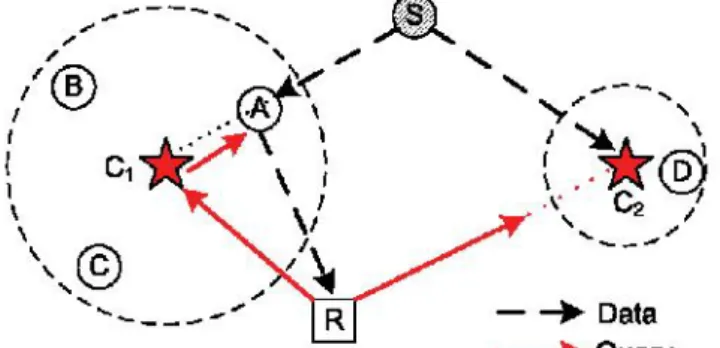
while. A requester R pulls information by questioning NCLs, and information duplicates from numerous NCLs are come back to guarantee brief information access. Especially, some NCL, for example, C2 may be too a long way from R to get the inquiry on time, and does not react with information. For this situation, information availability is dictated by both hub contact recurrence and information lifetime. Hubs in DT s are all around propelled to contribute their nearby assets for storing information on the grounds that the reserved information give brief information access to the storing hubs themselves. As represented by Fig. 2, since the focal hubs speaking to NCLs are organized for storing information, the closer a requester is to a focal hub, the sooner its questions are reacted by the relating NCL. The postponement for reacting to inquiries produced from focal hubs is, clearly, the most limited.
Fig. 2. The big picture of intentional caching
CACHING SCHEME
Our essential thought is to deliberately store information at an arrangement of NCLs, which can be immediately gotten to by different hubs. Our plan comprises of the accompanying three parts: 1. At the point when an information source creates information, it pushes information to focal hubs of NCLs, which are organized to store information. One duplicate of information is reserved at each NCL. On the off chance that the reserving cushion of a focal hub is full, another hub close to the focal hub will store the information. Such choices are consequently made taking into account cradle states of hubs included in the pushing procedure. 2. A requester multicasts an inquiry to focal hubs of NCLs to force information, and a focal hub advances the question to the reserving hubs. Different information duplicates are come back to the requester, and we enhance the tradeoff between information openness and transmission overhead by controlling the quantity of returned information duplicates. 3. Utility-based store substitution is directed at whatever point two reserving hubs contact and guarantees that well known information are reserved closer to focal hubs. We for the most part reserve more duplicates of mainstream information to advance the aggregate information access delay. We likewise probabilistically reserve less famous information to guarantee the general information availability.
Caching Location
At whatever point a hub S produces new information, S pushes the information to NCLs by sending an information duplicate to every focal hub speaking to a NCL. We utilize the pioneering way weight to the focal hub as hand-off
determination metric for such information sending, and a transfer advances information to another hub with a higher metric than itself. This "Look at and-Forward" system has been generally utilized as a part of the writing [10], [9] for effective information sending. As indicated by Definition 1 on deft way, this procedure probabilistically guarantees that every sending decreases the remaining postponement for information to be conveyed to the focal hub. For recently produced information, the beginning storing areas are consequently decided amid the sending procedure in view of hub cradle conditions. The reserving areas are then powerfully balanced by store substitution depicted in Section 5.4 as per inquiry history. By and large, information are sent to and reserved at focal hubs. This sending process just stops when the storing support of the following hand-off is full,4 and information are reserved at the present transfer in such cases. As it were, amid the information sending procedure toward focal hubs transfers conveying information are considered as transient storing areas of the information. Such determination of storing area is outlined in Fig. 7, where the strong lines show artful contacts used to forward information, and the dashed lines demonstrate information sending halted by hub cushion requirement. Focal hub C1 can store information, however information duplicates to C2 and C3 are
Fig. 3. Determining caching location at NCLs.
Stopped and cached at relays R24 and R33 , respectively,
because neither C2 nor R34has enough buffer to cache data
.Note that the caching location at a NCL may not be the contacted neighbor of a central node, like the case of nodes R33in Fig. 3.
CONCLUSION
Our fundamental thought is to purposefully store information at an arrangement of NCLs, which can be effortlessly gotten to by different hubs In this paper, we propose a novel plan to bolster agreeable reserving in DTNs. We guarantee fitting NCL choice taking into account a probabilistic metric; our methodology directions storing hubs to improve the tradeoff between information openness and reserving overhead. Broad recreations demonstrate that our plan enormously enhances the proportion of questions fulfilled and decreases information access delay, while being contrasted and existing plans.
Reference
Architectures, and Protocols for Computer Comm., pp. 373-384, 2007.
[2] C. Boldrini, M. Conti, and A. Passarella, “ContentPlace: Social- Aware Data Dissemination in Opportunistic Networks,” Proc. 11th Int’l Symp. Modeling, Analysis and Simulation of Wireless and Mobile Systems (MSWiM), pp. 203-210, 2008.
[3] L. Breslau, P. Cao, L. Fan, G. Phillips, and S. Shenker, “Web Caching and Zipf-Like Distributions: Evidence and Implications.”Proc. IEEE INFOCOM, vol. 1, 1999.
[4] J. Burgess, B. Gallagher, D. Jensen, and B. Levine, “MaxProp: Routing for Vehicle-Based Disruption-Tolerant Networks,” Proc.IEEE INFOCOM, 2006.
[5] H. Cai and D.Y. Eun, “Crossing over the Bounded Domain: From Exponential to Power-Law Inter-Meeting Time in MANET,” Proc.ACM MobiCom, pp. 159-170, 2007.
[6] P. Cao and S. Irani, “Cost-Aware WWW Proxy Caching Algorithms,” Proc. USENIXSymp. Internet Technologies and Systems, 1997.
[7] A. Chaintreau, P. Hui, J. Crowcroft, C. Diot, R. Gass, and J. Scott, Impact of Human Mobility on Opportunistic Forwarding Algorithms,” IEEE Trans. Mobile Computing, vol. 6, no. 6, pp. 606-620, June 2007.
[8] P. Costa, C. Mascolo, M. Musolesi, and G. Picco, “Socially Aware Routing for Publish-Subscribe in Delay-Tolerant Mobile Ad Hoc Networks,” IEEE J. Selected Areas in Comm., vol. 26, no. 5, pp. 748-760, June 2008.
[9] E. Daly and M. Haahr, “Social Network Analysis for Routing in Disconnected Delay-Tolerant MANETs,” Proc. ACM MobiHoc, 2007.
[10] H. Dubois-Ferriere, M. Grossglauser, and M. Vetterli, “Age Matters: Efficient Route Discovery in Mobile Ad Hoc NetworksUsing Encounter Ages,” Proc. ACM MobiHoc, pp. 257-266, 2003.
[11] J. Eriksson, L. Girod, B. Hull, R. Newton, S. Madden, and H. Balakrishnan, “The Pothole Patrol: Using a Mobile Sensor Network for Road Surface Monitoring,” Proc. ACM Sixth Ann. Int’l Conf. Mobile Systems, Applications and Services (MobiSys), 2008.
[12] V. Erramilli, A. Chaintreau, M. Crovella, and C. Diot, “Diversity of Forwarding Paths in Pocket Switched Networks,” Proc. Seventh ACM SIGCOMM Conf. Internet Measurement (IMC), pp. 161-174, 2007.
[13] V. Erramilli, A. Chaintreau, M. Crovella, and C. Diot, “Delegation Forwarding,” Proc. ACM MobiHoc, 2008. [14] K. Fall, “A Delay-Tolerant Network Architecture for Challenged Internets,” Proc. ACM SIGCOMM Conf. Applications, Technologies, Architectures, and Protocols for Computer Comm., pp. 27-34, 2003.
[15] L. Fan, P. Cao, J. Almeida, and A. Broder, “Summary Cache: A Scalable Wide-Area Web Cache Sharing Protocol,” IEEE/ACM Trans. Networking, vol. 8, no. 3, pp. 281-293, June 2000. [16] M. Fiore, F. Mininni, C. Casetti, and C.F. Chiasserini, “To Cache or Not to Cache?” Proc. IEEE INFOCOM, pp. 235-243, 2009.
[16] W. Gao and G. Cao, “On Exploiting Transient Contact Patterns for
Data Forwarding in Delay Tolerant Networks,” Proc. IEEE Int’l