290
OBSERVATIONS ON THE BIOLOGY OF THE CAMERARIA OHRIDELLA
DESCHKA DIMIČ SPECIES (LEAF MINING MOTH), DANGEROUS PEST
OF THE CHESTNUT TREE
Tălmaciu Nela 1*, Tălmaciu Mihai1
, Miroiu Carmen 2, Herea Monica1
1*University of Agricultural Sciences and Veterinary Medicine Iaşi, *e-mail: [email protected] 2Fitosanitary Office Vaslui
Key words: Cameraria ohridella, byology, generarion, chestnut.
ABSTRACT
The knowledge of biology of the Cameraria orhidella Deschka & Dimič species are of special importance for determining the moments and the control measures to be applied against it to prevent the attack on the chestnut trees crown.
In this paper, we bring the new contributions to the knowledge of the biology of chestnut leaf mining moth. These observations consisted in systematic registration of data on the occurrence and flying insect, oviposition, the completing larval stage, the pupa stage of developmentand, re-start the cycle to each generation, observations were conducted using pheromone traps ”atra-CAM „ type - end reading their every 3 days.
INTRODUCTION
Cameraria ohridella Deschka & Dimič has as main host ornamental chestnut, Aesculus hippocastanum L., ornamental species common in Europe, the preferred alignments for which it gives rich shade.
For the first time in Macedonia it was reported in 1985, around Lake Ohrid, close to the border with Albania and was described as a species new to science a year later. The true origin of the species is not known yet. (Augustine, S, 2009)
Cameraria genre is not represented by other species in Europe but some species belonging to the genus are found in Asia and North America. This supports the hypothesis of introducing species in Albania by the Chinese travel and after the flight has begun spreading through adult species habitat expansion taking place, first in countries of the former Yugoslavia, in the late 1980s (Badescu A. , 2003 si Brudea, V., 2010)
It was reported in 1989 in Zagreb, the Croatian capital. In the same year it was reported in Bulgaria. Also in 1989, was introduced deliberately in Austria at Linz by an entomologist, the purpose of a study without taking into account the consequences of a leak under control specimens studied. After losing control of insects, this location in Austria was the point of extending to many European countries.
Between 1993 - 1998 it was extended to Slovakia, Slovenia, Germany, Hungary, Switzerland and Poland, and between 2002 - 2004 was reported in the UK, Spain, Russia and Denmark and Lithuania. ( Gansca L. 2009, Oltean I. 2009 )
In Romania the presence of the insect was first reported in the west of the country, in Timisoara, in 1996, in 1998 was observed in central regions, Cluj-Napoca.
In 2005 the insect was observed in Vasluicounty, and in 2006 began to issue warning bulletins for combating insect.
MATERIAL AND METHOD
291
that measures to limit the population in conditions zone climate Huşi Vaslui County(Milici
Ionica 2007 and Şandru I. 2002).
RESULTS AND DISCUTIONS
For adults flight tracking of Cameraria ohridella were used pheromone traps, Atra-CAM. Thus was used by a trap / location, and change baits were made monthly from May to September in the years 2012, 2013, 2014, 2015 and 1016. notary on flight dynamics adults were done 3 times a week.
In order to correlate weather data obtained with the amounts were calculated degrees of the actual temperature (above 12C) for each stage of development.
Between 2014 - 2015, following the observations in nature, that the insect has three generations per year, iernând the pupa in a cocoon made from the leaf epidermis, the galleria of food for the larva.
Insect population level is influenced by weather conditions every year, especially in 2015, when losses inseminated, but have evolved almost normal stages.
Flight Dynamics adults of Cameraria ohridella Deschka Dimič in Husi, in 2014
In 2014, the first generation of adults caught - he III (hiemală) occurred on 10.05, a Σ (tn - to) = 85,25C (tab. 1).
Table 1 Flight Dynamics adults of Cameraria ohridella Deschka Dimič in Husi, in 2015
G3 G1 G2
Adult
appearance Adults captured
Adult
appearance Adults captured
Adult
appearance Adults captured
10.05 30 29.06 157 11.08 100
12.05 50 01.08 166 13.08 320
15.05 122 03.07 186 15.08 300
18.05 180 06.07 381 18.08 310
21.05 315 09.07 400 21.08 192
23.05 388 12.07 378 23.08 173
25.05 310 15.07 290 25.08 125
28.05 260 18.07 220 28.08 100
31.05 350 21.07 200 31.08 95
03.06 110 23.07 190 03.09 71
06.06 100 25.07 160 06.09 13
09.06 81 28.07 75 09.09 12
12.06 18 31.07 50
15.06 17 03.08 55
18.06 15 06.08 33
21.06 - 09.08 24
25.06 -
27.06 -
∑(tn – to) Duration of
flight ∑(tn – to) Duration of flight ∑(tn – to) Duration of flight
52,950C 41 362,360C - 783,420C 27
292
Adults Generation I (G1) occurred on 29.06, a Σ (tn - to) = 378,770C. Numerous flight took place between 03.- 25.07 for 22 days and a maximum between 16 and 15 July. 25.07 after the flight began to fall, but not stopped, so that it overlaps the second generation.
Adults II generation began to appear 11.08, a Σ (tn - to) = 833,96C, numerous flights took place between 13 - 28.08, for 15 days and the maximum flight curve was recorded during 13 - august 18th. Adults have flown until September 9.
The mining moth life cycle of the Cameraria ohridella in Husi in 2014
Life cycle of the moth mining chestnut in the Huşi Vaslui, was seen parks and alignments, monitoring the emergence of adult oviposition, emergence of larvae and stern, during each stage of the insect and the sum of effective temperatures for all generations of the insect.
Adults generation III (hiemală) occurred on 10.05, a Σ (tn - to) = 85,25C (table 2). The flight of butterflies and oviposition in May was hampered by heavy rains fallen for 16 days, when they recorded 179 mm rainfall, the deviation from the average is 118.9 mm and average daily temperatures relatively small until 18.05 between 9.6 and 16.2C.
After mating and sexual maturation, females began oviposition on 20.05, a Σ (tn - to) = 100,250C and hatched after about 8 days at a temperature of 20.00C decade average. Ponta is filed throughout the insect's flight, the last eggs were observed on 21.06.
V1 larvae first appeared on May 28, at a Σ (tn - to) = 147,49C, and stage lasted 24 days at a temperature of about 20C decade average.
Pupa was observed in 21/06 at a Σ (tn - to) = 324,88C, and after 8 days at an average temperature of 18.3 0 C butterflies have occurred first generation -Get on 29.06, a Σ (tn - to) = 378,77C.
First generation lasted 40 days (the deposit first eggs until the appearance of the first butterflies).
After the sexual maturation and mating butterflies I submitted the first generation eggs on leaves of 05.07, a Σ (tn - to) = 427,78C. Incubation lasted about 5 days, the first hatched larvae appeared to 10.07 only in one Σ (tn - to) = 484,01C. Larval stage duration was 22 days at the decadal average from 21.6 to 22.5 0 C and a relative humidity of 74%.
As of 03.08. first kiss was recorded at a Σ (tn - to) = 736,7C in 20%, and the pupae 05.08 percentage was 55% at Σ (tn - to) = 723,09C.
Pupal stage duration was 8 days at an average temperature of 24.2 0C decadal so on 11.08, a Σ (tn - to) = 833,96C, butterflies began to appear first generation -II has .
Butterflies II generation he started oviposition on 17.08, a Σ (tn - to) = 906,95C. Deposition in the egg mass was 20.08 registered in a ratio of more than 50%. Incubation lasted 5 days, while the first 22.08 larvae appeared V1 at a Σ (tn - to) = 949,95C. Larval stage duration was approximately 25 days at a temperature of 19.6 C decade average.
15. The first kiss occurred 09 to a Σ (tn - to) = 1143,25C. Transforming the percentage of over 50% took place on 20.09, a Σ (tn - to) = 1160,19C.
293
Table 2 Appearance of the first stages of mining moth
Cameraria ohridella Deschka Dimič, 2014 Generation Stage Adult appearance The duration of
stages ∑(tn – to)
G3 (hiemal) Adults 10.05 39 85,250C
G1 40 days
egg 20.05 6 100,250C
larvae 28. 05 30 147,490C
pupae 19.06 10 315,810C
adult 29.06 - 378,770C
G2 37 days
egg 05.07 5 427,780C
larvae 10.07 22 484,010C
pupae 03.08 8 736,700C
adult 11.08 28 833,960C
G3 up to May 2015
egg 17.08 5 906,950C
larvae 22.08 20 949,950C
pupae 15. 09 212 1143,250C
Table 3 Mining moth life cycle of chestnut Cameraria ohridella Deschka Dimič, 2014
Year Generation
I II III
2014 20 may – 29 june 05 july – 11 august 17 august – 08 may
Flight Dynamics adults of Cameraria ohridella Deschka Dimič in Husi, in 2015
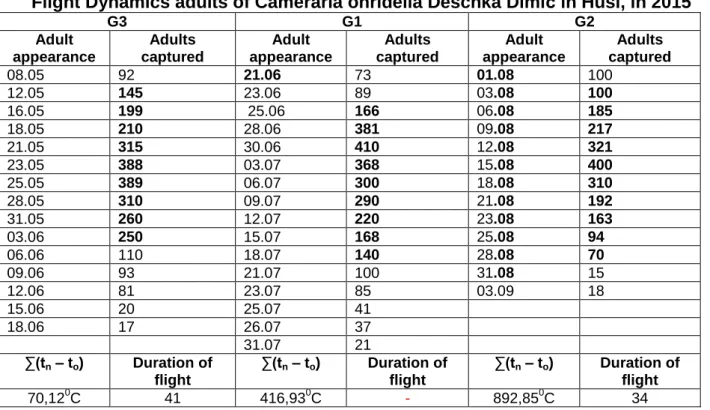
In 2015 the first generation adults III (hiemal) occurred on 08.05, a Σ (tn - to) = 70,12C. Flight numerous adults began on 12 May to 03 June for 23 days and had a maximum flight curve during May 21 to 28 for 7 days (Table 4)
Flight III -a adult generation (G3) lasted 42 days (08.05 - 18.06).
The adults generation I (G1) occurred on 21.06, a Σ (tn - to) = 416,93C. Flight numerous analyzes were registered during June 25 to July 18 for 24 days and the maximum flight was recorded during 28.06.- 09.07 for 12 days.
Table 4 Flight Dynamics adults of Cameraria ohridella Deschka Dimič in Husi, in 2015
G3 G1 G2
Adult appearance
Adults captured
Adult appearance
Adults captured
Adult appearance
Adults captured
08.05 92 21.06 73 01.08 100
12.05 145 23.06 89 03.08 100
16.05 199 25.06 166 06.08 185
18.05 210 28.06 381 09.08 217
21.05 315 30.06 410 12.08 321
23.05 388 03.07 368 15.08 400
25.05 389 06.07 300 18.08 310
28.05 310 09.07 290 21.08 192
31.05 260 12.07 220 23.08 163
03.06 250 15.07 168 25.08 94
06.06 110 18.07 140 28.08 70
09.06 93 21.07 100 31.08 15
12.06 81 23.07 85 03.09 18
15.06 20 25.07 41
18.06 17 26.07 37
31.07 21
∑(tn – to) Duration of
flight
∑(tn – to) Duration of
flight
∑(tn – to) Duration of
flight
294
After 18.07 the flight began to fall, but not stopped, so that it overlaps the second generation. Duration of flight generation I can not say precisely.
Adults II generation emerged 01.08, a Σ (tn - to) = 892,85C, augmented their flight was recorded between August 6 to August 23 for 18 days and the maximum flight curve was recorded from 12 - 18.08 for 6 days. Butterflies have flown continue until 3rd September.
The mining moth life cycle of the Cameraria ohridella in Husi, in 2015
Environmental conditions in the Husi area, 2015 Chestnut mining moth Cameraria ohridella Deschka Dimič a winter as pupa in the fallen leaves on the ground.
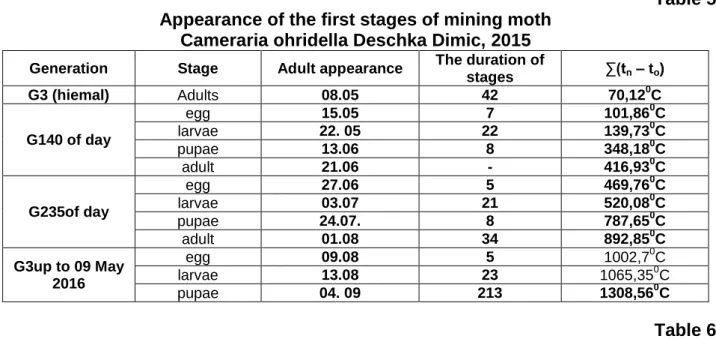
Adults generation III (hiemală) occurred on 08.05, a Σ (tn - to) = 70,120C (tab. 5). After copulation and sexual maturation, 7 days from the first appearance of butterflies, females began oviposition.
The first eggs were deposited on 15.05, a Σ (tn - to) = 101,86C. Ponta is filed throughout the insect's flight, the last eggs were observed on 19.06.
Incubation lasted about 7 days, and the larvae first appeared at 22.05 V1 at a Σ (tn - to) = 139,73C. Incubation was hurt by the fact that many of the eggs have hatched there (6-7%), atmospheric and soil drought because of decade II yet installed aa April and continued into May, the amount of rainfall in the first decade was 7.4 mm (3-4 May).
Larval stage lasted 22 days at a temperature of about 21,8C decade average, but low humidity of 55%.
Pupa was observed on 13.06, a Σ (tn - to) = 348,18C, and after eight days appeared first generation butterflies -I was on 21.06, a Σ (tn - to) = 416,93C.
Generation I lasted 40 days (the deposit first eggs until the appearance of the first butterflies).
After copulation, the first eggs (me) new leaves were observed on 27.06, a Σ (tn - to) = 469,76C.
Incubation at a temperature of 240C decade average it took about 3 days, the first emerged larvae on 03.07, a Σ (tn - to) = 520,080C. The duration of the larval stage was 20 - 21 days at a decadal mean temperature of about 24 - 260C.
On 24.07. first pupae were recorded on a Σ (tn - to) = 787,65C, in a proportion of 10%, and the percentage of pupae 29.07 was 50% at a Σ (tn - to) = 860,60C.
Pupal stagewas with duration of 8 days, so on 01.08, a Σ (tn - to) = 892,85C butterflies began to appear first generation has -II (butterflies appear as clove leaf, but stay a few hours before flying so).
Second generation lasted 38 days (the deposit first eggs until the appearance of the first butterflies).
After about 8 days after onset of the first generation of butterflies II - began oviposition on 09.08, a Σ (tn - to) = 1002,7C. The massive egg deposition was recorded 15.08 in 60%.
After about 5 days after oviposition larvae were first on 13.08, a Σ (tn - to) = 1065,35C. Larval stage The duration of was approximately 22 days.
The first appearance occurred 09.04 to a Σ (tn - to) = 1308,56C, the rate of 7-8%, and on 10.09, a Σ (tn - to) = 1085,94C percentage was 48% from pupae analyzed. At this stage the insect hibernating up to May next year.
295
Table 5 Appearance of the first stages of mining moth
Cameraria ohridella Deschka Dimic, 2015
Generation Stage Adult appearance The duration of
stages ∑(tn – to)
G3 (hiemal) Adults 08.05 42 70,120C
G140 of day
egg 15.05 7 101,860C
larvae 22. 05 22 139,730C
pupae 13.06 8 348,180C
adult 21.06 - 416,930C
G235of day
egg 27.06 5 469,760C
larvae 03.07 21 520,080C
pupae 24.07. 8 787,650C
adult 01.08 34 892,850C
G3up to 09 May 2016
egg 09.08 5 1002,70C
larvae 13.08 23 1065,350C
pupae 04. 09 213 1308,560C
Table 6 Mining moth life cycle of chestnut Cameraria ohridella Deschka Dimic, 2014
Year Generation
I II III
2015 15 may – 21 june 27 june - 01 august 09 august – 09 may
The pheromone traps have been reported sporadically specimens belonging to other species (they reached only accidentally or if they show any preference for the white color of the trap).
CONCLUSIONS
1. Use the specific sex attractant pheromone traps, attractants for mass capture of males Cameraria ohridella Deschka-Dimić, and prompted a flight duration of leaf mining moth chestnut between 27 days (in 2014) and 34 days (2015).
2. Capturing the mass of males help reduce pest biological reserve, if applied consistently each year.
3. In the Husi -Vaslui, chestnut leaf miner moth, developed 3 generations in 2014-2015 .
4. The hibernating generation adults begin their flight in the first half of May; first generation of flying adult start in the first decade of July and the last generation flight starts in the second decade of August.
5. The maximum flight curve is performed in 11 to 14 days of the start of the flight. 6. The first generation were first reported in the last days of May, the second generation in the last decade of July and last generation mines in the first days of September.
7. Duration of larval stage was 23-26 days from the first generation of 19-21 days in the second generation and 19-20 days from the last generation.
8. The pupal stage is phased in over a period of 9-10 days to 7-9 days the first generation and the second generation.
9. The duration of the total development of the first generation was 52-58 days and the second generation of 42-49 days.
10. It is worth noting that overlapping generations summer, flying adults is a continuous flight between July and August.
296
BIBLIOGRAPHY
Augustin, S., et all, 2009, Monitoring and dispersal of the invading
GracillariidaeCamerariaohridella, Journal of Applied Entomology Vol. 133 No. 1 pp. 58-66.
Badescu A. P., 2003, Molia minieră a castanului ornamental, Sănătatea Plantelor,
57, pag. 32-33.
Brudea, V., Risca, I. M., 2010, Implementation of some biopesticides in integrated
pest management (IPM) of larch aphid Adelges laricis vallot (F. adelgidae - Homoptera) and the horse chestnut leaf miner Cameraria ohridella desch & dimic (F. gracillarlidae -Lepidoptera), Cercetări Agronomice în Moldova Vol. 43 No. 4 pp. 79-87.
Drosu Sonia, Sesan Tatiana Eugenia, 2003, Aspecte fitosanitare actuale la
castanul ornamental (Aesculum hipocastanum L.) , Analele I.C.D.P.P. Bucureşti, vol. XXXII, pag. 95-104.
Gansca Lucia, Oltean I., Somsai P.A. , 2006, Biopesticid feromonal utilizat în
combaterea ecologică a moliei miniere Cameraria ahridella, dăunător invaziv al castanului
sălbatic (ornamental) Aesculus hippocastanum L, Simpozionul BIOTECH 2006
“Rezultatele cercetărilor biotehnologice româneşti” în cadrul Planului Naţional de Cercetare Dezvoltare Inovare şi perspective privind aplicarea lor”, Piatra Neamţ, 8-10 noiembrie 2006, pag. 26-28.
Milici Ionica, 2007, Cercetări asupra biologiei, ecologiei şi combaterii moliei
miniere a frunzelor de castan (Cameraria ohridella Deschka Dimić) în condiţiile Câmpiei de
Vest, Teză de doctorat, USAMVB Timişoara, 152 pag.
Oltean I., el all, 2006, Molia minieră a castanului, Cameraria ohridella
Deschka-Dimić, Editura AcademicPres, Cluj-Napoca, 115 pagini.
Şandru I., Fatol R., 2002, Molia minieră (Cameraria ohridella Deschka-Dimic;