
93
All Rights Reserved © 2012 IJARCSEEImage Segmentation in Satellite Image using Optimal
Texture Measures
G.Viji1, N.Nimitha2,A.Kalarani2
1
Assistant Professor, P.S.R.Rengasamy college of Engineering for women, Sivakasi
2
Lecturer, M.Kumarasamy college of Engineering,karur.
2
Assistant Professor, P.S.R.Rengasamy college of Engineering for women, Sivakasi.
Abstract— Texture in high resolution satellite images requires
substantial amendment in the conventional segmentation algorithms. In this paper, a satellite image is segmented using optimal texture measures. Satellite image used in this paper is a high resolution data which will provide more details of the urban areas, but it seems evident that it will create additional problems in terms of information extraction using automatic classification. This work improves the classification accuracy of intra-urban land cover types. Four texture measures are evaluated using grey-level co-occurrence matrix (GLCM). Four texture indices with six window sizes are obtained from satellite image. Principle Component Analysis (PCA) is applied to these texture measures. The resultant image is then compared with homogeneity texture feature image, obtained using 7×7 window. The per pixel classification accuracy is improved in this work by varying the window size.
Keywords - Gray Level Co-occurrence Matrix (GLCM), Principle Component Analysis (PCA), Remote Sensing, Satellite Image, Segmentation.
I. INTRODUCTION
Image segmentation plays an important role in human vision, computer vision and pattern recognition fields. Segmentation refers to the process of partitioning a digital image into multiple segments. The goal of segmentation is to simplify and or change the representation of an image into something that is more meaningful and easier to analyse. Image segmentation is typically used to locate objects and boundaries (lines, curves, etc.) in images. More precisely, image segmentation is the process of assigning a label to every pixel in an image such that pixels with the same label share certain visual characteristics. In order to better explain the structure of this work, the preliminary information about the satellite image and remote sensing is discussed [1].
Remote sensing is a science of obtaining information about an object, area or phenomenon through the analysis of data acquired by a device that is not in contact with the object [1]. Commonly remote sensing is referred to the collection and analysis of data regarding the earth using electromagnetic sensors, which are operated from the space borne platform. Satellite image is a remotely sensed one and defined as a picture of the earth taken from an earth orbital satellite. This image consists of buildings, roads, vegetations, water bodies and other open areas. Satellite images are an important
information source and provide current information on a periodic basis at low cost.
Satellite image consists of micro textures and macro textures. For micro textures the statistical approach seems to be work well. The statistical approaches have included auto correlation functions, digital transform, and gray level tone co-occurrence. For macro textures the approach seems to be moving in the direction of using histograms of primitive properties and co-occurrence of primitive properties in structural and statistical. These techniques are not sufficient to segment high resolution images due to the variability of spectral and structural information in such images [2].
Thus the spatial pattern or texture analysis becomes necessary to segment high resolution image. The proposed method is based on the feature extraction from the gray level co-occurrence matrix, which is a well known method for analysing the texture features. The segmentation based on this texture features can improve the accuracy of this interpretation. A problem that frequently arises when segmenting an image is that the number of feature variables or dimensionality is often quite large. It becomes necessary to decrease the number of variables to manageable size, at the same time, retaining as much discrimination information as possible. In this paper an algorithm called principle component analysis is introduced to solve this problem.
The paper is organized as follows. First in Section II, Proposed Methodology is dealt, Principle Component Analysis (PCA) in Section III, Results and discussion are dealt in Section IV. Finally conclusions are given in Section V.
II. PROPOSED METHODOLOGY
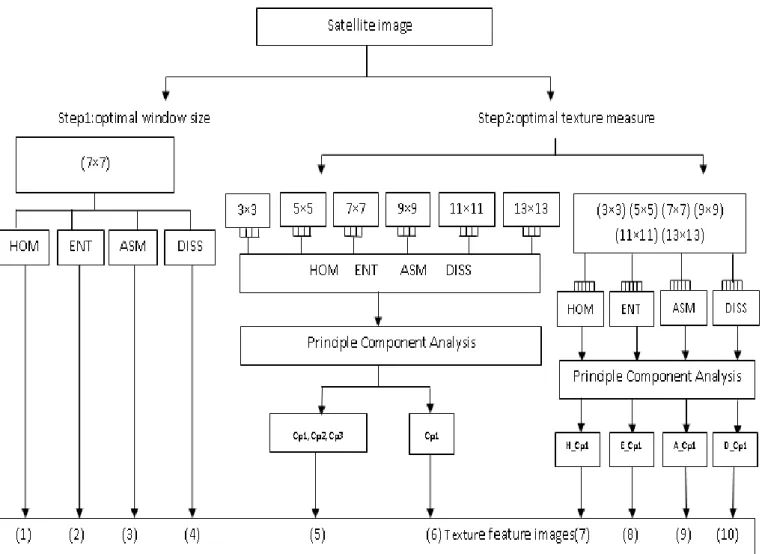
The Fig.1 shows that representation of the proposed methodology. The proposed methodology consists of two steps: Step1: optimal window size and Step2: optimal texture measure. Feature extraction acquired by this experiment is derived from gray level co-occurrence matrix. The more details of this texture analysis are shown by the following subheadings.
A. Gray level Co-occurrence matrix
Gray level co-occurrence matrix is the two dimensional matrix of joint probabilities Pd,r(i,j) between pairs of pixels,
94
All Rights Reserved © 2012 IJARCSEEobtained by calculating how often a pixel with gray level value i occurs horizontally adjacent to a pixel with the value j.
Each element (i,j) in GLCM specifies the number of times that the pixel with value i occurs horizontally adjacent to a pixel with the value j. It is used to detect objects with different sizes and directions. The co-occurrence matrix values are calculated for six window sizes (3×3,5×5,7×7,9×9,11×11,13×13) [3].It is popular in texture description and based on the repeated occurrence of some gray level configuration in the texture. This configuration varies with distance in fine textures, slowly in coarse textures.
B. Feature extraction
In order to estimate the similarity between different gray level co-occurrence matrices, [4] proposed 14 statistical features extracted from them. To reduce the computational complexity, only some of these features were selected. The description of 4 most relevant features that are widely used in literature [5, 6, 7] is given in Table1. These four features are calculated from the gray level co-occurrence matrix of different window sizes(3×3,5×5,7×7,9×9,11×11,13×13).
TABLE1 TEXTURE MEASURES Homogeneity
1 0 1 01
)
,
(
n i n j dj
i
j
i
P
Dissimilarity
1 0 1 0)
,
(
n i n jd
i
j
i
j
P
Entropy
1 0 1 0)
,
(
log
)
,
(
n i n j dd
i
j
P
i
j
P
Angular Second
Moment
1 0 1 0 2
)
,
(
n i n jd
i
j
P
where i,j – Coordinates in the co-occurrence matrix
Pd (i,j) – Co-occurrence matrix value at the
coordinates i,j
n – Dimension of the co-occurrence matrix Homogeneity is a measure of the overall smoothness of an image. It is high for GLCMs with elements localized near the diagonal. The range of gray levels is small, Pd(i,j) will tend to
be clustered around the main diagonal [4]. Dissimilarity measures can be used to quantify the differences between two images.
Entropy is a statistical measure of randomness that can be used to characterize the texture of the input image. It is high when the elements of GLCM have relatively equal value [6], low when the elements are close to either 0 or 1(when the image is uniform in the window). Entropy is inversely proportional to GLCM energy.
Angular Second Moment [6] is a measure of homogeneity of the image. It is high when the GLCM has few entries of large magnitude, low when all entries are almost equal. This is the opposite of entropy. This information is specified by the matrix of relative frequencies Pd(i,j) with which two
neighbouring pixels occur on the image, one with gray value i
and the other with gray value j.
In Step1 the classification procedure using textural measures depends largely on the selected window size. The optimal window size chosen in our implementation is 7×7, since it gives superior performance [3]. If the window size is too small, insufficient spatial information is extracted to characterise a specific land cover and if the window size is too large, it can overlap two types of ground cover and thus introduce erroneous spatial information.
In Step2 the analysis of the correlation matrix among all the texture measures with the six window sizes highlights high correlations [3] between the same texture measures with different window sizes and between the different texture measures with different window sizes. The four texture measures are calculated for a window size and principle component analysis (PCA) is applied to the 24 texture measures [3]. Then, on the one hand, the first three components are extracted, while on the other hand, only the first component is extracted. Next a texture measure is calculated for the six window sizes and PCA is applied for each type of texture measure.
III. PRINCIPLECOMPONENTANALYSIS
The steps involved in the implementation of PCA using the covariance method is shown below.
Organize the data set
Calculate the mean
Calculate the deviations from the mean
Find the Covariance matrix.
Find the eigenvectors and eigenvalues of the covariance matrix
Rearrange the eigenvectors and eigenvalues
Transform the eigen space into PCA parameter
IV. RESULTS & DISCUSSION
95
All Rights Reserved © 2012 IJARCSEEFig. 1 Strategy of the Textural Analysis
Fig.3 shows that classification result of textural images. The classification results, obtained using the integration of all texture image is shown in Fig 3(a), which gives the high global accuracy than other textural image, because, here the regions are more homogeneous. Nevertheless, the homogeneity measure with a 7×7 window size seems to be optimal regarding the rate of correct classification and hence the homogeneity feature image is used for comparison. In this homogeneity texture feature image, the four regions 1, 2, 3, 4 correspond to buildings, roads, and water and vegetations areas respectively. The number of pixels in these regions are 486311, 24357, 1728 and 132 respectively.
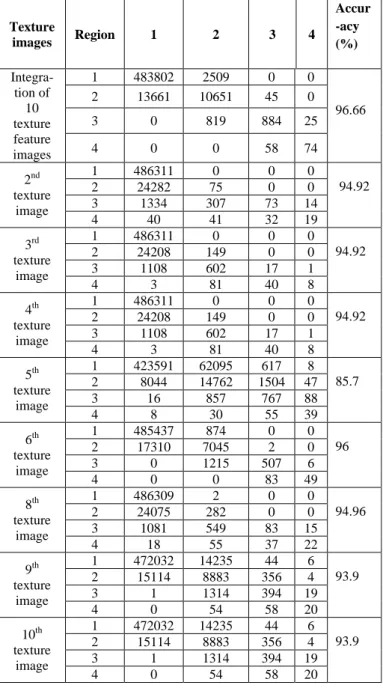
The success of proposed image segmentation is shown in the form of confusion matrix, in Table 2. In this table the number of pixels correctly and incorrectly classified in various regions for different feature images, the integrated texture feature images are reported. Please note that homogeneity
texture feature images (i.e. 1 &7) are not considered. Since against homogeneity feature image only, classification accuracy is compared.
From the Table 2, it is observed that, the accuracy of integration of 10 texture feature images are high, when compared to other texture feature images. In Table 2, if the region is same for row and column, then the region is correctly classified. Otherwise, the region is incorrectly classified. For example, in the integration of 10 texture feature images, if the region is 1 for row and column, it represents the correct classification of buildings. If the region is 1 for row and 2 for column, then it represents incorrect classification of buildings as roads. The number of pixels correctly classified in region 1 is 483802, region 2 is 10651, region 3 is 884 and region 4 is 74. The other numbers in each row correspond to the incorrectly classified pixels.
96
All Rights Reserved © 2012 IJARCSEE
(a) (b) (c)
(d) (e)
Fig. 2 Extract of different co-occurrence-based textured measure: (a) original image; (b) angular second moment; (c) homogeneity; (d) dissimilarity; (e) entropy
(a) (b) (c)
(d) (e) (f)
97
All Rights Reserved © 2012 IJARCSEEFig. 3 Classification results of textural images with the texture measure (Hom 7×7). (a) Integration of 10 texture feature images; (b) 3rd Texture feature image;
(c) 4th Texture feature image; (d) 5th Texture feature image; (e) 6th Texture feature image; (f) 7rd Texture feature image; (g) 8th Texture feature image; (h) 9th Texture feature image;
TABLE 2
CONFUSION MATRIX OF VARIOUS TEXTURAL IMAGES
Region: 1-Buildings, 2-Roads, 3-Water, 4-Vegitations
V.
CONCLUSIONS
This paper confirms the utility of textural analysis to enhance the per-pixel classification accuracy for high resolution images, especially in urban areas where the images are spectrally more heterogeneous. For the texture analysis, it is noted that the best co-occurrence based texture measure is the
homogeneity with a 7×7 window size. Satellite image consists of both micro textures and macro textures. For micro textures small window size is enough and for macro textures, large window size is required. For this reason, one can improve the per-pixel classification by varying the different window size. The co-occurrence based principle components (integration of all textural images) which give the high accuracy than other textural image. Moreover, as window size for texture analysis is related to image resolution and the contents within the image, it would be interesting to choose different window sizes according to the size of the features to be extracted.
REFERENCES
[1] ImagesManimala Singha et al “Color Image Segmentation for Satallite” International Journal on Computer Science and Engineering 2011.
[2] A.P.Carleer, O.Debeir, E.Wolff, “Assessment of very High Spatial Resolution Satellite Image Segmentations,” Photogrammetric Engineering and Remote Sensing, vol. 71, no.11, pp.1285-1294, 2005. [3] A.Puissant, J.Hirsch, and C.Weber, “The utility of texture analysis to improve per-pixel classification for high to very high spatial resolution imagery,” International Journal of Remote Sensing., vol.26, no.4, pp. 733-745, 2005.
[4] R.M.Haralick, K.Shanmugam, and I.Dinstein, “Textural Features for Image Classification,” IEEE Transactions on Systems, Man, and Cybemetics, vol.SMC-3, no.6, pp. 610-621, Nov.1973.
[5] S.Arivazhagan and L.Ganesan, “Texture Classification using Wavelet Transform Pattern Recognition Letters,’ vol.24, pp.1513-1521, 2003.
[6] A.Baraldi and F.Parmiggiani, “An investigations of the Textural Characteristics Associated with Gray Level Co-occurrence Matrix Statistical Parameters,” IEEE Transaction on Geoscience and Remote Sensing, vol.33, no.2, pp.293-304, 1995.
[7] R.M.Haralick, “Statistical and Structural Approaches to Texture,” Proceedings of the IEEE, vol.67, no.5,pp. 786-804,May.1979. H.Anys, A.Bannari, D.C.He, and D.Morin, ”Texture Analysis for the Mapping of Urban Areas using Airborne MEIS-II Images, ”In Proceedings of the First International Airborne Remote Sensing Conference and Exhibition,vol.III,pp.231-245,Sep.1994.
[8] P.Dulyakam, Y.Rangsanseri, and P.Thitimajshima, ”Textural Classification of urban Environment using Gray level Co- occurrence
Matrix Approach,” 2nd International Conference on Earth Observation
and Environmental Information, 2000.
[9] J.S.Weszka, C.R.Dyer, and A.Rosenfeld, “A Comparative Study of Texture Measures for Terrain Classification,” IEEE Transaction on Systems, Man and Cybernetics, vol.SMC-6, no.4, 1976.
[10] J.Gu, J.Chen, Q.M.Zhou and H.W.Zhang, “Quantitative Textural Parameter Selection for Residential Extraction from High Resolution remotely Sensed Imagery,” The International Archives of the Photogrammetry,Remote Sensing and Spatial Information Sciences,col.B4,no.37, 2008.
[11] G.Meinel and M.Neubert, “A Comparison of Segmentation Programs for High Resolution Remote Sensing Data,” International Archives of Photogrammetry and Remote Sensing, vol.35, pp.1097-1105, 2004.
Texture
images Region 1 2 3 4
Accur -acy (%) Integra- tion of 10 texture feature images
1 483802 2509 0 0
96.66 2 13661 10651 45 0
3 0 819 884 25
4 0 0 58 74
2nd texture
image
1 486311 0 0 0
94.92
2 24282 75 0 0
3 1334 307 73 14
4 40 41 32 19
3rd texture
image
1 486311 0 0 0
94.92
2 24208 149 0 0
3 1108 602 17 1
4 3 81 40 8
4th texture
image
1 486311 0 0 0
94.92
2 24208 149 0 0
3 1108 602 17 1
4 3 81 40 8
5th texture
image
1 423591 62095 617 8 85.7 2 8044 14762 1504 47
3 16 857 767 88
4 8 30 55 39
6th texture
image
1 485437 874 0 0
96
2 17310 7045 2 0
3 0 1215 507 6
4 0 0 83 49
8th texture
image
1 486309 2 0 0
94.96
2 24075 282 0 0
3 1081 549 83 15
4 18 55 37 22
9th texture
image
1 472032 14235 44 6 93.9 2 15114 8883 356 4
3 1 1314 394 19
4 0 54 58 20
10th texture image
1 472032 14235 44 6 93.9 2 15114 8883 356 4
3 1 1314 394 19
98
All Rights Reserved © 2012 IJARCSEE[12] O.O.Yashon, J.Tetuko and R.Tateishi, ”Analysis of
co-occurrence and Discrete Wavelet Transform Textures for
differentiation of Forest and Non-forest Vegetation in Very High Resolution Optical-Sensor Imagery,” International Journal of Remote Sensing,vol.29,no.12,pp.3417-3456, 2008.
[13] W.K.Pratt, “Digital Image Processing,” 2nd edition (New York;
Wiley).
[14] D.J.Marcead, P.J.Howarth, J.M.M.Dubois, and D.J.Gratton, “Evaluation of the Gray Level Cooccurrence Matrix Method for
Land Cover Classification using SPOT Imagery,” IEEE Transactions on Geoscience and Remote Sensing vol.28, pp.513- 519, 1990. [14] N.Haala and C.Brenner, “Extraction of Buildings and Trees in Urban Environments,” Photogrammetric Engineering and Remote Sensing,”vol.54, pp.130-137, 1999.
Viji Gurusamy received the B.Engg. degree in Electronics and Communication Engineering from Anna University, Chennai, in 2008 and the Master of Engg. degree from Anna University, Tirunelveli, in 2010. From June 2010 to May 2012, She was worked in M.Kumarasamy College of Engg, Karur. Now she is currently working in P.S.R.Rengasamy College of Engg for women, Sivakasi. She had attended four international conferences and one national conference in various colleges. Her research area includes Digital Signal processing, Digital Image processing, Digital Communication.
Kalarani Athilingam
completed herB.Engg. degree in Electronics and Communication Engineering from Anna University, Chennai, in 2008 and the Master of Engg. degree from Anna University, Tirunelveli, in 2010. From June 2010 to till now, She is working in P.S.R.Rengasamy College of Engg for women, Sivakasi. Her research area includes Digital Electronics, Digital Image processing, Antenna, Communication. She has been attended several workshops and conferences in various engg colleges.

 triangulo triruthenium](data:image/gif;base64,R0lGODlhAQABAIAAAP///wAAACH5BAEAAAAALAAAAAABAAEAAAICRAEAOw==)