108
STEEL SLAG-AMENDMENT FOR ACIDIC SOILS
1
EUGENIA GAMENT, 1GEORGIANA PLOPEANU, 2MIHAELA ULMANU
1 National Research and Development Institute for Soil Science, Agrochemistry and Environmental
Protection, Bucharest, Romania
2National Research and Development Institute for Nonferrous and Rare Metals, Bucharest,
Romania
Key words: amendment, steel slag, acidity, soil
ABSTRACT
Acidic soils are soils that have a pH less than 6,5. There are several ways to raise the pH of acidic soils, the addition of amendments is one of them.
The steel slag can be an effective liming material in the favorable soil conditions for productive plant growth; it can be used as acidic soils amendment considering the high contents of Ca and Mg.
To find out if the soil needs modification, have it tested and also should take into account the soil test recommendations to apply the steel slag as amendment.
INTRODUCTION
Normal application of the amendments and fertilizers in the recommended rates can influence both the chemical characteristics of the soil, also for a long time, and the plant growth, theycan seriously limit crop production(Metodologie, 1981).
The acidity of the soils is a limiting factor for the development and the production of the most crops. There are several ways to raise the pH of acidic soils.
The carbonated rocks, named limestone, are materials used for increasing the pH level of the soils. The steel slags generaly contain 35% to 45% calcium oxide, also small quantities of phosphate, magnezium and sulphur and can be considered as a soil conditioner of acidified soils. (www.cst.com.br)
METHODS AND MATERIALS
Soil acidity
Soil pH indicates the acidic level of a soil. A pH less than 6,5-7,0 indicates an acid soil. Acidity is caused to hydrogen (H+) ion concentrations in the soil.
Soil acidification is a natural process that is increased by normal production practices, particularly the use of nitrogen fertilizer and manure. Small changes in pH require the application of the lime on the soil.
The soil pH is a general indicator of whether the amendment is needed to reduce the acidity (Beegle and Lingenfelter, 1995).
The addition of amendments restores soil quality by balancing pH, and, on the other hand, a variety of problems accur.
All severely acidic soil systems are detrimental to plant growth because of Al and Mn toxicity. In cases where metal contaminants are present, acidity will increase metal availability.
109
A lower than normal pH in the soil (< 5.5) resulted often from the runoff or leaching of industrial contaminants can cause soil infertility and limit the microbial activity.
To protect plant health and ensure food-chain safety it must be used appropriate soil amendments (www.epa.gov, 2007).
Among the soil indicators, there is the soil pH that indicates whether liming is required to neutralize the acidity.
The most important lime materials used in agriculture are calcium and/or magnesium carbonates.
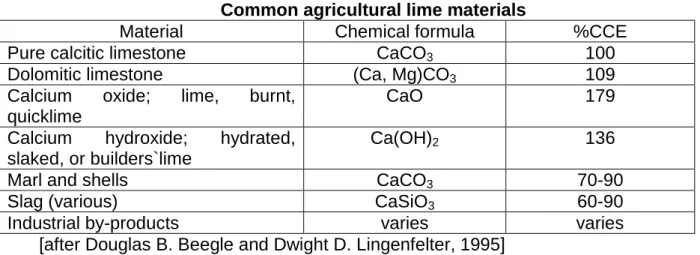
Burnt lime, hydrated lime, and some by-products materials are also used (Beegle and Lingenfelter, 1995). Table 1 presents these materials and their calcium carbonate equivalent (CCE) representing the amount of soil acidity of the material that can neutralize compared to pure calcium carbonate (the equivalent neutralizing value). (Beegle and Lingenfelter, 1995)
Table 1.
Common agricultural lime materials
Material Chemical formula %CCE
Pure calcitic limestone CaCO3 100
Dolomitic limestone (Ca, Mg)CO3 109
Calcium oxide; lime, burnt,
quicklime
CaO 179
Calcium hydroxide; hydrated,
slaked, or builders`lime
Ca(OH)2 136
Marl and shells CaCO3 70-90
Slag (various) CaSiO3 60-90
Industrial by-products varies varies
[after Douglas B. Beegle and Dwight D. Lingenfelter, 1995]
Steel slag. Amendment. Regulation.
Agricultural slag is a generalized term for fused calcium magnesium silicates. This material is normally a by-product of the steel industry.
When this by-product is used at the appropriate rate, the steel slag can be an effective liming material. (Johnson and Myers, 1999)
EU Waste Framework Directive 2008/98/CE includes steel slag in the corresponding list of wastes.
Generally, the slag is used in:
- cement production;
- road contruction;
- hydraulic engineering;
- fertilizer.
110
Mio. Tons 37%
42%
2% 2% 4% 3% 7%
3%
Cement Production Road Construction Hydraulic engineering Fertilizer
Internal Recycling Interior Storage Final Deposit Others
16.7 18.8 1.1 1.1 1.8 1.2 3.4 1.4
45.5 Total
Figure 1. Use of slags in Europe [after Siegmund Böhmer et. all., 2008.]
According to Principles of European Waste Management and to European Waste Shipment Regulation (No. 259/93), Green List, GC 070, the steel slag has to be recycled and the waste management hierarchy is (Apfel, 1993):
[after Dr. Jens Apfel, 1993]
Waste avoidence
Waste recycling
Wastes which can neither be avoided nor recycled shall be properly treated and disposed of in an
111
The classification of ferrous slag as either waste, product or by-product has been discussed worldwide for more than 25 years (EUROSLAG & EUROFER, 2012).
EUROSLAG (The European Slag Association, Germany) presented in 2006 a document entitled “Legal Status of Slags” about the classification of Ferrous Slag (blast furnance and steel slag) according of Waste Framework Directive 2008/98/CE (WFD) regarding Article 5 (“By-product”) and Article 6 (“End of waste status”).
Regarding Article 5 and 6, the Waste Framework Directive 2008/98/CE caracterised a by-product (Article 5) as well as a substance or material which shall stope to be considered as waste (Article 6) and finally becomes a useful product/secondary raw material(Waste Framework Directive, 2008).
Until now, the representatives of EU Commission announced that the procedure to classify slag as by-product will start in 2012 or 2013(EUROSLAG & EUROFER, 2012).
STEEL SLAG AS AGRICULTURAL AMENDMENT
There are hundreds of grades of steel, ranging from basic carbon steel to high grade stainless steel.
Considering about 90% of the total quantity of steel obtained in 12 countries in Europe, it has been accounted the percent of uses of slags.The 12 European countries are: Austria, Belgium, Denmark, Germany, Finland, France, Luxemburg, Netherlands, Slovenia, Slovak Republic, Spain and UK. The main utilisations were the cement production and in the road construction. As fertilizer it has been used 3% (1,1 mio. tons) (Böhmer et all., 2008).
From 3,5-4 millions tones per year – a total steel output, the total production of steel resulted from ISPAT-SIDEX Galati, Romania (Mittal Steel), aproximately 1 million ton of steel slag (25%) is accumulated per year.
Some materials that are used as agricultural amendment (ex. steel slag) may have high levels of heavy metals, water, a fineness of particles size etc.
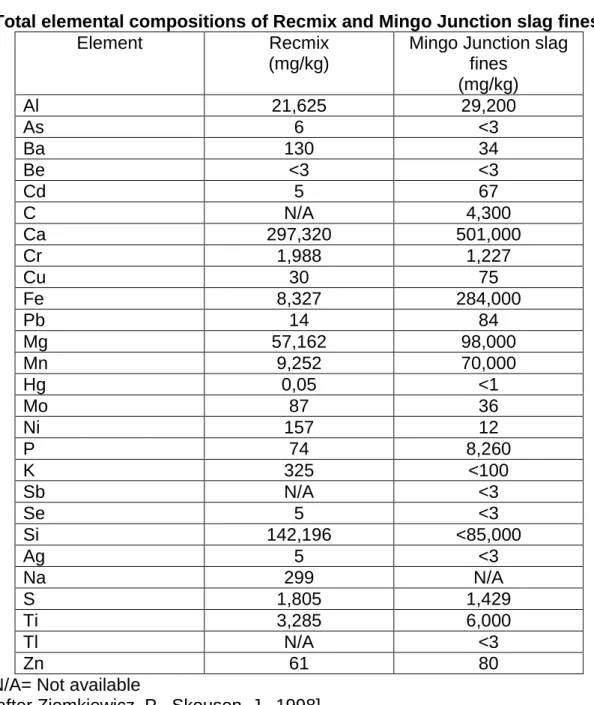
Some chemical characteristics of blast furnace slag and steel slag are presented in table 2.
Steel industry slags contain certain metals as: antimony, cadmium, chromium, manganese, molybdenum, selenium, silver, thallium, tin, vanadium. There are alkaline.
Steel slags are calcium alumino-silicate oxides.
It is important to know that all steel slags are not the same, they vary in composition, quality and fineness.
For environmental reasons, the properties of slag have to be tested (leaching test). The Neutralization Potential (NP) of steel slags can range from 45 to 78%. Generally, steel slag yielded more alkalinity than equal weights of limestone (from 500 to 2000 mg/L compared to 60 to 80 mg/L) (Ziemkiewicz and Skousen, 1998).
The steel slag can be used as soil acid amendment considering the high contents of CaO and MgO and low Al2O3. The hydrolysis of CaO and MgO in water and the presence
112
Table 2 Total elemental compositions of Recmix and Mingo Junction slag fines.
Element Recmix
(mg/kg)
Mingo Junction slag fines
(mg/kg)
Al 21,625 29,200
As 6 <3
Ba 130 34
Be <3 <3
Cd 5 67
C N/A 4,300
Ca 297,320 501,000
Cr 1,988 1,227
Cu 30 75
Fe 8,327 284,000
Pb 14 84
Mg 57,162 98,000
Mn 9,252 70,000
Hg 0,05 <1
Mo 87 36
Ni 157 12
P 74 8,260
K 325 <100
Sb N/A <3
Se 5 <3
Si 142,196 <85,000
Ag 5 <3
Na 299 N/A
S 1,805 1,429
Ti 3,285 6,000
Tl N/A <3
Zn 61 80
N/A= Not available
[after Ziemkiewicz, P., Skousen, J., 1998]
Research studies were initiated about the leachability of various slags in acid environments and it was evaluated the possibility of field applications using steel slags (Ziemkiewicz and Skousen, 1998). Column leaching studies were performed with various thicknesses of slag, there was a leaching procedure using deionized water over a period of three months. Leachate samples were analysed for pH, electrical conductivity, alkalinity concentration and metals. The leachate metal concentrations were compared to metal standards for U.S. Environmental Protection Agency’s Toxicity Characteristic Leaching Procedure (TCLP) and EPA’s drinking water standards. The results indicated that the slag did not release any element in quantities higher than TCLP limits (Ziemkiewicz and Skousen, 1998).
Liming an acid soil to an optimal range is the initial step in creating the favorable soil conditions for productive plant growth.
113
The soil test recommendation should take into account:
the steel slag characteristics;
the physical and chemical characteristics of the soil;
the test report based on the amount of exchangeable acidity;
the optimum soil pH for the plants;
the appropriate application rate;
the particles size;
the use of most tolerant crop species;
the cost per ton for application;
etc.
the recommendation – according to the state lime regulations.
BIBLIOGRAPHY
Apfel, J. - 1993, Sustainable Use of Steel Slag in the European Union, EWSR No.
259/93
Beegle, D.B., Lingenfelter, D.D. – 1995, Soil Acidity and Aglime, College of Agricultural Sciences, Cooperative Extension, Agronomy Facts 3, Pennsylvania State University
Böhmer, S., Moser, G., Neubauer, C., Peltoniemi, M. Schachermayer, E., Tesar, M., Winter, B. – 2008, Agregates Case Study, Final Report referring to contract no. 150787-2007F1SC-AT, Vienna, March 2008.
Johnson, J.W. Myers, D. – 1999, Most Asked Agronomic Questions, Bulletin 760,
Chapter 1: Liming and pH, The Ohio State University, 1999.
Ziemkiewicz, P., Skousen, J. - 1998, The Use of Steel Slag in Acid Mine Drainage, Treatment and Control, Proceedings 19th Annual West Virginia Surface Mine Drainage Task Force Symposium, Morgantown, West Virginia, April 7-8
***EUROSLAG & EUROFER – Position Paper, , Position Paper on the status of
Ferrous slag complying with the Waste Framework Directive 2008/98/CE/Article5/6 and the REACH Regulation, 2012.
***Metodologie de analiză agrochimica a solurilor în vederea stabilirii necesarului de
amendamente şi de îngrăsăminte. Vol. II, ICPA, Nr. 13, Metode. Rapoarte. Îndrumări., Bucureşti, 1981.
***Waste Framework Directive 2008/98/CE
***www.cst.com.br; Arcelor Mittal Brazil-Product-Coproducts-Applications
![Figure 1. Use of slags in Europe [after Siegmund Böhmer et. all., 2008.]](https://thumb-us.123doks.com/thumbv2/123dok_us/8075359.2139430/3.892.203.690.96.578/figure-use-slags-europe-after-siegmund-böhmer-all.webp)