3
http://innove.org/ijist/
The Impact of Using Educational Software on
Student Fraction Achievements
Case Study: Economic Course
Feras Hamed Zahda College of Applied Professions, Palestine Polytechnic University (PPU)
Hebron, Palestine [email protected]
Motasem na‟eem Natsheh College of Applied Professions, Palestine Polytechnic University (PPU)
Hebron, Palestine [email protected]
Abstract — This research is focuses on using and evaluating of an educational computer software as an attempt to facilitate the teaching of fractions in Economics course at Palestine Polytechnic University, a subject that is often regarded as complicated by students of all ages in schools and universities. An experiment was carried out to investigate how the software affects fraction learning. Two groups, a control and experimental, were assigned. Controlled students have learned fractions by traditional teaching method. While experimental students have learned fraction by using software game related to fraction learning. This paper presents a qualitative results for two groups and illustrated that the students in the experimental group performed better when using Computer game than the control group with traditional teaching method.
In this research we used pretest and posttest exams. The results obtained indicate that the educational software improve the learning process, and the t value was 2.50, However the p-value was significant with a p-value of 0.500 (p>0.05).
This results indicate that we reject the null hypothesis (There is no difference between the mean grades for the two groups). This means that the difference in the man score of both two groups was significant. This independent sample t-test was done to examine whether any significant differences exist between the posttest mean score of both the Control and Experimental group.
Keywords: Computerized Software, Fractions, Learning Achievement, ICT-Based Learning, Successful Learning.
INTRODUCTION
Computer use is deemed increasingly important in modern societies. Computers and the internet have introduced dramatic changes to work processes and to the organization of corporate structures over the past decade. Computers and the internet have also changed the shopping and recreational behavior of households. Similarly, students are faced with computers both at home and at school, and governments worldwide have introduced schemes to equip schools with classroom computers and internet connections [7].
The researchers noticed that the problem of some students in obtaining a high score in the Economics exam was due to fractions faulty, which resulted in students getting less marks because they did not reach the right final answer. Other questions depends on the final answer such as the type of flexibility.
Fractions have long been described by educational researchers as a challenging area of the curriculum for students in mathematics [25]. Fractions are also one of the important concepts that allow us to understand this hierarchical structure of mathematics. Student' lack of understanding fraction concept raises many problems in the following topics such as fraction computation, decimal and percent concepts, and other concepts areas which require the use of fractions [4].
Studies concerning student‟s understanding of fractions level have focused primarily on students misconceptions rather than on their information knowledge [16].
One of the topics that primary school students in unable to master in fraction. Traditional teaching approach using inconsistent teaching aids can confuse the students who are trying to develop the concepts of fraction. Besides, manipulating numbers approach is only suitable for the bright students and those who can memorize the steps to get the answers. There is even some occasion when students can give the correct answer although they don‟t really understand the concept itself. When these students are tested with higher order thinking type of questions, they may face difficulties as they do not have sufficient conceptual knowledge of fraction.
OBJECTIVE OF RESEARCH
4
http://innove.org/ijist/
LITERATURE REVIEW
1. Importance of Fraction in Post-School Experience
Fractions is an important concept in mathematics course of elementary school students [17]. However, according to Booker [8], fraction in not an easy concept to learn. If school students cannot understand this concepts of fraction, they will experience and face learning difficulties with other related mathematical topics in high school, and in university in future.
School success in mathematics contributes to higher earning. A national longitudinal study found that after controlling for the effects of number of years in school, adults with stronger mathematical skills (including fractions) had significantly wages that adults with lower mathematical achievement [12].
Teachers‟ ability to identify the conceptual origins of student difficulties, predict misconceptions, and relate current to future curriculum topics is enabled by their disciplinary and pedagogical content knowledge [15]. Generalist teachers in elementary schools and high school teachers assigned mathematics classes outside their specialization, might not have had the opportunity to develop the conceptual foundations required to promote deep understanding of fractions [25].
2. Challenges understanding fractions
Research into the education of mathematics has long demonstrated that math learning difficulties is a common and important problem among students of all ages. According to Garnett (1998) [9], many students face math learning problems of different types; these learning difficulties range from mild to severe, and require instructional attention and various treatment methods. Some of the most common math learning problems include: (a) difficulty memorizing basic number facts; (b) computational and arithmetic weakness; (c) confusion about terminology and the written symbolic notation system of school math; and (d) weak understanding of concepts due to visual-spatial organization deficits [9]. Apart from lower performance in math exercises and tests, these math learning disabilities can also result in avoidance behavior and negative perception of the particular subject. Often, students with math learning difficulties exhibit high math anxiety, which is defined as “a feeling of tension, apprehension, or fear that interferes with math performance” (Ashcraft, 2002). This math related problem was first reported by Dreger and Aiken (1957), who noticed that students demonstrated emotional reactions to arithmetic and mathematics. According to their study, math anxiety is distinct from general anxiety, not necessarily related to overall intelligence, and can contribute to poor performance in mathematics. These findings were substantiated and reinforced by more recent research (Richardson and Suinn, 1972; Tobias and Weissbroad, 1980; Wingfield and Meece, 1988; Ashcraft and Kirk, 2001), indicating that there is a negative correlation between math achievement and math anxiety [14].
Many children and adults struggles with fractions. On one National Assessment of Educational Progress (NAEP), an a nationwide test given to a very large, representative sample of U.S Children, only 49% of eighth graders correctly ordered 2/7 , ½ and 5/9 from least to greatest. On another NAEP, only 55% of 8th graders correctly solved a simple word problem involving fraction division. Despite fraction instruction beginning in elementary school, many people fail to gain a firm understanding of fractions and harbor misconceptions through high school and college [13].
However, clear the objectives for learning fractions, the mathematics education literature is resounding in its findings that understanding fractions is a challenging area of mathematics for North American students to grasp [20]. Students also seem to have difficulty retaining fractions concepts [21]. Adults continue to struggle with fractions concepts (the Electronic Journal of Mathematics and Technology) [6], even when fractions are important to daily work related tasks. For example, “pediatricians, nurses, and pharmacists…were tested for errors resulting from the calculation of drug doses for neonatal intensive care infants… Of the calculation errors identified, 38.5% of pediatricians' errors, 56% of nurses' errors, and 1% of pharmacists' errors would have resulted.
3. Information and Communication Technology (ICT)
In Mathematics
“Tools of some kind are unavoidable and essential for doing mathematics”. Mathematical tools can build a foundation for children to understand concepts, which can then initialize an abstract understanding. Mathematics educators and cognitive theorists have supported a theory of concept development based on a progression from physical objects (or mathematical tools) to representational forms and abstract thought. These theories are evident in school classrooms where physical manipulatives have become popular for mathematics instruction, and where teachers are now using computer or virtual manipulatives. Although the availability of computer technology in elementary schools has increased rapidly in recent years, national surveys of teaching practices show that a small percentage of elementary-school teachers use computers to teach concepts during mathematics instruction. The purpose of this project was to explore the use of several virtual manipulative computer applets for instruction during a fraction unit in a third-grade classroom[26].
5
http://innove.org/ijist/
in class would increase teachers‟ perception towards integrating ICT in classroom [28].
Game making has the potential to be a powerful learning environment according to attributes identified by Smeets in 2005 [27]. Making games is a rich task, in that it offers opportunities for children exercise a wide spectrum of skills (such as devising game rules, creating characters and dialogue, visual design, and computer programming) to create a complex arteifact. It is also authentic on the grounds that the resulting artefact is of value in popular culture and can be enjoyed by friends at home or at school. Making a game actively engages learners because they construct their own game using a software tool; it is not a passive experience. Pupils can learn autonomously using the software as a sounding board for their ideas – they can embody their creative ideas in a testable way in their game and then try it to evaluate their ideas [24].
There are several studies that report on the use of commercial computer games for mathematics, or present the development and evaluation of instructional games designed for the specific subject. As indicated by the following review of relevant studies, computer games can increase students‟ math achievement and performance, and promote positive attitudes towards mathematics. For instance, in a recent study, Pareto et al in 2011 [22], created a teachable-agent arithmetic game that aims in training basic arithmetic‟s skills. The game was evaluated in a study with 153 participants, consisting of 3rd and 5th grade students. The results indicate that the game helped students improve their math performance and self-efficacy beliefs. Ahmad and Latih in 2010 [29] describe the development of an educational math game on fractions for primary school students. Similarly, Lee in 2009 report on the creation and evaluation of an education game on fractions and mention that it improved students‟ understanding and performance [2].
4. ICT in Palestine
The state of Palestine, regardless of what its final borders are/will be, is small and limited in natural assets. Its people are its primary resource: population has increased in the past 10 years and due to high fertility rates and the continuing migration of young adults in search of employment the percentage of young people is very high. More than 30% of the Palestinian population are full-time students enrolled in school or university (more than one million students) so education in Palestine2 has become a community investment in human resources whose benefits are not only economic, but also cultural and social [5].
Although ICT in Palestine is seen as an important key to combating unemployment, sharing knowledge, overcoming restrictions on movement, ICT diffusion in the Palestinian education system is still faraway from being realized. “According to the MOE reports, 40 percent of the schools (2109) house computers labs (13 computers in each lab), while a small percentage of these labs are connected to the Internet” [18]. Many computers are very old and labs are used only during the technology class (45 minutes/week); the MoEHE
does not allow schools to use their budget to connect to Internet4 ; most of teachers do not use computers even when they had training courses in ICT because of lack of practice. Computers and Internet are more diffused at teachers and students‟ homes but it depends on how teachers and parents perceive ICT [5].
5. PPU Progression Towards an Entrepreneurial
University Mode
Palestine Polytechnic University (PPU) is one of the leading polytechnic universities in Palestine. It was founded in 1978 by the University Graduates Union (UGU), which is a non-profit organization in Hebron district. The primary mission is to emphasize quality vocational and technical engineering education. This is achieved by providing students with practical knowledge to help them acquire an up-to-date experience directly related to their disciplines. In addition to the two-year diploma degree, PPU has been offering a B.Sc. degree in a number of engineering programs since 1990. PPU is officially recognized by the Palestinian Ministry of Higher Education and it is an active member in the Rector Conference of Palestinian Universities. There are about 6000 students enrolled in the various areas of specialization at PPU during the academic year 2013/2014. PPU dedicates particular attention and commitment to enhance its relationship with the local community by identifying potential community priorities and needs. To this end, it promotes certain diverse services, strategies and programs to meet these priorities and needs [11].
Palestine Polytechnic University (PPU) changed its vision with new vision to: Towards Science, Technology, and Innovation Entrepreneurial University by the year 2016. PPU Entrepreneurial university development imperatives to be achieved by (Conducting more assignment and consultancies, Focusing on personal development of students (ie, entrepreneurial attitude, competences and character), not just academic content, Offering tailored career and employment guidance, Providing advice and assistance to students to start new businesses, and Developing staff competencies in „enterprising teaching‟ methods. [23].
6
http://innove.org/ijist/
advancement in the results as many students have no more understanding problem of this point [10].
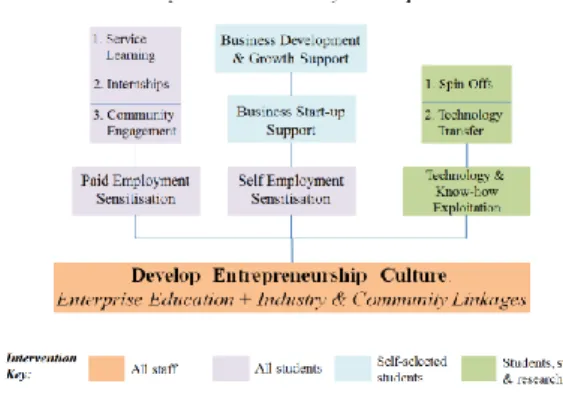
Palestinian Polytechnic University has developed its vision "Towards Science, Technology, and Innovation Entrepreneurial University", and has developed a model to the transmission of the Entrepreneurial University. [23].
The Below Figure I Shows PPU Entrepreneurial University Development:
Figure I: EC-OECD Framework for Entrepreneurial Universities, Source: (PPU, 2014).
METHODOLOGY
Price elasticity of demand measures the responsiveness of demand to a change in price and, where the Elasticity of supply measures the responsiveness of supply to a change in price, both of elasticity in demand and supply are computed as the percentage change .
Price inelastic – a change in price causes a smaller %change in demand. Price elastic – a change in price causes a bigger % change in demand. Elasticity of supply measures the responsiveness of supply to a change in price, Inelastic supply means an increase in price causes a smaller % change in supply. It means firms have difficulty increasing supply in response to a rise in price.
the simplified formula for percentage change is: (new value – old value)/old value.
Both the elasticity of supply and demands using the following formulas:
Price elasticity of Supply =
it is equal to the formula = (Q2-Q1/Q1) / (P2-P1/P1).
Price elasticity of Demand =
it is equal to the formula = (Q2-Q1/Q1) / (P2-P1/P1).
First exam was used as a Pretest exam for the students.
Wageez Math is a compact application designed to help Students in learning the basic math operations. The program allows Students to answer a series of questions in the Interactive mode and provides them with the answer after a few seconds in. Students can select the type of operation (Addition, Subtraction, Multiplication, Approximation, Common fractions, Decimal fractions, Math Games).
Figure II: Alwageez 6 Software.
1. Research Design and Sample
The 67 Participant Students of this study were all from Associate Degree (Diploma 2 Years) from College of applied professions at Palestine Polytechnic University, and registered for two Economic class.
The 67 Participant are all the students who registered for the Economic course in this semester.
This study employed a quasi-experimental design. A pretest and posttest was administered to both the two groups. The experimental group underwent an intervention where they learnt fractions using “wajeez Math Software, Common and Decimal fractions section “version 5” to teach fractions for two weeks, while the control group they learnt fractions using traditional chalk and talk method.
Two classes of Economics registered student were selected for this study, they were sixty seven students from different disciplines at College of Applied Professions at Palestine Polytechnic University. Their academic achievement were comparable as they were appointed to each class by zigzagging after they were streamed according to Pre-test examination result. Tow mutual groups was founded after making the Average for the two classes and three students were excluded. The result for the two classes in figure 3 below:
%change in Supply %change in Price
7
http://innove.org/ijist/
Figure III: Composition of Sample.
From the Figure III above we have obtained two equal sample through the average of pretest exam which was for the first group – 32 student – the average was 5.31, and for the second group – 32 students – the average was 5.71, Where the two samples can be considered almost equal.
2. Research Procedure
This study took place at College of Applied Professions at Palestine Polytechnic University after these students had their first exam in the Economics class. The examination covered the subject of elasticity of demand and supply, which is used fractions (Multiplication and Division), and the researchers found that they were struggled when they used fractions. They have learnt the fraction at school. Due to that, researchers has to teach them the concept of fractions. Both of the two groups sat for an achievement test on fractions which is called Pretest exam.
For the control group, it was used by teaching them how to solve the elasticity questions in the traditional way. Because researchers needed to refresh the concepts of fraction, and they have studied for examination.
The experimental group students were taken to the Computer laboratory for three time for one week, with one work hour. The researchers teach the student the concept of fractions by using the software and by using the game in this software.
After that both the control group and experimental group sat for the achievement test that is called posttest exam.
Figure IV: Research Model.
From the above figure III pretest was used to have similar sample (Matching) in order to made the intervention through the software for the experimental group. Moreover, posttest to examined the intervention results through posttest.
3. Data Analysis
Statistical Package for the Social Sciences (SPSS) was used to answer the objectives of this study. Achievement test scores were analyzed. The test was used to test for )Mean score, Students' knowledge of the elasticity law, The correct application of the elasticity law, and Error rate in fractions operations) between the pretest and posttest exam for the control group and experimental group. And SPSS was used to test the independent t-test for pretest and posttest for both groups.
RESULTS
In this section pretest and posttest done and this results of this study are discussed in the following tables and figures below:
8
http://innove.org/ijist/
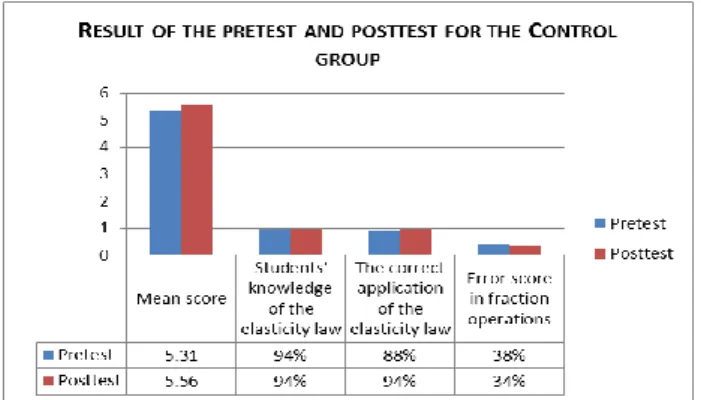
The Figure V above showed that the control group obtained a mean score of 5.31 in pretest exam while they obtained 5.65 in posttest exam. And the students‟ knowledge of the elasticity law in pretest and posttest are equal with 94%. The students application for the elasticity law in pretest was 88% correct, while in posttest was 94%. Finally, the students hade error score in fraction operations in pretest 38%, and 34% in posttest. This means that there has been an improvement in student achievements after the posttest exam.
TABLEI: Result of the Independent t-test on the pretest of both groups
Group N Mean Std. Deviation
T Sig. (2
Tailed)
Control 32 5.31 1.71
0.834 0.407 Experimental 32 5.71 2.15
Table I above showed that the control group obtained a mean score with 5.31, while the experimental group obtained a mean score of 5.71. The t value was 0.834, However the p-value was not significant with a p-p-value of 0.407 (p>0.05). This results indicate that we accept the null hypothesis (there is no difference between mean grades for the control and experimental group), in other words, we accept the alternative hypothesis (there is no difference between mean grades for the two groups). Making another exam using the same teaching methods do not affect the results of the students.
FigureVI: Result of the pretest and posttest for the experimental group
The Figure VI above showed that the experimental group obtained a mean score of 5.71 in pretest exam while they obtained 6.34 in posttest exam. And the students‟ knowledge of the elasticity law in pretest was 93%, and 96% in posttest. The students application for the elasticity law in pretest was 90% correct, while in posttest was 96%. Finally, the students hade error score in fraction operations in pretest 40%, and 31% in posttest. The results above showed that there is improvement in student achievement after the posttest exam.
TABLE II: Result of the Independent t-test on the posttest of both groups.
Group N Mean Std. Deviation
T Sig. (2
Tailed)
Control 32 5.56 1.58 2.05 0.044
Experimental 32 6.34 1.45
Table II above showed that the control group obtained a mean score with 5.56, while the experimental group obtained a mean score of 6.34. The t value was 2.05, However the p-value was significant with a p-value of 0.044 (p>0.05). This results indicate that we reject the null hypothesis (There is no difference between the mean grades for the two groups). This means that the difference in the man score of both two groups was significant. This independent sample t-test was done to examine whether any significant differences exist between the posttest mean score of both the Control and Experimental group.
Findings from this study showed that the experimental group improvement is higher than the control group. The mean score after the posttest for experimental group was 6.18 while in control group was 5.65. Error score in fractions operations in posttest for experimental group was decreased from 40% to 31%, while in control group was decreased from 38% to 34%. This means that there was big improvement in experimental group in using the fractions and this thing appeared when dropped in the use of fractures by 9%, while in control group dropped by 4%.
Finding from this study also showed that the student problems was not due to the concept of elasticity when both of the two groups have high knowledge in elasticity law before and after using pretest and posttest exam. On the other hands, both the two groups have applied correctly on the use of elasticity law.
DISCUSSIONS
Based on the researchers theory, which states that the weakness of the students in the Economic course signs is due to the weakness in the fractions, and not because of their lack of understating of Economic Concepts.
fraction instruction beginning in elementary school, many people fail to gain a firm understanding of fractions and harbor misconceptions through high school and college [13].
The studies about fractions have identified many misconceptions of students. The main reason for these misconceptions is that, in the teaching of fractions, one early passes to operations and numerical representations without understanding the important elements of fractions such as dividing whole into equal parts, identifying unit, unitizing and re-unitizing etc. [18]. Therefore, it is clear that if we want to enrich students‟ understanding of fractions and to help them overcoming their misconceptions, we should foremost start by overcoming the shortcomings of student teachers in this subject [4].
9
http://innove.org/ijist/
will jeopardize their perception toward mathematics in later stages [28]. Furthermore, These findings are encouraging and suggest that ICT-based learning activities are well-accepted by students. And this finding support previous studies to show that using technology in learning does give positive impact in constructing students understanding of any discipline and one of them are fractions.
This study was done to support the vision of Palestine Polytechnic University of the shift towards enterprising learning, These results support and stimulate university staff to shift towards enterprising learning, and the need to use technology in the teaching of all disciplines operations. with the possibility of cooperation with other universities in order to deepen the idea of enterprising learning, even more than of academic achievement for students.
CONCLUSION
If you want to get better results, you should use modern methods, especially the use of ICT in the learning process.
Several studies have talked about the use of technology in the learning process, and this study agrees with these studies regarding the methodology in the use of technology in learning.
The problem with students was that they did not know how to deal with fractions, not because they were not familiar with economic concepts in terms of demand and supply.
The finding of this study showed that using computer software in learning fraction has been effective. This was shown through the improved in (Mean score, fraction error rate) of the experimental students group.
Experimental group performed better when using the Software than control group that used the traditional teaching method. In addition, using software enhanced the concepts of fraction understanding for experimental group.
I advise the PPU University and College of applied professions to give the math course - which is compulsory course - to students before economics course, or to be in conjunction with it.
I advise also to use this Software or other similar Software to teach mathematics through the use of enterprising learning not only for economic course but also for all courses.
ACKNOWLEDGMENT
This research was supported by Palestine Polytechnic University (PPU). We thank our colleagues from PPU who provided insight and expertise that greatly assisted the research, although I would like to thank the students who was participated in this research.
FUTURE WORK
Another research is needed in order to make another comparative and to investigate the effect of using software in student achievement. And although another software is needed to make this comparatives.
REFERENCES
[1] A. Shittu. N. A. and Shittu, A. J. K, “Critical issues in evaluating education technology,” 47-58. doi: 10.4018/978-1-60960-015-0.ch004, 2011
[2] A. Katmad, A. Mavidis and T. Tsiatosos,” Implementing Gave for Supporting Learning in Mathematics”, The Electronic Journal of e-Learning Volume 12, (230-242), Issue 3 2014, available online
at www.ejel.org
[3] A.J. Grillo, A.D Latif, and K.S Stole, “The relationship between preadmission indicators and basic math skills at a new school of pharmacy,” The annals of pharmacotherapy, 35 (2), 167-172, 2001.
[4] Savas, “Primary Studetn Teachers‟ perspectives of the Teaching of Fractions,” Acta Didatica Napcensia, Volume 9, Number 1, 2016. [5] E. Pacetti,“Improving the quality of education in Palestine through e-Learning and ICT: the bottom-up approach for a sustainable pedagogy”, University of Bologna, Bologna, Italy, January 2008. [6] Electronic Journal of Mathematics and Technology, Volume 3,
Number 1, ISSN 1933-2823.
[7] Fuchs, Thomas and Woessmann Ludger, CESIFO working paper no. 1321, Gategory 4: Labour Markets, Novermber 2004. [8] G. Booker, “Children‟s construction of initial fraction concepts,”
In A. Olivier A k. Newstead (Eds.), (Vol. 2, pp. 128-135). Stellenbosch, South Africa: Program Committee of the 22th PME Conference, 1998.
[9] Garnett (1998) „Math learning disabilities‟, LD Online, [Online], Available: www.ldonline.org/article/5896 [30 Dec 2013]. Reference this paper as: Aikaterini Katmada, Apostolos Mavridis and Thrasyvoulos Tsiatsos “Implementing a Game for Supporting Learning in Mathematicss” The Electronic Journal of e-Learning Volume 12 Issue 3 2014, (230-242) available online at www.ejel.org.
[10]https://cetl.ppu.edu/en/actionresearch/Sharing Our Experiences 1st Symposium- 29/05/2016.
[11]https://www.ppu.edu/p/en/about.
[12]J.R Murnane, B.J, Willet, and F. Levy, “The growing importance of cognitive skills in wage determination. Review of Economics and Statistics, 77(2), 251-266, 1995.
[13]K. Fazio, “Casey A, Siegler. Rober S, Improving Children‟s Knowledge of Fraction Magnitudes, PLOS One \DOI:10.1371/Jornal.pone.0165243, 2016.
[14]Katmada Aikaterini, Mvridis Apostolos, and Tsiatsos Thrasyvoulos, “Implementing a Game for Supporting Learning in Mathematics” The Electronic Journal of e-Learning Volume 12 Issue 3 2014, (230-242) available online at www.ejel.org. [15]M.G. Lioyd, and M. Wilson, “Supporting innovation: The impact
of a teacher's conceptions of functions on his implementation of a reform curriculum,” Journal for Research in Mathematics Education, 29(3), 248-274, 1998.
[16]Mack K Nancey, Learning fractions with understanding: Building on information knowledge, Northen Illinois Unversity, Journal for Research in Mathematics Education 1990, Vol. 21, No. 1, 16-32. [17]Ministry of Education, Taipei, Taiwan, 2008.
01
http://innove.org/ijist/
[19]N.Wahbeh,”ICT and Education in Palestine: Social and Educational Inequalities in Access to ICT. A Case Study Approach. A.M. Quattan Fundation, 2006.
[20]National Assessment of Educational Progress 2001, Retrieved September 2008 from http://www.doe.k12.ga.us/sla/ret/naep.htm
[21]P. Groff, “Is teaching fractions a waste of time?” Clearing house, 69, 177-179, 1996.
[22]P. Lena, A.Tobias, D.Ylva, H. Magnus, and G.Agneta, “A Teachable-Agent Arithmetic Game‟s effects on Mathematics Understanding, Attitude and Self-Efficacy‟, Proceedings of the 15th International Conference on Artificial Intelligence in Education, Auckland, , Lecture Notes in Computer Science, Volume 6738, pp. 247-255, New Zealand, 2011.
[23]Palestine Polytechnic Universtiy, “Progression Towards an Entrepreneurial University Model, by Van Morar, Nuffic NFP-TMT Project, Maastricht School of Management, 2014. [24]R. Judy, and H. Chathrin,“Computer game design: Opportunities
for successful learning”, ScienceDirect, Computer & Education 50 (2008) 559-578, 2007.
[25]R.jhon,”Student Achievement Effects of Technology-Supported Remediation of Understanding of Fractions, Paper presented at the annual meeting of the Canadian Society for the Study of Education, Ottawa, May 2009.
[26]Rimer Kelly, and Moyer Patricica s. Jl. of Computers in Mathematics and Science Teaching (2005) 24(1), 5-25).
[27]S.Ed,”Does ICT contribute to powerful learning environments in primary education. Computers and Education, 44(3), 343–355, 2004.
[28]T.noorbaizura, E.Leon,“Effect of Student‟s Achivement in Fractions using GeoGebra”, SAINSAB, Vol. 16, pp 97-106, ISSN 1511 5267, 2013.