Corresponding Author. Mail. [email protected]
18
Innovative Research in Engineering Sciences Vol 2(3), 18-24(2016)
Journal of Innovative research in engineering sciences
Journal homepage :
www.Joires.com
Optimization of gas consumption in the city of Kashan
Alireza Rahimi
Assistant Professor, Energy Research Institute, University of Kashan, Kashan, Iran.
Abstract: This research, regarding research projectNo.92/27843(between the gas office of Kashan and Kashan University) has been conducted in the city of Kashan in order to reduce the consumption of natural gas in four hundred government agencies (including Schools and training centers, hospitals and health facilities, banks and financial institutions and...) The project implementation has been extracted from the plans of energy consumption optimization in Germany. According to this plan, the process of gas consumption in several government agencies has been controlled subtly. And after identifying the reasons for inappropriate usage of natural gas in these institutions, Gas optimization courses for four hundred heads of government agencies has been held. After that, from the staff of each of these institutions, one person was designated responsible for the energy and with providing them with the required instructions, controlling the amount of gas consumption has been dealt with. For all government agencies, free consulting services were given in2014 in order to optimize gas consumption and to know how to control the amount of gas consumption and following results have been obtained: 1- The government agencies, which have radiators as the heating system and they are not off at the end of office hours, have experienced Gas consumption increasing’s even times as much as it is needed.2- For several reasons, the optimization of gas consumption in government agencies is a higher priority than otherconsumers.3- it is inevitable to provide the necessary training courses in order to optimizegasconsumption.4- Cooperation between officials and heads of government institutions ,especially gas office and governor ’ offices are essential for optimization of the natural gas usage.5- Legally, for each major consumer of natural gas, energy management should be implemented.
Keywords: Optimization, gas consumption, government agencies, educational institutions, health facilities, banks
1. Introduction
In order to implement the plan for optimization of natural gas usage projecting the city of Kashan it has been tried to adopt the German experience in this field.
Accordingly, the process of optimizing energy
consumption in that country has been studied. Germany is a country built on the ruins of World War II, with an area of about 357thousandsquare kilometers (about one-third of Iran) and a population of about83million and with a GDP ofabout9.2trillion dollars, the largest economy in Europe and the third largest among countries of the Organization for Economic Cooperation and Development (OECD) (1). It was estimated in 2005that Germany had oil reservesabout367millionbarrels (with a daily production of170,000 barrels and natural gas reserves and resources in 2006were about9trillioncubic feet, and coal resources of about 7.5billiontonsin 2001. (2) In Germany 33% of energy consumption is in the industrial sector, 27% in transportation, 25%residential and15% in other sectors. (1) Natural gas consumption inGermanyduring1990 and 2005increasedby 8percent. The share of natural gas in total energy consumption in Germany was24% in2004, while domestic production was730billion cubic feet; it imported about 3trillion cubic feet of gas. (2)Strategies for optimization of the energy consumption in Germany are
based on a significant reduction in energy consumption and increase in the share of gas in energy consumption by 2050. During these years, nuclear power plants will gradually be out of the circuit and natural gas increased efficiency will make up for the deficit resulted by reduced consumption of other fossil fuels(1)
The basic guidelines for making energy policy in Germany: These guidelines have been developed based on the following parameters:
1- Increasing the Energy Efficiency
2- To Free the prices of energy carriers
3- Relying on domestic production
4- Increasing the share of renewable energies
5- Reducing the environmental impact by using renewable
energy
While the share of nuclear energy and coal for electricity generation decline sharply in Germany in the years from 2000to 2050, the share of natural gas for electricity production in the country will increase. Thus, for greater efficiency in the production electricity by natural gas the plants for combined heat and power take center stage, and besides providing the training courses for energy experts and publishing the results for reduction in energy consumption leads to provide cultural contexts for the
optimization of energy consumption (1).In the
19
ministry is in charge of optimization of and increase the energy efficiency projects in German (2). By programs ofoptimizing the energy consumption done
inGermanybetween1990 and 2005 the intensity of energy consumption reduced by 20 %.( 1)
The results obtained from the implementation of strategies to optimize energy consumption in Germany:
Quality evaluation of the implementation of strategies to reduce energy consumption is assessed at three levels: low, medium and high. Strategies intended to reduce energy consumption are in the forms of financial support, legal matters, voluntary agreements, tax mechanisms, training and providing the information as well as other market-based instruments. And each of these approaches covers its target population. Accordingly:
1- Combined heat and power, which has with financial support, and with target population of suppliers has been assessed to have an average qualitative impact. (Execution period: from 2002 to 2010)
2- Using solar energy for homes, which has financial support, and with target population of Large, small and medium-sized enterprises (smes) and civil engineers has been assessed to have a little qualitative impact. (1999) 3- Voluntary agreements with industries, with target population of large companies, energy suppliers,
specialized companies, small and medium-sized
enterprises(smes) and entrepreneurs, have been evaluated to have a high qualitative impact(2001)
4- Notification of heating systems with target population of Large, small and medium-sized enterprises (smes) with the guideline of legal notifications has been assessed to have an average qualitative impact.(2000)
5- Conserving the Environmental and energy saving with
tax strategy with the target population of small and medium-sized enterprises (smes) has been assessed to have a low qualitative impact.(1985)
Results obtained from the study of plans to reduce energy consumption in Germany indicate that plans which have targeted the main consumers (e.g. large and small industrial enterprises,) have been assessed average and high grade, while strategies to reduce energy consumption which have approaches based on education and voluntary agreements have higher levels of evaluation rate.
The plan for Optimization of gas consumption in the city of Kashan (Rahimi 2015)
Due to the fact that in Germany, strategies to reduce energy consumption which have approach based on education and voluntary agreements have higher levels of evaluation rate, so in the plan for optimization of gas
consumption in the city of Kashan providing the information and training have taken priority. Moreover, since in this plan four hundred government agencies (including all the Schools and training centers, hospitals and health facilities, banks and financial institutions and...) have been chosen as the target population. Thus, for the legal basis of the implementation of this plan some measures should also be considered. To this end, in cooperation with the National Gas Company of Esfahan, information about energy resources and the energy consumption in the developed industrial countries were provided for the heads of all government agencies. This project was approved at the meeting of the administrative council of the city of Kashan and based on that, the heads of all government agencies were required to cooperate to implement this plan. The main objectives of this plan are: (Rahimi 2015)
1-
Providing free consulting services to all government agencies in order to reduce gas consumption.2-
Holding the training courses on the need forimplementation of plan for the optimization of gas consumption and its process. About four hundred heads of government agencies attended these courses and information about the status of optimizing energy consumption in the developed countries and the Iran situation in this regard, the condition of energy resources in Iran and the world, global approaches to energy saving were provided for them.
3-
Offering the method for energy consumption in the government agencies and the indiscriminate use of gas in the offices and other numerous issues.4-
Appointing an employee of any of the agencies in charge of energy management and training the min order to continually control the use of natural gas.5-
Providing the required forms for recording information about the amount of gas consumed daily.6-
Inspections and subtle control of how gas consumed inevery agency, in collaboration with fifty students of Kashan University.
The amount of gas consumed and the its actual cost is some government agencies in 2013 (Rahimi 2015)
20
Diagram1.The diagram of gas consumption in the office Five hundred meters far from each other with the equal building area
In the first office, the heating system consists of conventional gas heater sand walls are insulated, while in the second office consists of central heating –radiator sand the building is not insulated. Moreover, in the first office after office hours and in the holidays, gas heaters have been off, while in the second office, the central heating system has worked continually. In addition to the above, absence of in solution in the second office has led to increase in the amount of natural gas consumption. From diagram (1), it is understood that even in the warm months the gas consumption in the second office is about seven times more than the first office. The reason is that in the first office water heater has been used to supply hot water, but for supplying the hot water in the second office, Hot water boiler and double boiler without insulation were used. If we calculate the cost of gas used in each of these offices based on gas export prices (around 0.35 USD per cubic meter) the diagram (2) is formed. As it can be seen in the diagram (2) in one year, in the second office that had higher level of consumption, more than 7600 USD has been cost, while the actual cost of natural gas consumed in the first office ,which had lower level of consumption, was around 1600USD. About 6000 USD difference in gas consumption in two offices with the equal building area and five hundred meters far from each other shows how much capital each year is wasted in this case. The investigation of the reason for the difference in the level of gas consumption in two offices with the equal building area and Five hundred meters far from each other Indicates that the following factors have resulted in a seven-fold difference in the rate of gas consumption (Rahimi 2015)
1- The heating system of the first office (which consumed less gas) consists of conventional gas heaters and the heating system of the second office (which consumed seven times as much as the first office) consists of central heating system and radiators.
2- The heating system of the first office turned on at the start of office hours turned off one hour before the end of office hours, while the heating system of the second office has been active around the clock. The custodian need for heating the in the second office was the reason for its heating system being active.
3- Hot water used in the first office was supplied by conventional water heater, while hot water needed in the first office was supplied by Hot water boiler and double boiler. This is the reason for 7-fold level of gas consumption in the second office in the summer.
4- Absence of insulation in the heating system in the second office has led to more increase in gas consumption.
5- On the one hand, Lack of knowledge of the
administrators of the second office about the solutions to reduce gas consumption, and on the other hand the relevant bills having been paid by the government (and partly the lack of sufficient commitment in administrators of the second office) altogether have resulted in gas consumption being more than it is needed in the second office.
6- The lack of binding rules for compliance with the
21
Diagram 2.The actual cost of gas consumed in two offices with the equal building area located on a same street
In the diagram (Rahimi 2015), the amounts of gas consumed by four major consumers (including the University of Kashan, Kashan University of Medical Sciences, and Islamic Azad University of Kashanand Kashan Shahid Beheshti Hospital) have been shown. In the diagram (Rahimi 2012) the actual cost of Total gas consumed from March 21st 2013 to March 21st2014, has been shown for four major consumers of the natural gas based on subsidized rates and also gas export prices. According to the diagram (Rahimi 2012), payments based on the subsidized price of natural gas compared to the actual value of gas consumed Is very little and almost negligible and this has led to the unconventional gas consumption,
Even at academic centers such as Kashan University and Azad University of Kashan (Rahimi 2015)
The total value of the gas consumed in forum in consumers in 2013, based on export price is around 2206000 USD and based on subsidized price it has become about 220600 USD. According to some conducted research, management of gas consumption in this four major joints, can reduce the amount of gas consumption by up to 40%, without the need for new investment or undermining the quality of service, in order to achieve this level of parsimony it is enough to turn off the heating and cooling systems after office hours, on days when the weather is good and in the holidays (Rahim 2015)
22
Diagram 4.Comparing the price of natural gas in 2013forfourmajor consumers based on subsidized and export prices
Conclusion
According to research conducted, with applying the management of gas consumption in government agencies, in most cases the amount of gas consumption can be reduced by up to fifty percent .The experimental work have been done in this areas hawed that with spending around1470USD, we can save about twenty thousand cubic meters of gas per year (with the actual value of about 7060 USD). This amount of parsimony is equivalent to 80%of annual gas consumption in one of the government agencies in the city of Kashan. Gas consumption management does not need new investment and it is also very effective on reduction of air pollution. (Rahim 2015) Factors that have caused the excessive gas consumption in government offices include:
1- Administrators lack of adequate information about the office supplies and ways to optimize the energy consumption of gas. 2- Free provision of Gas for government agencies. 3- The lack of binding rules for efficient way of gas consumption in government agencies. 4- Lack of commitment in some cases. 5- Lack of national determination to reduce gas consumption. 6- Failure to provide information and training in the field of efficient way of gas consumption. By comparing the actual price of the annual gas consumption with its subsidized price
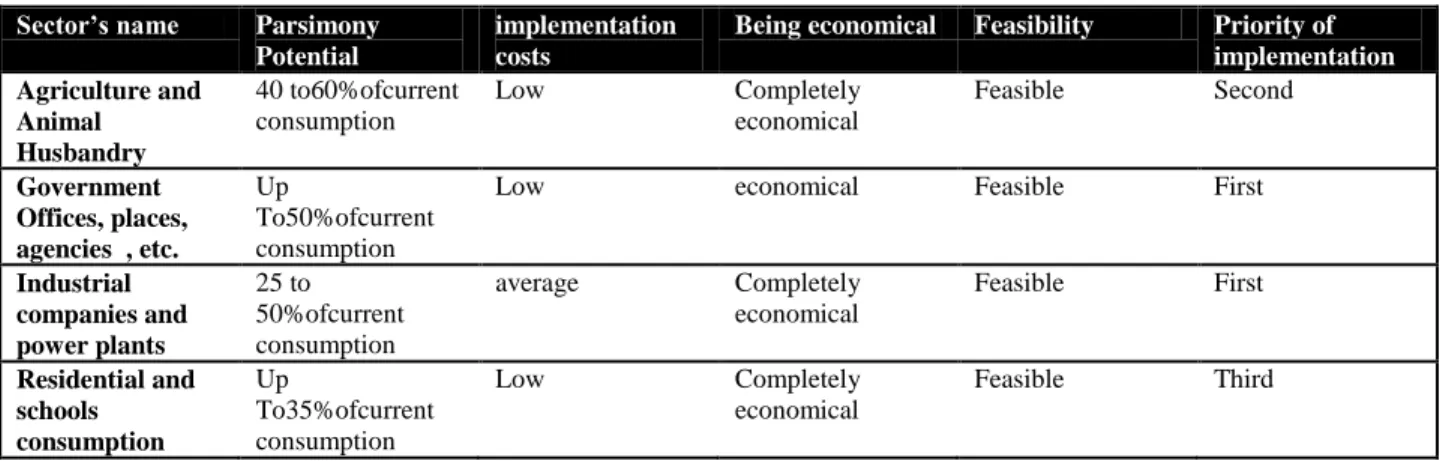
Concerning 4 major consumers (2206000 USD in comparison with 220600 USD) we can understand that how the national capital was burned and its consequent problems such as air pollution, cutting industries’ gas, industrial and economic backwardness make problems for people. In the plan for optimization of gas consumption in the city of Kashan, consumers of industrial, domestic, agricultural and animal husbandry [Rahimi 2012] origins and the thermal power plant and …they all have also been considered that we have not given all the details about them. A summary of the data obtained in the plan for the optimization of gas consumption in the city of Kashan has been presented in Table 1. In this table, low running costs and completely efficient situation means that return on Investment for the optimization of gas consumption gained from reduction in fuel consumption at the rates of energy carriers of 2014, will achieve within three years. Average cost of implementation and the efficient situation means that the investment made to optimize gas consumption at the price of gasin2014 will be paid back within five years. The feasibility of projects of optimizing the natural gas consumption means that the implementation of these plans with existing technology, tools and equipment in the country is quite possible and there is no need to have the new technology of industrialized countries.
Table 1.The results of the optimization of gas consumption in the city of Kashan
Sector’s name Parsimony Potential
implementation costs
Being economical Feasibility Priority of implementation Agriculture and
Animal Husbandry
40 to60%ofcurrent consumption
Low Completely
economical
Feasible Second
Government Offices, places, agencies , etc.
Up
To50%ofcurrent consumption
Low economical Feasible First
Industrial companies and power plants
25 to 50%ofcurrent consumption
average Completely
economical
Feasible First
Residential and schools consumption
Up
To35%ofcurrent consumption
Low Completely
economical
23
Recommendations
According to the results obtained in optimization plan of gas consumption in the city of Kashan, in order to improve the implementation of similar projects, the following is recommended:
1- The financial support from the government (as
provided low-interest loans with longer payment period) can reduce the problem of optimization projects cost in the industrial sector and....
2- The ground for cooperation with foreign companies, which are specialized in consumption optimization, should be laid for the implementation of optimization projects. 3- optimization projects of gas consumption should start from the major consumers(such as gas power plant sand large industrial companies) then it reaches The government agencies, banks, schools, training centers and…. And finally include the residential sector.
4- First, The projects for the reduction in energy consumption should be implemented and then energy carriers and natural gas be provided at actual price
5- Gas consumed in large industrial companies should be
provided at the actual price, and in return firstly, taxes levied on them should be decreased and then gradually increased over a period of five year. This will provide an opportunity for these companies to implement energy optimization projects without increasing their prices due to their reduced tax payment.
6- A set of factors effective on the optimization of gas consumption should act as a centralized group. For example, in some cases it has been observed despite substantial loans granted to optimize gas consumption no significant measures have been taken and even Loans received have been spent in other areas.
7- It is recommended that the city of Kashan hinged on Energy Research Institute, University of Kashan be selected as a model area by the government and all
operations related to the optimization of gas
consumption(including offering the plans, cost estimates, foreign partnership, granting the loans, giving the results, etc.) all should be conducted in a centralized way and in Collaboration with Energy Research Institute University of Kashan.
Acknowledgment
To Mr. Engineer Momeni the Hon. Chairman of the National Gas Company of Isfahan, Isfahan Hon. Deputy governor general and Hon.governor of special city of Kashan Mr. Engineer Sadrayieh, Mr. Engineer Nabovati the chairman of the Gas Office of Kashan, Mr. Engineer Khatami the chairman of the Gas Office of Natanz, Mr. Engineer Ghandi the chairman of the Gas Office of
Ghamsar,Mr. engineer Kafizadeh the chairman of Jihad
-e-Agriculture office of Kashan, Mr. Dr. Golabi Hon chairman of Energy Research Institute University of
Kashan and Other people involved in the project ,who have helped us, we offer our acknowledgement.
Reference
[1]. Energy efficiency policies and measure in the Germany 2006, monitoring of energy efficiency in Eu and Norway (opyssee-mure), Franhofer institute for system and Innovation research (Fraknhofer ISI).
[2]. Energy policies of IEA countries, International Energy Agency, Germany, 2002.
[3]. Rahimi, A.R. (Optimization ofenergy consumption in thecityof Kashan) Research Project No. 92/27843 the staff: The Gas Office of Kashan, 2015.
[4]. Rahimi, A.R. (Optimization of fuel consumption Soumeh Broiler checkens farms. Research Project No. 182939, the employer Agro Industry Paktyn Co., 2012.
[5]. Scientific and technological cooperation agreement between the University of Kashan and Jihad
-e-Agriculture office of Kashan, agreement No. 27301 dated, 2012.
[6]. Mostafaeipour, Ali, Behnoosh Bardel, Kasra Mohammadi, Ahmad Sedaghat, and Yagob Dinpashoh. "Economic evaluation for cooling and ventilation of medicine storage warehouses utilizing wind catchers." Renewable and
Sustainable Energy Reviews 38 (2014): 12-19.
[7]. Mehan, Asma, Hoda Mortazavi Alavi, and Hoda Behraveh. "Analysis and Investigation of Lasting Architectural Projects and Plans in Housing in Post Era of Ghajar, Tehran." Journal UMP Social Sciences and Technology Management Vol 3, no. 2 (2015).
[8]. Maghanaki, M. Mohammadi, B. Ghobadian, G. Najafi, and R. Janzadeh Galogah. "Potential of biogas production in Iran." Renewable and
Sustainable Energy Reviews 28 (2013):
702-714.
[9]. Panahi, Siamak, Qasem Mirzaei, and
Mohammad Mohammadikia. "Comparative Analysis of Natural Elements in the Architecture of Tabriz and Kashan Houses (During Qajar Era)." Middle-East Journal of Scientific
24
[10].Motamedi, Majid, Shahram Moeeni, Salman
Gharakhani, and Iman Keyfarokhi. "The Behavior of Iranian Restructured Electricity Market in Supply Function Equilibrium Framework." International Journal of Academic
Research in Business and Social Sciences 4,
no. 1 (2014): 178-191.
[11].Jamshidi, Mehran, Naghmeh Yazdanfar, and
Masoud Nasri. "Increasing of Energy Efficiency based on Persian Ancient Architectural Patterns in." Case study of traditional houses in Kashan. World Academy of Science, Engineering and
Technology 56 (2011): 360.
[12].Koyoma, Ken. "Oil Market in China, Current Situation and Future Prospects."The
Institute (2002).
[13].Karizi, Adel Ataei, and Mahjoobeh Noohi
Bezenjani. "The impact of sustainable architecture patterns in optimizing energy consumption (Case Study: hot and dry climate)."
[14].Moghbeli, Hassan, Abolfazl Halvaei Niasar, and
Naser Fallahi. "Fuzzy energy control strategy of through-to-road hybrid electric vehicle." In 2014
IEEE 23rd International Symposium on
Industrial Electronics (ISIE), pp. 1660-1665.
IEEE, 2014.
[15].Eslamian, Saeid, and Niloufar Lavaei.
"Modelling nitrate pollution of groundwater using artificial neural network and genetic algorithm in an arid zone." International Journal of Water 5, no. 2 (2009): 194-203.
[16].Ghobadian, Vahid. "Shape of Sustainable
Houses in Iran: A Climatic Analysis." European
Online Journal of Natural and Social Sciences 4,
no. 3 (s) (2015): 110.
[17].Shemirani, Seyed Majid Mofidi, and Hamed
Moztarzadeh. "Physical Criteria Codification of Urban Sustainable Communities (Emphasized on Iran Hot and Arid Climate)." American
Journal of Scientific Research 86 (2013): 12-27.
[18].RIYAHI ALAM, M. O. H. A. M. M. A. D.,
HOSSEIN FORSS, and SARA AFRAZ.
"Sustainable, energy saving and developed urban and housing project in district 6th of Shiraz city." (2013).
[19].Walton, Raymond. "Impacts of Global Climate Change." ASCE, 2005.
[20].HosseinAbadi, Saeed, Hasan Lashkari, and
Mohammad Salmani Moqadam. "Climatic Design of Residential Building of Sabzevar with Emphasis on Building Orientation and Depth of Canopy." Spatial Analysis of the Relationship between Social Capital and Sustainable Urban Development Case Study: Cities of West