S U R V E Y
Perceptions regarding minimal intervention dentistry
among dental interns in India: A cross-sectional survey
Gaurav Gupta, Namita Shanbhag, Manjunath P. PuranikDepartment of Public Health Dentistry, Government Dental College & Research Institute, Bengaluru, Karnataka, India
Abstract
Purpose: Minimal intervention dentistry (MID) is a treatment philosophy that emphasizes protection of existing tooth structure. It has been incorporated in the dental curricula worldwide in the management of dental caries. There is limited evidence that whether the familiarity with MID principles imbibed through the curriculum is translated into clinical decision-making and practice. This study was conducted to assess the knowledge, attitude, practice and behavior of dental interns toward MID. Materials and Methods: Across-sectional survey was conducted in the year 2014 for a period of 2 months among dental interns of all the dental colleges in Bengaluru city using a self-administered validated questionnaire. In addition to the demographic profi le, 25 questions focused on knowledge, attitude, practice and behavior toward MID. The data were analyzed using descriptive and inferential statistics. Results: Atotal of 417 questionnaires were found to be legible with an overall response rate of 90%.The mean scores for knowledge (3.40 ± 0.85), attitude (18.74 ± 2.8), practice (27.55 ± 6.8), and behavior (1.11 ± 0.9) showed that these interns had adequate knowledge and a positive attitude toward MID. However, their behavior toward MID was negative, and they did not practice MID very often. The mean attitude score showed a signifi cant correlation with knowledge and practice. Conclusion: Interns exhibited adequate knowledge and positive attitude which they acquired through their undergraduate curriculum, but it failed to create positive behavior toward practicing MID. Hence, it can be suggested that there is need to instill positive behavior among students so that they practice MID routinely.
Keywords: Dental caries, dental education, knowledge, minimal intervention dentistry Correspondence
Dr. Gaurav Gupta, Department of Public Health Dentistry, Government Dental College & Research Institute, Bengaluru, Karnataka, India. Phone: +91-7259972369, E-mail: [email protected].
Received 23 January 2015; Accepted 26 February 2015
doi: 10.15713/ins.ijcdmr.44
How to cite the article: Gaurav Gupta, Namita Shanbhag,
Manjunath P. Puranik, “Perceptions regarding minimal intervention dentistry among dental interns in India: A cross sectional survey,” Int J Contemp Dent Med Rev, vol. 2015, Article ID: 330115, 2015, doi: 10.15713/ins.ijcdmr.44
Introduction
The traditional restorative approach in practice followed the concepts of G.V. Black i.e. “extension for prevention.” This surgical approach was not tooth preserving, removing large amounts of tooth structure to accommodate the restorative material of choice and lead to what is described as repeat restorative cycle.[1] A paradigm shift is seen today in clinical
dental practice as a result of newer technologies, the development of adhesive restorative materials, and enhanced comprehensive knowledge in the fi eld of cariology. This shift is from the surgical model for caries management to the medical model where disease is managed by the “oral physician” and an associated oral health team.[2]
The focus on prevention and early caries detection has paved way for the concept of minimal intervention dentistry (MID). A treatment philosophy based on the medical model which incorporates assessment of the risk of disease, early detection
and prevention; remineralization of tissues; use of a variety of dental materials and equipment and surgical intervention when necessary or only when the disease has been controlled.[3] Disease
elimination and regular follow-up care are mainstay of MID. Mount, fi rst cited the need for “minimal treatment” of dental caries. Davis and Makinson, fi rst termed “MID” in the literature.[4]
The treatment a dentist adopts is most likely a result of the dental school training practice experience, and the continuing dental education.[5] Studies have reported that the dental schools
must accept the responsibility for teaching more important and complex aspect of care such as practice to arrest initial caries progression and prevent the formation of cavity than to focus on surgical intervention, as the prime measure to control caries.[6]
These approaches have been incorporated in the structure of various dental curricula worldwide[4] so that while passing
attitudes. Dental interns are graduates from the same school, with postings equally distributed in various dental departments during the stipulated 1 year. Training in minimal intervention is mainly provided in the 3rd and fi nal years of dental school in the
Disciplines of Pediatric Dentistry and Public Health Dentistry. Despite these trends toward conservative dental treatment, little is known about the familiarity of these concepts among the dental interns and whether the knowledge on MID acquired during their training period translates into practice or clinical decision making process? This study was therefore aimed to assess the knowledge, attitude, practices and clinical decision behaviors of dental interns of Bengaluru city, India. Secondly, whether the knowledge they acquire through their dental curriculum translates to positive attitudes, practices and clinical decision behaviors toward practicing MID.
Materials and Methods
A cross-sectional questionnaire-based survey was conducted among dental interns of all the dental colleges in Bengaluru city, South India for a period of 2 months in the year 2014. The study protocol was reviewed by the Ethical Committee of institutional review board, and ethical clearance was granted. Informed written consent was obtained from 464 dental interns who volunteered for the study. All those interns present on the day of the study were included. The questionnaire was administered to the interns in the various departments they were posted and was collected after 20 min.
A self-administered structured questionnaire was developed and tested for reliability after the face and content validity of the questionnaire were established. The questions were framed after thorough review of the literature and with the help of the experts. Questions were reviewed by three experts for content validity that were then analyzed with Aiken’s index.[7] Questions with
more than 0.7 Aikens index score were included in the study. Cronbach’s coeffi cient was found to be 0.78, which showed a good internal reliability of the questionnaire. The external reliability was established by test - retest method. Paired t-test showed no diff erence between the test - retest scores and the correlation coeffi cient for diff erent sections of the questionnaire was knowledge (0.48), attitude (0.67), practice (0.74) and clinical decision behavior (0.58).
Apart from the demographic profi le the questionnaire consisted of fi ve sections with four questions on knowledge, fi ve questions on attitude, ten questions on the practice and six questions on clinical decision behavior. All the questions were close-ended. The questions on knowledge were based on multiple choice questions. The questions on attitude and practice were based on Likert scale with questions on attitude ranging from strongly disagree (1) to strongly agree (5) and those on practice ranged from never (1) to always (5). One question on initial caries in the section pertaining to attitude was reverse scored so that a higher score meant a more positive attitude. The clinical decision behavior was assessed using pictures depicting ICDAS codes 1-6 along with the description of the lesion. The choices of treatments included Fluoride
application, preventive resin restorations, sealants and treatment option based on G.V black classifi cation. For the codes 1 and 2, fl uoride and/or pit and fi ssure sealants were considered as the correct options. Sealants and preventive resin restorations were considered as the correct option for ICDAS code-3. For codes 4-6, option of treatments based on surgical or conventional G.V black principal was considered as the correct option.[8] A single question
based on the awareness of MID through the curriculum was also incorporated into the questionnaire.
Statistical analysis was performed using SPSS 15.00 software (Chicago, III, USA). The descriptive summary statistics included percentages, means and standard deviations. Spearman’s rank correlation assessed the relation between the variables knowledge, attitude practice and their clinical decision behavior. A p ≤ 0.05 was considered as signifi cant for all statistical analyses.
Results
A total of 417 questionnaires that were completely fi lled were analyzed corresponding to a response rate of 90%. The age of the respondents ranged from 22 to 30 years (mean 23.18 ± 1.39 years). Of the 417 dental interns, 118 (28.3%) were males, and 299 (71.7%) were females.
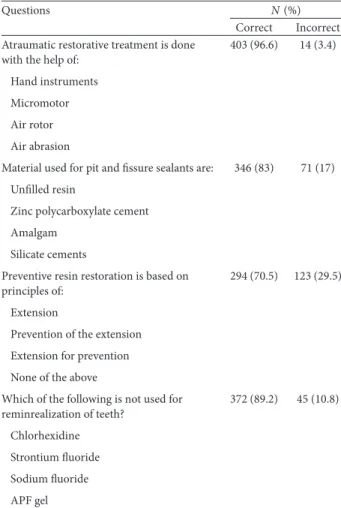
The majority (88%) of the dental interns were made aware of MID through their BDS curriculum. Knowledge, attitude, practice and clinical decision behavior scores were calculated separately. Most of the dental interns correctly selected the responses to each question on Knowledge. However the response to the question of preventive resin restoration elicited wrong responses from 30% of the dental interns, [Table 1]. The attitude of the dental interns toward MID was positive with more than 70% in agreement with the benefi ts of application of MID procedures and concepts. However, 40% of the dental interns exercised the option of “agree” and “strongly agree” to use G.V Black’s principle of “extension for prevention” for initial caries [Table 2]. The results for each of the 10 sub-questions of practice behaviors related to MID performed are presented in Table 3. The sub-questions regarding practice behavior with the greatest percentage of dental interns selected “always or most of the time” was the use of topical fl uoride (50.6%) and prescribing chlorhexidine for caries control (43.9%). The majority of students choose incorrect options for ICDAS codes 1-3 i.e. caries process in outer and inner half of the enamel that required remineralization, sealants or preventive resin restorations. However, majority chose correct options for ICDAS codes 4-6 that are extensive lesions requiring invasive treatments [Table 4].
Discussion
The adoption of a preventive methodology in the dental practice has been suggested as a reason for caries decline in recent years and to be an important part of the dental care practices in the future.[9] A dental practitioners clinical treatment decisions
can be infl uenced by their knowledge and attitudes toward care alternatives. In this study, the dental interns had adequate knowledge regarding MID procedures with a mean score of 3.39. A modest level of knowledge was observed in the 4th year
Australian dental students about application of the non-invasive method of caries management.[6] The results were similar to
the study of Brazilian dental professionals (with <5 years after graduation) where majority had adequate knowledge about MID procedures.[10]
Students’ attitude toward caries prevention can have a bearing on their training and consequently the approach toward preventive services that they are likely to provide in their future practices.[11] An overall positive attitude toward MID was
observed by most of the interns. Most of the dental interns in this study had a positive attitude toward the application of pit and fi ssure sealant that is in agreement with another Indian study.[12] The attitude of dental interns in this study toward
caries risk assessment was positive whereas, in the other study on dental interns in India, 49.66% reported that they would use caries activity test in the future.[12] About 90% of the dental
interns agreed that fl uoride application was an eff ective way of preventing caries similar to the responses of dental interns in the other Indian study and also among Iranian senior dental students.[12,13] A substantive percentage (40%) of the dental
interns in this study, were of the opinion that the G.V. Black principles could be applied forinitial caries. Similarly, one-third of senior Iranian students inclined to place restorations in enamel lesions on proximal and occlusal surfaces, respectively while most of the 3rd and 4th year dental students in Florida were willing
to monitor and arrest enamel lesions in their practices.[11,14]
Knowledge of a health behavior considered to be benefi cial, however, does not automatically mean that this behavior will be followed.[15] Among the MID procedures, the demineralization
of teeth with topical fl uoride application and prescribing chlorhexidine for caries control were either “always” or “most often” performed by 50% and 43.9% of the dental interns in this study respectively. Similarly in the study on Mongolian 5th year
dental students[5] 42% practiced topical fl uoride application ‘at
least quite often’ and also in the study of US dental surgeons[16]
topical fl uoride was most often practiced among all other MID procedures. The remineralization with casein phosphopeptide (CPP)/amorphous calcium phosphate (ACP) and slot and tunnel preparation were the least practiced whereas in the study of US dentists[16] microbial testing and CPP/ACP application were the
least practiced. In the present study, other MID procedures were “always” practiced by only 10% of the dental interns while in the study of Brazilian dentists 49.4% practiced MID procedures.[10] Table 1: Distribution of dental interns according to their
knowledge of MID
Questions N (%)
Correct Incorrect Atraumatic restorative treatment is done
with the help of:
403 (96.6) 14 (3.4)
Hand instruments
Micromotor
Air rotor
Air abrasion
Material used for pit and fi ssure sealants are: 346 (83) 71 (17)
Unfi lled resin
Zinc polycarboxylate cement
Amalgam
Silicate cements
Preventive resin restoration is based on principles of:
294 (70.5) 123 (29.5)
Extension
Prevention of the extension
Extension for prevention
None of the above
Which of the following is not used for reminrealization of teeth?
372 (89.2) 45 (10.8)
Chlorhexidine
Strontium fl uoride
Sodium fl uoride
APF gel
MID: Minimal intervention dentistry, APF: Acidulated phosphate fluoride
Table 2: Distribution of dental interns according to their attitude toward MID
Questions N (%)
Strongly disagree Disagree Uncertain Agree Strongly agree Do you think fl uoride application is an eff ective way of preventing dental caries 14 (3.4) 9 (2.2) 19 (4.6) 294 (70.5) 81 (19.4)
Do you think G.V. Black’s “extension for prevention” is relevant for initial caries 16 (3.8) 155 (37.2) 88 (21.1) 115 (27.6) 43 (10.3)
Do you think adhesive restorative materials have helped in preserving tooth structure 15 (3.6) 12 (2.9) 47 (11.3) 279 (66.9) 64 (15.3)
Do you think caries risk assessment should be carried out for all patients 14 (3.4) 24 (5.8) 75 (18.0) 225 (54.0) 79 (18.9)
Do you think application of pit and fi ssure sealants is in larger benefi t to society 12 (2.9) 5 (1.2) 51 (12.2) 238 (57.1) 111 (26.6)
Despite the advances in research related to better understanding of the initiation and progression of caries, it was observed that the conventional treatment with invasive interventions is still the reality of dental treatment. Majority of the interns gave incorrect answers for clinical decisions requiring preventive treatment (codes 1-3) than for the treatments with more extensive decay requiring surgical approach of treatment. Similar to this study, more than 50% of the Brazilian[17] and 77%
Iranian dentist[9] choose to restore a caries lesion confi ned to
enamel, while in the study on Australian 4th year dental students[6]
majority of them correctly selected the remineralizing option for enamel lesions.
The dental interns had adequate knowledge that correlated with their attitude and clinical decision behaviors whereas attitude correlated with the practice of MID only. However, in the Mongolian students practice of preventive procedures was strongly correlated with knowledge.[5] This discrepancy seems
to refl ect that either there may be little appreciation of dental preventive methods among the dental interns or the practice is limited by some other factors, for instance curriculum related, which calls for improvement.[5]
The results of this study could have been confounded due to social desirability bias as observed in questionnaire studies. In an attempt to limit this eff ect, the name of the institute, and the dental interns who participated in the study were not recorded so as to have unbiased responses. The other limitation was that dental interns work within the framework of institutional policies and guidance of faculty members. Faculty and clinical environment of the dental college have a great infl uence on how students choose their materials or concepts in their future practices.[11] Therefore, the attitudes of faculty members and
institutional policy could have a bearing on the opinion and decisions expressed by the dental interns in this study.
In order to inculcate the practice of MID procedures and orient the decisions of the dental interns toward managing dental caries using MID principles routinely, more emphasis on MID and its various procedures is needed to be incorporated into daily clinical practice while in dental school itself. Further research is recommended to assess the barriers in translation of theoretical knowledge into practice and clinical decision making of dental interns, particularly in the curriculum.
Table 4: Distribution of dental interns according to their clinical decisions behaviors toward MID
ICDAS codes Clinical conditions Correct (%) Incorrect N (%) 1 Opacity with air-drying: White,/brown, is not consistent with the clinical appearance of sound
enamel and is limited to the confi nes of the pit and fi ssure area
124 (29.7) 293 (70.3)
2 Opacity without air-drying: White, brown which is wider than the natural fi ssure/fossa that is not consistent with the clinical appearance of sound enamel
162 (38.8) 255 (61.2)
3 Surface integrity loss: Th e base and walls of the cavity are within enamel and dentin is not visible 178 (42.7) 239 (57.3)
4 Underlying grey shadow: Th is lesion appears as a shadow of discolored dentin visible through an apparently intact enamel surface which may or may not show signs of localized breakdown
308 (73.9) 109 (26.1)
5 Distinct cavity: Th ere is a frank cavitation and dentin is exposed 352 (84.4) 65 (15.6)
6 Extensive cavity: Obvious loss of tooth structure and dentin is clearly visible on the walls and at the base in a cavity that involves at least half of the tooth surface
389 (93.3) 28 (6.7)
MID: Minimal intervention dentistry, ICDAS: International caries detection and assessment system Table 3: Distribution of dental interns according to practice of MID
Procedures N (%)
Never Rarely Sometimes Oft en Always/most of the time Caries risk assessment (diet, oral hygiene, salivary test etc.) 46 (11.0) 56 (13.4) 141 (33.8) 130 (31.2) 44 (10.6)
Remineralized with CPP/amorphous calcium phosphate 205 (49.2) 54 (12.9) 111 (26.6) 45 (10.8) 2 (0.5)
Remineralize with topical fl uoride application 38 (9.1) 23 (5.5) 145 (34.8) 158 (37.9) 53 (12.7)
Prescribe chlorhexidine for caries control 107 (25.7) 25 (6.0) 102 (24.5) 116 (27.8) 67 (16.1)
Seal adjacent pits and fi ssures of amalgam restorations with a sealant 159 (38.1) 32 (7.7) 118 (28.3) 87 (20.9) 21 (5.0)
Seal adjacent pits and fi ssures of composite restorations with a sealant 115 (27.6) 41 (9.8) 139 (33.3) 98 (23.5) 24 (5.8)
Repair defective restorations instead of replacement 178 (42.7) 35 (8.4) 114 (27.3) 72 (17.3) 18 (4.3)
Slot and tunnel preparations 121 (29.0) 55 (13.2) 156 (37.4) 76 (18.2) 9 (2.2)
Preventive resin restoration 80 (19.2) 42 (10.1) 147 (35.3) 107 (25.7) 41 (9.8)
Atraumatic restorative treatment 72 (17.3) 35 (8.4) 171 (41.0) 107 (25.7) 32 (7.7)
Conclusion
This study was important as a fi rst step in providing information on dental intern’s perceptions in regard to MID, and to off er insight on future directions to be taken in this area. Interns exhibited adequate knowledge and positive attitude which they acquired through their undergraduate curriculum, but it did not infl uence their clinical decision-making behavior or practicing MID. Having adequate knowledge related to encouraging positive attitudes, but not to practice of MID procedures.
References
1. Elderton RJ. Preventive (evidence-based) approach to quality general dental care. Med Princ Pract 2003;12 Suppl 1:12-21. 2. Chalmers JM. Minimal intervention dentistry: Part 1. Strategies
for addressing the new caries challenge in older patients. J Can Dent Assoc 2006;72:427-33.
3. Mount GJ, Ngo H. Minimal intervention: A new concept for operative dentistry. Quintessence Int 2000;31:527-33.
4. Frencken JE, Peters MC, Manton DJ, Leal SC, Gordan VV, Eden E. Minimal intervention dentistry for managing dental caries - A review: Report of a FDI task group. Int Dent J 2012;62:223-43.
5. Tseveenjav B, Vehkalahti M, Murtomaa H. Time and cohort changes in preventive practice among Mongolian dental students. Eur J Dent Educ 2003;7:177-81.
6. Pakdaman A, Evans RW, Howe E. Dental students’ knowledge and perceptions of non-invasive dental caries management. Aust Dent J 2010;55:28-36.
7. Aiken LR. Content validity and reliability of single items or questionnaire. Educ Psychol Meas 1980;40:955-9.
8. Doméjean S, Gaucher C. Minimal intervention in cariology –
identifi cation stage detection and classifi cation of caries lesions. J Minim Intervent Dent 2011;4:38-41.
9. Ghasemi H, Murtomaa H, Torabzadeh H, Vehkalahti MM. Restorative treatment threshold reported by Iranian dentists. Community Dent Health 2008;25:185-90.
10. Katz CR, de Andrade Mdo R, Lira SS, Ramos Vieira EL, Heimer MV. Th e concepts of minimally invasive dentistry and its impact on clinical practice: A survey with a group of Brazilian professionals. Int Dent J 2013;63:85-90.
11. Autio-Gold JT, Tomar SL. Dental students’ opinions and knowledge about caries management and prevention. J Dent Educ 2008;72:26-32.
12. Agrawal R, Saxena V, Singh N, Dutta SD, Bhushan P. Dental students’ knowledge and attitude towards caries management and prevention. J Res Adv Dent 2014;3:82-9.
13. Khami MR, Virtanen JI, Jafarian M, Murtomaa H. Prevention-oriented practice of Iranian senior dental students. Eur J Dent Educ 2007;11:48-53.
14. Afsaneh P, Fatemeh SS, Javad KM. Knowledge, attitude and self-reported practice of senior dental students in relation to caries risk assessment. Oral Health Dent Manage 2014;13:1106-11. 15. The KAP survey model (knowledge, attitude
and practices). Available from: http://www. medecinsdumonde.org/content/download/1772 / 13753/ fi le/6c27001736f069d23fab6b06b30ee3a1.pdf. [Last accessed on 2014 Nov 22].
16. Gaskin EB, Levy S, Guzman-Armstrong S, Dawson D, Chalmers J. Knowledge, attitudes, and behaviors of federal service and civilian dentists concerning minimal intervention dentistry. Mil Med 2010;175:115-21.