1
Adaptive User Interface of Product Recommendation
Based on Eye-tracking
Shiwei Cheng, Xiaojian Liu
School of Computer Science, School of Art
Zhejiang University of Technology
Hangzhou 310023,China
[email protected], [email protected]
Pengyi Yan, Jianbo Zhou, Shouqian Sun
College of Computer Science
Zhejiang University
Hangzhou 310027,China
[email protected], [email protected],
[email protected]
ABSTRACT
To reduce the intrusive interaction and workload for the product recommendations, we seek implicit methods to indicate users’ preferences and recommend desirable products on the interface automatically. In this paper, we validate our approach with interactive genetic algorithm to compute fitness based on the eye-movement data metrics. And construct the adaptation strategies for content and layout design on the user interface. A digital camera recommendation prototype is proposed, and in the user study, we find that users can get interested products information with less physical effort and more satisfactions.
Author Keywords
Adaptive user interface, eye-tracking, recommendation, interactive genetic algorithm.
ACM Classification Keywords
H5.2 [Information interfaces and presentation]: User Interfaces-Input devices and strategies, interaction styles.
INTRODUCTION
E-commerce systems take personalization into account [14] for their marketing strategies. Some B2C or C2C websites utilize personalized recommendation solutions for product promotions, e.g., Amazon.com [1], which monitors users’ buying and browsing behaviors to indicate their interest and recommends relevant books to help them quickly deciding to purchase. Amazon.com requires explicit feedback from users, such as rating, which allow users range books from “I hate it” to “I love it”; or mark books with items “I own it” or “Not interested”. Then Amazon recommends users with books which have the similar topics to the high rated books. But these kinds of explicit approaches usually alter users’
natural browsing and navigation with additional manual operations (e.g., rating), which cost much more time, physical and mental workload. One the other hand, some interactive systems detect users’ interest by recording users’ behaviors implicitly during their natural interaction process, such as mouse clicks and movements, scrolling and elapsed time [3]. Then the systems interpret these data as users’ preference indicators with machine learning technology, and make recommendations based on it. Compared to the explicit approaches, the implicit approaches collect the users’ feedback without intrusive interactions. As the support to the natural human-computer interaction, implicit recommendation approaches are considered as the rising research directions.
Further more, recommendations need to be visualized on the interface to help users searching desirable products and making purchasing decisions efficiently. Hence, we resort to adaptive user interface (AUI) which is hoped to filter unnecessary products and push desirable products automatically. Especially face to the popular E-commerce systems (e.g., Taobao.com, the biggest C2C website in China) which have a lot of products in the database, we think AUI can reduce our searching workload.
In this paper, we treat product recommendation as an optimization problem, which can be viewed as one that requires search of the space of possible solutions (e.g., product database) to find some that respects the users’ interest. We use the optimization algorithm, interactive genetic algorithm (IGA), to compute the users’ desirable products’ features and search them in the database to match the similar products, which will be pushed to the interface automatically. But traditional IGA need explicit feedback from users to adjust the optimization and search process. As referred above, in order to reduce intrusive interactions of recommendation system and decrease the workload of users, we apply eye-tracking technology to indicate users’ visual attention on the desirable products, and then use this implicit feedback to drive IGA for the product recommendations. Through above approach, users need only natural browsing, and AUI can supply interested products quickly. The specific contributions here include:
Presented at International IUI 2010 Workshop on Eye Gaze in Intelligent Human Machine Interaction.
• A novel mechanism for AUI based on eye movement data;
• Implicit indicators to predict users’ intention with decreasing intrusive interactions;
• Implementation of product recommendations with IGA. In the rest of the paper, we firstly make a bird view of related work and compare the proposed approaches with them. It is followed by descriptions of the user interface adaption based on eye-tracking and IGA. Then a digital camera recommendation prototype is described and ended with the user study for supported validation and justification.
RELATED WORK Eye-tracking Based AUI
Xu et al [17] proposed one recommendation algorithm for online documents, images and videos, which depended on visual attention time of users captured by eye-tracking. For personalized image recommendation experiments, users were asked to look through search results in iterations and the system refined the rank by the visual attention prediction algorithm. Users could find the desirable images much quicker by the higher rank at the end. However, users had to look at same images for many times, and it cost much time, increased visual tiredness and decreased visual interest for familiar images. In fact, we can decrease the size of the low rank pictures or hid them at all and present new images. This user interface adaptation can help users allocating limited attentions on the more interested images and ranking them quickly. One E-learning system [5] inferred users’ need through the indication of users’ visual focus based on the real time eye-tracking, and then optimized teaching materials in flexible architecture. Its user interface could reduce the amount of pictures if users prefer texts to pictures, or display additional context information for the focused paragraphs or pictures. This approach recorded learners’ behaviors data in long-term, but it was not suitable for the usually short-term online learning process. Besides, eye-tracking was employed to help tourists with adaptive map and speech guide [12], or to identify important contents to crop the photos [13], and also was used for E-learning [4, 5] and HTML interface style design [10]. All the work above demonstrates the feasibility of the eye-tracking based AUI, and shows the research directions, however, research on useful usage of eye-movement data to enable AUI for product recommendation applications is still in its infancy.
IGA with Eye-tracking
Genetic algorithm (GA) was proposed by John Holland in early 1970 s. It is inspired by natural evolution mechanisms such as crossover, mutation, and survival of the fittest. GA provides an efficient performance on optimization problems, The general process is shown as follows [6]:
(1): Initialize the population of chromosomes.
(2): Compute the fitness for each individual in the population using fitness function.
(3): Reproduce individuals to form a new population according to each individual’s fitness.
(4): Perform crossover and mutation on the population. (5): Go to (2) until some condition is satisfied.
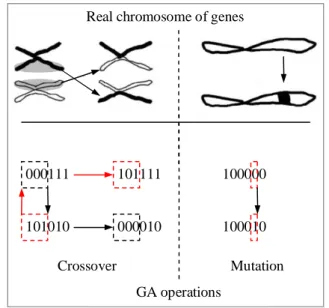
Chromosomes are encoded by bit strings. Crossover operation swaps parts of strings of parents’ generation to children generation. Mutation operation inverts some bits of parents’ generation to children generation with low frequency. The crossover and mutation operations in GA are shown in Figure 1. Each individual in the population evolves to getting higher fitness generation by generation. It’s the nature of the solution optimizations in GA.
Figure 1. Crossover and mutation.
IGA is similar to GA, which can ‘interact’ with uses and percept user’s response, emotion or preference as fitness value for optimization problems when the fitness function (to assess the performance of an individual) can’t be explicitly defined or effectively formalized. Hence, IGA can be used to solve problems that can’t be easily solved by GA, such as aesthetic design and art evolutional systems [18] [6]. In applications, fitness is valued based on objective human evaluation [15], e.g., rating. To reduce these explicit actions, the implicit evaluation methods are used to computer fitness function, such as eye-tracking based evolutionary algorithm for optimizing OneMax Problem (or BitCounting) [11] [2]. The research included three important eye-movement parameters and one basic hypothesis: the time user focus on interested screen area, the number of transitions towards the area, and the average of the pupil diameter; the hypothesis was that the more an individual was visual examined the high the fitness’ value would be. Nevertheless, the related research, such as [11] only coded one feature, color, into bit string; but for
Crossover Mutation
Real chromosome of genes
000111
101010
101111
000010
100000
100010
3 products, there are several different features, such as forms design, prices, and performances. There are also different types of presentations for these futures, such as texts, images, videos etc. Hence, the gene coding method with eye-movement data will be more complex for product recommendations.
EYE-TRACKING BASED PRODUCT RECOMMENDATION AUI
Research Framework
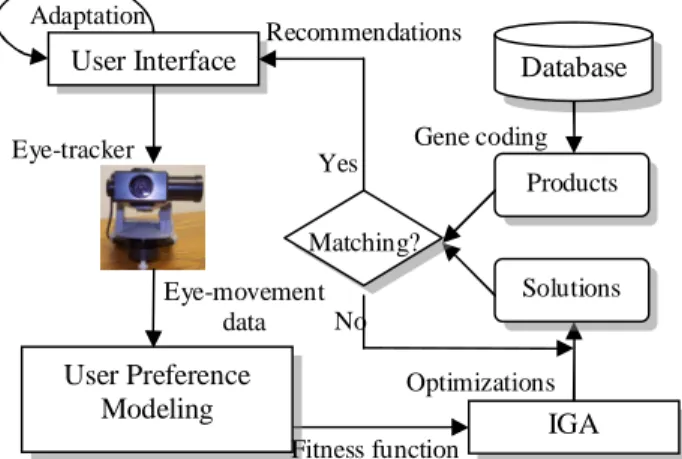
Our research framework for the product recommendation AUI is shown as Figure 2.
Figure 2. Research framework of eye-tracking based product recommendation AUI.
There are four main parts described here:
User preference modeling: Collect eye-movement data by tracker, and then set up the correlations between eye-movement data metrics and users preference for products.
Product gene coding: Code products into bit strings, which cover the features like brands, prices, form design and so on. Every code string represents one product in the database.
IGA: Formalize the fitness functions based on the user preference model, and then implement IGA to make optimizations for product solutions. Match the strings of solutions from IGA with the strings of products from database. If it is successful, the matched products will be pushed to interface; or not, IGA will make new solutions in a new turn.
AUI design: Present the recommended products on the user interface after each optimization of IAG, and make information filter or layout adjustment if possible.
The details about above main parts are described in following sections.
User Preference Modeling
Eye-movement data metrics
Typically, basic human eye-movements can be classified into four kinds of metrics, such as saccade, fixation, smooth pursuit and nystagmus [7]. For example, fixation was defined as “a relatively stable eye-in-head position within some threshold of dispersion (typically 2 degree) over some minimum duration (typically 100–200 ms), and with a velocity below some threshold (typically 15–100 degrees per second)” [8]. Till now, there are several different theories about the relationship between eye-movement data and human cognition and perception. In usability studies, there are some detailed analysis metrics for eye-movements, such as the number of fixations, gaze%(proportion of time) on each area of interest (AOI), fixation duration mean, number of fixations on each AOI [8].
In order to explore how the eye-movement data metrics indicate user preference in products search contexts, we designed the experiment to ask users searching the most desirable digital camera (DC) only by browsing images on the computer screen (see Figure 3), and stopped when they made their final selection, and told the results to the researchers at last. All the users (five male, four female) aged from 20 to 28, who were all undergraduates, had similar income levels, online shopping experience and interest for digital cameras in daily life. It could control their individual context as same as possible.
Figure 3. Eye-tracking experiment to search desirable DC.
There were four different DC images denoted as AOI1 to AOI4 in the whole screen. The ASLTM eye-tracker recorded
the eye-movement data (see Figure 4).
Figure 4. Fixations (blue dots) on each AOI.
As shown in Figure 4, after one user browsing the DC images, there were 28 fixations located at the screen totally.
AOI2
AOI4 AOI1
Eye-tracker
User Interface Database
IGA
Recommendations
User Preference Modeling
Adaptation
Fitness function
Solutions Products Matching?
No Eye-tracker
Yes
Optimizations Gene coding
Eye-movement data
We found AOI2 had the most fixation numbers. Indeed, we knew it was the most desirable one for this user when he told us after experiments.
Except for fixation amount on each AOI, we also recorded the fixation duration on each AOI [16], pupil diameter and first fixation on target AOI. Through the statistic analysis for all users, we found out correlations between these four eye-movement data metrics and users preference for products:
• Users allocate more fixations for their desirable products than no desirable products.
• Users have the long fixation durations for their desirable products than no desirable products.
• Users have the shorter pupil diameters for their desirable products than no desirable products.
• Users always locate first few fixations (first 200 milliseconds) on their desirable products than no desirable products.
User preference modeling
Based on our findings about the eye-movement data metrics with user preference for products, we construct the preference model by function Pi:
Pi=A·M
Here, Pi represents user degree of preference for the product, whose information presentation denoted as AOIi on the screen.
We define
[
1, 2, 3, 4]
TM = m m m m and normalize them as follows:
m1=fixation amount on AOIi /∑fixation amount on AOIi; m2=fixation duration mean on AOIi/∑fixation duration
mean on AOIi;
m3=pupil diameter on AOIi /∑pupil diameter on AOIi; i
4
i
1, first fixation on target AOI 0, first fixation not on target AOI
m =
.
We denote A=
[
a a a a1, 2, 3, 4]
as the weight for each metric,and value them based on our previous findings. We can value a1=1, a2=1, a3=-1, a4=0.5 based on empirical
experience. Here, from m1 to m4, they are assumed nearly
equally important for the preference model, and in the further study, maybe different contribution weights can be tried out.
Product Gene Coding
Take DC for instance, based on the survey, we find that among all the information that contributes to the recommendations, four types of features have the most significant role: form design, brand, performance and price. Fashion-driven users mostly care for the form design; the
brand-driven users are impressed by the manufacturer brands mostly when purchasing; the professional users focus on the performance mainly, such as optical zoom; and many other users care about the price mostly.
In order to apply IGA to product recommendations, we consider products’ features as chromosomes and model every product from the database with genetic representations, binary coding:
Brand: Canon-000, Sony-001, Nikon-010, Samsung-011, Panasonic-100, Fujifilm-101, Olympus-110, KODAK-111; Price (¥): below 1500-000, 1500 to 2000-001,2000 to 2500-010,2500 to 3000-011,3000 to 4000-100,4000 to 5000-101,5000 to 10000-110,over 10000-111;
Type: SLR-0, else 1;
Pixel (Mega): below 5-000, 6-001, 7-010, 8-011, 9-100, 10-101, over 12-110;
Optical zoom: static-000, below 3×-001, 3×-010, 4×-011, 5× to 6×-100, 7×-10×-101, over 10×-110;
Display screen size (Inch): 2.5-00, 2.7-01, 3.0-10, 3.5-11. Hence, each DC in our product database can be seen as one chromosome which has 6 genes, presented for example:
C=001|001|1|110|101|10
IGA Approach
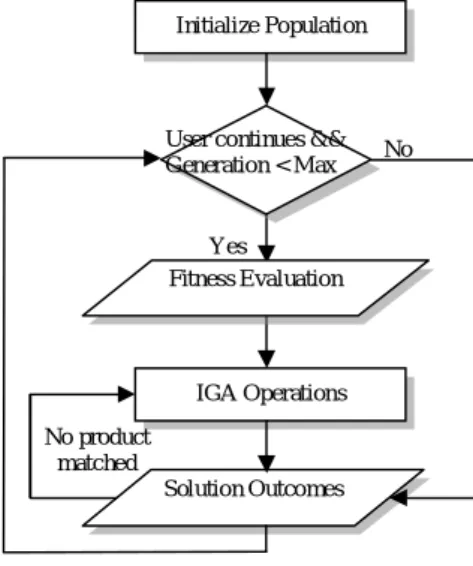
More details about IGA approach process here are shown in Figure 5:
Figure 5. IGA process
Here, we let crossover probability=0.8, mutation probability=0.005, max generation =20.
The main steps of the algorithm are described as follows: Step 1. Initialize population and generation count g =0;
Solution Outcomes Yes
No Initialize Population
IGA Operations Fitness Evaluation User continues && Generation < Max
No product matched
5 Step 2. Generate individual (first time generate them randomly and then generate them by evolutional operations);
Step 3. Evaluate the fitness function (based on preference model, we use Pi as the fitness function);
Step 4. Make operations of reproduction to form a new population according to each individual’s fitness, and make crossover and mutation with possibility defined in advance to generate next generation chromosomes;
Step 5. Get solution outcomes, then if the strings have no matched products in the database, go to Step 4.
Step 6. If g< max generation (defined in advance) and users want to continue, then return to step2 and g=g+1; or else quit.
Here, reproduction, crossover and mutation are three important operations. If one chromosome has a high fitness, the next generation will inherit it at high probability, and that’s to say, it will make a reproduction of itself to be a new chromosome. In this paper, it means that one DC appeals to a user will be displayed at the interface in a new round recommendation. Crossover and mutation should be controlled by the probability to prevent being limited to local solutions quickly or lost in too huge solution space to search.
Each string represents one real product in the database. But sometimes there are not any real products that match the chromosome string, and then the system will recommend the other most similar chromosome or to begin a new gene operations again.
AUI Design
Recommended products are visualized on the user interface with images and texts. We design the individual product has three interface components. Take DC for instance, shown in Figure 6, the interface includes:
• Image: front view of real DC form design;
• Brand: the label includes brand , e.g. SONY H50;
• Descriptions: descriptions about prices and functional performances, e.g. 15 mega pixels.
Figure 6. Example individual product on the user interface
In fact, there are two adaptation strategies for us: content adaptation and layout adaptation:
Content adaptation: The system will update whole interface by replacing old products with new recommended products based on each generation of IGA. Products’ contents and layouts are defined in advance, only be pushed from the database.
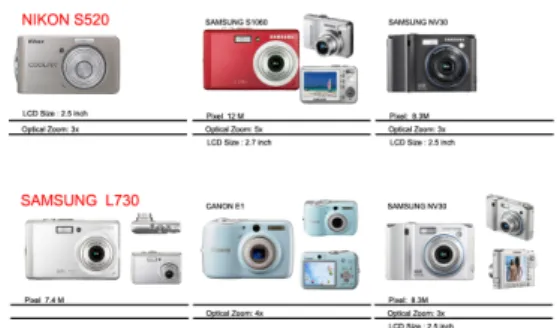
Layout adaptation: Layout defined by Figure 6 will be changed. For example, if one DC recommended mainly depend on users’ preference for the form design, its image will be zoom in or show more images, but the description texts will be zoom out or partly hided.Similarly, brands and descriptions will be highlighted with big fonts or chromatic colors (see Figure 7).
Figure 7. Example of layout design adaptation of AUI
For content adaptation, each product with image, brand and descriptions is seen as one AOI for eye-tracking based preference modeling; but for layout adaptation, each AOI must be divided into several sub-AOI for image, brand and descriptions respectively. Only in this way, IGA can make effort to optimize the layout design. However, if one screen has many small AOI, our eye-tracking technology will lose its accuracy for fixation identifications, and it can make influence to the preference model. Hence, currently we mainly choose content adaptation strategies. We will employ layout adaptation strategies in the future when the eye-tracking and preference model are improved.
PROTOTYPE
We used C++ programming to read raw eye-movement data from ASLTM Eye Tracker 6000 SDK.
Figure 8. User interface of the prototype (red dots are fixations)
The system divided the whole user interface into 6 AOIs evey screen to record eye-movements data metircs (shown in Figure 8)
AOI1 AOI2
AOI4 AOI5 AOI6
We chosen 220 digital cameras totally with related information from the Internet to set up database and implemented the IGA.
Besides, to protect against the position of user interface to affect the eye-movement data (e.g., some users usually gazed AOI1 at top left firstly), system presented DC randomly at different AOI locations in each generation.
USER STUDY
In this section, to show the validation of our approach, we describe the user study for DC recommendation AUI.
Method
Participants
Altogether nine participants from college (aged range from 20 to 28; four female) took part in the user study. All but two were a little shortsighted, and half of them were reported using digital cameras a few times per month, the others reported relying on digital cameras almost everyday.
Apparatus
We ran the study on two 1.7 GHz Pentium 4 Dell PC with 1G RAM, one supported participant’s interaction and the other supported eye-tracker operation. Each machine drove two LCD displays at 1024 x 768 resolutions.
In order to collect empirical eye-movements data, an RS H6 eye-tracker was used, whose gaze sampling frequency was 60 Hz, the accuracy was 0.5 degree, developed by ASLTM Ltd., USA. Here, a fixation is started when 6 consecutive samples fall with 0.5 degrees and ends when 3 consecutive samples fall outside of 1 degree. All samples within 1.5 degrees are included to compute the fixation location.
Procedure
At the beginning, participants had a chance to simply view some pictures (e.g., nine points) for eye-tracker calibrations (see Figure 9).
Figure 9. User engaged in eye-tracker calibrations
We adjusted the distance and sitting-height so that they could see the screen clearly and eye-tracker could record the eye-movement data successfully.
Then participants were presented with digital cameras’ information on the screen every time (each time as one generation in IGA). In the first generation, system represented DC randomly form the database, and then made eye-movement based preference adaptation to each generation.
Participants were asked to browsing the images and text descriptions (as shown in Figure 10) on the screen until they found some ones want to buy.
Figure 10. User browsed digital camera in front of eye-tracker.
Whenever they found the desirable DC successfully or not, they could press space key to the next generation for new recommendations. Notice that, in order to eliminate the influence of persistence of vision, between two adjacent generations’ screens, there was one black screen for several seconds (shown in Figure 11).
Figure 11. Sequences of screens during users’ browsing.
The system terminated the IGA process in two conditions: (1) If the generation count g is not smaller than the max generation n. n is determined by the total population count N, n=N/6.
(2)Users were tired or had found out enough desirable DC already, and then they can quit the experiment free. On the other hand, the compared system had no eye-tracker, and only allowed participants to browse DC by clicking “next page” or “previous page” buttons to search the database.
7 Participants were divided into two groups randomly, one group had five participants, and the other had four. Two groups used the eye-tracking based system and the compared system respectively first, and then exchanged for the second time. Each participant was asked to select no more than 5 digital cameras to buy, and to tell the results and subjective evaluations to the researchers after the experiments.
Results and Analysis
Time
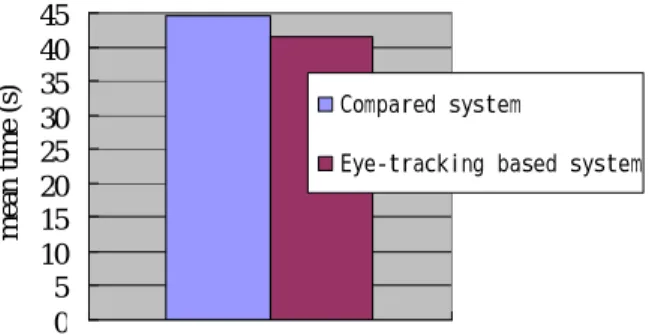
The time participants had used during the experiment from beginning to the end was recorded. The mean time for all the participants is shown in Figure 12.
0 5 10 15 20 25 30 35 40 45
m
ea
n
tim
e
(s) Compared system
Eye-tracking based system
Figure 12. Mean time participants used in two systems
But the difference between two systems was not significant. As we found that sometimes participants spent much time on the eye-tracking based system, as they felt it was interesting, and wanted to use it for a long while.
Manual workload
We denote manual workload (MW) as all the counts of mouse clicks and keyboard strokes. The MW from all participants in two systems is shown in Figure 13.
0 5 10 15 20 25 30 35 40 45
1 2 3 4 5 6 7 8 9 Participants
MW
Compared system Eye-tracking based system
Figure 13. MW in two systems
The difference was statistically significant (F1,16=5.5, p< .05) between the two systems, and that’s to say the eye-tracking based recommendation system can reduce much
physical workload than normal product information navigation system.
Accuracy
In order to check the accuracy of eye-tracking based recommendations system, we recorded the DC which had the maximal fitness value every generation. And after the experiments, we asked participants to make a review among these digital cameras, and to select how many they really want to have. And we found out that average 87.5% DC with maximal fitness value were the users’ real desirable ones.
Subjective evaluation
We designed 5 points scale to measure subjective feedback from participants: degree of satisfaction (1-no satisfaction at all, 5-most satisfaction), easy to use (1-very difficult to use, 5-very easy to use), and degree of interest (1-no interest at all, 5-be very interested). The mean score for two systems in the experiment is shown in Figure 14. Here, we found participants had better subjective feedback than the compared normal system, especially for satisfaction and interesting.
0 1 2 3 4 5
satis facti
on easy
to u se
inter est
m
ea
n
s
co
re Compared system
Eye-tracking based system
Figure 14. Subjective evaluations for two systems
CONCLUSION
Motivated by the eye-tracking interaction pattern and IGA, we explored the eye-tracking driven AUI for product recommendation applications. In contrast to previous research, this paper employed eye-movement data as implicit indicator to predict the users’ preferences. Compared to traditional explicit ways for product recommendations, our approach only need browsing the screen for a while, this has no intrusive interactions and reduces physical workload. The user study shows that our approach can improve the efficiency and subjective experience for product recommendation.
The implicit methods seem to be less accurate (subject to “what I say is not what I do” problem [3]) than explicit methods. Eye-tracker like other measuring equipments can produce both faults and misses, such as “Midas Touch” [9]. Likewise, the IGA and hypothesis of relationships between eye-movement data and user preference have limitations. But there is no doubt that these limitations can be dramatically reduced in the near future. As eye-tracking
technology become more and more mature and many new methods of machine learning, soft computing can improve the accuracy of users’ preference indications and predictions. Hence, the eye-tracking based AUI will be used widely, such as the e-shopping with the recommendations, even other specific application domains, e.g., CSCW or e-learning.
Our future work will be focused on improving the eye-tracking based users’ preferences modeling, and combining multiple implicit feedbacks, such as purchasing history, to enhance the product recommendation’s performance.
ACKNOWLEDGMENTS
This paper was supported in part by Chinese NSF (Project No. 60975048) and Taobao.com (Project No. 2009-M-687). We also thank all volunteers participated in the user study, and reviewers provided helpful comments on previous versions of this paper.
REFERENCES
1. Amazon.com: Recommended for You. http://www.amazon.com/.
2. Cheng ,C.D., Kosorukoff, A. Interactive One-Max problem allows to compare the performance of interactive and human-based genetic algorithms. In Proc. GECCO’04, ACM Press (2004), 983-94. 3. Claypool, M., Le, P., Wased, M., and Brown, D.
Implicit interest indicators. In Proc. IUI 2001, ACM Press (2001), 14-17.
4. García Barrios, V., Gütl, C., Preis, A., Andrews, K., Pivec, M., Mödritscher, F., Trummer, C. AdELE: A framework for adaptive e-learning through eye tracking. In Proc. IKNOW 2004, Graz, Austria (2004), 609-616. 5. Gütl, C., Pivec, M., Trummer, C., García Barrios, V.M.,
Mödritscher, F., Pripfl, J., Umgeher, M. AdeLE (Adaptive e-Learning with with Eye-Tracking): theoretical background, system architecture and application scenarios. Journal ERODL, II (2005). 6. Hee-Su Kim and Sung-Bae Cho. Application of
interactive genetic algorithm to fashion design.
Engineering Applications of Artificial Intelligence13, 6 (2000): 635-644.
7. Jacob R.J.K. Eye movement-based human-computer interaction techniques: toward non-command interfaces. In Advances in Human-Computer Interaction, Ablex Publishing Co (1993), 151-190.
8. Jacob, R.J.K., and Karn, K. S. (2003). Eye Tracking in Human-Computer Interaction and Usability Research: Ready to Deliver the Promises (Section Commentary). In Hyona, J., Radach, R., and Deubel, H. (Eds.), The Mind's Eye: Cognitive and Applied Aspects of Eye Movement Research.pp. 573-605, Amsterdam, Elsevier Science.
9. Jacob, R. J. What you look at is what you get: eye movement-based interaction techniques. In Proc. CHI '90, ACM Press (1999), 11-18.
10. Monmarche, N., Nocent, G., Slimane, M., Venturini, G., Santini, P. Imagine: a tool for generating HTML style sheets with an interactive genetic algorithm based on genes frequencies. 1999. Conference Proceedings. In Proc. IEEE SMC '99, (1999),640 - 645.
11. Pallez, D., Collard, P., Baccino, T., and Dumercy, L. 2007. Eye-tracking evolutionary algorithm to minimize user fatigue in IEC applied to interactive one-max problem. In Proc. GECCO '07. ACM Press (2007), 2883-2886.
12. Qvarfordt, P. and Zhai, S. Conversing with the user based on eye-gaze patterns. In Proc. CHI 2005. ACM Press (2005)221-230.
13. Santella, A., Agrawala, M., DeCarlo, D., Salesin, D., and Cohen, M. Gaze-based interaction for semi-automatic photo cropping. In Proc. CHI 2006, ACM Press (2006), 771-780.
14. Schafer, J.B., Konstan, J. A., Riedl, J. E-Commerce Recommendation Applications. Data Mining and Knowledge Discovery, 5(2001), 115-153.
15. Takagi H. Interactive evolutionary computation: fusion of the capacities of EC optimization and human evaluation. IEEE 2001:1275-1296.
16. Tzanidou1, E., Petre1, M., Minocha1, S., and Grayson, A. Combining eye tracking and conventional techniques for indications of user-adaptability. In Proc. INTERACT 2005, LNCS 3585, (2005), 753-766.
17. Xu S., Jiang, H. and Lau, F.C.M. Personalized online document, image and video recommendation via commodity eye-tracking. In Proc. RecSys 2008, ACM Press (2008),83-90.
18. Yanagisawa, H., Fukuda S. Interactive reduct
evolutional computation for aesthetic design. Journal of Computing and Information Science in Engineering 5, 1(2005), 1-7.