Chapter XVI
Software Quality Assurance
Dawn M. OwensUniversity of Nebraska at Omaha, USA
Deepak Khazanchi
University of Nebraska at Omaha, USA
AbstrAct
Successful implementation of IT (information technology) projects is a critical strategic and competi-tive necessity for firms in all industrial sectors today. However, due to cost overruns, schedule delays, unfilled requirements and poor quality, it is reported that less than 30% of IT projects are perceived to be successful. Much has been written about causes of project failure and many have provided best practices and critical success factors for effective management projects, yet projects still continue to fail. As a first step to overcome systemic causes of project failure we propose a unified definition of software quality assurance (SQA). We use this definition to develop and present an approach to SQA that focuses on controlling risks and provide a framework for assuring the development and project management life cycles.
INtrODUctION
Successful implementation of IT (information technology) projects is a critical strategic and
competitive necessity for firms in all industrial
sectors today. This is even more important in times of scarce resources needed for other competing
strategic initiatives important to a firm. However,
it is well established that a significant numbers
of software and infrastructure projects still fail to deliver on time and within target costs and
specifications (The Royal Academy of Engineer -ing, 2004). Due to cost overruns, schedule delays,
unfilled requirements and poor quality, less than
30% of IT projects are perceived to be successful (Glass, 2006).
Companies spend billions of dollars on IT projects each year, with the average spending at 4 to 5 percent of annual revenue on IT (Charette, 2005). In 2005, organizations spent an estimated $1 trillion on IT hardware, software, and services worldwide (Charette, 2005). Project failures have cost the US economy at least $25 billion and maybe as much as $75 billion (Charette, 2005). Based on the current project failure statistics, companies are faced with billions of wasted dollars on IT projects alone.
Many have written about the causes of project failure and have provided suggestions and criti-cal success factors for effective management of projects. This chapter takes a different approach by examining how software quality assurance practices can impact project outcomes. It is the authors’ contention that software quality assur-ance (SQA) plays a critical role in the software development lifecycle (SDLC) and can impact a project’s overall success. Failure to pay attention
to SQA can result in budget overruns, schedule
delays, failure to meet project objectives and poor
customer satisfaction (Chow, 1985). In fact, qual
-ity is considered a vital requirement of software
products, a business essential, a competitive necessity, and even a survival issue for the
soft-ware industry (Murugesan, 1994). Strong quality
focus is emerging in all phases of the software development lifecycle with increasing emphasis
on product quality, process maturity, and continual
process improvements (Murugesan, 1994). No matter how advanced the tools and
tech-niques – all will come to nothing and the project will fail if the quality management system is not effective (Gill, 2005). The term SQA is often
misunderstood, being viewed strictly in terms
of software testing activities. However, in our view, SQA is a much broader concept. As we will present in this chapter, SQA is a set of as -surance processes that are implemented across all phases of the project and software development
lifecycles. Using this definition, we propose in this chapter a comprehensive SQA process. The
SQA phases presented will provide IT profession -als with a framework for software practitioners
and managers to analyze their quality assurance
practices and determine where to initiate changes that will reduce and/or prevent causes of project failure. The rest of the chapter is organized around four main objectives: (1) Discuss the reasons for
project failure, (2) Define software quality assur
-ance, (3) Propose a software quality assurance
process and discuss how it can be used to assure
quality, and (4) Discuss implications for research
and practice.
rEAsONs FOr PrOJEct
MANAGEMENt FAILUrEs
The statistics on project management success are dismal and probably not surprising to most IT pro-fessionals. When a project fails it can jeopardize an organization’s reputation with its customers and its name in the marketplace (Charette, 2005). In addition, project failures can be costly to organi-zations in terms of wasted dollars and resources. The bottom line is that projects continue to fail for many reasons.
It is generally accepted that software project failures predominantly occur due to cost or
schedule overruns and quality control problems.
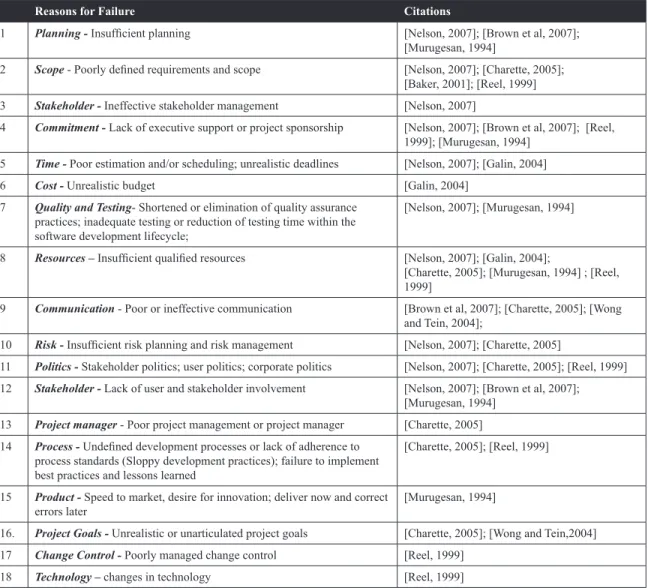
Table 1 summarizes the most common reasons for project failure documented from published literature.
Many projects fail due to a combination of the factors listed in Table l (Charette, 2005). Complicating matters is the fact that there are a
number of unique challenges related to software
development itself, such as, technology, the devel-opment process, scope and complexity of projects,
and risk of projects (Reel, 1999). However, since
most causes of software failures are predictable and avoidable, premeditated planning and inclu-sion of proper controls and processes can result in diminishing of these concerns, resulting in
Reasons for Failure Citations
1 Planning - Insufficient planning [Nelson, 2007]; [Brown et al, 2007];
[Murugesan, 1994]
2 Scope - Poorly defined requirements and scope [Nelson, 2007]; [Charette, 2005];
[Baker, 2001]; [Reel, 1999]
3 Stakeholder - Ineffective stakeholder management [Nelson, 2007]
4 Commitment - Lack of executive support or project sponsorship [Nelson, 2007]; [Brown et al, 2007]; [Reel,
1999]; [Murugesan, 1994] 5 Time - Poor estimation and/or scheduling; unrealistic deadlines [Nelson, 2007]; [Galin, 2004]
6 Cost - Unrealistic budget [Galin, 2004]
7 Quality and Testing- Shortened or elimination of quality assurance practices; inadequate testing or reduction of testing time within the
software development lifecycle;
[Nelson, 2007]; [Murugesan, 1994] 8 Resources – Insufficient qualified resources [Nelson, 2007]; [Galin, 2004];
[Charette, 2005]; [Murugesan, 1994] ; [Reel,
1999]
9 Communication - Poor or ineffective communication [Brown et al, 2007]; [Charette, 2005]; [Wong and Tein, 2004];
10 Risk - Insufficient risk planning and risk management [Nelson, 2007]; [Charette, 2005]
11 Politics - Stakeholder politics; user politics; corporate politics [Nelson, 2007]; [Charette, 2005]; [Reel, 1999]
12 Stakeholder - Lack of user and stakeholder involvement [Nelson, 2007]; [Brown et al, 2007]; [Murugesan, 1994]
13 Project manager - Poor project management or project manager [Charette, 2005] 14 Process - Undefined development processes or lack of adherence to
process standards (Sloppy development practices); failure to implement best practices and lessons learned
[Charette, 2005]; [Reel, 1999]
15 Product - Speed to market, desire for innovation; deliver now and correct
errors later [Murugesan, 1994]
16. Project Goals - Unrealistic or unarticulated project goals [Charette, 2005]; [Wong and Tein,2004] 17 Change Control - Poorly managed change control [Reel, 1999]
18 Technology – changes in technology [Reel, 1999]
Table 1. Common reasons for project failure
followed processes that assure quality at every
phase of the project and development lifecycles. Quality assurance practices can minimize proj-ect failures by providing checks throughout this
process. Many people associate quality assur -ance with testing and most people think about
testing once development is complete. However, developers and managers need to consider SQA
and testing as being integral to every phase of the project lifecycle.
DEFINING sOFtWArE QUALItY
AssUrANcE (sQA)
In this section we develop a unified definition for SQA. There are many different definitions of software quality assurance found in the literature
(refer to Table 2).
These definitions are built on the premise that SQA is a process or set of activities that as -sures adherence to standards as well as assuring
Another approach to defining SQA is to con -sider “assurance as a set of services or a set of activities that inspire confidence and certainty” (Merriam Webster, 2008). In this vein, Khazanchi and Sutton (2001) discuss assurance services
and its impact on assuring quality specifically
in business to business (B2B) electronic
com-merce related business practices. They define
assurance services as a set of activities conducted by trusted, independent organizations to certify and/or validate business transactions between business partners by reviewing internal control mechanisms with the fundamental objectives to reduce risk, assess internal controls, and improve
quality (Khazanchi & Sutton, 2001). Premeditated
assurance against project failures can potentially be achieved through the establishment of controls. We think of controls as a system of procedures, mechanisms or policies that could proactively prevent and detect software project failures. A software quality assurance process should incor -porate control mechanisms to assure conformity
with an organization’s policies, procedures, and standards.
Software quality assessment is difficult due to the uniqueness of software products (Rosqvist et al., 2003); therefore a well defined repeatable
process is necessary in order to deal with the
unique challenges. Repeatable processes such as
CMMI have shown to result in higher levels of
quality and project performance (Subramaniam, et al, 2007). Any such SQA process must also
address schedule and budget constraints. Proj-ects continue to fail because they do not meet stated time or cost constraints. It is important that the implementation of such a process does not negatively affect the ability to deliver on time and within budget.
Gill (2005), describes SQA as an umbrella
activity that is applied to each step of the software process. We believe that this umbrella activity should apply not only to the software develop-ment lifecycle, but also the project managedevelop-ment
lifecycle. Based on the above discussion, we define software quality assurance as follows.
Table 2. Definitions of SQA
Definitions of Software Quality Assurance
SQA is the planned and systematic approach to the evaluation of the quality of and adherence to software
product standards, processes and procedures. It includes the process of assuring that standards and procedures are followed throughout the software lifecycle.
Agarwal et al., 2007
Quality assurance is providing assurance and credibility that the product works correctly. Feldman, 2005
A set of actions necessary to provide confidence that the software development or maintenance process of a software system product conforms to established requirements while staying within the schedule and budget confines.
Galin, 2004
Software quality assurance is an umbrella activity applied to each step in the software process. It involves mapping managerial precepts and design disciplines of quality assurance onto the space of software
engineering.
Gill, 2005
Conformance to functional and performance requirements, documented development standards, and implicit
characteristics that are expected of all professionally developed software. Pressman, 2005
A planned and systematic pattern of actions necessary to provide confidence that the product conforms to
established requirements. IEEE Std 730-1998
The purpose of SQA is to provide management with appropriate visibility into the software process being use
and of the software product being built. It involves reviewing and auditing software products and activities
to verify they conform to procedures and standards (Schulmeyer & McManus, 1999).
CMM
ISO9000 defines the requirements for a quality management system in order to produce higher quality
products (Pressman, 2005). Quality is the totality of features and characteristics of a product that impact its ability to satisfy stated or implied needs (Stockman et al, 1990).
Software Quality Assurance (SQA)
SQA is a well defined, repeatable process that is integrated with project management and the software development lifecycles to review internal control mechanisms and assure adher-ence to software standards and procedures. The objective of the process is to assure con-formance to requirements, reduce risk, assess internal controls and improve quality while conforming to the stated schedule and budget constraints.
As stated earlier, the SQA process needs to
be well integrated with other lifecycle processes.
Therefore, SQA cannot occur late in the life
-cycle as a last attempt to add quality at the end
of development activity (Voas, 2003). The next section provides a more in depth discussion of
the SQA process.
tHE sQA PrOcEss AND rOLE OF
sQA tEAMs
Many developers and managers continue to believe
that quality is something to think about after the code has been compiled. Although this might be the reality, it should not be the practice. The SQA
process is a continuous assessment mechanism deployed throughout the project and development
lifecycles with specific controls and documenta
-tion requirements (Thayer & Fairley, 1999). The
process should be used to control and assure the
software development process, assure a quality
outcome (e.g., zero defects) and assure project success (e.g., on-time within budget delivery).
The activities in the SQA process may include
formal reviews, testing, control of documentation,
measurement, and reporting (Pressman, 2005). At a high level, the function of SQA is to perform
the following (Galin, 2004):
• Assure software project planning has taken place: Quality practices should be planned well in advance so that there is time for them to be implemented.
• Assure user requirements: Requirements
should be reviewed from beginning to end to assure conformance to established standards and conformance to user needs.
• Assure the design process: Provide guar-antee that methodologies are followed and
requirements are met by the design. • Assure coding practices: Coding standards,
practices, and guidelines must first be es -tablished, and then adhered to.
• Assure software integration and testing has taken place: Software integration and testing should be planned, implemented, and executed accordingly
• Conduct random and scheduled audits:
Perform SQA audits to assure the necessary
controls are in place.
The SQA process consists of a variety of phases with specific activities. These activities should be performed by a group such as an SQA team
that is independent of the project participants. The software engineers should have responsi-bility for performing the technical work while
the SQA group is responsible for software qual -ity assurance planning, analysis, and reporting
(Pressman, 2005). SQA is most effective when it
reports up through a separate management team so they can remain committed to the process and remain objective to the deliverable. The teams should consist of appropriately skilled profes-sionals (Godbole, 2004). The responsibilities of
the SQA team include review of documentation
(development plans, testing plans, project plan) for completeness and adherence to standards, participation in inspections, review of test results, and periodic audits of controls (Godbole, 2004).
The SQA team should document any plans or processes that do not reflect adherence to stan
also conduct all design reviews and audits that regulate the software development and project management activities.
The functions performed by the SQA team are
similar to that of IT auditors. Both are concerned with the existence of standards, adherence to standards, and documenting deviations (Weber,
1999). The existence of an SQA team can change
how both internal and external auditors perform
their work. SQA personnel are dedicated to quality assurance; therefore, the SQA team will
likely undertake more comprehensive checking
of controls than auditors (Weber, 1999). However, in the absence of an SQA team, auditors will perform many of the checks that the SQA team
would perform.
Once a SQA process has been fully imple -mented it can help eliminate defects and prevent
ambiguous and changing requirements resulting
in improved customer satisfaction (Schulmeyer
& McManus, 1999). The cost to find and repair defects or problems increases significantly as a project progresses through the requirements
phase to the implementation phase. Implementing
an integrated SQA process has the potential for
generating cost savings in the long run.
tHE sQA PrOcEss EXPLOrED
The SQA process has its own lifecycle and cov -ers all facets of a software project. It typicallyrequires careful planning and gathering of data
in the form of various snapshots of artifacts
(Feldman, 2005). For example the SQA plan,
project management plan, and project metrics are potential artifacts that could be found in the
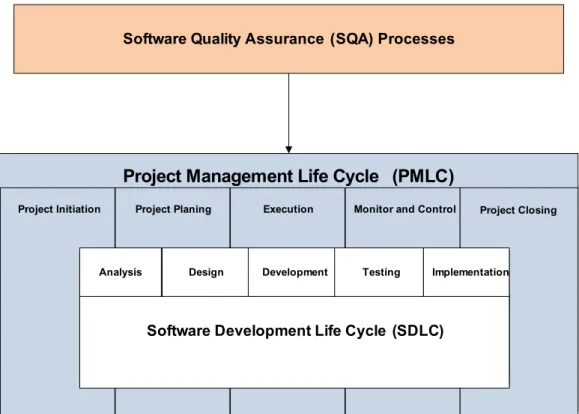
project document repository. SQA is not a single
Figure 1. Software Quality Assurance (SQA) Process integrated with PMLC and SDLC
Project Management Life cycle (PMLc)
software Quality Assurance (sQA) ProcessesMonitor and control
Execution Project closing
Project Planing Project Initiation
Analysis Design Development testing Implementation
process, but an approach that provides assurance and credibility throughout the project management and development lifecycle processes (Feldman,
2005). Figure 1 represents the SQA process and
shows how it encompasses the project manage-ment and developmanage-ment processes.
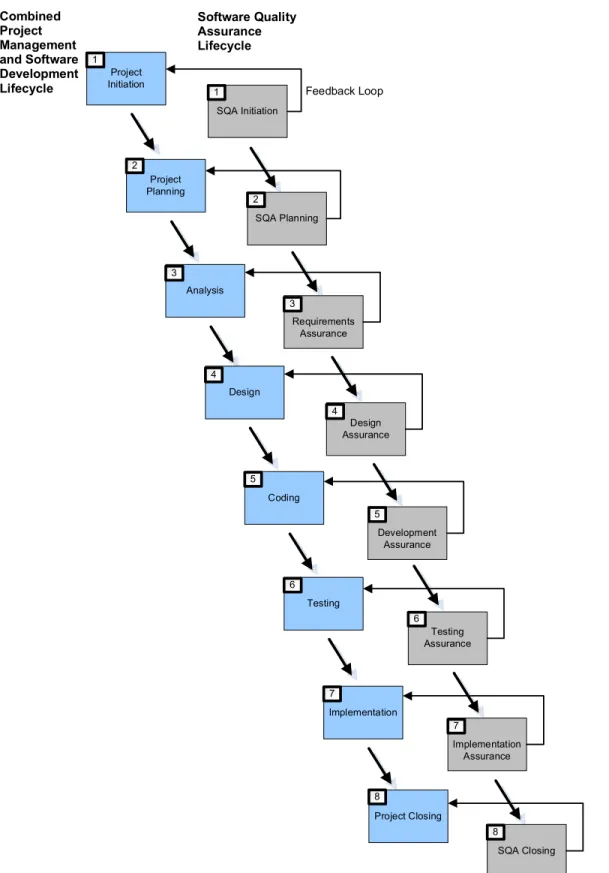
The combined project management life cycle (PMLC) and systems development life cycle
(SDLC) consists of eight unique phases – initiation,
planning, analysis, design, development, testing, implementation, and closing. For each one of these
phases there is a corresponding SQA process – SQA initiation, SQA planning, requirements
assurance, design assurance, development ance, testing assurance, implementation
assur-ance, and SQA closing. Each SQA phase contains
a feedback loop to the corresponding PMLC or SDLC phase. The purpose of the feedback loop is to provide input regarding issues or problems
found during SQA activities and to ensure con -tinuous improvement. Figure 2 denotes each of
the SQA phases aligned with each of the eight
combined PMLC or SDLC phases and the
feed-back loop. Each SQA phase has specific outputs which provide quality controls and documentation
throughout the life of the project.
sQA LIFEcYcLE PHAsEs
The following section discusses each of the phases in the combined project and development lifecycles
along with the corresponding SQA activity. We provide a formal definition of each phase and list
the inputs, outputs, and controls associated with
that phase. We will begin with the first phase –
project initiation.
Project initiation (see Box 1) is a project
management function. This phase is the official
start or formal kickoff of a project. The project manager is assigned and they begin working on the necessary initiation steps. The corresponding
SQA phase, SQA initiation is intended to notify the SQA team that a new project is being initi -ated. One of the key outcomes of this phase is to
define the quality control and audit processes for
the project and to ensure that the proper controls are in place.
• Inputs
Feasibility Analysis Business Case Document
• Outputs
Project Charter
Preliminary Scope Statement
• Controls
Verify the appropriate outputs have been completed.
Check the content of the outputs for correctness, consistency, and com-pleteness (3 Cs)1.
During project initiation the project charter is
completed, which identifies the project sponsor,
stakeholders, project objectives, and preliminary scope statement.
The controls in this phase include assuring that the proper outputs have been completed. The
Box 1. Project Initiation ⇒ SQA Initiation Definition
Project Initiation: The launching of a process that can result in a new authorized project with a formal
scope definition (PMBOK, 2004).
Project Initiation Project Planning Analysis Design Coding Testing Implementation Project Closing SQA Initiation SQA Planning Requirements Assurance Design Assurance Development Assurance Testing Assurance Implementation Assurance SQA Closing Combined Project Management and Software Development Lifecycle Software Quality Assurance Lifecycle Feedback Loop 1 2 1 2 3 3 4 4 5 5 6 6 7 7 8 8 Figure 2. Combined PMLC, SDLC, and SQA process
project charter document should be verified for
correctness, consistency, and completeness. For
example, the following questions need to be ad
-dressed: Has the project manager been identified and have the key stakeholders been identified? Have the project team members been informed? Have the stakeholders been engaged? Have the development and SQA teams been engaged?
The potential risks at this phase of the
proj-ect are low, however, if not identified can be
detrimental to the overall project outcome. The major risk in this phase is the risk of initiating a project without a thorough feasibility analysis or business case. Without a feasibility analysis or business case, projects may be initiated without formal executive signoff, without clear alignment of strategic objectives, or without the necessary technological resources.
Project planning (see Box 2) is a project management function which involves deciding in advance what do, how to do it, when to do it, and who will do it. This phase includes those
processes performed to define the scope, develop
the project management plan, and identify the schedule and activities that occur within the project (PMBOK, 2004). It is during this phase that the team should agree upon which organizational processes will be used throughout the lifecycle. The planning phase should comprise 20-25% of
the overall project timeline (PMBOK, 2004). SQA
planning is important at this stage so that assur-ance practices can be successfully implemented (Godbole, 2004).
• Inputs
Project Charter
Standards and Procedures Manual
• Outputs
Project Management Plan SQA Plan and Metrics
Project plans to represent the core knowledge areas (Project Scope Man-agement Plan, Cost ManMan-agement Plan,
Communication Plan, Risk Manage -ment Plan, Procure-ment Plan) Change management plan
Work Breakdown Structure (WBS) and WBS dictionary
Project Schedule with resource require -ments
Roles and Responsibilities
• Controls
Verify the appropriate outputs have been completed.
Check the content of the outputs for the 3 Cs (correctness, consistency, and completeness).
The SQA plan needs to be developed in close
coordination with the project management plan.
The SQA plan documents the standards, practices,
conventions and metrics to be used during the
overall SQA process. It includes the reviews and
audits that will be performed, the appropriate
controls, documents to be produced by the SQA
group, and the feedback to be provided to the soft-ware project team (Pressman, 2005). Stakeholders
Box 2. Project Planning ⇒ SQA Planning Definition
Project Planning: defining the goals and objectives for a project and planning the course of action required to meet the scope and objectives. This includes specifying the processes and procedures that will be followed during the project. (PMBOK, 2004; Christensen & Thayer, 2001).
SQA Planning: defining the goals and objectives of the software quality assurance plan which includes specifying any quality processes or procedures to be followed.
should review and approve both plans.
The primary function of the SQA team during
this phase is to evaluate whether the nature and extent of planning are appropriate for the type of software being developed (Weber, 1999). The team must evaluate how well the planning work
is being completed – for example, have resource requirements been accurately estimated (Weber,
1999). These assurance activities are conducted via interviews, observations, and reviews of documentation (Weber, 1999).
The potential risks at this phase of the project
can be critical. A major challenge in many soft -ware development projects is incorrect schedules,
incorrect cost estimates, inadequate project ac -countability procedures, and imprecise goals and
success criteria – all products of the planning and
analysis phases (Godbole, 2004). Not all of these risks can be prevented, but the key is to mitigate and control the risks by monitoring and ensuring that outputs include all facets that are relevant. For example, it is important to assure that the project schedule accounts for potential known risks.
Analysis (see Box 3) is an SDLC phase in
which the project team gathers and documents
formal user requirements. The software require
-ments are the foundation for subsequent phases
(Pressman, 2005). The major steps in this phase
include defining, reviewing, approving and base lining the requirements. Lack of confidence in requirements leads to lack of quality, therefore,
it is important that the appropriate controls to
ensure quality are implemented at this stage. During this phase the requirements are validated
and the SQA team assures that the appropriate
documents have been created.
• Inputs
Standards and Procedures Manual
• Outputs
Requirements Definition and Base -line
Requirements Traceability Matrix Software Development Plan High Level Design Plan • Controls
Software Requirements Review Preliminary Design Review
Verify the appropriate outputs have been completed.
Check the content of the outputs for the 3 Cs (correctness, consistency, and completeness).
Verify the requirements to ensure test -ability and feasibility.
Requirements verification includes a review of the requirements to ensure conformance to
established standards. It also includes examining
the specifications to ensure that all requirements
have been stated unambiguously and to ensure
testability (Pressman, 2005). If a requirement
cannot be tested, it has not been stated clearly.
After the requirements have been reviewed they
should be approved by the major stakeholders. Once approved, a baseline is established. This
baseline is used to track changes to the require -ments in order to improve processes along the way
Definition
Analysis: defining exactly what must be done to solve the problem by gathering and analyzing requirements and creating the initial software system model (Davis and Yen, 1999; Galin, 2004).
Requirements Assurance: providing assurance that requirements are testable and complete. Box 3. Analysis ⇒ Requirements Assurance
and provide an audit trail of which requirements
were changed.
Additional outputs in this phase include a requirements traceability matrix, a software
development plan, and a high level design plan
(Pressman, 2005; Galin 2004). A requirements
traceability matrix is used in future phases to map
the requirements back to specific functionality. It is a two-dimensional grid that lists out the require -ments on one side and the functionalities on the other. This matrix is used in both development and testing. (Godbole, 2004 It can be used to
deter-mine how a change in one requirement will affect changes to other requirements or functionality. A
software development plan determines how the software will be developed and includes a descrip-tion of the processes and standards that will be
used in development. A high level design (HLD) plan may also be created. According to IEEE standard 730.1 1995, the HLD should state which
standards, practices, conventions and metrics will be used for specifying the internal structure of
each program (IEEE Std730, 1998).
Due to its importance, the analysis phase of software development needs careful consid-eration in terms of risk. If the proper controls are not in place there is the potential for poor project outcomes. Incorrect, incomplete, unclear
or inconsistent requirements can lead to risks
such as poor customer satisfaction, not meeting customer expectations, or poor scope manage-ment. (Godbole, 2004). It is very important that the scope statement is managed and controlled
in order to prevent scope creep, which can result in schedule delays or cost overruns. It is at this point that scope changes need to be documented,
verified and approved.
In the design phase (see Box 4), the informa-tion from the analysis phase is translated into a blueprint that can be used for developing the
software (Pressman, 2005). Lack of quality during design can invalidate good requirements
(Godbole, 2004). During the design process, it is determined which standards will be used as well as the design process that the software team will use to perform the work (Pressman, 2005). Standards also address matters such as naming conventions and use of program design language
(IEEE Std 730, 1998). If those standards are not
followed, the end result is a product with poor
quality (Pressman, 2005).
The objective of design assurance is to assure the processes being used to create the design
conform to standards and that design is verified against the established requirements. Once a
design process (i.e. waterfall, iterative, or proto-typing) is chosen by the software design team, the
SQA team reviews the selected design process in
order to ensure compliance with organizational policies, internal software standards, or externally imposed standards such as ISO9000 (Pressman, 2005). Product and process metrics can be used to measure design coverage and complexity.
Examples of process metrics used to measure
the development process include development time and average level of developer experience Box 4. Design ⇒ Design Assurance
Definition
Design: an iterative process where requirements are translated into an architecture or blueprint for developing the software and the inputs, outputs and processing procedures of the system are defined
(Pressman, 2005; Galin, 2004).
Design Assurance: executing the appropriate controls to assure design has been completed according to stated policies and standards as well as assuring the necessary outputs have been completed.
(Godbole, 2004). Examples of product metrics
include lines of code to measure size and number of integrated modules to measure complexity (Godbole, 2004). Quality metrics include lines of code and test case coverage (Godbole, 2004). It is important to identify metrics during the analysis and design phases to ensure that the proper mea-sures are put in place.
• Inputs
Requirements Definition and Base -line
Software Development Plan High Level Design Plan
Requirements Traceability Matrix
• Outputs
Detailed Design Plan and Design Pro-cess
Metrics Definitions to be used in the process (Product Metrics, Process Metrics, and Quality Metrics)
• Controls
Design walkthrough and inspection Evaluation of the design process to
ensure planned methodologies are followed
Check the design process for adher-ence to organizational policies and standards.
Verify the appropriate outputs have been completed.
Check the content of the outputs for the 3 Cs (correctness, consistency, and completeness).
SQA controls in this phase are implemented to assure adherence to the defined process and to assure a completed design. The SQA team is
primarily concerned with determining whether the programmers used a systematic approach to the design of the software (Weber, 1999). For example, the team should utilize design practices that support a design plan and modular reusable code. The team can obtain evidence of design practices by conducting interviews, observations of programmers at work, and review of documen-tation (Weber, 1999).
Design walkthroughs and inspections are
ef-fective for providing traceability of requirements
back to design, identifying potential defects,
increasing programming quality, and increasing effectiveness of testing activities (Schulmeyer &
McManus, 1999). Best practice suggests that for every hour of design a software engineer should spend .59 hours in design review and for every hour of coding they should spend an average of
.64 hours of code review (Humphreys, 2004).
During development (see Box 5), design is
translated into code. At this stage test plans and
test cases are developed so that when the software
is implemented testing can be done. The SQA
team works on assuring that the design process
is if high quality and that testing plans are ap -propriate for the implementation.
• Inputs
Standards and Procedures Manual Software Development Plan Detailed Design Plan
Box 5. Development ⇒ Development Assurance Definition
Development: code is generated, reviewed, compiled and tested (Pressman, 2005).
Development Assurance: assure that the development team is following the stated development process and coding standards.
• Outputs
Code (testable software product) Test Plan and Test Cases
Metrics
• Controls
Verify unit testing
Conduct random audits through code walkthroughs, inspections, and peer reviews
Audit Test Plan
Check the code to ensure adherence to standards
Verify the development process for adherence to organizational policies and standards.
Verify the appropriate outputs have been completed.
Check the content of the outputs for the 3 Cs (correctness, consistency, and completeness).
The objective of writing test cases is to detect undiscovered errors, not to show that the product
functions (Godbole, 2004) correctly. As the test
-ing team reviews the requirements and design
documents to create the test plans, they should document any problems they encounter with the
design. If the requirements document is incom -plete or unavailable, the ability to detect defects is compromised (Baker, 2001). Therefore, this is one
of the reasons why controls for complete require -ments are necessary. It is much less expensive to catch these problems earlier, before the code has been completely developed.
The controls in this phase are designed to review the code to catch defects, even before testing begins and to capture metrics that were
defined during the planning and design phases.
The controls are also used to verify develop-ment processes and standards were followed. Unit testing and code walkthroughs are the two
methods used to catch defects. The SQA team
should evaluate how well unit testing has been performed by evaluating whether a systematic approach to unit testing has been chosen (Weber,
1999). Random code walkthroughs, inspections,
and peer reviews are very effective tools to address
the basic question whether the design has been
correctly converted to the target coding language
(Schulmeyer & McManus, 1999). Additional
issues to consider are: Does the code meet the
specified requirements? Have the programmers
followed established programming conventions
(Weber, 1999)? Is there any erroneous, ineffec
-tive, or inefficient code (Weber, 1999)? Random inspections conducted by the SQA team can
help uncover defects early, before they become costly or before they become so deep-rooted in the system that it is impractical to remove them (Grady, 1993; Boehm, 2001).
One of the biggest risks is developing a product
that does not meet the stated requirements or de -veloping a product full of defects. The development controls and assurance activities are necessary to mitigate these risks and detect defects early and the risks associated with software development are diminished.
The goal of testing in SDLC (see Box 6) is to
find and document defects. A defect is some
thing
Box 6. Testing ⇒ Testing AssuranceDefinition
Testing: the goal is to uncover as many software errors as possible in order to achieve an acceptable level
of quality assurance (Galin, 2004).
Testing Assurance: providing assurance that adequate testing has been completed and defects have been
that detracts from the products ability to meet the
stated requirements (Humphreys, 2004). Testing
activities include integration testing, automated testing, regression testing, and performance
test-ing. The SQA team needs to work closely with the
testers and developers to ensure testing procedures
are of the highest quality (Weber, 1999).
• Inputs
Test Plan and Test Cases
• Outputs
Test Summary Report Implementation Plan Metrics
• Controls
Review Test Summary Report Review Testing procedures (Test data,
test environment, automated testing) Review Implementation Plan
Verify the appropriate outputs have been completed.
Check the content of the outputs for the 3 Cs (correctness, consistency, and completeness).
The foundations of software testing include
defining test processes, test cases and test plans, testing techniques, methodologies, tools, stan -dards, and testers (Murugesan, 1994). Once testing is completed, the test results should be documented in a test summary report and reviewed with the developers and stakeholders. This important step is necessary before making a decision on whether or not to proceed with implementation. The test
summary report should also provide a list of the documented risks of moving forward with the known defects.
The purpose of the controls in this phase is to review the testing results to ensure complete and rigorous testing procedures were followed and to assure metrics have been captured. Metrics are important for measuring performance and to provide useful measures for future projects. If these controls are not implemented correctly, there is risk in deploying a product that has many defects.
Once the project team has been given the okay to move forward, the implementation team (see Box 7) will install the product into production. The implementation team should carefully review the implementation plan including the change
management and conversion strategy. The SQA
team should conduct a post release review and ensure that production testing of the software is complete and satisfactory to the users.
• Inputs
Implementation Plan
• Outputs
Implemented Software • Controls
Product Release Review
Verify the appropriate outputs have
been completed.
Check the content of the outputs for
the 3 Cs (correctness, consistency,
and completeness).
Box 7. Implementation ⇒ Implementation Assurance Definition
Implementation: after the software system has been approved, the software is installed into the target production environment (Galin, 2004).
Implementation Assurance: providing assurance that the necessary implementation steps have been completed prior to and after implementation.
The primary control in this phase is the
product release review. The product release
review is necessary in order to assure there
are no new defects present once the software
is in production.
Both the project team and the SQA team
should wrap up any project activities together
including finalizing the project documentation
and notifying the stakeholders and sponsors of project completion (see Box 8).
• Inputs
Metrics
Documentation from prior phases
• Outputs
SQA Summary Report
Post Project Review (lessons learned)
Metrics
• Controls
Verify the appropriate outputs have been completed and delivered. Check the content of the outputs for
the 3 Cs (correctness, consistency, and completeness).
During this phase there should be a formal documentation of lessons learned through a post project review. It is necessary to take the time to understand what went right and what went wrong so as not to repeat the same mistakes. It is also important to gather all the metrics that have been collected during the project. These metrics can help identify trends and best practices for future projects.
IMPLIcAtIONs FOr PrActIcE
Based on our experience and anecdotal evidence,
we believe that using a well defined SQA process
can substantially improve the chance of project
success. Our proposed SQA framework provides
an overarching framework for practitioners to de-velop an integrated assurance process to mitigate potential risks associated with project manage-ment and software developmanage-ment.
Implementing a SQA process is not easy. It
takes commitment and executive support. The term process has a negative reputation in the world of IT development. People think of a process as slowing down the delivery of software and as a result there is a reluctance to consider new
pro-cesses. However, once the value of SQA has been
shown, IT personnel are more likely to embrace it.
Clearly, any SQA process needs to include metrics
and concrete deliverables in order to measure its value and help provide support for the future improved development of software products.
Project managers educated about the
im-portance of the SQA process can champion its
inclusion at the beginning of a project and not as an afterthought. Clear communication on the
expectation of SQA is also important. All stake -holders need to understand and agree upon the
role of the SQA process and team.
Organizations should have a dedicated SQA
staff. This staff needs to be educated on risks, organizational standards, and policies and proce-dures relating to software development. Quality should be part of everyone’s job and not just the
Definition
Project Closing: the processes performed to end all activities of a project, transfer the completed project, or close a cancelled project (PMBOK, 2004).
SQA Closing: completing all the assurance process which includes making sure the necessary project closing activities have been completed.
responsibility of top management (Gill, 2005).
Having management support for implementing SQA processes in all software development proj -ects can go a long way to ameliorating risks and reducing software defects.
IMPLIcAtIONs FOr rEsEArcH
Clearly there is consensus from research about
why projects fail. However, little effort has been
made in proposing processes that can integrate
de-velopment with software quality assurance. This
chapter proposes one approach for achieving this goal. Further research needs to be conducted on whether incorporating such a process leads to greater project success. In addition, research needs to be conducted to better understand the nature of risks in each phase of software development and the types of controls necessary. Finally, it would be also interesting to study how such controls are used and whether other factors need to be included.
cONcLUsION
In this chapter, we have discussed the reasons why projects fail and made a case for why a software
quality assurance process is necessary to mitigate
risk of failure and reduce failure rates. We have
proposed a consolidated definition of SQA and developed a process for assuring software quality
that encompasses the whole software development and project management life cycles.
rEFErENcEs
Agarwal, R. Nayak, P., Manickam, M., Suresh, P., & Modi, N. (2007). Virtual quality assurance
facilitation model. IEEE International Conference on Global Software Engineering (ICGSE 2007),
IEEE Computer Society.
Baker, E. R. (2001). Which way, SQA? IEEE Software, January/February 2001, 16-18.
Boehm, B., & Basili, V. R. (2001). Software defect
reduction top 10 list. Computer, 34(1), 135-137.
Brown, S. A., Chervany, N., L., & Reinicke, B. A. (2007). What matters when introducing new
information technology. Communications of the ACM, 50(9), 91-96
Charette, R. N. (2005). Why software fails. IEEE Spectrum, September, 2005, 42.
Chow, T. W. (1985). Software quality assurance: A practical approach. Silver Spring, MD: IEEE
Computer Society Press.
Christensen, M. J., & Thayer, R. H. (2001). The project manager’s guide to software engineering best practices. Los Alamitos, CA: IEEE Computer
Society.
Davis, W. S., & Yen, D. C. (1999). The information system consultant’s handbook: System analysis and design. Boca Raton, FL:CRC Press.
Feldman, S. (2005). Quality Assurance: Much
More than Testing. ACM Queue, February 2005, (pp. 27-29).
Galin, D. (2004). Software quality assurance: From theory to implementation. Harlow, UK: Pearson Education Limited.
Gill, N. S. (2005). Factors affecting effective
soft-ware quality management revisited. ACM Sigsoft Software Engineering Notes, 30(2), 1-4.
Godbole, N. S. (2004). Software quality assur-ance: Principles and practice. Pnagbourne, U.K.:
Alpha Science.
Grady, R. B. (1993). Practical results from mea
-suring software quality. Communications of the ACM, 36(11), 62-68.
Humphreys, W. S. (2004). The software quality profile, Retrieved September 12, 2004, from http://
www.sei.cmu.edu/publications/articles/quality-profile/index.html
IEEE Std730 (1998). IEEE standard for software quality assurance plans Std 730-1998. IEEE stan-dards software engineering, Vol. Two, Process
Standards, 1999 Edition, IEEE, (pp. 1-16). IEEE Std1012 (1998). IEEE standard for software verification and validation. IEEE standards Soft
-ware Engineering, Vol. Two, Process Standards, 1999 Edition, IEEE
Khazanchi, D., & Sutton, S. (2001). Assurance
services for business-to-business electronic
com-merce: A framework in implications. Journal of the Association for Information Systems, 1(11). Merriam Webster (2008). Merriam Webster online: Assurance. Retrieved March 17, 2008,
from http://www.merriam-webster.com/diction-ary/assurance
Murugesan, S. (1994, Dec. 21-22). Attitude towards testing: A key contributor to software quality. IEEE’s Proceedings of 1st International Conference on Software Testing, Reliability and Quality Assurance, (pp. 111-115).
Nelson, R. R. (2007). IT project management:
Infamous failures, classic mistakes, and best practices, MIS Quarterly Executive, 6(2), June 2007, 67-78.
PMBOK (3rd Ed) (2004). A guide to the project management body of knowledge. Newton Square, PA: Project Management Institute.
Pressman, R. S. (6th Ed.) (2005). Software en-gineering: A practitioner’s approach, Boston:
McGraw Hill.
Rosqvist, T., Koskela, M., & Harju, H. (2003). Software quality evaluation based on expert judg -ment.Software Quality Journal,11(1), 39-55.
The Royal Academy of Engineering (2004). The
challenges of complex IT projects. The Royal Academy of Engineering and the British Computer Society. Retrieved April 08,2008, from www.bcs.
org/server.php?show=conWebDoc.1167
Reel, J. S. (1999). Critical cuccess factors in soft -ware projects. IEEE Software,May/June, 18-23.
Schulmeyer, G. G., & McManus, J. I. (3rd Ed) (1999). Handbook of software quality assurance.
Upper Saddle River, NJ: Prentice Hall.
Glass, R. L. (2006). The Standish report: Does it really describe a software crisis? Communications of the ACM, 49(8), 15-16.
Stockman, S. G., Todd, A. R, & Robinson, G. A. (1990). A framework for software quality
measurement. IEEE Journal on Selected Areas in Communications, 8(2), February, 224-233.
Subramaniam, G. H., Jiang, J., & Klein, G. (2006). Software quality and IS project performance im -provements from software development process maturity and IS implementation strategies. The Journal of Systems and Software,80, 616-627.
Thayer, R. H., & Fairley, R. E. (2nd Ed.) (1999). software engineering project management: The silver bullets of software engineering. Software Engineering Project Management, (pp. 503-504).
Los Alamitos, CA: IEEE Computer Society,. Voas, J. (2003). Assuring software quality assur -ance. IEEE Software, May/June, 48-49.
Weber, R. (1999). Information systems control and audit. Upper Saddle River, NJ: Prentice-Hall, Inc.
Wong, B., & Tein, D. (2004). Critical success
factors for enterprise resource planning projects. Journal of the Australian Institute of Project Management, 24(1), 28-31.
KEY tErMs AND DEFINItIONs
Design Assurance:
Executing the ap
-propriate controls to assure design has been
completed according to stated policies and
standards as well as assuring the necessary
outputs have been completed.
Development Assurance:
Assure that
the development team is following the stated
development process and coding standards.
Implementation Assurance:
Providing
assurance that the necessary implementation
steps have been completed prior to and after
implementation.
Requirements Assurance:
Providing
assurance that requirements are testable and
complete.
Software Quality Assurance:A well defined,
repeatable process that is integrated with the proj-ect management and the software development lifecycles to review internal control mechanisms and assure adherence to software standards and procedures. The objective of the process is to
assure conformance to requirements, reduce risk, assess internal controls and improve qual -ity while conforming to the stated schedule and budget constraints.
SQA Closing:
Completing all the
assur-ance process which includes making sure the
necessary project closing activities have been
completed.
SQA Initiation:
The launching of SQA ac
-tivities after a project has been authorized.
SQA Planning:
Defining the goals and
objectives of the software quality assurance
plan which includes specifying any quality
processes or procedures to be followed.
Testing Assurance:
Providing assurance
that adequate testing has been completed and
defects have been tracked and recorded.
ENDNOtE
1 IEEE Std 1012-1998 (IEEE Standard for
Software Verification and Validation) uses the 3 Cs for V&V (Verification and Valida -tion). The 3 Cs consist of correctness, con-sistency, and completeness.
APPENDIX A: sQA cHEcKLIsts
PMLC and SDLC Phases SQA Lifecycle ChecklistInputs Outputs Controls 1. Project Initiation Feasibility Analysis
Business Case Project Charter Scope Statement Verification Check 3 Cs Project Planning 1. Project Charter Standards/Procedures Manual PM Plan
SQA Plan & Metrics
PM plans for core knowledge areas
CM Plan
WBS & dictionary
Project Schedule & resource requirements
Roles & responsibilities
Verification
Check 3 Cs
Analysis
2. Standards/Procedures Manual Requirements definition & baseline
Requirements traceability matrix
Software development plan
High level design plan
Software requirements review
Preliminary design review
Verification
Check 3 Cs
Verify for testability and feasibility
Design
3. Requirements definition &
baseline
Software development plan
High level design plan
Requirements traceability matrix
Detailed design plan and design process
Metrics
Design walkthrough and inspection
Evaluation of processes
Check for adherence to process
Verification
Check 3 Cs Development
4. Standards/Procedures Manual
Software development plan
Detailed design plan
Code
Test plan & test cases
Metrics
Unit testing
Code walkthroughs, inspections, and peer reviews
Check code for adherence to process
Verification
Check 3 Cs Testing
5. Test plan & test cases Test summary report
Implementation Plan
Metrics
Review test summary report
Review testing procedures
Review implementation plan
Verification
Check 3 Cs Implementation
6. Implementation Plan Implemented software Product release review
Verification
Check 3 Cs Project Closing
7. Metrics
Documentation from prior phases
SQA summary report
Post project review (lessons learned)
Metrics
Verification