ABSTRACT
Background and Objective: The current challenge of diabetes mellitus is to prevent its complications. These complications are directly associated with hyperglycemia in diabetics. The HbA1c measurement is essential for long-term glycemic control. Synchronization of HbA1c measurement is important in order to avoid discrepancies between results reported by laboratories. This study aimed to evaluate the accuracy, precision and agreement of five HbA1c measurement methods with HPLC reference method.
Methods: HbA1c levels of 55 samples were measured using six methods of microcapillary electrophoresis (Sepia), enzymatic method (Pishtaz Teb), immunoturbidometry (Pars Azmoon), boronate affinity (Nycocard), immunofluorescence (ichroma) and Tosoh G8 HPLC.
Results: The five tested methods showed a good agreement with the HPLC method with correlation coefficient of less than 95%. Regression testing of HPLC method and other methods showed slope of 0.99 (P<0.05) for Sebia, 1.02 (P<0.05) for Pishtaz Teb, 0.79 (P<0.05) for Pars Azmoon, 0.82 (P<0.05) for Nycocard and 0.89 (P<0.05) for ichroma. Average inaccuracy for the Sebia, Pishtaz Teb, Pars Azmoon, Nycocard and ichroma in comparison with the HPLC reference method were -0.09, -0.004, -0.75, -0.79 and -0.78, respectively.
Conclusion: The Sebia microcapillary method and Pishtaz teb enzymatic method have appropriate accuracy and precision. Therefore, these methods can be used as alternatives to the HPLC method for HbA1c measurement. Other methods such as Pars Azmoon, Nycocard and ichroma have significant shortcomings in terms of accuracy.
Keywords: Diabetes Mellitus, Accuracy, Percision, Agreement, HbA1c, HPLC.
Mohammad Taha Jalali (PhD)
Department of Clinical Biochemistry, Department of Laboratory Sciences, School of Paramedical Sciences, Jundishapur University of Medical Sciences, Ahvaz, Iran
Hajie Bibi Shahbazian(PhD)
Department of Endocrinology, Health Research Institute, Diabetes Research Center, Jundishapur University of Medical sciences, Ahvaz, Iran
Mohammad Reza Afsharmanesh(MSc)
Department of Clinical Biochemistry, Faculty of Medicine, Jundishapur University of Medical sciences, Ahvaz, Iran
Rohollah MousaviDehmordi (MSc)
Department of Clinical Biochemistry, Faculty of Medicine, Jundishapur University of Medical Sciences, Ahvaz, Iran
Mohammad Taha Jalali (PhD)
Department of Clinical Biochemistry, Department of Laboratory Sciences, School of Paramedical Sciences, Jundishapur University of Medical Sciences, Ahvaz, Iran
Hajie Bibi Shahbazian(PhD)
Department of Endocrinology, Health Research Institute, Diabetes Research Center, Jundishapur University of Medical sciences, Ahvaz, Iran
Mohammad Reza Afsharmanesh(MSc)
Department of Clinical Biochemistry, Faculty of Medicine, Jundishapur University of Medical sciences, Ahvaz, Iran
Rohollah MousaviDehmordi (MSc)
Department of Clinical Biochemistry, Faculty of Medicine, Jundishapur University of Medical Sciences, Ahvaz, Iran
Azadeh Saki (PhD)
Department of Environmental Statistics and Epidemiology, Jundishapur University of Medical Sciences, Ahvaz, Iran
Corresponding author: Mohammad Reza Afsharmanesh
Tell: 09166162697
Email: [email protected]
Address: Department of Clinical Biochemistry, Faculty of Medicine, Jundishapur University of Medical sciences, Ahvaz, Iran
Evaluation of Accuracy, Precision and Agreement of Five
Hba1c Measurement Methods with HPLC
Reference Method
Received : 07 Oct 2014
Revised: 25 Mar 2014
Accepted: 09 Nov 2015
(15-17). American Diabetes Association recommends that HbA1c can be used to diagnose diabetes with a threshold of ≥ 6.5% (18). There are several methods available for measuring HbA1c that are based on different physical, chemical and immunological characteristics of the glycosylated hemoglobin (2,19). Since HbA1c is used for patient management, care, education and motivation for diabetes control, its measurement should be precise and accurate. Since the different methods of measuring HbA1c levels lead to results with unfavorable differences, it is essential to compare these laboratory methods in terms of precision, accuracy and agreement. In this way, laboratories are able to use alternative methods of HbA1c measurement if necessary, without any significant difference. Moreover, practitioners can confidently use the results of different methods for evaluation of patients’ glucose status (20, 21).
MATERIAL AND METHODS
This study was carried out at the Department of Medical Laboratory Sciences, Ahvaz Jundishapur University of Medical Sciences. A total of 55 diabetic and nondiabetic individuals were selected for this study. First, the blood samples (3 ml) were collected in tubes containing EDTA (as anticoagulant). Then, HbA1c in all samples were measured using six methods of microcapillary electrophoresis (Sebia),
enzymatic method (Pishtaz teb),
immunoturbidimetry (Pars Azmoon), Boronate affinity (Nycocard), immunofluorescence assay (ichroma) and Tosoh G8 HPLC. It is automated HbA1c analyzers that works based on liquid ion exchange chromatography with high pressure. In this apparatus, separation is based on the ionic transaction difference between the hemoglobin components and superficial cation-exchange resins for ions in column. It functions based on capillary electrophoresis in free solution. In this technique, the charged molecules are separated based on their electrophoretic motion in alkaline buffer with a specific PH. The separation is also based on the electrolyte’s PH and electro-osmotic flow. The basis of this method is to create a colored complex with aid of enzymatic reactions. In the first stage, total hemoglobin concentration
INTRODUCTION
Diabetes mellitus is a metabolic disorder characterized by hyperglycemia and impaired metabolism of carbohydrates, fats and proteins. This disorder is resulted from defect in either insulin secretion or insulin action or both (1-3). It is also considered as one of the biggest public health problems around the world. The prevalence of this disorder among adults was estimated about 171 million in 2000. In 2030, this figure is expected to reach 366 million (4). Diabetes mellitus is associated with disorders of eye, kidney, cardiovascular and other body systems. The long-term complications of diabetes include retinopathy and loss of vision, nephropathy that ultimately leads to renal failure, peripheral neuropathy with risk of foot ulcers and autonomic neuropathy that leads to intestinal, gastrointestinal, urogenital, cardiovascular and sexual disorders (5, 6). The results of clinical trials on diabetes and its complications as well as prospective studies of diabetes in the UK indicate that the development and progression of diabetic complications can be delayed by monitoring glucose levels (7, 8). The most important tests widely used to monitor patients’ blood sugar levels are blood sugar and glycosylated hemoglobin measurements (9, 10). There are some limitations for long-term glycemic control by blood sugar measurement; therefore, the glycosylated hemoglobin or HbA1c measurement is used widely as the routine clinical method. HbA1c is the product of glucose non-enzymatic and irreversible reaction with N-terminal Valine of beta chain of hemoglobin. Since red blood cells are completely permeable to glucose, the amount of HbA1c is completely proportional to the concentration of glucose. Glycosylated hemoglobin shows the average level of glucose concentration in the last 2 to 3 months (11-13).
After the results of clinical trials on diabetes and its complications as well as prospective studies of diabetes in the UK, HbA1c was chosen as the gold standard method for measuring hyperglycemia (14). Nowadays, HbA1c is accepted as the only main independent parameter of metabolic control and risk factor for development of diabetes complications. It is also widely used as the therapeutic target in diabetes management
according to the kit instructions. Methods accuracy control The calibrators and controls related to each method were used for controlling and calibration. Two samples with normal and high HbA1c levels were used to evaluate the accuracy of the methods. The
coefficient of variation (CV) was calculated
after repeating the experiments through all the methods.
RESULTS
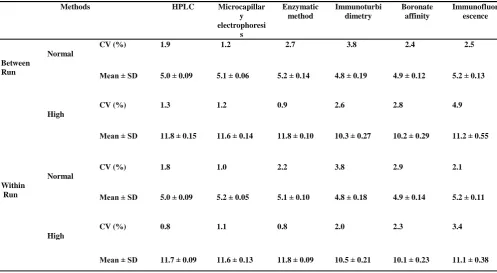
HbA1c levels in all 55 samples were assessed by the six aforementioned methods. The mean age of patients was 50.8 ± 12.4 years (with age range of 12-70 years). Twenty of these patients were male (36.4%) and 35 (63.6%) female. The mean and standard deviation (SD) of the results in both HPLC and Pishtaz Teb were 8.3% ± 2.6, 8.2% ± 2.6 in the Sebia method, 7.6% ± 2.1, in the Pars Azmoon method, 7.5% ± 2.2 in the Nycocard and 7.5% ± 2.4, respectively. The two samples selected were tested 20 times each using all the methods and the results were used to calculate the CVs between and within each run. In addition, they were tested by all methods two times for 5 days in the morning and evening and the results were used to calculate the CV between them. The results calculated by the SPSS are shown in Table 1.
is measured at wavelength of 505 nm and finally, absorption of the created colored complex is determined at 660 nm to specify the amount of HbA1c. Combining the results of total hemoglobin and HbA1c in the system is used to calculate and express the percentage of HbA1c. The Pars Azmoon kit was installed on the Hitachi 911 device and the prepared samples were transferred to the device according to the manufactures instructions. This method is based on reinforced immunoturbidimetry by latex particles. The HbA1c value is determined directly and without measuring total hemoglobin. Twenty microliters of whole blood were prepared according to the kit instruction and then the samples were transferred to the Cobas Mira biochemistry autoanalyzer that the kit was already installed on.
This method uses the technology that is based on boronate affinity. Five ml of whole blood from each participant was used for this test and the precipitation, reaction, washing and readings were performed according to the kit manufacturer instructions. This method is based on fluorescence immunoassay, particularly competitive immunoassay technology. Five ml of whole blood from each participant was obtained for the testing
Immunofluor escence Boronate
affinity Immunoturbi
dimetry Enzymatic
method Microcapillar
y electrophoresi
s HPLC
Methods
2.5 2.4
3.8 2.7
1.2 1.9
CV (%) Normal
Between
Run Mean ± SD 5.0 ± 0.09 5.1 ± 0.06 5.2 ± 0.14 4.8 ± 0.19 4.9 ± 0.12 5.2 ± 0.13
4.9 2.8
2.6 0.9
1.2 1.3
CV (%) High
11.2 ± 0.55 10.2 ± 0.29
10.3 ± 0.27 11.8 ± 0.10
11.6 ± 0.14 11.8 ± 0.15
Mean ± SD
2.1 2.9
3.8 2.2
1.0 1.8
CV (%) Normal
Within
Run Mean ± SD 5.0 ± 0.09 5.2 ± 0.05 5.1 ± 0.10 4.8 ± 0.18 4.9 ± 0.14 5.2 ± 0.11
3.4 2.3
2.0 0.8
1.1 0.8
CV (%) High
11.1 ± 0.38 10.1 ± 0.23
10.5 ± 0.21 11.8 ± 0.09
11.6 ± 0.13 11.7 ± 0.09
Mean ± SD
Table 1- The CV within and between the methods of HbA1c measurement in this study
60/ Evaluation of Accuracy, Precision. . .
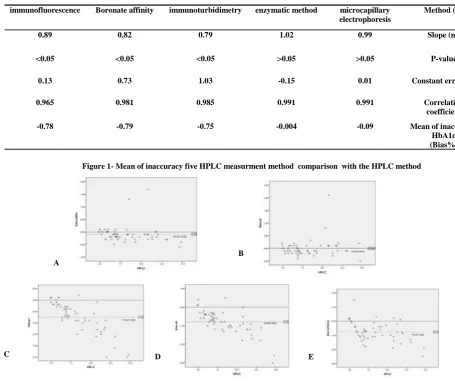
regression coefficients of 0.99 and 1.02 when compared to the HPLC method. The results of immunoturbidometry, boronate affinity and immunofluorescence assay showed significant differences with regression coefficients of 0.79, 0.82 and 0.89 compared to the HPLC method, respectively (P-value <0.05). The average level of inaccuracy for the methods in comparison with the HPLC method was calculated and the results are presented in Table 3 and Figures 1.
The correlation coefficient test between HPLC and other methods was performed and showed a good correlation between the reference method and all other methods (Table 2). The regression analysis was used to investigate the accuracy of methods and the five methods were separately compared to the HPLC method (Table 2). The results obtained by the microcapillary electrophoresis and enzymatic method showed no significant difference with
Method (Y) microcapillary
electrophoresis enzymatic method
immunoturbidimetry Boronate affinity
immunofluorescence
Slope (m) 0.99
1.02 0.79
0.82 0.89
P-value >0.05
>0.05 <0.05
<0.05 <0.05
Constant error (C) 0.01
-0.15 1.03
0.73 0.13
Correlation coefficient 0.991
0.991 0.985
0.981 0.965
Mean of inaccuracy HbA1c (Bias%) -0.09
-0.004 -0.75
-0.79 -0.78
Table 2-The results of regression analysis Y = mX + c, correlation coefficient and average of inaccuracies of methods in comparison with the reference method (HPLC)
Figure 1- Mean of inaccuracy five HPLC measurment method comparison with the HPLC method
B: Mean of inaccuracy of the Pishtaz Teb method in comparison with the HPLC method
C: Mean of inaccuracy of Pars Azmoon method in comparison with the HPLC method
D: Mean of inaccuracy of Nycocard method in comparison with the HPLC method
E: Mean of inaccuracy of ichroma method in comparison with the HPLC method
A
B
C D E
A: Mean of inaccuracy of the Sebia method in comparison with the HPLC method
control and consequently the incidence of diabetic complications. This will be a very serious matter of concern when you realize that slight changes in the results can be effective on the quality of healthcare policy in preventing the complications of diabetes. HPLC and capillary electrophoresis are considered the first class methods with global approvals among the methods available for measuring HbA1c. In fact, these methods have received approvals by standardization testing using the International Federation of Clinical Chemistry and can be used as good basis for synchronization and evaluation of methods. There are three methods available in Iran. The first group of methods that are sometimes approved globally (HPLC, capillary electrophoresis and immunoassay). The second group includes domestic production methods and finally the third group includes foreign methods that are purchased in large volumes and packaged in Iran. Naturally, methods of the second and third group experience quality loss in performance due to involvement of intermediary companies that often lack sufficient experience in the field of methods engineering. Practically, the difference in the results from the measurement of glycated hemoglobin in different centers have alarming status, particularly when considering the impact of only 1% variation in the results of HbA1c on the incidence of diabetic complications. Hence, we decided to compare the five methods available in the Iranian market with the HPLC as the verified reference method and obtain information about the accuracy of the existing methods. These findings can provide a basis for a large assessment project consisting of all available methods in the country and result in their standardization and synchronization with the international standards. The findings of our study and previous studies (22-24) indicate that the results of all HbA1c measurement methods have good correlations with the reference methods such as HPLC. The correlation between the results obtained from different methods and the reference method of measuring HbA1c is important. since the diagnosis or control of diabetic complications has fixed decision-making levels, it is necessary that the results are close enough to one another so that using kits and different methods will not affect the final decision and
DISCUSSION
Diabetes is a chronic metabolic disease and its prevalence is increasing all over the world. The main characteristic of this disease is hyperglycemia, which is the origin of various diabetic complications. The severity of complications is related to the severity of hyperglycemia in patients and successful glycemic control can significantly delay their onset or reduce the severity. The results of epidemiological studies show that the severity and prevalence of the symptoms can be controlled or corrected through proper glycemic control. The investigations in this regard show that evaluating the effectiveness of diabetes treatment protocols can be performed by measuring HbA1c levels, which is one of the products of glycosylation process in diabetes.the glycosylation rate is proportional to the concentration of blood glucose. In fact, HbA1c reflects the blood glucose concentration during the last 8-12 weeks. Since HbA1c levels are not affected by the factors such as daily changes and physical activity, it can be used as an effective index for evaluation of glycemic control.
A limited reduction of HbA1c levels in diabetic patients, for example decrease from 8% to 7.2%, can be accompanied by about 43-45% reduced risk of retinopathy progression. In other words, one percent reduction in HbA1c can have significant effects on the progression of retinopathy in diabetics. It was observed during the diabetes control and complications trial that reduced risk of diabetes and progression of diabetic
complications (microvascular and
macrovascular) is proportional to the success rate of treatment protocols for maintaining glycemic control. Therefore, there may be a direct relationship and sustainability between the severity of various diabetic complications and success rate of glycemic control. In this regard, HbA1c test is considered a good indicator to track the effectiveness of treatment protocols for controlling hyperglycemia. There are over 30 methods available for measuring HbA1c, which are divided into two main groups. A group is based on glycosylated hemoglobin separation from each other and another is based on chemical reactions. Naturally, these methods will provide different results based on the impact of error factors before, during and after the analysis. This can
62/ Evaluation of Accuracy, Precision. . .
the limitations of analytical methods and clinical laboratories are not able to correct their error sources.
CONCLUSION
The Sebia microcapillary method and Pishtaz Teb enzymatic method have appropriate accuracy and precision. Therefore, these methods can be used as alternatives to the HPLC method for HbA1c measurement. The lack of standardization of methods available in the Iranian market certainly affects the accuracy of clinical interpretation of the results. These adverse effects will cause irreparable consequences in patients’ monitoring and incidence of diabetic complications. It is suggested to set up a special committee by the reference laboratory of Ministry of Health for extensive assessment of the accuracy of existing methods for HbA1c measurement and take immediate action in this regard.
ACKNOWLEDGMENTS
Hereby, the assistance and cooperation of all participants in this study, Department of Research and Hyperlipidemia Research Center of Jundishapur University of Medical Sciences are gratefully acknowledged.
CONFLICT OF INTEREST
The authors have no conflict of interests.
7. Hoelzel W, Weykamp C, Jeppsson J-O, Miedema K, Barr JR, Goodall I, et al. IFCC reference system for measurement of hemoglobin A1c in human blood and the national standardization schemes in the United States, Japan, and Sweden: a method-comparison study.
Clinical chemistry. 2004; 50(1): 166-74.
8. Steffes M, Cleary P, Goldstein D, Little R, Wiedmeyer H-M, Rohlfing C, et al. Hemoglobin A1c measurements over nearly two decades: sustaining comparable values throughout the Diabetes Control and Complications Trial and the Epidemiology of Diabetes Interventions
and Complications study. Clinical chemistry.
2005;51(4):753-8.doi: 10.1373/clinchem.2004.042143.
9. Goldstein DE, Little RR, Lorenz RA, Malone JI, Nathan D, Peterson CM, et al. Tests of glycemia in
diabetes. Diabetes care. 2004; 27(7): 1761-73.
http://dx.doi.org/10.2337/diacare.27.2007.S91.
10. Jeppsson J-O, Kobold U, Barr J, Finke A, Hoelzel W, Hoshino T, et al. Approved IFCC reference method for
the measurement of HbA1c in human blood. Clinical
Chemistry and Laboratory Medicine. 2002; 40(1): 78-89.
control of diabetes complications. Thus, the correlation between the results of kits and different methods of measuring HbA1c is necessary but not sufficient.
Among the methods tested in this study, only the results of the microcapillary method and Pishtaz Teb kit were not significantly different from the results obtained by the HPLC reference method. The two mentioned methods showed appropriate accuracy and precision with average inaccuracy level of -0.09 and 0.004 and bias of less than 3%, respectively. Immunoturbidimetry (Pars Azmoon), boronate affinity (Nycocard) and immunofluorescence (ichroma) methods showed significant differences with the HPLC method in the regression test. These three methods also have significant shortcomings in terms of accuracy with mean inaccuracy level of -0.75, -0.79 and -0.78 and lack of precision with bias of 2 to 5%, respectively. The similar issues have been reported by other studies on some foreign kits (15, 23). It seems that the main cause of the changes between the methods is related to lack of standardization of methods, changes in the solution quality produced by the manufacturer and nonconformity to maintenance the principles by distributor companies. The consumer cannot change the standardization and re-calibration of most tools or solutions for the measurement of HbA1c. Moreover, manufacturers are responsible for correcting
REFERENCES
1. Alberti KGMM, Zimmet PZ. Definition, diagnosis and
classification of diabetes mellitus and its complications. Part 1: diagnosis and classification of diabetes mellitus.
Provisional report of a WHO consultation. Diabetic
medicine. 1998; 15(7): 539-53.
2. Burtis CA, Ashwood ER, Bruns DE. Tietz textbook of clinical chemistry and molecular diagnostics. 4th ed. Elsevier Health Sciences. 2012.
3. Jager AV, Tavares MFM. Novel approach for the
analysis of glycated hemoglobin using capillary
isoelectric focusing with chemical mobilization. Journal
of Chromatography B. 2003; 785(2): 285-92.
4. Shera A, Jawad F, Maqsood A. Prevalence of diabetes
in Pakistan. Diabetes research and clinical practice.
2007; 76(2): 219-22.
5. Association AD. Diagnosis and classification of
diabetes mellitus. Diabetes care. 2010; 33(Supplement
1): S62-S9.
6. Shafiqur-Rahman, Irfan Zia. Prevalence of
microvascular complications among diabetic
patients. Pakistan J Med Res. 2004; 43 (4): 1-3.
16. Miedema K. Standardization of HbA1c and optimal
range of monitoring. Scandinavian Journal of Clinical &
Laboratory Investigation. 2005; 65(S240): 61-72. DOI:
10.1080/00365510500236143.
17. Moridani MY, Verjee Z, Allen LC. Analytical
evaluation of hemoglobin A< sub> 1c</sub> dual kit assay on Bio-Rad Variant II: an automated HPLC hemoglobin analyzer for the management of diabetic
patients. Clinical biochemistry. 2003; 36(4): 317-20
18. Little RR, Rohlfing CL, Sacks DB. Status of
hemoglobin A1c measurement and goals for
improvement: from chaos to order for improving
diabetes care. Clinical chemistry. 2011; 57(2): 205-14.
19. Nuttall FQ. Comparison of percent total GHb with percent HbA1c in people with and without known
diabetes. Diabetes care. 1998; 21(9): 1475-80.
20. Halwachs-Baumann G, Katzensteiner S, Schnedl W,
Pürstner P, Pieber T, Wilders-Truschnig M. Comparative
evaluation of three assay systems for automated
determination of hemoglobin A1c. Clinical chemistry.
1997; 43(3): 511-7.
John WG, Mosca A, Weykamp C, Goodall I. HbA1c
standardisation: history, science and politics. The
Clinical Biochemist Reviews. 2007; 28(4): 163-168.
11. Kilpatrick E. Haemoglobin A1c in the diagnosis and
monitoring of diabetes mellitus. Journal of clinical
pathology. 2008;61(9):977-82. doi:
10.1136/jcp.2007.054304.
12. Miedema K. Towards worldwide standardisation of
HbA1c determination. Diabetologia. 2004; 47(7):
1143-8.
13. Shiba T, Yano M, Maehata E, Kiyose H, Kotaki Y, Fukuzawa N, et al. Standardization of HbA1c value and
its comparison to immunoassay—two years of
experience. Diabetes research and clinical practice. 1996;
32(3): 175-82.
14. Consensus Committee. Consensus statement on the
worldwide standardization of the hemoglobin A1C measurement: the American Diabetes Association, European Association for the Study of Diabetes, International Federation of Clinical Chemistry and Laboratory Medicine, and the International Diabetes
Federation. Diabetes Care. 2007; 30(9): 2399.
15. Hawkins R. Comparison of four point-of-care HbA1c
analytical systems against central laboratory analysis.
Singapore medical journal. 2003; 44(1): 8-11.
64/ Evaluation of Accuracy, Precision. . .