R E S E A R C H A R T I C L E
Open Access
De novo
assembly and characterization of
breast cancer transcriptomes identifies
large numbers of novel fusion-gene
transcripts of potential functional
significance
Vinay K. Mittal and John F. McDonald
*Abstract
Background:Gene-fusion or chimeric transcripts have been implicated in the onset and progression of a variety of cancers. Massively parallel RNA sequencing (RNA-Seq) of the cellular transcriptome is a promising approach for the identification of chimeric transcripts of potential functional significance. We report here the development and use of an integrated computational pipeline for thede novoassembly and characterization of chimeric transcripts in 55 primary breast cancer and normal tissue samples.
Methods:An integrated computational pipeline was employed to screen the transcriptome of breast cancer and control tissues for high-quality RNA-sequencing reads. Reads werede novoassembled into contigs followed by reference genome mapping. Chimeric transcripts were detected, filtered and characterized using our R-SAP algorithm. The relative abundance of reads was used to estimate levels of gene expression.
Results:De novoassembly allowed for the accurate detection of 1959 chimeric transcripts to nucleotide level resolution and facilitated detailed molecular characterization and quantitative analysis. A number of the chimeric transcripts are of potential functional significance including 79 novel fusion-protein transcripts and many chimeric transcripts with alterations in their un-translated leader regions. A number of chimeric transcripts in the cancer samples mapped to genomic regions devoid of any known genes. Several ‘pro-neoplastic’ fusions comprised of genes previously implicated in cancer are expressed at low levels in normal tissues but at high levels in cancer tissues.
Conclusions: Collectively, our results underscore the utility of deep sequencing technologies and improved bioinformatics workflows to uncover novel and potentially significant chimeric transcripts in cancer and normal somatic tissues.
Keywords:Breast cancer, Transcriptome, Fusion-gene, Chimeric transcripts,de novotranscript assembly
* Correspondence:[email protected]
Integrated Cancer Research Center, School of Biological Sciences, and Parker H. Petit Institute of Bioengineering and Biosciences, Georgia Institute of Technology, 315 Ferst Dr, Atlanta, GA 30332, USA
Background
Gene-fusions are a prevalent class of genetic variants that have been implicated in the onset and progression of a variety of cancers [1, 2]. These variants may be gen-erated on the DNA level by genomic rearrangements (e.g., large deletions or insertions, inversions and/or chromosomal translocations [3]). On the RNA level,
chimeric transcripts may be generated by
co-transcription or co-transcriptional read-through of neigh-boring genes [4, 5], or bytrans-splicing of multiple sim-ultaneously processed pre-mature RNAs from different genes [6, 7]. Recurrent gene-fusions in cancers have often been employed as cancer biomarkers [1, 8] and, in some cases, as potential candidates for targeted gene therapy [9, 10].
In recent years, massively parallel RNA sequencing (RNA-Seq) of the cellular transcriptome has emerged as a promising approach for the identification of previously uncharacterized fusion-gene or chimeric transcripts of potential functional significance [7, 11–15]. In cancer biology, for example, a recent RNA-Seq analysis of 24 primary breast cancer samples uncovered 15 subtype specific fusion-genes that may serve as useful bio-markers of drug sensitivities [16]. In another study, ana-lysis of 89 breast cancer and control samples identified several fusion transcripts involving MAST (microtubule associated serine-threonine) kinase and Notch-family genes that may be drivers of breast cancer onset and/or progression [17].
Currently available computational methods for chimeric transcript discovery such as Tophat-Fusion [18], SnowShoeFTD [19] and FusionSeq [20], typically rely upon reference genome mapping of short (50– 75 bp) paired-end reads generated by the sequencing of both ends (5′- and 3′-) of an RNA or cDNA fragment. While these methods are relatively rapid, the results can be ambiguous due to the inherent imprecision associated with genome mapping of short reads [21, 22]. In this study, we take an alternative method of whole transcrip-tome de novo assembly to screen for fusion transcripts in The Cancer Genome Atlas (TCGA) RNA-Seq data of 45 primary breast-cancer and 10 normal-breast tissue samples. We developed an integrated computational workflow to generate significantly longer (>800 bp) con-tiguous sequences or contigs. These longer contigs not only provide greater accuracy in reference genome map-ping but also allow for more reliable identification of splice-variants because longer contigs typically extend across multiple exons [23]. We report here the detection of 1959 chimeric transcripts including 1535 that are spe-cific to the breast cancer samples, 155 that are present only in the normal samples and 269 that are present in both the cancer and normal samples. We found that a number of these fusion transcripts are of potential
functional significance including novel fusion-proteins and chimeric transcripts with alterations in their un-translated leader regions (UTRs). A number of breast cancer chimeras mapped to genomic regions devoid of any known genes. Finally, we identified several ‘pro-neo-plastic’chimeric transcripts [24] of potential significance that are suppressed in normal tissue but activated in cancer tissues. Collectively our findings indicate that an unexpectedly large number of chimeric transcripts are present in both cancerous and normal breast tissues and that many of these variants may play a significant role in breast cancer onset and development.
Methods
Data acquisition
Forty-five breast adenocarcinoma primary tumors and 10 adjacent normal breast tissue samples were selected
from ‘The Cancer Genome Atlas project’ (TCGA) data
portal and subsequently RNA-Seq raw data files were downloaded from NCBI-SRA using dbGAP. RNA-Seq data files downloaded in ‘sra’ format were further con-verted to FastQ format files using the sra-toolkit (https://www.ncbi.nlm.nih.gov/sra/docs/toolkitsoft/). We selected only paired-end reads with high-read coverage to ensure high accuracy in the downstream de novo
assembly.
Data analysis
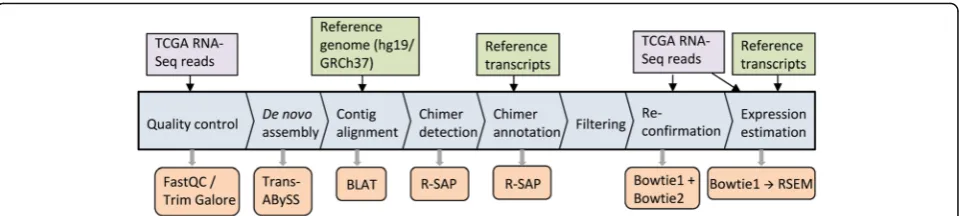
For the accurate detection, characterization and quanti-tative analysis of fusion transcripts using RNA-Seq data, we designed a computational workflow (Fig. 1) that inte-grates several existing bioinformatics tools including our previously published pipeline R-SAP [25]. The overall workflow is as follows:
Data pre-processing
RNA-Seq data may contain low-quality bases due to se-quencing errors and fragments of sese-quencing adapters derived from failed or short cDNA inserts during the li-brary preparation. Such low-quality bases can reduce the efficiency of the assembler and lead to miss-assembly [26]. We, therefore, trimmed low-quality bases (quality score < 20) and sequencing adapters from the 3′-end of the reads using ‘Trim Galore’ [27]. Subsequently the quality of the data was assessed using FastQC [28].
Transcriptome assembly
assembly process merges short DNA or RNA sequences that share terminal overlapping bases into a longer con-tiguous sequence (contig). The length of the terminal overlap or“k-mer length” is a critical parameter for as-sembly programs. Unlike genomic libraries, where a uni-form representation of each base pair can be assumed, non-normalized transcriptome libraries contain a broad range of expressed transcripts and splicing isoforms. Therefore, complete coverage of the transcriptome can-not be achieved at a single k-mer value assembly [30]. To maximize coverage, we adopted previous recommen-dations [30] and varied the k-mer length from half of the read length up to the full read length in increments of two base pairs at a time. For example, for a library with 50 bp long reads, we performed assembly for k-mer length of 25, 27, …49. Multiple k-mer assemblies were then merged into a single meta-assembly by using the Trans-ABySS pipeline [30] that combines overlapping contigs by extension and removes duplicate contigs from the assembly.
Chimeric transcript detection and filtering
Assembled transcripts were aligned to the human refer-ence genome (hg19, GRCh37) using BLAT (Blast like alignment tool; [31]). BLAT reports independent align-ment of different fragalign-ments of the RNA sequences and allows long gaps in the alignment that can be represen-tative of introns present in a RNA sequence. We ob-served the presence of short stretches of homopolymers (poly As and poly Ts) toward the ends of the assembled contigs. Such repeats may affect the overall alignment and may create ambiguous alignments. We therefore trimmed homopolymer repeats as well as other low complexity repeats detected using RepeatMasker (http://
www.repeatmasker.org) and Tandem Repeat Finder (http://tandem.bu.edu/trf/trf.html).
For potential chimeric transcript detection, we employed our previously developed pipeline R-SAP [25] that efficiently detects gene-fusion events and filters po-tential false positives and alignment errors. Alignment files were exported in‘.pslx’format from BLAT and were supplied to R-SAP as input for detecting chimeric tran-scripts. Chimeric transcripts result in fragmented (or split-) alignments where fragments of the chimeric tran-scripts map to discrete genomic loci. R-SAP detects such alignments and derives the underlying fusion structure using the known gene models. We combined Ensembl and lincRNA (long intergenic non-coding RNA) annota-tions (available from UCSC genome database) in order to generate a comprehensive set of known gene models. R-SAP characterized each chimeric transcript based upon the genic regions (5’UTR, protein coding se-quences [CDS] or 3’UTR) of the reference transcripts intersecting with the genomic loci involved in the chimeric transcript formation.
Fusion transcripts, representing a fusion-gene event, are very likely to produce discrete alignments to distant or proximate genomic loci. These discrete alignments are also called fragmented- or split-alignments. R-SAP performs the characterization of detected fusion tran-scripts by associating the fragmented alignments with reference transcripts and categorizes various chimeric transcript structures according to the genic or inter-genic regions to which they map (Fig. 2). We created a comprehensive set of 224,555 reference transcripts by merging Ensembl [32] and lincRNA [33] annotations for hg19 available from the UCSC Genome Browser [34]. These merged annotations were used as the known tran-script set for analysis by R-SAP.
Fusion transcripts that were detected and character-ized by R-SAP were subjected to additional stringent fil-tering in order to minimize potential assembly and alignment errors. First, to ensure the validity and signifi-cance of the alignment, fusion transcript fragments were required to be at least 25 bp long and to have an align-ment identity of >95%. Fusion transcripts with fragalign-ments mapping to the same gene were discarded as potential li-brary artifacts. Similarly, fusion-gene events between two paralogous genes (as determined using BioMart for Ensembl genes; [35]) were also discarded because they may potentially represent alignment errors.
Additional potential chimeric transcripts were dis-carded if either component fulfilled at least one of the following filtering criteria: a) Maps to mitochondrial or Y chromosome; b) Overlaps with genome assembly gaps or maps within 100 k bps of centromere or telomeres (assembly gaps, centromere and telomere coordinates were obtained from UCSC Genome Browser [34]); c) Maps to a genomic region containing ribosomal RNAs (defined by UCSC Genome Browser [34]); d) Has >50% overlap with the genomic low-complexity or simple
repeat regions (determined by RepeatMasker track in the UCSC Genome Browser [34]).
In order to further filter potentially miss-assembled fusion contigs, we aligned the original RNA-Seq reads to the fusion transcripts using Bowtie [36] in single-end mode and retained only those contigs that had support of at least two sequencing reads at the fusion breakpoint (Fig. 3). We also aligned sequencing reads to the reference genome using Bowtie2 [37] and defined a fusion transcript to be supported by mate-pairs if both mates of the same pair map to the genomic locations involved in the fusion event. We required that each fusion transcript be supported by at least two sets of mate-pairs.
Fusion transcripts are generally considered to be in low abundance in the human transcriptome [38]. Ninety-five percent (52/55) of our samples exceeded the sequencing depth of 100 million reads recommended for optimal detection of low abundance transcripts [30]. In addition, the correlation between the number of reads in the RNA-Seq library and the number of filtered fusion transcripts was insignificant (R = 0.24, Student t-test Fig. 2Chimeric transcript detection and characterization by R-SAP. Assembled contigs (black box) representing chimeric transcripts will produce discrete or fragmented alignments (blue and grey boxes) when mapped to the reference genome. It will result in the alignment structure where fragments of the assembled contigs will map to the genomic locations (e.g. chromosome A and chromosome B) underlying the fusion-gene formation. This structure is also called‘split-mapping’of the contig. R-SAP detects split-mapping and then compares the alignment coordinate of each fragment with the genomic coordinates of the known reference transcripts (shown in green boxes). Based on the fusion-point mapping (vertical orange bar on the top), R-SAP can determine the transcript regions (such as CDS or UTRs) that are involved in the gene-fusion
p-value >0.05) further indicating our estimates of fu-sion transcripts are independent of depth of sequen-cing coverage.
Expression quantification
We performed a two-way expression estimation on the filtered set of 1959 chimeric transcripts. First, we esti-mated the expression (also known as normalized read count) of the reference transcripts (comprised of Ensembl and lincRNA annotation set) that were involved in the chimer transcript formation. Reference transcript sequences were obtained from the UCSC genome data-base and filtered RNA-Seq reads were mapped using Bowtie. Alignment files were obtained in “bam” format that were sorted using Samtools [39]. Abundance was estimated as expected read counts by using RSEM (RNA-Seq by Expectation Maximization) [40]. Expres-sion values were then normalized using the “Upper quartile normalization” method proposed by Bullard et al. [41]. Expression values of reference transcripts (non-chimers) were used to calculate the fold change of 5′ -and 3′- UTR change-associated chimers in cancer sam-ples relative to the normal samsam-ples.
In order to determine the relative fusion-read fre-quency and also the “pro-neoplastic” potential of the nominated chimeric transcripts, we relied upon the ex-pression (or normalized read count) of the chimeric transcript itself rather than the associated reference tran-scripts. We estimated the expression for each chimeric transcript. RNA-Seq reads were mapped to the assem-bled contig representing the chimera and read counts were then estimated using RSEM. Read counts were nor-malized using upper-quartile normalization [41].
Fusion transcript frequency was calculated as percent-age of fusion transcript reads relative to total reads that included fusion transcript reads, wild-type 5′-reference gene reads and wild-type 3′-reference gene reads. Ex-pression fold change for pro-neoplastic chimeric tran-scripts in cancer relative to normal was computed using
the average expression values measured across cancer and normal samples.
Results
An average of 35 chimeric transcripts per sample were detected in cancerous and normal breast tissue samples analyzed
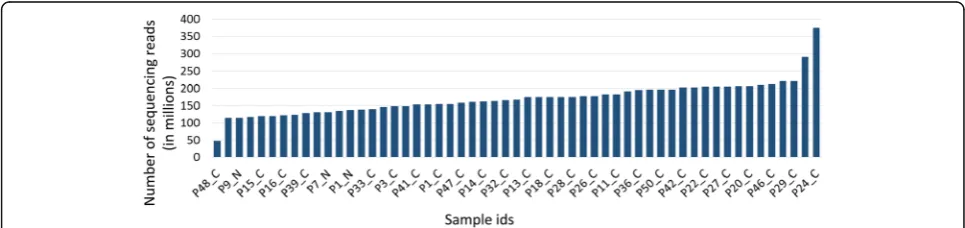
RNA-Seq data for breast cancer and normal breast tis-sues were downloaded from the TCGA database [42]. The RNA-Seq data (Additional file 1) were generated by sequencing total RNA libraries on the Illumina HiSq2000 system in paired-end mode. The raw data consisted of 50 bp long paired-end reads with an average of 170 million (range 47 million to 374 million; Fig. 4). We selected for analysis only paired-end reads with high read-coverage (45 breast adenocarcinoma primary tu-mors and 10 normal breast tissue samples) to ensure high accuracy in the downstream de-novo assembly. An integrated computational workflow was employed that included the ABySS [29] and Trans-ABySS [30] algo-rithms to generate long (>800 bp) contiguous sequences or“contigs”.De novo assembly (see Methods) of 7.8 bil-lion 50 bp long reads from the 55 RNA-Seq libraries re-sulted in 12.8 million contigs (an average of 233,615 contigs per sample) with an average length of 860 bps (Additional file 1). The R-SAP algorithm [25] was incor-porated into the workflow to identify and characterize chimeric transcripts (Fig. 1). R-SAP follows a hierarch-ical decision-making procedure to characterize various classes of transcripts such as splice-variants and gene-fusions. Chimeric transcripts (or gene-fusions) are de-tected by comparing the fragmented reference genome alignments of assembled contigs with well-annotated ref-erence transcripts. R-SAP also applies stringent filtering to limit the potential of false-positive detection (for an independent experimental validation of our pipeline see Additional file 2).
After subjecting the putative chimeric transcripts to a stringent set of filtering criteria (see Methods), 2461
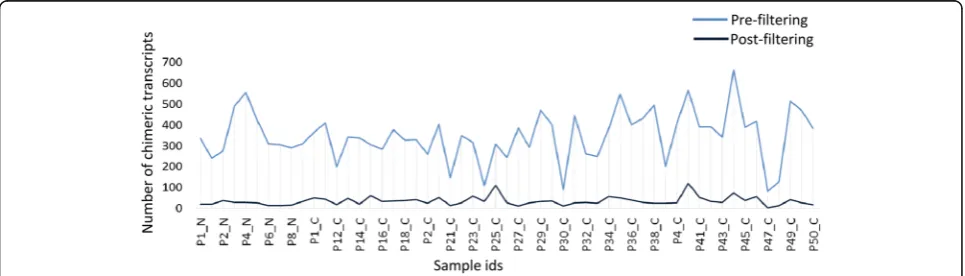
high-confidence chimeric transcripts remained. Of these, nearly 21% were immunoglobulin (Ig) gene fusions likely due to infiltrating T-cells in breast tissue and were ex-cluded from further analysis. After this additional filter-ing, 1959 chimeric transcripts remained with an average of 35 chimeric transcripts per sample (range 3 to 121) (Fig. 5). We compared chimeric transcripts across all normal and cancer samples by comparing the genomic alignment coordinates of each partner fragment of the chimeric transcript and allowing up to six base pairs to vary around the breakpoint. Out of the 1959 identified chimeric transcripts, 1535 were detected only in the can-cer samples, 155 were detected only in the normal sam-ples and 269 were detected in both the normal and cancer samples (Fig. 6a).
Chimeric transcripts were classified based on structural and functional criteria
A detailed characterization of all chimeric transcripts identified in this study was carried out using the R-SAP algorithm [25] and employing a comprehensive set of 224,555 reference transcripts (Ensembl version 73 and lincRNAs, see Methods). Most (98.82%) of the cancer-specific chimeric transcripts overlapped with at least one reference transcript. Overall 2012 reference transcripts (corresponding to 1917 genes) were associated with chimeric transcripts across all breast cancer samples (Additional file 3). Interestingly, the proportion of protein-coding reference transcripts associated with chimeric transcripts was significantly greater (Fisher’s exact test p < 0.0001) than the proportion associated with the entire reference annotation set (Fig. 6b). This suggests that protein-coding transcripts may be prefer-entially selected in the formation of chimeric transcripts. To more accurately characterize fusion transcripts and infer potential functional significance, we first estab-lished a hierarchical classification system (Fig. 7) where
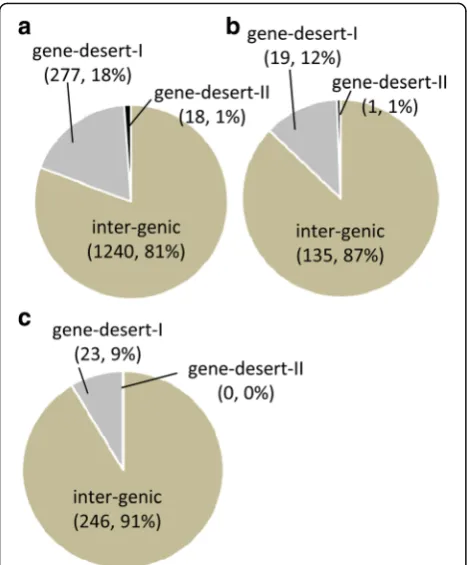
the fusion transcripts were divided into three major clas-ses: inter-genic-where the fusion is composed of two an-notated genes; gene-desert I- where the fusion is composed of one annotated gene and a sequence from an un-annotated or“gene-desert”region (lacking any an-notated gene within 5 kb); and gene-desert II- where the fusion is comprised of sequences from two distant ‘gene-desert’ regions. Overall, the vast majority (>80%) of fu-sion transcripts were inter-genic while <18% were gene-desert-I chimers. Only ~1% of the chimers were com-prised of two un-annotated transcripts (gene desert-II) (Fig. 8).
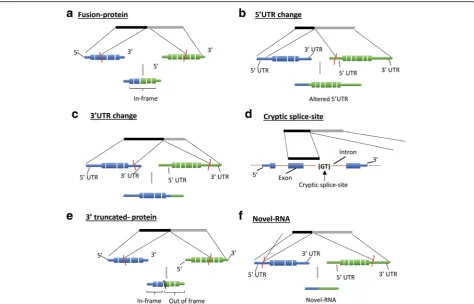
We further classified the detected fusions into six functional sub-categories (Fig. 9): A) Fusion-protein- fu-sion transcripts that combine protein coding sequences (CDS) from two different annotated genes while keeping the open-reading frames intact; B & C) 5′ or 3′ UTR-UTR exchange from another gene or gene-desert region in such a way that the original protein-coding region of the fusion remains intact. This group may include inter-genic and gene-desert-I type chimeras (Fig. 7); D) Cryp-tic splice-site- A novel splice-variant fusion where the breakpoint lies within a known intron. This group may include inter-genic and gene-desert-I chimeras; E) 3′ truncated-protein- The in-frame coding sequence of the upstream (5′) gene in the fusion is partially included (truncated) while the coding region of the 3′gene is not in frame. This group may include inter-genic and gene-desert I fusions; and F) Novel-RNA- Non-canonical fu-sion transcript formation where the potential function of the transcript, if any, is unknown (e.g., 5’UTR-3’UTR fu-sions). This group also includes out-of-frame truncated fusion-protein transcripts. The distribution of the identi-fied chimeras in each of these functional groups is dis-played in Fig. 10 and Tables 1, 2 and 3.
Out of 1535 cancer specific fusions, 5% (79/1535) are fusion-proteins, 3% (45/1535) are 5′ UTR changes and
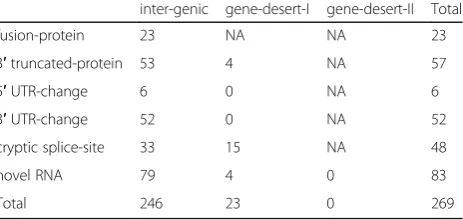
11% (166/1535) are 3′ UTR changes. The novel-RNAs constitute the most abundant class (30%, 459/1535) of fusion transcripts. The next most frequent class is the 3′ truncated-protein (27%, 419/1535) followed closely by the cryptic splice-site fusions (24%, 367/1535) (Fig. 10a). These relative proportions were generally maintained in the normal specific and overlap class of fusions (Fig. 10b, c).
Some fusion-protein transcripts recur across the cancer patient samples investigated
Although the functional significance of fusion transcripts cannot be unambiguously determined without experimental
validation, the recurrence of chimeric transcripts across multiple patients is sometimes taken as tentative indication of biological significance [1]. For example, the KRI1-ATRX
fusion transcript is the most frequently observed fusion transcript in our dataset (present in nine cancer and one normal samples). It involves a fusion between a partial ORF associated with the KRI1 (KRI 1 homolog) gene and the DEAD helicase domain (helicase domain containing amino acid sequence D-E-A-D = asp-glu-ala-asp) from the ATRX
(ATP-dependent helicase ATRX) gene. The DEAD box heli-cases are a family of proteins involved in ATP hydrolysis dependent DNA and RNA unwinding that, in-turn, Fig. 6Distribution of fusion and associated reference transcripts. (a) Venn diagram representing the distribution of fusion transcripts in 10 normal (blue) and 45 cancer (red) breast tissues. Two-hundred and sixty-nine fusion transcripts were found in both normal and cancer samples. (b) Relative distribution of protein coding (black) and non-protein coding (blue) reference transcripts associated with all annotated human transcripts vs. the relative distribution associated with fusion transcripts detected in this study. Table insert displays the total numbers of transcripts in each category
regulates RNA expression and its translational efficiency (e.g., [43]. The frequency of recurrent fusion transcripts across cancer samples is shown in Fig. 11 and Table 4.
Seventy-nine cancer-specific fusions encode protein-coding domains where the ORFs are maintained
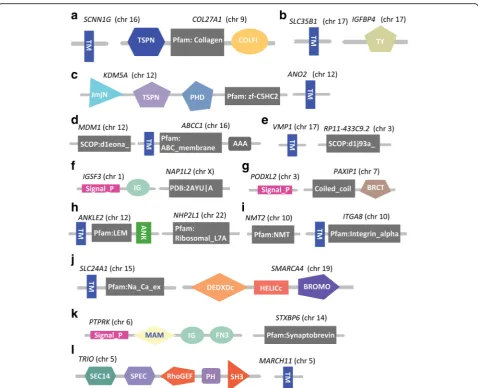
We identified 79 breast cancer specific fusion transcripts where the fusion occurs within the protein coding re-gions of the two participating genes and the open-reading frames are maintained (Fig. 10a; Table 1). We analyzed the protein coding domains in these 79 fusion-protein transcripts using SMART (simple modular archi-tecture research tool; [44]). We found that 38% (30/79) of the fusion-protein transcripts contained functional domains for both genes involved in the fusion formation (Additional file 4). Interestingly, 50% (15/30) of these protein coding fusion-transcripts involved the novel joining of a signal peptide (2/15) or a trans-membrane domain (13/15) with a protein coding domain not previ-ously associated with these functional groups. Signal peptide sequences are components of proteins that are normally secreted from cells [45]. Trans-membrane (TM) domains are signaling, transport and subcellular localization components of proteins that are critical to a variety of inter- and intracellular interactions [46–48].
Mutations resulting in the gain or loss of TM domains are known to have a significant effect on cellular func-tions and molecular interacfunc-tions [49]. Of the 15 fusions associated with signal peptide/TM domain sequences, 12 are fusions with protein coding sequences (COL27A1, IGFBP4, KDM5A, MDM1, NAP1L2, NHP2L1, NMT2, PAXIP1, RP11-433C9.2, SMARCA4, STXBP6and TRIO) not previously associated with these signaling functions (genes defined in Fig. 12).
Fusions that place protein-coding genes under novel regulatory control are frequent in the breast cancer sam-ples investigated
A gene fusion between two different genes often puts one gene (downstream or 3′ partner gene) under the transcriptional regulatory elements (promoter or enhan-cer) of the other gene (upstream or 5′ partner gene). Such fusion-based regulatory variants have often been associated with the activation of the 3′ proto-oncogene in cancer cells. For example, it has been previously re-ported that the oncogenic transcription factor ERG
(ETS-related gene), is up regulated in prostate cancer due to the fusion with the 5′ region of the TMPRSS2
(trans-membrane protease, serine 2) gene that contains an androgen responsive promoter element [50].
For the 79 fusion-protein transcripts in the cancer samples, we estimated the fold-change in gene expres-sion of the 3′partner genes involved in the fusion rela-tive to their expression in their normal configurations (i.e.,non-chimeric) by comparing the expression of each of the 3′ partners. We used normalized read counts as expression estimates (see Methods) and found that 24% (19/79) of the 3′ partners were associated with a ≥ 2-fold expression increase in cancer for at least one pro-tein coding domain (Additional file 5). Several of the genes involved in these up-regulated fusions have been previously identified as either cancer biomarkers or as potential therapeutic targets. For example, the
B4GALNT2 (beta-1,4 N-acetylgalactosaminyltransferase 2) gene, the 3′ partner in the THRA (thyroid hormone receptor, alpha)-B4GALNT2 fusion, has been previously proposed as a prognostic biomarker of breast cancer [51] and is reported to be up regulated in colorectal and metastatic prostate cancer [52, 53]. TheABCC3 (canalic-ular multispecific organic anion transporter 2) gene, the 3′ partner in theMED1 (mediator complex subunit
1)-ABCC3 fusion, is known to efflux therapeutic com-pounds resulting in multidrug resistance in cancer cells [54, 55].
We also compared the expression of the 79 protein-fusion transcripts with the 419 3′-truncated protein-fusions. The protein-fusions were found to have 2.7-fold higher ex-pression (p-value: 0.005; Student t-test one-tailed) than Fig. 8Relative distribution of inter-genic, gene-desert-I and gene
the 3′-truncated fusions (Fig. 13 and Additional file 6) possibly due to non-sense mediated decay (NMD) [56].
Another class of fusions that may be expected to alter patterns of gene expression involves the exchange of 5′ or 3′un-translated leader regions (UTRs) of intact pro-tein coding sequences. For example, alteration in the poly-A tail attached to 3’UTR and removal of 5′cap (7-methyle guanosine) may promote mRNA decay and hence overall turnover in the cell [57]. Additionally, fu-sions involving the exchange of a 5’UTR may place a gene under the control of a novel promoter. For ex-ample, chromosomal rearrangements involving UTRs that result in high - level expression of the ETS (E26 transformation-specific) gene family members are com-mon events in human prostate cancer [50]. Similarly, changes in the 3’UTR can alter microRNA target bind-ing sites leadbind-ing to changes in the gene expression. For
example, in glioblastoma, the FGFR3 (fibroblast growth factor receptor 3) gene has been shown to escape regula-tion by the miR-99a microRNA due to a fusion with the 3’UTR of the TACC3 (transforming, acidic coiled-coil containing) gene [58].
In our analysis, 14% (211/1535) of the fusions detected in our breast cancer samples consisted of un-disrupted protein coding sequences fused with heterologous UTRs. Nearly 21% (45/211) of these are 5’UTR fusions while 79% (166/211) are fusions with 3’UTRs (Fig. 10a, Table 1). Most (88%, 186/211) of the UTRs were interchanged between two known genes but 12% of the chimers in-volved the UTRs of known coding sequences with se-quences from un-annotated ‘gene-deserts’regions of the genome (Table 1).
We estimated the effects of 5′and 3′UTR changes on gene expression by measuring the fold-change in the Fig. 9Structure based functional classification of fusion transcripts. Fusion transcripts are represented by black and grey boxes; reference
expression level of each UTR-protein coding gene fusion in the cancer samples relative to the protein-coding gene’s average level of expression in our normal samples (see Methods). The results indicate that 54 of the UTR-protein coding fusion genes are ≥2-fold up regulated relative to their wild-type counterparts in normal cells (Fig. 14; Additional file 7). Several of the up-regulated genes encode transcription factors previously implicated
in cancer. For example, the epigenetic transcriptional regulator proteins CBX3 (chromobox homolog 3) and CBX4 (chromobox homolog 4) were up regulated in our cancer samples due to alternative 3’UTRs obtained by gene-fusion. CBX3 has been previously identified as a potential biomarker for tumor stem cells in osteosar-coma [59], while CBX4 has been reported to induce hypoxia-mediated activation of VEGFA (vascular endo-thelial growth factor A) and angiogenesis in hepatocellu-lar carcinomas [60]. Another chimeric transcript up regulated in our cancer samples is a fusion of the tran-scriptional regulator-encoding gene,RARA(retinoic acid receptor, alpha), with the 3′UTR from thePSME3 (pro-teasome activator subunit 3) gene. Interestingly, an analogous reciprocal translocation between the RARA
withPML(promyelocytic leukemia) genes has been pre-viously associated with the primary cytogenetic abnor-mality leading to acute promyelocytic leukemia [61].
In our breast cancer samples, 17 genes were estimated to be ≥2-fold down-regulated due to the fusion with novel UTRs (Table 1; Fig. 14; Additional file 7). For ex-ample, a fusion between the PTEN (phosphatase and tensin homolog) and the 3′UTR of thePIK3C2A (phos-phatidylinositol-4-phosphate 3-kinase, catalytic subunit type 2 alpha) genes resulted in the down regulation of
PTEN > 2-fold in our cancer samples. PTEN is a well-known tumor suppressor gene that displays loss-of-function mutations in many cancers (e.g.,[62]).
Fig. 10Relative distribution of functional classes of fusion transcripts present. (a) Only in cancer tissue samples; (b) only in normal tissue samples; and (c) in both normal and cancer samples
Table 1Distribution of cancer specific fusion transcripts across multiple structural and functional classes
inter-genic gene-desert-I gene-desert-II Total
fusion-protein 79 NA NA 79
3′truncated-protein 6 133 NA 419
5′UTR-change 41 4 NA 45
3′UTR-change 145 21 NA 166 cryptic splice-site 289 78 NA 367
novel RNA 400 41 18 459
Total 1240 277 18 1535
Table 2Distribution of structural and functional classes for chimers found only in normal tissue samples
inter-genic gene-desert-I gene-desert-II Total
fusion-protein 9 NA NA 9
3′truncated-protein 22 4 NA 26
5′UTR-change 6 2 NA 8
3′UTR-change 18 1 NA 19
cryptic splice-site 41 6 NA 47
novel RNA 39 6 1 46
Total 135 19 1 155
Table 3Distribution of structural and functional classes for chimeras found in both normal and in cancer tissue samples
inter-genic gene-desert-I gene-desert-II Total
fusion-protein 23 NA NA 23
3′truncated-protein 53 4 NA 57
5′UTR-change 6 0 NA 6
3′UTR-change 52 0 NA 52
cryptic splice-site 33 15 NA 48
novel RNA 79 4 0 83
Other protein coding genes involved in UTR fusions in our cancer samples that have been previously associ-ated with cancer onset and/or progression are the inter-feron gamma receptor 1 (IFNGR1) gene [63], the period circadian clock 2 (PER2) gene [64, 65], the chloride intracellular channel 4 (CLIC4) gene [66], the sorbin and SH3 domain containing 2 (SORBS2) gene [67] and the eukaryotic translation initiation factor 2-alpha kinase en-coding (EIF2AK2) gene [68, 69].
A number of detected fusion transcripts include sequences from gene-desert regions of the genome Previous studies have shown that the human genome is more pervasively transcribed than previously thought [70]. For example, the recent ENCODE (Encyclopedia of DNA Elements; [71]) data release suggests that nearly 80% of the human genome displays transcriptional
functionality in a cell type specific manner [72]. Al-though many of these transcripts are derived from anno-tated protein-coding genes, others may represent long non-encoding RNAs or other non-encoding regulatory RNAs of currently undetermined function. In our cancer samples, we identified 338‘gene-desert’fusions where ei-ther one (319, gene-desert-I) or both components (19, gene-desert-II) of the chimeric transcript maps to the
‘gene-desert’ regions of the genome (Fig. 7; Additional
file 8).
We obtained transcription factor binding site (TFBS) predictions based on Chip-Seq data from the ENCODE project [71] for five breast or mammary cell lines (HMEC, HMF, MCF-7, MCF10A-Er-Src, T-47D). We then searched for active TFBS in the ENCODE database at positions proximal to gene-desert regions involved in our chimeric transcripts. Since most TFBSs are present within 8 kb of the transcription start site of regulated genes [73], we considered only those TFBSs mapping within 8 kb of the gene-desert transcripts (Fig. 15a). Interestingly, all (100%, 319/319) of the gene-desert re-gions involved in chimer formation had at least one ac-tive TFBS within 8 KB of the transcript. Also, we found that the gene-desert chimeric regions are distributed at distances from TFBS similar to that observed for anno-tated reference transcripts (Fig. 15b). These findings support the contention that actively transcribed tran-scripts mapping to gene-desert regions of the genome participate in fusion formation. However, since neither the structure nor the function of transcripts mapping to these gene-desert regions are currently known, the po-tential functional significance of gene-desert fusions also remains undetermined. Nevertheless, the fact that 9% (28/319) of gene-desert chimeric transcripts involve the fusion of known protein-coding sequences with UTRs from gene-desert regions suggests that at least some of these fusions may represent significant regulatory variants.
Fusion transcripts are associated with both high and low frequency clones
Because breast cancers, like most solid tumors, are gen-erally polyclonal in make-up [74], RNA-sequencing reads typically represent a mixture of transcripts arising from the various clones comprising the tumor. While higher frequency or predominant clones may make up the bulk of the tumor, a number of lower frequency clones are often also present. To estimate the proportion of the 79 protein fusions associated with high- and low-frequency clones, we computed the low-frequency of each type of fusion transcript reads relative to the total num-ber of reads detected in the patient samples (see Methods). The results presented in Table 5 (see also Additional file 9) indicate that >50% (43/79) of the Fig. 11Recurrence of breast cancer associated fusion transcripts
across patient samples. Shown is the percentage of all cancer fusion transcripts detected in one or more cancer patient samples. The vast majority of fusion transcripts are specific to individual patients. Inset details the distribution of transcripts found in more than one sample
Table 4Recurrence of chimeric transcripts across cancer samples
Recurrence Frequency Percentage
1 1309 93.97
2 55 3.95
3 17 1.22
4 5 0.36
5 5 0.36
6 1 0.07
7 0 0
8 0 0
9 1 0.07
Total 1393
identified protein fusions represent ≤10% of total reads in the patient samples indicating that they are likely associated with low-frequency clones. In contrast, 9% (7/79) of the identified protein fusions represent >50% of the identified reads in individual patient tumors indicating that these fu-sions are associated with high-frequency clones. While the association of protein fusions with high frequency clones is suggestive, the relative frequency of fusions in a tumor sam-ple is not necessarily indicative of relative functional
significance. Tumors are a dynamic community of cells where inter-clonal selection is continuously ongoing as new variants arise and/or new environmental challenges (e.g., chemotherapy) are presented to the tumors.
Comparative analysis of fusion transcripts in normal and cancer samples identifies potential pro-neoplastic genes Comparison of fusion transcripts across all normal and cancer samples was carried out by comparing the Fig. 12Structure of in-frame gene-fusion mutations resulting in gain of signaling protein domains (trans-membrane and/or signal peptide domains) from another participating gene. Depicted are 12 of 15 detected fusion events where genes were not previously associated with the signaling/TM functions. Gene symbols and corresponding chromosomes (in parenthesis) are shown above each gene fusion structure. Gene symbols are defined as follows: (a)SCNN1G: Sodium Channel, Non-Voltage-Gated 1, Gamma Subunit;COl27A1L: Collagen, Type XXVII, Alpha 1; (b)SLC35B1: Solute Carrier Family 35, Member B1;IGFBP4: Insulin-Like Growth Factor Binding Protein 4; (c)KDM5A: Lysine (K)-Specific Demethylase 5A;ANO2: Anoctamin 2; (d)MDM1: Mdm1 Nuclear Protein Homolog (Mouse);ABCC1: ATP-Binding Cassette, Sub-Family C (CFTR/MRP), Member 1; (e)VMP1: Vacuole Membrane Protein 1;RP11-433C9.2: Clone based putative protein coding gene on chromosome 3; (f) IGSF3: Immunoglobulin Superfamily, Member 3;NAP1L2: Nucleosome Assembly Protein 1-Like 2; (g)PODXL2: Podocalyxin-Like 2;PAXIP1: PAX Interacting (With Transcription-Activation Domain) Protein 1; (h)ANKLE2: Ankyrin Repeat And LEM Domain Containing 2;NHP2L1: NHP2 Non-Histone Chromosome Protein 2-Like 1 (S. cerevisiae); (i)NMT2: N-Myristoyltransferase 2;
genomic alignment coordinates of each partner fragment of the chimeric transcript and allowing up to six base pairs to vary around the breakpoint. Although 88% (1716/1959) of all chimeric transcripts detected were found in the cancer samples and only 12% (243/1959) in the normal samples, this is largely attributable to the dis-proportionate number of samples examined (45 cancer
vs. 10 normal). When the average number of chimers detected per sample is compared, the differences are less dramatic (normal: 24/sample; cancer: 38/sample) albeit still significant (Student’s t-testp< 1.05E-03).
The unexpected abundance of chimeric transcripts in normal samples and the fact that the majority of these (> 60%, 269/424; see Fig. 6) were also present in the can-cer samples, led us to explore these fusions in more de-tail. It is possible that at least some of the chimeric transcripts detected in normal tissue may represent
“pro-neoplastic” fusions whose cancer-causing potential
is at least partially repressed in normal cells (i.e., onco-gene expression repressed; tumor suppressor potential Fig. 13Fusion-protein transcripts have higher expression than 3′
-truncated proteins. Chimeric transcripts resulting in 3′-trunctated proteins are likely to produce non-functional transcripts and undergo non-sense mediated decay. Fusion-proteins where the open-reading frame of the participating gene is maintained, on the other hand, are expected to have higher expression than 3′-truncated chimers. The figure shows statistically higher (p-value: 0. 005, Student t-test one-tailed) expression for breast cancer specific fusion-protein transcripts (left) than for the 3′-truncated chimeric transcripts (right). Normalized read counts are used as expression estimates. Errors bars shown here are standard errors derived from the expression value distribution across chimer transcript in each category
Fig. 14Gene-expression change due to fusion with heterologous UTRs. Chimera formation can result in the altered 5’UTR or 3’UTR while keeping the original ORF intact. Histograms display the number of chimeric transcripts where the protein-coding genes are up-regulated (red) or down-regulated (green) by >2 fold in breast cancer samples relative to the protein-coding genes (native state) in normal breast tissue
Fig. 15Detection of transcription factor binding sites (TFBS) in proximity to gene-desert regions involved in chimera formation. (a) A search was carried out for documented transcription factor binding sites (TFBS; grey box) within 8 kb from gene-desert transcripts (black box) involved in breast cancer gene fusions. (b) At least one active TFBS is located within 8 KB of gene-desert transcripts involved in gene-fusions in cancer. The distribution of the locations of TFBS from the gene-desert transcripts (red line) is identical to that associated with annotated reference transcripts (blue line). The x-axis is the distance in kilobases of a TFBS detected from a transcript; the y-axis is the percentage of transcripts with a specific TFBS distance corresponding to X-axis
Table 5Distribution of percentage of fusion reads across functional classes in cancer specific chimeric transcripts
chimer functional class Min% Max% Average% Median%
fusion-protein 0.00360 93.79 16.87 9.16
3′truncated-protein 0.00034 99.64 15.19 6.54 cryptic splice-site 0.00600 99.83 17.50 4.37
novel RNA 0.00041 99.72 26.23 10.30
amplified). For example, chimeric transcripts of the well-studied chronic myeloid leukemia causing BCR-ABL
(breakpoint cluster region-Abelson protooncogene) fu-sion gene have been detected at low levels in the blood cells of healthy individuals as well [75]. Similarly, the anti-apoptotic chimeric transcript comprised of the zinc finger genesJAZF1(JAZF zinc finger 1) andJJAZ1(also known as SUZ12 or SUZ12 polycomb repressive com-plex 2) is highly expressed in nearly 50% of all endomet-rial stromal sarcomas [76, 77], but has also been detected at low levels in normal endometrial stromal cells as well [24].
We detected 269 chimeric transcripts that were shared between our normal and breast cancer samples. Many of these fusions are associated with moderate- to high-frequency clones (Table 6). For example, four of these shared chimeric transcripts were identified as in-frame fusion-protein coding transcripts of potential pro-neoplastic significance (ZBTB47-FGD1, KRI1-ATRX, CACNA1D-CTNNBL1, andSCAF4-TNRC6A) (genes de-fined in Fig. 16; Additional file 10). RNA-Seq reads were mapped to the assembled contigs representing each of these four fusions and read counts were estimated using RSEM (RNA-Seq by Expectation Maximization; [78]) and normalized using upper-quartile normalization [41] (see Methods). Two of the fusions (ZBTB47-FGD1 and
KRI1-ATRX) displayed a > 2.5-fold increase in expres-sion in cancer relative to the normal samples (Fig. 16a, b; Additional file 10). Both of these fusions are estimated to be associated with clones in moderately high fre-quency in their respective tumors based on % of total reads (Additional file 10). A third fusion ( SCAF4-TNRC6A), also associated with moderately high-frequency clones (Additional file 10), displayed a 1.3-fold increase in expression (Fig. 16c) in the cancer samples while a fourth fusion (CACNA1D-CTNNBL1), associated with a lower-frequency clone (Additional file 10), dis-played a decrease in expression in the cancer samples (Fig. 16d; Additional file 10).
In the ZBTB47-FGD1 fusion transcript, a BTB/POZ domain (BR-C, ttk and bab domain/Pox virus and Zinc finger virus and zinc finger domain) fromZBTB47(zinc finger and BTB domain containing 47) is fused with the RhoGEF (a.k.a., the Dbl homologous domain), PH
(pleckstrin homology) and FYVE domains from FGD1. Interestingly, a previously identified oncogenic fusion gene (Dbl) was also found to contain a RhoGEF domain whose over-expression is essential to the Dbl gene’s
oncogenic potential [79]. Over expression of FGD1 has also been previously associated with cancer progression in prostate and breast cancer [80]. The 3′ member of theKRI1-ATRXfusion (ATRX) has been previously asso-ciated with childhood neuroblastoma [81] and the 3′
member of the CACNA1D-CTNNBL1 fusion
(CTNNBL1), is associated with an anti-apoptotic, tumor suppressive function [82, 83] consistent with its reduced expression in our breast cancer samples.
Fusion transcripts display breast cancer subtype specificity
Breast cancer is a heterogeneous disease with distinct clinical subtypes [84]. For example, the estrogen recep-tor negative (ER-), progesterone receprecep-tor negative (PR-) and human epidermal growth factor receptor 2 negative (HER2-) (a.k.a., triple negative) sub-type is particularly aggressive and associated with a high risk of metastasis. Previous studies suggest that gene-fusions in breast can-cers are often sub-type specific (e.g., [85, 86]). To inves-tigate this question in our dataset, we divided our breast cancer samples into two categories: a) ER+/HER2+ (n = 33) and b) triple negative (ER-, PR-, HER2-) (n= 12). Consistent with previous reports, we found that the fusions identified in our study were also highly sub-type specific (Table 7). For example, only ≈3% (41/ 1535 = 0.026) of all of the identified fusion transcripts were detected in both subtype groups (Table 7; Add-itional file 11). The majority of fusions were associated with the ER+/HER+ sub-group (1052/1535 = 0.68). For the 79 in-frame fusion protein transcripts this preference was even more pronounced (59/79 = 0.75) with only one protein fusion, LNPEP-ANPEP (leucyl and cystinyl ami-nopeptidase- alanyl aminopeptidase, membrane) being shared between the ER+/HER+ and triple negative sub-groups.
Discussion
The oncogenic potential of gene fusions and fusion tran-scripts was first recognized in malignant hematological disorders and childhood sarcomas [87]. In recent years, the importance of fusions in the onset and progression of a vast diversity of solid tumors has become more widely appreciated. The rapidly growing awareness of the extensiveness and potential importance of fusion transcripts in cancer has been facilitated by the high-throughput transcriptome sequencing of a broad spectrum of cancer types. The Cancer Genome Anatomy Project [88] currently lists well over 1800 fusions identi-fied in >63,000 cancer patient samples and it has been Table 6Distribution of percentage of fusion reads in
nominated pro-neoplastic transcripts in breast cancer
Fusion type Min% Max% Average% Median%
Pro-neoplastic 0.55318 33.13 12.00 8.93
Percent of fusion reads was calculated as using fusion (chimeric) transcript reads divided by total reads (fusion read count + wild-type (non-fusion) 5′-gene read count + wild-type (non-fusion) 3′-gene read count) (see
estimated that gene-fusions account for >20% of human cancer morbidity [2].
We present here an integrated computational workflow that not only allows accurate detection of fusion transcripts to nucleotide level resolution but also facilitates detailed molecular characterization and quantitative analysis. We employed this workflow to analyze 55 breast transcriptomes that, to our knowledge, is the first such study to explore global patterns and characteristics of chimeric transcripts in any tumor using ade novoassembly approach.
associated alterations, our de novo assembly based ap-proach allowed us to explore other classes of fusion structures such as cryptic-splice sites and non-canonical RNA structures. While the accuracy of our pipeline was experimentally validated using a prostate cancer cell line dataset (Additional file 2), the tissue samples used in es-tablishing the TCGA datasets employed in this analysis are not available for experimental confirmation. Thus, although the potential functional impact of many of the chimeric transcripts computationally identified here have yet to be experimentally verified, their widespread occur-rence in the breast cancer samples investigated in this study strongly suggests that this class of chimeric tran-scripts warrants further investigation. In total, we identi-fied 111 novel gene-fusions, 13 of which were detected across multiple patient samples.
Most previously identified gene-fusions in cancer have been associated with oncogene activation [89]. Our find-ings suggest that gene-fusions can also result in signifi-cant down regulation of potentially signifisignifi-cant genes. For example, while we identified 54 examples of genes being up regulated in cancer due to fusions with heterologous UTRs, an additional 17 such fusions resulted in a signifi-cant down regulation in gene expression including the well-known tumor suppressor genePTEN.
Chimeric transcripts are typically associated with can-cer cells but, with notable exceptions (e.g., [90]), their presence in normal somatic cells is often overlooked. In our study, we identified a number of fusion transcripts that are present in both normal and cancer tissues but significantly differentially expressed in these two tissue types. Several of these were identified as potential pro-neoplastic fusions where domains previously associated with oncogenic functions were up regulated in cancer while those previously associated with tumor suppressor functions were down regulated in cancer.
Finally, we detected a large number of chimeric tran-scripts mapping partially or completely to genomic re-gions devoid of any known genes (“gene deserts”). We observe that the fusion transcripts involving gene-desert
regions can result in the fusion of altered 5′or 3′UTRs to known protein-coding genes resulting in significant changes in gene expression. We also detected the fusion of transcripts mapping to two distinct gene-desert re-gions giving rise to novel RNA structures of currently unknown significance.
Conclusions
Overall, our de novoassembly approach has revealed an unexpected prevalence and diversity of chimeric tran-scripts in breast cancer tissues. While our results are highly suggestive, we recognize that our conclusions can only be taken as tentative until they are substantiated by experimental validation. While we hope that our findings will stimulate such empirical investigations, we believe our present results underscore the utility of deep se-quencing technologies and improved bioinformatic workflows to uncover novel and potentially significant fusion transcripts in cancer and normal somatic tissues.
Additional files
Additional file 1: Summary statistics on raw and processed RNA-Seq data from the 55 breast samples used in this study. Additional columns contain statistics on assembled contigs, initial and final number of chimeric transcripts after filtering. The first sheet in the excel file contains the data columns and a key describing the data is on the second excel sheet. (XLSX 18 kb)
Additional file 2: Summary of independent validation of fusion detection pipeline. File describes the test dataset, conductedin silico
experiment and test results. Summary statistics and test results are summarized in tables. (DOCX 20 kb)
Additional file 3: Detailed alignment and annotation information on 1959 filtered chimeric transcripts from 55 samples analyzed in the study. Each chimeric transcript is represented by a unique ID in the first column. Structural and functional classification (as described in the text) information is presented in columns S, T and U. Cells in the gene name columns (‘geneName1’and‘geneName2’) with value“none”represent gene-desert regions. The first sheet in the excel file contains the data columns and a key describing the data is on the second excel sheet. (XLSX 684 kb)
Additional file 4: Cancer specific in-frame fusions where at least one protein domain from each (5′and 3′) of the participating genes is covered by the ORFs involved in the chimera formation. Protein domain names Table 7Distribution of chimeric transcripts across breast cancer subtypes
Chimer Functional Class ER+/HER2+ only Triple negative only Common Totala
Fusion-protein 59 18 1 79
3′UTR change 111 33 11 166
5′UTR change 31 10 2 45
3′truncated protein 294 107 9 419
cryptic splice-site 292 133 8 441
novel RNA 265 100 10 385
Overall 1052 401 41 1535
Number of breast cancer specific (not detected in normal tissues) chimeric transcripts from different functional classes in breast cancer subtypes. Two major subtype groups were defined. ER+/HER+ is where patient is either ER+ or HER2+ or both; triple negative where patient is ER-, PR- and HER2-.a
(as defined by SMART database) are present in columns K and T. The first sheet in the excel file contains the data columns and a key describing the data is on the second excel sheet. (XLSX 115 kb)
Additional file 5: Cancer specific in-frame fusions where the 3′partner gene is up regulated by >2X relative to the intact gene in normal tissue samples. Expression is the normalized RNA-Seq read counts as estimated using RSEM and followed by upper quartile normalization. Expression fold change for the 3′- gene is present in column U. The first sheet in the excel file contains the data columns and a key describing the data is on the second excel sheet. (XLSX 113 kb)
Additional file 6: Expression (normalized read count) for breast cancer specific 79 fusion-protein and 419 3′-truncated protein transcripts. Expression is the normalized RNA-Seq read counts as estimated using RSEM and followed by upper quartile normalization. File contains expression data for breast cancer specific fusion-protein and 3′-truncated protein transcripts only. The first sheet in the excel file contains the data columns and a key describing the data is on the second excel sheet. (XLSX 33 kb)
Additional file 7: Cancer specific chimeric transcripts with fused 5′or 3′ UTRs and having the ORF of the coding gene intact and displaying >2X change in expression relative to the intact gene’s expression in normal tissue. The first sheet in the excel file contains the key defining column entries. The second sheet contains data for chimeras with a fused 5′UTR; the third sheet contains data for chimeras with a fused 3′UTR. For 5′-UTR fusions, the expression fold change for the 3′partner gene is calculated; for 3′UTR fusions, the expression fold change for the 5′partner gene is calculated. The upper portion in each data sheet summarizes the down-regulated genes and the lower portion summarizes the up-regulated genes. (XLSX 27 kb)
Additional file 8: Detailed information for desert-I and gene-desert-II chimeric transcripts. The first sheet of the excel file contains the key defining column entries. The data for cancer specific, normal control and shared chimeric transcripts is presented separately in second, third and fourth sheets, respectively. Cells in the gene name columns (‘geneName1’and‘geneName2’) with value“none”represent gene-desert regions. (XLSX 72 kb)
Additional file 9: Fusion read frequency for 79 breast cancer specific fusion-protein transcripts relative to total reads. Expression for fusion tran-scripts, as well as, those associated wild-type 5′- and 3′- reference tran-scripts is summarized in the file. Expression is the normalized RNA-Seq read counts as estimated using RSEM followed by upper quartile normalization. Fusion read frequency is shown in column H. The first sheet in the excel file contains the data columns and a key describing the data is on the second excel sheet. (XLSX 19 kb)
Additional file 10: Distribution of fusion reads relative to total reads for pro-neoplastic fusion-protein transcripts in breast cancer samples. File contains fusion specific read counts, as well as, the read counts for wild-type 5′- and 3′- partner reference genes for nominated pro-neoplastic transcripts (in-frame fusion gene transcripts present in both normal and cancer samples) in breast cancer. Expression levels are presented as nor-malized RNA-Seq read counts as estimated using RSEM and upper quar-tile normalization. Column J contains relative fusion read frequency as percentage value. The first sheet in the excel file contains the data col-umns and a key describing the data is on the second excel sheet. (XLSX 12 kb)
Additional file 11: Fusion read relative frequency in breast cancer subtypes. Expression for 79 breast cancer specific fusion transcripts as well as those associated wild-type 5′- and 3- reference genes is summa-rized in the file. Expression is the normalized RNA-Seq read counts as esti-mated using RSEM and followed by upper quartile normalization. Fusion transcripts were divided into two breast cancer sub-type groups: ER and/ or HER2 positive and triple negative. The first sheet in the excel file con-tains the data columns and a key describing the data is on the second excel sheet. (XLSX 39 kb)
Abbreviations
ABCC1:ATP-binding cassette, sub-family C (CFTR/MRP), member 1 gene; ABCC3: ATP-binding cassette sub-family C, member 3 gene; ABL: Abelson protooncogene; ACHE1: Acetylcholinesterase 1 gene; ANKLE2: Ankyrin repeat
and LEM domain containing 2 gene; ANO2: Anoctamin 2 gene; ANPEP: Alanyl aminopeptidase, membrane gene; ATP: Adenosine triphosphate; ATRX: ATP-dependent helicase ATRX gene; B4GALNT2: Beta-1,4 N-acetylgalactosaminyltransferase 2 gene; BCR: Breakpoint cluster region; BLAT: Blast-like alignment tool; BTB: BR-C, ttk and bab domain;
CACNA1D: Calcium channel, voltage-dependent, L type, alpha 1D subunit gene; CBX3: Chromobox homolog 3; CBX4: Chromobox homolog 4; cDNA: Complementary DNA; CDS: Protein coding sequences; CES4A: Carboxylesterase 4A gene; CLIC4: Chloride intracellular channel 4 gene; COL27A1L: Collagen, type XXVII, Alpha 1 gene; Contig: Contiguous sequence; CTNNBL1: Calcium channel, voltage-dependent, L type, alpha 1D subunit gene; dbGAP: Database of Genotypes and Phenotypes;
DEAD: Helicase domain containing amino acid sequence D-E-A-D (asp-glu-ala-asp); EIF2AK2: Eukaryotic translation initiation factor 2-alpha kinase encod-ing gene; ENCODE: Encyclopedia of DNA Elements; ER−/+: Estrogen receptor negative or positive gene; ERG: ETS-related gene; ETS: E26 transformation-specific gene; FGD1: FYVE, RhoGEF and PH domain-containing protein 1 gene; FGFR3: Fibroblast growth factor receptor 3 gene; HER2−/+: Human epidermal growth factor receptor 2 negative or positive gene; HMEC: Human microvascular endothelial cell line; HMF: Human mammary fibroblast cell line; IFNGR1: Interferon gamma receptor 1 gene; Ig: Immunoglobulin genes; IGFBP4: Insulin-like growth factor binding protein 4 gene;
IGSF3: Immunoglobulin superfamily, member 3 gene; ITGA8: Integrin, alpha 8 gene; JAZF1: JAZF zinc finger 1 gene; JJAZ1: AKA, SUZ12 polycomb repressive complex 2 gene; KDM5A: Lysine (K)-specific demethylase 5A gene; K-mer: All the possible subsequences (of length k) from a read obtained through DNA-seq; KRI1: KRI 1 homolog gene; lincRNA: Long intergenic non-coding RNAs; LNPEP: Leucyl and cystinyl aminopeptidase gene;
MARCH11: Membrane-associated ring finger (C3HC4) 11 gene; MAST: Microtubule associated serine-threonine gene;
MCF10A-Er-Src: Michigan Cancer Foundation-10A, mammary, non-tumorigenic epithelial inducible cell line, containing a derivative of the Src kinase oncoprotein fused to the ligand-binding domain of the estrogen receptor; MCF-7: Michigan Cancer Foundation-7, breast cancer cell line; MDM1: Mdm1 nuclear protein homolog (mouse) gene; MED1: Mediator complex subunit 1 gene; NAP1L2: Nucleosome assembly protein 1-like 2 gene; NCBI-SRA: National Center for Biotechnology Information-Sequence Read Archive; NHP2L1: NHP2 non-histone chromosome protein 2-like 1 (S. cerevisiae) gene; NMD: Nonsense mediated decay; NMT2: N-myristoyltransferase 2 gene; ORF: Open reading frame; PAXIP1: PAX interacting (with transcription-activation domain) protein 1 gene; PER2: Period circadian clock 2 gene; PIK3C2A: Phosphatidylinositol-4-phosphate 3-kinase, catalytic subunit type 2, alpha gene; PML: Promyelocytic leukemia gene; PODXL2: Podocalyxin-like 2 gene; POZ: Pox virus and Zinc finger virus and zinc finger domain; PR −/+: Progesterone receptor negative or positive gene; PSME3: Proteasome activator subunit 3 gene; PTEN: Phosphatase and tensin homolog gene; PTPRK: Protein tyrosine phosphatase, receptor type, K gene; RARA: Retinoic acid receptor, alpha gene; RNA-Seq: Sequencing RNA; RP11-433C9.2: clone based putative protein coding gene on chromosome 3 gene; R-SAP: RNA-Seq analysis pipeline; RSEM: RNA-RNA-Seq by Expectation Maximization; SCAF4: SR-related CTD associated factor 4 gene; SCNN1G: Sodium channel, non-voltage-gated 1, gamma subunit gene; SLC24A1: Solute carrier family 24 (sodium/potassium/calcium exchanger), member 1 gene; SLC35B1: Solute carrier family 35, Member B1 gene; SMARCA4: SWI/SNF related, matrix associated, actin dependent regulator of chromatin, subfamily A, member 4 gene; SMART: Simple modular architecture research tool; SORBS2: Sorbin and SH3 domain containing 2 gene; STXBP6: Syntaxin binding protein 6 (Amisyn) gene; T-47D: Breast epithelial metastatic cell line; TACC3: Transforming acidic coiled-coil containing gene; TCGA: The cancer genome atlas;
TFBS: Transcription factor binding site; THRA: Thyroid hormone receptor, alpha gene; TM: Transmembrane; TMPRSS2: Transmembrane protease, serine 2 gene; TNRC6A: SR-related CTD associated factor 4 gene fused with trinucleotide repeat-containing gene 6A; TRIO: Trio Rho guanine nucleotide exchange factor gene; UCSC: University of California, Santa Cruz;
UTR: Untranslated leader regions; VEGFA: Vascular endothelial growth factor A; VMP1: Vacuole membrane protein 1 gene; ZBTB47: Zinc Finger and BTB Domain Containing 47
Acknowledgments
an Advanced Computing Environment’(pace.gatech.edu). The results published here are in whole or part based upon data generated by The Cancer Genome Atlas managed by the NCI and NHGRI. Information about TCGA can be found at http://cancergenome.nih.gov.
Funding
This work was supported by grants from Ovarian Cancer Institute, Deborah Nash Endowment Fund, Josephine Robinson Family and Northside Hospital (Atlanta).
Availability of data and materials
RNA-Seq data from 45 breast adenocarcinoma primary tumors and 10 normal breast tissue samples were downloaded from the TCGA project database (https://cancergenome.nih.gov). All data generated or analyzed during this study are included in this published article (and its Additional files).
Authors’contributions
VKM and JFM conceived the study. VKM conducted all computational analyses. VKM and JFM evaluated the results and wrote the paper.
Ethics approval and consent to participate
Institutional review boards at each tissue source site reviewed protocols and consent documentation and approved submission of cases to TCGA.
Consent for publication Not applicable.
Competing interests
The authors declare they have no competing interests.
Publisher’s Note
Springer Nature remains neutral with regard to jurisdictional claims in published maps and institutional affiliations.
Received: 14 October 2016 Accepted: 17 August 2017
References
1. Mitelman F. Recurrent chromosome aberrations in cancer. Mut Res. 2000;
462:247–53.
2. Mitelman F, Johansson B, Mertens F. The impact of translocations and gene
fusions on cancer causation. Nature Rev Cancer. 2007;7:233–45.
3. Maher CA, Palanisamy N, Brenner JC, Cao X, Kalyana-Sundaram S, Luo S,
Khrebtukova I, Barrette TR, Grasso C, Yu J, et al. Chimeric transcript discovery by paired-end transcriptome sequencing. Proc Natl Acad Sci U S A. 2009;
106:12353–8.
4. Akiva P, Toporik A, Edelheit S, Peretz Y, Diber A, Shemesh R, Novik A, Sorek
R. Transcription-mediated gene fusion in the human genome. Genome Res.
2006;16:30–6.
5. Parra G, Reymond A, Dabbouseh N, Dermitzakis ET, Castelo R, Thomson TM,
Antonarakis SE, Guigo R. Tandem chimerism as a means to increase protein
complexity in the human genome. Genome Res. 2006;16:37–44.
6. Garcia-Blanco MA. Messenger RNA reprogramming by
spliceosome-mediated RNA trans-splicing. J Clin Investig. 2003;112:474–80.
7. Kannan K, Wang L, Wang J, Ittman MM, Li W, Yen J. Recurrent chimeric
RNAs enriched in human prostate cancer identified by deep sequencing.
Proc Natl Acad Sci U S A. 2011;108:9172–7.
8. Laxman B, Morris DS, Yu J, Siddiqui J, Cao J, Mehra R, Lonigro RJ,
Tsodikov A, Wei JT, Tomlins SA, et al. A first-generation multiplex biomarker analysis of urine for the early detection of prostate cancer.
Cancer Res. 2008;68:645–9.
9. Baselga J, Tripathy D, Mendelsohn J, Baughman S, Benz CC, Dantis L, Sklarin
NT, Seidman AD, Hudis CA, Moore J, et al. Phase II study of weekly intravenous recombinant humanized anti-p185HER2 monoclonal antibody in patients with HER2/neu-overexpressing metastatic breast cancer. J Clin
Oncol. 1996;14:737–44.
10. Druker BJ, Sawyers CL, Kantarjian H, Resta DJ, Reese SF, Ford JM, Capdeville
R, Talpaz M. Activity of a specific inhibitor of the BCR-ABL tyrosine kinase in the blast crisis of chronic myeloid leukemia and acute lymphoblastic
leukemia with the Philadelphia chromosome. New Eng J Med. 2001;344:
1038–42.
11. Maher CA, Kumar-Sinha C, Cao X, Kalyana-Sundaram S, Han B, Jing X, Sam L,
Barrette T, Palanisamy N, Chinnaiyan AM. Transcriptome sequencing to
detect gene fusions in cancer. Nature. 2009;458:97–101.
12. Ozsolak F, Milos PM. RNA sequencing: advances, challenges and
opportunities. Nature Rev Genet. 2011;12:87–98.
13. Wang Q, Xia J, Jia P, Pao W, Zhao Z. Application of next generation
sequencing to human gene fusion detection: computational tools, features
and perspectives. Brief Bioinform. 2013;14:506–19.
14. Kannan K, Coarfa C, Rajapakshe K, Hawkins SM, Matzuk MM, Milosavijevic A,
Yen Y. CDKN2D-WDFY2 is a cancer-specific fusion gene recurrent in high grade serous ovarian carcinoma. PLoS Genet. 2014;10:e1004216. https://doi. org/10.1371/journal.pgen:1004216.
15. Mittal VK, McDonald JF. Integrated sequence and expression analysis of
ovarian cancer structural varianta underscores the importance of gene fusion regulation. BMC Med Genet. 2015;8:40. https://doi.org/10.1186/ s12920-015-0118-9.
16. Asmann YW, Necela BM, Kalari KR, Hossain A, Baker TR, Carr JM, Davis C,
Getz JE, Hostetter G, Li X, et al. Detection of redundant fusion transcripts as biomarkers or disease-specific therapeutic targets in breast cancer. Cancer
Res. 2012;72:1921–8.
17. Robinson DR, Kalyana-Sundaram S, Wu YM, Shankar S, Cao X, Ateeq B,
Asangani IA, Iyer M, Maher CA, Grasso CS, et al. Functionally recurrent rearrangements of the MAST kinase and notch gene families in breast
cancer. Nature Med. 2011;17:1646–51.
18. Kim D, Salzberg SL. TopHat-fusion: an algorithm for discovery of novel
fusion transcripts. Genome Biol. 2011;12:R72.
19. Asmann YW, Hossain A, Necela BM, Middha S, Kalari KR, Sun Z, Chai HS,
Williamson DW, Radisky D, Schroth GP, et al. A novel bioinformatics pipeline for identification and characterization of fusion transcripts in breast cancer and normal cell lines. Nucleic Acids Res. 2011;39:e100.
20. Sboner A, Habegger L, Pflueger D, Terry S, Chen DZ, Rozowsky JS, Tewari
AK, Kitabayashi N, Moss BJ, Chee MS, et al. FusionSeq: a modular framework for finding gene fusions by analyzing paired-end RNA-sequencing data. Genome Biol. 2010;11:R104.
21. Li B, Ruotti V, Stewart RM, Thomson JA, Dewey CN. RNA-Seq gene expression
estimation with read mapping uncertainty. Bioinformatics. 2010;26:493–500.
22. Li J, Jiang H, Wong WH. Modeling non-uniformity in short-read rates in
RNA-Seq data. Genome Biol. 2010;11:R50.
23. Martin JA, Wang Z. Next-generation transcriptome assembly. Nature Rev
Genetics. 2011;12:671–82.
24. Li H, Wang J, Mor G, Sklar J. A neoplastic gene fusion mimics trans-splicing
of RNAs in normal human cells. Science. 2008;321:1357–61.
25. Mittal VK, McDonald JF. R-SAP: a multi-threading computational pipeline for
the characterization of high-throughput RNA-sequencing data. Nucleic Acids Res. 2012;40:e67.
26. Lindgreen S. AdapterRemoval: easy cleaning of next-generation sequencing
reads. BMC Res Notes. 2012;5:337.
27. Trim Galore. http://www.bioinformatics.babraham.ac.uk/projects/trim_
galore/. Accessed 28 Mar 2013.
28. FastQC. http://www.bioinformatics.babraham.ac.uk/projects/fastqc/.
Accessed 25 Mar 2013.
29. Tanner NK, Linder P. DExD/H box RNA helicases: from generic motors to specific
dissociation functions. Mol Cell. 2001;8:251–62.
30. Letunic I, Doerks T, Bork P. SMART 7: recent updates to the protein domain
annotation resource. Nucleic Acids Res. 2012;40:D302–5.
31. Kent WJ. BLAT–the BLAST-like alignment tool. Genome Res. 2002;12:656–64.
32. Hubbard T, Barker D, Birney E, Cameron G, Chen Y, Clark L, Cox T, Cuff J,
Curwen V, Down T, et al. The Ensembl genome database project. Nucleic
Acids Res. 2002;30:38–41.
33. Cabili MN, Trapnell C, Goff L, Koziol M, Tazon-Vega B, Regev A, Rinn JL.
Integrative annotation of human large intergenic noncoding RNAs reveals
global properties and specific subclasses. Genes Dev. 2011;25:1915–27.
34. Karolchik D, Barber GP, Casper J, Clawson H, Cline MS, Diekhans M, Dreszer
TR, Fujita PA, Guruvadoo L, Haeussler M, et al. The UCSC genome browser
database: 2014 update. Nucleic Acids Res. 2014;42:D764–70. (The UCSC
Genome Browser. https://genome.ucsc.edu. Accessed 4 Apr 2013)
35. Flicek P, Amode MR, Barrell D, Beal K, Billis K, Brent S, Carvalho-Silva D,
Clapham P, Coates G, Fitzgerald S, et al. Ensembl 2014. Nucleic Acids Res.