The Potential of Date-palm Leaf Ash as Low-cost Adsorbent for the Removal of
Pb(II) Ion from Aqueous Solution
F. Ghorbania, A. M. Sanatia, H. Younesia*, A. A. Ghoreyshib
a Department of Environmental Science, Faculty of Natural Resources, Tarbiat Modares University, Noor, P.O. Box: 64414-356 Iran b Faculty of Chemical Engineering, Babol Noshirvani University of Technology, Babol, Iran
P A P E R I N F O
Paper history:
Received 3 March 2012
Received in revised form 27 May 2012 Accepted 25 June 2012
Keywords: Date-palm LeafAsh Adsorption Pb(II)
A B S T R A C T
The feasibility of Date-palm (Phoenix dactylifera) Leaf Ash (DLA) (a low-cost agricultural-byproduct) for adsorption of Pb(II) ions was investigated. An adsorption process was carried out to evaluate initial concentration, adsorbent dose, contact time, pH and temperature on the removal of Pb(II). The removal efficiency decreased with an increase of initial Pb(II) concentration and optimum removal efficiency of 99.72% was at 50 mg/l Pb(II) solution, 0.5 g/l DLA dose and pH level of 5. The equilibrium data were analyzed using the Langmuir and Freundlich isotherm models by nonlinear regression analysis at 20, 30 and 40 oC. It was found that the Langmuir isotherm model fitted better than the Freundlich isotherm
model. The kinetic adsorption of Pb(II) ions was analyzed by the first-order, the pseudo-second-order and the intra-particle diffusion model, demonstrating the overall adsorption was the one most suited to the pseudo-second-order kinetic model. Thermodynamic parameters, Gibbs free energy (∆Go), enthalpy (∆Ho), and entropy (∆So) were also evaluated with application of the van’t Hoff
equation that describes the dependence of equilibrium constant on temperature. The thermodynamics of Pb(II) adsorption onto DLA demonstrated that adsorption was spontaneous and endothermic.
doi:10.5829/idosi.ije.2012.25.04b.03
1. INTRODUCTION1
Protection of the environment has recently become an important global issue. Heavy metal contamination of the aqueous environment has been going on for centuries, but its extent has increased markedly in the last decades due to technological developments and increased consumption of materials containing these metals [1]. Presence of heavy metals in the environment is a serious concern because they are non-degradable and can be harmful to a variety of living species [2]. Therefore, either the complete removal of these metals from water and wastewater, or a decrease of their concentrations to permitted levels before discharge, becomes essential with increased industrial activity. The heavy metal lead is widely used in many important industrial applications such as storage in batteries, manufacturing, printing, pigments, fuels, photographic materials and explosives, it is very toxic [3]. Lead is the most significant toxin of the heavy metals and its effects are of a toxicological and neurotoxic nature including irreversible brain damage in humans. Inorganic forms of
*Corresponding Author Email: [email protected](H. Younesi)
lead typically affect the central nervous system, peripheral nervous system, and hematopoietic, renal, gastrointestinal, cardiovascular, and reproductive systems. Organic lead toxicity predominantly tends to affect the central nervous system. Other hazardous effects of lead are visual disturbances, convulsions, loss of cognitive ability, antisocial behavior, constipation, anemia, tenderness, nausea, vomiting, severe abdominal pain, anemia, and gradual paralysis in the muscles [4]. Elimination of these toxic metal ions from water and wastewater is therefore very important and urgent action needs to be taken to protect both public health and the environment. The common methods used for the removal of heavy metal ions from aqueous solutions include ion-exchange, solvent extraction, chemical precipitation, ultra filtration, reverse osmosis, electro dialysis and adsorption [5-8]. However, some of these techniques have significant disadvantages including the utilization of expensive equipment and monitoring systems, high reagent or energy requirements, the generation of toxic sludge or other waste products that require disposal resulting in ineffective or incomplete metal removal. They are also ineffective when the metal ion concentration in aqueous solution is in the range of
J o u r n a l H o m e p a g e : w w w . i j e . i r
10–100 mg/l [9]. However, amongst these various methods, metal cation adsorption is quite a promising technique due to its high efficiency, ease of handling, the availability of different adsorbents and its cost efficiency. Carbons are widely used to activate adsorption because of their good ability to adsorb a large number of heavy metal ions. However, the price of activated carbon is relatively high, which limits their use therefore research into the production of cheaper alternative adsorbents will generate widespread interest. In general, an adsorbent can be assumed as “low cost” if it requires little processing, is naturally abundant, or is a by-product or waste material from industry or agriculture [3]. Agricultural waste such as papaya wood [10], teak leaf powder [11], coal fly ash [12], sago waste [13], banana and orange peel [14], sawdust [15], rice husk ash and neem bark [16], jute fiber [17], peanut hull pellets [18], are all inexpensive adsorbents because they have low economic value. Some advantages of using these biomaterials for heavy metal adsorption include: simple technique, simple processing requirement, high adsorption efficiency, and capacity for the selective adsorption of heavy metals [19]. Date-palm Leaf is an agricultural by-product that has high silica content making it unsuitable for consumption by domestic animals. However, in this study date-palm (Phoenix
dactylifera) leaf ash (DLA) was used as a low cost and
simple adsorbent.
The objective of this work was to study the adsorption characteristics of the Pb(II) ions from an aqueous solution using DLA. Well-known isotherm and kinetic models were applied to analyze the equilibrium data and thermodynamic parameters, which were then also calculated to describe the adsorption mechanism. The change in enthalpy was used to identify whether the sorption process is endothermic or exothermic and the change in entropy was evaluated to indicate the interaction forces between lead ions and DLA and the spontaneity in the adsorption process.
2. MATERIALS AND METHODS
2. 1. Preparation of Sorbent Date-palm leaves
(Phoenix dactylifera) were collected from Bushehr
nakhlestans (date-palm garden), SW Iran. They were washed with distilled water to separate the remains of sediment and particulate matter. Then, after shredding and drying at 60˚C for 24 h, the remains were
pulverized and burned in an electric furnace at 500˚C for 3 h.
2. 2. Metal Solutions Solutions of Pb(II) ions were prepared by diluting a stock solution, which was obtained by diluting a distinct quantity of Pb(NO3)2 [in
HNO3 0.5 mol/l] of analytical reagent grade obtained
from Merck in de-ionized water. The pH of metal solution was adjusted to 5 and fresh dilutions were made for each study.
2. 3. Batch Adsorption Studies In order to study Pb(II) adsorption in contaminated solutions, experiments were carried out in batch laboratory scale. Adsorption experiments were conducted to study the effects of solution pH, initial Pb(II) ion concentration, sorbent dose and temperature. Each experiment was carried out in a 250 ml Erlenmeyer flask containing 100 ml Pb(II) solution by shaking the flask at 120 rpm for the contact time period of 60 min. Samples were withdrawn at specific time intervals (0, 5, 10, 15, 30 and 60 min) and filtered through 0.45 µm filters. The filtered samples were then analyzed for residual Pb(II) concentration.
2. 4. Initial Pb(II) Concentration and
Temperature Study To evaluate the effect of metal ion concentration, 0.5 g sorbent was added to 100 ml of solution, with different initial concentrations of 50, 100, 150, 200, 250 and 300 mg/l at three temperatures (20, 30 and 40˚C) and at pH 5. Filtered samples were
analyzed for residual metal ion concentrations. Metal uptake by DLA was determined according to Equation (1) [8]:
)
( i e
e C C
s V
q = - (1)
where q (metal uptake) is the amount of metal ion adsorbed on the DLA in mg/g, V is the volume of metal containing solution in contact with the sorbent in liter, Ci and Ce are the initial and equilibrium (residual)
concentrations of metal in the solution in mg/l, respectively and S is the amount of added sorbent on dry basis quantified in grams.
The adsorption efficiency was calculated using the following equation [3].
100 ) ( - ´ =
i e i
C C C
R (2)
TABLE 1. Quantitative results of DLA analysis by XRF methods
Characteristic Value (%) Characteristic Value (%) characteristic Value (%)
Na2O 0.12 SO3 8.943 Fe2O3 0.402
MgO 2.068 Cl 0.357 Zn 0.033
Al2O3 0.633 K2O 6.411 Sr 0.023
SiO2 61.177 CaO 7.566 L.O.I 11.349
2. 5. pH Study The effect of the initial pH solution on the equilibrium uptake of Pb(II) was analyzed over a pH range of 2 to 6. The pH was adjusted using 1N NaOH and 1N HCl solutions. In this study, 100 ml of metal solution of concentration 10 mg/l was agitated with 0.1 g/l of adsorbent at room temperature for 60 min at a constant agitation speed. Filtered samples were analyzed for residual metal ion concentrations.
2. 6. Effect of Sorbent Dosage The effect of adsorbent dosage on metal adsorption was done by agitating 100 ml of Pb (II) solution of 100 mg/l with 0.1, 0.3, 0.5, 1 and 2 g/l of adsorbent at room temperature for 60 min at a constant stirring speed.
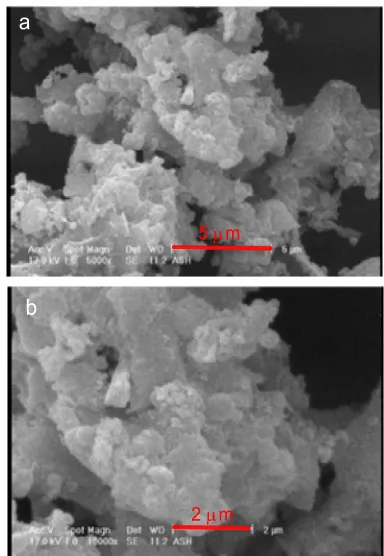
2. 7. Analytical Procedures The chemical composition of DLA was analyzed using X-ray fluorescence spectroscopy (XRF) (Phillips, Axios). The characteristics and composition of DLA are shown in Table 1. The concentrations of residual Pb(II) ions in the supernatant solutions were determined using flame atomic absorption spectrophotometer (Philips, PU9400, USA). Each determination was repeated three times and the results presented as averages. Scanning Electron Microscope (SEM, Phillips XL30, Holland) was used for observation of DLAsurface structures.
3. RESULTS AND DISCUSSION
3. 1. Characterization of DLA Knowledge about the chemical and physical properties of DLA is necessary in order to understand its adsorptive behavior. The main constituents of DLA are silicon, sulfur, calcium, potassium with smaller amounts of magnesium, aluminum, iron and traces of many other elements. Table 1 shows the chemical composition of the DLA samples used in this study obtained by XRF analysis. The SiO2 is the main constituent (61.177%)
and SO3 makes up about (9%) in sorbent sample. CaO
and K2O contents make up about 14% of DLA, while
Al2O3 and MgO compose about 2.7%. The loss on
ignition was found to be 11.349% by weight. The morphological features and surface characteristics of adsorbent materials are widely studied by using SEM method. The SEM image of DLA is shown in Figure 1. The adsorbent appeared to have a coarse porous surface with irregular pores.
3. 2. Effect of Initial Pb(II) Concentration on Removal Efficiency Several experiments were carried out to study the effect of initial Pb(II) concentration on the removal efficiency (R) from the solution. For this purpose 50-300 mg/l Pb(II) solutions at pH 5, were contacted with 0.5 g/l DLA for the contact period of 60 min. The results are shown in Figure 2.
This data show that the percentage adsorption of Pb(II) decreased with an increase of initial metal ion concentration, which is in agreement with observations of other studies [10-11, 13, 16]. The percentage removal of Pb(II) ions from solutions decreased from 99.72% to 54.83%. The decrease in removal efficiency may be attributed to lack of sufficient surface area to accommodate excess metal available in the solution. At lower concentrations, almost all Pb(II) ions of solution could interact with the binding sites, and thus the removal efficiency was higher than those at higher initial Pb(II) ions concentrations. At higher concentrations, the lower removal efficiency was due to the saturation of adsorption sites. This result may indicate the suitability of DLA as a sorbent for the removal of Pb(II) ions from industrial effluent at lower concentrations (<150 mg/l).
3. 3. Effect of pH Solution on Adsorption The pH level of the solution has been identified as the most important variable affecting metal ion adsorption onto the adsorbent which should be considered for any study on adsorption [20]. The reaction of metal ions in solution with the sorbent may be described as:
M+n + BH
n↔ BM + nH+ (3)
where, M represents the metal, n its charge and B the active sorption site of the adsorbent.
5 mm
a
2 mm
b
Ci, mg/l
0 50 100 150 200 250 300 350
R
em
ov
al
e
ff
ic
ie
n
cy
, %
0 20 40 60 80 100 120
Figure 2. The effect of initial Pb(II) concentration (50–300 mg/l) on removal efficiency (R%) at 0.5 g/l of sorbent and pH level of 5.
pH
2 3 4 5 6
P
b(
II
)
re
m
ov
al
, %
0 20 40 60 80 100 120
Figure 3. Effect of pH level on metal ion adsorption at 10 mg/l of Pb(II) concentration and 0.1 g/l of sorbent.
Time, min
0 10 20 30 40 50 60 70
P
b
(I
I)
c
on
cent
rat
ion
,
m
g/l
0 20 40 60 80 100 120
0.1 mg/l 0.3 mg/l 0.5 mg/l 1 mg/l 2 mg/l
Figure 4. Effect of sorbent dose on metal ion adsorption at 100 mg/l of Pb(II) concentration and pH level of 5.
This, on one hand is due to the fact that hydrogen ions themselves are strong competing ions, and on the other hand that the pH of the solution influences the
chemical speciation of the metal ions as well as the ionization of the functional groups onto the adsorbent surfaces [21]. In order to evaluate the influence of this parameter the experiments were carried out at different initial pH values. The pH range 2-6 was chosen in order to avoid metal precipitation, which have been estimated to occur at pH>6.5 for Pb(OH)2 [22]. The effect of pH
on metal ion adsorption at 10 mg/l of Pb(II) concentration and 0.1 g/l of sorbent is shown in Figure 3. There is a gradual increase in adsorption with increased pH from 2 to 5 and the maximum adsorption occurred at pH 5. The same trend was reported in the removal of Pb(II) ions by other sorbent materials such
as Hydrilla verticillata [2], Mango peel waste [23],
activated carbon, kaolin, bentonite, blast furnace slag and fly ash [24]. The lower degrees of adsorption at low pH values can be explained by the fact that at lower pH values the H+ ion is higher and therefore protons can
compete with lead cations for surface sites, since at low pH lead are present in solution as Pb2+ free cations. In
addition, when pH increases, there is a decrease in positive surface charge (since the deprotonation of the sorbent functional groups could occur), which results in lower electrostatic repulsion between the positively charged metal ions and the DLA surface as the sorbent. At pH values above this optimum range, most metals tend to precipitate out of solution in the hydroxide form [25].
3. 4. Effect of Sorbent Dosage To achieve the maximum adsorption capacity, doses of PLA varied from 0.1 to 2 g/l at 100 mg/l of Pb(II) concentration and pH 5 the results of which are shown in Figure 4. In general, an increase in adsorbent dosa increased the Pb(II) adsorption due to an increased adsorbent surface area. Results from other studies are in agreement with this study [4, 26-27]. The results clearly indicate that a Pb(II) concentration with 0.1 and 0.3 g/l of sorbent seems to be the limit, the dose seems unable to be reduced to zero and maximum percentage removal of Pb(II) ions achieved 21.56% and 74.41%, respectively. However, at 0.5 and 1 g/l sorbent the maximum percentage removal of Pb(II) ions achieved 99% and 99.9%, respectively. Finally, the maximum percentage removal with 2 g/l sorbent achieved 100% at 5 min contact time.
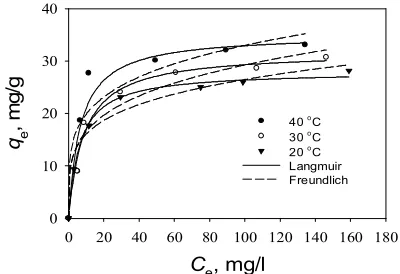
3. 5. Adsorption Isotherms The Langmuir and Freundlich sorption isotherm models have been successfully applied to establish the relationship between the amount of Pb(II) adsorbed onto DLA and its equilibrium concentration in aqueous solution at 20, 30 and 40˚C.
a surface with a finite number of identical sites. A basic assumption of the Langmuir theory is that adsorption takes place at specific homogeneous sites within the adsorbent. It is then assumed that once a metal ion occupies a site, no further adsorption can take place at that site. The rate of adsorption to a surface should be in accordance with the proportion of driving force to area. The driving force is the concentration in the solution, and the area is the amount of bare surface. The equation is written as follows [8]:
e e
e bC
bC q q
+ =
1
max
(4)
where qe is the amount of metal ion adsorbed in (mg/g), Ce the equilibrium concentration of Pb(II) ions in mg/l,
qmax is qefor a complete monolayer in (mg/g) and b the
equilibrium constant that is referred to the bonding energy of sorption in mg/l.
The Freundlich isotherm is an empirical equation that is based on the sorption of a sorbate on a heterogeneous surface of a sorbent, which is most commonly written as follows [8]:
n e f e K C q
1
= (5)
where qe is the amount of metal ion adsorbed in (mg/g), Ce the equilibrium concentration of Pb(II) ions in mg/l
and Kf (in mg/l) and 1/n are the Freundlich constants
incorporating all factors affecting the adsorption process such as capacity and intensity. The Langmuir and Freundlich constants and their correlation coefficients (R2) evaluated from these isotherms from the non linear
Langmuir and Freundlich plots by plotting qe versus Ce
(Figure 5) are given in Table 2.
The sorption characteristics of Pb(II) on the DLA followed more closely the Langmuir isotherm model than the Freundlich isotherm model.
This observation is further supported by evaluation of the respective correlation coefficients, which is a measure of how well the predicted values from a forecast model match the data from the experiment. The main reason for this trend is the electrostatic interaction between adsorbent molecules and the adsorbate.
When electrostatic interaction between DLA with a negative surface charge and Pb(II) ions with a positive
charge exists, the Langmuir isotherms do not perform as well as other types of interaction between adsorbent and adsorbate [28].
There is also hydrophobic interaction between the DLA surface and heavy metal ions [29]. According to the correlation coefficient given in Table 2, the Freundlich equation is an accurate presentation.
This fact can be justified by both physical and chemical adsorption of the DLA processes which are concurrent as the DLA used in this study contained many amino and carboxyl functional groups notable for their effective adsorption capacities that facilitated multilayer adsorption at high concentrations [31]. Moreover, the qmax (35.151 mg/g) decreases with
decreasing temperature. Also, maximum adsorption capacities (Kf) at 40˚ C reached to 11.98 mg/l. The
obtained qmax was higher than some qmax values of
sorbents reported in the literature [30-32]. The R2 values
suggest that Langmuir and Freundlich isotherm models provide good correlations for the sorption of the Pb(II) ions [33]. The good correlation confirms the formation of a monolayer of Pb(II) on the surface of the PLA. The main reason for this trend is the electrostatic interaction between the adsorbent molecules and the adsorbate.
Ce, mg/l
0 20 40 60 80 100 120 140 160 180
q e
,
m
g/g
0 10 20 30 40
40 o
C 30 oC
20 oC
Langmuir Freundlich
Figure 5. Langmuir and Freundlich isotherms for adsorption of Pb(II) ions on DLA with of 0.5 g/l of sorbent and pH level of 5.
TABLE 2. Constants of Langmuir and Freundlich isotherms for Pb(II) ions adsorption by DLA.
Temperature, oC Langmuir Freundlich
B qmax R2 N Kf R2
20 0.158 28.06 0.996 4.61 9.76 0.970
30 0.116 31.84 0.984 4.06 9.42 0.947
TABLE 3. Kinetic parameters for adsorption rate expressions
Ci (mg/l) qeexp. (mg/g)
Pseudo-first order Pseudo-second order Intra-particle diffusion
qe1 (mg/g) K1 (min−1) R2 qe2 (mg/g) K2 (min−1) R2 Ki (g/mg.min) R2
50 9.419 2.263 0.121 0.736 9.425 2.817 1.000 0.018 0.544
100 17.816 8.548 0.070 0.565 18.975 0.014 0.991 2.633 0.434
150 27.24 27.568 0.059 0.973 32.258 0.002 0.923 1.202 0.993
200 29.9 20.836 0.058 0.947 31.545 0.007 0.988 1.170 0.988
250 36.34 17.738 0.056 0.839 37.594 0.009 0.995 1.523 0.928
300 34.45 25.704 0.056 0.970 36.764 0.005 0.986 3.959 0.992
Ci:initial Pb(II) concentration; qeexp.: experimental value; qe1 and qe2: calculated values; K1, K2 and Ki: rate constants.
3. 6. Adsorption Kinetics In the present study, the two kinetic models mentioned below were used to describe Pb(II) ion adsorption by PLA. The degree of conformity between data from the experiment and values of the predicted model was expressed by the coefficient of determination (R2). A relatively high R2
value for the relationship between measured and predicted Pb(II) adsorption data indicated that the model successfully described kinetic activity.
It should be noted that a high R2 for a particular
kinetic model does not necessarily mean that this equation is the best. The first order and pseudo-second order models [34] were applied to describe the kinetics of adsorption. The pseudo-first order rate equation is represented as:
(
qe qt)
lnqe K1tln - = - (6)
where qt and qe (mg/g) are the amounts of Pb(II) ions
adsorbed onto DLA at equilibrium and at time t (min), respectively, and K1 (min−1) is the pseudo-first order
reaction rate equilibrium constant. The pseudo-first order considers the rate of occupation of sorption sites to be in proportion to the number of unoccupied sites. A straight line of ln(qe-qt) versus t (min) indicates
application of the pseudo-first order kinetics model (Figure6). In a true pseudo-first order process, -K1 and
ln qe parameters should be equal to the slope and
intercept of plot of ln(qe-qt) against t, respectively. In many cases, the first order equation of Lagergren [35] does not fit well with the whole range of contact time and is generally applicable over the initial stage of the adsorption process [36].
Based on equilibrium adsorption, the pseudo-second order kinetic equation is expressed as:
e e
t q
t q K q
t = +
2 2
1
(7)
where k2 is the pseudo-second order rate constant in
(g/mg.min). qe and K2 the parameters can be calculated
by a curve-fitting program from the slope and intercept
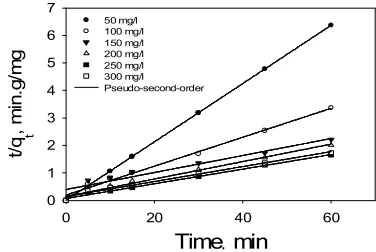
of t/qt (min.g/mg) versus t (min) plots, respectively
(Figure 7). The results of the kinetics parameters for Pb(II) ions, calculated from linear plots of pseudo-first order and pseudo-second order kinetics models are presented in Table 3. The low correlation coefficient values obtained for the pseudo-first order model indicates that sorption of metal ions did not follow the pseudo-first order reaction.
Time, min
0 20 40 60
ln(
qe
-qt
)
-10 -8 -6 -4 -2 0 2 4 6 8
10 50 mg/l
100 mg/l 150 mg/l 200 mg/l 250 mg/l 300 mg/l Pseudo-first-order
Figure 6. Pseudo-first order equations for Pb(II) adsorption at 0.5 g/l of sorbent, pH level of 5 and Various initial Pb(II) ion concentration.
Time min,
0 20 40 60
t/q t
, m
in
.g
/mg
0 1 2 3 4 5 6 7
50 mg/l 100 mg/l 150 mg/l 200 mg/l 250 mg/l 300 mg/l Pseudo-second-order
t0.5, min0.5
0 10 20 30 40 50 60 70 80
q e
,
m
g/g
0 10 20 30 40 50 60
50 mg/l 100 mg/l 150 mg/l 200 mg/l 250 mg/l 300 mg/l
Figure 8. Intra-particle diffusion plots for the adsorption of Pb(II) ions at various initial concentrations.
1/Tx10-3, K-1
3.15 3.20 3.25 3.30 3.35 3.40 3.45
ln
K
lg
,
/
9.6 9.7 9.8 9.9 10.0 10.1 10.2 10.3 10.4
Experimental data Thermodynamic isotherm
Figure 9. Plot of lnK vs. 1/T×10-3 for estimation of
thermodynamic parameters for Pb(II) adsorption.
The calculated values of qe1 from the first-order
kinetic model are lower than those from the experimental one. The insufficiency of the pseudo-first-order model to fit the kinetic data could possibly be due to limitations of the boundary layer that controls the sorption process. It was observed that data from the experiment fitted well to the pseudo-second-order equation, which is based on the sorption capacity of the solid phase.
The correlation coefficients (R2) for the linear plots
of t/qt against t for the pseudo-second order equation were observed to be close to 1 for Pb(II) ions. The theoretical qe2 values for metal ions were also very close
to the values deduced from the experimental values. These observations suggest that metal sorption by DLA followed the pseudo-second-order reaction, suggesting that the process controlling the rate may be a chemical sorption involving valence forces through sharing or exchanging of electrons between sorbent and sorbate [37].
3. 7. Adsorption Mechanism The intra-particle diffusion model proposed by Weber and Morris [38] is
tested for the diffusion mechanism. The intra-particle equation can be described as [39]:
5 . 0 t k
qi = i (8)
where ki is the intra-particle diffusion rate constant in
g/mg.min. This demonstrated that the adsorption of heavy metal by DLA was probably not due to surface-binding but also occurred via intra-particle accumulation. The plots of qt versus t0.5 at different
initial Pb(II) ion concentrations show multi-linearity characterizations that are presented in Figure 8.
The results of the kinetics parameters for Pb(II) ions, as calculated from the linear plots on the intra-particle diffusion model are presented in Table 3. According to this model, if there is a straight line passing through the origin, it can be assumed that the mechanism involved the diffusion of the species and the slope of the linear curve is the rate constant of intra-particle transport (ki).
In the present study, for any plot that did not pass through the origin the deviation was considered as being due to the difference in the mass transfer rate between the initial and final stages of adsorption. This plot indicates that two steps occurred in the adsorption process [40]. The first sharp section represents the external surface adsorption or instantaneous adsorption stage. The second subdued portion represents a gradual adsorption stage, when the intra-particle diffusion is rate-controlled [41]. The larger slopes of the first sharp sections indicate that the rate of metal removal is higher at the beginning stage due to the instantaneous availability of a large surface area and an active adsorption site. The lower slopes of the second subdued portions are due to decreased concentration gradients making Pb(II) ion diffusion in the micro pores of the adsorbent take a long time, thus leading to a low removal rate. These two steps evident in the plots as well as their deviation from the origin suggest that intra-particle diffusion is not the only rate controlling step taking place during the adsorption of Pb(II) ions onto DLA [42].
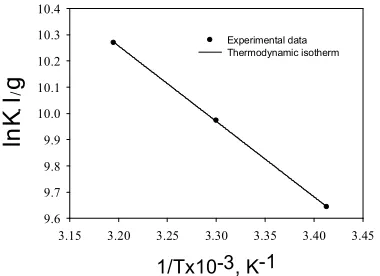
3. 8. Thermodynamic Studies The thermodynamic parameters can be determined using the distribution coefficient (K) that is dependent on temperature. The change in free energy (∆G0), enthalpy (∆H0) and
entropy (∆S0) associated with the adsorption process
were calculated using following equation [43]:
RT H R S K
o o D
-D =
ln (9)
where R is the universal gas constant (8.314 J/mol.K) and T is the temperature in K. According to Equation (9), ∆H0 and ∆S0 the parameters can be calculated by a
concentration of Pb(II) in the initial concentration (Ci)
and that of Pb(II) in the supernatant (Ce) after filtration
according to the following equation [44]:
m V C
C C K
e e i- ´
= (10)
Where V is the volume of the solution (ml), and m is the mass of the sorbent (g). The Gibbs free energy, ∆G0, of
specific adsorption was calculated from the well-known equation:
o o o H T S
G =D - D
D (11)
The data calculated from Equations (9 - 11) are presented in Table 4. The adsorption of Pb(II) ions increase with an increase of temperature and the value of ΔH0 is positive. The positive values of ΔH0 indicate
the endothermic behavior of the adsorption reaction of Pb(II) ions and suggest that a large amount of heat is consumed to transfer the Pb(II) ions from an aqueous to a solid phase (DLA). The ΔG0 for the adsorption
process was as −47.383, −49.001 and −50.619 kJ/mol at 293, 303 and 313 K, respectively. The negative ΔG0
values at different temperatures were due to the fact that the adsorption process is feasible and thermodynamically spontaneous. The value of ΔG0 that
decreased with an increase in temperature indicated more efficient adsorption of Pb(II) at higher temperature. At higher temperature, ions are readily desolvated, and therefore their adsorption becomes more favorable. The positive values of entropy change (ΔS0) reflect the affinity of adsorbent material (DLA) to
Pb(II) ions in aqueous solutions and suggest that some structure change has taken place in the adsorbent.
4. CONCLUSION
In this study, Date-palm Leaf (Phoenix dactylifera) Ash (DLA) was used as a low cost and simple adsorbent for the removal of Pb(II) from an aqueous solution. The DLA had a very high adsorption capacity to remove the Pb(II) ions, with a maximum monolayer adsorption capacity of 35.408 mg/g at 40 ˚C. Adsorption capacity was affected by the initial Pb(II) concentration, pH level of the solution and the adsorbent dose. The Removal Efficiency decreased with the increase of initial Pb(II) concentration and a gradual increase was observed in adsorption with an increase of pH from 2 to 5. However, the maximum adsorption was at a pH level of 5. Moreover, an increased dose of adsorbent increased Pb(II) adsorption, evidently due to an increased adsorbent surface area. The sorption characteristics of Pb(II) on the DLA followed more closely the Langmuir isotherm model than the Freundlich isotherm model. The low correlation coefficient values obtained for the pseudo-first order model indicates that sorption of metal
ions did not follow the pseudo-first order reaction. Data from the experiment fitted well to the pseudo-second order equation, which is based on the sorption capacity of the solid phase. According to data from this experiment, the intra-particle diffusion was not the only rate controlling step for the adsorption of Pb(II) ions onto DLA. The negative value of ∆G and positive value of ∆S showed that the adsorption of Pb(II) ions onto DLA was feasible and spontaneous while the positive value of ∆H confirmed the endothermic nature of adsorption. It can therefore be concluded that this agricultural waste in the form of residue could be substituted in place of activated carbon as an adsorbent due to its abundant availability, high adsorption capacity and low cost. Further research dealing with other aspects of the adsorption process and toxic metal may still be needed.
5. REFERENCE
1. Melegy, A., "Adsorption of Lead (II) and Zinc (II) from Aqueous Solution by Bituminous coal", Geotechnical and
Geological Engineering, Vol. 28, (2010), 549-558.
2. Huang, L.-z., Zeng, G.-m., Huang, D.-l., Li, L.-f., Huang, P.-m. and Xia, C.-b., "Adsorption of lead(II) from aqueous solution onto Hydrilla verticillata", Biodegradation, Vol. 20, (2009), 651-660.
3. Liu, S.-Y., Gao, J., Yang, Y.-J., Yang, Y.-C. and Ye, Z.-X. "Adsorption intrinsic kinetics and isotherms of lead ions on steel slag", Journal of Hazardous Materials, Vol. 173, (2010), 558-562.
4. Gupta, V.K. and Ali, I., "Removal of lead and chromium from wastewater using bagasse fly ash-a sugar industry waste", Journal of Colloid and Interface Science, Vol. 271, (2004), 321-328.
5. Blِocher, C., Dorda, J., Mavrov, V., Chmiel, H., Lazaridis, N.K. and Matis, K.A., "Hybrid flotation membrane filtration process for the removal of heavy metal ions from wastewater", Water
Research, Vol. 37, (2003), 4018-4026.
6. Kryvoruchko, A.P., Atamanenko, I.D. and Yurlova, L.Y., "Concentration/purification of Co(II) ions by reverse osmosis and ultrafiltration combined with sorption on clay mineral montmorillonite and cation-exchange resin KU-2-8n", Journal
of Membrane Science, Vol. 228, (2004), 77-81.
7. Yan, G. and Viraraghavan, T., "Heavy metal removal from aqueous solution by fungus Mucor rouxii", Water Research, Vol. 37, (2003), 4486-4496.
8. Ghorbani, F., Younesi, H., Ghasempouri, S.M., Zinatizadeh, A.A., Amini, M. and Daneshi, A., "Application of response surface methodology for optimization of cadmium biosorption in an aqueous solution by Saccharomyces cerevisiae", Chemical
Engineering Journal, Vol. 145, (2008), 267-275.
9. Bulut, Y. and Tez, Z., "Removal of heavy metals from aqueous solution by sawdust adsorption", Journal of Environmental
Sciences, Vol. 19, (2007), 160-166.
new biosorbent", Separation and Purification Technology, Vol. 45, (2005), 25-31.
11. King, P., Srinivas, P., Kumar, Y.P. and Prasad, V.S.R.K., "Sorption of copper(II) ion from aqueous solution by Tectona grandis l.f. (teak leaves powder)", Journal of Hazardous
Materials, Vol. 136, (2006), 560-566.
12. Nascimento, M., Soares, P.S.M. and Souza, V.P.d., "Adsorption of heavy metal cations using coal fly ash modified by hydrothermal method", Fuel, Vol. 88, (2009), 1714-1719.
13. Quek, Y. S., Wase, J. D. A. and Forster, F. C., "The use of sago waste for the sorption of lead and copper", Water Research Commision, Pretoria, AFRIQUE DU SUD, 1998.
14. Annadural, G., Juang, S. R. and Lee, J. D., "Adsorption of heavy metals from water using banana and orange peels", Anglais, Vol. 47, (2003), 185-190.
15. Šćiban, M. and Klašnja, M., "Wood sawdust and wood originate materials as adsorbents for heavy metal ions", European
Journal of Wood and Wood Products, Vol. 62, (2004), 69-73.
16. Bhattacharya, A.K., Mandal, S.N. and Das, S.K., "Adsorption of Zn(II) from aqueous solution by using different adsorbents",
Chemical Engineering Journal, Vol. 123, (2006), 43-51.
17. Shukla, S.R. and Pai, R.S., "Adsorption of Cu(II), Ni(II) and Zn(II) on modified jute fibres", Bioresource Technology, Vol. 96, (2005), 1430-1438.
18. Johnson, P.D., Watson, M.A., Brown, J. and Jefcoat, I.A., "Peanut hull pellets as a single use sorbent for the capture of Cu(II) from wastewater", Waste Management, Vol. 22, (2002), 471-480.
19. Bailey, S.E., Olin, T.J., Bricka, R.M. and Adrian, D.D., "A review of potentially low-cost sorbents for heavy metals", Water
Research, Vol.33, (1999), 2469-2479.
20. Ho, Y.-S., "Effect of pH on lead removal from water using tree fern as the sorbent", Bioresource Technology, Vol. 96, (2005), 1292-1296.
21. F.T. Li, H. Yang, Y. Zhao, R. Xu, Novel modified pectin for heavy metal adsorption, Chinese Chemical Letters 18 (2007) 325-328.
22. Baes, C.F. and Mesmer, R.E., "The Hydrolysis of Cations", Wiley, New York, (1976).
23. Iqbal, M., Saeed, A. and Zafar, S.I., "FTIR spectrophotometry, kinetics and adsorption isotherms modeling, ion exchange, and EDX analysis for understanding the mechanism of Cd2+ and
Pb2+ removal by mango peel waste", Journal of Hazardous
Materials, Vol. 164, (2009), 161-171.
24. Mishra, P.C. and Patel, R.K., "Removal of lead and zinc ions from water by low cost adsorbents", Journal of Hazardous
Materials, Vol. 168, (2009), 319-325.
25. O'Connell, D.W., Birkinshaw, C. and O'Dwyer, T.F., "Heavy metal adsorbents prepared from the modification of cellulose: A review", Bioresource Technology, Vol. 99, (2008), 6709-6724.
26. Kadirvelu, K. and Namasivayam, C., "Activated carbon from coconut coirpith as metal adsorbent: adsorption of Cd(II) from aqueous solution", Advances in Environmental Research, Vol. 7, (2003), 471-478.
27. Jain, C.K., Singhal, D.C. and Sharma, M.K., "Adsorption of zinc on bed sediment of River Hindon: adsorption models and kinetics", Journal of Hazardous Materials, Vol.114, (2004), 231-239.
28. Wang, Y.-J., Chen, J.-H., Cui, Y.-X., Wang, S.-Q. and Zhou, D.-M., "Effects of low-molecular-weight organic acids on Cu(II)
adsorption onto hydroxyapatite nanoparticles", Journal of
Hazardous Materials, Vol. 162, (2009), 1135-1140.
29. Adamczyk, Z. and Warszynski, P., "Role of electrostatic interactions in particle adsorption", Advances in Colloid and
Interface Science, Vol. 63, (1996), 41-149.
30. Imamoglu, M. and Tekir, O., "Removal of copper (II) and lead (II) ions from aqueous solutions by adsorption on activated carbon from a new precursor hazelnut husks", Desalination, Vol. 228, (2008), 108-113.
31. Brown, P., Atly Jefcoat, I., Parrish, D., Gill, S. and Graham, E., "Evaluation of the adsorptive capacity of peanut hull pellets for heavy metals in solution", Advances in Environmental
Research, Vol. 4, (2000), 19-29.
32. Wang, L., Yang, L., Li, Y., Zhang, Y., Ma, X. and Ye, Z., "Study on adsorption mechanism of Pb(II) and Cu(II) in aqueous solution using PS-EDTA resin", Chemical Engineering
Journal, Vol. 163, (2010), 364-372.
33. Sharaf, M.A., Arida, H.A., Sayed, S.A., Younis, A.A. and Farag, A.B., "Separation and preconcentration of some heavy-metal ions using new chelating polymeric hydrogels", Journal of
Applied Polymer Science, Vol. 113, (2009), 1335-1344.
34. Yang, X. and Al-Duri, B., "Kinetic modeling of liquid-phase adsorption of reactive dyes on activated carbon", Journal of
Colloid and Interface Science, Vol.287, (2005), 25-34.
35. Lagergren, S., "Zur theorie der sogenannten adsorption geliister stoffe, Kungliga Svenska Vetenskapsakademiens", Handlingar, Vol. 24, (1898), l-39.
36. Ho, Y.S. and McKay, G., "The sorption of lead(II) ions on peat",
Water Research, Vol. 33, (1999), 578-584.
37. Ho, Y.S. and McKay, G., "Sorption of dye from aqueous solution by peat", Chemical Engineering Journal, Vol. 70, (1998), 115-124.
38. Weber, W.J. and Morriss, J.C., "Kinetics of adsorption on carbon from solution", Journal of Sanitary Engineering Division, American Society of Civil Engineers, Vol. 89, (1963), 31-60.
39. Wang, L., Zhang, J., Zhao, R., Li, Y., Li, C. and Zhang, C., "Adsorption of Pb(II) on activated carbon prepared from Polygonum orientale Linn.: Kinetics, isotherms, pH, and ionic strength studies", Bioresource Technology, Vol. 101, (2010), 5808-5814.
40. Wu, F.-C., Tseng, R.-L. and Juang, R.-S., "Comparisons of porous and adsorption properties of carbons activated by steam and KOH", Journal of Colloid and Interface Science, Vol. 283, (2005), 49-56.
41. Cheung, W.H., Szeto, Y.S. and McKay, G., "Intraparticle diffusion processes during acid dye adsorption onto chitosan",
Bioresource Technology, Vol. 98, (2007), 2897-2904.
42. Gerçel, Ö. and Gerçel, H.F., "Adsorption of lead(II) ions from aqueous solutions by activated carbon prepared from biomass plant material of Euphorbia rigida", Chemical Engineering
Journal, Vol. 132, (2007), 289-297.
43. Chen, C. and Wang, X., "Adsorption of Ni(II) from Aqueous Solution Using Oxidized Multiwall Carbon Nanotubes",
Industrial and Engineering Chemistry Research, Vol. 45,
(2006), 9144-9149.
44. Wang, X., Chen, C., Hu, W., Ding, A., Xu, D. and Zhou, X., "Sorption of 243Am(III) to Multiwall Carbon Nanotubes",
Environmental Science and Technology, Vol. 39, (2005),
The Potential of Date-palm Leaf Ash as Low-cost Adsorbent for the Removal of
Pb(II) Ion from Aqueous Solution
F. Ghorbania, A. M. Sanatia, H. Younesia, A. A. Ghoreyshib
a Department of Environmental Science, Faculty of Natural Resources, Tarbiat Modares University, Noor, P.O. Box: 64414-356 Iran b Faculty of Chemical Engineering, Babol Noshirvani University of Technology, Babol, Iran
P A P E R I N F O
Paper history:
Received 3 March 2012
Received in revised form 27 May 2012 Accepted 25 June 2012
Keywords: Date-palm LeafAsh Adsorption Pb(II)
هﺪﯿﮑﭼ
ﻞﺨﻧگﺮﺑﺮﺘﺴﮐﺎﺧدﺮﺑرﺎﮐﺖﯿﻠﺑﺎﻗ
)
Phoenix dactylifera
) (
DLA
(
ار
)
ﺖﻤﯿﻗنازرايزروﺎﺸﮐﺪﻧﺎﻤﺴﭘناﻮﻨﻋﻪﺑ
(
ﺖﻬﺟ
نﻮﯾبﺬﺟ يﺎﻫ
Pb(II)
ﺖﺳاهﺪﺷﯽﺳرﺮﺑ
.
،سﺎﻤﺗنﺎﻣز،بذﺎﺟزود،ﻪﯿﻟواﺖﻈﻠﻏﯽﺳرﺮﺑﺖﻬﺟبﺬﺟﺪﻨﯾآﺮﻓ
pH
ﺎﻣدو
ﺪﺷمﺎﺠﻧا
.
نﻮﯾبﺬﺟ،بذﺎﺟزودﺶﯾاﺰﻓاﺎﺑﻪﮐدادنﺎﺸﻧﺞﯾﺎﺘﻧ
ﯽﻣﺶﯾاﺰﻓايﺰﻠﻓ ﺪﺑﺎﯾ
.
ﺬﺣﯽﯾارﺎﮐﺶﻫﺎﮐ ﺶﯾاﺰﻓاﺎﺑف
فﺬﺣﻪﻨﯿﻬﺑراﺪﻘﻣوﻪﺘﻓﺎﯾﺶﯾاﺰﻓانﻮﯾﺖﻈﻠﻏ
72 / 99 %
ﺖﻈﻠﻏﺎﺑ
mg/l
50
،يﺰﻠﻓنﻮﯾ
g/l
5 /0
بذﺎﺟزود
DLA
و
pH
5
ﻪﺑ ﺪﻣآﺖﺳد
.
هداد ﯽﻟدﺎﻌﺗيﺎﻫ ﻪﺑ
لﺪﻣزاهدﺎﻔﺘﺳاﺎﺑهﺪﻣآﺖﺳد ﻢﻫيﺎﻫ
ردﯽﻄﺧﺮﯿﻏنﻮﯿﺳﺮﮔرﺎﺑﭻﯿﻟﺪﻧوﺮﻓوﺮﯾﺎﻤﮕﻧﻻيﺎﻣد
20
،
30
و
˚C
40
ﺪﻧﺪﺷﺰﯿﻟﺎﻧآ
.
ﺘﻨﯿﺳ نﻮﯾبﺬﺟﮏﯿ يﺎﻫ
Pb(II)
ﻪﺒﺗﺮﻣﻪﺒﺷ،لواﻪﺒﺗﺮﻣﻪﺒﺷﯽﮑﯿﺘﻨﯿﺳلﺪﻣﻪﺳزاهدﺎﻔﺘﺳاﺎﺑ
هرذنورد رﺎﺸﺘﻧاومود ﺪﻨﺘﻓﺮﮔراﺮﻗﯽﺳرﺮﺑدرﻮﻣيا
.
دادنﺎﺸﻧمودﻪﺒﺗﺮﻣﻪﺒﺷلﺪﻣﺎﺑارقﺎﺒﻄﻧاﻦﯾﺮﺘﺸﯿﺑ بﺬﺟﺪﻨﯾآﺮﻓ
.
ﮑﯿﻣﺎﻨﯾدﻮﻣﺮﺗيﺎﻫﺮﺘﻣارﺎﭘﻦﯿﻨﭽﻤﻫ ﯽ
ﺲﭙﯿﮔدازآيژﺮﻧا،
)
∆G˚
(
ﯽﭙﻟﺎﺘﻧا،
)
∆H˚
(
و ﯽﭘوﺮﺘﻧآ
)
∆S˚
(
ﺖﻧاوﻪﻟدﺎﻌﻣزاهدﺎﻔﺘﺳاﺎﺑ
ﯽﻣﻒﯿﺻﻮﺗارﺎﻣدﻪﺑلدﺎﻌﺗﺖﺑﺎﺛﯽﮕﺘﺴﺑاوﻪﮐ،فﻮﻫ ﺪﺷﯽﺑﺎﯾزرا،ﺪﻨﮐ
.
ﮑﯿﻣﺎﻨﯾدﻮﻣﺮﺗﯽﯾﺎﻬﻧﯽﺑﺎﯾزرا ﯽ
نﻮﯾبﺬﺟ يﺎﻫ
Pb(II)
بذﺎﺟﺎﺑ
DLA
ﺑدﻮﺧترﻮﺻﻪﺑوﺖﺳازﺎﻣﺮﮔﺶﻨﮐاوﻪﮐدادنﺎﺸﻧ ﻪ
ﯽﻣمﺎﺠﻧايدﻮﺧ دﻮﺷ
.