International Journal of Engineering
J o u r n a l H o m e p a g e : w w w . i j e . i rProperties of Particleboard Made from UF with Low-formaldehyde (E
1)
S. M. Hosseini *a, M. Fadaeib
a Wood and Paper Engineering of Tarbiat Modares University and Product Expert in Choube Shomal Company, Gonbad-e- kavous, Iran
b Industrial Engineering of Ellmosanat University and Industrial Expert in Choube Shomal Company, Gonbad-e- kavous, Iran
P A P E R I N F O
Paper history:
Received 13 October 2012
Accepted in revised form 15 November 2012
Keywords:
Mechanical Properties UF
Particleboard Formaldehyde
A B S T R A C T
The objective of this study was to manufacture particleboard made from UF with low formaldehyde (E1)
for use in indoor environments. The influence of UF in particles on the formaldehyde emission and its mechanical properties were investigated. The experimental results showed that the formaldehyde emission released decreased linearly with consumption UF-low formaldehyde- particle. Formaldehyde emission was below 0.3 mg/L when the weight percentage of UF particles was up to 60%. The formaldehyde emission from urea-formaldehyde resin-impregnated paper overlaid particleboard was 17% lower than UF ordinary (E2) for particleboard. The reason is that the bending strength, internal
bonding strength decreased with increasing low-formaldehyde UF. However, the percentage thickness swelling of the particleboard decreased with increasing UF-low formaldehyde. In addition, there were significant positive relationships between the UF-low formaldehyde and the bending strength and internal bonding strength of the particleboard, which allowed evaluation of the properties of the particleboard made with UF-low formaldehyde.
doi:10.5829/idosi.ije.2013.26.01a.07
1. INTRODUCTION1
In recent years, Particleboard is famous product in wood industry which is always popular for use in furniture, architecture and indoor decoration. Due to its use for furniture, particleboard has always been the largest proportion of material used [1]. During the process of using particleboard for further reutilization, some problems should be taken into consideration, such as formaldehyde can be released from particleboard used as an interior building product due to incompletely reacted urea-formaldehyde (UF), Urea-melamine-formaldehyde (UMF), melamine-Urea-melamine-formaldehyde (MF) or phenol-formaldehyde (PF) resins used in particleboard [2]. It also indicated that emissions from building and furnishing materials, which are frequently constructed from particleboard and medium density fiberboard, are a potentially important contributor of indoor volatile organic compounds [3, 4]. As a result, the indoor air quality can deteriorate and a serious health risk may arise, especially in modern homes and offices, which are frequently more airtight than older structures. This
* Corresponding Author Email:[email protected] (S. M.
Hosseini)
increases the significance of the role of formaldehyde in inducing illness via immune mechanisms, infectious processes, and direct toxicity [5]. This phenomenon has become known as sick building syndrome (SBS), whereby the occupants of certain affected buildings repeatedly describe complex range of vague and often subjective health complaints [6]. To overcome these problems related to air quality and health in the indoor environment, the effects of press conditions (press temperature and time), mat moisture content (MC), lower molecular weight UF resins, and additive of formaldehyde scavenger on formaldehyde emissions or using low-formaldehyde and non-formaldehyde resins for the manufacture of various wood-based panels have been extensively studied in the past [7].
These studies yielded similar results and established relationships between the mechanical strength to proportion urea/formaldehyde [8].
The purpose of this study was to investigate the quantity of formaldehyde released, bending properties, internal bonding strength, and thickness swelling of Particleboard made from chips of different species – hircanian forest, Iran- with sprayed with UF-low formaldehyde resin for the core layer and the face and back layers.
2-EXPRIMENTAL MATERIALS AND METHOD
2. 1. Materials In this study, chips of mixed wood
species were sprayed with a water-soluble UF resin. Chips were from mixed hardwood species including hircanian forest, gorgan, Iran. The adhesives used were a water-soluble UF resin (60-63% solid content and pH 7-7.5; samed Resin, Mashhad, Iran). UF resin spray was on the face and back layers of the particleboard. Chip production process Chips were divided into coarse chips, which passed through a four-mesh and were retained by an eight-mesh screen, and fine chips, which passed through an eight-mesh and were retained by a 20-mesh screen. The ratio of coarse/fine chips used for particleboard was 60:40%. The chips were oven-dried to 2–4% MC at a temperature of 120oC. Then, they were sprayed with a water-soluble UF resin according to the experimental program. After that, Chips were placed into industrial frame of 366×183 cm. Three-layer particleboard was formed using coarse and fine chips at a ratio of 60: 40. A conventional hot press was used for fabrication of the particleboard and the temperature, pressure and pressing time were 175oC, 2.7MPa and 240 sec, respectively. The dimensions of particleboard were 500mm_500mm_16mm (thick), with three layers for tests. The thickness of the particleboard was controlled by stop bars and the target density was 0.7 g/cm3. Five samples were fabricated in this study.
2. 2.Testing Methods The particleboards produced
for this study were tested in accordance with the EN Standard, which involves various tests. Test for the quantity of formaldehyde released acquisition of formaldehyde: A 120-mm-diameter, 60-mm-high crystallizing dish containing 300mL of distilled water was placed in the bottom of a 240-mmdiameterdesiccator with a capacity of 1071L [9]. Formaldehyde released from the specimens was absorbed by the distilled water which was subsequently used as the sample solution [10]. Quantification of formaldehyde concentration: The formaldehyde concentration in the sample solution was determined using acetyl acetone-ammonium acetate solution and the acetyl acetone method, with colorimetric detection at 415nm. Prior to testing; the particleboards were conditioned 65% relative humidity. The particleboards tested were cut into specimens for static bending and internal bond strength (IB) tests and their positions relative to the full particleboard were recorded.
2. 2. 1. Density and Moisture Content Fabricated
particleboards were conditioned at ambient humidity for 1 week and then tested for density and MC according to the following formulae:
Air – dried density (g/cm3) = (Wa / Va) (1)
MC (%) = (W1– W0 / W0) × 100 (2)
Wa is the air-dried weight, Va is the air-dried volume, and W0 is the oven-dried weight of the particleboard and W1 is early weight .
2. 2. 2. Static Bending Test Bending specimens of
50×250mm were cut from full particleboard according to EN-DIN 622 standard [11]. The bending modulus of elasticity (MOE) and modulus of rupture (MOR) was calculated from load– deflection curves according to the following formulae:
MOR (Mpa)= [3/2 (Pb L/bh2)] (3)
MOE (Mpa)= [Pbp L3/4bh3 Yp] (4)
where, MOR is the static bending strength (modulus of rupture) (MPa), MOE is the static bending modulus of elasticity (MPa), Pb is the maximum load (N), Pbp is the load at the proportional limit (N), Yp is the deflection corresponding to Pbp (mm), b is the width of the specimen (mm), h is the thickness of the specimen (mm), and L is the span (mm).
2. 2. 3. Internal Bond Strength The tensile strength
perpendicular to the surface was determined using three conditioned specimens of 50×50mm from each particleboard according EN-DIN 68754 standard [12]. The rupture load (Ps) was determined and internal bond strength was calculated using the following formula:
IB (MPa) = Ps / A (5)
where, IB is the internal bond strength (MPa), Ps is the rupture load, and l is the length of the specimen. It should be noted that the ultrasonic velocity of IB specimens was measured as described above before the IB tests.
2. 2. 4. Thickness Swelling Specimens with
dimensions of 100×100mm were prepared for evaluation of the thickness swelling according to EN 317 standard [13]. The thickness at the middle of the test specimen was measured with a micrometer. Then, the test specimens were placed into water in parallel for 30mm and soaked for 2 and 24 h before further measurement of the thickness. The thickness-swelling rate (TS) was determined from the following formula:
TS2 (%)= (t2-t0) × 100
TS24 (%)= (t24-t0) × 100
3. RESULTS AND DISCUSSION
3. 1. Quantity of Formaldehyde Released It was
found that the quantity of formaldehyde released decreased linearly with consumption UF (E1). An analysis showed a degree of correlation between the quantity of formaldehyde released and the low-formaldehyde UF for the particleboards tested. The quantity of formaldehyde released from particleboards is shown in Table 1.
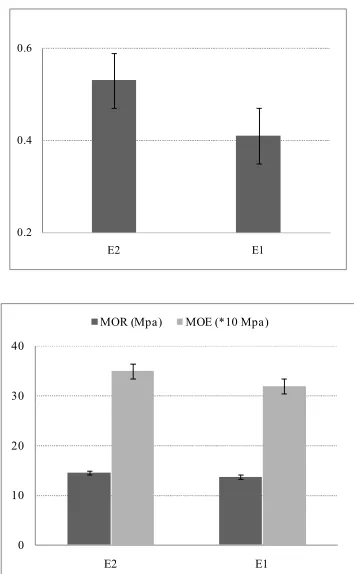
For samples with a low-formaldehyde UF, the quantity of formaldehyde released was 0/24 mg/L. E1 sprayed on particle, the less formaldehyde released from particleboard, and one possible explanation for the reduction in formaldehyde from particleboard bonded with UF adhesive is that the UF molecules can react with water rapidly during hot-pressing to form amines, which can further react with other UF molecules top reduce UF polymers. Lower MOE and MOR values were found for the E1 sprayed particleboards. However, MOR values for experimental particleboard were not significantly different from each other. The bending properties of particleboards with E1 and E2 were shown in Figure 1. Internal bond strength was observed for the particleboards with different formaldehyde in UF our study (see Figure 1).
0.2 0.4 0.6
E2 E1
0 10 20 30 40
E2 E1
MOR (Mpa) MOE (*10 Mpa)
Figure 1. Valuation MOR and MOE (left) and IB (right)
particleboard made with E1 and E2
TABLE 1. Quantity of formaldehyde released (mg/l)
E1 0/25± 0/02 E2 0/3 ± 0/02
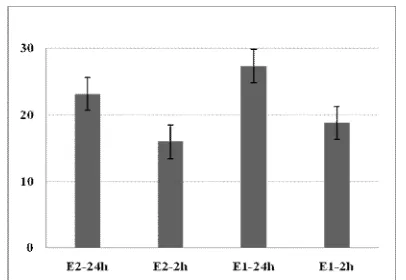
The major components formed from the curing of UF in wood are urea structures and then formaldehyde arising from the reaction with water. Formaldehyde can penetrate into the wood cells and into the middle lamellae between the wood cells, where it reacts with the available moisture stored in the wood to form either linear urea structures and /or cross linking biuret /dimmer/ Trimmer structures [14, 15]. In addition, the formaldehyde may react with the chemical components (the hydroxyl groups in polysaccharide or the lignin phenolic groups) of the wood to form urethane structures, and can further contribute to adhesion. The cross linking can also serve to increase the rigidity of the panels, especially at high levels of cross linking [16]. By comparing the same densities of particleboards, which were manufactured by MF, PF and UF (E2) resin indicated that the IB values of particleboard manufactured by MF, PF and UF (E2) resin were higher than those of particleboard manufactured by UF (E1) resin. The IB depends on the bonding effect of chips anthem core layer of particleboard, rather than on any retrofitting on the face and back layers. Moreover, IB values increased with increasing formaldehyde of the particleboard. Thickness swelling (TS) results for the thickness swelling of particleboards manufactured by UF (E1) was more than UF (E2).
The results could be represented by linear formulae. It seems that the formaldehyde can penetrate into the panel more easily, resulting in higher protection against moisture, which can partially explain the lower improvement in TS [17], observed in this study. The relationship is between TS and percent formaldehyde with a proximate relation [5, 18]. A result that may arise from the methodology described above is the effect that formaldehyde may have damage on the health [19]; not on properties of particleboards. However, with decrease in formaldehyde (E1), properties of panels are over than standard.
4. CONCLUSIONS
This study investigated the quantity of formaldehyde released and the properties of particleboard produced particles with low-formaldehyde UF. Results showed that 0.24 mg/L of formaldehyde was released from samples, which meets the E1 standard.
However, it has no significant effect on the TS. The results show that the quantity of released formaldehyde decreased linearly with consumption UF (E1) .
The MOR, IB and TS results for UF (E1) particleboard samples were superior to those for conventionally manufactured particleboard and could meet standard. However, the mechanical properties were lower than particleboard made with UF (E2). Particleboard with E1 significantly decreased the quantity of released formaldehyde. The negative relationships between the quantity of released formaldehyde and the properties mechanical could be represented by linear regression formulae.
Figure 2. Valuation TS particleboard made with E1and E2
after 2 and 24 h
5. ACKNOWLEDGEMENTS
The authors express their sincere thanks to sanate choube Shomal Company for help for this research
6. REFERENCES
1. Rowell, R.M. and Winandy, J.E., “Chemistry of wood strength”, Handbook of wood chemistry and wood composites, CRC Press, London, (2006), 303-347.
2. Baumann, M.G.D., Lorenz, L.F., Batterman, S.A. and Zhang, G.Z., “Aldehyde emission from particleboard and medium density fiberboard products”, Forest Products Journal, Vol. 50, (2000), 75–82.
3. Wang, W.L. and Gardner, D.J., “Investigation of volatile organic compound press emissions during particleboard production: Part I. UF-bonded southern pine”, Forest Products Journal, Vol. 49, (1999), 65–75.
4. Wang, W.L., Gardner, D.J. and Baumann, M.G.D., “Factors affecting volatile organic compound emissions during hot-pressing of southern pine particleboard”, Forest Products
Journal, Vol. 53, (2003), 65–72.
5. Wiglusz, R., Nikei, G., Igielska, G., Sitko, E., “Volatile organic compounds emissions from particleboard veneered with decorative paper foil”, Holzforschung, Vol. 56, (2002), 108–10. 6. Wendler, S.L., Ni, J. and Frazier, C.E., “Analysis of the
isocyanate-woodadhesive bonding using 15N CP/MAS NMR”, Wood Adhesives. Madison., Forest Product Society, (1995), 37–42.
7. Sun, Y.C. and Arima, T., “Structural mechanics of wood composite material: Ultrasonic propagation mechanism and internal bonding of particleboard”, Journal of Wood Science, Vol. 45, (2009), 221–6.
8. Minemura, N., “To lessen formaldehyde liberation from the urea resin glued plywood”, Wood Industry, Vol. 31, (1976), 8–12. 9. Liu, C.T., “Detected and liberated method of formaldehyde
emission from particleboards”, Proceedings of Processing Techniques and Utilization, Chinese Forest Products Industry Association, (1987), 95–103.
10. Liu, C.T., “Formaldehyde emission and liberated method of urea resin glued plywood and its processing materials”, Plywood manufacturing techniques and management, Chinese Forest Products Industry Association, (1985), 57–67.
11. European Committee for Standardization (CEN); DIN EN 622-5, “Wood based panels- Determination of modulus of elasticity in bending strength”, (1997).
12. European Committee for Standardization (CEN); DIN EN 68754, “Wood based panels- Determination of internal bonding strength”, (1997).
13. European Committee for Standardization (CEN); DIN EN 317, “Particleboards and fiberboards- Determination of swelling in thickness after immersion in water”, (1993).
14. Grigoriou, A.H., “Straw-wood composites bonded with various adhesive systems”, Wood Science and Technology, Vol. 34, (2000), 355–65.
15. Yang, T.H., Chen, B.J. and Wang, S.Y., “Properties of the lightweight OSB made from PF-resin impregnated flakes”,
Forest Products Industries, Vol. 21, (2002), 39–50.
16. Johns, W.E., Maloney, T.M., Huffaker, E.M., Saunders, J.B. and Lentz, M.T., “Isocyanate binders for particle-board manufacture”, 15th international symposium on particle board, Pullman, Washington State University, (1981), 213–39. 17. George, I.M. and Antonios, N., “reducing the thickness swelling
of wood based panels applying a nanotechnology compound”, Springer, verlag, Vol. 58, (2010), 18–28.
18. Rowell, R.M. and Winandy, J.E., “Chemistry of wood strength”, Handbook of wood chemistry and wood composites, CRC Press, London, (2005), 303-347.
Properties of Particleboard Made from UF with Low-formaldehyde (E
1)
TECHNICAL NOTES. M. Hosseini a, M. Fadaeib
a Wood and Paper Engineering of Tarbiat Modares University and Product Expert in Choube Shomal Company, Gonbad-e- kavous, Iran
b Industrial Engineering of Ellmosanat University and Industrial Expert in Choube Shomal Company, Gonbad-e- kavous, Iran
P A P E R I N F O
Paper history:
Received 13 October 2012
Accepted in revised form 15 November 2012
Keywords:
Mechanical Properties UF
Particleboard Formaldehyde
هﺪﯿﮑﭼ
عﻮﺿﻮﻣ
ياﺮﺑﻦﯿﯾﺎﭘﺪﯿﻫﺪﻟﺎﻣﺮﻓيارادﺪﯿﻫﺪﻟﺎﻣﺮﻓهرواﺐﺴﭼﺎﺑهﺪﺷﻪﺘﺧﺎﺳيﺎﻫبﻮﭼهدﺮﺧﻪﺘﺨﺗﺮﺛاﻪﻌﻟﺎﻄﻣﻖﯿﻘﺤﺗﻦﯾا
ﺖﺳاﯽﻧﺎﻤﺘﺧﺎﺳنوردفرﺎﺼﻣردهدﺎﻔﺘﺳا
.
ﺐﺴﭼﺎﺑبﻮﭼهدﺮﺧﻪﺘﺨﺗ
UF
ﻢﮐﺪﯿﻫﺪﻟﺎﻣﺮﻓﺎﺑ
)
E1
(
ﺪﺷﻪﺘﺧﺎﺳ
.
صاﻮﺧ
ﺧﺎﺳيﺎﻫﻪﺘﺨﺗﯽﮑﯿﻧﺎﮑﻣ
ﺐﺴﭼﺎﺑهﺪﺷﻪﺘ
E1
ﺐﺴﭼﻪﺑﺖﺒﺴﻧويﺮﯿﮔهزاﺪﻧا
E2
ﺪﺷﻪﺴﯾﺎﻘﻣ
.
ﺐﺴﭼ
UF
يارادﯽﻓﺮﺼﻣ
0,3
mg/L
ﺖﻈﻠﻏﺎﺑﻦﯾزرياﺮﺑدازآﺪﯿﻫﺪﻟﺎﻣﺮﻓ
60
دﻮﺑﺪﺻرد
.
ﻦﯾزرﺪﯿﻫﺪﻟﺎﻣﺮﻓرﺎﺸﺘﻧا
E1
ﻦﯾزرﻪﺑﺖﺒﺴﻧ
E2
راﺪﻘﻣ
17
ﺖﺳاﺮﺘﻤﮐﺪﺻرد
.
ﻦﯾزرزاهدﺎﻔﺘﺳاﺎﺑ
E1
ﻪﺑﺖﺒﺴﻧ
E2
,
ﻨﺒﺴﭼوﯽﮑﯿﻧﺎﮑﻣيﺎﻫﺖﻣوﺎﻘﻣ
دﺮﮐاﺪﯿﭘﺶﻫﺎﮐﯽﻠﺧادﯽﮔﺪ
.
ﺎﻣا
ﺐﺴﭼفﺮﺼﻣزاﯽﺷﺎﻧدازآﺪﯿﻫﺪﻟﺎﻣﺮﻓرﺎﺸﺘﻧا
E1
زاﺮﺘﻤﮐ
E2
ﺪﺷﻪﺒﺳﺎﺤﻣ
.