INFECTIOUS DISEASES
INFECTIOUS DISEASE REPORTING BY HEALTH SERVICES
this edition of the Bulletin we report for the
I first time on infectious diseases by the new
Area Health Services in NSW. Regular readers
will note that, until now, Table 6 has reported
cumulative cases of notifiable diseases for the
year by Public Health Unit service areas (either
an urban Area or a group of rural Districts). In
July 1996, the 23 former rural Health Districts
were reorganised into eight Area Health
Services. Starting with this issue of the Bulletin,
we will present notifiable diseases reports
among residents of each of the 17 NSW Health
Areas received during the preceding month.
TRENDS
With
winter well established, illnesses with the usual
pathogens have been reported, prominent among
them Neisseria meningitidis (Figure 1), respiratory
syncytial virus (RSV) (Figure 2) and influenza A (Figures 3 and 4).
In July, 18 cases of meningococcal disease were reported,
bringing the total so far for the year to 72. Household and other close contacts (such as other small children in child care) of meningococcal cases may be at increased risk of disease. Public Health Units (PHIJs) can help identi' contacts who will benefit from antibiotic prophylaxis. Hospitals and laboratories should telephone their Public Health Unit on provisional diagnosis of meningococcal disease to ensure contacts are correctly identified and treated. Health care workers (including emergency department staff and ambulance officers) are rarely at increased risk for disease and are therefore not candidates for prophylaxis uuless they have intimate exposure to nasopharyngeal excretions and precautions have not been
REPORTS OF SELECTED INFECTiOUS DISEASES. NSW, 12 MONTHS TO JUNE 1996 BY MONTH OF ONSET (WITH HISTORICAL COMPARISON)
Cases
000 400
000 '00
140 120
Hepatitis A
0060 40 20
14 12 10
Hib infection
10
Legionella
500
300
Measles
'40
AS ON DO F MA Mi
• July 95-June 96
Cases
MerngococcaI
200
Pertussis
I50 •_..-\00
50
40 3, 30
Qfever
a
20 IS 00
300 250 200
Rubella
I5a100____________________ so
0•
160 140 120 ISO
Salmonellosis
0000 40 20
JASON 001 MA MO
I
I
taken (e.g. during mouth-to-mouth resuscitation, emergency intubation or auctioning).
The outbreaks of hepatitis A seen predominantly in eastern Sydney and the Shoalhaven earlier this year have continued, albeit at lower levels, and several other Areas (notably Central Sydney, Western Sydney, Mid Western NSW, Northern Rivers and Western NSW), have reported increased numbers of cases (Table 6). Doctors, hospitals and laboratories are reminded to telephone PFIIJs to report suspected cases of hepatitis A and ensure that contacts at risk are promptly identified and treated.
EASTERN SYDNEY LABORATORY SURVEILLANCE PROGRAM
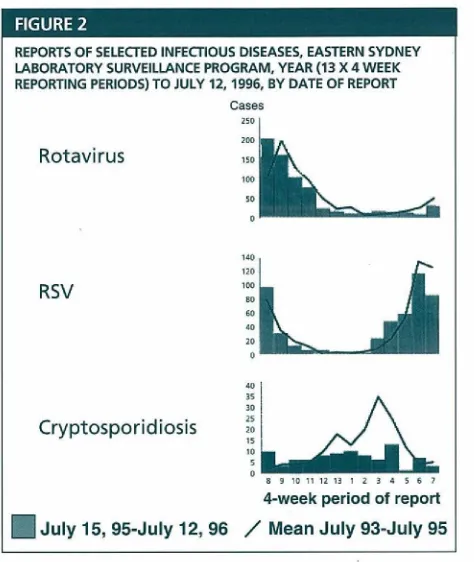
Figure 2 shows reports of rotavirus, RSV and cryptosporidiosis received by the Eastern Sydney Laboratory Surveillance Program (ESLSP)' by four-week reporting period. In the ESLSP, nine laboratories
voluntarily report diagnoses of selected infectious diseases to the South Eastern Sydney PHIJ. These data show that reports of RSV peaked in May-June, but that rotavirus infections have risen (in line with historical trends). Reports of cryptosporidiosis have remained relatively low.
AUSTRALIAN CHILDHOOD IMMUNISATION REGISTER (AIR)
The ACIR began on January 1, 1996, managed by the Health Insurance Commission (HIC). The HIC reports that in NSW, 79 per cent of iminunisation encounter forms were received from general practitioners, 10 per cent from local councils, 7 per cent from community health centres, 3.5 per cent from hospitals and 0.3 per cent from Aboriginal Health Services.
Preliminary NSW data indicate that at June 30, 1996:
• 633,139 children <7 years of age were registered on the ACIR through the Medicare database; • 423,954 valid vaccinations were reported; and • 327 parents opted off the recall/reminder system.
These data indicate that the ACIR is well under way. Further analysis is required to gain an accurate picture of childhood inmiunisation rates in the community.
The NSW Health Department has signed an agreement with the HIC for the release of identified data on children recorded as 90 days overdue for vaccination. The data will be distributed to immunisation providers via PHTJs with strict confidentiality provisions that limit their use to immunisation. As soon as reliable data from the ACIR are available, regular reporting on coverage will be published in the Bulletin. A Departmental Circular providing guidelines for the follow-up of these children wifi be released shortly.
Q FEVER IN SOUTHERN NSW
Greg Sam, Louise Remington and Paul Van Buynder,
South Eastern Public Health Unit
An abattoir in southern NSW recently experienced its second major outbreak of Q fever in 10 months. Q fever was con.firnied serologically in 37 of the 150 employees (31 male and six female) from all work areas of the abattoir. Onset of illness occurred between June 13, 1996 and July 26, 1996. All cases exhibited flu-like symptoms, including sudden onset of fever, coughing and muscle pains. Almost all
REPORTS OF SELECTED INFECTIOUS DISEASES. EASTERN SYDNEY LABORATORY SURVEILLANCE PROGRAM. YEAR (13 X 4 WEEK REPORTING PERIODS) TO JULY 12. 1996, BY DATE OF REPORT
Cases 250 200
Rotavirus
100 10 0
140 120
RSV
10080 80 40 25
Cryptosporiclosis
89101112101234 501
4-week period of report
•Julyl5, 95-July 12, 96 / Mean July 93-July 95
required review by a general practitioner, and four were admitted to hospital because of hepatic and splenic involvement. The age range of cases was 18 to 57 years. None had been immunised.
Q fever is caused by Coxiella burnettli, a highly resistant rickettsial organism found in placental tissues, birth fluids and/or excreta from infected cattle and other livestock. Infection is most commonly acquired by inihaling infected aerosols. The acute manifestations of the disease are well documented. About 65 per cent of cases experience fatigue, arthralgia and myalgia for six months or more, and 20 per cent may experience a post-Q fever fatigue syndrome for a number of years'.
The high attack rate in this outbreak, and the distribution of cases throughout the facility, demonstrate the efficiency of dissemination of contaminated aerosols and the risk to susceptible individuals in these environments.
Formalin-inactivated whole cell Q fever vaccine was first used on a trial basis in South Australian abattoirs in 1981 and licensed in 1989. Since its widespread availability in NSW in 1993, notifications for Q fever have declined. Between 1993 and 1995 the level of notifications for the disease declined from 6.6/ 100,000 to 2.2/100,000.
Individuals involved in the meat industry or other vocations involving contact with livestock make up more than 90 per cent of cases2.
Reluctance by some sections of the meat industry to provide vaccination programs has been largely due to perceived
Infectious diseases
Continuecf from page 91
inequities of the cost/benefit ratio for staff at greatest risk, i.e. those entering the workforce for the first time or staff employed on a casual basis. The cost of acute disease to the workplace has been estimated to be $7,000 and chronic sequelae estimated to around $50,000 per patient per years. Coimnon law action for damages is also possible for workplace injury. Clearly the benefit of an institutionalised vaccination program is justffied.
The abattoir in which these outbreaks occurred has begun a Q fever vaccination program.
1. Marmion BP, Ormsbee itA, Kyrkou M et al. Vaccine prophylaxis of abattoir-associated Q fever: 8 years experience in South Australian abattoirs, Epidemiology and infection 1990; 104:275.287.
2. Q fever: greater immunisation coverage needed. NSW Public Health
Bulletin 1995; 6:71-73.
3. Marmion BP. Vaccine prophylaxis of Q fever. 200 Year Celebration of Vaccine Development 1798-1996. SA Health Commission; May 1996: 12-13.
INFLUENZA SURVEILLANCE
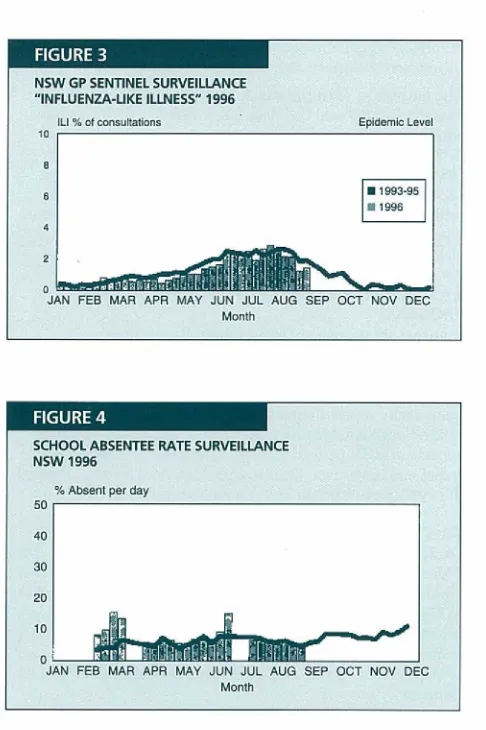
Influenza activity continued at a moderate level during the first half of August, similar to the historical average for this time of year.
Reports of influenza-like illness (ILl) from the NSW Sentinel GP Surveillance Scheme are received through five PFHJs from about 50 doctors carrying out around 7,000 consultations a week. Figure 3 shows the State average consultation rate for ILl in the last week of July was 3.5 per cent, slightly higher than the average for the previous few years. Southern and New England were the only Areas to report data for August so far and both reported consultation rates of around 3.5 per cent.
School absentee rates are being monitored from 12 schools with a total of about 11,000 students, through six 1°HIJs. Figure 4 shows that the average absentee rate has continued at levels similar to the historical average for this time of year. The high absentee rates in early July were in the last week of term and not due to infectious diseases.
Reports from Westmead, Prince of Wales and Liverpool Hospital laboratories indicate that during the first two weeks of August, virology diagnoses of influenza (mainly in children) continued at levels similar to the previous month (23 influenza A diagnoses and no influenza B diagnoses). Serological diagnoses of influenza A (mainly in adults) increased during this period, however, with 20 reports, compared with eight reports in the previous fortnight.
JAPANESE ENCEPHALITIS
In March and April 1995, three cases of Japanese
encephalitis (JE) were reported among residents of a single Torres Strait Island (population 780). Two died. Until then, Japanese encephalitis had never been reported in Australia or east of Bali1.
Japanese encephalitis is caused by a virus (an arthropod-borne flavivirus) carried by mosquitoes. Infection causes an acute brain syndrome including reduced consciousness, generalised spasticity, focal neurological signs and fits. No specific treatment is available for JIE; of all patients,
N5W GP SENTINEL SURVEILLANCE "INFLUENZA-LIKE ILLNESS" 1996
L1 ci coeSultalions - Epidcrrnc Lecci ic
S •1993-95
C 1995
:
JAN FEB MAR APR MAY JUN JUL AUG SEP OCT NOV DEC MotOh[cjuJ
SCHOOL ABSENTEE RATE SURVEILLANCE N5W '1996
% Absent psi dy 50
40
30
JAN FEB MAR APR MAY JUN JUL AUG SEP ocr NOV DEC
MoOt
one-quarter die arid 30 per cent have long-term neuropsychiatric problems. In populations exposed from birth, however, for each clinical case, between 100 and 1,000 people are infected without symptoms. Adults who are not immune, such as travellers to infected areas, have higher rates of serious ilinesir.
About 500,000 cases of JE are reported each year in Asia, mostly from rural areas of China, Taiwan, Hong Kong, Korea, South-east Asia, the Indian subcontinent, Sri Lanka, Guam, Indonesia, the Philippines and Russia. The virus reservoir is primarily in animals such as pigs, horses and wild birds. In subtropical areas, outbreaks occur at the end of the wet season. The risk to travellers appears low; the mam risk is travelling to endemic rural areas for long periods, especially during epidemic seasonst.
An effective vaccine is widely used in Asia, and is available in Australia for travellers >1 year of age spending ^1 month in endemic rural areas, or ^1 year in endemic urban areas2.
In April 1995, in response to identffication of the Torres Strait cases, control activities were initiated including1:
• education of the community about personal mosquito protection measures;
• identification and control of mosquito breeding sites; • a serological study of 212 island residents. (This
a serological survey of island horses and pigs (showing evidence of infection); and vaccination of 3,440 people mainly resident in the outer Torres Strait Islands5.
To Australians, JE historically has been a risk to some travellers to Asia. The recent Torres Strait cases were the first reported in Australia. While it seems possible the virus could be carried to NSW by birds and mosquitoes, this has never been recorded and it is impossible to predict if it will ever occur.
Irs NSW, structures in place to detect and control outbreaks of mosquito-borne diseases, including mandatory laboratory reporting of cases of arboviruses (including JE) and the Arbovirus Disease Surveillance and Control Plan, should allow early detection and control of locally acquired disease. Research under way in Queensland on risks to humans and animals will further guide policy.
1. Hanna J et al. Probable Japanese encephalitis acquired in the Torres
Strait. Comm Dir Inteti 1995; 19:206-208.
2. NHMRC. The Australian Immunisation procedures handbook. 5th ed. Canberra: 1994.
3. Hanna J et al. Vaccination against Japanese encephalitis in the Torres Strait. Comm Dir Intel 1996; 20:188490.
INFECTIOUS DISEASES COMMITTEES
Infectious Diseases Advisory Committee (II)AC)
IDAC met in July and considered future changes to the list of notiflable diseases in NSW. Proposals for changes to the list were sought from members of the Laboratory
Surveillance Advisory Committee and Public Health Unit staff. IDAC also considered the national list of notffiable conditions.
The proposed changes to the schedule will not come into effect until a system is developed that would allow laboratory reports to be transmitted electronically to a single, secure database. This will probably not occur for at least several months.
Letters to the Editor
P Continued from page 89
break out of the mould into which specialisation has placed them and begin to collaborate with a much broader range of disciplines'. Tt is clear that geography must be one of these disciplines.
1. Stewart 0, Chipps J, Sayer 0. Suicide mortality in NSW: geographic variations. NSWPubltc Health Bulletin 1995; 6(61:49-52.
2. Stewart 0, Chipps J, Sayer G. Suicide mortality in NSW local government areas. NSWPublic Health Bulletin 1996; 7(1-2):1-10.
IDAC supported the following changes to the list:
Conditions to be notified by doctors:
• I acute viral hepatitis to be notified by telephone.
Conditions to be notified by hospital chief executive officers:
• hepatitis A, paratyphoid, typhoid and rabies to be notified by telephone.
Conditions to be notified by laboratories:
• campylobacteriosis, chancroid, Chiarnyclia trachornatis infections, donovanosis, shigellosis, yersinosis, equine morbillivirus infection, influenza, rotavirus infection and respiratory syncytial virus to be included on list; and
• flaviviruses, hepatitis A, rabies and equine morbillivirus infection to be notffied by telephone.
NSW Imniunisation Advisory Committee (IAC)
At its last meeting, IAC reviewed 78 cases of adverse events following immunisation (AEFIs) notified in 1994 and 1995. A full report of this review will be published in a future issue of the Bulletin. AEFIs are defined as at least one of the following conditions occurring ^30 days after administration of a vaccine:
persistent screaming (>3 hours) anaphylaxis
shock
hypotonic/hypertonic episode encephalopathy
convulsion aseptic meningitis thrombocytopaenia death
Health professionals are reminded that all AEFIs should be reported to the local Public Health Unit.
1. Contributing microbiology laboratories include: Prince of Wales Hospital, St Vincents Hospital, New Children's Hospital Virology Lab, Sugerman's Pathology, Frack & Mansfield Pathologists, Quinn Pathology Services, Douglas Laboratories, Macquarie Pathology Services and Hanly Moir Pathology.
3. Glover J, Woollacott T. A Social Health Atios ofAustmiia, Volumes 1 and 2. Australian Bureau of Statistics Catalogue No 4385.0, September 1992.
4. Curson P. Siciliano F. An Atia of Premature Mortality in New South
Wales 1981-1988. Report prepared for the Commonwealth Department of Community Services and Health, April 1992.
5. Harrison J, Moller J, Dolinis J. Letter to the Edithr. Suicide mortality in NSW: geographic variations. NSW Public Health Bulletin 1995; 6(91:92-93.
6. Stewart G, Chippe J, Sayer G. On the achievement of real targets: reply to Harrison et al. NSW Public Health Bulletin 1995; 619):93-94. 7. Jones K, Moon G. Health, Disease and Society. An introduction to medical geography. London: Routledge & Kegan Paul, 1987, p128. 8. Openshaw S. The modifiable areal unit problem. Concepts &
Techniques in Modern Geography 38. Norwich: Geo Books, 1983.
9. Vimpani G. The seduction of medicine by health outcomes: from meaning to measurement. NSW Public Health Bulletin 1995; 6(1 1):132.
11.
INFECTIOUS DISEASE NOTIFICATIONS FOR NSW IN JULY 1996, RECEIVED BY AREA HEALTH SERVICE
Area Health Service Pe riod
Total Year
Condition CSA NSA WSA WEN 5W5 CCA HUN ILL SES NRA MNC NEA MAC MWA FWA GMA SA for July to date
Blood-borne and sexually transmitted
AIDS - 4 - - 1 - 1 - - 1 - - - 7 166
HIV infection 4 - 1 - 4 - - - 11 1 - - - - 1 - - 37 276
Hepatitis B - acute viral - - - 1 - - - 1 24
Hepatitis B - other 34 30 42 1 51 7 2 1 23 3 3 5 - - - 2 2 201 2,678*
HepatitisC-acuteviral - - - -. - - - 8
HepatitisC--other 41 13 2 1 21 9 25 5 64 31 17 12 1 3 - 10 25 282 4,516*
HepattisD-unspecified - - - 3
Hepatitis, acute viral (NOt) - - 1 - - - 1 4
Gonorrhoea 1 - 2 - - - 16 2 - 1 1 - 1 - - 24 287
Syphilis 6 5 5 - 10 - 2 - 9 - - 9 - - 2 - - 48 431
Vector-borne
Arboviral infection - - - 3 - - 8 3 1 1 - - - - 16 1,083
Malaria 1 1 1 2 1 - 1 - 2 - - - - 1 - - - 10 131
Zoonoses
Brucellosis - - - 1
Hydatiddiseese - - - 7
Leptospirosis - - - 1 - - 1 - - - 2 21
Qfever - - - 1 2 1 1 1 1 7 14 161
Respiratory/other
Legionnaires' disea5e - - - 1 - - - 1 40
Meningococcal (invasive) infection 2 3 - - - 3 1 - 3 1 2 - - 1 - 1 1 18 72
Leprosy - - - 1
Mycobacterial tuberculosis - 5 4 - - - 9 199
Mycobacteria other than TB 2 1 - - 4 - - - 1 - - - 8 225
Vaccine-preventable
Adverse event after inmunisation - - - 1 1 - - 1 - - - 3 28
H.infiuenzae(invasive)infection - - - 1 - - - 1 10
Measles - - 1 1 - - 1 2 1 - - - - 1 - 7 99
Mumps - - 1 - - - 1 15
E'ertu5sis - 6 1 2 1 - 3 - 3 4 - - - 6 3 29 454
Rubella 1 - 1 - - - 1 - 1 - - - 4 140
Faecal-oral
Cholera - - - -. - - - 2
Foodborneillne5s(NO5) - - - 41
Gastroenteritis (iristit) 14 - - 5 - - - 1 - - - 20 164
Hepatitis A 4 - 4 1 1 - 1 3 10 - 2 3 - 5 - - 1 35 590
Listeriosis - - 1 - - - 1 6
Sairronellosis (NOS) 5 5 6 4 3 3 4 - 7 5 1 2 - - - - 3 48 677
Typhoid and paratypboid - - - 2 - - - 2 22
* includes acute