UBIR: University of Bolton Institutional Repository
Educational Cybernetics: Reports Institute for Educational Cybernetics
2007
Roadmap for KRSM RTD.
Albert Angehrn
INSEAD
David Griffiths
University of Bolton, [email protected]
Scott Wilson
University of Bolton, [email protected]
This Report is brought to you for free and open access by the Institute for Educational Cybernetics at UBIR: University of Bolton Institutional Repository. It has been accepted for inclusion in Educational Cybernetics: Reports by an authorized administrator of UBIR: University of Bolton Institutional Repository. For more information, please [email protected].
Digital Commons Citation
Project no. 027087
TENCompetence
Building the European Network for Lifelong Competence Development
Project acronym: Integrated Project TENCompetence
Thematic Priority: 2.4.10
ID5.2: Roadmap for KRSM RTD
Due date of deliverable: 31-05-2007 Actual submission date: 26-07-2007
Start date of project: 01-12-2005 Duration: 4 years
GIUNTI Interactive Labs s.r.l.
Version 1.0
Project co-funded by the European Commission within the Sixth Framework Programme (2002-2006)
Dissemination Level
PU Public X
PP Restricted to other programme participants (including the Commission Services) RE Restricted to a group specified by the consortium (including the Commission
TENCompetence IST-2005-027087
Project Internal Deliverable Report
ID5.2: Roadmap for KRSM RTD
Workpackage WP5
Task 4
Date of delivery Contractual: 30-04-2007 Actual: 20-07-2007
Code name ID5.2 Version: 1.0 Draft Final
Type of deliverable Report
Security
(distribution level)
Public
Contributors TENC Vision Group, in particular:
Albert Angehrn (INSEAD), Dai Griffiths (UB), Scott Wilson (CETIS)
Authors (Partner) TENC Vision Group, in particular:
Albert Angehrn (INSEAD), Dai Griffiths (UB), Scott Wilson (CETIS)
Contact Person A.Marco Luccini (Giunti Labs), Michele Dicerto (Giunti Labs).
WP/Task responsible Giunti Labs / INSEAD
EC Project Officer Hans-Jürgen Westhof
Abstract
(for dissemination)
Roadmap for KRSM RTD activities.
Keywords List WP5, internal deliverable, knowledge management, knowledge resources, discovery, collaboration, social networks, metadata, KRSM, system, interfaces, usability, sharing, architecture, API, GUI, federated search, digital repositories, P2P, client, proof-of-concept, model, method, roadmap.
TENCompetence Project Coordination at: Open University of the Netherlands Valkenburgerweg 177, 6419 AT Heerlen, The Netherlands
Table of Contents
1 INTRODUCTION ... 2
2. WP5 IN THE TENCOMPETENCE CONTEXT ... 3
2.1 GENERAL OBJECTIVES... 3
2.2 THE FIRST CYCLE APPROACH... 3
2.3 WP5 AND THE TENCOMPETENCE DOMAIN MODEL... 4
2.4 STATE-OF-THE-ART AND WP5... 6
2.5 R&DROADMAP:DIP-1 VS.DIP-2 ... 6
3 WP5 FOCUS MEETING OUTCOMES... 8
3.1 MAIN FINDINGS... 8
3.2 RELATED OPEN ISSUES ... 9
4 NEXT STEPS & CONCLUSIONS... 11
4.1 THE UPDATED R&D ROADMAP...11
4.1.1 Actions list ...11
4.1.2 Short term view ...12
SUMMARY... 14
ANNEX A WHAT IS KNOWLEDGE RESOURCES MANAGEMENT? ... 15
ANNEX B CATEGORIES OF KNOWLEDGE RESOURCES... 30
ANNEX C STATE-OF-ART ON KNOWLEDGE RESOURCES MANAGEMENT AND SHARING ... 34
ANNEX D RELEVANT EXISTING INITIATIVES CONCERNING KNOWLEDGE RESOURCES MANAGEMENT AND SHARING ... 45
ANNEX E RELEVANT EXISTING STANDARD AND SPECIFICATIONS... 56
1 Introduction
This document reports the future perspective of WP5 as currently devised. It can be certainly considered the richest part of the WP5 research work. It stems from the initial State-of-the-Art input developed in order to set the common base ground for the WP5 partners and the consortium (see the Annexes for the most relevant subject considered), and it has been fed mainly by the research work on models and methods run in WP5 task 4 of the project first cycle (see in D5.1) and by the outcome of a cooperative work performed in a focus meeting among WP5 partners, the TENC Vision Group and representatives from WP3 (Technical Design & Implementation of the Integrated System) as here described in §3. All in all provides the drivers for the WP5 R&D efforts in the second cycle (and afterwards). Please note that overall WP5 outcomes are reported in D5.1 deliverable and that the implementation of the R&D Roadmap here provided will be reported in deliverable D5.2 that will collect intermediate results in the internal deliverable ID5.3 to ID5.10, see (TENC staff, 2007)1.
Remarks:
Please note that in order to maintain document’s consistency with other WP5 documentation (such as D5.1), and to make it self contained, some excerpts from other suitable documents have been integrated.
Please also note that all References are here reported in footnotes and detailed in the main document D5.1.
1 TENC staff (2007). TENCompetence – Building the European Network for Lifelong Competence Development. Detailed Implementation Plan month 13-30.
2. WP5 in the TENCompetence context
2.1 General objectives
As stated in §2 (Project Objectives) of the Description of Work of the
TENC project (TENC staff, 2005)2, the “central need addressed by
TENCompetence is to provide ubiquitous and lifelong adapted access to facilities that support the creation, storage, use and exchange of formal and informal knowledge and learning resources”.
Therefore, it is clear from the very beginning of the project presentation that the KRs management plays a key role in the overall framework infrastructure. In fact, the third major requirement addressed by the TENC infrastructure is to “provide policies and software agents that support the proactive sharing of knowledge and learning resources”. This is the core goal of WP5 on Knowledge Resources Sharing and Management.
Moreover, since the KRs dealt with by all the other aspect WPs can be sought via the KRSM system, it is apparent how WP5 is functional to address the other main issues tackled by the project (i.e. new pedagogical models, finding adequate learning opportunities, assessment, support tools, decentralized management, integrate isolated tools).
Again, the “field of Knowledge Resource Sharing & Management” including “the fields of knowledge management, digital repositories, learning management systems that work on learning objects, etc.” represents one out of the four pillars of the integrated TENC infrastructure (along with the fields of Learning Activities & modelling of Units of Learning, of Formal and Informal Programmes for Competence Development, and of Networks and Communities of Lifelong Learners), that aims to serve the “lifelong competence development in Europe”.
Stemming from this background analysis, the fourth project objective outlines the scope that WP5 will take charge of during project lifespan: “4. To research and develop innovative methods and technologies for the creation, storage, use and exchange of knowledge resources related to lifelong competence development.”
2.2 The first cycle approach
As far as the actual relation of WP5 with the other WPs in the project is concerned, the work performed in the first project cycle has been
2 TENC staff (2005). TENCompetence – Building the European Network for Lifelong Competence Development. Annex I - "Description of Work".
devoted to provide the basic proof-of-concept technical infrastructure for the KRs handling so that the KRSM system developed could work both as a standalone tool and as a component ready to be integrated in the overall TENC framework. The actual integration in the general infrastructure will start in the second cycle. Therefore, in the first phase, the user requirements identified at WP5 level fed the WP2 general definitions, while the cooperative work with WP3 has helped to outline how the KRSM system will be integrated in the general infrastructure. A taxonomy of knowledge resources has been built in order to list all kind of items that are processed at TENC infrastructure level and that may be handled via the KRSM system. This taxonomy has been fed by estimating the input coming from other aspect WPs. In particular, given the close relationship at research level, even though operating on different scope and perspective, it is foreseen that the collaboration between WP5 and WP8 will be strengthen in the project second phase3. After the first cycle such a list will be validated by aspect WPs and then used to populate WP5 updated scenarios and use cases.
2.3 WP5 and the TENCompetence Domain Model
Last but not the least, it is useful to see where the KRs are placed in
the ‘Domain Model’ (TENC staff, 2006)4 that defines the conceptual
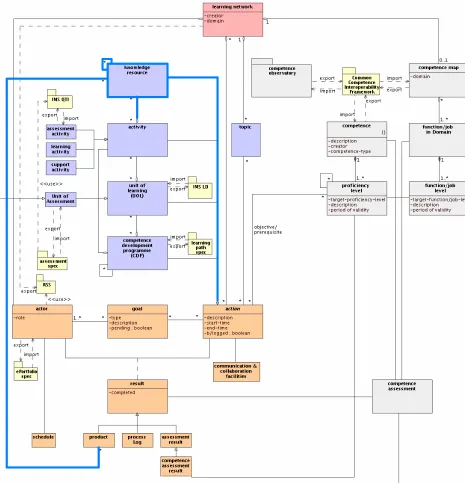
framework of the project in order to fully understand the key role played by WP5. In the following picture, one can see, highlighted in light blue, the connections / relation of the Knowledge Resource class with the other classes. It is apparent that apart from the auto-inferential link KRs are accessed and invoked by Activities and / or Actions performed by Actors. Moreover, KRs are handled by Products
3 WP5 perspective should be addressed to the individual users of knowledge resources while
WP8 point-of-view should be more community- (i.e. network)-oriented. In fact, the focus of WP8 task 3 is clearly on communities management "This task describes, develops and tests tools and models that help understand and manage the dynamic behaviour of networked communities." (TENC staff, 2007).
Therefore, the two WPs consider two different aspects of the same issue:
1) (WP5) how individual users take advantage of the tools developed for sharing KRs (this means that the models will help in understanding what are the most proper tools to be used / developed - likely by WP8 - and how to use them - this would help also in terms of usability design, e.g. the model foresee a particular way of interaction that has to be taken into account in the GUI design),
2) (WP8) how the community and the networked communities are related to each other and how the individuals towards to the community(-ies). Therefore the knowledge resources sharing has to be taken into account since it affects the relationship dynamics in the community(-ies) and is functional to them (e.g. as a prerequisite).
4
TENC staff (2006). TENCompetence – Building the European Network for Lifelong Competence Development. Domain Model v.1.0.
(used by Actors), that is the KRSM and / or the ones developed in the aspect WPs and the general TENC infrastructure.
Figure 1 – TENCompetence Domain Model v.1.0 (TENC staff, 2006)
2.4 State-of-the-art and WP5
A first thorough State-of-the-art analysis has been performed at the beginning of the project in order to set the bases for a common and shared background information and knowledge among the WP5 partners mainly. The results of such work were collected into the first WP5 White Paper. However, current research and technologies have been constantly investigated during the project lifespan in order to always guarantee the best approach and choices provided that general project perspective and guidelines are safeguarded.
In the White Paper mentioned above all the relevant aspects related to Knowledge Management (KM) have been addressed. Therefore, after reporting the KM scientific foundations extensive analyses of categories of KRs and of off-the-shelf SW have been performed.
All the relevant information has been here reported in the Annexes A to E.
In particular, the list of categories of KRs reported into the first WP5 White Paper, was provided as preliminary base-ground of the taxonomy currently being developed.
2.5 R&D Roadmap: DIP-1 vs. DIP-2
The main difference between DIP-1 (TENC staff, 2005)5 and DIP-2
(TENC staff, 2007)6 emerges at first sight while considering the order
tasks are detailed within. In fact, in a sort of top down representation, one can see outcomes from task 1 feeding the tasks following (i.e. task 2, task3…). According to this pattern, it is apparent a different perspective in carrying out and in prioritising WP5 activities in DIP-1 and DIP-2. Hence, in the first project phase (DIP-1) the first task, pretty technical, had to provide the basic infrastructure, in terms of digital accessible repositories and services, as proof-of-concept of the knowledge resources sharing and management; then, running in parallel, the liaison-related activities, the experimentation and, lastly, the research followed. On the contrary, DIP-2 puts on the top (and in the main focus) the research work, and then the technical development and the experimentation.
The different scope and point-of-view was apparent and, along with the research work on methods and models described in Part I and performed at DIP-1 task 5.4 level, drove the discussion of the WP5 focus meeting that was organised among WP5 partners, TENC Vision
5
TENC staff (2005). TENCompetence – Building the European Network for Lifelong Competence Development. Annex I - "Description of Work".
6
TENC staff (2007). TENCompetence – Building the European Network for Lifelong Competence Development. Detailed Implementation Plan month 13-30.
Group and WP3 representatives at Giunti Labs premises around mid-March 2007.
3 WP5 focus meeting outcomes
The meeting held in Sestri Levante on 12th and 13th March 2007 was
very important and fruitful since set out the research guidelines for WP5 in the second project cycle and, in perspective for the remaining project lifespan.
Two main (reciprocally-related) issues have been considered:
1- Where is the Competence Management aspect in WP5?
2- How can Tacit Knowledge be transferred into KRs?
Both questions are relevant since the first one deals with the main issue and objective of the project, while the second one addresses directly the typology of KRs used / handled at WP5 (and KRSM system) level. The latter, in particular, points out the problem of mapping in a proper and concrete way KRs that are difficult to be practically formalised, but that, if skipped or not sufficiently considered, a potential loss of knowledge would occur.
3.1 Main findings
The most relevant outcome of the meeting was to change the focus of WP5 scope from the KRs Search to KRs Discovery. This introduces a fundamentally different approach which is completely in line with the changed perspective of DIP-2 with respect to DIP-1, as mentioned in the Introduction.
The real added value of the renewed point-of-view relies on discovering (by harvesting) the Connections / Relations associated to and among KRs as well as on analysing such connections.
Moreover, the clarification of WP3 new developments brought new light to the possible interfacing between the KRSM system and the TENC one as well as support to the new discovery-oriented approach. In fact, because of the strict client-sever architecture of the TENC infrastructure, all pure P2P features will be removed in order to follow the general pattern for client communication architecture.
Another relevant finding is related to the introduction of the
Collaboration Cost Reduction concept. This is obviously related to
KRs sharing, use and reuse and, indirectly, to the motivation that will trigger collaboration and to the competence needed for repurposing KRs or valuable part of them. In fact, the cost of finding valuable information in a KR used in a certain context in order to reuse it in another one depends on the cost of (a) the de-contextualisation effort – for extracting more transferable Knowledge from a ‘less-transferable’ and high and context-specific KR; and of (b) the re-contextualisation
effort – for repurposing the extracted Knowledge in a different KR and into a more generic context. This research issue will be likely addressed at a later stage in the project (i.e. cycle 3).
3.2 Related open issues
There are some open issues related to these findings that will have a concrete impact on actual WP5 future activities. For instance, the fact that the actual discovery process relies on harvesting and analysing connections among KRs requires the identification and / or definition of a specific intelligence that properly handles their indexing. And
Indexing the relations among KRs is a task that deserves special
attention itself.
A further impact on investigation activities will be in terms of identification and definition of suitable new scenarios and use cases, on the one hand, and of new Metadata in order to provide the linking information, on the other hand (of course, already existing information – metadata included – have to be analysed, e.g. by data mining on logs – for the same reasons). In both cases, the Taxonomy of KRs, that has been introduced in D5.1, has to be revised in order to take into account the linking information.
Once the KRs have been discovered likely new ways of KRs browsing and visualisation have to be investigated in order to meet user’s (new) approach (i.e. discovering them rather than simply searching for). For instance, a user-friendly way for visualising the relations among KRs could be given by the use of concept maps.
However, aside this structural analysis of KRs that makes visible and understandable the connections, there is the need of analysing KRs usage in terms of e.g. users’ reputation (i.e. the higher, the more reliable her/his ‘judgement’ on use of KRs is), WEB 2.0 tagging. This is a key factor for addressing and fostering the collaboration during KRs authoring. In fact, by means of log mining (e.g. on content, people involved, schedule: start and stop timing), and of coupling with the output coming from the communication among users (e.g. via chat, email, Instant Messaging, Audioconference, Videoconference, webinars) it is possible not only to make tacit knowledge explicit, but also to derive useful information to drive KRs recommendation and rating. Of course, privacy issues related to acquisition, storage, access and use of the data stored and / or detected have to be carefully investigated. Enforcement privacy mechanisms for centralized and distributed indexing, search and retrieval must be investigated. Moreover, in relation to fostering the collaboration, other investigation efforts should be performed in order to suitably identify how to set up a proper set of authors. Discovering the right people can be helped by
analysing competence-driven rating, or just by advertising the subject to work on. Again, the GUI design could play a key role for presenting ‘discovery’ results in an effective way.
Again usability concerns should address the work of displaying the tips arising from the discovery outcomes, in case a recommending system will be implemented to support the user. In fact, the possible invasiveness of pushing suggestions, for instance via pop-up windows, and the prioritisation of such information have to be seriously taken into account in order not to loose the advantage given by the additional semantic rich information gained along with the discovery outcomes.
On the architectural side, moving the TENC infrastructure towards a
client-server architecture means that KRSM P2P features have to be
skipped since publishing and sharing KRs will become one common function, provided with more sophisticated access and filtering mechanisms and supported just by saving KRs on TENC server(s). It is clear and already accepted that APIs for accessing the repositories are provided by WP3.
In addition, there are some other problems related to the definition of the APIs for the devised integration of the Google search engine and of the Google Docs & Spreadsheet (also in terms of services licensing), on the one hand, and to the lack of cross platform solutions for some collaborative tools that can be considered, on the other hand. A further issue is represented by the fact that some WEB 2.0-oriented tools do not provide public APIs. Finally, keyword-based search still produces an overload for the user side. Combinations of keyword search and metadata based queries should be investigated.
4 Next Steps & Conclusions
4.1 The updated R&D roadmap
The R&D agenda of WP5 can be easily derived from the previous sections, in terms of research subjects and of accompanying issues, and can be broken down into the second and the third project cycles according to the following main drivers:
1. The change in approaching the seek of KRs, that is, from the
(traditional) search, based on standard and extensive use of interfaces with digital repositories, towards to the combination with metadata possibly extracted from the discovery of KRs and identification / detection of the connections that may link KRs one another. The intrinsic semantic value of the connections provides users with richer information than just the bare items sought. This is certainly the main focus of R&D work in the next project phases.
2. the combined introduction of collaboration and KRs creation in
terms of collaboration cost reduction for the last phase of the project that will address the use and reuse of KRs as well as their customisation. In particular, it will be interesting to investigate how to establish the group of authors that collaboratively work on a subject and on a (set of) KR(s) as well as how to optimise the de-contextualisation and re-de-contextualisation efforts to be spent in repurposing KRs, or part of them.
The actual outcomes that are expected by the implementation of such roadmap will be clear after the new round of scenarios and use cases identification and definition that will start after the conclusion of the first project cycle. From that analysis not only ‘what’ has to be ‘discovered’ but also ‘how’ to do it will be understood. KRSM v2.0 system design and development will be affected accordingly, too. Therefore, at month 30 the new KRSM system will offer users at least some of the new semantically enriched functionalities and services that are intrinsic to the objectives mentioned above.
4.1.1 Actions list
From a practical point of view the changed perspective has a certain impact on WP5 activities breakdown. In fact, and first of all, the scenarios and use cases related to the KRSM system will be revised and updated accordingly. They will be used for designing and developing the new version of the KRSM system on the one hand, and for modelling the relation between the KRSM system and the Personal
Competence Manager (PCM), that is the final and overall TENC
infrastructure, on the other hand.
Next, we have to rework the KRSM system architecture, in order to fit it to the current TENCompetence infrastructure, moving from pure P2P communications to client-server based communication model. This will have significant impact on both the KRSM client, as well as on some of our services already developed. We will need to re-design our client tool and adapt and extend existing services to allow for their integration into the new architecture.
But we also need to design and implement new services and functionalities as well. In particular, the most WEB 2.0-related issues, such as social bookmarking, folksonomies, cloud tagging (where not only the owner of a KR is allowed to tag it but also other users), collaborative editors, e.g. Google Docs, wikis, forums, personal and automatic annotation, will be addressed. Other items to be investigated are related to the ways of setting up a group of collaborators on a specific subject as well as the use of logs and of communication tools output for tracking users’ interests and KRs use. However, as already pointed out, and in relation with the PCM development, efforts will be devoted to the integration of the collaboration services with the authoring tools, on the base of the enhancement of the Knowledge Resources Taxonomy, and its integration in both the KRSM client as well as in the TENCompetence server(s), and its joint use and re-use with other TENCompetence tools and services, developed by other WPs.
4.1.2 Short term view
The kind of investigation mentioned above will guide the research work from the second cycle of the project on. The following more specific activities will be needed at first place:
• Completely new GUI component have to be developed as an Eclipse
plug-in
• New Publishing and Sharing services have to be developed,
adopting the centralized TENCompetence server(s) approach, using centralized DB
• Searching functionality needs to be changed and improved.
However, and in the meanwhile, some other activities have to be performed in order to complement the current version of the KRSM system and setting the ground of the future work.
In particular, (1) the integration of the Google search engine, since it is the most effective and popular, will be further investigated and implemented provided that it will be possible in terms of licensing, (2) a wider integration of the Taste recommending system, already used
in the KRSM system, and that will be fed by the rating services in order to be more effective, (3) the integration of the DSpace digital repository, in order to accomplish one of the objectives of the project first cycle, (4) finalizing implementation of the services for downloading (i.e. get) , publishing (i.e. post) and metadata handling (e.g. update, delete) on the Ariadne and Lobster repositories, and (5) the integration of the adopted solution for the user’s Authentication and Authorisation as will be defined by WP3.
Summary
The initial WP5 approach, described in DIP-1 (TENC staff, 2005), was more technology oriented, while the specificity of the personal competence development was not fully addressed. Therefore, and according to the overall development, WP5 changed its focus and point-of-view as far as the main subject of R&D research is concerned. The new focus shifted from infrastructural basic requirements to more specific knowledge management and WEB 2.0 issues. So that the KRs retrieving is no longer linked to the bare ‘search’ concept only, but has been enriched with a strong ‘semantic’ flavour as attention is paid in harvesting and analysing the connections among KRs, their use and related user’s behaviour etc.
This new ‘discovery’-oriented approach is completely in line with fostering the collaboration between users and the ‘intelligent’ use (and re-use, exchange and sharing) of the KRs, that could have been apparently at risk after WP3 decision of adopting the client-server pattern that somehow drops off the role covered by P2P in the KRSM architecture.
The ‘intelligence’ mentioned above is in relation with the minimisation of the efforts required for repurposing a KR or a part of it from a specific context into a new a one. This demanding objective will guide WP5 R&D research in the last phase of the project lifespan.
Of course, several issues will arise and have to be addressed. In particular, KRs handling and exchange bring IPRs and licensing problems that will be better met at project general level. The same applies for the privacy of the users once their logs are ‘investigated’ in order to drive rating and recommending facilities in the TENC clients. It is also likely that in order to maintain full grasp with project evolution other WP5 focus meetings, as the one organised in March 2007, will be organised in the following project cycles on regular basis or at need.
Annex A
What is knowledge resources
management?
A.1 DEFINITIONS ... 16
A.2 THE STARTING POINT ... 22
A.3 KNOWLEDGE MANAGEMENT: A CROSS-DISCIPLINARY DOMAIN ... 23
A.3.1 MECHANISTIC APPROACHES TO KNOWLEDGE MANAGEMENT...25
A.3.2 CULTURAL/BEHAVIOURISTIC APPROACHES TO KNOWLEDGE MANAGEMENT...26
A.3.3 SYSTEMATIC APPROACHES TO KNOWLEDGE MANAGEMENT...26
A.4 BASIC PRINCIPLES & MAIN ISSUES ... 27
A.4.1 WHAT BENEFITS CAN ORGANISATIONS AND INSTITUTIONS EXPECT FROM KM? ...27
A.4.2 WHAT ARE THE CHALLENGES OF KM? ...28
A.5 BASIC TECHNOLOGIES... 29
A.1 Definitions
When dealing with knowledge management (KM) the first issue is to define knowledge itself. We need such a definition as this will directly impact the whole discussion eventually preventing a real understanding on what exposed. Therefore, as usual in all multidisciplinary environments, it is necessary to agree on used terms in order to fully avoid misunderstanding.
Unfortunately, there's no universal definition of KM, just as there's no agreement as to what constitutes knowledge in the first place. Over the millennia, philosophies of each age have added their own definition of knowledge to the list, so did Science. According to Plato (as emerging from his dialogues) and other Greek philosophers we have that:
• Knowledge is what is True (Socrates). That which is true represents
Reality as it is (definition of Truth) so, Knowledge represents Reality as it is.
• Conceptual Knowledge is truly Knowledge for us (psychological
fact), so Conceptual Knowledge represents Reality as it is.
• Conceptual Knowledge represents Reality as immobile, eternal and
necessary. (Parmenides)
• The Phenomenal world (becoming) is not immobile, eternal and
necessary. (Heraclitus)
• The Phenomenal world is not Reality. Therefore Conceptual
Knowledge doesn’t represent the phenomenal world.
From what just stated is apparent that the concept of knowledge can be split in what is absolutely true (maybe also unknowable) and what is perceivable. In the latter, knowledge is specific to the cognitive system that created it, not residing outside the cognitive system.
As a matter of fact several definitions of knowledge management have been given in time by different authors as evident from the following collection:
Author Definition
Charles Savage Knowledge comes alive in an organization when people learn to trust one another and seek out and build upon their capabilities and aspirations - individually, across functions and with other companies.
Debra M.
Amidon Knowledge management is an oxymoron and could run the course of a fad. Knowledge innovation is fundamentally sustaining a collaborative advantage
Author Definition
for the excellence of an enterprise, the sustainability of a nation's economy and the advancement of society.
Alvin Toffler People do not manage knowledge; knowledge
manages people.
Gene Meieran Knowledge management is about the use of
computer and communication tools to help people gather and apply their collective data, information, knowledge and wisdom in order to make better, quicker, wiser and more effective decisions.
Matthias
Bellmann Knowledge Management is the transformation of knowledge into business—and learning the transformation of information into knowledge.
Karl Erik Sveiby It is the art of creating value by leveraging the intangible assets. To be able to do that, you have to be able to visualize your organization as consisting
of nothing but knowledge and knowledge flows.7
Charles
Armstrong It's about elevating organizational conductivity to improve our capability to engage with the outside world and our customers. This requires creating the place, time and mood to promote reflective work and the strategic effectiveness of our interactions. Robert K. Logan It's about using information strategically to achieve
one's business objectives. Knowledge Management is the organizational activity of creating the social environment and technical infrastructure so that knowledge can be accessed, shared and created.
Larry Prusak It is the attempt to recognize what is essentially a
human asset buried in the minds of individuals, and leverage it into an organizational asset that can be accessed and used by a broader set of individuals on whose decisions the firm depends.
Hubert
Saint-Onge It is creating value based on the intangible assets of the firm through relationships where the creation, exchange and harvesting of knowledge builds the individual and organizational capabilities required to provide superior value for customers.
Peter Vieser The hybrid medium of Internet technology
facilitates information and knowledge sharing among colleagues which enhances the intellectual capital of the organization.
7 Sveiby, Karl-Erik, "What is knowledge management"
Author Definition
Howard
Eisenberg The modern term knowledge worker is a misnomer. Instead we need Thinkers, people who can perceive current limitations, detect emerging trends, anticipate possibilities and heuristically re-tool themselves for the opportunities of tomorrow. Such knowledge workers would then become appreciating assets - the reserve and source of intellectual capital which can be deployed to create competitive advantage.
Chris Argyris The art of management is managing knowledge.
That means we do not manage people per se, but rather the knowledge that they carry. Leadership means creating the conditions that enable people to produce valid knowledge and to do so in ways that encourage personal responsibility.
Josef Hofer-Aleis KM is the systematic and explicit management of policies, programmes, practices and activities in the enterprise which are involved in sharing, creating and applying of knowledge. The management of knowledge aims to enhance existing knowledge and its networking and reuse. The management for knowledge aims to enhance new knowledge and the ability for innovation. (with acknowledgement to P. Seeman and K. Wiig)
Josef Hofer-Aleis It is one of the most important factors for
enterprise value, competition and production.
Linda Stone Knowledge management initiatives help to
transform an individual's tacit knowledge and experience into explicit knowledge that is readily accessible by others, which thereby increases our structural capital.
Stan Lepeak A knowledge management system is a virtual
repository for relevant information which is critical to tasks performed daily by organizational knowledge workers.
Thomas
Koulopouloas Knowledge management is the ability to link structured and unstructured information with the changing rule by which people apply it.
InformationWeek
(March 16, 1998)
Knowledge management is the concept under which information is turned into actionable knowledge and made available effortlessly in a usable form to the people who can apply it.
University of Knowledge management is the systematic process
Author Definition
Texas
KM Server of finding, selecting, organizing, distilling and presenting information in a way that improves an employee's comprehension in a specific area of interest. Knowledge management helps an organization to gain insight and understanding from its own experience. Specific knowledge management activities help focus the organization on acquiring, storing and utilizing knowledge for such things as problem solving, dynamic learning, strategic planning and decision making. It also protects intellectual assets from decay, adds to firm intelligence and provides increased flexibility.
Fernando J.
Moran Knowledge Management is the ability to help oneself or others, strategically achieve goals, ambitions, objectives and life-time dreams. Knowledge is NOT power, it is how you use it that matters!
The often used definition of knowledge as information made
actionable8 refers to the observable output of knowledge, not
knowledge itself. Encyclopaedias, handbooks, manuals, other reference material, speeches, lectures, conversations contain only information, not knowledge.
Understanding written and oral material requires a cognitive system (i.e. a human) to transform the information contained in that material into knowledge.
Groups are cognitive systems that have a shared knowledge resulting in a shared or mutual understanding from one or more interactions between individuals within the group. Hence, organizations are cognitive systems possessing a shared understanding that is the result of socialization and culturalization processes9.
Therefore we believe that it is possible to state that KM is the process through which individuals and organizations generate value from their intellectual and knowledge-based assets. Most often, generating value from such assets involves sharing them among individuals / employees, departments and even with other companies in an effort to
8 Whereas the first part of the "information revolution" focused on information, the second
needs to focus on knowledge, on understanding. The often used definition of knowledge as information made actionable refers to the observable output of knowledge, not knowledge itself. The role of knowledge management should be to increase the cognitive system's understandings so more information can be made actionable - so cognitive systems can take more effective action based upon its knowledge, not based upon the amount of information it can process.
9 “Knowledge Management” http://members.aol.com/rgwenig/homepage.htm
devise best practices. It's important to note that the definition says nothing about technology; while KM is often facilitated by IT, technology by itself is not KM.
What is even more interesting from our point of view is that knowledge can be turned in a real asset. Valuable and tangible as it is possible to transfer it according to a well defined process. Our statement is
supported by the following considerations. Fleming10 says that
information, knowledge and wisdom are more than collections. He states that a collection of data is not information and similarly a collection of information is not knowledge ... proceeding in the same way he turn to say that also wisdom is not a collection of knowledge nor truth a collection of wisdom. This implies that the whole represents more than the sum of its parts and has a synergy of its own.
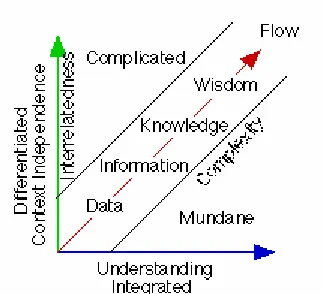
Fig. 1 – The process from data to wisdom
It's a well known fact that when we bounce in some raw data we automatically tend to arrange it into some context, maybe guessing, and this suddenly fabricates meaning which was not there in the data itself.
Pieces of data may represent information, yet whether or not it becomes information depends on the knowledge of the interpreter. It seems that information entails an understanding of the relation between data, is relatively static in time and linear in nature being mainly a relation between data with great dependence on context. Such statement is expressible also in graphical terms as evident from figure 1, where are highlighted the factors that characterise the quantum leap from one state to the other. On the axes are reported the two main
characterising factors: understanding and context
independence.
10 Neil Fleming, "Coping with a revolution: Will the Internet Change Learning?", Lincoln University, Canterbury, New Zealand
What is particularly interest to examine is the relation between the aforementioned process and the interpretation of complexity by Csikszentmihalyi. According to his approach what is more highly differentiated and integrated is more complex. So in his view while high levels of differentiation without integration promote the complicated, that which is highly integrated, without differentiation, produces mundane. Also this approach can be represented with a diagram.
What is apparent at first sight is that the superposition of this diagram on the previous one is that there is a
direct correlation between “integrated” and “understanding”
as well as between “context
independence” and
“differentiated”.
In the overall it seems that the path from data to wisdom correlates exactly with Csikszentmihalyi’s model of evolving complexity. This is reported in the schema presented in figure 2 where the two diagrams are superimposed to each other.
Fig. 2 – Complexity evolution & wisdom process
From what just stated is apparent that not all information is valuable. Therefore, it's up to individuals / companies to determine what information qualifies as knowledge-based assets. In general, however, such assets fall into one of two categories: explicit or tacit
Included among the former are assets such as patents, trademarks, business plans, marketing research and customer lists. As a general rule of thumb, explicit knowledge consists of anything that can be documented, archived and codified, often with the help of IT.
Much harder to grasp is the concept of tacit knowledge, or the know-how contained in people's heads. The challenge inherent with tacit knowledge is figuring out how to recognize, generate, share and manage it. While IT in the form of e-mail, groupware, instant messaging and related technologies can help facilitate the
dissemination of tacit knowledge, identifying tacit knowledge in the first place is a major difficulty for most organizations.
Further information related to the definition of Knowledge Management is provided in the Appendices.
A.2 The starting point
For our purposes we can define knowledge management as a business activity with two primary aspects:
1. Treating the knowledge component of business activities as an
explicit concern of business reflected in strategy, policy, and practice at all levels of the organization.
2. Making a direct connection between positive business results and
organization’s intellectual assets – both explicit [recorded] and tacit [personal know-how].
In practice, knowledge management often encompasses identifying and mapping intellectual assets within the organization, generating new knowledge for competitive advantage within the organization, making vast amounts of corporate information accessible, sharing of best practices, and technology that enables all of the above — including groupware and intranets.
Knowledge management has direct connections with several well-known management strategies, practices, and business issues, including:
• Change management
• Best practices
• Risk management
• Benchmarking
According to several sources knowledge management can be seen as a natural extension of "business process reengineering,". The need to manage knowledge seems obvious, and discussions of intellectual capital have proliferated, but few businesses have acted on that understanding. Where companies have take action (actually the number is growing) implementations of KM may range from technology-driven methods of accessing, controlling, and delivering information to massive efforts to change corporate culture. Opinions about the paths, methods, and even objectives of knowledge management abound. Some efforts focus on enhancing creativity (creating new knowledge value) while other programs emphasize leveraging existing knowledge.
In traditional perceptions of the role of knowledge in business organizations, tacit knowledge is often viewed as the real key to getting things done and creating new value. Not explicit knowledge. Thus we often encounter an emphasis on the "learning organization" and other approaches that stress internalization of information (through experience and action) and generation of new knowledge through managed interaction.
A.3 Knowledge management: a
cross-disciplinary domain
Knowledge management draws from a wide range of disciplines and technologies. In this section we try to point out the most relevant one and certainly the list is not inclusive.
Cognitive science. Insights from how we learn and know will
certainly improve tools and techniques for gathering and transferring knowledge.
Expert systems, artificial intelligence and knowledge base
management systems (KBMS). AI and related technologies have acquired an undeserved reputation of having failed to meet their own (and also marketplace’s) high expectations. In fact, these technologies continue to be applied widely, and the lessons practitioners have learned are directly applicable to knowledge management.
Computer-supported collaborative work (groupware). In Europe,
knowledge management is almost synonymous with groupware … and therefore with Lotus Notes. Sharing and collaboration are clearly vital to organizational knowledge management (with or without supporting technology). This is in any case just a point of view.
Library and information science. We take it for granted that card
catalogs in libraries will help us find the right book when we need it. The body of research and practice in classification and knowledge organization that makes libraries work will be even more vital as we are inundated by information in business. Tools for thesaurus construction and controlled vocabularies are already helping us manage knowledge.
Technical writing. Under-appreciated as a professional activity,
technical writing (often referred to by its practitioners as technical
communication) forms a body of theory and practice that is directly relevant to effective representation and transfer of knowledge.
Document management. Originally concerned primarily with
managing the accessibility of images, document management has moved on to making content accessible and re-usable at the component level. Early recognition of the need to associate "metainformation" with each document object prefigures document management technology’s growing role in knowledge management activities.
Decision support systems. According to Daniel J. Power, " DSS have
brought together insights from the fields of cognitive sciences, management sciences, computer sciences, operations research, and systems engineering in order to produce both computerised artifacts for helping knowledge workers in their performance of cognitive tasks, and to integrate such artifacts within the decision-making processes of modern organisations." In practice the emphasis has been on quantitative analysis rather than qualitative analysis, and on tools for managers rather than everyone in the organization.
Semantic networks. Semantic networks are formed from ideas and
typed relationships among them (sort of "hypertext without the content," but with far more systematic structure according to meaning). Often applied in such arcane tasks as textual analysis, semantic nets are now in use in mainstream professional applications, including medicine, to represent domain knowledge in an explicit way that can be shared.
Relational and object databases. Although relational databases are
currently used primarily as tools for managing "structured" data (and object-oriented databases are considered more appropriate for "unstructured" content) we have only begun to apply the models on which they are founded to representing and managing knowledge resources.
Simulation. According to Karl-Erik Sveiby (a well known KM Expert)
"simulation" is a component technology of knowledge management, referring to "computer simulations, manual simulations as well as role plays and micro arenas for testing out skills."11
11 Sveiby, Karl-Erik, "What is knowledge management"
Organizational science. The science of managing organizations
increasingly deals with the need to manage knowledge (often explicitly). It’s not a surprise that the American Management Association’s APQC has sponsored major knowledge management events.
As already stated this is only a partial list. Other technologies include:
• object-oriented information modelling;
• electronic publishing technology,
• hypertext, and the World Wide Web;
• help-desk technology;
• full-text search and retrieval;
• performance support systems.
The term "knowledge management" is now in widespread use. Karl-Erik Sveiby12 identified two "tracks" of knowledge management:
• Management of Information. To researchers in this track,
according to Sveiby, "… knowledge = Objects that can be identified and handled in information systems."
• Management of People. For researchers and practitioners in this
field, knowledge consists of "… processes, a complex set of dynamic skills, know-how, etc., that is constantly changing."
Sveiby’s characterization is certainly relevant even if less complete than the one given by Knowledge Praxis, nominally:
A.3.1
Mechanistic approaches to knowledge
management
Mechanistic approaches to knowledge management are characterized by the application of technology and resources to do more of the same better. The main assumptions of the mechanistic approach include:
• Better accessibility to information is a key, including enhanced
methods of access and reuse of documents (hypertext linking, databases, full-text search, etc.)
• Networking technology in general (especially intranets), and
groupware in particular, will be key solutions.
• In general, technology and sheer volume of information will make it
work.
12 Sveiby, Karl-Erik, "What is knowledge management"
A.3.2 Cultural/behaviouristic
approaches
to
knowledge management
Cultural/behaviouristic approaches, with substantial roots in process re-engineering and change management, tend to view the "knowledge problem" as a management issue. Technology (though ultimately essential for managing explicit knowledge resources) is not the solution. These approaches tend to focus more on innovation and creativity (the "learning organization") than on leveraging existing explicit resources or making working knowledge explicit. Assumptions of cultural/behaviouristic approaches often include:
• Organizational behaviours and culture need to be changed …
dramatically. In our information-intensive environments, organizations become dysfunctional relative to business objectives.
• Organizational behaviours and culture can be changed, but
traditional technology and methods of attempting to solve the "knowledge problem" have reached their limits of effectiveness. A "holistic" view is required. Theories of behaviour of large-scale systems are often invoked.
• It’s the processes that matter, not the technology.
• Nothing happens or changes unless a manager makes it happen.
A.3.3
Systematic approaches to knowledge
management
Systematic approaches to knowledge management retain the traditional faith in rational analysis of the knowledge problem: the problem can be solved, but new thinking of many kinds is required. Some basic assumptions:
• It’s sustainable results that matter, not the processes or technology
… or your definition of "knowledge."
• A resource cannot be managed unless it is modeled, and many
aspects of the organization’s knowledge can be modeled as an explicit resource.
• Solutions can be found in a variety of disciplines and technologies,
and traditional methods of analysis can be used to re-examine the nature of knowledge work and to solve the knowledge problem.
• Cultural issues are important, but they too must be evaluated
systematically. Employees may or may not have to be "changed," but policies and work practices must certainly be changed, and technology can be applied successfully to business knowledge problems themselves.
• Knowledge management has an important management component, but it is not an activity or discipline that belongs exclusively to managers.
A.4 Basic principles & Main issues
In general, managing knowledge has been perceived as an unmanageable kind of problem that was intractable with traditional management methods and technology.
There is a tendency to treat the activities of knowledge work as necessary, but ill-defined. It often perceived that explicit manifestations of knowledge work are forms of publishing and by-products of "real" work.
As a result, the metrics associated with knowledge resources (and our ability to manage those resources in meaningful ways) have not become part of business infrastructure.
We do know a lot about how people learn and how organizations develop and use knowledge. The body of literature about managing intellectual capital is growing. We have new insights and solutions from a variety of domains and disciplines that can be applied to making knowledge work manageable and measurable. Computer technology (even if it’s also a cause of the problem) can provide new tools to make it all work too.
A.4.1
What benefits can organisations and
institutions expect from KM?
Some benefits of KM correlate directly to bottom-line savings, while others are more difficult to quantify. In today's information-driven economy, organisations and institutions uncover the most opportunities — and ultimately derive the most value — from intellectual rather than physical assets. To get the most value from a company's intellectual assets, KM practitioners maintain that knowledge must be shared and serve as the foundation for collaboration. Yet better collaboration is not an end in itself; without an overarching business context, KM is meaningless at best and harmful at worst. Consequently, an effective KM program should help a complex organization do one or more of the following:
• Foster innovation by encouraging the free flow of ideas
• Improve customer and users service by streamlining response time
• Boost revenues by getting products and services to market faster
• Recognizing the value of organization memebers’ knowledge and rewarding them for it
• Streamline operations and increase efficiency by eliminating
redundant or unnecessary processes
• Increase the efficiency and effectiveness of learning and training
processes within the organization
These are the most prevalent examples. A creative approach to KM can result in improved efficiency, higher productivity and increased revenues in practically any business function.
A.4.2
What are the challenges of KM?
The major problems that occur in KM usually result because organizations ignore the people and cultural issues. In an environment where an individual's knowledge is valued and rewarded, establishing a culture that recognizes tacit knowledge and encourages members to share it is critical. For instance, within a company the need to sell the KM concept to employees shouldn't be underestimated; after all, in many cases employees are being asked to surrender their knowledge and experience (the very traits that make them valuable as individuals).
One way companies motivate employees to participate in KM is by creating an incentive program. However, then there's the danger that employees will participate solely to earn incentives, without regard to the quality or relevance of the information they contribute. The best KM efforts are as transparent to employees' workflow as possible. Ideally, participation in KM should be its own reward. If KM doesn't make life easier for employees, it will fail.
KM is not a technology-based concept. Don't be duped by software vendors touting their all-inclusive KM solutions. Organisations and institutions that implement a centralized database system, electronic message board, Web portal or any other collaborative tool in the hope that they've established a KM program are wasting both their time and money.
A KM program should not be divorced from a business goal. While sharing best practices is a commendable idea, there must be an underlying business reason to do so. Without a solid business case, KM is a futile exercise.
As with many physical assets, the value of knowledge can erode over time. Since knowledge can get stale fast, the content in a KM program should be constantly updated, amended and deleted. What's more, the relevance of knowledge at any given time changes, as do the skills of employees. Therefore, there is no endpoint to a KM program. Like
product development, marketing and R&D, KM is a constantly evolving business practice.
Organisations and institutions diligently need to be on the lookout for information overload. Quantity rarely equals quality, and KM is no exception. Indeed, the point of a KM program is to identify and disseminate knowledge gems from a sea of information.
A.5 Basic technologies
KM tools run the gamut from standard, off-the-shelf e-mail packages to sophisticated collaboration tools designed specifically to support community building and identity. Generally, tools fall into one or more of the following categories:
• knowledge repositories,
• expertise access tools,
• e-learning applications,
• discussion and chat technologies,
• synchronous interaction tools,
• search and data mining tools.
Annex B
Categories of knowledge resources
Two main categories of knowledge resources can be identified: on the one hand the ‘material’ resources of knowledge, on the other hand the ‘immaterial’ ones.
B.1 MATERIAL’ RESOURCES OF KNOWLEDGE ... 31 B.2 ‘IMMATERIAL’ RESOURCES OF KNOWLEDGE... 32 B.2.1 FURTHER INSIGHT...32
People as knowledge resources...32 Tacit knowledge management ...33 A new model...33
B.1 Material’ Resources of Knowledge
In this category the most traditional resources can be listed:• Digital resources:
o Resources Descriptors (e.g. .xml, .rdf),
o Planning & Design (e.g. .mpp)
o Text & Hypertext (e.g. .txt, .doc, .rtf, .pdf, .sxw, .odt, .tex, .htm, .chm, .cfm),
o Spreadsheets (e.g. .xls, .ods ,sxc, .dif, .csv, .sdc),
o Images & Graphics (e.g. .tiff, .jpg, .png, .gif, .ai, .eps, .psd, bmp, .raw, .xcf, .ico, .ps, .tga, .wmf, .wrl, .3ds, .w3d),
o Presentations (e.g. .ppt, .pps, .odp, .sxi, .sda),
o Audio & Movies & Animations (e.g. .wav, .aif, .ram, .mpeg, .avi, .mov, .qt, .rm, .dcr, .dir, ..osx, swf, .fla),
o DTP (e.g. .qxd),
o OCR (e.g.),
o Data Base (e.g. .mdb, .dbf),
o Scripting (e.g. .asp, .jsp, .cgi)
o Executable Programs & Libraries & Source Codes (e.g. .exe, .com, .dll, .c, .h, .java)
o e-learning courses (e.g. xpf).
• Other Resources:
o References (e.g. libraries, publications).
o Sources & Repositories (e.g. P2P networks & P2P tools – such as BitTorrent, Kazaa, Gnutella, Edutella, Lionshare, AllPeers13
Zipping formats (e.g. .zip, .rar, .cab, .sqx, .Z, .gz, .7z, .tar) have not been considered on purpose since the compression tools do not alter the properties of the processed resources.
13 Next-to-come new Firefox extension, as reported by ZDNet Asia
(http://www.zdnetasia.com/news/software/0,39044164,39302503,00.htm) and announced by AllPeers official website (http://www.allpeers.com/more_f.htm)
B.2 ‘Immaterial’ Resources of Knowledge
Within this category all ‘qualitative’ resources can be grouped:• Human resources (e.g. personal skills i.e. acquired competencies,
personal abilities i.e. natural capabilities, personal ‘operative’ / on-the-field experience),
o Human Area Network (HAN) resources (i.e. “Human Area
Networks connect mobile terminals and devices within the
human movement”14; e.g. RedTacton15),
• Environmental resources (e.g. organization know-how, training and
lifelong learning ‘governmental’ policies at European / National / local level),
B.2.1
Further insight
In this section some considerations on the human resources are provided in order to better focus on the ‘added value’ related to their unexpressed potentialities in terms of effective ‘(re)sources’ of knowledge.
People as knowledge resources
Most traditional Knowledge Management Systems reflect the classic, “document-centered” approach for managing knowledge. Such classic approaches have some advantages, such as providing users with a powerful means to access and manipulate a huge amount of “formalized & formalizable” knowledge of the domain. However, they also present some major limitations such as
1. they do not take sufficiently into account all the knowledge that is
not present in documents, i.e. tacit knowledge;
2. the knowledge delivered is static, and frequently represented in a
form difficult to apply, is often obsolete, incomplete and is also disconnected from its context of use;
3. the mode of delivery does not take into account the specificity of
each user such as current activity, existing competencies, and working style.
These limitations are particularly frustrating in the context of modern professional fields, which need to be flexible and adaptable and for which a large amount of knowledge (experiences, social knowledge, or
14 From NTT’s RedTacton website (http://www.redtacton.com/en/info/index.html#a04) 15 (ibid.) “RedTacton is a new Human Area Networking technology that uses the surface of the
human body as a safe, high speed network transmission path.” (http://www.redtacton.com/en/info/index.html#a01)
know-how) is not formalized in repositories but is present in people’s heads.
Tacit knowledge management
As a consequence, Knowledge Management Systems have to be defined to support these new settings and in particular, the knowledge-related activities of knowledge workers which have considerably evolved in this last decade. The design of KMS needs to consider at least two other components
1. The users, with their targets, intentions, attitudes (towards
competency development, towards using a CMS, etc.), motivation, etc., and
2. The Social Network, which provides the context in which
competency development takes place.
The social network encompasses many different types of relationships users have (and develop) with individuals in their professional context (typically an organization, or a community) as well as in their broader social context.
A new model
KMS has to rely on a new vision that requires a fundamental shift from current content-oriented e-learning solutions towards a more user-centered, interactive and collaborative model of learning. In the new model, the learner is no longer considered as a simple passive recipient of data and information, but is seen as a participant that is actively engaged through a rich set of interactions (e.g. learning by doing, educational games, simulation environments, problem-based learning, learning by discussing, knowledge discovery, etc). This set of processes plays an important role not only for the delivery of the knowledge, but also in the knowledge selection process, the stimulation of the learner, the construction and the internalization of this knowledge, the validation of this knowledge, its situating in a social context, and its application in real world situations.
Annex C
State-of-art on knowledge
resources management and sharing
C.1 INTRODUCTION ... 35 C.2 SURVEY ... 36 C.2.1 PROTÉGÉ...37
C.2.2 PATHMAKER...38
Technical Specifications:...40 C.2.3 MINDMANAGER...40
C.2.4 THEBRAIN...40
C.2.5 WISDOMWARE...41
C.2.6 MULTICENTRIX...42
C.2.7 WINCITE...43
C.1 Introduction
In the present section we will examine in more detail what is presently available in terms of technology, tools, products ….
A table of classified products is also presented. What surprises to most is that in less than 5 years the majority of reported links have become obsolete or totally unavailable, despite they refer to products and companies still on the market. This is a clear evidence of the fast evolution of the market. It is also quite evident that the technology underlying these products has also evolved fast enough to cause the quick obsolescence of the provided solution and in certain case also the failure of the producing company.
C.2 Survey
Category Reference
Knowledge Management E@SY
InfoMap by Aw Kong Koy
Insights Knowledge Server
Knowledgebuilder by Servicesoft
Technologies
Knowledger by Knowledge Associates
International
Knowledge XchangeTM Knowledge Management System
Scintilla by CyberMarché
Sentient System for Engineering
SolutionBuilder and SolutionPublisher by Primus
Wincite Intelligence Software
Groupware Axista.com - Collaborative Software
Products
GroupSystems by Ventana Corporation
K.net by Milagro Systems
HyperText/Media
Access/Development Emissary Fulcrum Knowledge Network Internet Explorer
KnowledgeX
Netscape Navigator
Web Conferencing Software
Webinator from Thunderstone
http://www.adobe.com/
Claris HomePage Microsoft FrontPage
Problem Resolution Ask.Me Pro from KnowledgeBroker, Inc. Assistum Visual Designer by Higher Level Systems
Case Advisor, Case-Based Reasoning Group, Simon Fraser University, Burnaby, BC
Ernie from Ernst & Young
Help!CPR by The Haley Enterprise
Network Based Information Brokering, a Project at Knowledge Systems Lab, Stanford University
SolutionBuilder and SolutionPublisher,
Primus Communications, Seattle, WA. Top of Mind, Molloy Group
Information Management InfoCentral by Corel
VisiMap by CoCo Systems
Document
Management/Information Retrieval
Folio Views, Folio Corporation
Intraspect Know It All
MeltingPoint
NetAnswer Open Text Corp
Search '97, Verity, Inc.
SearchServer, Fulcrum Technologies,
Inc.
Problem
Tracking/Management Action Request System from Remedy CA-Paradigm by Computer Associates Clarify
Clientele Software
SupportMagic by Magic Solutions
In the remainder of this section are presented some specific products in more detail. We have reported the general product description and some other data aiming to provide a rational basis for evaluation.
C.2.1 Protégé
16Protégé is a free, open-source platform that provides a growing user community with a suite of tools to construct domain models and knowledge-based applications with ontologies. At its core, Protégé implements a rich set of knowledge-modeling structures and actions that support the creation, visualization, and manipulation of ontologies in various representation formats. Protégé can be customized to provide domain-friendly support for creating knowledge models and entering data. Further, Protégé can be extended by way of a plug-in architecture and a Java-based Application Programming Interface (API) for building knowledge-based tools and applications.
An ontology describes the concepts and relationships that are important in a particular domain, providing a vocabulary for that domain as well as a computerized specification of the meaning of terms used in the vocabulary. Ontologies range from taxonomies and
16All the information here reported is taken from the Protégé official website
(http://protege.stanford.edu/). “Protégé is a national resource for biomedical ontologies and knowledge bases supported by the National Library of Medicine. Protégé is a core component of The National Center for Biomedical Ontology. Copyright © 2005 Stanford Medical
Informatics” (ibid.)
classifications, database schemas, to fully axiomatized theories. In recent years, ontologies have been adopted in many business and scientific communities as a way to share, reuse and process domain knowledge. Ontologies are now central to many applications such as scientific knowledge portals, information management and integration systems, electronic commerce, and semantic web services.
The Protégé platform supports two main ways of modelling ontologies:
• The Protégé-Frames editor enables users to build and populate
ontologies that are frame-based, in accordance with the Open Knowledge Base Connectivity protocol (OKBC). In this model, an ontology consists of a set of classes organized in a subsumption hierarchy to represent a domain's salient concepts, a set of slots associated to classes to describe their properties and relationships, and a set of instances of those classes - individual exemplars of the concepts that hold specific values for their properties.
• The Protégé-OWL editor enables users to build ontologies for
the Semantic Web, in particular in the W3C's Web Ontology Language (OWL). "An OWL ontology may include descriptions of classes, properties and their instances. Given such an ontology, the OWL formal semantics specifies how to derive its logical consequences, i.e. facts not literally present in the ontology, but entailed by the semantics. These entailments may be based on a single document or multiple distributed documents that have been combined using defined OWL mechanisms" (see the OWL Web Ontology Language Guide).
Further information on this product can be found in the Appendices.
C.2.2 PathMaker
17PathMaker 6.0 is the most powerful suite of collaborative tools for
problem-solving, continuous improvement, Six Sigma18, planning and
project execution. It is a new breed of software, which automates and supports team processes, decision making, and rapid action. It provides software support for the logical and creative thinking,
17All the information here reported is taken from the PathMaker official website
(http://www.skymark.com/pathmaker/pathhome.asp).
18 “[…] It's a very specific measure, and it's a new way of managing. PathMaker helps you
translate it from a new idea, to an actual working system, in your organization, without a huge investment. Six Sigma gets its name from a fairly arcane statistical measure -- how wide a process is vs. its specification limits. The point is that making parts that are out of spec is expensive for everyone, so we want to reduce variation until the actual variation in the process is much less than the variation that is allowed by the specification.” […] from http://www.skymark.com/pathmaker/uses/sixs