R E S E A R C H
Open Access
A strategy for enhanced circular DNA
construction efficiency based on DNA cyclization
after microbial transformation
Ying-Ying Guo
1†, Zhen-Yu Shi
3†, Xiao-Zhi Fu
1, Jin-Chun Chen
1, Qiong Wu
1*and Guo-Qiang Chen
1,2*Abstract
Background:With the rapid development of synthetic biology, the demand for assembling multiple DNA (genes) fragments into a large circular DNA structure in one step has dramatically increased. However, for constructions of most circular DNA, there are two contradictions in the ligation/assembly and transformation steps. The ligation/ assembly consists of two different reactions: 1) the ligation/assembly between any two pieces of a linear form DNA; 2) the cyclization (or self-ligation) of a single linear form DNA. The first contradiction is that the bimolecular ligation/assembly requires a higher DNA concentration while the cyclization favors a lower one; the second contradiction is that a successful transformation of a ligation/assembly product requires a relatively high DNA concentration again. This study is the first attempt to use linear plasmid and Cyclization After Transformation (CAT) strategy to neutralize those contradictions systematically.
Results:The linear assembly combined with CAT method was demonstrated to increase the overall construction efficiency by 3–4 times for both the traditional ligation and for the newin vitrorecombination-based assembly methods including recombinant DNA, Golden Gate, SLIC (Sequence and Ligation Independent Cloning) and Gibson Isothermal Assembly. Finally, the linear assembly combined with CAT method was successfully applied to assemble a pathway of 7 gene fragments responsible for synthesizing precorrin 3A which is an important intermediate in VB12 production.
Conclusion:The linear assembly combined with CAT strategy method can be regarded as a general strategy to enhance the efficiency of most existing circular DNA construction technologies and could be used in construction of a metabolic pathway consisting of multiple genes.
Keywords:Synthetic biology, DNA assembling, Circular DNA, DNA ligation, Sequence and ligation independent cloning
Background
The rapid developing synthetic biology has an increas-ing need for assemblincreas-ing multiple genes or operons into a large DNA fragment consisting of multiple metabolic pathways [1-4]. At present, three major DNA assembly techniques were commonly used: The first one is the traditional recombinant DNA technology based on the
type II restriction endonucleases, BioBrick and BglBrick are two representatives, mutiple DNA fragments with standardized flanking sequences allow assembly to achieve via a simple and standardized restriction/ligation proced-ure [5,6]. However, the BioBrick and BglBrick techniques cannot be used for seamless assembly due to the use of restriction enzyme(s). The assembly becomes laborious when applied to a pathway involving mutiple genes. The challenge of multiple DNA fragment assembly has led to the emerge of Golden Gate method, a parallel one-pot, one-step 5 min technique to seamless assemble larger constructs [7,8]. Golden Gate method had been successfully used to assemble a 32 kb gene cluster [8]. * Correspondence:[email protected];
[email protected] †Equal contributors
1MOE Key Lab of Bioinformatics, Department of Biological Science and
Biotechnology, School of Life Science, Tsinghua-Peking Center for Life Sciences, Tsinghua University, Beijing 100084, China
Full list of author information is available at the end of the article
© 2015 Guo et al.; licensee BioMed Central. This is an Open Access article distributed under the terms of the Creative Commons Attribution License (http://creativecommons.org/licenses/by/4.0), which permits unrestricted use, distribution, and reproduction in any medium, provided the original work is properly credited. The Creative Commons Public Domain Dedication waiver (http://creativecommons.org/publicdomain/zero/1.0/) applies to the data made available in this article, unless otherwise stated.
Guoet al. Microbial Cell Factories (2015) 14:18
The second DNA assembly technique is in vitro re-combination method based on single-strand overhangs generated by single-strand exonucleases or incomplete PCR (Polymer Chain Reaction), typically represented by OE-PCR (Overlap Extension-PCR). The method is com-monly used in vitro to assemble 0.5 to 5 kb DNA frag-ment [9]. For multiple DNA assembly by the second method, three more improvements including In-Fusion, SLIC and Gibson have been made [10-12]. All three im-provements use a proprietary enzyme mixture to assem-ble any fragment with 15+ bp sequence overlap. The last common method is USER (uracil-specific excision re-agent) cloning, which first introduces at least one uracil in the PCR process, followed by excision of uracil using uracil DNA glycosylase [13]. The resultant abasic site(s) cleaved by an AP-lyase, leaving 30 overhangs annealed with the complementary overhang of a fragment sharing the same overlap sequence [13].
The third major DNA assembly technique is thein vivo recombination that requires certain recombination sys-tems operating inside the cells [14,15], represented by the yeast homologous recombination developed by J. Craig Venter Institute [16,17]. It can be used to assemble the en-tire circular syntheticMycoplasma. genitaliumgenome in one step from 25 DNA pieces approximately 24 kb in size [18]. For genome-sized assembly, yeast is not the only pre-fer host; recently the complete assembly of chromosomes was also achieved in Bacillus by Itaya et al. [19]. The 3500 kb ofSynechocystisDNA was inserted intoB. subtilis from some 100 kb + long starting DNA fragments [20]. Except for the extreme case of blunt ligation, both the first two assembly methods rely on the annealing of single strand DNA overhangs. Some of these technologies were reported to be successful in assembling 4–6 fragments routinely such as the Gibson isothermal assembly [12]. Nevertheless, they suffer from demanding operations and constrains on fragment lengths mentioned in their proto-cols. Therefore, multiple fragment assembly is still chal-lenging and requires improvement on efficiency.
Apart from strategies to improve ligation andin vitro re-combination efficiency, two contradictions in most circu-lar DNA construction procedures regarding the DNA concentration have been mostly neglected so far [7,17]. The first contradiction is that the bimolecular ligation/ assembly and the monomolecular cyclization require different DNA concentrations. In any construction of circular DNA from linear forms, there are both bimolecu-lar ligation/assembly and monomolecubimolecu-lar cyclization (Figure 1A). Specifically, the bimolecular ligation/as-sembly between two linear DNA fragments needs a high reagent concentration, yet the monomolecular cyclization of linear DNA into circular form requires low concentration to reduce formations of multimer by-products. The second contradiction is that DNA
transformation including both electroporation and chem-ical approach usually requires a relatively high DNA concentration, yet the cyclization step requires lower con-centration as mentioned previously [12]. Considering all the three steps, most ligation/assembly of linear DNA fragments into circular forms is recommended to perform at a compromised DNA concentration. Therefore, the overall construction yield is sacrificed due to the forma-tion of multimer by-products at the cyclizaforma-tion step [7]. In addition, more fractions of multimers will be formed when more linear fragments are assembled/ligated in one reac-tion (Figure 1B-D). This issue is even more important for multiple fragments DNA ligation/assembly such as Golden Gate assembly and Gibson isothermal assembly. However, few studies were devoted to solve the concen-tration dilemma caused by the above mentioned three steps so far.
The current study focuses on finding a solution to the dilemma: if the cyclization step is not in between the other two steps that require a high DNA concentration, the dilemma should be avoided. This solution will have three advantages: there is no by-product if all DNA frag-ments are mixed at an equal molar ratio when the target ligation/assembly product is linear form DNA with each junction designed to be specific (Figure 1C); secondly, the absence of by-product further allows even higher concentration for ligation/assembly and subsequently for an efficient transformation; thirdly, if an efficientin vivo cyclization after transformation can occur, the trans-formation will dilute and even separate the DNA physic-ally by cell walls to allow higher yield of in vivo cyclization of linear DNA inserted into the cells with less oligomer by-products than cyclizations performed at a higher ligation concentration.
Alternatively, there is also a way to avoid cyclization if linear plasmids are used. The linear lambdoid phage N15 is one of the best studied E. coli phages due to its unique linear form, whose linear ends are protected by telomerase attached hairpins [21]. A series minimized N15 phages were developed and reported to improve the cloning efficiency of large DNA fragments [22]. They are candidates for constructing plasmids without cyclization. A linear ligation/assembly with Cyclization after Transformation (CAT) strategy mentioned above could provide a way out of the dilemma, it could be especially useful for multiple fragments DNA ligation/assembly.
Results
Unidirectional linear ligation system and grouped assembly
a proper ligation strategy for traditional type II restric-tion endonucleases based methods.
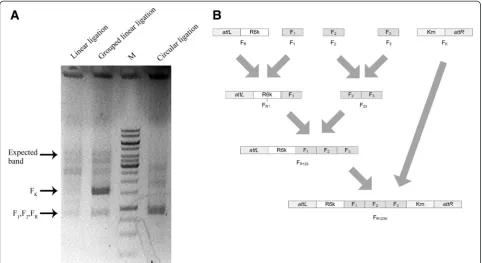
Anin vitro linear ligation system based on the type II restriction endonucleases was developed to provide spe-cificity to the theoretically by-product free ligation. In this in vitrolinear ligation system, five restriction endo-nucleases produced non-palindromic 3’sticky ends with the customized triplet NNN [23-26], 33 DNA fragments with 64 properly designed overhangs could theoretically be ligated into one fragment in one mixture. A 4 frag-ments ligation experiment containing F1 (935 bp), F2 (948 bp), FR(921 bp) and Fk(1598 bp) was designed, the 4 fragments were mixed together at the same molar con-centration with the T4 ligation system. After the 2 hours ligation, the mixture was treated with SDS at 75°C for 20 min before electrophoresis to remove ligase from li-gated DNA. The electrophoresis showed that more ex-pected ligation products were obtained using the linear ligation system than that of the circular ligation system when the same DNA molar concentration was added
for every ligated fragment used in the two systems (Figure 2A). As expected, the sequencing results of some incorrectly assembling plasmids by the circular ligation demonstrated the formation of multimer by-products (data not shown). Of course these incorrectly assembled products were expectable.
Although the designed sticky ends created by 5 endo-nucleases could theoretically be ligated in only one way, unexpected annealing of non-complementary sticky ends were always observed when more than two fragments were mixed together. In a previous study, T to G and A to C mismatches were reported to occur in unidirec-tional ligation [7]. In our study, similar phenomenon was observed when the incorrectly assembled plasmids were sequenced.
Therefore, a computer program termed StickyEnd-Designer was developed to reduce mismatching phe-nomena during the primer design process. A copy of this software can be freely downloaded from http:// stickyenddesigner.codeplex.com/. This software was Figure 1Mechanism of the contradiction between bimolecular ligation and cyclization and its resulting by-production formation mechanisms. A)In any construction of circular DNA from linear forms, there are both bimolecular ligation/assembly and monomolecular cyclization.B)Multimer by-product formation mechanism in single molecule cyclization.C)By-product formation mechanism when circular plasmids are constructed from two fragments.D)This contradiction becomes more obvious when more fragments are involved in ligations.
designed to avoid T or A as the last base in the sticky ends, because the T or A base easily leads to mismatch in the annealing process. With all possibilities consid-ered, the software generates only 8 sets of sticky ends that satisfied the requirements above. Hence, the previous 4 DNA fragment ligation process was modi-fied to use 3 pairs of software-designed triplets. In addition, a grouped ligation procedure was applied with the hope that physical isolation of subgroups may show a better performance in reducing mismatch phenomenon (Figure 2B). Impressively, a denser target band was observed in the electrophoresis for the final round of grouped ligation mixture (Figure 2A, lane 2), indicating a reduced unexpected ligation, this was accompanied by increasing number of correctly con-structed plasmids.
Different ligases and buffers were compared during the 4 fragments ligation experiments containing F1 (935 bp), F2(948 bp), FR(921 bp) and Fk(1598 bp). The 4 fragments were mixed at the same molar concentra-tion with the different ligaconcentra-tion systems preapared above. After the 2 h ligation, the ligation efficiency was studied after the mixture was treated with SDS at 75°C for 20 min before electrophoresis. Solution I containing T4 ligase was revealed to be the most suitable for the ligation. In addition, in vitro linear ligation efficiency was also dependent on DNA fragment purity (data not
shown). For example, the ligation efficiency was much higher if the DNA fragment was cloned by Phusion polymerase and purified via gel extraction compared with that of its cloned by Pfu polymerase and purified by solution extraction.
Linear plasmid as an alternative choice to avoid cyclization
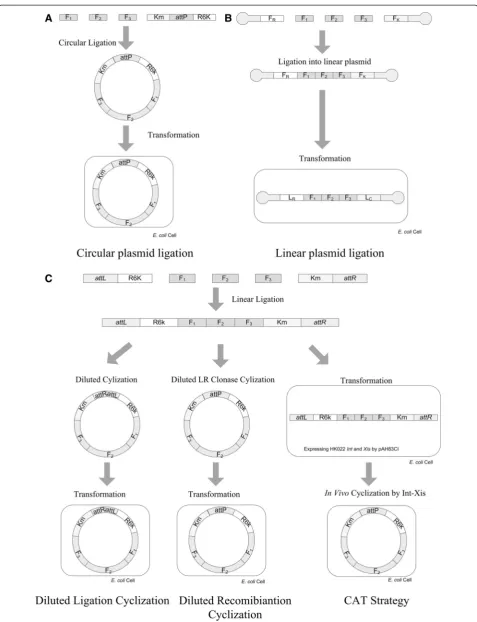
As a shortcut to reproducible E. coli plasmid assembled from linear fragments, a linear plasmid is apparently an attractive option to avoid the multimer issue associated with circular plasmids (Figure 3A-B). Therefore, the effi-ciency of linear plasmids ligation from multiple frag-ments was investigated by ligating 1, 2 or 3 gene fragments into a linear plasmid (Figure 3B). It was found very difficult even to insert more than one DNA frag-ment in between the FR and FK. Since the FR and FK were the purified digestion products of plasmids with sizes up to 10 Kbp, their molar concentrations are much lower than the PCR products so that the inserting frag-ments have to be diluted to match their concentration requirement to avoid by-product formation.
Two traditionalin vitrocyclization strategies
Figure 3(See legend on next page.)
could not replicate in E. coli due to their linear nature. Therefore, an efficient cyclization strategy must be estab-lished. We further evaluated the “in vitro cyclization” by comparing with two traditional strategies.
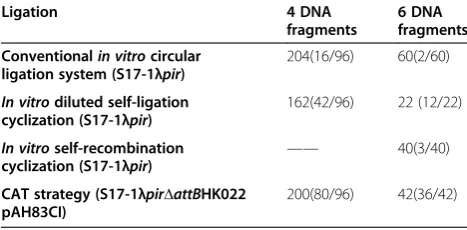
The two traditionalin vitromethods are“diluted ligation cyclization”and “diluted recombination cyclization”. In the “diluted ligation cyclization” method, the yield of cyclization was determined based on the cases of 4 and 6 DNA fragments assembling into circular plasmids with controls of corresponding grouped circular liga-tions (Additional file 1: Table S1). Results showed that “diluted ligation cyclization” method resulted in a lower colony number and a higher accuracy than that of the circular cyclization (Table 1). The second strategy was termed “diluted recombination cyclization”, the highly efficient site-specific recombination also turns linear DNA into circular one (Figure 3C). LR clonase II was used to cyclize the grouped ligation product of 6 DNA fragments with 40 colonies obtained on a selective plate, of which, only 3 were eventually found to be the correct ligation form (Table 1).
CAT (Cyclization after transformation) strategy
The two traditional in vitro cyclization strategies were not as efficient as expected. Therefore, a new CAT (Cyclization after Transformation) strategy was devel-oped. In CAT, the ligation product E. coli S17-1 λ
pir-ΔattBHK022 harboring pAH83CI was transformed with the ligation product (See Bacterial Strains and Mediums) and the ligation product would to be cyclized via the attL-attR in vivo recombination system (Figure 3C). Four and six fragments were assembled based on the CAT strategy above, as a result, 80 in 96 and 36 in 42
clones were demonstrated to be properly assembled via PCR screening of every junction, respectively, and followed by the supporting sequencing results (Table 1). Both transformation yield and DNA assembly accuracy based on the CAT strategy outperformed those of the circular ligation and diluted cyclization. It was demon-strated that the efficiencies of grouped unidirectional ligation coupled with CAT strategy are more efficient and precise than that of the conventional circular ligation, “in vitro diluted self-ligation cyclization” and “in vitroself-recombination cyclization”(Table 1). As ex-pected, less colony numbers containing 6 properly as-sembled fragments were formed compared with those consisting of 4 fragments assembly. In order to further explore the advantages of this CAT strategy on multiple fragments assembly, nine DNA fragments assembly was performed (Additional file 2: Table S2). The number of successful transformants selected by kanamycin was only 16, and 2 of them were found to be assembled in the correct order via PCR screening and DNA sequencing. Colony PCR was used to study ligation accuracies. 96 randomly selected transformants were investigated if the colony number exceeded 96. After screening by colony PCR, random colonies were selected to do plasmid ex-traction. The extracted plasmids were analyzed by endo-nuclease digestion and DNA sequencing. It was found that all the sequencing results were consistent with the colony PCR ones. Also, the incorrect constructed plas-mids were sequenced, the sequencing results showed that the incorrect assembly could mainly be contributed to the ligation mismatching.
CAT-Recombinant DNA: Recombinant DNA using CAT
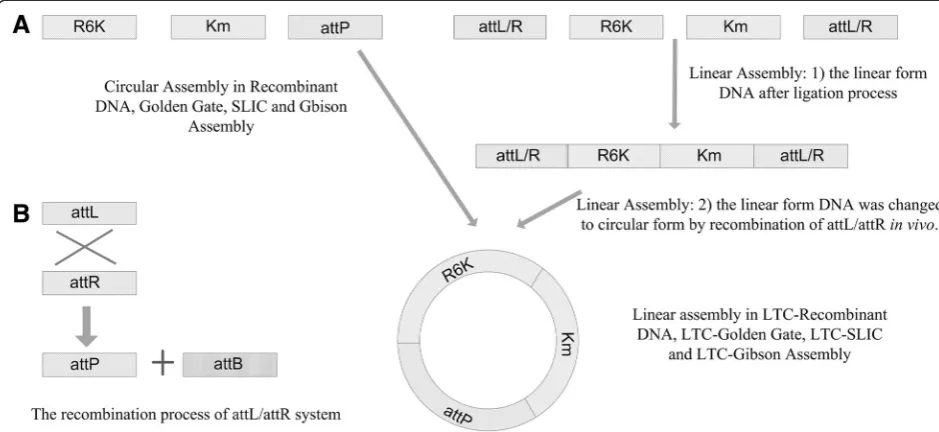
In order to demonstrate that CAT strategy can improve the efficiency when it was combined with other assembly technique(s), CAT was first applied in existing recom-binant DNA method. Since CAT strategy always has its linear loose ends enclosed byin vivorecombination, the three in vitro linear ligation steps of CAT strategy were identical to the 3 ligations of the non-CAT ligation con-trol. That is why CAT strategy with 4 fragments should be compared to non-CAT strategy with 3 fragments (Figure 4A-B). In order to maintain the same plasmid concentration level in both CAT and non-CAT controls, both groups have the same total DNA concentration. At 2 pM total DNA molar concentration, CAT strategy en-hanced 3.48 folds efficiency compared with the non-CAT control (Table 2 and Figure 4A).
(See figure on previous page.)
Figure 3Schematic description of various attempts to avoid the contradiction on bimolecular ligation/assembly and monomolecular cyclization. A)Conventional circular ligation,B)Ligation into linear plasmid. No cyclization is required to make the plasmid stable and thus the contradiction was avoided.C)Linear ligation and diluted self-ligating cyclization (First branch from the left), linear ligation andin vitro LRclonase cyclization (Second branch from the left) linear ligation coupled within vivocyclization (Third branch from the left).
Table 1 Number of transformants formed using conventionalin vitrocircular ligation system,in vitro diluted self-ligation cyclization,in vitroself-recombination cyclization, and CAT,respectively
Ligation 4 DNA
fragments
6 DNA fragments
Conventionalin vitrocircular ligation system (S17-1λpir)
204(16/96) 60(2/60)
In vitrodiluted self-ligation cyclization (S17-1λpir)
162(42/96) 22 (12/22)
In vitroself-recombination
cyclization (S17-1λpir) ——
40(3/40)
CAT strategy (S17-1λpirΔattBHK022 pAH83CI)
CAT-Golden Gate
Golden Gate method has a low overall efficiency when the concentration is low. We repeated 3 times yet were not able to obtain reliable data at 0.5 pM total DNA molar concentration. When the total concentrations are 1 pM and 2 pM, respectively, however, CAT strategy showed exceptional 24.44 times and 19.98 times more efficient compared with the non-CAT controls, respect-ively (Table 2).
CAT-SLIC
In order to demonstrate that the CAT strategy can truly improve the efficiency for DNA assembly, and it was possible to apply to SLIC method. Similar to the recom-binant DNA (ligation) method, the overall efficiency of CAT turned out to be 3.48 times of the non-CAT one at 2 pM total DNA molar concentration (Table 2).
CAT-Gibson assembly
When CAT strategy was applied to Gibson isothermal assembly, similarly, an overall efficiency as 3.48 times high as the non-CAT control was observed at 2 pM total DNA molar concentration (Table 2).
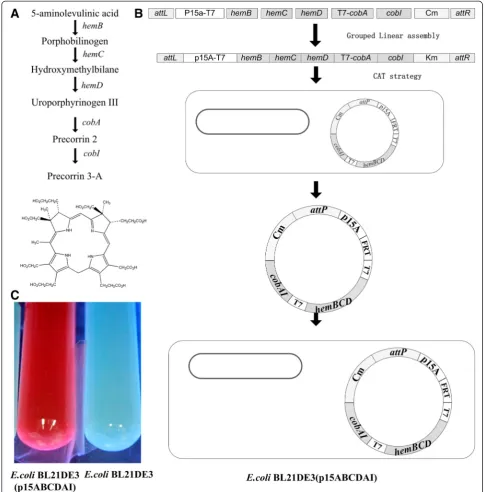
Construction of optimized precorrin-3A production pathway from precursor 5-aminolevulinic acid
Precorrin-3A pathway was constructed with linear ligation coupled with CAT strategy as an application in metabolic engineering. Aerobic bacterium Psudomonas denitrificans produces corrins via an oxygen-dependent pathway [27]. Precorrin-3A is the first of the tetrapyrro-lic intermediates committed solely to vitamin B12 bio-synthesis. From the precursor 5-aminolevulinic acid to precorrin-3A, there are 5 steps including 5 genes hemBCD, cobAI (Figure 5A). The five genes were con-structed into the plasmid p15ABCDAI with the linear ligation coupled with CAT strategy, and then E. coli strain BL21DE3 was transformed with p15ABCDAI (Figure 5B). The recombinant strain was cultured in LB Figure 4The experimental comparison between non-CAT and CAT strategy. A)The non-CAT control group assembled 3 fragments into a circular formin vitroand thus engaged 3in vitroligation/assembly reactions (left). CAT strategy assembled 4 fragments withattLandattRas the linear ends inin vitroligation/assembly, thus also engaged precisely the same threein vitroligation/assembly reactions (right).B)The cyclization mechanism.attLandattRrecombines and producesattP, and thus the final products in CAT strategy are the same as the final products in non-CAT control group.
Table 2 Results of the comparisons between CAT strategy and non-CAT control
Ligation 0.5 pM 1 pM 2 pM
Circular Recombinant DNA 38 (35/38) 184 (44/48) 304 (40/48)
CAT- Recombinant DNA 88 (44/48) 364 (35/48) 804 (42/48)
CAT/non-CAT× 4/3 3.07 2.10 3.70
Circular Gibson Assembly 84 (37/48) 168 (32/48) 284 (32/48)
CAT- Gibson Assembly 140 (40/48) 308 (33/48) 624 (38/48)
CAT/non-CAT× 4/3 2.40 2.52 3.48
Circular SLIC 66 (20/48) 142 (25/48) 276 (28/48)
CAT-SLIC 124 (38/48) 212 (41/48) 486 (40/48)
CAT/non-CAT× 4/3 4.76 3.26 3.48
Circular Golden Gate N/A 4 (3/4) 25 (10/25)
CAT- Golden Gate N/A 132 (40/48) 248 (29/48)
The comparisons between CAT and non-CAT control (explained in Figure4) were presented by the colony number and correct colony number. CAT/non-CAT is the correct colony number in CAT over the correct colony number in non-CAT.
medium supplemented with 1 g/L 5-aminolevulinic acid as a precursor for production of precorrin-3A. When grown in LB with 1 g/L 5-aminolevulinic acid, the fermentation broth supernatants of recombinant strain developed a red color and exhibited a bright red fluorescence at 301 nm as reported for precorrin-3A (Figure 5C) [28].
Discussion
Grouped ligation can avoid DNA assembling mismatch
As long as every DNA fragment has an equal molar concentration in the mixture, and the ligation yield of every ligation process is 100%, the theoretical ligation yield should be 100%. To precisely address the effect of each fragment on ligation yield, theoretical models (http://www.synthenome.com/StickyEndDesigner.zip) were developed to study effects of concentrations of the DNA fragments in the ligation mixture on linear ligation yield. It was found that over-dose of the first and the last fragments, namely FR and FK did not affect ligation yield, while other DNA fragments in between must have an equal molar ratio to avoid ligation by-products.
However, ligation yield was always below 100% under experimental conditions due to inadequate ligations and unexpected ligations (Figure 2A). Many studies fo-cused on unexpected ligation resulted from mismatch-ing ligation, such as the mismatches of T to G and A to C [7]. It is useful to properly design sticky ends so that unexpected ligation can be significantly reduced. However, the designed sticky ends did not significantly reduce mis-matches (data not shown). Therefore, the method of grouped ligation into a linear fragment with a free end was developed. The method was found the most efficient in reducing the ligation mismatches (Figure 2B). As grouped ligation isolates fragments that are not designed to ligate, and thus lead to reduction on unexpected liga-tions. Furthermore, parts of the unexpected ligation may be attributed to unexpected digestion of the single-strand overhangs [29]. It could be expected that unwanted diges-tions can be significantly reduced when highly pure re-agents were used. The single strand annealing nature determines that unspecific annealing would be also an issue forin vitrothe recombination methods such as SLIC and Gibson isothermal assembly. This study also demon-strates that the grouped ligation/assembly can enhance SLIC assembly efficiency.
CAT strategy takes advantages of DNA concentration conditions in both ligation and transformation
Unidirectional ligation/assembly requires a DNA con-centration to be high enough to allow efficient bimol-ecular ligation/assembly, transformation will benefit from a high DNA concentration of the ligation/assem-bly mixture. However, the challenge for transforming linear ligation products into a host is the difficulty to cyclize them rapidly and efficiently in vivo to form stable and reproducible circular DNA form. In order to obtain a high cyclization efficiency, site-specific recom-bination was selected as the cyclization strategy, as this attB-attPrecombination catalyzed by Int or Int-Xis has very high efficiency (Figure 3C, right hand) [30]. When E. coli DH5 alpha harboring pInt-ts was transformed with plasmid pAH63 [31], the number of resulting
successful transformants could match that ofE. coliS17
λpir. That is to say, if the transformation efficiencies of lin-ear and circular DNA are similar, the attB-attP in vivo recombination may be close to 100% (Additional file 3: Figure S1) [31]. Therefore, the in vivo cyclization does not result in decrease in efficiency. During the trans-formation, the transformed linear ligation products are naturally diluted by competent cell mixtures and finally isolated physically by cell walls. This provides a situ-ation that favors a much higher yield of self-cyclizsitu-ation. Our results demonstrated that circular ligation of six fragments showed a lower efficiency than that of the linear ligation coupled with in vivo cyclization of six fragments (Table 1). Therefore, the grouped ligation coupled with the in vivo cyclization process can take advantages of all procedures including: a close to 100% theoretical yield of linear ligation, a dilution during transformation, and a close to 100% yield on in vivo lambda attachment sequences recombination, as well as a final high self-cyclization yield (Figure 3C, right hand). Furthermore, this strategy showed enhanced efficiency in ligating at least nine fragments (data not shown) than that of the traditional circular approaches.
CAT strategy increases overall construction efficiency for existing circular DNA construction methods
In order to demonstrate that the CAT strategy can im-prove the efficiency for all known existing circular plas-mids construction methods, it was applied to 4 most widely used methods, i.e. Recombinant DNA, Golden Gate, SLIC and Gibson isothermal assembly (Table 2). Since it is a challenge to obtain highly concentrated DNA, a comparison was made using CAT strategy and non-CAT control based on same total DNA concentra-tion to ensure that there is no addiconcentra-tional difficulty in preparing DNA for CAT strategy. As a result, the multi-plier 4/3 is applied to the CAT/non-CAT number to present the true difference in efficiency. It was found that CAT strategy generated a 3.55 ± 0.13 times correct colonies of the original technologies for all technologies except Golden Gate. And this stable 3.55 times may in-dicate that there is at least 71.8% by-products in the cir-cular ligation/assembly products for the three fragments when each fragment is 0.67 pM in the ligation/assembly mixture. Another assembly technique including recom-bination of attL/R for assembling multiple fragments should also benefit from CAT strategy [32].
CAT strategy is easy to use together with most existing circular construction technology
Any existing circular construction system can easily adopt CAT strategy by splitting the plasmid backbone into 2 fragments and this will not affect the ligation/as-sembly of the other fragments/inserts. WhenattPscar is
allowed to appear between inserts and plasmid backbone, a 5-time higher efficiency could be possible, which means, the efficiency of the CAT strategy was 5 times as high as the conventional in vitro cyclization (Table 1). Although the CAT strategy requires thein vivocyclization step, this step is identical to typical electroporation because the re-combination occursin vivowithout even the need for heat induction. The only additional in vitro operation is the preparation of an additional fragment. Furthermore, as discussed in the section above, no additional efforts in concentrating DNA is required to adopt CAT strategy.
Conclusion
Synthetic biology often requires the assembly of many fragments at one time. Low concentration and high by-products ratio are the two major challenges for such as-sembly. Since CAT strategy has a higher tolerance to high DNA concentration without formation of by-products as long as every junction is specific, it should have wide application in multiple-fragments ligation/ assembly.
In summary, this study successfully established the CAT strategy to avoid the long-standing concentration dilemma in circular DNA construction. CAT was shown to significantly improve recombinant DNA, SLIC, USER and Gibson isothermal assembly, thus it can be applied to existing circular plasmid construction methods.
Materials and methods
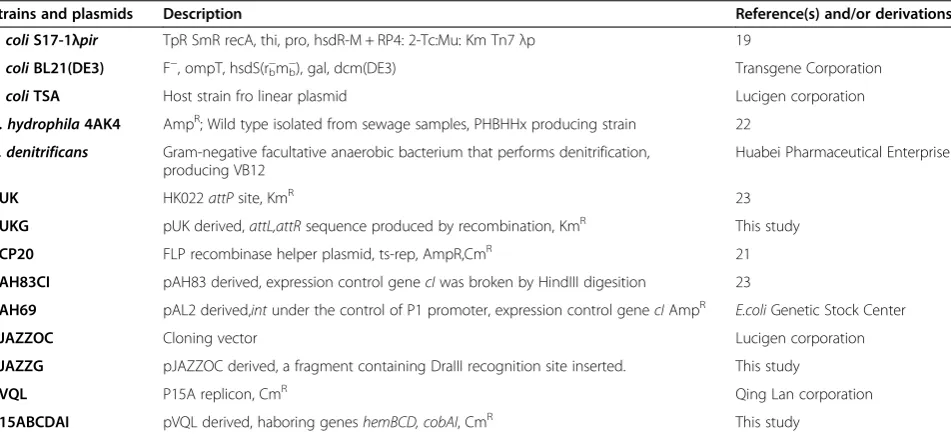
Bacterial strains, media and plasmids
E. coli S17-1 λpir [33-35] and E. coli S17-1 λ
pir-ΔattBHK022 were used as ligation and cyclization hosts (Table 3). The inactivation of HK022attB [36] inE. coli
S17-1 λpir genome was carried out based on Wanner’s method of one-step inactivation of chromosomal genes [37]. The inactivation primers were listed in Additional file 4: Table S3. E. coli strain TSA was used as a linear plasmid host [22].Aeromonas hydrophila4AK4 [38] was used as the template for ligation of multiple fragments (F1…Fn) (Table 3). Luria-Bertani (LB) broth was used to incubate various strains ofE. coli. TheE. colistrains har-boring temperature-sensitive plasmid pAH83 [31] or pAH83CI [39,40]were incubated at 30°C. All otherE. coli strains were incubated at 37°C. 25 mg/ml kanamycin, 50 mg/ml ampicillin or 25 mg/ml chloramphenicol were added to the cultures for maintaining or selectingE. coli harboring corresponding antibiotic resistance genes. All antibiotics were purchased from Sigma (Beijing, China).
In this study, HK022 attL-attR(Additional file 5: Table S4) recombination system was used forin vivocyclization [30]. Plasmid pUKG (Additional file 6: Figure S2) was used as a template for vector backbone fragments FR,
attL-R6K(R6K: R6kγorigin) and FK,attR-Km(Km: kana-mycin resistant gene). pUKG was constructed by the fol-lowing procedures: pUK plasmid [39] was integrated into E. coligenome with the help of pAH69 [31] by recombin-ation betweenattB and attP. The resultingattL-R6K– Km-attRfragment in the genome was then amplified by PCR, and self-ligated into a circular plasmid, namely pUKG (Table 3).
Preparation of DNA fragments with sequence of 5 specific non-palindromic restriction endonucleases
In order to ligate N DNA fragments i.e. F1, F2…FN, two fragments as backbone of the plasmids, namely, FR and FK, were required. Totally N + 2 fragments were produced
Table 3 Bacterial strains and plasmids used in this study
Strains and plasmids Description Reference(s) and/or derivations
E. coliS17-1λpir TpR SmR recA, thi, pro, hsdR-M + RP4: 2-Tc:Mu: Km Tn7λp 19
E. coliBL21(DE3) F−, ompT, hsdS(rb−mb−), gal, dcm(DE3) Transgene Corporation
E. coliTSA Host strain fro linear plasmid Lucigen corporation
A. hydrophila4AK4 AmpR; Wild type isolated from sewage samples, PHBHHx producing strain 22 P. denitrificans Gram-negative facultative anaerobic bacterium that performs denitrification,
producing VB12
Huabei Pharmaceutical Enterprise
pUK HK022attPsite, KmR 23
pUKG pUK derived,attL,attRsequence produced by recombination, KmR This study
pCP20 FLP recombinase helper plasmid, ts-rep, AmpR,CmR 21
pAH83CI pAH83 derived, expression control genecIwas broken by HindIII digesition 23
pAH69 pAL2 derived,intunder the control of P1 promoter, expression control genecIAmpR E.coliGenetic Stock Center
pJAZZOC Cloning vector Lucigen corporation
pJAZZG pJAZZOC derived, a fragment containing DraIII recognition site inserted. This study
pVQL P15A replicon, CmR Qing Lan corporation
using PCR. The backbone fragments were different due to the various types of vectors and ligation methods used. In circular ligation, the FR fragment contained
R6K (R6kγ replicon) and attL, and the FK fragment consisted of kanamycin resistant gene and attR (attL and attR were the HK022 attL/R recombination sys-tem). Five non-panlindromic restriction sites (AlwnI, BglI, DraIII, PflmI and SfiI) for unidirectional ligation (i.e. each junction in the ligation is designed to be spe-cific) were attached to all ends of the N + 2 fragments. For linear ligation, all the N + 2 fragments were the same except for no restriction site added at the attL and attR sides of FR and FK. Furthermore, the N DNA fragments were ligated into the specific linear plasmid pJAZZ-OC-DraIII which was modified on the basis of pJAZZ-OC (Lucigen, USA) by inserting a fragment sub-cloned from pBBR1MCS2 [41] with twoDraIII recogni-tion sites. The two backbone fragments FRand FKwere different, they are the two large digestion products of pJAZZ-OC-DraIII: FR contained the linear replication origin, telN: telemorease and one hairpin end, and FKwas the chloramphenicol resistant gene linked with the other end of the hairpin [42]. All the fragments were digested by corresponding restriction enzymes, respectively, followed by purification using agarose gel-electrophoresis or solu-tion extracsolu-tion, and finally they were adjusted to a final molar concentration of 200 fmol/μl.
In vitroligation
Two ligation systems were adopted. The first one com-bined all the N + 2 fragments with the same molar con-centration into one test tube, followed by the ligation process using the commercial Takara ligation kit. The second one is called“grouped ligation”, in which the lin-ear ligation process was divided into several runs. Taking the group of ligation fragments FR, F1, F2, F3and FK as an example (Figure 5), FR and F1were ligated into FR1, F2and F3into F23in the first run, and FK was left for the next run. During the second run of ligation, FR1and F23 were ligated to form FR123, and FK was left for the next round. In the final round, FR123 and FK were ligated to become the final product FR123K. In each run, an equal mole of every two adjacent fragments was assigned in one group and ligated at 16°C for 2 h. This method could reduce unspecific ligation between non-adjacent fragments. After thein vitroligation process, the circular DNA products that could replicate in E. coli directly were formed in circular ligation system, and E. coli S17-1λpirwas transformed with these circular DNA products.
In vitroandin vivocyclization
In the case of linear ligation system, the linear ligation products need to be cyclized to be able to replicate as circular plasmids in E. coli. In this study, three systems
were adopted. The first was in vitro “diluted ligation cyclization”, the ligation products were diluted 10 folds with water in order to ensure self-ligation, and T4 ligase was used to cyclize the ligation products (The first branch from left of Figure 3C); The second one is“in vi-tro diluted self-recombination cyclization”, LR clonase was applied to cyclize the ligation products. In the case of LR clonase, the HK022 attL and attR in FR and FK were changed toλattLand attR. All thein vitrocyclized products were electroporated into E. coli S17-1 λpir electro-competent cells (The second branch from left of Figure 3C). Transformants were sprayed onto kanamycin agar plates, and then verified by PCR after 18 h of incuba-tion. The last one is the “CAT strategy”, the linear ligation products were directly electroporated into electro-competent cells of E. coli S17-1 λpirΔattBHK022 carrying the corresponding pAH83CI helper plasmid (The right branch of Figure 3C). The pAH83CI could catalyze the recombination reaction of the Hk022attL/Rsystem.
CAT on Recombinant DNA: Recombinant DNA using CAT
When CAT (Linear assembly - Transformation –in vivo Cyclization) is applied to a Recombinant DNA technol-ogy ligation of 3 fragments, the backbone fragment with anattPsite is designed as 2 separate fragments with the attL and attR sites respectively for in vivo cyclization. The attL and attR sites will recombine and produce an attP site so that the final product is exactly the same as the expected ligation product from 3 fragment (Figure 4A). The fragments for digestion were all pre-pared by PCR. In thein vitro linear ligation of the CAT strategy, 4 DNA fragments digested by 5 specific non-palindromic restriction endonucleases were mixed at equal molar ratio to reach final total DNA concentra-tions of 0.5 pM, 1.0 pM, 2.0 pM, and then ligated into linear form intermediates by grouped ligation. And then the ligation products were directly electroporated into electro-competent cells of E. coli S17-1 λpirΔattBHK022 carrying the corresponding pAH83CI helper plasmid to do thein vivocyclization step. At the meanwhile, 3 frag-ments digested by the same set of restriction enzymes were mixed at 0.5 pM, 1.0 pM, 2.0 pM concentrations and directly ligated into circular forms and then electro-porated into the sameE. coliS17-1λpirΔattBHK022 com-petent cells carrying the corresponding pAH83CI helper plasmid to serve as the non-CAT control. The colonies on the Km screening plates from both CAT and non-CAT control sets were counted and verified by PCR and sequencing.
CAT-Golden Gate: Golden Gate Assembly using CAT
Similarly, the CAT strategy was also applied to the Golden Gate methods. DraIII and BglI were used as the cutting enzymes in Golden Gate method. For short, in
CAT strategy, 4 PCR fragments were mixed at equal molar ratio with 0.5 μl of DraIII (Fermentas), 0.5 μl of BglI (Fermentas), 5 units of T4 DNA ligase and 1 μl of T4 DNA ligase buffer and finally calibrated to a 10 μl digestion-ligation system with total DNA concentrations at 0.5 pM, 1.0 pM and 2.0 pM. The 3 fragments for non-CAT control were treated in the same way to reach the 0.5 pM, 1.0 pM and 2.0 pM digestion-ligation system, respectively. The digestion-ligations were performed in a thermocycler. Programs consist of the following steps: 1) incubation for 2 minutes at 37°C and 5 minutes at 16°C, both steps repeated 50 times; 2) incubation for 5 minutes at 50°C (final digestion); 3) 5 minutes at 80°C (heat inacti-vation). Finally, electro-competent cells of E. coli S17-1
λpirΔattBHK022 harboring the corresponding pAH83CI helper plasmid were transformed with the digestion-ligation products to finished the in vivo cyclization step. The colonies of transformants on the Km screening plates were counted and verified by PCR and sequencing.
CAT-SLIC: SLIC using CAT
In a similar manner, CAT was also applied to SLIC. The 4 fragments for CAT-SLIC and 3 fragments for non-CAT control were prepared from the same templates as the recombinant DNA group, but a 40 bp homologous region that could specifically recombine under T4 DNA polymerase and annealing treatments were attached to each end. These PCR products were purified by gel-electrophoresis, and subsequently treated by T4 DNA polymerase for 5 minutes in a thermocycler. T4 DNA polymerase was inactivated at 75°C for 10 minutes, then, 4 fragments for CAT strategy were mixed together in a reaction system containing RecA and T4 ligation buffer at final DNA concentration of 0.5 pM, 1.0 pM and 2.0 pM, respectively. The annealing process was conducted by gradually reducing the temperature from 75°C to 37°C at the rate of 0.1°C/s. The 3 fragments for non-CAT con-trol were treated in the same way. Finally, E. coli S17-1
λpirwas transformed with the reaction system and spread on a selective plate containing Km. The colonies of transformants were counted and verified by PCR and sequencing.
CAT-Gibson: Gibson isothermal assembly using CAT strategy
Similar to the CAT-SLIC strategy, the 4 PCR fragments for CAT-Gibson or the 3 fragments for non-CAT Gib-son control were mixed at final DNA concentrations of 0.5 pM, 1.0 pM and 2.0 pM in the Gibson Assembly Master Mix (2X). Then electro-competent cells of E. coli S17-1 λpirΔattBHK022 harboring the corresponding pAH83CI helper plasmid were transformed with the Gibson assembly products to complete the in vivo cyclization step. The colonies of transformants on the
Km screening plates were counted and verified by PCR and sequencing.
Construction of optimized precorrin-3A synthesis pathway from precursor 5-aminolevulinic acid
The genes for precorrin-3A synthesis pathway from precursor 5-aminolevulinic acid include hemB, hemC, hemD, cobA,andcobI.Among these genes,hemB, hemC, hemDare fromBacillus subtilis. cobA, cobIfromP. deni-trificans(Table 3). For the expression of these 5 genes in E. coli, codon optimization was conducted. These genes were synthesized chemically. These 5 genes were con-structed into one plasmid p15ABCDAI which requires a multiple DNA (in this case, 7) fragments assembly method. These 7 fragments include FR (attL-p15a-T7), F1(hemB), F2(hemC), F3(hemD), F4(T7-cobA), F5(cobI) and Fk(Cm-attR).
The FR fragment was prepared by over-extension PCR using the template plasmid pUK and pVQL, the T7 promoter was attached into the primer sequence. The 7 fragments were cloned, digested, and linearly li-gated in group according the standard grouped in vitro linear ligation method (Figure 5B). Then, electro-competent cells ofE. coli S17-1λpirΔattBHK022 harbor-ing the correspondharbor-ing pAH83CI helper plasmid were transformed with the ligation products (The right branch of Figure 3C). Transformants were sprayed onto chloromycetin agar plates, and then verified by PCR after 18 h of growth. TheE. coliBL21 (DE3) was trans-formed with the constructed plasmid p15ABCDAI to from the strain E. coli BL21DE3 (p15ABCDAI). The BL21DE3 (p15ABCDAI) strain was cultured by LB medium with 1 g/L 5-aminolevulinic acid as precursor to test the production of precorrin 3A.
Additional files
Additional file 1: Table S1.Primers for 4 and 6 fragments used for in vitrocircular ligation and linear ligation.
Additional file 2: Table S2.Primers for 9 fragments linear ligation.
Additional file 3: Figure S1.Demonstration of cyclization.
Additional file 4: Table S3.Primers used for gene knock out and verification for HK022attBsite.
Additional file 5: Table S4.Sequences of HK022attLand HK022attR.
Additional file 6: Figure S2.Plasmid map of pUKG.
Competing interests
The authors declare that they have no competing interests.
Authors’contributions
Acknowledgments
This project was supported by the State Basic Science Foundation 973 (Grant No. 2012CB725201 to GQC, Grant No. 2012CB725204 to QW) and National Natural Science Foundation of China (Grant No. 31430003 and 31270146).
Author details
1MOE Key Lab of Bioinformatics, Department of Biological Science and
Biotechnology, School of Life Science, Tsinghua-Peking Center for Life Sciences, Tsinghua University, Beijing 100084, China.2Center for Nano and Micro Mechanics, Tsinghua University, Beijing 100084, China.3Synthenome. com, Dingley Village VIC3172, Australia.
Received: 18 December 2014 Accepted: 28 January 2015
References
1. Ellis T, Adie T, Baldwin GS. DNA assembly for synthetic biology: from parts to pathways and beyond. Integr Biol (Camb). 2011;3:109–18.
2. Lu C, Mansoorabadi K, Jeffries T. Comparison of multiple gene assembly methods for metabolic engineering. Appl Biochem Biotechnol. 2007;137–140:703–10. 3. Zhou XY, Yuan XX, Shi ZY, Meng DC, Jiang WJ, Wu LP, et al.
Hyperproduction of poly(4-hydroxybutyrate) from glucose by recombinant Escherichia coli. Microb Cell Fact. 2012;11:54.
4. Rodriguez A, Martinez JA, Flores N, Escalante A, Gosset G, Bolivar F. Engineering Escherichia coli to overproduce aromatic amino acids and derived compounds. Microb Cell Fact. 2014;13:126.
5. Smolke CD. Building outside of the box: iGEM and the BioBricks Foundation. Nat Biotechnol. 2009;27:1099–102.
6. Anderson JC, Dueber JE, Leguia M, Wu GC, Goler JA, Arkin AP, et al. BglBricks: a flexible standard for biological part assembly. J Biol Eng. 2010;4:1.
7. Engler C, Gruetzner R, Kandzia R, Marillonnet S. Golden gate shuffling: a one-pot DNA shuffling method based on type IIs restriction enzymes. PLoS One. 2009;4:e5553.
8. Engler C, Marillonnet S. Combinatorial DNA assembly using Golden Gate cloning. Methods Mol Biol. 2013;1073:141–56.
9. Bryksin AV, Matsumura I. Overlap extension PCR cloning: a simple and reliable way to create recombinant plasmids. Biotechniques. 2010;48:463–5. 10. Sleight SC, Bartley BA, Lieviant JA, Sauro HM. In-Fusion BioBrick assembly
and re-engineering. Nucleic Acids Res. 2010;38:2624–36.
11. Li MZ, Elledge SJ. Harnessing homologous recombination in vitro to generate recombinant DNA via SLIC. Nat Methods. 2007;4:251–6. 12. Gibson DG, Young L, Chuang RY, Venter JC, Hutchison 3rd CA, Smith HO.
Enzymatic assembly of DNA molecules up to several hundred kilobases. Nat Methods. 2009;6:343–5.
13. Geu-Flores F, Nour-Eldin HH, Nielsen MT, Halkier BA. USER fusion: a rapid and efficient method for simultaneous fusion and cloning of multiple PCR products. Nucleic Acids Res. 2007;35:e55.
14. Li MZ, Elledge SJ. MAGIC, an in vivo genetic method for the rapid construction of recombinant DNA molecules. Nat Genet. 2005;37:311–9. 15. Shao Z, Zhao H. DNA assembler, an in vivo genetic method for rapid
construction of biochemical pathways. Nucleic Acids Res. 2009;37:e16. 16. Gibson DG, Benders GA, Andrews-Pfannkoch C, Denisova EA, Baden-Tillson
H, Zaveri J, et al. Complete chemical synthesis, assembly, and cloning of a Mycoplasma genitalium genome. Science. 2008;319:1215–20.
17. Gibson DG, Benders GA, Axelrod KC, Zaveri J, Algire MA, Moodie M, et al. One-step assembly in yeast of 25 overlapping DNA fragments to form a complete synthetic Mycoplasma genitalium genome. Proc Natl Acad Sci U S A. 2008;105:20404–9.
18. Gibson DG, Glass JI, Lartigue C, Noskov VN, Chuang RY, Algire MA, et al. Creation of a bacterial cell controlled by a chemically synthesized genome. Science. 2010;239:52–6.
19. Itaya M, Fujita K, Kuroki A, Tsuge K. Bottom-up genome assembly using the Bacillus subtilis genome vector. Nat Methods. 2008;5:41–3.
20. Itaya M, Tsuge K, Koizumi M, Fujita K. Combining two genomes in one cell: stable cloning of the Synechocystis PCC6803 genome in the Bacillus subtilis 168 genome. Proc Natl Acad Sci U S A. 2005;102:15971–6.
21. Ravin NV. N15: the linear phage-plasmid. Plasmid. 2011;65:102–9. 22. Godiska R, Mead D, Dhodda V, Wu C, Hochstein R, Karsi A, et al. Linear
plasmid vector for cloning of repetitive or unstable sequences in Escherichia coli. Nucleic Acids Res. 2010;38:e88.
23. Rieger A, Nassal M. Restriction endonuclease Alw NI is blocked by overlapping Dcm methylation. Nucleic Acids Res. 1993;21:4148. 24. Burger KJ, Schinzel R. Restriction endonuclease BglI as a tool for in vitro
reconstruction and recombination of plasmid and bacteriophage genomes. Mol Gen Genet MGG. 1983;189:269–74.
25. Grosskopf R, Wolf W, Kessler C. Two new restriction endonucleases DraII and DraIII fromDeinococcus radiophilus. Nucleic Acids Res. 1985;13:1517–28. 26. Qiang BQ, Schildkraut I. A type II restriction endonuclease with an eight
nucleotide specificity fromStreptomyces fimbriatus. Nucleic Acids Res. 1984;12:4507–16.
27. Heldt D, Lawrence AD, Lindenmeyer M, Deery E, Heathcote P, Rigby SE, et al. Aerobic synthesis of vitamin B12: ring contraction and cobalt chelation. Biochem Soc Trans. 2005;33:815–9.
28. Roessner CA, Park JH, Scott AI. Genetic engineering of Escherichia coli for the production of precorrin-3 in vivo and in vitro. Bioorg Med Chem. 1999;7:2215–9.
29. Tsuge K, Matsui K, Itaya M. One step assembly of multiple DNA fragments with a designed order and orientation inBacillus subtilisplasmid. Nucleic Acids Res. 2003;31:e133.
30. Minaeva NI, Gak ER, Zimenkov DV, Skorokhodova AY, Biryukova IV, Mashko SV. Dual-In/Out strategy for genes integration into bacterial chromosome: a novel approach to step-by-step construction of plasmid-less marker-less recombinantE. colistrains with predesigned genome structure. BMC Biotechnol. 2008;8:63.
31. Haldimann A, Wanner BL. Conditional-replication, integration, excision, and retrieval plasmid-host systems for gene structure-function studies of bacteria. J Bacteriol. 2001;183:6384–93.
32. Zhang L, Zhao G, Ding X. Tandem assembly of the epothilone biosynthetic gene cluster byin vitrosite-specific recombination. Sci Rep. 2011;1:141. 33. Simon R, Priefer U, Pühler A. A broad host range mobilization system for
in vivogenetic engineering: transposon mutagenesis in gram negative bacteria. Nat Biotechnol. 1983;1:784–91.
34. Meng DC, Shi ZY, Wu LP, Zhou Q, Wu Q, Chen JC, et al. Production and characterization of poly(3-hydroxypropionate-co-4-hydroxybutyrate) with fully controllable structures by recombinantEscherichia colicontaining an engineered pathway. Metab Eng. 2012;14:317–24.
35. Zhou Q, Shi ZY, Meng DC, Wu Q, Chen JC, Chen GQ. Production of 3-hydroxypropionate homopolymer and poly(3-hydroxypropionate-co-4-hydroxybutyrate) copolymer by recombinantEscherichia coli. Metab Eng. 2011;13:777–85.
36. Yagil E, Dolev S, Oberto J, Kislev N, Ramaiah N, Weisberg RA. Determinants of site-specific recombination in the lambdoid coliphage HK022. An evolutionary change in specificity. J Mol Biol. 1989;207:695–717.
37. Datsenko KA, Wanner BL. One-step inactivation of chromosomal genes in Escherichia coliK-12 using PCR products. Proc Natl Acad Sci. 2000;97:6640–5. 38. Lee SH, Oh DH, Ahn WS, Lee Y, Choi J, Lee SY. Production of
poly(3-hydroxybutyrate-co-3-hydroxyhexanoate) by high-cell-density cultivation of Aeromonas hydrophila. Biotechnol Bioeng. 2000;67:240–4.
39. ZY S. Parallel DNA Assembly by Recombination. https://minerva-access. unimelb.edu.au/handle/11343/37429?show=full (2014). Accessed 22 May 2014 40. Zhenyu S, Anthony Gordon W, Gras SL. Parallel In Vivo DNA Assembly by
Recombination: experimental demonstration and theoretical approaches. PLoS One. 2013;8:e56854.
41. Kovach ME, Elzer PH, Hill DS, Robertson GT, Farris MA, Roop 2nd RM, et al. Four new derivatives of the broad-host-range cloning vector pBBR1MCS, carrying different antibiotic-resistance cassettes. Gene. 1995;166:175–6. 42. Mardanov AV, Ravin NV. Functional characterization of the repA replication
gene of linear plasmid prophage N15. Res Microbiol. 2006;157:176–83.