www.astesj.com
Special Issue on Multidisciplinary Sciences and Engineering
Guidance Law Based on Line-of-Sight Rate Information
Considering Uncertain Modeled Dynamics
Saori Nakagawa*, Takeshi Yamasaki, Hiroyuki Takano, Isao Yamaguchi
National Defense Academy of Japan, Department of Aerospace Engineering, 239-8686, Japan
A R T I C L E I N F O A B S T R A C T
Article history:
Received: 28 August, 2018 Accepted: 28 October, 2018 Online: 15 November, 2018 Keywords:
Aerospace Engineering Autonomous system
Adaptive control and tuning
Proportional navigation (PN) is a widely-used guidance law for missile-target engagement. The goal of the missile intercept problem is to reduce the closest distance between the missile and target by diminishing the line-of-sight rate (LOS rate). In general, PN guidance law necessitates information of the LOS rate and missile velocity. The closing velocity (relative approaching speed to the target) instead of the missile velocity is an additional option for effective guidance. However, there are cases where a sensing device for measuring target motions that can be mounted on a missile is limited. In this paper, we propose a novel guidance law on the basis of proportional navigation (PN) using only line-of-sight (LOS) rate information. In this paper, an uncertainty and disturbance estimator (UDE) is applied to estimate such target motions including velocity change or unpredictable movement etc. The UDE works also for compensating uncertain modeled dynamics such as a missile’s bearing uncertainty and velocity changes. The proposed guidance law is referred to as uncertainty and disturbance-compensated intercept guidance. Nu-merical simulations with some engagement scenarios are presented taking account of the velocity changes of the missile to demonstrate the potential of the proposed guidance law.
1
Introduction
Proportional navigation (PN) is a widely-used guid-ance law for terminal interception of target-missile engagement [1], and the guidance law attracts atten-tion since the first half of the 20th century. Researches have been conducted not only for missile guidance, but also in the fields such as the guidance of vehicles [2], the formation flight of aircraft [3], small UAVs autonomous path-following [4], furthermore the prob-lem of rendezvous of satellites and terminal guidance control to a small moon landing [5, 6].
Proportional navigation (PN) is mainly classified into two; (1) true proportional navigation (TPN) using closing velocity information and (2) the pure propor-tional navigation (PPN) using the missile’s velocity information [7]. Both laws use information on the line-of- sight (LOS) rate (rate of change in the direction of a line connecting a missile and a target) and the veloc-ity of the missile (if it is obtained, using the closing velocity to the target). The PN is widely used as a guid-ance law for the intercept in two-vehicle engagement
because the implementation only with the LOS rate information is quite simple [1]. In the case of a station-ary or non-maneuvering target, without measurement error, dynamics lag, nor lateral acceleration limit on the navigation system of the missile, the PN can com-pletely intercept the target with zero miss distance. For such a reason, researches on missile guidance have been conducted based on the PN or alternative repre-sentation such as the zero-effort-miss (ZEM) guidance. For instance, the augmented proportional navigation (APN) compensates a target lateral constant accelera-tion by adding a modified acceleraaccelera-tion term to the PN law [8]. The compensated PN [9] (or velocity change-compensated PN [10]) guides missiles to keep the LOS rate constant at zero by correcting the LOS rate change produced by the missile’s axial acceleration.
In [11], optimal theory on intercept guidance pro-vides that the effective navigation constant of the PN set to three is an optimal against the non-maneuvering target in the sense of the least squared integral of the lateral accelerations. The preceding guidance system does not take dynamics-lag into account while an
opti-*Saori Nakagawa, 1-10-20 Hashirimizu, Yokosuka, Kanagawa 239-8686, Japan, TEL:+81-468-41-3810, email: [email protected]
mal guidance for a first-order time-lag system is given in [8]. The guidance law in [8] that minimizes the squared integral of the commanded lateral accelera-tion of the missile uses the target lateral acceleraaccelera-tion information. In addition, in this optimal guidance law (referred to as OG in this paper), a variable gain is used instead of the constant value, and the variable gain can be expressed as a function of the time-to-go (the time remaining till interception). In this regard, the sub-optimal guidance (SOG) law was proposed using PN with phase lead compensation by Baba et al. [12]. The optimal or suboptimal guidance laws described so far are effective under the assumption where the closing velocity information is available. Sensing device for target information may depends on the missile’s opera-tions. There are cases where the missile cannot install an equipment measuring the closing velocity. There-fore, in this study, we focus on the case where only LOS rate can be acquired as for target maneuvers-related information other than that of the missile itself.
Since the closing velocity cannot be obtained while only LOS rate is used, the usual fixed gain approach in PN may not exhibit sufficient guidance performance. Here, we focus on the LOS rate dynamics in order to enhance or keep the guidance performance under restricted conditions where only information as for the target is to be the LOS rate. We proposed a new guidance law that drives the LOS rate to be zero, esti-mates and compensates an uncertain group including unmodeled dynamics and external [13]; In [13], the authors did not consider time-lag in system response, so we present results for a time-lag system [14]. Fur-thermore, this study demonstrates the robustness of the proposed guidance affected by the axial accelera-tion by the missile thrust and the deceleraaccelera-tion due to aerodynamic drag.
The rest of this paper is organized as follows: Sec-tion 2 details the setting of the guidance problem with notation assignments for the missile-target engage-ment, followed by the governing equations. Next, a guidance law, which is based on an assembled simple LOS rate dynamics model, is developed. In Section 3, numerical simulation results are shown to demonstrate the potential of the proposed guidance law. Section 4 summarizes this study.
2
Guidance Theory
2.1
Engagement problems and Governing
equations
This section introduces the notations, assumptions, governing equations for the guidance law, and defines the engagement problem.
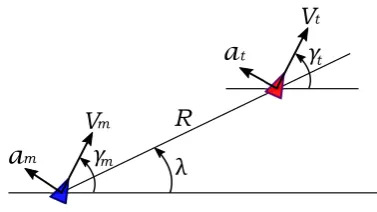
Figure 1 shows a missile-target geometry and their related notations for deriving the guidance law for the missile-target engagement scenario. Here after, the guided vehicle is referred to as a missile.λdenotes the LOS angle ,andRis the LOS range.V,γandafor each vehicle represents the velocity, flight path angle, and
lateral acceleration, respectively. The subscripts for these variables distinguish the missile from the target; with “m” for the missile, and “t” for the target.
R
V
a
m
t
γ
mλ
a
V
tm
γ
tFigure 1: Engagement Geometry
Assumptions are made for the derivation of the proposed guidance law as
(i) The missile and target are point masses, moving in a plane.
(ii) The target moves with a constant speed.
(iii) The LOS rate is available without error.
(iv) The response lag to the commanded lateral ac-celeration for the missile can be represented by a first-order-lag system.
Under these assumptions, the governing equations on the missile-target engagement can be summarized as
˙
R=Vtcos(γt−λ)−Vmcos(γm−λ) (1) ˙
λ= 1
R{Vtsin (γt−λ)−Vmsin (γm−λ)} (2)
˙
γt=at/Vt (3)
˙
γm=am/Vm (4)
˙
am=− 1
τ1
am+ 1
τ1
ac (5)
˙
Vm=
T −D
m (6)
˙
m= −T
gIsp
(7)
whereacis a commanded value of missile’s lateral ac-celeration, and system responseamis approximated by the output from a first-order-lag system with the time constantτ1. AlsoT,D,Ispandgdenote the mis-sile’s thrust, drag force, and specific impulse, and the gravitational acceleration, respectively. For additional variables for simulations, the lift denoted byLand the drag-related equations are shown as;
L=1 2ρVm
2SC
L (8)
D=1
2ρVm
2SC
D (9)
CD=CD0+κCL
whereρis the air density,Sis the cross sectional area,
CL,CD,CD0, andκdenote the lift coefficient, the drag coefficient, the zero-lift drag coefficient, and the in-duced drag-related parameter, respectively.
If the LOS angleλis maintained constant, the mis-sile can intercept the target [1, 8]. That is, the problem for deriving the guidance law on missile-target engage-ment is to calculate the commanded lateral accelera-tion for missile,ac, which will bring the LOS angular velocity (the LOS rate) ˙λto zero. Thus, the objective of this study is to findacnullifying the LOS rate without using information of the closing velocity.
2.2
Construction of a simplified
dynam-ics model
In designing a guidance system, the construction of a dynamics model plays an important role. An accu-rate model is indispensable to build a high precision guidance. On the other hand, a designed guidance system with such an accurate model tends to become a complicated and high-order system, and to demand multiple sensors and/or estimators. For this reason, we try to use a simplified guidance model as much as possible aiming at simplifying the design process for a guidance system that uses only information of the LOS rate.
In order to design a guidance system, this study fo-cuses on a mathematical model representing the LOS rate dynamics. By differentiating Eq. (2) and substitut-ing Eqs. (1), (3) and (4), the LOS rate dynamics model is derived in the following differential equation form;
¨
λ= 1
R
n
−2 ˙Rλ˙−am+h0o (11) h0=am{1−cos(γm−λ)}+atcos(γt−λ)
+ ˙Vtsin(γt−λ)−V˙msin(γm−λ)
(12)
The termh0in the preceding Eq. (12) includes ”model
uncertainty” arising from mathematical simplifica-tions, and ”disturbance” caused mainly from uncertain target accelerations or maneuvers. Hereafter, the term
h0including such model uncertainty and external
dis-turbance is called an uncertainty and disdis-turbance term (UDT).
In [15], Eq. (11) is used as a system equation for the development of the guidance logic. However, Eq. (11) includes not only the available LOS rate but also the LOS range and the closing velocity (Vc=−R˙) that cannot be measured or estimated. Instead of Eq. (11), in order to take account of the restriction where only the LOS rate is available, this study uses the following equation;
¨
λ=−am R0
+h (13)
whereR0is a given parameter in advance, for example
the reachable flight range of the missile or the initial value of the LOS range. The UDT (h0) of Eq. (11) and
additional uncertain terms caused from this simplifi-cation are combined as
h= 1
R0
−1 R
!
am+ 1
R
n
−2 ˙Rλ˙+h0o (14)
The estimation of the UDT (h) is explained in Section 2.4.
In this study, the command lateral accelerationac is considered as the input to the guidance system while taking account of the missile dynamics which is ap-proximated as a first-order-lag system. In the guidance system, the LOS rate ˙λand the lateral acceleration of the missileamare treated as state variables. Thus, the lateral accelerationam is treated as an intermediate variable for a backstepping approach. The purpose of this guidance system can be interpreted as ”driv-ing the first state variable ˙λto zero with the input of
ac”. A method for calculating the inputacdriving the first state variable to zero will be described in the next section.
2.3
Derivation of uncertainty and
disturbance-compensated guidance
In this section, we explain the derivation of uncer-tainty and disturbance-compensated guidance based on the governing Eqs. (5) and (13). The guidance law should drive the LOS rate ˙λto zero with the lat-eral commanded accelerationac as described in the previous section. However, the first state variable can-not be directly controlled by the lateral acceleration commanded valueac. Therefore, this study uses the backstepping method to control the LOS rate ˙λvia the intermediate stateam. A candidate of the Lyapunov function is defined as
V =1
2σ
2 (15)
where, for simplicity, the LOS rate ˙λis defined asσ. When Eq. (15) is differentiated with time, it becomes
˙
V =σσ˙=σ −am R0
+h
!
(16)
The estimated value of the UDThis defined as ˆh. More-over, the desired missile lateral accelerationamd is set as
amd=R0
kσ+ ˆh (17)
On the other hand, addition and subtraction ofamd/R0
to Eq. (13) and making (amd−am) term lead to ˙
σ=−amd R0
+h+amd−am
R0
(18)
Substituting Eq. (17) for the first term of Eq. (18) provides
˙
σ=−kσ+h−hˆ+amd−am R0
(19)
Substituting Eq. (19) for the first equality in Eq. (16), it is found that
˙
V =−kσ2+σh−hˆ+ σ R0(amd
If the lateral accelerationamconverges to the desired lateral accelerationamd, and when the UDT(h) can be estimated without error, that is, ˆh→h, the Eq. (20) is
expressed as ˙V ≈ −kσ2≤0 (the equality holds when σ= 0). Consequently, ifkis positive,V can be called as the Lyapunov function. For this reason, the LOS rateσ converges to zero as the lapse of time.
In order to makeamclose toamd, a new candidate Lyapunov function is defined as
V1=
1 2σ
2+1
2(amd−am)
2 (21)
Differentiating Eq. (21) with time leads to ˙
V1=σσ˙+ (amd−am) ( ˙amd−a˙m) (22) From the observation of Eqs. (5), (17) and (22),com-manded lateral acceleration can be selected as
ac=amd+
τ1σ
R0
(23)
If it can be approximated as ˙amd;0 and the estimated value become ˆh→h, Eq. (22) becomes
˙
V1=−kσ2−(amd−am)2/τ1 (24)
that shows ˙V1≤0.
Equations (17) and (23) represent the guidance law. Excepting the estimated value ˆhof the UDT in Eqs. (17) and (23), the guidance law includes terms propor-tional to the LOS rate without the closing velocity: Eqs. (17) and (23) essentially includes the PN guidance law. For comparison purpose to the proposed guidance law, the conventional guidance laws are illustrated next, which clarifies what kind of extra information is required for each guidance law.
The PN guidance law that uses missile velocity in-stead of the closing velocity (what is called ’pure PN (PPN)’) is represented as [16]:
amP P N=N Vmσ (25)
whereN denote the navigation constant. The lateral acceleration is assumed to be generated perpendicular to the velocity vector in the PPN guidance law. In this research, the closing velocity information cannot be obtained. However, if this is obtained, it is effective to use the closing velocityVcinstead of the missile ve-locityVmof the Eq. (25). Thus, the command lateral acceleration of PN guidance law is
amT P N=N
0
Vcσ (26)
whereN0 is the effective navigation constant [16]. Ac-cording to the optimal control theory as described in the introduction [11], if the missile has perfect dy-namics (it has no response lag), and the target has constant-speed with rectilinear motion, when the ef-fective navigation constant is 3 (N0
= 3), the input of command lateral acceleration is minimizing the square integral of acceleration.
The augmented PN (APN) guidance law is a well-known optimal guidance law against the constant
maneuvering target. The target’s constant lateral acceleration-related term is added to the TPN guid-ance law as [8]
amAP N =N
0 Vcσ+
N0at
2 (27)
whereaT indicates the target maneuver (lateral accel-eration which is assumed to be normal to the LOS) [15].
Furthermore, the optimal guidance law (OG) is de-rived based on the optimal control theory for a liner system in case where the response of the system can be approximated by a first-order-lag;
amOG=
N0 tgo2
[y+ ˙ytgo+ 0.5att2go−acτ12(e
−x
+x−1)]
(28)
where
x=tgo
τ1
(29)
Also, y indicates a component perpendicular to the initial LOS. y is subtraction of the missile position component from the target one with respect to the ini-tial LOS. Ifyis sufficiently small, the relationship of trigonometric ratio provides
λ;sinλ= y
R (30)
The following relationship can be obtained by diff eren-tiating both sides of Eq. (30).
Vcλ˙;
y+ ˙ytgo
t2go
(31)
The numerator in the right hand side in Eq. (31) is called ZEM (the miss distance with no guidance force applied). The variable gain in Eq. (28) is derived as
N0= 6x
2(e−x−
1 +x) 2x3+ 3 + 6x−6x2−12xe−x−
3e−2x (32)
Using Eq. (31), Eq. (28) is expressed as
amOG=N
0 Vcσ+
N0at
2 −N
0 acx
−2
(e−x+x−1) (33)
In the simulation of this paper, these commanded acceleration (Eqs. (25)∼(27) and Eq. (33)) are used to
compare with the proposed guidance law.
kof the proposed guidance law (Eq. (17)) is a pos-itive constant to be tuned. Some design policy can be helpful. In this study, the gain is determined as compared with PN guidance law of Eq. (25) as
k=N Vm0/R0 (34)
whereR0is a pre-specified value; it could be the initial
LOS range or the possible flight range.Vm0andN
the navigation constant, respectively. In this proposed guidance law,N is the main tuning parameter.
2.4
Estimation of the uncertainty and
dis-turbance term
We describe the estimation method [15, 17, 18] for UDThin this section.
As for the UDT estimation, assembled term for un-certainty and disturbance in a focused system dynam-ics are estimated based on the system dynamdynam-ics. For example, a discrete-type method, so-called time delay control (TDC) [19, 20] was proposed for an uncertainty and disturbance compensator. The TDC technique, however, arose a potential problem; since the time derivative in TDC is approximated with numerical dif-ferentiations, instability of the system may occur. In [17], a frequency-domain-based approach that can be treated in continuous system were proposed by Zhong. In this method, the stability of the disturbance is guar-anteed. Hence, this study follows the Zhong’s idea for the UDT estimator with additional extensions for the measurement limit.
In [18] and [15], the authors also proposed missile guidance law using an uncertainty and disturbance compensator under the condition where the measure-ments of the LOS range and the range rate as well as the LOS rate can be obtained. The guidance system proposed here imposed further limitations, that is, the proposed system can use information of the LOS rate only.
The UDT estimation methodology using the LOS rate without the LOS range nor the closing velocity is developed.
The first step begins with solving Eq. (7) forh
h= ˙σ+am
R0
(35)
The right hand side of the Eq. (35) contains the dif-ferential term of the LOS rate which is a measured variable. Using the derivative of the measured vari-able (or estimated value) may cause numerical problem since the differentiation is sensitive to measurement noise and to the characteristics of state estimator. Thus, using the derivative of the LOS rate should be avoided. Similar to [18] and [15], assuming that a UDT h
is the input to some strictly proper virtual filterG(s), and setting its output denoted by ˆhas the estimate of
h, lead to the following representation in the Laplace domain form as
ˆ
H(s) =G(s)H(s) (36)
In fact, it is impossible to extracth(t) as a signal. In this paper, we merely assume that it is the input to the vir-tual filter for the sake of developing the UDT estimator. Although various kinds of filters can be the candidates for the virtual filter, the following first-order-lag filter is applied in order to facilitate the design.
G(s) = 1
τs+ 1 (37)
whereτindicates the time constant and that is a design parameter to be tuned. The time constantτ character-izes the convergence rate. By using the first-order-lag filter shown in Eq. (37), Eq. (36) is expressed in the time domain form as follows:
τh˙ˆ(t) + ˆh(t) =h(t) (38)
where we assume ˆh(0) = 0 without loss of generality. Substitute the left hand side of Eq. (38) for the left hand side of Eq. (35) and rearrange it to derive
τh˙ˆ+ ˆh= ˙σ+am
R0
τh˙ˆ= ˙σ−hˆ+am R0
(39)
After integration of Eq. (39) with intervals [0, t] and solving for ˆh, the following estimator can be obtained.
ˆ
h= (σ−σ(0) +ω)/τ (40)
˙
ω=−hˆ+am
R0, ω(0) = 0,
ˆ
h(0) = 0 (41)
The estimator, denoted by Eqs. (40) and (41) is con-sisted only of the measurable LOS rate, the lateral accel-eration of missile and the design parameter. Therefore, if the LOS rate is measurable, the UDT estimator is designed using one design parameterτ.
The convergence rate of the UDT can be enhanced by decreasing the design parameterτ. However, in practically, it has minimum limitation to attenuate the influence of noise. Since Zhong [17] explains the con-vergence property of the estimate, it is omitted in this paper.
2.5
Stability of the Uncertainty and
Dis-turbance Term
In this section, we explain about the convergence of the uncertainty and disturbance estimator. It is assumed that the UDT (h) is continuous (the time differentiation ofhis bounded). Estimated error is defined as
˜
h≡h−hˆ (42)
Considering the following non-negative-definite func-tion.
Vh=τ 2h˜
2 (43)
and performing the time derivative of Eq. (43) yields ˙
Vh=τh˜h˙˜ (44)
Substituting Eq. (13) into Eq. (39) provides ˙ˆ
h=1
τh˜ (45)
Then, the differentiation with time of Eq. (42) derives ˙˜
Substituting Eq. (46) for Eq. (45) leads to
˙˜
h= ˙h−1
τh˜ (47)
Noting Eq.(47), Eq. (44) can be rewritten as ˙
Vh= ˜h
τh˙−h˜ (48)
where ˙his assumed to be bounded, considering|h˙| ≤C
(C: the positive constant), ˙Vh<0 is guaranteed when
|h˜|> τ|h˙|and the estimation error with elapse of time
(t→∞) is ultimately bounded within the range of
|h˜| ≤τ|h˙| ≤τC (49)
It can be seen from Eq. (49) that the estimation error can be reduced by decreasingτ. Furthermore, when the UDT is constant, that is ˙h= 0, the uncertainty and disturbance termhis estimated without error (ˆh→h).
2.6
Discussion of uncertainty and
disturbance-compensated intercept
guidance with LOS rate
measurements
From the UDT estimator of Eqs. (40)∼(41) and the
guidance command of Eq. (35), the proposed UDT is summarized as follows:
˙
ω=−hˆ+am R0
, ω(0) = 0,hˆ(0) = 0 ˆ
h= (σ−σ(0) +ω)/τ am=R0(kσ+ ˆh)
When the lateral acceleration command value is not limited and there is no time-lag in the guidance system, the lateral acceleration in Eq. (41) equals to the desired lateral acceleration of Eq. (17) as described in the pre-ceding equation. In this case, Eq. (17) is substituted into Eq. (41) witham=amd then one obtain
˙
ω=kσ , ω(0) = 0 (50)
As shown above, the UDT estimator proposed by the authors is almost equivalent to the one composed only proportional-integral filter of the LOS rate, and the design parametersk,R0andτ. That is, in comparison
with the existing guidance laws demanding extra infor-mation such as the closing velocity, the LOS range, the time-to-go and the lateral acceleration of target, the proposed guidance law using only the LOS rate is use-ful from the view point of implementation simplicity.
3
Simulation
Guidance simulations have been performed to confirm the effectiveness of the proposed guidance law. When the missile velocity is sufficiently larger than the target velocity, there is no significant difference between the proposed guidance law and PN guidance law. There-fore, this paper presents an example case; the target velocity is larger than the missile velocity where the
performance difference appears noticeably by using the proposed guidance law. In the simulations, the equations of motion Eqs. (1)∼(7) are used. The
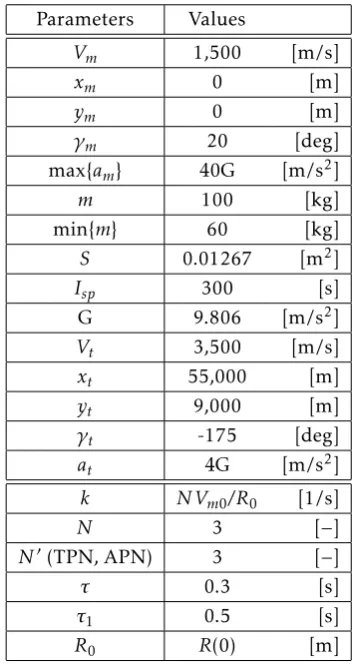
set-ting values of initial states and design parameters are summarized in the Table 1.
The limitation load of the missile is set to forty times of the gravitational acceleration (G), that is, 40G. When the commanded lateral acceleration exceeds the limit, the limited value is used as a command in the simulation. The target acceleration set as 4G to be constant. For comparison purposes, the PPN guidance law using the missile velocity in Eq. (25); the TPN guidance law using the closing velocity in Eq. (26); the APN guidance law adding the extra term which considered the maneuvering target in Eq. (27); and the OG of usingtgoinformation in Eq. (33) are compared by the proposed guidance law in the simulations.
Table 1: Initial kinematics and design parameters
Parameters Values
Vm 1,500 [m/s]
xm 0 [m]
ym 0 [m]
γm 20 [deg]
max{am} 40G [m/s2]
m 100 [kg]
min{m} 60 [kg]
S 0.01267 [m2]
Isp 300 [s]
G 9.806 [m/s2]
Vt 3,500 [m/s]
xt 55,000 [m]
yt 9,000 [m]
γt -175 [deg]
at 4G [m/s2]
k N Vm0/R0 [1/s]
N 3 [−]
N0
(TPN, APN) 3 [−]
τ 0.3 [s]
τ1 0.5 [s]
R0 R(0) [m]
The simulations with such comparative guidance laws are made because the simulation setting of guid-ance laws with the effective navigation constant of
shown as for another comparison guidance law with the same measurement condition. When simulations are performed for TPN, APN and OG guidance law, in-formation on the closing velocity and the target lateral acceleration can be used without error.
Table 2: Resulting miss distance is shown. For com-parison, we also show the results whenVmis constant, that is, when the affect of the axial acceleration by the thrust or of the deceleration due to the aerodynamic drag is not considered.
guidance method miss distance [m]
Vm=const. Vmchanges
Proposed < δ < δ
PPN 565.76 813.19
TPN 0.18 8.43
APN 0.0028 0.02
OG < δ 0.0096
δB0.001
The flight trajectories of the missile and the target are shown in Fig.2. The red solid line drawn from the upper right to the lower left is the trajectory of the tar-get, the red broken line denotes the missile trajectory with the PPN guidance law, the green broken dotted line is made with the TPN guidance law, the magenta dotted line is made with the APN guidance law, the red broken line is made with the OG law, and the blue solid line is made with the proposed guidance law. The resulting miss distance value using each guidance law is shown in Table 2. For comparison purpose, the re-sults of the case where the missile velocity is constant is also shown. In this case, when the miss distance is 0.001[m] or less, it is expressed as ”< δ”.
From enlarged view of the lower right of Fig. 2 (the equivalent aspect ratio), it is observed that the trajectories with the APN, OG and proposed guidance laws have similar trajectories. Simultaneously, we can see that the APN, OG and the proposed guidance law approach to the target in a shape close to a straight line, but the PPN and TPN guidance law draws a curve towards the target. It is considered that this causes large miss distance values as shown in Table 2. Addi-tionally, for the case where the missile velocity changes with time, the miss distance values of the PPN, TPN, APN and OG guidance law become large, whereas the proposed guidance law keeps in the same level. Note that the trajectory with the proposed guidance law is almost similar to the trajectories with the APN guid-ance law and OG law using the closing velocity and the lateral acceleration, and the miss distance value is smaller than the other guidance laws.
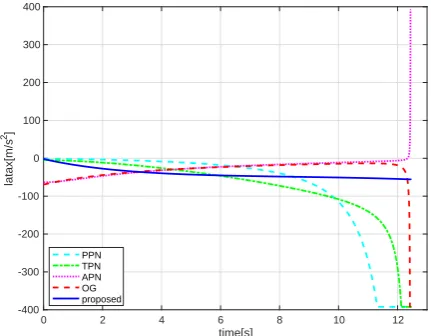
The curvature of the missile trajectory in Fig. 2 becomes clear by observing the histories of the lateral acceleration applied to the missile. Figure 3 shows the time history of the missile’s lateral acceleration (so-called latex) when using the each guidance law as well
as the time history of the LOS rate in Fig. 4. In Fig. 3, the value of lateral accelerations of the APN guidance and OG laws converge to almost zero with exception at the time of intercept. In the proposed guidance law, since the target lateral acceleration is considered as a part of the UDT, it turned out that the missile lateral acceleration tends to converge to a value close to the target lateral acceleration at 4G. In addition, it can be seen from Fig. 3 that the PPN and TPN guidance laws have reached the limited value of 40G before the inter-cept. The PPN guidance law is considered to generate a large miss distance value as shown in Table 2 because it reached this limit earlier than that of the TPN guid-ance law. It can also be observed from Fig. 4, since the LOS rate with the proposed guidance law converges to a value close to zero at the impact time, a small miss distance value shown in Table 2 was obtained. Con-sequently, under the condition shown in Table 1, that is, when the target velocity is larger than the missile velocity, the proposed guidance law is considered to exhibit desirable performance.
Figure 2: Flight trajectories of the missile and the tar-get. The lower right is an enlarged view.
0 2 4 6 8 10 12
time[s] -400
-300 -200 -100 0 100 200 300 400
latax[m/s
2]
PPN TPN APN OG proposed
0 2 4 6 8 10 12 time[s]
-0.05 -0.04 -0.03 -0.02 -0.01 0 0.01 0.02
PPN TPN APN OG proposed
Figure 4: LOS rate vs time is shown. It is desirable for the LOS rate to be zero.
Figure 5 and 6 shows the time histories of the mis-sile velocity and the mismis-sile mass. In this simulation, since the minimum value of the missile mass is lim-ited to 60[kg], the missile intercepted the target before reaching that value.
0 2 4 6 8 10 12
500 1000 1500
Vm (PPN)
0 2 4 6 8 10 12
500 1000 1500
Vm (TPN)
0 2 4 6 8 10 12
500 1000 1500
Vm (APN)
0 2 4 6 8 10 12
500 1000 1500
Vm (OG)
0 2 4 6 8 10 12
time[s] 500
1000 1500
Vm
(proposed)
Figure 5: The missile velocity of each guidance con-sidering axial acceleration by the thrust force, and deceleration due to aerodynamic drag vs time.
0 2 4 6 8 10 12
time [s] 86
88 90 92 94 96 98 100
mass [kg]
Figure 6: Mass of missile decreasing with time.
0 2 4 6 8 10 12
time[s] 0
0.1 0.2 0.3 0.4 0.5 0.6 0.7 0.8 0.9 1
estimated UDT h
10-3
true value estimated
Figure 7: The time history of the estimated UDThand the true value.
0 2 4 6 8 10 12
time[s] 0
0.1 0.2 0.3 0.4 0.5 0.6 0.7 0.8 0.9 1
estimation error of UDT
10-3
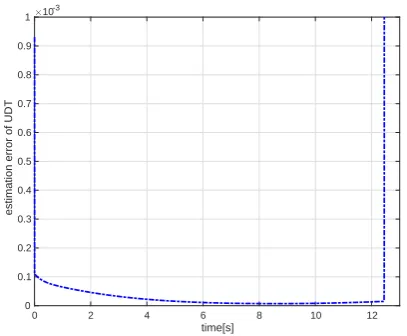
Figure 8: UDT error vs time. This figure shows (true)−(estimate) values in Fig.7.
Finally, to demonstrate the performance of the UDT estimator, the time history of the UDThwhich is a true value and that of estimated value ˆhare shown in Fig. 7, in addition, the time history of the estimation er-ror is also shown in Fig. 8. From these figures, it can be seen that the estimator using the time constant of
result-ing miss distance as shown in Table 1 demonstrates the excellent performance of the proposed guidance law.
4
Conclusions
A new guidance law for missile-target engagement us-ing information of LOS rate only is developed. From the simulation study, the proposed guidance law ex-hibits excellent performance almost equal to the OG law where the OG law uses additional information of the LOS range, the closing velocity and the lateral acceleration of the target, whereas the proposed guid-ance law uses only LOS rate information even if un-certain modeled dynamics such as velocity change and directional error is included. Hence, even with a guid-ance system that cannot measure the closing velocity or maneuvering target, we can anticipate that almost the same performance as that of conventional excel-lent guidance with using the closing velocity or target maneuver can be obtained by using the proposed guid-ance law.
For future works, we will apply the proposed guid-ance against various targets or initial settings, study a blind sight determination method (or deactivation technique in the proximity of the target), and investi-gate the influence of the time-lag constant changes and observation noise to the design parameters on guid-ance performguid-ance.
References
[1] R.E. Machol, W.P. Tanner.Jr, and S.N. Alexander, System Engi-neering Handbook, Chap.19 Guidance, R.E. Hill, 1965.
[2] Y. Yavin, R.De. Villiers, Proportional navigation and the game of two cars: the case of a pursuer with variable speed, Comput-ers & Mathematics with Applications, Vol.18, No.1-3, pp.69-76, 1986.
[3] M.J. Tahk, C.S. Park, and C.K. Ryoo , Line-of-Sight Guidance Laws for Formation Flight, Journal of Guidance, Control, and Dynamics, Vol.28, No.4, pp.708-716, 2005.
[4] Y. Sato, T. Yamasaki, et al., Trajectory Guidance and Control for a Small UAV, International Journal of Aeronautical and Space Sciences, Vol.7, No.2, pp.137-144, 2006.
[5] M. Matsuda, H. Takano, T. Yamasaki and I. Yamaguchi, A Note on the Optimal Spacecraft Guidance, APISAT, 7.4.1.pdf, 2012.
[6] P.J. Yuan and S.C. Hsu, Rendezvous Guidance with Propor-tional Navigation, Journal of Guidance, Control, and Dynam-ics, Vol.17, No.2Cpp.409-411, 1994.
[7] C.D. Yang, C.C. Yang, A Unified Approach to Proportional Navigation, Transactions on aerospace and electronic system, IEEE, Vol.33, No.2, pp.557-567, April 1997.
[8] P. Zarchan, Tactical and Strategic Missile Guidance, Sixth Edition, AIAA, ch.8, pp.163-185, 2007.
[9] P. Zipfel, Modeling and Simulation of Aerospace Vehicle Dy-namics, Second Edition, AIAA, 2007.
[10] T. Kuroda, and F. Imado, Advanced Missile Guidance System against a Very High Speed Maneuvering Target, Proceedings of AIAA Guidance, Navigation and Control Conference, pp.3445, 1989.
[11] A.E. Bryson, Jr., and Y.C. Ho, Applied Optimal Control, -Optimization, Estimation, and Control-, Hemisphere Publish-ing Corporation, New York, pp.154-155, 1975.
[12] Y. Baba, K. Inoue, and R.M. HOWE, Suboptimal guidance with line-of- sight rate only measurements, Proceedings of AIAA Guidance, Navigation and Control Conference, AIAA 88-4066-CP, Minneapolis, pp.122-129, 1988.
[13] S. Nakagawa, T. Yamasaki, H. Takano, and I. Yamaguchi, Disturbance- Compensated Intercept Guidance Using Line-of-Sight Rate Information, 11th Asian Control Conference, IEEE, pp.388-393, December 2017.
[14] S. Nakagawa, T. Yamasaki, H. Takano, and I. Yamaguchi, Com-parison study on Disturbance-Compensated Intercept Guid-ance Using Line-of-Sight Rate Information against Optimal Guidance, Multi-Symposium on Control System, 2018.
[15] T. Yamasaki, S.N. Balakrishnan, and H. Takano, Sliding mode-based intercept guidance with uncertainty and disturbance compensation, Journal of Franklin Institute, Vol. 352(11), pp. 5145-5172, 2015.
[16] C.D. Yang, and C.C. Yang, A Unified Approach to Proportional Navigation, IEEE , Transactions on aerospace and electronic system, Vol.33, No.2, pp.557-567, April 1997.
[17] Q.C. Zhong, Comments on gA time delay controller for sys-tems with Uncertain Dynamicsh, 27th January 2013.
[18] S.B. Phadke, and S.E. Talole, Sliding Mode and Inertial De-lay Control Based Missile Guidance, IEEE Transactions on Aerospace and Electronic Systems, Vol.48(4), pp.3331-3346, 2012.
[19] K. Youcef-Toumi, and O. Ito, Controller design for systems with unknown nonlinear dynamics, Proceedings of the Amer-ican Control Conference, Minneapolis, pp.836-845, 1987.