The effects of amiodarone prophylaxis on cardiac dysrhythmia
in acute aluminium phosphide poisoning
Mohammad-Reza Beyranvand
1, Soleyman Farrokhi
2, Hassan Peyvandi
3, Kambiz Soltaninejad
4,
and Shahin Shadnia
51 Department of Cardiovascular, Shahid Moddarres Hospital, School of Medicine, Shahid Beheshti University of Medical Sciences, Tehran, Iran
2 Department of Internal Medicine, Loghman Hakim Hospital, School of Medicine, Shahid Beheshti University of Medical Sciences, Tehran, Iran
3 Department of General Surgery, Hearing Disorders Research Center, School of Medicine, Shahid Beheshti University of Medical Sciences, Tehran, Iran
4 Department of Forensic Toxicology, Legal Medicine Research Center, Legal Medicine Organization, Tehran, Iran 5 Toxicological Research Center, Center for Excellence in Clinical Toxicology, Department of Clinical Toxicology, Loghman Hakim Hospital, School of Medicine, Shahid Beheshti University of Medical Sciences, Tehran, Iran
[Received in June 2018; Similarity Check in July 2018; Accepted in February 2019]
Cardiovascular toxicity is the most common cause of fatality in the first 24 hours of poisoning with aluminium phosphide (AlP). Most often manifesting itself in cardiac dysrhythmias. The aim of this study was to evaluate the benefits of amiodarone prophylaxis against cardiac dysrhythmia in 46 patients with acute AlP poisoning. They were divided in two
groups of 23: one receiving amiodarone and the other not (control). The treatment group received amiodarone prophylaxis
in the initial intravenous bolus dose of 150 mg, followed by a drip of 1 mg/min for six hours and then of 0.5 mg/min for eighteen hours. Both groups were Holter-monitored for 24 hours since admission. Save for amiodarone, both groups received the same standard treatment. Amiodarone had a significant beneficial effect in reducing the frequency of ST-segment elevation and ventricular fibrillation plus atrial fibrillation (P=0.02 and P=0.01, respectively), but the groups did not differ significantly in mortality (9 vs 11 patients, respectively). The mean time between ICU admission and death (survival time) was significantly longer in the treatment group (22 vs 10 h, respectively; P=0.03). Regardless its obvious
limitations, our study suggests that even though amiodarone alone did not reduce mortality, it may provide enough time
for antioxidant therapy to tip the balance in favour of survival and we therefore advocate its prophylactic use within the first 24 h of AlP poisoning.
KEY WORDS: AlP; antidysrhythmics; atrial fibrillation; ECG; Holter; rice tablet; ST-segment; toxicity; ventricular fibrilation
Aluminium phosphide (AlP) is used in agriculture due
to low cost and high efficacy as a fumigant pesticide. Acute
AlP poisoning is mainly reported in Asian countries like India and Iran (1-3) and is the most common cause of death among
pesticides, with a mortality rate of 31% to 77%(2-6). Signs and symptoms of acute AlP poisoning include gastrointestinal, cardiovascular, hepatic, renal, and neurologic(1). Most of the deaths occur within the first 24
hours after ingestion due to cardiovascular involvement, dysrhythmias such as ventricular tachycardia (VT),
ventricular fibrillation (VF), supra-ventricular tachycardia (SVT), and atrial flutter and fibrillation (AF) in particular
(7-10).
Amiodarone is an antidysrhythmic used to treat SVT and ventricular tachydysrhythmia, by blocking repolarisation and prolonging the refractory period of the myocardium,
which prevents tachydysrhythmia. It is associated with
improved survival in non-ischaemic cardiomyopathy but not in myocardial infarction, yet its use in post-myocardial infarction and congestive heart failure patients is safe (11, 12). Amiodarone also improves survival in
patients with AF by effectively converting AF to sinus
rhythm and maintaining it after conversion (12).
For all these reasons, the aim of this study was to
evaluate its potential as prophylaxis against AlP-induced dysrhythmia.
SUBJECTS AND METHODS
Study population
This was a prospective, randomised, controlled, open label clinical trial in patients with acute AlP poisoning. The
study included 46 patients older than 12 years admitted to
the Medical Toxicology Intensive Care Unit (MT ICU) of
the Loghman Hakim Hospital Poison Center, Tehran, Iran
Corresponding author: Shahin Shadnia MD, PhD, FACMT, Department of Clinical Toxicology, Loghman Hakim Hospital Poison Center, Kamali Street, South Karegar Avenue, Tehran-1333635445, Iran,
mellitus, cardiovascular, respiratory, renal, and hepatic failure, substance abuse, co-ingestion, advanced medical management for poisoning, and antidysrhythmic therapy
started elsewhere before admission were excluded from the
study.
The diagnosis was based on the history of exposure,
clinical manifestations, and positive silver nitrate test on
exhaled breath or stomach content samples. The study was
approved by the Ethics Committee of the Shahid Beheshti
University of Medical Sciences in Tehran and observed the
Declaration of Helsinki.
Treatment protocol
The treatment started with gastric decontamination in the Emergency Department, followed by immediate admission to the ICU and management based on the same
standard protocol for all patients (4–6 g of magnesium sulphate and 4 g of calcium gluconate by intravenous (IV)
infusion daily and adequate hydration), except for
amiodarone treatment. IV infusion of 10 µg/min
norepinephrine was administered as required. All the patients were treated under the supervision of the same
physicians and nurses.
The patients were randomised in two groups: those with even file number were assigned to the treatment group receiving amiodarone prophylaxis (n=23) and those with the odd file number were assigned to control (not receiving amiodarone) (n=23).
bolus, followed by IV infusions of 1 mg/min for six hours
and then of 0.5 mg/min for another 18 hours, as described
elsewhere (13). Both groups were monitored with a 24-hour Holter from admission to the ICU or until the time of death if it occurred within the first 24 h. Holter records were then
given to a cardiologist blind to the treatment and control
groups for interpretation. All the patients were followed up
until discharge from the hospital or death.
Patient information about sex, age, cause of poisoning,
ingested AlP dose, time between ingestion and ICU admission, clinical manifestations and paraclinical findings
on admission time, duration of hospitalisation, and outcome
were taken from the patients’ medical files. All information was kept confidential during the study.
Statistical analysis
The data were expressed as mean ± standard deviation (SD), frequency, and ratio and analysed with SPSS version 16 (SPSS Inc., Chicago, IL, USA). Qualitative variables were compared with the chi-square test, and quantitative variables were tested for normality of distribution with the Kolmogorov-Smirnov test. Variables with normal distribution were further tested with Student’s t-test and
others with the Mann-Whitney U-test. P values of 0.05 or less were considered statistically significant.
RESULTS
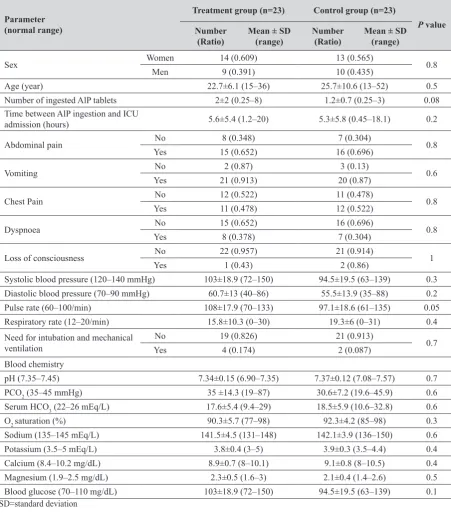
In 45 of the 46 cases poisoning was intentional, and 20 patients died (ratio 0.435). Table 1 shows the demographic,
clinical and laboratory data for both groups on admission
to the ICU.
Table 2 compares the frequencies of dysrhythmias registered by the Holter between the groups. Amiodarone significantly lowered the occurrence of ST-segment elevation and VF+AF.
The need for the administration of vasopressor
norepinephrine and mortality did not significantly differ
between the treatment and control group [12 vs 13 patients (P=1) for norepinephrine and 9 vs 11 patients for mortality (P=0.8), respectively].
Median time elapsed between ICU admission and death (survival time) was 23 h (range: 16–28) in the treatment
group and 10 h (range: 6-14) in the control group (P<0.001) (Figure 1).
DISCUSSION
To the best of our knowledge there are only two studies
on IV administration of amiodarone in acute AlP poisoning,
Parameter (normal range)
Treatment group (n=23) Control group (n=23)
P value Number
(Ratio) Mean ± SD (range) Number (Ratio) Mean ± SD (range)
Sex Women 14 (0.609) 13 (0.565) 0.8
Men 9 (0.391) 10 (0.435)
Age (year) 22.7±6.1 (15–36) 25.7±10.6 (13–52) 0.5
Number of ingested AlP tablets 2±2 (0.25–8) 1.2±0.7 (0.25–3) 0.08
Time between AlP ingestion and ICU
admission (hours) 5.6±5.4 (1.2–20) 5.3±5.8 (0.45–18.1) 0.2
Abdominal pain No 8 (0.348) 7 (0.304) 0.8
Yes 15 (0.652) 16 (0.696)
Vomiting No 2 (0.87) 3 (0.13) 0.6
Yes 21 (0.913) 20 (0.87)
Chest Pain No 12 (0.522) 11 (0.478) 0.8
Yes 11 (0.478) 12 (0.522)
Dyspnoea No 15 (0.652) 16 (0.696) 0.8
Yes 8 (0.378) 7 (0.304)
Loss of consciousness No 22 (0.957) 21 (0.914) 1
Yes 1 (0.43) 2 (0.86)
Systolic blood pressure (120–140 mmHg) 103±18.9 (72–150) 94.5±19.5 (63–139) 0.3 Diastolic blood pressure (70–90 mmHg) 60.7±13 (40–86) 55.5±13.9 (35–88) 0.2
Pulse rate (60–100/min) 108±17.9 (70–133) 97.1±18.6 (61–135) 0.05
Respiratory rate (12–20/min) 15.8±10.3 (0–30) 19.3±6 (0–31) 0.4
Need for intubation and mechanical
ventilation
No 19 (0.826) 21 (0.913)
0.7
Yes 4 (0.174) 2 (0.087)
Blood chemistry
pH (7.35–7.45) 7.34±0.15 (6.90–7.35) 7.37±0.12 (7.08–7.57) 0.7
PCO2 (35–45 mmHg) 35 ±14.3 (19–87) 30.6±7.2 (19.6–45.9) 0.6
Serum HCO3 (22–26 mEq/L) 17.6±5.4 (9.4–29) 18.5±5.9 (10.6–32.8) 0.6
O2 saturation (%) 90.3±5.7 (77–98) 92.3±4.2 (85–98) 0.3
Sodium (135–145 mEq/L) 141.5±4.5 (131–148) 142.1±3.9 (136–150) 0.6
Potassium (3.5–5 mEq/L) 3.8±0.4 (3–5) 3.9±0.3 (3.5–4.4) 0.4
Calcium (8.4–10.2 mg/dL) 8.9±0.7 (8–10.1) 9.1±0.8 (8–10.5) 0.4
Magnesium (1.9–2.5 mg/dL) 2.3±0.5 (1.6–3) 2.1±0.4 (1.4–2.6) 0.5
Blood glucose (70–110 mg/dL) 103±18.9 (72–150) 94.5±19.5 (63–139) 0.1
Type of dysrhythmia Treatment group(n=23) Control group(n=23) P value
Sinus bradycardia 1 1 1
First-degree atrioventricular block 0 1 0.3
Second-degree atrioventricular block
(Mobitz type II) 1 0 0.3
Atrial premature contraction (APC) 13 9 0.2
Sinus tachycardia 9 7 0.5
Atrial fibrillation (AF) 3 8 0.08
Junctional rhythm 2 1 0.5
Idioventricular rhythm 4 3 0.6
Ventricular premature contraction (VPC) 10 13 0.3
Ventricular tachycardia (VT) 9 6 0.5
Ventricular fibrillation (VF) 1 5 0.3
Left bundle branch block (LBBB) 3 1 0.3
Right Bundle Branch Block (RBBB) 7 3 0.2
ST-segment elevation 1 7 0.02*
ST-segment depression 2 3 0.6
VF+AF 3 11 0.01*
VT and VF and AF 8 13 0.1
Asystole following AF 2 7 0.06
*Statistically significant difference between the two groups (P<0.05)
and one reported no VT response to treatment (14) and the
other reported very limited beneficial effects (15). Even though amiodarone prophylaxis in our study significantly decreased the occurrence of AF+VF and ST-segment elevation and significantly increased survival time, it did not reduce mortality. However, interpretation of our results is quite limited by the small sample.
Another limitation of our study is that we did not observe or treat myocardial oxidative damage, whereas other studies showed significant beneficial effects of
antioxidants against cardiovascular toxicity (16–18). Future studies should therefore combine amiodarone and antioxidant treatment.
Even though amiodarone alone did not reduce mortality, it may provide enough time for antioxidant therapy to tip
the balance in favour of survival and we therefore advocate its prophylactic use within the first 24 h of AlP poisoning.
Acknowledgements
This article is the part of Dr Soleyman Farrokhi’s thesis, who was internal medicine resident at the time of the study. We would also like to thank the Clinical Research
Development Center of the Loghman Hakim Hospital for their support.
Conflicts of interest
None to declare.
REFERENCES
1. Proudfoot AT. Aluminium and zinc phosphide poisoning. C l i n T o x i c o l 2 0 0 9 ; 4 7 : 8 9 - 1 0 0 . d o i : 10.1080/15563650802520675
2. Soltaninejad K, Nelson LS, Bahreini SA, Shadnia S. Fatal
aluminum phosphide poisoning in Tehran-Iran from 2007 to 2010. Indian J Med Sci 2012;66:66-70. PMID: 23603623 3. Shadnia S, Sasanian G, Allami P, Hosseini A, Ranjbar A,
Amini-Shirazi N, Abdollahi M. A retrospective 7-years study
of aluminum phosphide poisoning in Tehran: opportunities for prevention. Hum Exp Toxicol 2009;28:209-13. doi: 10.1177/0960327108097194
4. Soltaninejad K, Faryadi M, Sardari F. Acute pesticide poisoning related deaths in Tehran during the period 2003-2004. J Forensic Leg Med 2007;14:352-4. doi: 10.1016/j.
jflm.2006.12.011
5. Shadnia S, Mehrpour O, Soltaninejad K. A simplified acute
physiology score in the prediction of acute aluminum phosphide poisoning outcome. Indian J Med Sci 2010;64:532-39. PMID: 21258160
6. Mathai A, Bhanu MS. Acute aluminium phosphide poisoning:
Can we predict mortality? Indian J Anaesth 2010;54:302-7.
doi: 10.4103/0019-5049.68372
7. Soltaninejad K, Beyranvand MR, Momenzadeh SA, Shadnia
S. Electrocardiographic findings and cardiac manifestations
in acute aluminum phosphide poisoning. J Forensic Leg Med
2012;19:291-93. doi: 10.1016/j.jflm.2012.02.005
8. Alter P, Grimm W, Maisch B. Lethal heart failure caused by
Eizadi-Mood N, Hajihosseini M, Mehrpour O. The effect of N-acetyl cysteine (NAC) on aluminum phosphide poisoning
inducing cardiovascular toxicity: a case-control study. Springerplus 2016;5:1948. doi: 10.1186/s40064-016-3630-2 10. Moghadamnia AA. An update on toxicology of aluminum
phosphide. DARU 2012;20:25. doi:
10.1186/2008-2231-20-25
11. Naccarelli GV, Wolbrette DL, Patel HM, Luck JC.
Amiodarone: clinical trials. Curr Opin Cardiol 2000;15:64-72. PMID: 10666663
12. Brendorp B, Pedersen O, Torp-Pedersen C, Sahebzadah N, Køber L. A benefit-risk assessment of class III antiarrhythmic
agents. Drug Saf 2002;25:847-65. doi: 10.2165/00002018-200225120-00003
13. Susla GM, Suffredini AF, McAreavey D, Solomon MA, Hoffman WD, Nyquist P, Ognibene FP, Shelhamer JH, Masur
H, editors. Handbook of Critical Care Drug Therapy. Philadelphia: Lippincott Williams & Wilkins; 2006. 14. Jadhav AP, Nusair MB, Ingole A, Alpert MA. Unresponsive
ventricular tachycardia associated with aluminum phosphide
poisoning. Am J Emerg Med 2012;30:633.e3-5. doi: 10.1016/j.ajem.2011.01.026
Cardiac arrhythmias in aluminium phosphide poisoning studied by on continuous holter and cardioscopic monitoring. J Assoc Physicians India 1998;46:598-601. PMID: 12152839 16. Jafari A, Baghaei A, Solgi R, Baeeri M, Chamanara M,
Hassani S, Gholami M, Ostad SN, Sharifzadeh M, Abdollahi
M. An electrocardiographic, molecular and biochemical approach to explore the cardioprotective effect of vasopressin and milrinone against phosphide toxicity in rats. Food Chem Toxicol 2015;80:182-92. doi: 10.1016/j.fct.2015.02.022 17. Baghaei A, Solgi R, Jafari A, Abdolghaffari AH, Golaghaei
A, Asghari MH, Baeeri M, Ostad SN, Sharifzadeh M,
Abdollahi M. Molecular and biochemical evidence on the protection of cardiomyocytes from phosphine-induced oxidative stress, mitochondrial dysfunction and apoptosis by acetyl-L-carnitine. Environ Toxicol Pharmacol 2016;42:30-7. doi: 10.1016/j.etap.2015.12.019
18. Azad A, Lall SB, Mittra S. Effect of N-acetylcysteine and L-NAME on aluminium phosphide induced cardiovascular
toxicity in rats. Acta Pharmacol Sin 2001;22:298-304. PMID: 11742581
Djelotvornost amiodarona u profilaksi srčane disritmije uzrokovane akutnim otrovanjem aluminijevim fosfidom
Najčešći uzrok smrti u prva 24 sata od otrovanja aluminijevim fosfidom (AlP) jesu njegovi toksični učinci na srce i krvožilje. Oni se obično manifestiraju srčanim disritmijama. Cilj je ovoga ispitivanja bio procijeniti blagotvorne učinke amiodarona u profilaksi srčane disritmije u 46 bolesnika primljenih na intenzivnu njegu s otrovanjem AlP-om. Bolesnici su podijeljeni u dvije skupine od 23 ispitanika. Jedna je primala amiodaron, a druga (kontrolna) nije. Ostalo liječenje bilo je standardno i identično u objema skupinama. Amiodaronska se je profilaksa sastojala od udarne intravenske bolusne doze od 150 mg, nakon čega je uslijedila infuzija u dozi od 1 mg/min prvih šest sati, a zatim od 0,5 mg/min sljedećih
osamnaest sati. Obje su skupine od prijama na intenzivnu njegu bile nadzirane 24-satnim holterom. Amiodaron je iskazao
značajnu djelotvornost u smanjenju učestalosti povišenoga ST-segmenta odnosno ventrikulske i atrijske fibrilacije (P=0,02 odnosno P=0,01), ali nije značajno smanjio smrtnost (9 bolesnika u skupini na amiodaronu odnosno 11 u kontrolnoj skupini). Srednje vrijeme od prijama na intenzivnu njegu do smrti (vrijeme preživljenja), međutim, značajno se produžilo u skupini na amiodaronu (22 h prema 10 h u kontrolnoj skupini; P=0,03). Unatoč jasnim ograničenjima, napose zbog premaloga uzorka, ovo ispitivanje upućuje na to da amiodaron može dovoljno produžiti vrijeme preživljenja i time dati dovoljno vremena antioksidacijskom liječenju da spasi život te iz tog razloga preporučujemo njegovu profilaktičku
primjenu u prva 24 sata od otrovanja AlP-om.