249
International Journal of Pharmaceutical Sciences and Drug Research
2016; 8(5): 249-253
Research Article
CODEN (USA): IJPSPP
ISSN: 0975-248X
Development and Optimization of Gastro-Retentive Formulation of
Hydralazine HCl
Himanshu A Acharya
*, Rakesh P Patel
Faculty of Pharmacy, Ganpat University, Kherva, Mahesana, Gujarat, India
ABSTRACT
Hydralazine hydrochloride has a half-life of 2 to 4 hours with an oral bioavailability of 26-50%. Since hydralazine has a demethylating effect on various suppressor genes, it can be used in various types of cancer to support chemotherapy. The purpose of this study was to optimize and evaluate floating tablets of hydralazine hydrochloride designed to prolong the gastric residence time and to provide controlled release of the drug for 24 h. The floating tablets of hydralazine hydrochloride were prepared by the wet granulation method. Polymers of hydroxy propyl methyl cellulose (HPMC K100M), HPMC K15M, carbopol 940 and sodium bicarbonate were used as the release retarding agents. This study investigated utility of a 3-factor, 3-level Box-Behnken design and optimization process for floating tablet of Hydralazine with 5 replicates of center points. Amount of HPMC K4 (Hydroxy Propyl Methyl cellulose), amount of sodium bicarbonate were selected as the independent variables whereas total floating time (TFT), T90, % cumulative drug release at 24 hours, and T20, Q1 were selected as dependent variables. Non-Fickian diffusion release transport was confirmed as the release mechanism for the optimized formulation and the predicted values agreed well with the experimental values. Drug excipient compatibility studies were investigated by FTIR, DSC and XRD. The produced tablets exhibited good floating time and controlled drug release over a period of 24 h. The resultant data were critically analyzed to locate the composition of optimum formulations. All predicted values of response variables of optimized formulation demonstrated close agreement with the experimental data during optimization procedure.
Keywords: Hydralazine, Floating oral dose, Box-Behnken, HPMC K4M, Carbopol 940, Sodium bicarbonate.
INTRODUCTION
Globally, more than 43 million people are infected with the Hypertension syndrome Hypertension (HTN) or high blood pressure, sometimes called arterial hypertension, is a chronic medical condition in which the blood pressure in the arteries is elevated. Hypertension is classified as either primary (essential) hypertension or secondary hypertension; about 90–95%
*Corresponding author: Mr. Himanshu A Acharya,
Ph.D Scholar, Faculty of Pharmacy, Ganpat University, Kherva, Mahesana-Gozaria Highway, Mahesana, Gujarat, India; E-mail: [email protected]
Received: 29 August, 2016; Accepted: 25 September, 2016
of cases are categorized as "primary hypertension" which means high blood pressure with no obvious underlying medical cause. The remaining 5–10% of cases (secondary hypertension) is caused by other conditions that affect the kidneys, arteries, heart or endocrine system. Vasodilators that act primarily on resistance vessels (arterial dilators) are used for hypertension and heart failure, but not for angina because of reflex cardiac stimulation.
Int. J. Pharm. Sci. Drug Res. September-October, 2016, Vol 8, Issue 5 (249-253) drug before it reaches the absorption window, thus
ensuring optimal bioavailability. Local delivery also increases the stomach wall receptor site bioavailability and increases efficacy of drugs to reduce acid secretion. Hence this principle may be applied for improving systemic as well as local delivery of Hydralazine, which would efficiently reduced gastric acid secretion. [1-3]
Various approaches including floating systems, mucoadhesive systems, conventional system and in situ gel systems have been successfully employed to improve the gastric residence time of a delivery system. Though highly efficient for gastro retention, floating systems suffer from a major disadvantage that they are effective only when the fluid level in the stomach is sufficiently high. However, as the stomach empties and the tablet is at the pylorus, the buoyancy of the dosage form may be impeded. This serious limitation can be overcome by making the system eventually adhere to the mucous lining of the stomach wall. Mucoadhesion along with floating system has been an extensively adapted approach for achieving site-specific drug delivery through the amalgamation of mucoadhesive polymers within pharmaceutical formulations along with the active pharmaceutical ingredient (API). Mucoadhesive materials are hydrophilic macromolecules containing numerous hydrogen bond forming groups. The mechanism by which mucoadhesion takes place has been said to be in two stages: the contact (wetting) stage followed by the consolidation stage (establishment of adhesive interactions). The objective of the current study was to develop floating-mucoadhesive tablets of Hydralazine hydrochloride and optimize their mucoadhesive and drug release characteristics using the benefits of BoxBehnken design methodology.
MATERIAL AND METHODS
The Active pharmaceutical ingredient was procured from Sun Pharma Ltd, Vadodara, India and was British Pharmacopeia grade. The excipients were gifted by SD fine chemical, Vadodara, India and were United Pharmacopeia grade. Melting points of Active pharmaceutical ingredient were determined in open capillaries using Veego melting point apparatus, Model VMP-D (Veego India Ltd., Mumbai, India) and were uncorrected. Infrared spectra were recorded using KBr pellets on SHIMADZU-FT-IR 8400S instrument. Mass spectra were recorded on PerkinElmer LC–MS PE Sciex API/65 Spectrophotometer. The 1H NMR spectra were
recorded on Brucker Avance-300 (300 MHz) model spectrophotometer in CDCl3 using DMSO as solvent.
SHIMADZU dissolution apparatus was used to study drug release profile. Pfizer tester was used for hardness evaluation. Satorious LOD instrument for measuring Loss on drying (LOD).
Various methods and characterization of the Formulations are reported as below.
Floating Systems [4]
a. Effervescent floating dosage forms b. Non effervescent dosage forms. c. Raft forming systems.
Floating systems or hydro dynamically controlled system are low density system that has sufficient buoyancy to float over the gastric contents and remain buoyant in the stomach without affecting the gastric emptying rate for the prolong period of time. [5] While
the system is floating on the gastric contents, the drug is released slowly at the desired rate from the systems. After release of the drug, the residual system is emptied from the stomach. This result in increased GRT and a better control of the fluctuation in the plasma drug concentration.
Effervescent floating dosage forms[6]
These are matrix type of system prepared with the help of Swellable polymers such as methyl cellulose and chitosan and various effervescent compounds, examples; sodium bicarbonate, tartaric acid and citric acid. They are formulated in such a way that when in contact with acidic gastric contents, CO2 is liberated
and get entrapped in swollen hydrocolloids, which provides buoyancy to the dosage form.
Non Effervescent Floating Dosage Forms
Non effervescent floating dosage form use a gel forming or swellable cellulose type hydro colloids, polysaccharides and matrix forming polymer like poly carbonate, polyacrylate, polymethacrylate, polystyrene. The formulation method includes a simple approach of thoroughly mixing the drug and gel forming hydro colloid. After oral administration, this dosage form swells in contact with gastric fluids attains a bulk density. The air entrapped within the swollen matrix imparts buoyancy to the dosage form. The so formed swollen gel-like structure acts as a reservoir and allows sustained release of the drug through the gelatinous mass.
Raft Forming Systems
Here, a gel forming solution (example Sodium alginate solution containing carbonates or bicarbonates) swells and forms a viscous cohesive gel containing entrapped CO2 bubbles in contact with gastric fluid. Formulations
also typically contain antacids such as aluminum hydroxide or calcium carbonate to reduce gastric acidity. Because raft-forming systems produce a layer on the top of gastric fluids, they are often used for gastroesophaeal reflux treatment as with liquid.
Mucoadhesive or bioadhesive systems
Table 1: List of drug and excipients
Materials Company
Hydralazine Sun Pharma ltd, Vadodara
Starch S D Fine Chem, Mumbai
Sodium Bicarbonate S D Fine Chem, Mumbai
Sodium Alginate S D Fine Chem, Mumbai
HPMC K4M S D Fine Chem, Mumbai
Carbopol 940P S D Fine Chem, Mumbai
DCP S D Fine Chem, Mumbai
MCC S D Fine Chem, Mumbai
SSG S D Fine Chem, Mumbai
Aerosil S D Fine Chem, Mumbai
Talc S D Fine Chem, Mumbai
Magnesium Stearate S D Fine Chem, Mumbai
Table 2: List of drug excipients concentration for batch Materials Quantity
Hydralazine 50 mg
HPMC K4M 65 mg
Carbopol 940P 60 mg
Sodium Bicarbonate 30 mg
Starch 50 mg
Water Q.S.
SSG 5 mg
Aerosil 5 mg
Talc 2.5 mg
Mg Stearate 2.5 mg
Tablet Weight 270 mg
Table 3: Results of evaluation parameter Batc h No Tablet Thicknes s (mm) Tablet Hardness
(g/cm3)
Average Weight
(mg)
Tablet friability
(%) CCPR (%)
B1 2.41±0.05 1±0.01 270.5 0.63±0.01 98.0
B2 2.39±0.04 1±0.02 271 0.7±0.01 99.1
B3 2.40±0.04 1±0.01 270 0.69±0.02 99.6
B4 2.39±0.03 1±0.03 270 0.74±0.01 98.4
B5 2.39±0.04 2±0.01 268 0.7±0.01 98.0
B6 2.39±0.03 2±0.03 270 0.63±0.01 99.1
B7 2.40±0.04 2±0.01 270 0.69±0.02 99.8
B8 2.39±0.05 2±0.02 270 0.7±0.01 98.0
B9 2.39±0.04 1±0.03 271 0.63±0.01 99.3
B10 2.40±0.04 2±0.03 270 0.63±0.01 99.6
B11 2.41±0.03 2±0.03 269 0.74±0.01 99.1
B12 2.40±0.05 2±0.01 271 0.69±0.02 99.9
B13 2.39±0.04 1±0.03 270 0.74±0.01 98.0
B14 2.41±0.04 2±0.03 270 0.69±0.02 99.6
B15 2.41±0.05 2±0.02 271 0.63±0.01 99.9
B16 2.39±0.03 1±0.03 269 0.7±0.01 99.1
B17 2.40±0.05 2±0.01 270 0.74±0.01 98.0
Table 4: Accelerated stability study data
Parameters Specification Month 1 Mont2 h 3 Mont h 6 Mont hs
Description White to off white color tablets
Compl
ies Complies Complies Complies Water
content NMT 0.5% 0.3% 0.3% 0.3% 0.3%
Assay (By
HPLC) Not less than 95-105% 98.5% 98.35% 98.22% 98.10%
Formulation Method
Pure Hydralazine HCl and excipients were accurately weighed and were collected in a mortar and pestle. The mixture was well mixed in blender for 10 mins in order to achieve uniform mixing and was passed through sieve number 40. Remaining material was then passed
through sieve number 20 in order to get uniform mixing. The blend was binded and dried up to desire LOD was obtained. This blend was compressed using 9.0mm S/C punches.
Table 5: Experimental design code values
Translation of coded values in actual units Independent variables Levels used, actual (coded)
Low(-1) Medium (0) High (+1)
Concentration of HPMC K4M
(%w/w) = X1 20 40 70
Concentration of Sodium Alginate
(%w/w)=X2 5 10 15
Concentration of Carbopol 940P
(%w/w) = X3 10 15 20
Dependent variables
Y1= Time required to release 90% of drug (t90 in hrs) Y2= Time required to release 20% of drug (t20 in hrs) Y3= Q1 (Amount of drug release in 1hr (%))
Table 6: Factorial design runs
Batches X1 X2 X3 X12 X13 X23 X11 X22 X33
F1 1 0 -1 0 -1 0 1 0 1
F2 0 0 0 0 0 0 0 0 0
F3 0 -1 1 0 0 -1 0 1 1
F4 0 0 0 0 0 0 0 0 0
F5 0 1 1 0 0 1 0 1 1
F6 -1 0 1 0 -1 0 1 0 1
F7 -1 1 0 -1 0 0 1 1 0
F8 -1 0 -1 0 1 0 1 0 1
F9 0 0 0 0 0 0 0 0 0
F10 0 0 0 0 0 0 0 0 0
F11 0 1 -1 0 0 -1 0 1 1
F12 0 0 0 0 0 0 0 0 0
F13 1 0 1 0 1 0 1 0 1
F14 1 -1 0 -1 0 0 1 1 0
F15 0 -1 -1 0 0 1 0 1 1
F16 1 1 0 1 0 0 1 1 0
F17 -1 -1 0 1 0 0 1 1 0
Table 7: Optimized batches formulation table Batch API
(mg) HPMC K4M (mg) Sodium Alginate (mg) Carbopol 940P (mg)
O1 50 52.0 44.5 42.5
O2 50 52.5 45.0 43.0
Tablet weight: 250mg
RESULTS
All the batches for all dosage forms were formulated and evaluated on the same ground and best dosage form was selected and was compared with the optimized batches in order to get desired and reproducible results. While carrying out the experiment evaluation parameters like weight variation, content uniformity, thickness, hardness, friability test, floating lag time and in-vitro dissolution study were carried out and suitable results were then optimized using experiment design software.
15 trial runs with different concentrations were carried out and compared. The best trial batched giving desire results was short listed and compared with different dosage forms in order to select the best delivery system keeping in consideration all the parameters.
Int. J. Pharm. Sci. Drug Res. September-October, 2016, Vol 8, Issue 5 (249-253) it was found that floating delivery system yield the best
desired and reproducible results.
Table 8: Evaluation of optimized batches
Batch No.
Tablet Thickn ess (mm)
Tablet Hardness
(kg/cm3) Drug content
(%) T90 T20 Q1
%CCPR (%)
O1 2.39 1-2 99.16 7 hr 45min 6hr 21.68 99.16
O2 2.41 1-2 99.66 10min 6hr 7hrs 20.00 99.96
Table 9: Comparison of final batch (B1) and optimized batch O1 & O2
Time (hrs) Final Batch %CCPR Optimized Batch
B1 O1 O2
1 1.21 1.54 1.99
3 3.11 4.12 3.14
5 8.1 8.9 9.7
8 15.86 16.55 15.43
12 24.99 25.18 28.17
16 42.98 39.12 43.91
20 61.55 59.44 60.64
22 78.56 80.39 79.87
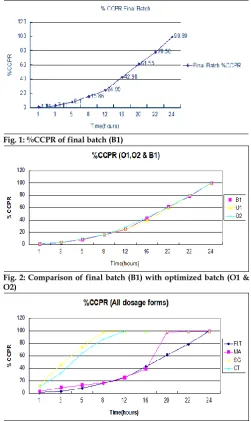
24 99.89 99.48 99.97
Table 10: Comparison of Floating Tablets (FLT), Mucoadhesive Tablets (MA), In-situ gel (SG), Conventional Tablets (CT)
Time (hrs) FLT MA SG CT
1 1.21 3.11 12.56 10.78
3 3.11 9.23 45.98 32.07
5 8.1 13.12 74.18 64.1
8 15.86 16.55 98.32 86.99
12 24.99 25.18 99.12 99.1
16 42.98 39.12 99.2 99.32
20 61.55 98.18 99.2 99.32
22 78.56 98.77 99.2 99.32
24 99.89 99 99.2 99.32
The stability studies viz accelerated and real time were carried out for all the trial and it was found the all the batches which were formulated were found to be stable and their physio-chemical properties were unchanged. The stability batches were subjected to calculate the drug release profile and it was found that the profile was same as that was before. This formula was optimized [7-9] using experimental design software by
keeping in consideration dependent and independent variables. The 3D contour plot was obtained and was interpreted. [10-13]
Formulation Design (BOX-BEHNKEN DESIGN) [14-16] A 3-factor 3-level Box-Behnken design was used for the formulation of tablets. This design is suitable for exploring quadratic response surface and constructing second order polynomial models. The design consists of replicated center points and the set of points lying at the midpoint of the multidimensional cube that defines the region of interest. The non linear quadratic model generated by the design in the form:
Y = X0 + X1A + X2B + X3C + X4A2 + X5B2 + X6C2 + X7AB + X8BC + X9AC + E
Where, Y is the measure response associated with each factor level combination: X0 is an intercept: X1 - X9 are
the regression coefficient: A, B, C are the factor studied and E is the associated error term.
Fig. 1: %CCPR of final batch (B1)
Fig. 2: Comparison of final batch (B1) with optimized batch (O1 & O2)
Fig. 3: Comparison of Floating Tablets (FLT), Mucoadhesive Tablets (MA), In-situ gel (SG), Conventional Tablets (CT)
DISCUSSION
ACKNOWLEDGEMENTS
The authors gratefully acknowledge Ganpat University, Mehasana for providing support and laboratory facilities. The authors are indebted to the Yaari Healthcare, Vapi and C.S.M.C.R.I, Bhavnagar for Spectral characterization. Special Thanks to Dr. Rakesh Patel, Assistant Professor, Dharamsinh Desai University, Nadiad for providing Design experiment software.
REFERENCES
1. Shep S, Dodiya S, Lahoti S, Mayee R. Swelling System: "A Novel Approach towards Gastroretentive Drug Delivery System." Indo-Global Journal of Pharmaceutical Sciences 2011; 1(3): 234-242.
2. Rajput G, Majmudar F, Patel J, Patel K, Thakor R, Patel B. Stomach specific mucoadhesive tablets as controlled drug delivery system: A review work. International Journal of Pharmaceutical Biological Research 2010; 1:30-141.
3. Shinde S, Tadwee I, Shahi S. Gastro Retentive Drug Delivery System: A Review. International Journal of Pharmaceutics 2012; 1(1):01 -13
4. Soni RP, Patel V, Patel RB, Patel M, Patel K, Patel N. Gastroretentive drug delivery systems: a review. International Journal of Pharma World Research 2011; 2(10):1-24.
5. Singh BN, Kim KH. Floating drug delivery systems: an approach to oral controlled drug delivery via gastric retention. Journal of Controlled Release 2000; 63(3):235-259. 6. Kim MS, Kim JS, You YH, Park HJ, Lee S, Park JS, et al.
Development and optimization of a novel oral controlled delivery system for tamsulosin hydrochloride using response surface methodology. International journal of Pharmaceutics 2007; 341(1-2):97-104.
7. Sauzet C, Claeys-Bruno M, Nicolas M, Kister J, Piccerelle P, Prinderre P. An innovative floating gastro retentive dosage system: Formulation and in vitro evaluation. International journal of Pharmaceutics. 2009; 378(1):23-9.
8. Yang L, Fassihi R. Examination of drug solubility, polymer types, hydrodynamics and loading dose on drug release behavior from a triple-layer asymmetric configuration delivery system. International journal of Pharmaceutics. 1997; 155(2):219-229.
9. Siddikqui S, Bose A. Modulation of drug (Metoprolol succinate) release by inclusion of hydrophobic polymer in hydrophilic matrix. Drug development and industrial pharmacy 2011; 37(9):1016-1025.
10.Prajapati ST, Patel LD. Gastric floating matrix tablets: design and optimization using combination of polymers. Acta pharma. 2008; 58: 221-229.
11.Reynolds JEF. Martindale the Extra Pharmacopoeia. The Royal Pharmaceutical Society: London, 1996, pp. 1218-20. 12.Singh B, Kim K. Formulation and evaluation of famotidine
floating tablets. J Control Release 2000; 63: 235-59.
13.Coffin M, Parr A, inventors. Glaxo Inc. Ranitidine solid dosage form. US patent 5 407 687. April 18, 1995.
14.Nazzal S, Khan MA. Response surface methodology for the optimization of ubiquinone self-nanoemulsified drug delivery system. Pharm Sci Tech. 2002; 3: 1-9.
15.Rosa M, Zia H, Rhodes T. Dosing and testing in-vitro of a bioadhesive and floating drug delivery system for oral application. Int J Pharm. 1994; 105: 65-70.
16.Chavanpatil MD, Jain P, Chaudhari S, Shear R. Novel sustained release, swellable and bioadhesive gastroretentive drug delivery system for ofloxacin. Int J Pharmaceutics 2006; 304: 178–184.