Written word recognition by the elementary and advanced level
Persian-English bilinguals
FerdosTaleb
(MA, Islamic Azad University, Najafabad Branch, Isfahan, Islamic Republic of Iran) [email protected]
Zahra Fotovatnia
(PhD, Islamic Azad University, Najafabad Branch, Isfahan, Islamic Republic of Iran) [email protected]
(Received: 01.02.2013, Accepted: 01.06.2013)
Abstract
According to a basic prediction made by the Revised Hierarchical Model (RHM), at early stages of language acquisition, strong L2-L1 lexical links are formed. RHM predicts that these links weaken with increasing proficiency, although they do not disappear even at higher levels of language development. To test this prediction, two groups of highly proficient and two groups of elementary L2 learners were tested on noncognate stimuli with episodic recognition tasks in both forward (L1-L2) and backward (L2-L1) directions. The pattern observed for the elementary L2 learners in both directions wasconsistent with the prediction of the RHM. The results showed the existence of strong lexical links in the backward direction at the elementary level but no such links were found in the forward direction. Contrary to the predictions of the RHM, however, L2-L1 lexical links are lost at higher levels of proficiency.
Keywords: lexical links, conceptual links, episodic recognition task, language priming, RHM
Introduction
As about half of the world’s population know more than one language (Grosjean, 1982), research on bilingualism has been on the rise (Costa, Santesteban, & Cano, 2005; Kroll, Bobb, &Wodniecka, 2006; Kroll & Curley, 1988; Kroll & Stewart, 1994; Ju& Luce, 2004; Lagrou, Hartsuiker, &Duyck, 2011; Marian & Spivey, 2003; Potter, So, Von Eckardt, & Feldman, 1984; Schulpen, Dijkstra, Schriefers, &Hasper, 2003; Spivey & Marian, 1999; Weber & Cutler, 2004; Weinreich, 1953). Two main models explore the mental representation of languages in a bilingual mind. According to traditional models, two separate lexicons exist, one for L1 and the other for L2. When reading in one language, only words from the relevant lexicon are activated. In
this sense, the bilingual lexical memory is activated selectively; the language used determines the words to be retrieved. As a result, only orthographic and phonological representations of words from the same language are activated and no activation spreads to the orthographic and phonological representation of the other language. This view works for a number of models such as the Word Association Model (Kroll & Curley, 1988), the Concept Mediation Model (Kroll & Curley, 1988; Potter et al., 1984), and the Revised Hierarchical Model (Kroll & Stewart, 1994).
2005). These studies suggest that lexical representations of L1are accessed when the bilingual is reading in L2 (Brysbaert, van Dyck, & van de Poel, 1999; Costa, Caramazza& Sebastian-Galles, 2000; Dijkstra, Grainger, & Van Heuven, 1999; Dijkstra, Timmermans, &Schriefers, 2000; Duyck, 2005; Duyck, Diependaele, Drieghe, &Brysbaert, 2004; Haigh& Jared, 2007; Jared & Kroll, 2001; Lemhöfer&Dijkstra, 2004; Schwartz, Kroll, & Diaz, 2007) and vice versa (Duyck, 2005; Van Assche, Duyck, Hartsuiker, &Diependaele, 2009; Van Hell &Dijkstra, 2002). For example, Distributed Lexical/Conceptual Feature Model (Kroll & De Groot, 1997) proposes that lexical and conceptual features are shared between languages and are stored in a distributed mode. There are language-specific lemmas including syntactic information mediating these mental representations. Such processing leads to the assumption of nonselectivity of language in reading. The bilingual interactive activation model+ (BIA+) is based on the same assumption (Dijkstra& Van Heuven, 2002). Additionally, BIA+ postulates one unified lexicon for both languages.
There has been continuous debate over the selectivity vs. nonselectivity assumptions. A number of researchers have argued that cross-language orthographical differences may restrict language nonselectivity when the two scripts differ (Nakayama, Sears, Hino, &Lupker, 2012).The reason seems to be that orthographical differences guide incoming sensory information toward the appropriate lexical system such that nontarget language representations are never contacted. If this is the case, Persian-English bilinguals are supposed to show language selectivity when reading in English due to cross-script differences between Persian and English. Therefore, we base the theoretical
foundation of this study on the models that support the language selective view.
Literature review
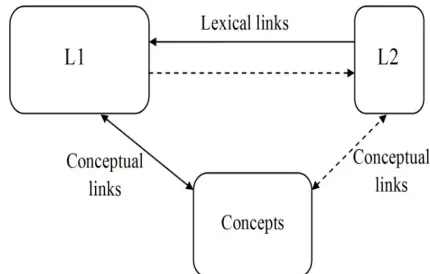
RHM is a dominant model in psycholinguistics research (Kroll & Steward, 1994; Kroll &Tokowicz, 2001). This model acknowledges two levels of word representation: the conceptual and the lexical. The model proposes that both languages of a bilingual share the same conceptual store; however, each language has its own separate store at the lexical level. There are connections between the two languages of a bilingual speaker at both lexical and conceptual levels. The conceptual store is connected to L1 and L2 lexical stores via routes called the conceptual connections. There are also some links connecting the L1 lexical store to the L2 lexical store called the lexical links. Lexical processing may occur at the lexical level through lexical routes or at the conceptual level via conceptual connections (Figure 1).
Figure 1: Revised Hierarchical Model
by the semantic manipulation of words because it occurs at the conceptual level but backward translation would not be affected by the semantic categorization of wordsbecause it occurs at the lexical level. The findings of the study confirmed these two assumptions.
Other studies concluded that for both early and advanced L2 learners, forward translation takes more time and is more sensitive to semantic manipulation than backward translation (de Groot, Dannenburg& Van Hell, 1994; Sanchez-Casas, Davis & Garcia-Albea, 1992; Sholl, Sankaranararyanan& Kroll, 1995).
One basic assumption made by RHM (Kroll & Stewart, 1994) is that at early stages of language acquisition, L2 learners rely mainly on lexical links between L2 words and that their L1 translation equivalence is established once a language is learned. Hence, the lexical links from L2 to L1 translation equivalents are stronger than the reverse links. The existence of strong L2 to L1 lexical links means strong priming from L2 to L1. Several cross-language studies have failed to find translation priming effects from L2 to L1 for noncognates although strong priming effects have been found from L1 to L2(Basnight-Brown &Altarriba, 2007; Gollan, Forster, & Frost, 1997; Jiang, 1999, Jiang & Forster, 2001; Kim & Davis, 2003; Voga& Grainger, 2007; Williams, 1994). Generally, the magnitude of forward priming is greater than backward priming, although the evidence for L2- L1 translation priming is less consistent.
What these aforementioned studies have in common is that they have failed to report significant masked translation priming effects when a lexical decision task was used. Bradley (1991) observed L2-L1 priming when he tested unrelated word pairs
in a speed recognition memory task. The task was to decide as rapidly as possible whether the presented word was one of the words already learned. The words were preceded by a masked version of an already learned or a completely new word. What he found was strong L2-L1 priming.
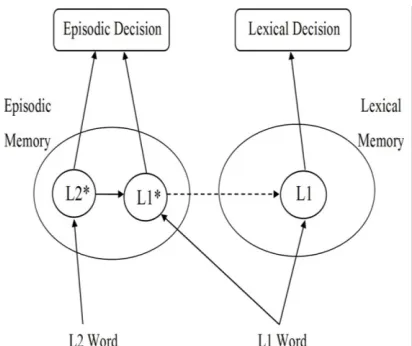
In order to see if the task presented would influence priming effects in forward or backward directions, Jiang and Forster (2001) gave episodic and lexical decision tasks to a number of Chinese–English bilingual speakers using masked priming paradigm. The results of the study demonstrated significant masked translation priming effects in the backward direction when an episodic task was used and significant priming effects in the forward direction when a lexical decision task was used. To interpret the findings, these authors put forward a separate memory system model. According to this model, lexical memory and episodic memory constitute separate memory modules (Figure 2).
Figure 2: Separate Memory System Model
same memory (episodic), L2-L1 priming occurs. Moreover, the L1-L2 priming was effective in the lexical decision task because the L1 prime activates the shared semantic features through strong L1 conceptual connections. Nonetheless, in the backward direction, as the conceptual connection between the L2 prime and the conceptual store is weak, the target is not preactivated (Kroll & Stewart, 1994). In fact, the results of the study suggest that different tasks involve different links in a bilingual memory and the presence of both lexical and conceptual connections cannot be demonstrated in one particular task. Lexical links show priming effects in episodic recognition tasks but conceptual connections show priming in lexical decision task.
The present study
RHM predicts strong L2-L1 lexical connections at the early stages of language learning, which do not disappear with increasing proficiency, although the nature of the links might change. There is little evidence whether or not initial dependence on L1 would play a continuing role during L2 processing even at higher levels of proficiency. If L1 simply provides a way for L2 to find its way into the cognitive system, the same sort of activity might be absent at higher stages as L2 learners become more proficient. Very little information from the existing literature tells us how and through what process the nature of these connections change with increasing proficiency. The main purpose of this study is to further investigate the issue. According to Jiang and Forster (2001), testing L2 learners in an episodic recognition task can explain the existence and strength of lexical links. Hence, to serve the main goal of the study, four experiments were designed to test two groups of elementary and two groups of high proficiency L2 learners with an episodic task in forward and backward
directions as summarized in the following questions:
If according to RHM there are strong L2-L1 lexical links at low levels of language proficiency, will significant priming be obtained in episodic recognition tasks for elementary L2 learners in the backward direction?
If according to RHM L2-L1 lexical links do not disappear even at high stages of language proficiency, will significant priming be obtained in episodic recognition tasks for highly proficient L2 learners in the forward direction?
Method
Four experiments were conducted to explore two main predictions of RHM. In experiments 1 and 2, two groups of elementary and highly proficient L2 learners were tested in an episodic task in the backward direction. The same method was followed in experiments 3 and 4 to test the two other groups of elementary and highly proficient learners in an episodic task in the forward direction.
Participants
Twenty four Persian learners of English were selected out of 60. All the participants were undergraduate students of TEFL at the Islamic Azad University, Najafabad Branch. They were Persian native speakers; however, they had received formal instruction in English in high school, at the university, and in language institutes. They had no exposure to English in natural settings.
English. Those who scored between 52 and 59 were identified as elementary participants and were selected. The reliability index of the test was estimated through Chronbach’s alpha (α = .78).
The participants were randomly assigned to two groups for the first and third experiments. Group 1 consisted of L2 participants who took part in an episodic task in the backward direction while group 2 involved L2 participants who anperformed episodic task in the forward direction.
Another sample of 24 was selected from the same pool delineated above; this time, however, these learners were identified as highly proficient participants based on the OPT manual. The participants were randomly assigned to two groups for the second and fourth experiments. Group 1 consisted of L2 participants, who took part in an episodic task in the backward direction and group 2 involved L2 participants who performed an episodic task in the forward direction.
Stimuli and design
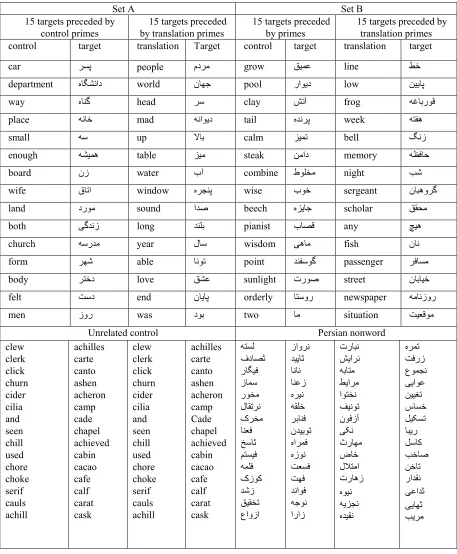
The stimuli used in experiments 1 and 2 included 60 English-Persian translation pairs and 60 Persian nonwords (Appendix A).The Persian target words were divided into two sets (A & B) of 30 in the study phase (Appendix B) and two sets of the same words in the test phase (Appendix C).In the study phase, each set was shown to half of the participants in each group. This set, therefore, was considered as old and the other as new. The same was followed for the second group. In the test phase, two presentation lists were constructed, each with 30 old items and 30 new items. Half of the Persian targets (both old and new) on each presentation list were paired with English translation primes, and the other half were paired with English control primes
that were unrelated to the target. In order to make the stimuli homogenous, the control primes were matched with the translation primes on length, frequency, and concreteness.The translation and its control prime were similar to each other in terms of length, frequency and concreteness, yet different from each other in terms of semantic relation to the target; i.e., related (translation prime) vs. unrelated (control prime). Thirty English control primes were generated by the MRC Psycholinguistic Database (Cullings, 1988).
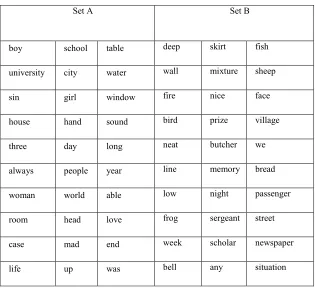
The same Persian-English translation pairs were used in experiments 3 and 4(Appendix E).The English target words were divided into two sets (A & B) of 30(Appendix F).The same procedure was adopted to create two presentation lists (Appendix G).Half of the English targets (both old and new) on each presentation list were paired with Persian translation primes, and the other half were paired with Persian control
primes. Bijankhan corpus
(Amiri&AleAhmad, n.d.) was used for this purpose. Moreover, 60 nonwords were generated by the ARC nonword database (Rastle, Harrington, &Coltheart, 2002).All the nonwords were preceded by unrelated primes. Ten additional translation pairs were selected to be used as practice items.
Procedure
were given as much time as they needed to memorize the words on the list. Then they received an initial recognition task on paper, in which they were asked to circle the words they had studied on the study list. In cases when the performance was 90% or more accurate, they received the computer version of the recognition task in which the participants were to decide as quickly as possible whether the word presented on the screen was one of the words they had studied in the study phase.
Following Forster and Davis (1984), presentation of items in experiments 1 and 2 included the following masked priming sequence: First, the participants were presented with a row of 10 hash marks for 500 ms which served to mask the subsequently presented prime. Second, the prime word immediately appeared for 50 ms. Next, a blank interval, consisting of a row of hash marks, was presented for 150 ms. The target immediately followed the backward mask. The target remained on the screen until the participants made a response (Appendix D). The inclusion of the blank space and the backward mask was for the purpose of increasing the amount of prime processing time (see Jiang 1999, Experiment 4). Normally when the prime is in the L2, its processing is slower than when it is in the L1; as a result, there would be no chance for the L2 prime to have any effect on the L1 target (see Jiang 1999, Experiment 4). After each trial was completed, the participants received feedback on the speed and accuracy of their performance.
In experiments 3 and 4, each trial consisted of the following sequence: First, a forward mask of 10 hash marks appeared for 500 ms.This forward mask was followed by the prime which was presented for 50 ms. Finally, the target word immediately followed the prime and remained on the
screen until the participants made a response (Appendix H). The participants were asked to decide as rapidly as possible whether the word presented on the screen was one of the words on the study list.
Apparatus
The DMDX package developed at the University of Arizona by J.C. Forster (Forster & Forster, 2003) was used to presentthe stimuli.
Results
Elementary L2 learners (forwardddirection) RTs longer than 1400 ms and incorrect responses, which included 25.5 % of the data, were excluded from the analysis (Gollan et al., 1997; Keatley, Spinks, & de Gelder, 1994). The descriptive statistics of the RTs in the forward direction are provided in Table 1 (tables appear after References).
The means for response times were 13.63 ms faster for the translation items in the old group and 0.7 ms faster for the control items in the new group. To compare the means of the noncognate translation and the noncognate control items in the old and new groups, two paired samples t-tests were run, the results of which showed that the noncognate translation and the noncognate control items were processed similarly by both groups (see Table 2).
Elementary L2 learners (backwarddirection) As in the previous analysis, 7.22 % of the data, which included the scores over 1400 ms and incorrect responses, were excluded from the analysis (Gollan et al., 1997; Keatley et al., 1994). The descriptive statistics of the RTs in the backward direction are provided in Table 3.
faster for the translation items in the new group.
In order to compare the means of the noncognate translation and the noncognate control items in old and new groups, two paired samples t-tests were applied. The results show that noncognate translation the noncognate control items were processed similarly in the forward direction; however, the noncognate translation items were reacted to significantly faster than the noncognate control items in the backward direction (see Table 4).
Highly proficient L2 learners (forward direction)
The incorrect responses and the RTs longer than 1400 ms, which included 17.5 % of the data, were excluded from the analysis (Gollanet al., 1997; Keatley et al., 1994). The descriptive statistics of the RTs for the noncognates in the forward direction are provided in Table 5.
The mean RTs were 37.55 ms faster for the control items in the old and 24.64 ms faster for the control items in the new group.
Two paired samples t-test were run to compare the means of noncognate translation and the noncognate control items in old and new groups. The results show that noncognate translation and noncognate control items were processed similarly (see Table 6).
Highly proficient L2 learners (backward direction)
Response times longer than1400 ms and incorrect responses, which included 21.52% of the data, were excluded from the analysis (Gollan et al., 1997; Keatley et al., 1994). The descriptive statistics of the RTs for the noncognates in the forward direction are provided in Table 7.
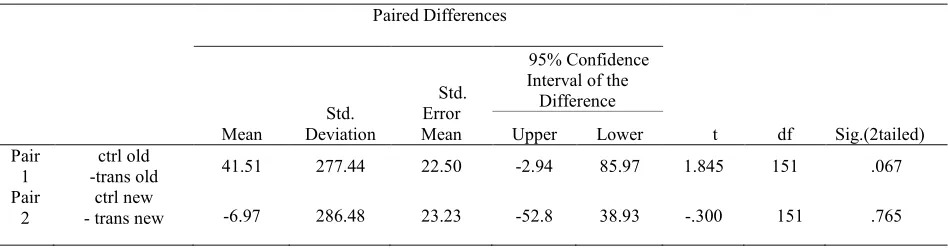
The mean response times were 41.51 ms faster for the translation items in the old and 6.98 ms faster for the control items in the new group.
Two paired samples t-test run to compare the means of the noncognate translation with the noncognate control items in old and new groups show that the noncognate translation and the noncognate control items were processed similarly by both groups (see Table 8).
Discussion and conclusion
The main purpose of the experiments conducted in this study was to evaluate predictions made by RHM indicating whether or not the strong L2-L1 lexical links formed at the beginning stages of language learning remain unchanged at higher stages. Two groups of elementary and two groups of high proficiency L2 learners were tested on noncognate stimuli with an episodic recognition task in both forward and backward directions.
The results obtained for the elementary learners showed no significant priming in the forward but significant priming in the backward direction. This pattern is consistent with the basic prediction made by RHM regarding elementary stages of language learning; however, no such links seem to exist in the forward direction.
In another experiment done by Kroll and Stewart (1994), a number of L2 learners were tested on picture naming and translation tasks in either semantically categorized or randomized context. The findings of the study showed slower RTs for the picture naming and forward translation in the semantically categorized context. Moreover, semantic manipulation of the context did not affect backward translation. The authors suggested that forward translation and picture naming tasks proceed along the conceptual routes; however, backward translation exploited lexical links between L1 and L2.
Shorter RTs for backward translation proves the existence of the strong lexical connections in the backward direction. Moreover, the fact that backward translation is not sensitive to semantic factors when compared with forward translation can be taken as evidence suggesting that backward translation occurs through L2-L1 lexical routes. The present study shed more light on this issue by showing consistent priming effects in the backward direction.
The observed pattern also supports the Word Association Model (Figure 3). According to this model, there is a common conceptual system for the lexical systems of the two languages. L2 learners retrieve the meaning of L2 lexical items via links to their translation equivalents in the first language (L2-L1 lexical links).
Figure 3: Word Association Model
Another finding of the study was that no significant priming was obtained in either direction for highly proficient L2 learners. This pattern shows that at higher levels of proficiency, L2-L1 lexical links are lost and L1 has almost no role in retrieving the semantic content of L2 words. This is not consistent with the prediction of RHM, as this model predicted the existence of these routes even at higher stages of language learning. The observed pattern shows that as L2 learners become more proficient, they begin to make direct conceptual connections from the L2 lexicon. In fact, at higher stages of L2 acquisition, the role of L2-L1 lexical access decreases and is replaced by L2 conceptual connections. As L2 learners increasingly rely on these connections, such connections gradually become stronger (Figure 4). This finding is consistent with the Concept Mediation Model.
Figure 4: Concept Mediation Model
A study conducted by Kroll and Curley (1988) confirms this pattern. In this study, advanced and elementary English-German learners performed translation and picture naming tasks. It was concluded that early L2 learners performed picture naming task through conceptual connections and backward translation through lexical routes. However, proficient L2 learners relied on the conceptual connection whendoing both tasks.
absence of lexical links for highly proficient learners in the present study shows that they are lost at this stage. As proficiency in L2 increases, learners begin to use the conceptual connections instead of the lexical routes. The presence of the lexical links in early learners and the absence of such links in highly proficient learners provide enough support for a shift from word association to concept mediation.
Based on the discussion, the following implications seem to be in order for L2 vocabulary teaching and learning. The use of L1 has several advantages. It provides the core meaning of words,which is the first step in associating the form with meaning and reinforcing the connection. As Grabe and Stoller (1997, p.114) put it, "perhaps, for adults, there are times when it is important to know that a word is understood accurately." Furthermore, using L1 may link an L2 word to its firm semantic and linguistic structure which can serve as the steadiest “cognitive hook to hang the new item on"(Fraster, 1999, p.238). This way, learners canretain the words in long term memory more efficiently.
References
Allan, D. (2004). Oxford Placement Test. Retrieved August 20, 2010, from www.waterstones.com.
Amiri, H., AleAhmad, A. (n.d.). Bijankhan Corpus. Retrieved Sep 20, 2010, fromhttp://ece.ut.ac.ir/dbrg/bijankha n.
Basnight-Brown, D.M., &Altarriba, J. (2007). Differences in semantic and translation primingacross languages: The role of language direction and language dominance.Memory and Cognition, 35, 953-965.
Bradley, D. C. (1991). Masked priming studies of episodic and lexical representations.Paper presented at
the 32nd Annual Meeting of the Psychonomic Society, San Francisco.
Brysbaert, M., Van Dyck, G., & Van De Poel, M. (1999). Visual word recognition in bilinguals: Evidence from masked phonological priming.
Journal of Experimental Psychology: Human Perception and Performance, 25, 137-148.
Costa, A., Caramazza, A., & Sebastian-Galles, N. (2000). The cognate facilitation effect: Implications for models of lexical access. Journal of Experimental Psychology: Learning, Memory, and Cognition, 26, 1283-1296.
Costa, A., Santesteban, M., & Cano, A. (2005).On the facilitatory effects of cognate words in bilingual speech production.Brain and Language, 94,
94-103.
Cullings.J. (1988).MRC psycholinguistic database. Retrieved Sep 25, 2010, fromhttp://www.psy.uwa.edu.au/mrc database/uwa_mrc.htm.
de Groot, A. M. B., Dannenburg, L., & van Hell, J. G. (1994). Forward and backward word translation by bilinguals. Journal of Memory and Language, 33, 600-629.
Dijkstra, A. (2005). Bilingual visual word recognition and lexical access. In J. F. Kroll & A.M. B. De Groot (Eds.),
Handbook of bilingualism: Psycholinguistic approaches (pp. 178201). New York, NY: Oxford University Press.
Dijkstra, T., Grainger, J., & Van Heuven, W.J.B. (1999). Recognition of cognates and interlingual homographs: The neglected role of phonology. Journal ofMemory and Language, 41, 496-518.
other language: Effects of task demands on interlingual homograph recognition.Journal of Memory and Language, 42, 445-464.
Dijkstra, T., & Van Heuven, W. J. B. (2002). The architecture of the bilingual word recognition system: From identification to decision.
Bilingualism: Language and Cognition, 5, 175-197.
Duyck, W. (2005). Translation and associative priming with cross-lingual pseudo-homophones: Evidence for nonselective phonological activation inbilinguals.
Journal of Experimental Psychology: Learning, Memory, and Cognition, 31, 1340-1359.
Duyck, W., Diependaele, K., Drieghe, D., &Brysbaert, M. (2004). The size of the crosslingual masked phonological priming effect does not depend on second language proficiency. Experimental Psychology, 51, 116-124.
Forster, K. I., & Davis, C. (1984).Repetition priming and frequency attenuation in lexical access.Journal of Experimental Psychology: Learning, Memory, & Cognition, 10, 680-698. Forster, K. I., & Forster, J. C. (2003).
DMDX: A Window display program with millisecond accuracy.
Behavioral Research Methods, Instruments, & Computers, 35, 116-124.
Fraster, C. A. (1999).Lexical processing strategy use and vocabulary learning through reading.Studies in Second Language Acquisition, 21, 25-241 Gollan, T., Forster, K. I., & Frost, R. (1997).
Translation priming with different scripts: Masked priming with cognates and noncognates in Hebrew–English bilinguals. Journal of Experimental Psychology:
Learning, Memory, and Cognition, 23,1122–1139.
Grabe, W. &Stoller, F. L. (1997). Reading and vocabulary development in a second language: A case study. In J. Coady& T. Huckin (Eds), Second Language vocabulary acquisition
(pp.98-122). Cambridge: Cambridge University Press.
Grosjean, F. (1982).Life with two languages: An introduction to bilingualism.
Cambridge, MA: Harvard University Press.
Haigh, C. A., & Jared, D. (2007). The activation of phonological representations bybilinguals while reading silently: Evidence from interlingual homophones. Journal of Experimental Psychology: Learning, Memory, and Cognition, 33,623-644. Jared, D., & Kroll, J. F. (2001). Do bilinguals activate phonological representations in one or both of their languages when naming words?
Journal of Memory and Language, 44, 2-31.
Jiang, N. (1999). Testing processing explanations for the asymmetry in
masked cross-Language
priming.Bilingualism: Language & Cognition, 2, 59-75.
Jiang, N. & Forster, K. I. (2001).Cross-language priming asymmetries in lexical decision and episodic recognition.Journal of Memory and Language, 44, 32-51.
Ju, M., & Luce, P. A. (2004).Falling on sensitive ears - Constraints on bilingual lexical activation.
Psychological Science, 15(5), 314-318.
Kim, J., & Davis, C. (2003).Task effects in masked cross-script translation and phonological priming.Journal of Memory and Language, 49, 484-499. Kroll, J. F., Bobb, S., &Wodniecka, Z.
(2006). Language selectivity is the exception, not the rule: Arguments against a fixed locus of language selection in bilingual speech.
Bilingualism: Language and Cognition, 9, 119-135.
Kroll, J. F., & Curley, J. (1988). Lexical memory in novice bilinguals: The role of concepts in retrieving second language words. In M. Gruneberg, P. Morris, &R.Sykes (Eds.), Practical aspects of memory (pp. 389–395). London: Wiley.
Kroll, J. F., & De Groot, A. M. B. (1997). Lexical and conceptual memory in the bilingual: Mapping form to meaning in two languages. In A. M. B. De Groot & J. F. Kroll (Eds.),
Tutorials in bilingualism: Psycholinguistic perspectives (pp. 169- 199). Mahwah, NJ. Lawrence Erlbaum Publishers.
Kroll, J. F., & Stewart, E. (1990).Concept mediation in bilingual translation.Paper presented at the meeting of thePsychonomic Society, (pp. 1-7). New Orleans, LA.
Kroll, J. F., & Stewart, E. (1994). Category interference in translation and picture naming:Evidence for asymmetric connections between bilingual memory representations. Journal of Memory and Language,33, 149-174. Kroll, J. F., &Tokowicz, N. (2001). The
development of conceptual representation for words in a second language. In J. N. Nicol (Ed.), One mind, two languages:Bilingual language processing (pp. 159-176). Malden, MA: Blackwell.
Lagrou, E., Hartsuiker, R. J., &Duyck, W. (2011). Knowledge of a second language influences auditory word recognition in the native language.
Journal of Experimental Psychology: Learning, Memory, and Cognition, 37, 952-965.
Lemhöfer, K., &Dijkstra, T. (2004).Recognizing cognates and interlingual homographs: Effects of code similarity in language-specific and generalized lexical decision.Memory & Cognition, 32,
533-550.
Marian, V., & Spivey, M. (2003).Bilingual and monolingual processing of competing lexical items.Applied Psycholinguistics, 24, 173-193. Nakayama, M., Sears, C.R., Hino, Y.,
&Lupker, S.J. (2012). Cross-script phonological priming for Japanese-English bilinguals: Evidence for integrated phonological representations. Language and Cognitive Processes, 27, 1563-1583. Potter, M. C., So, K. F., Von Eckardt, B., &
Feldman, L. B. (1984). Lexical and conceptual representations in beginning and more proficient bilinguals. Journal of Verbal Learningand Verbal Behavior, 23, 23–38.
Rastle, K., Harrington, J., &Coltheart, M. (2002).ARC Non-word Database. Retrieved Sep 20, 2010, from http://www.maccs.mq.edu.au/nwd/ Sanchez-Casas, R. M., Davis, C. W., &
Garcia-Albea, J. E. (1992). Bilingual lexical processing: Exploring the cognate/noncognate distinction.
European Journal of Cognitive Psychology Special Issue: Multilingual community,4, 293-310. Schulpen, B., Dijkstra, T., Schriefers, H. J.,
auditory word recognition.Journal of Experimental Psychology: Human Perception and Performance, 29,
1155-1178.
Sholl, A., Sankaranarayanan, A., & Kroll, J. F. (1995). Transfer between picture naming and translation: A test of asymmetries in bilingual memory.
Psychological Science, 6,45–49. Schwartz, A. I., Kroll, J. F., & Diaz, M.
(2007). Reading words in Spanish and English: Mapping orthography to phonology in two languages.
Language and Cognitive Processes, 22, 106-129.
Spivey, M. J., & Marian, V. (1999). Cross talk between native and second languages: Partialactivation of an irrelevant lexicon. Psychological Science, 10, 281-284.
Voga, M., & Grainger, J. (2007).Cognate status and cross-script translation priming.Memory & Cognition, 35,
938-952.
Van Assche, E., Duyck, W., Hartsuiker, R. J., &Diependaele, K. (2009). Does
bilingualism change native-language reading? Cognate effects in sentence context.Psychological Science, 20, 923-927.
Van Hell, J. G., &Dijkstra, T. (2002). Foreign language knowledge can influence native language performance in exclusively native contexts. Psychonomic Bulletin & Review, 9, 780-789.
Williams, J. N. (1994). The relationship between word meanings in the first and second language: Evidence for a common, but restricted, semantic code. European Journal of Cognitive Psychology, 6, 195–220.
Weber, A., & Cutler, A. (2004).Lexical competition in nonnative spoken-word recognition. Journal of Memory and Language, 50, 1-25.
Table 1: Descriptive statistics of RTs (ms) in forward direction
Mean N Std. Deviation Std. Error Mean
Pair 1 ctrl/old 941.3060 126 172.47378 15.36519
trans/ old 927.6794 126 172.45006 15.36307
Pair 2 ctrl/ new 1000.6944 133 182.66317 15.83891
trans/new 1001.3949 133 182.76293 15.84756
Table 2: Paired sample test (forward priming with episodic task)
Paired Differences
t df Sig.(2tailed)
Mean
Std. Deviation
Std. Error Mean
95% Confidence Interval of the Difference
Upper Lower
Pair
1 ctrl old - trans old 13.62 252.247 22.47 -30.84 58.10 .606 125 .545
Pair
2 ctrl new- trans new -.7005 270.225 23.43 -47.05 45.64 -.030 132 .976
Table 3: Descriptive statistics of RTs (ms)
Mean N Std. Deviation
Std. Error Mean
Pair 1 ctrl old 970.622 124 183.34514 16.4648
trans old 886.813 124 192.79180 17.3132
Pair 2 ctrl new 926.724 135 199.45865 17.1666
trans new 900.899 135 178.38317 15.3527
Table 4: Paired sample test (backward priming with episodic task)
Paired Differences
t df Sig.(2tailed) Mean
Std. Deviation
Std.Error Mean
95% Confidence Interval of the
Difference
Upper lower
Pair 1
ctrl old -
trans old 83.80 264.75 23.77 36.74 130.8 3.525 123 .001
Pair 2
ctrl new -
Table 5: Descriptive statistics of RTs (ms)
Table 6: Paired sample test (forward Priming with episodic task)
Paired Differences
t df Sig.(2tailed)
Mean
Std. Deviation
Std. Error Mean
95% Confidence Interval of the
Difference
Upper Lower
Pair 1
ctrl old –
trans old -37.5 311.70 25.28 -87.5 12.40 -1.48 151 .140
Pair
2 ctrl new – trans new -24.6 282.84 22.94 -69.9 20.68 -1.07 151 .285
Table 7: Descriptive statistics of RTS (ms)
Mean N Std. Deviation Std.Error Mean
Pair 1 ctrl old 770.8611 152 272.26222 22.08338
trans old 808.4125 152 206.96369 16.78697
Pair 2 ctrl new 818.9561 152 219.86327 17.83327
trans new 843.5961 152 170.69690 13.84535
Mean N Std. Deviation Std. Error Mean
Pair 1 ctrl old- 793.6472 152 303.67523 24.63131
trans old 752.1337 152 310.82759 25.21145
Pair 2 ctrl new- 831.4486 152 266.72770 21.63447
Table 8: Paired sample test (backward priming with episodic task)
Paired Differences
t df Sig.(2tailed)
Mean Deviation Std.
Std. Error Mean
95% Confidence Interval of the
Difference
Upper Lower
Pair
1 -trans old ctrl old 41.51 277.44 22.50 -2.94 85.97 1.845 151 .067
Pair
Appendix A: 60 English-Persian translation pairs and 60 Persian nonwords selected as the stimuli for experiments 1 and 2
60 English-Persian translation pairs
boy رسپ school هسردم table زیم deep قیمع skirt نماد fish یهام university هاگشناد city رهش water بآ wall راوید mixture طولخم sheep دنفسوگ sin هانگ girl رتخد window هرجنپ fire شتآ nice بوخ face تروص house هناخ hand تسد sound ادص bird هدنرپ prize هزیاج village اتسور three هس day زور long دنلب neat زیمت butcher باصق we ام always هشیمه people مدرم year لاس line طخ memory هظفاح bread نان woman نز world ناهج able انوت low نییاپ night بش passenger رفاسم room قاتا head رس love قشع frog هغابروق sergeant نابهورگ street نابایخ case دروم mad هناوید end نایاپ week هتفه scholar ققحم newspaper همانزور life یگدنز up لااب was دوب bell گنز any چیه situation تیعقوم 60 Persian nonwords
Appendix B: Set A and set B words for experiments 1 and 2
Set A Set B
رسپ هسردم زیم قیمع نماد یهام
هاگشناد رهش بآ راوید طولخم دنفسوگ
هانگ رتخد هرجنپ شتآ بوخ تروص
هناخ تسد ادص هدنرپ هزیاج اتسور
هس زور دنلب زیمت باصق ام
هشیمه مدرم لاس طخ هظفاح نان
نز ناهج انوت نییاپ بش رفاسم
قاتا رس قشع هغابروق نابهورگ نابایخ
دروم هناوید نایاپ هتفه ققحم همانزور
Appendix C: two presentation lists constructed for experiments 1 and 2
List 1
Set A Set B
15 targets preceded by control primes
15 targets preceded by translation primes
15 targets preceded by primes
15 targets preceded by translation primes
control target translation Target control target translation target
car رسپ people مدرم grow قیمع line طخ
department هاگشناد world ناهج pool راوید low نییاپ
way هانگ head رس clay شتآ frog هغابروق
place هناخ mad هناوید tail هدنرپ week هتفه
small هس up لااب calm زیمت bell گنز
enough هشیمه table زیم steak نماد memory هظفاح
board نز water بآ combine طولخم night بش
wife قاتا window هرجنپ wise بوخ sergeant نابهورگ
land دروم sound ادص beech هزیاج scholar ققحم
both یگدنز long دنلب pianist باصق any چیه
church هسردم year لاس wisdom یهام fish نان
form رهش able انوت point دنفسوگ passenger رفاسم
body رتخد love قشع sunlight تروص street نابایخ
felt تسد end نایاپ orderly اتسور newspaper همانزور
men زور was دوب two ام situation تیعقوم
Unrelated control Persian nonword
List 2
Set A Set B
15 targets preceded by control primes
15 targets preceded by translation primes
15 targets preceded by primes
15 targets preceded by translation primes
translation target control target translation target control target
boy رسپ little مدرم deep قیمع play طخ
university هاگشناد still ناهج wall راوید try نییاپ
sin هانگ high رس fire شتآ wool هغابروق
house هناخ fun هناوید bird هدنرپ told هتفه
three هس us لااب neat زیمت rice گنز
always هشیمه music زیم skirt نماد wisdom هظفاح
woman نز light بآ mixture طولخم point بش
room قاتا island هرجنپ nice بوخ sunlight نابهورگ
case دروم court ادص prize هزیاج orderly ققحم
life یگدنز come دنلب butcher باصق two چیه
school هسردم well لاس fish یهام brick نان
city رهش tell انوت sheep دنفسوگ physician رفاسم
girl رتخد free قشع face تروص ground نابایخ
hand تسد far نایاپ village اتسور breakfast همانزور
day زور for دوب we ام beginning تیعقوم
Unrelated control Persian nonword
Appendix D: presentation of experiments’ 1 and 2 stimuli in the test phase
##########
prime
##########
Appendix E: 60 English-Persian translation pairs and 60 English nonwords selected as the stimuli for experiments 3 and 4
60 English-Persian translation pairs
boy رسپ school هسردم table زیم deep قیمع skirt نماد fish یهام university هاگشناد city رهش water بآ wall راوید mixture طولخم sheep دنفسوگ sin هانگ girl رتخد window هرجنپ fire شتآ nice بوخ face تروص house هناخ hand تسد sound ادص bird هدنرپ prize هزیاج village اتسور three هس day زور long دنلب neat زیمت butcher باصق we ام always هشیمه people مدرم year لاس line طخ memory هظفاح bread نان woman نز world ناهج able انوت low نییاپ night بش passenger رفاسم room قاتا head رس love قشع frog هغابروق sergeant نابهورگ street نابایخ case دروم mad هناوید end نایاپ week هتفه scholar ققحم newspaper همانزور life یگدنز up لااب was دوب bell گنز any چیه situation تیعقوم 60 English nonwords
Appendix F: Set A and set B words for experiments 3 and 4
Set A Set B
boy school table deep skirt fish
university city water wall mixture sheep
sin girl window fire nice face
house hand sound bird prize village
three day long neat butcher we
always people year line memory bread
woman world able low night passenger
room head love frog sergeant street
case mad end week scholar newspaper
Appendix G: two presentation lists constructed for experiments 3 and 4
List 1:
Set A Set B
15 targets preceded by control primes
15 targets preceded by translation primes
15 targets preceded by primes
15 targets preceded by translation primes
control target translation target control target translation target
هلول boy مدرم people بوچ skirt طخ line
يزاب university ناهج world بجاو mixture نییاپ low
هار Sin رس head رتهب nice هغابروق frog
تفن house هناوید mad هلاقم prize هتفه week
ملیف three لااب up ازتیپ butcher گنز bell
هدرتسگ always زیم table فایلا sheep هظفاح memory
زاگ woman بآ water سیئر face بش night
هلابز room هرجنپ window هزاغم village نابهورگ sergeant
سیئر case ادص sound ای we ققحم scholar
ریزو life دنلب long زامن bread چیه any
نفلت school لاس year يلاخ deep نان fish
میت city انوت able عبرم wall رفاسم passenger
مرج girl قشع love هچب fire نابایخ street
تلود hand نایاپ end ماوقا bird همانزور newspaper
هورگ day دوب was اطعا neat تیعقوم situation
Unrelated control Persian nonword
List 2:
Set A Set B
15 targets preceded by control primes
15 targets preceded by translation primes
15 targets preceded by primes
15 targets preceded by translation primes
translation target control target translation target control target
رسپ boy نارهت people قیمع deep بش line
هاگشناد university دیلوت world راوید wall نشور low
هانگ sin ربخ head شتآ fire ينحنم frog
هناخ house یلاحشوخ mad هدنرپ bird ناتسا week
هس three مشچ up زیمت neat قلف bell
هشیمه always بوچ table نماد skirt ناجیه memory
نز woman امش water طولخم mixture نیچ night
قاتا room رواد window بوخ nice هاگترپ sergeant
دروم case حلاس sound هزیاج prize نادمه scholar
یگدنز life ماو long باصق butcher ندش any
هسردم school رد year یهام fish دلاوف fish
رهش city ناطیش able دنفسوگ sheep روتوم passenger
رتخد girl نهذ love تروص face هاگتسد street
تسد hand طسوت end اتسور village بلاقنا newspaper
زور day زین was ام we يگژیو situation
Unrelated control Persian nonword
Appendix H: presentation of experiments’ 3 and 4 stimuli in the test phase
##########
prime