Viscoelastic Response of Multilayered Pavements
Mahmood Malakouti
1, Mahmoud Ameri
2, Parviz Malekzadeh
3Received: 23.06.2013 Accepted:07.10.2013
Abstract
7KLVSDSHUSURYLGHVDQLQFUHPHQWDOOD\HUZLVH¿QLWHHOHPHQWIRUPXODWLRQIRUWKHYLVFRHODVWLFDQDO\VLVRIPXOWLOD\HUHG SDYHPHQWV7KHFRQVWLWXWLYHEHKDYLRURIDVSKDOWFRQFUHWHLVUHSUHVHQWHGE\WKH3URQ\VHULHV/D\HUZLVH¿QLWHHOHPHQW KDVEHHQVKRZQWRSURYLGHDQHI¿FLHQWDQGDFFXUDWHWRROIRUWKHQXPHULFDOVLPXODWLRQRIODPLQDWHGVWUXFWXUHV0RVW
of the previous researches on numerical simulation of laminated structures have been limited to elastic material
be-KDYLRU7KXVWKHFXUUHQWZRUNIRFXVHVRQOD\HUZLVH¿QLWHHOHPHQWDQDO\VLVRIODPLQDWHGVWUXFWXUHVZLWKHPEHGGHG
viscoelastic material such as pavements.A computer code based on the presented formulation has been developed to
SURYLGHWKHQXPHULFDOUHVXOWV7KHSURSRVHGDSSURDFKLVYHUL¿HGE\FRPSDULQJWKHUHVXOWVWRWKHDQDO\WLFDOVROXWLRQV
existing numerical solutions in the literature, and those obtained from the ABAQUS software, as well.Finally, and as an application of the presented formulation, the effects of time and load rate on the quasi-static structural response of asphalt concrete (AC) pavements are studied.
Keywords:
/D\HUZLVH ¿QLWH HOHPHQW OLQHDU YLVFRHODVWLF PDWHULDOV 0XOWLOD\HUHG VWUXFWXUHV 3DYHPHQWV 3URQ\series
ѨѨѨѨѨѨѨѨ
Corresponding Author: Email: [email protected]
3K'7UDQVSRUWDWLRQ'HSDUWPHQWRI&LYLO(QJLQHHULQJ,UDQ8QLYHUVLW\RI6FLHQFHDQG7HFKQRORJ\7HKUDQ,UDQ 3URIHVVRU'HSDUWPHQWRI&LYLO(QJLQHHULQJ,UDQ8QLYHUVLW\RI6FLHQFHDQG7HFKQRORJ\7HKUDQ,UDQ
1. Introduction
Evaluating pavement responses, such as stresses and strains, in pavement layers, is an important issue for pavement designers. Since the pavement is a
PXOWLOD\HUHGV\VWHPWKHDQDO\VLVRIÀH[LEOHSDYHPHQWV
is a complex problem. Conventionally, the pavement is considered as a layered elastic structure for which the stresses and strains can be estimated based on the layered elastic theory [Yoder and Witczak,1975]. The initial studies of structural analysis in pavements have been carried out by Boussinesq [Boussinesq,1885] in which soils were modeled as a linear-elastic material. Afterwards the Boussinesq’s theory was extended to a multilayer elastic model and Burmister
>%XUPLVWHU @ ZDV WKH ¿UVW UHVHDUFKHU ZKR
introduced solutions for two- and three-layer systems. Layered elastic theory has been systemized and widely
XVHG IRU DQDO\VLV DQG GHVLJQ RI ÀH[LEOH SDYHPHQWV ,QWKHODVWGHFDGHVWKHWKHRU\KDVEHHQH[WHQGHGLQWR
an arbitrary number of layers, and various computer
FRGHV KDYH EHHQ GHYHORSHG FRGHV VXFK DV %,6$5 >-RQJ 3HXW] DQG .RUVZDJHQ@ .(1/$<(5 >+XDQJ@ -8/($ >8]HQ@ DQG %,6$5
[Hildebrand, 2002]. However, most of the previous research works have been limited to elastic material
EHKDYLRU ,W LV ZHOO NQRZQ WKDW DVSKDOW FRQFUHWH LV D
complex multilayered structure where the surface layer has a time-dependent behavior due to the viscoelastic binder. Therefore, the elasticity assumption is valid only when the asphalt mixture stays below the glass
WUDQVLWLRQ WHPSHUDWXUH>-DHVHXQJ 5H\QDOGR DQG
Thomas,2009]. Obtaining more realistic structural responses for asphalt mixture is still a challenging topic in mechanistic pavement design methods. Accurate simulation of these types of materials requires the
XVH RI YLVFRHODVWLF FRQVWLWXWLYH PRGHOV>-LDQOLQ DQG
Bjorn, 2007]. The main problem towards mathematical modeling of the mechanical behavior of these materials is time dependency, i.e. the response is not only a function of the current input but also depends on the past input history and as a consequence, the solution of such problems becomes more complicated than the relevant linear elastic problem. For this reason, sometimes the viscoelastic solutions for simple problems are estimated by using the associated elastic
solutions. For this purpose, the viscoelastic equations are transformed into equivalent elastic ones by means of Fourier and Laplace transforms. After solving the transformed problem, a numerical inversion is employed to recover the desired time domain response (see for example [Bozzaand Gentili,1995; Drozdov and Dorfmann,2004;Chou andLarew,1968; Huang,1973; Lee,1955;Hopman,1996;Radok,1957]).
Due to the complexity of the viscoelastic constitutive relations; however, such treatment is reasonable only in the cases of simple geometries or idealized boundary
FRQGLWLRQV ,Q DGGLWLRQ LQ WKH FDVHV IRU ZKLFK WKH
relaxation or creep molduli cannot be expressed accurately by a simple model, the viscous parameters are time dependent, or complicated time dependent boundary conditions should be implemented, the Laplace transformation-inversion method become too complicated to be used. Since most of the existing analytical solutions require retaining of the complete history of stress and strain in the memory of a digital computer, these methods fail to deal with real and complex problems [Ghazlan, Caperaa and Petit,1995; Zocher, Groves and Aellen,1997]. To overcome this shortcoming, a number of theories based on the incremental constitutive equations have been proposed. For example, incremental constitutive equations in
FRQMXQFWLRQ ZLWK ¿QLWH HOHPHQW PHWKRG KDYH EHHQ
employed by some researchers [Ghazlan, Caperaa and Petit,1995; Zocher, Groves and Aelle,1997; Kim and Sung Lee, 2007; Theocaris ,1964; Chazal, Pitti, 2009; Dubois; Chazal and Petit, 1999].
Different types of mathematical models are usually obtained for the viscoelastic behavior of materials by means of different arrangements of spring(s) and dashpot(s). For example, Generalized models (Prony series models) such as the generalized Maxwell model consisting of a spring and Maxwell elements connected in parallel manner [Zocher, Groves and Aelle,1997;
(OVHL¿$O4DGLDQG<RR&KHQ3DQDQG*UHHQ
2005; Benedetto et. al., 2004;Chupin et. al., 2010], power law model [Bahia and Anderson,1995], etc.….
,Q WKH SUHVHQW SDSHU D 3URQ\ JHQHUDOL]HG 0D[ZHOO
model series is adopted, which has been frequently employed by the researchers for modeling the asphalt
FRQFUHWH EHKDYLRU >(OVHL¿ $O4DGL DQG <RR
Chen, Pan and Green, 2009; Gibson et. al., 2003; Park
DQG 6KDSHU\ -XQLRU HW DO )XMLH DQG
Walubita, 2006].
$ GLVSODFHPHQW EDVHG OD\HUZLVH ¿QLWH HOHPHQW
method (LW-FEM) has been introduced by Reddy [Reddy,1987] to accurately determine the transverse shear and normal stress distributions of laminated composites based on the three-dimensional elasticity theory. This method was increasingly used by others as in the original form proposed by Reddy or in its extended forms for the solution of engineering problems, such as laminated structure [Lee and Liu, 1992; Malekzadeh, 2009; Setoodeh and Karami, 2004; Malekzadeh, Setoodeh and Barmshouri, 2008; Setoodeh, Malekzadeh and Nikbin, 2009] during recent
\HDUV7KHOD\HUZLVHWKHRU\LVDUH¿QHGWKHRU\WKDWFDQ
take into account the thickness effects with minimum computational cost [Malekzadeh, 2009; Setoodeh and Karami, 2004; Malekzadeh, Setoodeh and Barmshouri, 2008; Setoodeh, Malekzadeh and Nikbin, 2009]. Since the layerwise theories assume a separate displacement
¿HOGH[SDQVLRQVZLWKLQHDFKVXEGLYLVLRQLWSURYLGHVD NLQHPDWLFDOO\FRUUHFWUHSUHVHQWDWLRQRIWKHVWUDLQ¿HOG
in discrete layers [Reddy,1987; Bert and Malik,1996].
,QDGGLWLRQEHFDXVHWKHVKHDUVWUDLQVDUHGLVFRQWLQXRXV
this leaves the possibility of the continuous transverse stresses between adjacent layers in the layerwise theory. The approach actually shrinks the modeling to a combined from two one-dimensional analysis, which considerably reduces the number of manipulations,
DQGWKHFRPSOH[LW\LQWKHIRUPXODWLRQRIWKH'¿QLWH HOHPHQW PHWKRG ,PSOHPHQWLQJ VXFK PHWKRGRORJ\
is not possible in powerful software like ABAQUS, which are developed on the basis of the conventional FEM.
7KH FXUUHQW ZRUN SUHVHQWV D VLPSOH DQG HI¿FLHQW
algorithm based on the incremental viscoelastic LW-FEM for axisymmetric analysis of multilayer viscoelastic structures and in particular, asphaltpavements. This paper presents the details of
WKH /:)( IRUPXODWLRQ YHUL¿FDWLRQ DQG DQ DVSKDOW
pavement simulation example. The model is capable of evaluating the contact force, displacement, velocity and stress time histories for laminated structures subjected to different boundary conditions. Apart from simulation of asphalt pavements, the present approach could also be used for analysis of other engineering problems that exhibit viscoelastic behavior.
2. Characterization of Viscoelastic Behavior
of Asphalt Concrete
Asphalt concrete belongs to the wide group of viscoelastic materials. Usual laboratory tests are used to determine the linear viscoelastic characteristic parameters of asphalt mixtures such as relaxation modulus C(t), creep compliance D(t), and complex modulus E*. The relaxation modulus, C(t), is the ratio of the stress response to a constant strain input, whereas the creep compliance, D(t), is the ratio of the strain response to a constant stress input. For purely elastic asphalt mixtures, C(t) and D(t) are reciprocals. However, as a result of viscoelastic characteristics of asphalt mixtures, this is only true in the Laplace transform domain [Chen, Pan and Green, 2009]. The viscoelastic behavior of asphalt concrete can be modeled by either the generalized Maxwell model,
RUWKHJHQHUDOL]HG.HOYLQPRGHO>(OVHL¿$O4DGLDQG
Yoo, 2006;Gibson et. al., 2003].The relaxation modulus
C(t) from the generalized Maxwell model and the creep compliance D(t) from the generalized Kelvin model are given by [Chen, Pan and Green, 2009].
where:
and are equilibrium modulus and relaxation strength, respectively;
and are glassy compliance and the retardation strength receptively; and are relaxation time and retardation time, respectively;
H(t) is the unit step function.
Once viscoelastic materials represent time dependency,
C
ijkl(t)= C
() ijkl+ C
ijkl(m)e H(t), D
ijkl(t)=
——
tȡ
(m)ijkl M
m=1
C
ijkl()C
ijkl(m)D
(0) ijklD
(0)+ D
(n)1e H(t)
ijkl N
n=1——
ijkl tIJ
(n) ijklD
(n) ijklȡ
(m) ijklIJ
(n) ijkltheir responses at a given instant do not only depend on the applied load at that instant but also on the complete history [Christensen, 1982]
Using the Boltzmann superposition principle [Boltzmann,1878], the stress-strain relationship of a viscoelastic material can be written as a hereditary integral. For instance, the stress ıij(t)DQGVWUDLQİij(t) of a linear viscoelastic material for 2D problems is given by:
ı
ijW &
ijkl(t IJ)——
GIJ
İ
ij(t)=
t
'
ijkl(t IJ)——
GIJ
where Cijkl(t) and Dijkl(t) are the components of relaxation modulus and creep compliance tensor,
UHVSHFWLYHO\IJLVWKHWLPHGXPP\YDULDEOHDQGt is the
time since loading. Hereafter, repeated indices imply the summation convention.
From Eq. (2 a, b) it is obvious that the response is a function of the current input and the input history as well. The constitutive equations represented by (2 a, b) can be expressed into an incremental form in order to be used with a layerwise finite element analysis. This method is based on a time discretization of the compliance or relaxation function according to Prony series represented by (1 a, b). The use of incremental form has the advantage of eliminating the memory possessing problem because it does not need to solve a set of differential equations simultaneously. Different time integration algorithms for the linear viscoelastic problems have been presented in the literature for both isotropic and anisotropic solids [Ghazlan, Caperaa and Petit, 1995; Zocher, Groves and
$HOOHQ7D\ORU3LVWHUDQG*RXUGUHDX@,Q
this study, after a comprehensive review of the relevant literature, the numerical algorithm proposed by Zocher [Zocher, Groves and Aellen,1997] was adopted. Based on this method, the relaxation function C(t) is used to display the Prony series, while in the Ghazlan's method [Ghazlan, Caperaa and Petit,1995], the creep compliance D(t) is used. Based on this algorithm and prior to development of the layerwise finite element formulation, the constitutive relation in terms of
relaxation functionis transformed from integral form into an incremental algebraic form by a Prony series
UHSUHVHQWDWLRQ,QWKHIROORZLQJWKHPDLQIRUPXODWLRQV
and principles of this algorithm are briefly described.
,Q WKLV DOJRULWKP WKH WLPH FRUUHVSRQGLQJ WR WKH QH[W
step n+1 is obtained from the current time tn through:
ǻtn=t n+1 tn (3)
where:
ǻtn is a time increment between the two steps.
The stress increment from time tn to time tn+1 is defined as,
ǻı
ij=ǻı
R+ C
ijkl
(ǻİ
kl)
(4)
where:
ǻİij DQG ǻıij are the increments of strain and stress
tensor components, respectively, and Cijkl is a fourth order tensor which can be interpreted as a viscoelastic relaxation tensor,
C
ijkl=C
+— ȡ(m) C(m) 1 e (5)
$OVRǻıR is given by
ǻıR =1 e S(m)(t
n) (6)
where S(m) can be expressed as
(7)
ZKHUHİkl(tn 1 ) is constant representing the time rate of change over the interval from time step tn-1 to tn . When using small time increments, it is possible to assume a constant strain rate variation during the interval
İkl= —— —— (8)
For a complete solution of the algorithm regarding the incrementalization method, refer to [Zocher, Groves and Aellen, 1997]. The incremental constitutive law represented by (4) can be introduced in a layerwise finite element discretization in order to obtain solutions to complex viscoelastic problems.
3. Axisymmetric LayerwiseFinite Element
Formulation for Viscoelastic Analysis
3.1 Axisymmetric Modeling
2 2k l
t
klİ
IJ
2 2 k l
klı
IJ
ij
2 2
k l
—
ij
—
ijkl
1
ǻtn M
m ijkl ijkl
ǻtn
——ȡ(m)
—
ij
M
m
ǻtn
——
ȡ(m) ijkl
ijkl
ijkl
klİ
t ǻİkl
ǻt
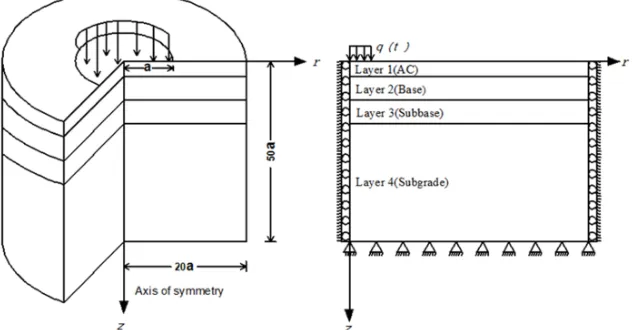
An axisymmetric analysis is carried out for the LW-FE approach. The axisymmetric modeling has been selected because it could simulate circular loading and did not require excessive computational cost. A typical axisymmetric cross section is shown in Figure1. Based on the two-dimensional theory of elasticity, the linearized axisymmetric strain displacement relations are as follows,
ZKHUHİii (i=r , z,ș) and Yxz are the Lagrangian normal and shear components of the strain tensor, respectively.
3.2 Layerwise Finite Element Formulation for Viscoelastic Analysis
Based on this theory, the laminated structure in the thickness direction is subdivided into a series of NML PDWKHPDWLFDO OD\HUV ,Q HDFK PDWKHPDWLFDO OD\HU WKH
displacement components in the thickness direction are approximated in a similar manner as the
one-GLPHQVLRQDO ¿QLWH HOHPHQW PHWKRG 7RWDO QXPEHU RI
nodes in the z-direction, N
z ,is determined in terms of
the number of mathematical layers N
ML and the node
per layer N
PL according to Nz = ( NPL 1 )NML+1 . The
layerwise concept is general such that the number of subdivisions through the thickness can be greater than, equal to, or less than the number of material or
SK\VLFDO OD\HUV WKURXJK WKH WKLFNQHVV ,QGHSHQGHQW VKDSHIXQFWLRQVDUHGH¿QHGWKURXJKWKHOD\HUWKLFNQHVV
as well as the longitudinal direction. Any desired displacement variation degree through the thickness
LV HDVLO\ REWDLQHG E\ HLWKHU DGGLQJ PRUH ' ¿QLWH
element subdivisions along the thickness, or using
higher–order Lagrangian interpolation polynomials
WKURXJK WKH WKLFNQHVV ,Q WKLV VWXG\ WKLV VWXG\ WKH OLQHDUJOREDOVKDSHIXQFWLRQVȥj(z) and i(r) are used. For the case of two nodes per mathematical layers in the thickness direction and r-direction elements, the global interpolation functions become:
0 Z Zj1
——— Zj1 ==j
ȥj(z)= for j=1,2,3,...,N z (10)
——— Zj==j+1
0 Zj+1Z
And
ʔi(r)=
where r
i and zj are the r-coordinate and z-coordinate of
the global node i and j, respectively. i(r) and j(z) are the 1D the global interpolation function in the r and z-direction, respectively.
,Q DQ LQFUHPHQWDO GLVSODFHPHQWEDVHG IRUPXODWLRQ
the deformation would be stated in terms of these shape functions and the nodal displacements. Hence, the incremental displacement components of any desired element at any point within the jth-layer may be
expressed as,
{
İij T
= İrr İzz İșșYrz = — — — — + —
{
{
{
ur wz ur uz wr
z zj1
zj zj1
zj+1 z zj+1 zj
{
0
UU
i-1r-r
i-1ѨѨ r
i-1UU
ir
i-r
i-1r
i+1-r
ѨѨr
iUU
i+1r
i+1-r
i0 r
i+1U
for i=1,2,3,...,N
r (11)
(9)
N
rN
z i=1 j=1
N
rN
z i=1 j=1ǻu
r = ǻu(r,z,ǻtn)= ǻUij(ǻtn) ʔi(r)ȥj(z)=
ǻUij(ǻtn) ʔi(r)ȥj(z) (12)
ǻuz = ǻW(r,z,ǻtn)= ǻWij(ǻtn) ʔi(r)ȥj(z)=
ǻWij(ǻtn) ʔi(r)ȥj(z) (13)
ZKHUH ǻur DQG ǻuz are the incremental displacement
components of an arbitrary material point in the r–z plane along r and zGLUHFWLRQVUHVSHFWLYHO\ǻUij(ǻtn)
DQG ǻWij(ǻtn) are the incremental displacement
components of ith node corresponding to jth node
(defined by r=ri and z=zi ) in the r and z-direction, respectively; also, as obvious from Eqs. (12) and (13), for brevity purpose the indicial summation notation is used.
To derive the incremental stress-strain relations at an arbitrary point of a laminate, the axisymmrtric constitutive relations is used, which according to Eq. (4) for a viscoelastic materials is
where: ǻVii (i=r, z, ș ) and ǻVxz are the Lagrangian increments of normal and shear stress, respectively.
Also [C ] is the viscoelastic material stiffness matrix
in the principal coordinates of the laminae. Substituting
the displacement components from Eqs. (12) and (13)
into Eq. (9), -results:
ǻİrr(ǻtn)=ǻ8ij (ǻtn)ȥj(z) ѨѨ
ǻİzz(ǻtn)= ǻ:ij (ǻtniji(r) ѨѨ
ǻİșș(ǻtn)= ѨѨѨѨ
ǻȖrz=ǻU
ij(ǻtniji(r) ѨѨѨǻWij(ǻtnȥj(z)ѨѨѨ
The incremental equilibrium equations for the viscoelastic problem under consideration can be
derived using the principle of virtual work. For a two-dimensional continuum problem, during the time step
ǻtn in dynamic condition can be written as follows:
ʌ³³>ǻVrrįǻİrr )+ǻVzz įǻİzz )+ǻVșșįǻİșș)+ ǻVrz įǻȖrz )]r dz dr
(16)
-ʌ³
ǻqTUWijUįjNzįǻWij)r dr -2ʌ³ǻT]Wȥj]įiNr
įǻ8ij )r dr
+ʌ³³ȡǻhįǻUij )+ǻWij ))r dz dr = 0
where: dot over a displacement components represent
LWVGHULYDWLYHZLWKUHVSHFWWRWLPHǻqT (r,t)DQGǻqR (z,t)
are the increments of external transverse and radial loads, ȡ the material density, R the domain radius, h
the domain depth; and finally įij is the Kronecker delta. Using Eqs. (14)–(16) and performing the finite element assembling procedure, the discretized equations of motion take the following form,
where: is the external load vector increment and is the elements load vector due to change of stresses during the time. The elements of the stiffness matrices [Kij](i ,j=u, v), the mass matrices [Mij] (i ,j=u, v), and the load vector increments and are presented in Appendix A.
,Q SUREOHPV IRU ZKLFK WKH ORDGLQJ LV DSSOLHG TXDVL
statically ( i.e. the dynamic effects of the acceleration are negligible), the pertinent terms can be dropped from the equation of motionto reduce Eq. (17)to
4. Code Development
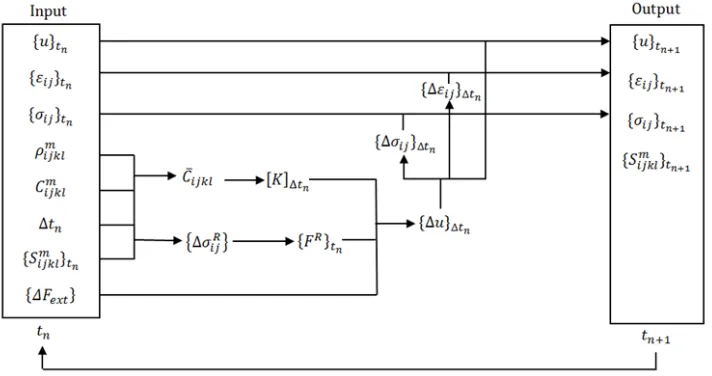
Based on the theoretical concept discussed in the preceding sections, a code was developed in this study. The base part of this code is anaxisymmetric LW-FE program as defined previously. An outline of the step-by-step calculations performed in the code is provided as follows. The solution algorithm is also shown in Figure 2.
Suppose that mechanical fields are known at time and the time increment is fixed to .
{
ǻVrr C11 C12 C13 ǻİrr ǻVrrǻVzz C12 C22 C23 ǻİzz ǻVzz = +
ǻVșșC
13 C23 C33 ǻİșșǻVșș
ǻVrz 0
0 0 C44 ǻȖrz ǻVrz
{
[
[
ǻtn{
{
{
RRR
R
{
ǻtn
ǻUij(ǻtn ) r
d
ȥj(z) dzd
iji(r) drd
iji(r) drd
ȥj(z)dz
(15 a- d)
ǻtn
R
= [C@^ǻİij`^ǻVij}
1. Firstly, the relaxation tensor C
ijkl, is computed from
Eq. (5) and the global linear viscoelastic stiffness matrix [Kij] is evaluated from Eqs. (A1-A12)
2. Pseudo stress tensor is computed from Eq. (6) and then the load vector, is determined using Eq. (A15- A17).
3. The equilibrium equations (18) are solved for the external load vector and the nodal displacement
vector increment isdetermined.
4. The strain increment is computed from the equations (15a-d).
5. The results of step (2) are utilized to compute the stress increment using Eq. (4).
7KHVWDWHRIDOO¿OHGYDULDEOHVGLVSODFHPHQWVWUHVV
and strain) is updated at the end of the time increment as follows:
8
,I WLPH 6WHS Q LV WKH ODVW VWHS GR QRWKLQJOtherwise, is calculated using the resulted , and Eqs.(6), (7).
9. Go to step 1
5. Numerical Results
,QWKLVVHFWLRQWKHSUHVHQWHGIRUPXODWLRQDQGPHWKRG
of solution is validated and then a pavement structure composed of a viscoelastic layer and three elastic layers is analyzed and some numerical results are presented.
,QRUGHUWRHYDOXDWHWKHDFFXUDF\RIWKHD[LV\PPHWULF OD\HUZLVH ¿QLWH HOHPHQW IRUPXODWLRQ WKH QXPHULFDO
solution is compared to analytical solutions for three-layer pavement. The stress values calculated using the proposed algorithms are compared to the widely
XVHG -RQHV¶ 7DEOHV RI VWUHVVHV LQ WKUHHOD\HU HODVWLF V\VWHP>-RQHV@3DYHPHQWVWUXFWXUHDQGPDWHULDO
properties for this set of analysis is given in Table 1, pavement section is subjected to a circular load with a radius of 15 cm and uniform pressure of 550KPa. The LW-FE domain has the size of 50×a in the verticaldirection and 20×a in the horizontal directions, where a is the radius of circular loaded area .
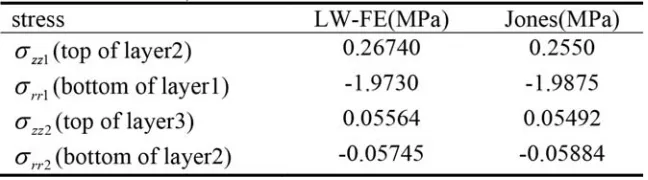
Table 2, shows the stresses calculated using LW-FE
IRUPXODWLRQDQGDQDO\WLFDOVROXWLRQE\-RQHV2QHFDQ
observe that the results are in excellent agreement with those of analytical solution.
—
ǻt n
Table 1. Pavement structure and material properties for validation of axisymmetric LW-FE analysis
7DEOH3UHGLFWHGVWUHVVHVE\/:)(DQG-RQHV1XPEHURIUDGLDOHOHPHQW
After analytical validation of the proposed approach, a multilayered pavement section, with a viscoelas-tic layer, is analyzed and the results are compared to the ones obtained using the software ABAQUS. The pavement section (see Figure 1) is simulated by using
DQ D[LV\PPHWULF OD\HUZLVH ¿QLWH HOHPHQW PRGHO7KH
pavement structure is composed of four homogeneous
DQGLVRWURSLFOD\HUV,QRUGHUWRLQFRUSRUDWHWKHYLVFRH
-lastic properties of the asphalt concrete, the top layer is assumed to be viscoelastic, while the lower three layers have linear elastic behavior. The viscoelastic properties of the top layer are characterized by the time-depend-ent relaxation modulus C(t) DQG 3RLVVRQ¶V UDWLR ,W LV
assumed that the layers are perfectly bonded and thus, the tractions and displacements are continuous across the interface. The time-dependent load is
ap-SOLHGRYHUDFLUFOHRIUDGLXVDRQWKHVXUIDFH] ,QWKLV
study, a step load is applied on the surface, as follows:
The intensity of the load varies with the time of the half sine wave, as assumed by [Huang,1993],
where q 0is the load amplitude and t0 is the load dura-tion.
Pavement structure is subjected to a circular load which has radius of 15cm and pressure of 550KPa.LW-FE do-main has the size of 50×a(7.5m) in the vertical direc-tion and 20×a(3m) in the horizontal direcdirec-tions, where a is the radius of circular loading.
The pavement under study is composed of AC, base, granular sub-base and subgrade with parameters listed in Table 3, The AC layer is viscoelastic and material constants used in the relaxation functionpresented in Eq. (1) are listed in Table 4. The bottom surface of
WKHVXEJUDGHLVDVVXPHGWREH¿[HGZKLFKPHDQVWKDW
nodes at the bottom of the subgrade cannot move hori-zontally or vertically. The boundary nodes along the pavement edges are horizontally constrained, but are free to move in the vertical direction. Boundary condi-tions for the problem are given in Figure1.
A load duration t0=0.1 s corresponding to the vehicle speed of 10 (km/h), is considered. Quasi-static analy-ses are conducted and computed parameters are verti-cal displacement at the top of the surface layer, radial and shear stress at the bottom of AC layer and vertical stress on the top of the subgrade layer. According to Table 5,the predicted pavement responses are in agree-ment with ABAQUS results.
(19)
Table 3. The material properties and thickness of layers for a typical four-layer pavement
Table 4. The values of Cm and ȡm for viscoelastic AC layer[Lee,1996]
8VLQJWKHSUHVHQWHGIRUPXODWLRQWRVWXG\WKHLQÀXHQFH
of different values of the load’s duration (t0) of 0.1 s and 0.006 s corresponding to speeds of 10 (km/h) and 120 (km/h) of the vehicle, respectively, the quasi-static analyses is conducted in order to evaluate the impor-tance of velocity effects.
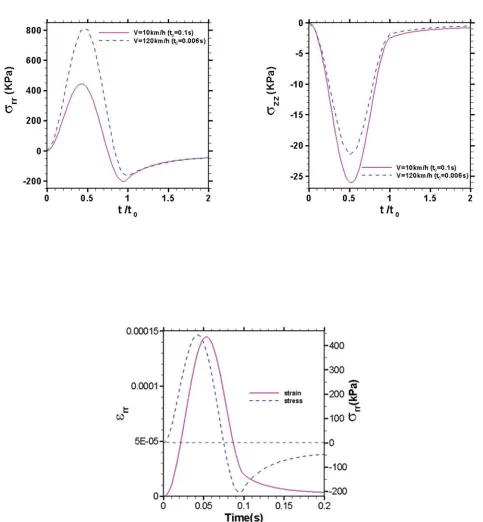
,Q )LJXUHV DG WKH WLPH KLVWRULHV RI WKH V\PPH
-try axis displacement on the top surface W(0,0), the symmetry axis shear stress and radial stress at the bottom of the AC layer, and the symmetry axis transverse normal stress applied on the top of subgrade for the two different load duration of 0.1 s (correspond to speed V =10 km/h) and 0.006 s (correspond to speed V=120 km/h) are
present-HG,WLVREYLRXVWKDWWKHORDGGXUDWLRQKDYHVLJQL¿FDQW
effect on the variation of the symmetry axis shear stress and normal stress at the bottom of the AC layer. One of the most important characteristics of viscoelastic materials is the time lag between stress and strain. This is indicated in Figure 4 for t
0=0.1 s.
Variation of the transverse normal strain a and stress along the symmetry axis of the pavement is shown in Figures 5 (a) and (b) for a pulse of 0.006s
9 NPK,WFDQEHVHHQWKDWWKHSUHVHQWHGIRUPX
-lation and method of solution can capture the zig-zag variation of the normal strain and the smooth variation of the transverse normal stress. Also, it is observable that the variation these quantities
have the same trend for both values of the load
dura-tion. Figures 6 (a) and (b) depict distribution through the depth for the radial strain and stress at the symmetry axis of the pavement for a pulse of 0.1s (V =10km/h) at t=0.05s.
6. Conclusions
$Q LQFUHPHQWDO OD\HUZLVH ¿QLWH HOHPHQW IRUPXODWLRQ
was presented to solve the time-dependent response of multilayered viscoelastic pavement under surface loadings and a code was developed as well. The two-dimensional elasticity theory approach guarantees the generality of the method and the layerwise theory
PDNHV DQDO\VLV HFRQRPLFDO DQG RSWLPDO ,QFUHPHQ
)LJXUH'LVWULEXWLRQRIWKHV\PPHWU\D[LVU WUDQVYHUVHQRUPDOVWUDLQİzzDQGVWUHVVızz) in depth for a pulse of 0.006s (V =120km/h) at t=0.003s.
)LJXUH'LVWULEXWLRQRIWKHV\PPHWU\D[LVU UDGLDOVWUDLQİrrDQGVWUHVVırr) in depth for a pulse of 0.1s
7. References
-Bahia, H. U. and Anderson, D. A. (1995) “Develop-ment of the bending beam rheometer; Basics and criti-cal evaluation of the rheometer”, in: Proc. ASTM Phys-ical Properties of Asphalt Cement Binders Conf., Vol. 1241, 1995,pp.28–50.
-Benedetto, H.D., Olard, F., Sauzéat, C. and Delaporte, B. (2004) “Linear viscoelastic behavior of bituminous materials: from binders to mixes”, Road Materials and Pavement Design, Vol. 5, 2004, pp. 163–202.
-Bert, C. W. and Malik, M. (1996) “Differential quad-rature method in computational mechanics: a review”, Applied Mechanics Review, Vol. 49, 1996, pp. 1–27.
-Boltzmann, L. (1878) “Zurtheorie der elastischen-nachwirkungsitzungsber” Mat Naturwiss. Kl. Kaiser. Akad.Wiss., Vol. 70, 1878, 275.
%RXVVLQHVT - ³$SSOLFDWLRQ GHV SRWHQWLHOV i
l'étude de l'équilibre et du mouvement des solidesélas-tique” Paris: Gauthier-Villard.
%R]]D$DQG*HQWLOL*³,QYHUVLRQDQGTXD
-si-static problems in linear viscoelasticity”,Meccanica, Vol. 30, 1995, pp. 321–335.
-Burmister, D.M. (1943)“The theory of stress and dis-placements in layered systems and applications to the design of airport runways”, Highway Research Board, Proceedings of the annual meeting, Vol. 23, 1943, pp. 126–144.
-Burmister, D.M. (1945)“The general theory of stress
DQGGLVSODFHPHQWVLQOD\HUHGVRLOV\VWHPV´-RXUQDORI
Applied physics, Vol. 16, 1945, pp. 89–94.
-Burmister, D.M. (1945)“The general theory of stress
DQGGLVSODFHPHQWVLQOD\HUHGVRLOV\VWHPV,,´-RXUQDO
of Applied physics, Vol. 16, 1945, pp. 126–127.
-Burmister, D. M. (1945)“The general theory of stress
DQGGLVSODFHPHQWVLQOD\HUHGVRLOV\VWHPV,,,´-RXUQDO
of Applied physics, Vol. 16, 1945, pp. 296–302.
-Chazal, C. F. and Pitti, R.M. (2009)“An incremental constitutive law for ageing viscoelastic materials, a three dimensional approach”, ComptesrendusMecan-ique, Vol. 337, 2009, pp.30–33.
-Chen, E. Y. G., Pan, E. and Green, R. (2009) “Surface loading of a multilayered viscoelastic pavement: semi
DQDO\WLFDO VROXWLRQ´ -RXUQDO RI (QJLQHHULQJ 0HFKDQ
-ics, Vol. 35, No. 6, 2009, pp. 517–528.
-Chou, Y. T. and Larew, H. G. (1969) “Stresses and dis-placements in viscoelastic pavement systems under a moving load”, Highway Research Board, National Re-search Council, Washington, D. C., Vol.282, 1969, pp. 24–40.
-Christensen, R.M. (1982) “Theory of viscoelasticity”, New York, Dover, 2nd. Edition.
&KXSLQ2&KDERW$3LDX-0DQG'XKDPHO' ³,QÀXHQFHRIVOLGLQJLQWHUIDFHVRQWKHUHVSRQVH
of a layered viscoelastic medium under a moving load”,
,QWHUQDWLRQDO-RXUQDORI6ROLGVDQG6WUXFWXUHV9RO
2010, pp. 3435–3446.
-Drozdov, A.D. and Dorfmann, A. (2004) “constitutive
PRGHO LQ ¿QLWH YLVFRHODVWLFLW\ RI SDUWLFOH UHLQIRUFHG
rubbers”, Meccanica, Vol. 39, 2004, pp. 245–270.
'XERLV ) &KD]DO & DQG 3HWLW & ³$ ¿QLWH
element analysis of creep-crack growth in viscoelastic media”, Mechanics of Time-Dependent Materials, Vol. 2 ,1999, pp. 269–286.
(OVHL¿0$$O4DGL,/DQG<RR3-³9LV
-FRHODVWLF PRGHOLQJ DQG ¿HOG YDOLGDWLRQ RI ÀH[LEOH SDYHPHQW´ -RXUQDO RI (QJLQHHULQJ 0HFKDQLFV 9RO
132, N0. 2, 2006, pp. 172–178.
-FujieZ., S. Hu. andWalubita, L. F. (2009)
“Develop-PHQW RI D 9LVFRHODVWLF YLVFRHODVWLF )LQLWH ¿QLWH (OH
-ment ele-ment Tool tool for Asphalt asphalt Pave-ment pavement Low low Temperature temperature Cracking cracking Analysisanalysis”, Vol. 4, 2009, pp. 833–858.
in-cremental formulation for the linear analysis of thin viscoelastic structures using generalized variables”,
,QWHUQDWLRQDO-RXUQDOIRU1XPHULFDO0HWKRGVLQ(QJL
-neering , Vol. 38, No. 19, 1995, pp. 3315–3333.
-Gibson, N. H., Schwartz, C. W., Schapery, R. A and Witczak, M. W. (2003) “Viscoelastic, viscoplastic, and
GDPDJH PRGHOLQJ RI DVSKDOW FRQFUHWH LQ XQFRQ¿QHG
compression”, Transportation Research Record, Vol. 1860, 2003, pp. 3–15.
+LOGHEUDQG*³9HUL¿FDWLRQRI)OH[LEOH3DYH
-PHQW5HVSRQVH)URPD)LHOG7HVW´'DQLVK5RDG,QVWL
-tute, Report 121. Ministry of Transport, Denmark.
-Hopman, P. C. (1996) “VEROAD: A viscoelastic mul-tilayer computer program”, Transportation Research Record, Vol. 1539, 1996, pp. 72–80.
-Huang, Y. H. (1973)“Stresses and strains in viscoe-lastic multilayer systems subjected to moving loads”, Highway Research Board, National Research Council, Washington,D. C., Vol. 457, 1973, pp. 60–71.
-Huang, Y. H. (1993), Pavement analysis and design,
3UHQWLFH+DOO(QJOHZRRG&OLIIV1--DHVHXQJ . 5H\QDOGR 5 DQG 7KRPDV % ³9LVFRHODVWLF$QDO\VLV RI )OH[LEOH 3DYHPHQWV DQG ,WV (IIHFWVRQ7RS'RZQ&UDFNLQJ´-RXUQDORI0DWHULDOV
in Civil Engineering, Vol. 21, 2009, pp. 324–332.
-LDQOLQ : DQG %MRUQ % ³$ WLPH GRPDLQ
boundary element method for modeling the quasi-static viscoelastic behavior of asphalt pavements”, Engineer-ing Analysis with Boundary Elements Vol. 31, 2007, pp. 226–240.
-RQHV$³7DEOHVRIVWUHVVHVLQWKUHHOD\HUHODV
-tic systems”, Highway Research Board Bulletin , Vol. 342, 1962, pp. 176–214.
-RQJ ' / 3HXW] 0 * ) DQG .RUVZDJHQ$ 5 ³&RPSXWHUSURJUDP%,6$5/D\HUHGV\VWHPV
under normal and tangential surface load”, External Rep. No. AMSR. 0006. 73, Koninklijke /Shell
Labora-torium, Amsterdam, The Netherlands.
-XQLRU3-%DUERVD6RDUHV$6+RODQGD-XQLRU ( 3 DQG -XQLRU ) ( ³'\QDPLF 9LVFRHODVWLF
Analysis of Asphalt Pavements using a Finite Element Formulation”, Road Materials and Pavement Design, Vol. 11, 2010, pp. 409–433.
-Kim, K. S. and Sung Lee, H. (2007) “An incremen-tal formulation for the prediction of two-dimensional
IDWLJXHFUDFNJURZWKZLWKFXUYHGSDWKV´,QWHUQDWLRQDO -RXUQDO IRU 1XPHULFDO 0HWKRGV LQ (QJLQHHULQJ 9RO
72, 2007, pp. 697–721.
-Lee, C. Y. and Liu, D. (1992) “An interlaminar stress continuity theory for laminated composite analysis”,
&RPSXWHUV 6WUXFWXUHV9RO1RSS±
78.
-Lee, E. H. (1955) “Stress analysis in viscoelastic bod-ies”, Quarterly of Applied Mathematics, Vol. 13, 1955, pp. 183–190.
/HH+-³8QLD[LDO&RQVWLWXWLYH0RGHOLQJRI
Asphalt Concrete Using Viscoelasticity and Continuum Damage Theory”, PhD Dissertation, North Carolina State University, Raleigh,NC, 1996.
-Malekzadeh, P. (2009) “A two-dimensional layerwise-differential quadrature static analysis of thick laminat-ed composite circular arches”, Applilaminat-ed Mathematical ModellingModeling, Vol. 33, 2009, pp. 1850–1861.
-Malekzadeh, P. , Setoodeh, A. R. and Barmshouri, E. (2008) “A hybrid layerwise and differential quadrature method for in-plane free vibration of laminated thick
FLUFXODUDUFKHV´-RXUQDORI6RXQGDQG9LEUDWLRQ9RO
315, 2008, pp. 212–225.
-Olard, F., Benedetto, H. D., Dony, A. and Vaniscote,
-&³3URSHUWLHVRIELWXPLQRXVPL[WXUHVDWORZ
temperatures and relations with binder characteristics”, Material and Structure, Vol. 38, No. 1, 2005, pp. 121– 126.
IXQFWLRQV3DUW,$QXPHULFDOPHWKRGEDVHGRQ3URQ\ VHULHV´,QWHUQDWLRQDO-RXUQDORI6ROLGVDQG6WUXFWXUHV
Vol. 36, No. 11, 1999, pp. 1653–1675.
-Pellinen, T. K. and Witczak, M. W. (2002) “Use of stiffness of hot-mix asphalt as a simple performance test”, Transportation Research Record, Vol. 1789, 2002,pp. 80–90.
5DGRN-50³9LVFRHODVWLFVWUHVVDQDO\VLV´
Quarterly of Applied Mathematics 15,1957, pp. 198– 202.
5HGG\-1³$JHQHUDOL]DWLRQRIWZRGLPHQ
-sional theories of laminated composite plates”, Com-munications in Applied Numerical Methods, Vol. 3, 1987, pp. 173–180.
-Setoodeh, A. R. and Karami, G. (2004) “Static free vi-bration and buckling analysis of anisotropic thick lami-nated composite plates on distributed and point elastic supports using a 3-D layer-wise FEM”, Engineering Structures, Vol. 26, 2004, pp. 211–220.
-Setoodeh, A. R., Malekzadeh, P. and Nikbin, K. (2009) “Low velocity impact analysis of laminated composite
plates using a 3D elasticity based layerwise FEM”, Ma-terials and Design, Vol. 30, 2009, pp. 3795–3801.
-Taylor, R. L., Pister, K. S. and Gourdreau, G. L. (1970) “Thermomechanical analysis of viscoelastic solids”,
,QWHUQDWLRQDO-RXUQDOIRU1XPHULFDO0HWKRGVLQ(QJL
-neering, Vol. 2, 1970, pp. 45–59.
-Theocaris, P. S. (1964)“Creep and relaxation
contrac-WLRQ UDWLR RI OLQHDU YLVFRHODVWLF PDWHULDOV´ -RXUQDO RI
the Mechanics and Physics of Solids, Vol. 12, No. 3, 1964, pp. 125–138.
8]HQ - ´$GYDQFHG EDFNFDOFXODWLRQ WHFK
-niques, Nondestructive testing of pavements and back-calculation of moduli”, ASTM STP. 1198, 1994, pp. 3–37.
<RGHU(-DQG:LWF]DN0:³3ULQFLSOHVRI 3DYHPHQW'HVLJQ´QG(GLWLRQ-RKQ:LOH\ 6RQV
New York.
-Zocher, M. A., Groves, S. E. and Aellen, D. H. (1997)
³$ 7KUHHGLPHQVLRQDO ¿QLWH HOHPHQW IRUPXODWLRQ IRU WKHUPRYLVFRHODVWLF RUWKRWURSLF PHGLD´ ,QWHUQDWLRQDO -RXUQDO IRU 1XPHULFDO 0HWKRGV LQ (QJLQHHULQJ 9RO
40, 1997, pp. 2267–2288.
![Table 4. The values of Cm and �m for viscoelastic AC layer[Lee,1996]](https://thumb-us.123doks.com/thumbv2/123dok_us/14833.2001422/9.612.78.519.276.479/table-values-cm-m-viscoelastic-ac-layer-lee.webp)