International Journal of Ethics & Society (IJES)
Journal homepage: www.ijethics.com Vol. 1, No. 3 (2019)
Corresponding Author: Email: [email protected]
Received: 25 Feb 2019, Accepted:3 Apr 2019
(Original Article)
Professional Ethics and Knowledge Sharing within Supply Chain:
the Role of Trust
Rossella Canestrino
a, Saeed Khayat Moghadam
b, Hadi Hematian
c,
*Leila Oliaee
da)Dept. of Management and Quantitative Studies, Parthenope University of Naples, Naples, Italy b)Dept. of Management,Mashhad Branch, Islamic Azad University,Mashhad, Iran
c) Dept. of Management,Semnan Branch, Islamic Azad University, Semnan, Iran d)Dept. of Human Resource, Khorasan Regional Electricity Company, Mashhad, Iran
Abstract
Background: The paper aims to provide an integrative review of empirical literature on factors affecting
knowledge sharing in supply chain, analyzing the various results of the published articles about the topic to find out critical factors.
Method: A quality-quantitative mixed method has been adopted in our exploratory study. Delphi method, a qualitative approach, has been initially applied to design a conceptual model for knowledge sharing within supply chain. After this, through a review of literature, 21 articles have been analyzed based on the resulted model to present the critical factors. Finally, the resulting model has been examined and evaluated in the case study, by a quantitative approach. The main instrument of the study is a researcher-made questionnaire. The statistical population comprises all the managers of Khorasan Electricity Supply Chain in Iran (461 people). 215 of them have been selected as samples, using Stratified Random Sampling. Data analyzed by using SPSS 21 software, Z-test, Friedman test, and Student's t-test.
Results: According to the results, a model for knowledge sharing in supply chain has been developed based
on 5 dimensions and 38 factors. In addition, Communication, trust, and absorptive capacity of knowledge receiver are primary factors in a majority of articles. Also, inter-organizational trust is at average level in Khorasan Electricity Supply Chain, Iran.
Conclusion: This paper will contribute to improve understanding on the role of trust as one of the most important components of professional ethics in promoting the culture of knowledge sharing among mem-bers.
Keywords: Knowledge sharing, Professional ethics, Supply chain, Trust
Introduction
Competition between supply chains is fast replac-ing competition between and among firms, thanks to the maximum value that the supply chains make available for the customers. Supply chain is a set of firms that pass materials forward (1). There are typically three flows in the supply chain: materials, information, and financial (2) .
Supply chain practice focuses on material move-ment while information sharing focuses on in-formation flow. Inin-formation sharing is a prereq-uisite for knowledge sharing (3) .Since 2003, the research on knowledge sharing in supply chain has attracted the attention of scholars at both national and international level. In a research, the factors affecting trading partners’ knowledge sharing were studied using the lens of transaction cost economics and socio-political theories. The findings showed that trust towards the partner, the partner’s power, and magnitude of interde-pendence are the factors that affect the firm’s decision-making on knowledge sharing with a particular trading partner (4). In another research, it was examined how trust interacts with factors affecting inter-organizational knowledge sharing in Taiwan’s green supply chain, where coopera-tion and competicoopera-tion coexist. The influencing factors on inter-organizational knowledge sharing were identified, including participation, commu-nication, opportunistic behavior, power, resource fitness, and learning capacity (5). Some research-ers aimed at analyzing the published journals and combine various results to find out critical factors affecting knowledge sharing .Their research con-cludes that trust, pro-sharing norms, identifica-tion, and reciprocity are primary factors in a ma-jority of articles (6). In a study, the influencing factors on knowledge sharing were discussed from five aspects including knowledge-sharing platform, enterprise organizational structure, corporate culture, Trust among enterprises, and knowledge market in supply chain (7). Some re-searchers investigated the influencing factors on knowledge sharing in supply chain from the per-spective of knowledge characteristics. The results
showed that the knowledge tacitness, knowledge complexity, and knowledge embeddedness re-duce the behavior and effects of knowledge shar-ing among supply chain members (8). Other re-searchers studied knowledge sharing among en-terprises in the supply chain. Knowledge sharing cost, knowledge sharing environment, the infra-structure of information technology, the learning capacity, and cultural factors are considered to be the factors that affect the knowledge sharing and knowledge transfer among enterprises in supply chain (9). Some researchers identified the influ-encing factors on inter-organizational trust and knowledge sharing in supply chain including shared goals, social relational embeddedness, and influence strategy (10). Other authors ranked the factors affecting information sharing in the sup-ply chain of NIORDC using fuzzy multi-criteria decision making technique. Based on the re-search’s results, accountability and commitment among supply chain members, senior manage-ment support, the accuracy rate of the provided information, the level of the available infor-mation technology capability among the mem-bers of the supply chain, the cost of the required information technology, the lack of customer re-liability, and the interests of the supply chain members were respectively identified as the most important factors affecting the information shar-ing in the supply chain of NIORDC (11). The result of a research showed that the principles of professional ethics and managing intellectual cap-ital at universities can be of great importance in promoting the culture of knowledge sharing and also effective training among faculty members (12). As a matter of fact, assuring the effective-ness of knowledge sharing in supply chain may be a source of competitive advantage. This is the reason why providing a systematic study of the factors influencing the share of knowledge in supply chain covers a high significance as well as few studies have summarized and analyzed the various results of the published articles about fac-tors affecting knowledge sharing in supply chain.
Therefore, this study is going to provide an inte-grative review of empirical literature on factors affecting knowledge sharing in supply chain.
Materials & Methods
Delphi method, a qualitative approach, was ini-tially applied to design a conceptual model for knowledge sharing within supply chain. Delphi technique is well suited as a mean and method for consensus-building by using a series of ques-tionnaires to collect data from a panel of selected subjects (13). The selection of the qualified members for Delphi group is considered the most important stage of this method because the validity of the results depends on the competence and knowledge of these people. The selection of group members is usually done through Non-probability sampling. Non-Non-probability sampling is often divided into three primary categories: quota sampling, purposive sampling, and convenience sampling. Purposive sampling is also referred to as judgmental sampling or expert sampling. The main objective of purposive sampling is to pro-duce a sample that can be considered ‘‘repre-sentative’’ of the population (14). Accordingly, in order to form the Delphi panel in this research, 132 people (85 in abroad and 47 in Iran) have been identified using the purposive sampling and finally, among invited experts in Delphi panel, 23 people announced their agreement and formed the expert panel of the research.
The development stage of Delphi, for this re-search, has been organized into three phases as follows: in the first phase, an unstructured or open questionnaire has been provided to the ex-pert panel to identify all factors influencing knowledge sharing in the supply chain. After gathering and organizing responses, finally, 110 factors have been identified, in order to be used to design the structured questionnaire (as the in-strument of the next phase). In the second phase, members of expert panel have been asked for their comments and views on the 110 factors in a five points “Likert” scale range. At this stage, with the aim of re-evaluation of the importance and effect of the factors agreed in the initial
Del-phi plan, the significance of each factor has been measured by a statistical Z-test and proportion of supporters and opposes for each of the factors have been obtained. Based on the results of this stage, 63 factors have been approved by the Del-phi panel members and 47 rejected factors have been removed from the final model of factors influencing knowledge sharing in the supply chain. Also in this stage, the Delphi panel mem-bers have been asked to classify the factors dis-cussed in the suggested dimensions. According to the results, the meaningful factors in this stage (63 factors) have been classified into five categories of the dimensions include: inter-organizational, or-ganizational, environmental, cultural and knowledge .In the final phase, Delphi panel have been, once again, asked to comment their views in relation to each of 63 factors formatted in the five dimensions to identify the "agreement" and "disa-greement" Items. Also, indicators for the remain-ing factors have been determined in this stage. Thus, Delphi technique ended after the third round and the factors affecting Knowledge shar-ing in the supply chain in 5 dimensions and 38 factors and 126 indexes have been confirmed. Next, through a review of literature on knowledge sharing in supply chain, 21 articles have been found, published between 2003 and 2015, which examined the factors affecting knowledge sharing in supply chain. Sometimes knowledge sharing called as knowledge transfer (15), so knowledge transfer (KT) should not be ignored to explore knowledge sharing. For ex-ample, Riege identifies over three dozen knowledge-sharing barriers in one article in 2005. In a more recent article in 2007, the same author uses the term knowledge transfer when suggest-ing actions to overcome the same and similar barriers (16). Therefore, the papers were chosen by searching their abstracts for either keywords “knowledge sharing,” “knowledge transfer,” or “information sharing.” After this, an analysis was applied to summarize and analyze 21 articles based on the framework mentioned above.
Finally, the resulting model has been examined and evaluated in Khorasan Electricity Supply Chain, Iran. The main instrument of this research is a
made questionnaire that its validity was achieved through Content. Also, Cronbach's alpha test has been used to assess reliability of the questionnaire, which according to the alpha obtained at 97 %, it could be concluded that the questionnaire's reliability (trustworthy) is acceptable. The statistical population of the research comprises all the managers of Khorasan Electricity Supply Chain in Iran, employed in the fields of generation, transmission, and distribu-tion (461 people). 215 of them have been selected as samples, using Stratified Random Sampling. Data analyzed by using SPSS 21 software and statistical tests (Z-test, Friedman test, and Student's t-test).
Results
The Research model
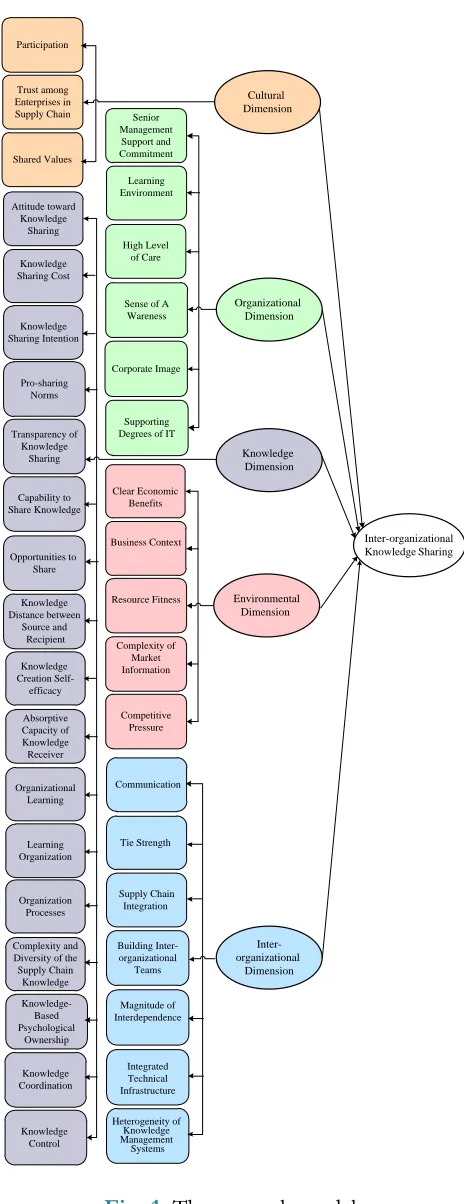
Based on the results, an appropriate model for knowledge sharing in supply chain was deter-mined in 5 dimensions and 38 factors. Fig. 1 shows the research model.
An Analysis of Empirical Findings/ Distribu-tion of Articles by Year
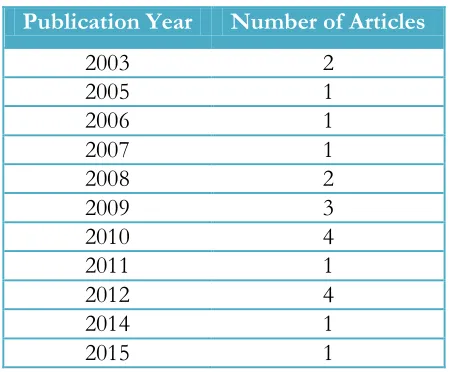
The distribution of articles published by year is shown in Table 1. Since 2003, the research on
knowledge sharing in supply chain is gradually increasing.
Distribution of Articles by Factors Affecting Knowledge Sharing
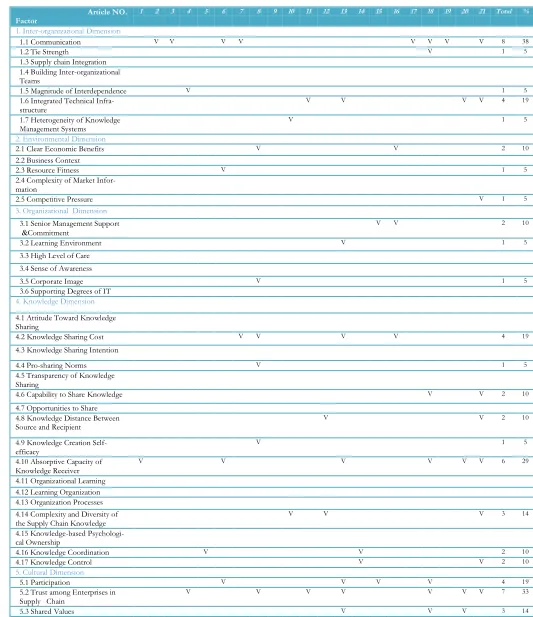
Based on the research model, the study summa-rized five dimensions and adopted an analysis to understand the distribution in relevant literature. Distribution of articles by factors affecting knowledge sharing is shown in Table 2. 8 papers (38%) indicated that Communication was a sig-nificant factor affecting Knowledge Sharing in supply chain. Trust among enterprises in supply chain had the second largest percentage (7 arti-cles, 33%) of the articles. Absorptive capacity of knowledge receiver with 6 (29%) articles was lo-cated in third rank. Integrated technical infra-structure, knowledge sharing cost, and Participa-tion were located in fourth rank with 4 (19%) articles. Complexity and diversity of the supply chain knowledge, and Shared values were located in next rank with 3 (14%) articles. The other fac-tors were at the least rank with only 0(0%) or 1 (5%) or 2 (10%) articles. The 8 factors are dis-cussed by ranking as follows.
Table 1: Distribution of articles by year
Publication Year Number of Articles
2003 2
2005 1
2006 1
2007 1
2008 2
2009 3
2010 4
2011 1
2012 4
2014 1
2015 1
Communication
Tie Strength
Supply Chain Integration
Building Inter-organizational
Teams
Magnitude of Interdependence
Integrated Technical Infrastructure
Heterogeneity of Knowledge Management Systems Clear Economic
Benefits
Business Context
Resource Fitness
Complexity of Market Information
Competitive Pressure
Senior Management
Support and Commitment
Learning Environment
High Level of Care
Sense of A Wareness
Corporate Image
Supporting Degrees of IT Participation
Trust among Enterprises in Supply Chain
Shared Values
Attitude toward Knowledge
Sharing
Knowledge Sharing Cost
Knowledge Sharing Intention
Pro-sharing Norms
Transparency of Knowledge
Sharing
Knowledge Creation
Self-efficacy
Absorptive Capacity of Knowledge Receiver
Organizational Learning
Learning Organization
Organization Processes
Complexity and Diversity of the Supply Chain
Knowledge Knowledge-Based Psychological
Ownership
Knowledge Coordination
Knowledge Control Capability to Share Knowledge
Opportunities to Share
Knowledge Distance between
Source and Recipient
Cultural Dimension
Organizational Dimension
Knowledge Dimension
Inter-organizational
Dimension
Inter-organizational Knowledge Sharing
Environmental Dimension
Fig. 1: The research model
Table 2: Distribution of articles by factors affecting knowledge sharing
Article NO. Factor
1 2 3 4 5 6 7 8 9 10 11 12 13 14 15 16 17 18 19 20 21 Total %
1. Inter-organizational Dimension
1.1 Communication V V V V V V V V 8 38
1.2 Tie Strength V 1 5
1.3 Supply chain Integration 1.4 Building Inter-organizational Teams
1.5 Magnitude of Interdependence V 1 5
1.6 Integrated Technical Infra-structure
V V V V 4 19
1.7 Heterogeneity of Knowledge Management Systems
V 1 5
2. Environmental Dimension
2.1 Clear Economic Benefits V V 2 10
2.2 Business Context
2.3 Resource Fitness V 1 5
2.4 Complexity of Market Infor-mation
2.5 Competitive Pressure V 1 5
3. Organizational Dimension
3.1 Senior Management Support
&Commitment
V V 2 10
3.2 Learning Environment V 1 5
3.3 High Level of Care 3.4 Sense of Awareness
3.5 Corporate Image V 1 5
3.6 Supporting Degrees of IT
4. Knowledge Dimension
4.1 Attitude Toward Knowledge Sharing
4.2 Knowledge Sharing Cost V V V V 4 19
4.3 Knowledge Sharing Intention
4.4 Pro-sharing Norms V 1 5
4.5 Transparency of Knowledge Sharing
4.6 Capability to Share Knowledge V V 2 10
4.7 Opportunities to Share 4.8 Knowledge Distance Between Source and Recipient
V V 2 10
4.9 Knowledge Creation Self-efficacy
V 1 5
4.10 Absorptive Capacity of Knowledge Receiver
V V V V V V 6 29
4.11 Organizational Learning 4.12 Learning Organization 4.13 Organization Processes 4.14 Complexity and Diversity of the Supply Chain Knowledge
V V V 3 14
4.15 Knowledge-based Psychologi-cal Ownership
4.16 Knowledge Coordination V V 2 10
4.17 Knowledge Control V V 2 10
5. Cultural Dimension
5.1 Participation V V V V 4 19
5.2 Trust among Enterprises in Supply Chain
V V V V V V V 7 33
5.3 Shared Values V V V 3 14
To Test Model in a Case Study
Based on the research’s results (arising by the testing and validation of the model), Cultural di-mension is located in third rank in Khorasan Electricity Supply Chain, whereas this dimension was identified as the most important dimension
influencing knowledge sharing in the supply chain from the experts’ point of view (Refer Ta-ble 3). Also, the results showed that the trust among enterprises in supply chain is lower than the other factors of cultural dimension (Refer Table 4).
Table 3: Friedman test to determine priority of the five dimensions
from the experts’ point of view
Mean Rank Category
4.20 Cultural dimension
3.43 Inter-organizational dimension
3.25 Organizational dimension
3.02 Knowledge dimension
2.95 Environmental dimension
χ2 = 14.253, DF =4, Sig.= 0.007
Table 4: Student’s t -Test to evaluate the factors related to culture dimension from the managers' point of view
P-value T
σ Μ
Factor
0.000 12.31
19.7 66.6
Participation
0.040 1.76
15.7 51.9
Trust among enterprises in supply chain
0.000 12.65
16.4 64.2
Shared values
Discussion
This paper concludes that communication, trust among enterprises in supply chain, and absorp-tive capacity of knowledge receiver are primary factors in a majority of articles. The research fo-cus is on the trust, as one of the most important components of professional ethics (17). Profes-sional ethics is a code of values and norms that actually guide practical decisions when they are made by professionals (18). The employees’ pro-fessional ethic can increase their participation rate in the knowledge and sharing of knowledge and experiences (19). Trust among enterprises in sup-ply chain refers to a firm’s belief to have confi-dence in its partner’s reliability and integrity that lead to positive outcomes (5). Also, it is defined as a belief that one organization acts in a con-sistent manner and will perform in accordance with expectations and intentions (20). According
to the results, since trust among enterprises in Khorasan Electricity Supply Chain is at average level, it is necessary to establish an open corpo-rate culture which encourages knowledge innova-tion and knowledge sharing and makes all mem-bers be aware that the benefits of knowledge sharing is greater (21).
To strengthen the trust and communication of member enterprises in supply chain, some steps must be taken including enhancing the transpar-ency of knowledge sharing through formal or informal channels of communication among member enterprises, and then evaluating the credibility level of the knowledge sharing, estab-lishing and improving the incentive mechanism to stimulate the enthusiasm of member enterpris-es, correcting the opportunistic behaviors of knowledge sharing (7). The research results are consistent with various studies (i.e., 4, 5, 6, 8, 9, 10, 22, 23, and 24). This study is conducted on
supply chains, with data collected from Khorasan Electricity Supply Chain in Iran. The extent to which the findings can be generalized to others is unknown.
Conclusions
This research will contribute to develop a con-ceptual model useful for future investigations, providing an integrative review of empirical liter-ature on factors affecting knowledge sharing in supply chain, and achieving more comprehensive understanding about the role of professional eth-ics components as a competitive advantage in enhancing the culture of inter-organizational knowledge sharing in supply chains.
Ethical consideration
Ethical issues (Including plagiarism, informed consent, misconduct, data fabrication and/or fal-sification, double publication and/or submission, redundancy, etc.) have been completely observed by the authors.
References
1. Dey D, Nath A (2013). Study on key Issues and Critical Success Factors of e-Supply Chain Management in Health Care Services. Interna-tional Journal of Advanced Computer Research, 3(1): 7-13.
2. Rainer RK, Cegielski CG (2011). Introduction to In-formation Systems: Supporting and Transforming Busi-ness (3rd ed.). John Wiley & Sons, Inc, Hoboken, N.J.
3. RashedCAA, Azeem A, Halim Z.(2010). Effect of Information and Knowledge Sharing on Supply Chain Performance: A Survey Based Approach. Journal of Operations and Supply Chain Management, 3(2): 61-77.
4. Ke W, Wei KK (2007). Factors affecting trading partners’ knowledge sharing: Using the lens of transaction cost economics and socio-political theories. Electronic Commerce Research and Applica-tions, 6(3): 297-308.
5. Cheng JH, Yeh CH, Tu CW. (2008). Trust and knowledge sharing in green supply chains.
Sup-ply Chain Management: An International Journal, 13(4): 283-295.
6. Hung YC, Chuang YH (2009). Factors affecting knowledge sharing behavior: a content analysis of empiri-cal findings. International Conference of Pacific Rim Management, China.
7. Yurong Z,Mingwei L (2010). Study on the influencing factors of knowledge sharing in supply chain.2010 In-ternational Conference on Intelligent Compu-tation Technology and Automation, China. 8. Feng C, Li T, Yan Y (2011). Factors of knowledge
sharing in supply chain-based on perspective of knowledge characteristics. Journal of System and Management Sciences, 1(3): 21-29.
9. Zheng S, Zhong J (2011). Study on knowledge sharing among enterprises in supply chain. Proceedings of the 2011 International Conference on Informatics, Cybernetics, and Computer Engineering ,Melbourne, Australia.
10.Chen YH, Lin TP, Yen DC (2014). How to facili-tate inter-organizational knowledge sharing: The impact of trust. Information & Management, 51(5): 568-78.
11.Olfat L, Sedighi Gariz S (2015) Ranking the factors affecting information sharing in national Irani-an oil refining & distribution industry using fuzzy multi-criteria decision making (FMCDM) technique. Journal of Industrial Management, 12(32): 99-121. (In Persian).
12.GhaemiM, Shariatmadari M(2018).The relationship between professional ethics and restore confi-dence among faculty members. Ethics in Science and Technology, 12 (4): 39-47. (In Persian). 13.Hsu CC, SandfordBA (2007). The Delphi
tech-nique: making sense of consensus. Practical As-sessment, Research & evaluation, 12(10): 1-8. 14.Lavrakas PJ. (2008). Nonprobability sampling:
Encyclo-pedia of Survey Research Methods. California:
SAGE Publications.Pp. 523-526.
15.Zawawi AA, Zakaria Z, Kamarunzaman NZ,
Noordin N, Sawal MZ, Junos NM, et al (2011). The study of barrier factors in knowledge
shar-ing: A case study in public university.
Manage-ment Science and Engineering, 5(1):59-70.
16.Paulin D, Suneson K (2012). Knowledge transfer, knowledge sharing and knowledge barriers-Three blurry terms in KM. The Electronic Journal of Knowledge Management, 10(1): 81-91.
17.Farahani MF, Farahani FF (2014). The study on professional ethics components among faculty
members in the Engineering. Procedia-Social and Behavioral Sciences, 116: 2085-9.
18.Airaksinen T. (2010). The philosophy of profes-sional ethics. Peace studies, public policy and global se-curity ,5: 150.
19.Amiri J. (2015). Evaluating the influence of
em-ployees’ professional ethic on their knowledge
sharing. International Journal of Science Culture and
Sport, 3(2): 29-40.
20.Seyyedeh N, Daneshgar F (2010). What drives organizations to share knowledge with their supply chain partners. ECIS 2010 Proceedings. p. 167. 21.Yiming C. (2010). Research on knowledge sharing among
partners in supply chain. 2010International Con-ference on Management and Service Science, China.
22.Zhu T, Ku T, Xu L (2009). Knowledge sharing in green supply chain based on trust adjustment mechanism. 2009 International Conference on Manage-ment and Service Science, China.
23.Chanvarasuth P, Ravichandran T (2003). Absorptive capacity and strategic alliance in the supply chain
con-text. IEMC'03 Proceedings. Managing
Techno-logically Driven Organizations: The Human Side of Innovation and Change.
24.Van Der Meer R, Torlina L,Mustard J (2012). A framework for inter-organizational knowledge sharing: managerial influences. ACIS 2012: Location, location, location: Proceedings of the 23rd Australasian Conference on Information Systems 2012.