ISSN No. 2356 - 2536
Conceptual Framework for Knowledge Sharing Initiative in
Institution of Higher Learning to Enchance The Teaching
Performance and Innovation
Mohd Norhadi Muda
*, Zawiyah M. Yusof
Faculty of Technology & Information Science, Universiti Kebangsaan Malaysia, Bangi 43600, Selangor
Abstract
Institutions of Higher Learning (IHL) should cultivate the practice of sharing knowledge among lecturers for the purpose of preserving knowledge. Knowledge sharing is a mechanism which can result in the establishment of knowledge repository. This repository enables knowledge deposited be retrieved for further usage other than a way for preserving knowledge in Institution of Higher Learning (IHLs). The Reuse of knowledge from repository can improve the teaching performance and innovation among lecturers. The knowledge sharing initiative among lecturers enable knowledge deposited be retrieved for further usage other than a way for preserving knowledge in Institution of Higher Learning (IHLs). However, knowledge sharing initiative has not been established base on any guide or framework. Furthermore, factors influencing the initiative to the teaching performance and innovation ought to be revealed since there is no such research has been carried out. It is the objective of this paper to propose a conceptual framework for knowledge sharing initiative in Public Institution of Higher Learning (IHLs) in Malaysia which eventually improve the teaching performance and innovation. Qualitative approach is adopted by means of reviewing the literature in the area. The technology, organization and environmental framework (TOE) was used as a base to propose the conceptual framework. It is discovered that knowledge sharing framework ought to be tailored according to the jurisdiction of IHLs. Such a framework could serve as a guideline for future planning in setting up knowledge sharing initiatives, particularly among lecturers later.
Keywords: knowledge-sharing framework, knowledge-sharing initiative, Institution of Higher Learning, repository,teaching performance, teaching innovation
* Corresponding author. Tel.: N/A; fax: N/A. E-mail address: [email protected].
1. Introduction
IHLs are centres of knowledge that can excel through the existence of knowledge sharing initiative, especially among lecturers [62] which are in the form of discussions, conferences or publications [8]. However, the knowledge sharing initiatives might not materialize if the culture of sharing is not instilled [8]. The initiatives are currently appear to be social phenomena and apparently is an important process in any organization [20]. But knowledge sharing requires a prerequisite whereby organization needs to possess a culture that create, manage and share knowledge [13] which eventually improve the teaching performance and innovation. However, before knowledge become a strategic resource, organizations had in the first place have to have a culture of creating, managing and
sharing knowledge [13]. This knowledge could ultimately make up the knowledge repository apart from maintaining organizational resources [62]. The implementation of knowledge sharing initiative in the context of IHLs in Malaysia, poses its own challenges [50].
Therefore, to eliminate problems and to maximise benefits, the initiative has to be well-planned and systematically implemented. This paper seeks to investigate the factors influencing knowledge sharing initiatives such as organizational (IHLs) factors, Information and Communication Technology (ICT) and individual (lecturers) in an effort to establish a knowledge repository and can be used by lecturers to enchance the teaching performance and innovation.
2. Problem Statement
Please read through the following sections for more information on preparing your paper. However, if you use the template you do not have to worry about setting margins, page size, and column size etc. as the template already has the correct dimensions. Knowledge sharing initiative in IHLs either globally or locally are under explored [16, 43, 71, 18]. Previous studies on factors influencing knowledge sharing in IHLs merely focused on
the organization’s environment [66], practices [8], ethics [39], learning environment [1], the practice of the endeavour in community [36], predicting intentions [43], behaviour [16] and educational cooperation [16, 31]. There is no specific study on factors influencing the initiative in IHLs which eventually resulted in the teaching performance innovation. This study is in tandem with the suggestion by [23] that study on factors influencing knowledge sharing should consider the individual, organizational and technological factors. Knowledge Sharing in IHL aims to increase performance [28]. However, past studies only examine the relationship between knowledge management and academic performance of students. Thus, there is no study that knowledge sharing can affect the teaching performance of lecturers in HEIs. IHLs is to produce graduates who meet the needs of potential and skills required by industry. Therefore lecturers should play a better role of teaching performance and teaching innovation [30] through the reuse of knowledge repositories in IHLs.
3. Objective
The objective of this paper is to propose a conceptual framework for knowledge sharing initiative in Public Institution of Higher Learning (IHLs) in Malaysia which eventually improve teaching performance and innovation.
4. Literature Review
4.1 Knowledge Sharing
Knowledge can be define as an integration of experiences, values, informations and individual understandings [45]. Moreover, knowledge can be uttered, summarized, written down and gathered to form experiences and new knowledge [37]. Knowledge can also be obtained in various format such as documents, pictures, voice recordings and video [12]. Sharing knowledge occurs through a process of exchanging experience, expertise, events and thoughts that agreed by the giver and the receiver. Sharing knowledge is also one of the activities in knowledge management [9]. In this study, sharing knowledge is referred to sharing notes, tests, quizzes and projects among lecturers in IHLs.
4.2 Knowledge Repository
The knowledge repository is a warehouse for storing knowledge that can be used as a strategic source [34]. Organizations, especially IHLs, should develop knowledge repositories to encourage knowledge sharing among employees, particularly academic staff or lecturers who have limited variety of knowledge [2, 10]. Therefore, the repository will be able to gather knowledge from among lecturers [9] through the knowledge sharing initiative [25, 42]. Thus, the knowledge can be obtained and re-used for
the purposes of learning, teaching, research and publishing [10, 12]. Concurrently, forming a repository needs management’s support, especially for coordinating and managing the repository. Thus, this aims to ensure that the organization anticipates the present challenges, particularly a change of administration and its associated vision [26]. 4.3 Teaching Performance
The purpose of teaching is to facilitate the learning process for students to gain knowledge. Therefore, there are a variety of teaching methods used by lecturers in institutions of higher learning (IHLs) such as lectures or lecture, discussion, demonstration methods, seminars, tutorials, projects, tours and troubleshooting. For this purpose, a lecturer requires teaching materials such as lecture notes, exam questions, questions assignments, quizzes and practical questions. Teaching materials can adapt teaching content to students with different needs. Thus, one process for instructional materials is through the sharing of knowledge among lecturers. Thus, lecturers with teaching materials can improve the performance of teaching and thus produce students who are competent and effective. 4.4 Teaching Innovation
Lecturers at the IHLs need for teaching innovation as new ideas and approaches to improve the existing methods. Other than that, teaching innovation can help lecturers in terms of new approaches in the teaching process, increase creativity in teaching and the learning process becomes easier than ever. Innovation in teaching is a creative reforms that involve new methods or means used by educators to achieve the objectives of teaching. However the increase in the value of innovation and progress depend on knowledge. Teaching innovation is important for lecturers to enhance teaching in IHLs which uses the concept of multimedia teaching [30]. Hence the teaching innovation brought by the lecturer can increase the value added graduates.
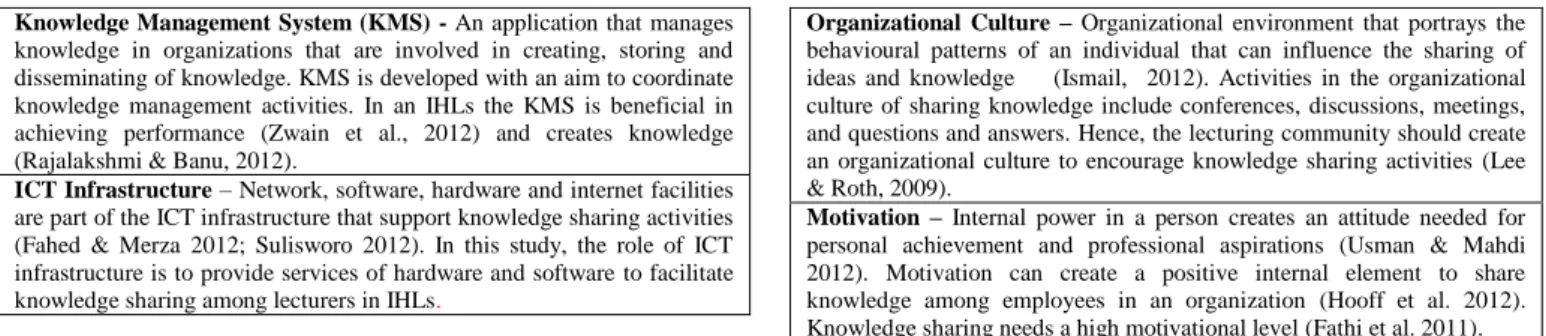
4.5. Information and Communication Technology (ICT) The first factor influencing knowledge sharing is ICT. ICT helps the knowledge sharing activities through the process of storing, circulating and adding value to knowledge [13] either formally or informally [13]. In addition, this provision could reduce barriers in sharing knowledge and it also could save time. Thus, the role of ICT is to encourage lecturers to share knowledge and also to support the process of knowledge sharing [21] across geographical boundaries, functions and divisions [41]. Knowledge Management Systems (KMS), infrastructure ICT are the factors emphasized in this research. These are shown in Table 1.
Table 1 ICT Factor
Knowledge Management System (KMS) - An application that manages knowledge in organizations that are involved in creating, storing and disseminating of knowledge. KMS is developed with an aim to coordinate knowledge management activities. In an IHLs the KMS is beneficial in achieving performance (Zwain et al., 2012) and creates knowledge (Rajalakshmi & Banu, 2012).
ICT Infrastructure – Network, software, hardware and internet facilities are part of the ICT infrastructure that support knowledge sharing activities (Fahed & Merza 2012; Sulisworo 2012). In this study, the role of ICT infrastructure is to provide services of hardware and software to facilitate knowledge sharing among lecturers in IHLs.
4.6 Organization
The second factor influencing knowledge sharing is organization. The organizational factor is one of the factors that plays an important role in knowledge sharing initiative [66, 35] because it influences individual behaviour towards knowledge sharing activities [67]. Organizational factor also exploits and supports the source of knowledge for knowledge sharing process from expert employees to new employees [15]. Hence, the organizational factor is assumed as an innovation in the knowledge sharing process [69]. The organizational factor in this paper involves planning and promotion, as shown in Table 2.
Table 2 Organzation Factor
Planning – A detailed process to achieve the organizational objectives and create a comprehensive strategy in order to coordinate and integrate organizational activities (Robbins& Coulter, 2009) Planning enables to forecast assumptions and technology that renders organizations to be in a prepared position ( Lee & Roth, 2009) and anticipate knowledge sharing activities among lecturers (Sohail & Daud, 2009)
Promotion – All efforts and activities towards encouraging or improving a product or service. The promotional aspect is important for an IHLs in playing an effective role in promoting knowledge sharing activities among lecturers with the aim of encountering competition in the education industry (Agarwal, Kiran & Verma 2012).
4.7 Lecturer
The third factor influencing knowledge sharing is lecturer. The lecturer factor is an important element because lecturers constitute a big portion of IHLs staff [60]. The standard of excellence of an IHLs is measured by the quality of its lecturers based on aspects such as learning and teaching, supervising or even research and development. Besides that, lecturers need knowledge as a source of reference in preparing themselves to become competent educators [27] and subsequently to help achieve the aims and performance of the organization [46]. Hence, the lecturers should have the responsibility to practice the knowledge sharing culture [70]. The lecturer factor in this paper falls under the culture of the organization and motivation, as shown in Table 3.
Table 3 Lecturer Factor
Organizational Culture – Organizational environment that portrays the behavioural patterns of an individual that can influence the sharing of ideas and knowledge (Ismail, 2012). Activities in the organizational culture of sharing knowledge include conferences, discussions, meetings, and questions and answers. Hence, the lecturing community should create an organizational culture to encourage knowledge sharing activities (Lee & Roth, 2009).
Motivation – Internal power in a person creates an attitude needed for personal achievement and professional aspirations (Usman & Mahdi 2012). Motivation can create a positive internal element to share knowledge among employees in an organization (Hooff et al. 2012). Knowledge sharing needs a high motivational level (Fathi et al. 2011). 4.8 Knowledge Sharing in Institution of Higher Learning
The management of IHLs need to plan the knowledge sharing initiative in order to encourage the practice At the same time, the initiative has to be in parallel with the mission of the IHLs in ways such as increasing the performance, increasing competitiveness and improving educational services [28] and fulfilling the industry’s peripheral needs [73]. Besides that, the knowledge sharing initiative can also overcome the problem of lost knowledge due to retirement [70] and transfer [11, 18] of lecturers, besides supporting the formation of the repository. Earlier studies on knowledge sharing in IHLs had studied factors that influenced, impeded and contributed towards the knowledge sharing initiative. As mentioned in section II there are several studies on factors that influence knowledge sharing practice. The factors that have been studied are organizational culture, the role of leaders and utilization of ICT [66] and attitude, trust and rewards [8]. Whereas, the value of knowledge, knowledge ownership, abuse of knowledge, perception, ethics, commercial, social influence and the facilitating role was studied by [39]; profile, leadership, culture, structure, utilizing ICT, infrastructure and knowledge management system by [1] and estimated effort and estimated performance by [36]. Meanwhile, [43] had studied the psychological factors, organizational climate, combination and communication. [16] went on to study rewards, autonomy, institutions, leadership and the technology platform, while [31] had studied motivation, convenience in sharing and types of knowledge. Studies on factors that impeded knowledge sharing initiatives had focused on practices [24, 50]. Factors that impeded the knowledge sharing initiative included trust, lack of time, experience, rewards, culture, activities, working environment, communication and application [24] besides types of knowledge, motivation, chances and culture [50]. Meanwhile, [3] had studied factors that contributed to the knowledge sharing initiative, such as knowledge sharing practices that include organizations, culture, technology and communications. Past researches had also grouped these factors into three categories, which are technology, organization and individual. The study that focused on individuals was carried out by [36, 31]; while organization and technology was studied by [66] and [3]; individuals and organizations by [8, 39]. Studies that had focused on all three factors (individuals, organizations and technology) were carried
The Original of TOE Framework
The Or
Addtional
Framework
The Or
out by [24, 4, 1, 43, 16]. However, there was no specific study focused on factor that had influenced the knowledge sharing initiative among lecturers in IHLs, which enentually improve teaching performance and innovation. Hence, studies on knowledge sharing need to be explored further because each initiative differs in its focus [23].
5. Theoretical Framework
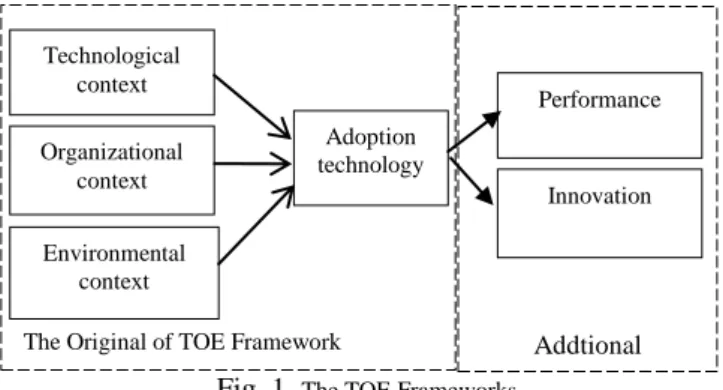
The theoretical framework used to develop the conceptual framework in this study is the technology, organization and environment (TOE) framework which was introduced by Tornatzky and Fleischer in 1990 and adapted from the ‘Theory of Organizational Contingencies’. The TOE framework is suitable to use in research based on organizations [6] and performance indicators [49]. This framework has three contexts: technology, organizational and environmental, as shown in Fig. 1 [7, 5]. The technology context includes infrastructure, processes, techniques and the latest ICT expertise [63, 38] that emphasise on making decisions related to ICT [64]. While the organizational context includes size, scope, centralization, official function, management structure, quality of human resources, decision-making methods, communication, intentions, planning and structure [63, 32] that leans towards organizational characteristics [6]. The environmental context comprises firms, suppliers, employees, customers, competitors and government agencies [63]. There are previous researcher using the TOE framework for evaluating the performance and the innovation. Thus, the performance constructs can be used in studies using TOE framework.
Fig. 1. The TOE Frameworks
6. Knowledge Sharing Conceptual Framework
Analysis on past models and knowledge-sharing frameworks has found that the framework emphasises two factors. First, there is a need to develop repository, and second, the different factors that influence knowledge sharing initiatives. Both these factors are the basis for developing the conceptual framework in this paper according to the approach used by [22, 68]. The approach to the conceptual framework development is shown in Fig. 2. The inputs that actually represent the factors that
influence knowledge sharing are ICT, organization (IHLs) and lecturers. Meanwhile, the process represents the Knowledge sharing is a mechanism which can result in the establishment of knowledge repository and the output represents teaching performance and innovation.
Fig. 2. The Framework Development Approach Source Ismail (2010) and Yassin et al., (2011)
The TOE framework is chosen based on the development of the conceptual framework since it suits the factors that will be studied. This is because the factors that influence knowledge sharing (inputs), which are technology (ICT), organization (IHLs) and environment (lecturers) are indeed congruent with the TOE framework. Also research by [33, 29, 30] had used the environmental context to portray individualsIn the context of this study, lecturers represent the individuals.
The TOE framework is also used to study the information system, knowledge sharing and knowledge management. Furthermore, the TOE framework is used to evaluateperformance and the innovation. The conceptual framework development process is shown in Fig. 3, while Fig. 4 is the final form of the suggested knowledge sharing conceptual framework. The details factors are shown in Table 1 ICT, 2 Organization(IHLs) and 3 lecture as the above.
7. Conclusion
Studies had shown that the lecturers at IHLs practice knowledge sharing activities among them. However, these activities do not have specific guidelines administered by the university. Hence, management in IHL should plan systematically and state clearly their objectives and directions. This planning should consider three main factors, namely: technological, organizational and lecturer. The development of conceptual framework for knowledge sharing initiative in this study has emphasised on two components - the knowledge sharing influencing factors and the need to establish of knowledge repository. The reuse of knowledge from repository can improve the teaching performance and innovation among lecturer. TOE framework was incorporated in the development of the conceptual framework due to its suitability to the factors being studied. The framework is developed since it is evident from the past research that is no study has been undertaken on knowledge sharing initiative which finally improve the teaching performance and innovation.
Technological context Organizational context Environmental context Adoption technology Performance Innovation
References
[1] Agarwal, P. D., Kiran, R., & Verma, A. K. (2012). Knowledge sharing for stimulating learning environment in institutions of higher technical education. African Journal of Business Management, 6(16), 5533– 5542.
[2] Al-Busaidi, K. A., Olfman, L., Ryan, T., & Leroy, G. (2010). Sharing Knowledge to A Knowledge Management System : Examining the motivators and the benefits in an Omani organization. Journal of Organizational Knowledge Management 2, 2010.
[3] Alwi, N. H.M., Bakar, A.B., Hamid, H.A. (2008). Factors Contributing Knowledge Sharing In Higher Learning Institution. Knowledge Management International Conference 2008 (196-199), Langkawi, Malaysia.
[4] Alhammad, F., Faori, S. & Husan, S. A. (2009). Knowledge Sharing In The Jordanian Universities. Journal of Knowledge Management Practice, 10, 3.
[5] Angeles, R. (2013). 7G’s Environmental Initiative through the Lens of the Technology-Organization-Environment (TOE) Framework. Computer Technology and Application, 4, 39–68.
[6] Arpaci, I., Yardimci, Y. C., Ozkan, S., & Turetken, O. (2012). Organizational Adoption of Information Technology : A Literature Review. Journal of business and government, 4(2), 37–50.
[7] Awa, H. O., Harcourt, P., & Emecheta, B. C. (2012). Integrating TAM and TOE Frameworks and Expanding their Characteristic Constructs for E-Commerce Adoption by SMEs Electronic Commerce ( EC ). In Proceedings of Informing Science & IT Education Conference (InSITE) 2012. Montreal, Canada.
[8] Ayalew, E., Bekele, R., & Straub, D. (2010). Attitude Matters : Exploring The Knowledge Sharing Behavior Of Academic in Ethiopian Public Higher Education s. In Proceedings of the 21st European Conference on Information Systems (pp. 1–12). United States.
[9] Beatrice, B. A., Kirubakaran, E., & Saravanan, V. (2010). Knowledge Acquisition and Storing Learning Objects for a learning repository to enhance E-Iearning Categories of Knowledge Learning the ontology V2-235. In 2010 2nd International Conforence on Education Technology and Computer (ICETC) (pp. 234–236). Shanghai, China. [8] Cheng, M., Ho, J. S., & Lau, P. M. (2008). Knowledge Sharing in
Academic Institutions : a Study of Multimedia University Malaysia. Journal of Knowledge Management, 7(3), 313–324.
[9] Chong, C. W., Choy, C. S., Chew, G. G., & Yuen, Y. Y. (2012). Knowledge sharing patterns of undergraduate students. Library Review, 61(5), 327–344.
[10]Choubey, B. (2011). A Repository of Real-world Examples for Students and Academics. In Information Society (i-Society), 2011 International Conference on (pp. 204–207). London.
[11] Cranfield, D. J., & Taylor, J. (2008). Knowledge Management and Higher Education : A UK Case Study. Journal of Knowledge Management, 6(2), 85–100.
[12] Du, Z., Fu, X., Zhao, C., & Liu, T. (2012). University Campus Social Network System for Knowledge Sharing. In 2012 International Conference on Systems and Informatics (ICSAI 2012) (pp. 2505– 2508). China.
[13] Dukiü, G., & Kozina, G. (2012). Knowledge Management in Higher Education : ICT Equipment , Skills and Attitudes of Croatian Polytechnic Students. In The ITI 2012 34 International Conference on Information technology Interfaces (pp. 177–182). Croatia.
[14] Fathi. M. N., Eze, U. C., & Goh, G. G. G. (2011). Key determinants of knowledge sharing in an electronics manufacturing firm in Malaysia. Library Review, 60(1), 53–67.
[15] French, N. (2010). Factors which influence organisational knowledge sharing. Master Thesis. University of Pretoria.
[16]Fullwood, R., Rowley, J., & Delbridge, R. (2013). Knowledge sharing amongst academics in UK universities. Journal of Knowledge Management, 17(1), 123–136.
[17]Geiger, D., & Schreyögg, G. (2012). Narratives in knowledge sharing: challenging validity. Journal of Knowledge Management, 16(1), 97– 113.
[18] Goh, S.-K., & Sandhu, M.-S. (2013). Affiliation , Reciprocal Relationships and Peer Pressure in Knowledge Sharing in Public Universities in Malaysia. Asia Social Science, 9(7), 290–298. [19] Hanrui, & Liulei. (2011). The core changes of Promotion Mode in the
Era of Knowledge Economy. In 2011 International Conference on Business Computing and Global Informatization The. China. [20] Hooff, B. Van Den, Schouten, A. P., & Simonovski, S. (2012). What
one feels and what one knows: the influence of emotions on attitudes and intentions towards knowledge sharing. Journal of Knowledge Management, 16(1), 148–158.
[21] Hu, W. W. (2010). Self-efficacy and Individual Knowledge Sharing. 2010 3rd International Conference on Information Management, Innovation Management and Industrial Engineering, 401–404. Kunming, China.
[22]Ismail. M.B. (2010). Model kualiti perkongsian dalam organisasi awam dan kesannya ke atas prestasi pekerja serta penyampaian perkhidmatan. PhD. Thesis. Universiti Kebangsaan Malaysia. [23]Ismail, N.A.M. (2012). Key Determinants of Research Knowledge
Sharing in UK Higher Education Institution. Ph.D Thesis. University of Portsmouth.
[24]Jain, K. K., J., Sandhu, M. S., & Sidhu, G.K. (2007). Knowledge Sharing Among Academic Staff : A Case Study of Business Schools in Klang. Journal for the Advancement of Science and Arts, 2, 23–29. [25] Kankanhalli, A., Lee, O.-K. (Daniel), & Lim, K. H. (2011).
Knowledge reuse through electronic repositories: A study in the context of customer service support. Information & Management, 48(2-3), 106–113.
[26] Kim, D. (2011). The Effects of Knowledge Sharing on Program Performance : Influences on CPS Program Performance. PhD Thesis. UMI.
[27] Kiran, R., Agarwal, P. D., & Verma, A. K. (2013). Knowledge Management : Role of. Sage Open, 1(13), 1–13.
[28] Kumar, N., & Rose, R. C. (2012). The impact of knowledge sharing and Islamic work ethic on innovation capability. Cross Cultural Management: An International Journal, 19(2), 142–165.
[29] Lee, H., & Roth, G. L. (2009). New Horizons in Adult Education and Human Resource Development. New Horizons in Adult Education and Human Resource Development, 23(4), 22–37.
[30] Lee, O.-K. D., Wang, M. W., & Lim, K. H. (2009). Knowledge Management Systems Diffusion in Chinese Enterprises : A Multistage Approach Using Environment Framework. Journal of Global Information Management (JGIM), 17(1), 70–84.
[31] Li, X., Roberts, J., Yan, Y., & Tan, H. (2013, August). Knowledge sharing in China–UK higher education alliances. International Business Review, pp. 1–13. Elsevier Ltd.
[32] Lippert, S. K., & Ph, D. (2006). Technological , Organizational , and Environmental Antecedents to Web Services Adoption. Communications of the IIMA, 6(1).
[33]Liu, M. (2008). Determinants of E-Commerce Development: An Empirical Study by Firms in Shaanxi, China. 4th International Conference on Wireless Communications, Networking and Mobile Computing (1-31), Dalian, China.
[34]Naiwen, L., & Xin, Z. (2012). The Study on Constructing Institutional Repository of University. In 2012 Fourth International Conference on Multimedia Information Networking and Security (pp. 689–692). Nanjing.
[35] Nissen, M. E., & Leweling, T. A. (2010). Knowledge Sharing as a Contingency Organizations. International C2 Journal, 4(2).
[36]Nistor, N., Baltes, B., & Schustek, M. (2012). Knowledge sharing and educational technology acceptance in online academic communities of practice. Campus-Wide Information Systems, 29(2), 108–116. [37]Nonaka, I., Krogh, G. Von, & Voelpel, S. (2006). Organizational
Knowledge Creation Theory: Evolutionary Paths and Future Advances. Organization Studies (Vol. 27, pp. 1179–1208). London: Sage Publication.
[38]Pan, H. (2005). Factors Affecting IT Adoption : The Case of a Chinese Retail Company. In International Conference on Services Systems and Services Management (pp. 1462–1464). Chongquing, China. [39]Patel, M., & Ragsdell, G. (2011). To Share or Not to Share
Knowledge: An Ethical Dilemma for UK Academics? Journal of Knowledge Management Practice, 12(2).
[40]Paul, S. (2012). Institutional Repositories: Benefits and incentives. The International Information & Library Review, 44(4), 194–201. [41]Phang, M. M. S., & Foong, S. (2010). InformatIon Communication
technologIes ( ICT) and knowledge sharIng : the Case of professIonal aCCountants In malaysIa. Journal of Science, Technology and Subtainable Developmen, 7(1), 21–35.
[42]Pidun, T., & Felden, C. (2013). The Role of Performance Measurement Systems between Assessment Tool and Knowledge Repository. In 2013 46th Hawaii International Conference on System Sciences. Hawaii.
[43]Rahab, & Wahyuni, P. (2013). Predicting Knowledge Sharing Intention Based on Theory of Reasoned Action Framework : An Empirical Study on Higher Education Institution. American International Journal of Contemporary Research, 3(1), 138–147. [44]Rainer, R. K., Turban, E. & Potter, R. E. (2007). Introduction to
Information Systems: Supporting and Transforming Business, John Wiley & Sons, Inc, NJ, USA
[45]Rajalakshmi, S., & Banu, R. S. D. W. (2012). Analysis of Tacit Knowledge Sharing and Codification in Higher Education. In 2012 International Conference on Computer Communication and Informatics (ICCCI -2012). Coimbatore, India.
[46] Refaiy, M. & Labib, A. (2009), The effect of applying tacit knowledge on maintenance performance: an empirical study of the energy sector in the UK and Arab countries, Knowledge Management Research & Practice, Vol. 7, pp. 77-288.
[47]Robbins, S.R. & M. Coulter, 2009. Management. (10th Ed.). Pearson Education Ltd., London.
[48]Samuel, C., & Certo, T., (2006). Strategic Planning. Modern Management: Prentice Hal.
[49] Savita, K. s, Dominic, P. D., & Ramayah, T. (2012). Eco-Design Strategy among ISO 14001 Certified Manufacturing Firms in Malaysia : Green Drivers and Its Relationship to Performance Outcomes. In 2012 International Conference on Computer & Information Science (ICCIS) (pp. 154–159). Kuala Lumpur. [50] Sohail, M. S., & Daud, S. (2009). Knowledge sharing in higher
education institutions: Perspectives from Malaysia. The journal of information and knowledge management systems, 39(2), 125–142. [60]Shukor, N.S.A., Nawi, H.S.A., Basaruddin, S., & Rahim, N.D. (2009).
Investigation of Knowledge Management Processes Among Academicians at Faculty Of Industrial Information Technology, UNISEL.2009 International Conference on Information Management and Engineering InvestigationJournal of Knowledge Management, (732 - 735). Kuala Lumpur.
[61]Smith, A. & Rupp, W. (2002). Communication and loyalty among knowledge workers: a resource of the firm theory view. Journal of Knowledge Management, Vol. 6 No. 3, pp. 250-61.
[62]Sulisworo, D. (2012). Enabling ICT and Knowledge Management to Enhance Competitiveness of Higher Education Institutions. International Journal of Education, 4(1), 112–121.
[63]Tornatzky, L. & Fleischer, M. (1990). The Processes of Technological Innovation. Lexington, MA: Lexington Books.
[64]Tung, T., & Lai, W. (2013). The Key Factors Affecting Business Model for Enterprises Adopting Cloud Computing Technology. In Business and Information 2013 (Vol. 2013, pp. 386–425). Bali, Indonesia.
[65]Usman, U.M. Z., & Musa, M. A. (2012). The influence of Organization Knowledge. 2012 International Conference onnformation Retrieval & Knowledge Management (CAMP), (pp. 87– 90). Skudai, Johar Bharu.
[66]Wahab, S. R. A., Shaari, R., Nordin, N. A., Rajab, A., & Isa, K. (2009). Faktor Persekitaran Organisasi Mempengaruhi Perkongsian Pengetahuan: Satu Analisis di Institut Kemahiran MARA Johor. In Amalan Latihan & Pembangunan Sumber Manusia di Malaysia (pp. 218–236). Johar Bharu: UTM: Penerbit UTM Press.
[67]Xue, Y., Bradley, J., & Liang, H. (2011). Team climate, empowering leadership, and knowledge sharing. Journal of Knowledge Management, 15(2), 299–312.
[68]Yassin, F., Sahari, N., & Salim, J. (2011). A Framework of Knowledge Sharing through ICT for Teachers in Malaysia. In 2011 International Conference on Electrical Engineering and informtics. Bandung, Indonesia.
[69]Yi, Z. (2008). Knowledge management for library strategic planning: Perceptions of applications and benefits. Library Management, 29(3), 229–240.
[70]Zawawi, A. A., Zakaria, Z., Kamarunzaman, N. Z., Noordin, N., Sawal M. Z. H. M., Junos, M.N., & Najid N. S. A. (2011). The Study of Barrier Factors in Knowledge Sharing : A Case Study in Public University. Journal of management science and Engineering, 5(1), 59– 70.
[71]Zaqout, F., & Abbas, M. (2012). Towards a model for understanding the influence of the factors that stimulate university students' engagement and performance in knowledge sharing. Library Review, 61(5), 345–361.
[72]Zookefli, Z., & Nor, M. K. (2008). Hubungan budaya organisasi dan perkongsian pengetahuan. Jurnal Kemanusiaan, 11(1), 68–79. [73]Zwain, A. A. A., Lim K. T. , & Othman S. N. (2012). Knowledge
Management Processes and Academic Performance in Iraqi HEIs : An Empirical Investigation. Journal of academic research in business and social sciences, 2(6), 273–293.