Copyright © 2013 IJECCE, All right reserved
Performance of Power Control Algorithm for
DS-CDMA on Reverse Link
Chandra Prakash, Manish Rai
Abstract –In this paper, the performance comparison of
smart step closed loop power control (SSPC) algorithm with base station assignment method based on minimizing the transmitter power (BSA-MTP) technique for direct sequence-code division multiple access (DS-CDMA) receiver in a 2D urban environment has been compared. It has been observed that SSPC algorithm with CGBF algorithm converges in about 12 iterations for the BSA-MTP technique, while VSPC and FSPC algorithms converge in about 13 and 16 iterations, respectively. It has been also observed that with help of CLMS algorithm transmitted power is higher than other used techniques. Further, the convergence speed of the SSPC algorithm is faster than that of conventional algorithms.
Keywords – Smart Step Closed Loop Power Control
(SSPC), Base Station Assignment Method Based On Minimizing The Transmitter Power, Direct Sequence-Code Division Multiple Access (DS-CDMA), CGBF Algorithm, CLMS Algorithm.
I. I
NTRODUCTIONIn present modern wireless communication system in mobile communication the Direct Sequence- Code Division Multiple Access (DS-CDMA) plays vital role is a cellular system with other present techniques such as Frequency Division Multiple Access (FDMA) and Time Division Multiple Access (TDMA). The main
importance’s of DS-CDMA for mobile communication
applications are the widespread one-cell frequency reuse, intrinsic multipath diversity, and soft capacity limit. The effects of closed-loop power control in direct-sequence (DS)-CDMA systems have been mainly studied through simulations due to the analytical complexity of these aspects. In, a new log-linear model is presented that allows an analytical expression for the temporal correlation of the power-controlled signal over a flat Rayleigh channel.To efficiently apply the advantage of CDMA, it is necessary understand effect of power control on the near-far problem, slow shadow fading and multipath fading [1–2]. The power control scheme in CDMA was proposed by Gejji [3] in which power control scheme was developed as a function of the distance for forward link and the direction from the base station (BS) to provide a more accurate power control scheme. In CDMA scheme has two basic power control mechanisms: closed-loop and open-loop power control. In Frequency Division Multiple Access or FDMA strategies, the focus is on the frequency dimension. Here, the total bandwidth (B) is divided into N narrowband frequency slices. So several users are allowed to communicate simultaneously by assigning the narrowband frequency slices to the users, where the narrowband frequencies are assigned to a designated user at all time. Since the total bandwidth (B) is subdivided into
N frequency slices or channels, only N users may be supported simultaneously. This proposed analytical approach is applied to a typical DS-CDMA environment to derive the maximum number of supportable users. The goodness of the analytical approaches has been validated through computer simulations.In order to meet the increasing demand of mobile subscribers for various services such as multimedia, internet, transferring of big data like digital pictures, it is crucial to have higher capacity and more severe Quality of Service (QoS) requirement, to meet this requirements new technologies and improved resource management including channel assignment, power control and handoff are needed.
II. S
YSTEMS
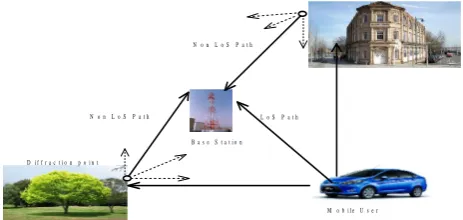
TRUCTUREConsidering the 2D urban model for computing reverse link (path between a mobile set and base station) is shown in Fig 1. This shows that diffraction and reflection of power signal from mobile user and base station. This cause the loss in power of the signal due diffraction and reflections provide obstacle such as building, trees mountains etc. whereas these signal remains in the environment until its power of the signal fall below the threshold level. Block diagram of reverse link is shown in Fig. 2(a). The USPS simulation software is used, in which it is considered to as physical environment of mobile user such that signal data radiated from mobile system reaches to base station as well as diffuse in all the directions. This software also stores all environment information angles of the path (reverse link or forward link) and transmitting and receiving power. Block diagram of reverse link and forward link are shown in Fig 2.
M o b i l e U s e r D i f f r a c t i o n p o i n t
R e f l e c t i o n p o i n t
B a s e S t a t i o n L o S P a t h N o n L o S P a t h
N o n L o S P a t h
Fig.1. 2D urban environment in reverse link
III. P
OWERC
ONTROLchanges its access to the resources by adapting its transmitting power to the changing channel and interference conditions. Therefore power control also known, as Transmit Power Control (TPC) is a significant design problem in CDMA systems. Power control encompasses the techniques and algorithms used to manage the transmitted power of base stations and mobiles. Power control helps to reduce co-channel interference, increasing the cell capacity by decreasing interference and prolonging the battery life by using a minimum transmitter power.
Frequency Error Detection Signal from
Forward channel Frequency Shift Back
Base Band
Filter ChannelSounder Conjugate Index
PN Code Generator
Walsh Function Generator One Finger of
BS Rake Receiver
One Finger of BS Rake Receiver Forward Receiver Viterbi Decoder De-Interleave CxToRect
One Finger of Coherent Rake Receiver AFC Ch_Eff (a) Signal from Reverse channel
PN Code Acquisition
PN Code Acquisition Verification
PN Code
Tracking Searcher
PN Code Index
Long Code Generator
Walsh Function Generator One Finger of
BS Rake Receiver
One Finger of BS Rake Receiver Reverse Receiver M ult i p ath C om bin er
To Power Control Part Bit Energy Estimation O/P
Viterbi Decoder De-Interleave Decision Maker
BER Performance
(b)
Fig.2. Block diagram of (a) Forward Link (b) Reverse Link receiver system.
A. Forward Link Power Control System
In CDMA systems power control insures distribution of resources among users. When power control is not implemented, all mobiles transmit their signal with the same power without taking into consideration the fading and the distance from the base station, in this case mobiles close to the base station will cause a high level of interference to the mobiles that are far away from the base station, this problem is known as the near-far effect and is shown in Fig 2 (a)
B. Reverse Link Power Control System
Power control on the reverse link is an important issue in achieving high capacity for the DS-CDMA wireless system. Conventional power control uses an open-loop algorithm, or a closed-loop algorithm, or some combination of the two. Reverse link closed-loop power control for a packetized DS-CDMA network has been examined in [4-5] for a system accommodating voice and data users. A closed-loop algorithm based on equal signal strength for data users and on equal error probability for voice users is proposed. The closed-loop power control algorithm in [6-7] is designed to update the transmitted power of a mobile at a rate faster than that of multipath
fading. The received power at the base station is compared to a threshold value and the result is hard quantized to a 1-b power command which informs the user whether to increase or decrease its transmitted power. Block diagram of Reverse Link receiver system is shown in Fig 2. (b).
C. Power Control Algorithm
A major limiting factor for the satisfactory performance of CDMA systems is the near-far effect. Power control is an intelligent way of adjusting the transmitted powers in cellular systems so that the TTP is minimized, but at the same time, the user SINRs satisfies the system quality of service (QoS) requirements [8-9].
Depending on the execution location, power control algorithms can be categorized as either centralized and distributed [1–9, 14-15]. In centralized power control, a network center can simultaneously compute the optimal power levels for all users. However, it requires measurement of all the link gains and the communication overhead between a network center and base stations. Thus, it is difficult to realize in a large system [16]. Distributed power control, on the other hand, uses only local information to determine transmitter power levels. It is much more scalable than centralized power control. However, transmitter power levels may not be optimal, resulting in performance degradation [17].
The distributed closed-loop power control problem has been investigated by many researchers from many perspectives during recent years [8,17,23]. For instance, the conventional fast closed-loop power control strategy used in practice in CDMA systems is a fixed step controller based on SINR measurements. The fixed step closed-loop power control (FSPC) algorithm is defined by [8]. ) ( .' * . ' . 1 ' . n q i q i m q i m q
i P sign
P , (1)
Where .',
m q i
P i*.q, and
' .
n q i
are the transmitter power,
SINR target, measured SINR of user i, q at time m’,
respectively and
is the fixed step size. Also, the Pi.mq'1is transmitter power control (TPC) command in the
feedback link of the base station to i, q at time m’+1 in
decibel.
Also, the distributed traditional closed-loop power control (DTPC) is defined by [23]
) ( ' . * . ' . 1 ' . n q i q i m q i m q i P P
, (2)
In above algorithms, the simple intuition behind this iteration is that if the current SINR
in.q' of user i, q is less than the target SINR
i*.q,
then the power of that user is increased; otherwise, it is decreased.Copyright © 2013 IJECCE, All right reserved
D. The BSA-MTP Technique
To improve the performance of cellular systems, base station assignment technique can be used. In the joint power control and base station assignment, a number of base stations are potential receivers of a mobile transmitter. Accordingly, the objective is to determine the assignment of users to base stations which minimizes the allocated mobile powers. In simple mode and in multiple-cell systems, the user is connected to the nearest base station. This method is not optimal in cellular systems under the shadowing and multipath fading channels and can increase the system BER [19,20].
The system capacity might be improved if the users are allowed to switch to alternative base stations, especially when there are congested areas in the network. Obviously, when uplink performance is of concern, the switching should happen based on the total interferences seen by the base stations [20].
So far, it has been considered that the power control problem for a number of transmitter-receiver pairs with fixed assignments, which can be used in uplink or downlink in mobile communication systems. In an uplink scenario where base stations are equipped with antenna arrays, the problem of joint power control and beam forming, as well as base station assignment, naturally arises. In this paper, it is considered the BSA-MTP technique [4] to support base station assignment as well in a 2D urban environment.
E. Constrained LMS Algorithm
Constrained LMS algorithm is a gradient based algorithm to minimize the total processor output power, based on the look direction constraint. The adaptive algorithm is designed to adapt efficiently to the environment and is able to permanently preserve the desired frequency response in the look direction while minimizing the output power of the array. In [22,26], we used the CLMS algorithm in order to decrease the interference of DS-CDMA cellular systems in multipath fading channels. In this algorithm, unlike the CGBF algorithm, the number of weights and sensors are equal, i.e., S = N. Accordingly, by the CLMS algorithm, desired
users’ signal in an arbitrary path is passed but the IPI is
not canceled in other paths in each RAKE finger, while the IPI is removed in the CGBF algorithm. Accordingly, the output of the array with the CLMS algorithm in the nth iteration in the j th path for user i, q is given by [22, 44, 46].
Table1. System Information for DS-CDMA in Reverse Link
Number of users (M) 9
Spacing between channels(d)
Input data rate(Tb) 9.6Kbps
the number of antenna weights(N) 3 the number of antenna sensors in CGBF algo(S)
5
the number of antenna sensors in CLMS algo(S)
3
propagation paths for all users (L) 4
Resolution(R) 1
Path loss parameter (Lp) 0.05 dB/m
variance of the log-normal shadow
fading(
4 dB
gradient step size in the CLMS
algorithm( )
0.005
m-sequence generator with processing gain(G)
512
the average SINR(Ku) users 120
SNR 10 dB
IV. D
ISCUSSION OFR
ESULTSU
NITSFigure 4 shows the comparison of the SINR of all users versus power control iteration index (n`) for SSPC, VSPC (qv = 4), and FSPC algorithms and for the BSA-MTP
technique (solid line) and conventional BSA technique (dashed line). In this simulation, the two-stage receivers are used CGBF and CLMS methods. It has been observed that SSPC algorithm with CGBF algorithm converges in about 12 iterations for the BSA-MTP technique, while VSPC and FSPC algorithms converge in about 13 and 16 iterations, respectively.
Figure 5 shows the comparison of Total transmit power of all users versus power control iteration index (n`). Fig. shows that the SSPC algorithm saves maximum transmitted power as compared with the FSPC and VSPC algorithms. It can be also observed that with help of CLMS algorithm transmitted power is higher than other used techniques.
Figure 6 shows the average BER for all users in network versus the SNR for different receivers (one, two-stage receivers), Ku =120 active users, and a log-normally
distributed PCE withσ2υ=4 dB. It has been observed that the average BER in the CLMS algorithm is higher than that in the CGBF algorithm this happen due to the CGBF algorithm the IPI is removed whereas in CLMS algorithm it is not canceled.
Fig.4. Average SINR of all users versus power control iteration index (n`), with maximum power constraint of 1
Fig.5. Total transmit power of all users versus power control iteration index (n`), Ku =120, and SNR =10 dB.
No power constraints
0 2 4 6 8 10 12 14 16 18 20 10-5
10-4 10-3 10-2 10-1 100
S NR (dB)
A
ve
ra
g
e
B
E
R
S ingle use r pe r ce ll (CG BF+ M F)&(BS A-Conv.) (CLM S + M F)&(BS A-M TP ) (CG BF+ M F)&(BS A-M TP )
Fig.6. Average BER versus the SNR for = 4 dB and Ku
= 120.
V. C
ONCLUSIONIn this paper, the receiver performance of multiple-cell DS-CDMA system with the space diversity processing, closed-loop power control, and power control error in a 2D urban environment has been successfully performed. The output result of the MFs are combined and then fed into the decision circuit for the desired user. It has been observed from the results that the TTP for BSA-MTP technique is lower than that in conventional case. Thus, it decreases the BER by allowing the SINR targets for the users to be higher, or by increasing the number of users supportable at a fixed SINR target level. On the other hand, it has been observed that the convergence speed of the SSPC algorithm is increased in comparison with that of the VSPC and FSPC algorithms. The SSPC algorithm and the BSA-MTP technique have performed to produce good results.
R
EFERENCES[1] Abrardo, A. and Sennati, “On the analytical evaluation of closed -loop power-control error statistics in DS-CDMA cellular
systems,”IEEE Trans. Vehicular Technology, Vol.49 pp. 2071–
2080, 2000.
[2] Femenias, G., and Carrasco, L., “Effect of slow power control
error on the reverse link of OSTBC DS-CDMA in a cellular system with Nakagami frequency-selective MIMO fading”IEEE Trans. Vehicular Technology, Vol.5, pp. 1927–1934, 2006. [3] Gejji, R. R, “Forward-link-power control in CDMA cellular
systems,”IEEE Tran. Vehicular Technology, Vol.41, pp. 532–
536, 1992.
[4] Mohamad Dosaranian-Moghadam ,Hamidreza Bakhshi and
Gholamreza Dadashzadeh, “Reverse Link Performance of DS-CDMA Cellular Systems through Closed-Loop Power Control, Base Station Assignment, and Antenna Arrays in 2D Urban Environment,”Wireless Pers Commun, Vol. 65, pp. 293–318, 2012.
[5] J. T.-H. Wu and E. Geraniotis, “Power control in multi-media CDMA networks,” inProc. VTC, pp. 789–793, 1995.
[6] Salim Manji and Weihua Zhuang, “Power control and capacity
analysis for a packetized indoor multimedia DS-CDMA
network,” IEEETrans. Vehicular Technology, Vol. 49, pp.
911-935, May 2000.
[7] S. Ariyavisitakul and L. F. Chang, “Signal and interference statistics of a CDMA system with feedback power control,”
IEEE Trans. Commun., vol. 41, pp. 1626–1634, Nov. 1993. [8] Yener, A., Yates, R. D., and Ulukus, S. Interference management
for CDMA systems through power control, multiuser detection, and beamforming. IEEE Transactions on Communications,
49(7), 1227–1239, 2001.
[9] Kandukuri, S.,&Boyd, S. (2002). Optimal power control in interference-limited fading wireless channels with outage probability specifications. IEEE Transactions on Wireless
Communications, 1(1), 46–55.
[10] Carrasco, L., & Femenias, G. (2008). Reverse link performance of a DS-CDMA system with both fast and slow power controlled users. IEEE Transactions on Wireless Communications, 7(4), 1255–1263.
[11] Qian, L., & Gajic, Z. (2006). Variance minimization stochastic power control in CDMA system. IEEE Transactions on Wireless
Communications, 5(1), 193–202.
[12] Rintamaki, M., Koivo, H., & Hartimo, I. (2004). Adaptive closed-loop power control algorithms for CDMA cellular communication systems. IEEE Transactions on Vehicular
Technology, 53(6), 1756–1768.
[13] Wang, J., & Yu, A. (2001). Open-loop power control error in cellular CDMA overlay systems. IEEE Journal on Selected
Areas in Communications, 19(7), 1246–1254.
[14] Rashid-Farrokhi, F., Ray-Liu, K. J., & Tassiulas, L. (1998). Transmit beamforming and power control for cellular systems.
IEEE Journal on Selected Areas in Communications, 16(8),
1437–1450.
[15] Zhang, R., Chai, C. C., & Liang, Y.- C. (2009). Joint beamforming and power control for multiantenna relay broadcast channel with QoS constraints. IEEE Transactions on Signal
Processing, 57(2), 726–737.
[16] Grandhi, S. A., Vijayan, R., Goodman, D. J., & Zander, J. (1993). Centralized power control in cellular radio systems.
IEEE Transactions on Vehicular Technology, 42(4), 466–468. [17] Zander, J. (1992).Distributed cochannel interference control in
cellular radio systems. IEEE Transactions on Vehicular
Technology, 41(3), 305–311.
[18] Kurniawan, A. (2002). Effect of feedback delay on fixed step and variable step power control algorithm in CDMA systems.
IEEE International Conference on Communication Systems, Singapore, 2, 1096–1100.
[19] Hanly, S. V. (1995). An algorithm for combined cell-site selection and power control tomaximize cellular spread spectrum capacity. IEEE Journal on Selected Areas in Communications,
13(7), 1332–1340.
[20] Rashid-Farrokhi, F., Tassiulas, L., &Ray-Liu, K. J. (1998). Joint optimal power control and beamforming in wireless networks using antenna arrays. IEEE Transactions on Communications,
46(10), 1313–1324.
[21] Gotsis, K. A., Siakavara, K., & Sahalos, J. N. (2009). On the direction of arrival (DoA) estimation for a switched-beam antenna system using neural networks. IEEE Transactions on
Copyright © 2013 IJECCE, All right reserved [22] Dosaranian-Moghadam, M., Bakhshi, H., & Dadashzadeh, G.
(2010). Joint centralized power control and cell sectoring for interference management in CDMA cellular systems in a 2D urban environment. Journal of Wireless Sensor Network, 2(8), 599–605.
[23] Yener, A., Yates, R. D., & Ulukus, S. (2001). Interference management for CDMA system through power control, multiuser detection, and beamforming. IEEE Transactions on
Communications, 49(7), 1227–1239.
[24] Corazza, G. E., De Maio, G., & Vatalaro, F. (1998). CDMA cellular systems performance with fading, shadowing, and imperfect power control. IEEE Transactions on Vehicular
Technology, 47(2), 450–459.
A
UTHOR’
SP
ROFILEDr. Manish Rai
He received the B.Tech. and M.Tech. degrees in Electronics and Telecommunications from University of Allahabad, Allahabad, and the Ph.D. degree from Motilal Nehru Regional Engg. College (University of Allahabad, a central university), Allahabad. His current area of research is Wireless Adoc Network, millimeter wave, and fiber optics. He is presently working as a Professor in the Department of Electronics & Communication Engineering Faculty of Engg. & Tech. MJP Rohilkhand University.
Email: [email protected]