Original Article
Barriers to implementation of
evidence-based practice in physiotherapy
Priyanika Jesrani1, M.Sarfraz2, Kailash Kumar1, Fauzia
Imtiaz3, Rubina Kanwal4, Farheen Hasnain1 & Husna Haroon3
1Department of Physiotherapy, Jinnah Postgraduate Medical Centre Karachi, Pakistan.
2Department of Physiotherapy, Institute of Physical Medicine & Rehabilitation, (DUHS)
3Department of Biochemistry, Dow Medical College (DMC), Dow University of Health Sciences (DUHS)
4Mohammadi Homeopathic Medical College
Abstract
Background: Patient and clinician relationship plays a pivotal role in the progress of treatment. Evidence based practice is the key methodology which integrates the best research evidence, clinical expertise and patient need for a better outcome. To evaluate the factors that influence the application of evidence based physiotherapy in public and private sectors of Karachi, Pakistan.
Methodology: A cross-sectional survey was conducted from July to December 2017 in major physiotherapy clinics and rehabilitation centers of Karachi covering major government, semi-government and private sectors. Data was collected from 75 practicing physiotherapists through convenience sampling technique and were asked to fill self-administered close-ended questionnaire. Data entry and analysis was done using SPSS Version 16 and chi-square test applied.
Results: Lack of availability of resources to access information was noted to be the biggest practitioner barrier while disinterest in evidence based practice (EBP) was considered as the least important. Among various organizational barriers, lack of time provided by management and lack of support among physiotherapists were stated to be the biggest barriers. Perception of evidence based physiotherapy was noted to be generally positive among the physiotherapists. Graduates with experience of 1-5 years were found to be keener to refine their EBP skills and were more likely to agree that EBP integration with practical knowledge improved prognosis. Almost 70% well experienced (10 years +) physiotherapists were reported to have access to research publications whereas 80.4% fresh experienced said they were confident of their capability to search relevant research.
Conclusion: Individuals and organizations should work to rectify the identified barriers from this study and express learning in a way that helps them in applying research findings to ordinary patients in ordinary clinical settings.
Keywords
Evidence-based Practice, Physiotherapy, Barriers to Implementation, Allied Healthcare Professionals.
DOI:10.29052/IJEHSR.v6.i4.2018.22-32 Corresponding Author Email:
Introduction
Evidence based practice means “integration of the best research evidence with clinical
expertise and patient values”1. To follow
evidence based practice, a physiotherapist must go through six sequential steps, a) identify patient problem, b) construct clinically relevant questions, c) conduct systematic literature search via most reliable resources, d) critically appraise the evidence for its validity and reliability, e) apply the acquired evidence to the patient problem appropriately and f) evaluate the results with the help of patient opinion2. Failure to accomplish any of these
processes may create a hindrance to the implementation of evidence in practice. EBP has caused a stir in the physiotherapy communities around the globe by deviating their mind-set from traditional practices in healthcare settings and inclining them to incorporate their practice knowledge with clinically relevant guidelines that are backed by
high quality research3. However, the
modifications in the clinical practice have not been consistent with the increasing accessibility to evidence which is why physiotherapy practice has not evolved as much as it should.
Factors influencing the implementation of EBP in physiotherapy are varied. A Canadian cross-sectional survey showed that only nearly 50% of the respondents had studied the basics of EBP or learned methods of critical appraisal during their academic period while 55% agreed that a gap existed between practice and
research4. A systemic review study on evidence
based physiotherapy by Screiber and Stern (2005) reflects that there are many hurdles to EBP and practitioners still make clinical decisions based on grounds other than scientific research5. Ploeg and his fellows
(2007) stated that individual, organizational and environmental factors that affect the
application of EBP include negative attitude of staff, time and resource limitation and restricted integration of recommended
guideline into organizational structures6.
Insufficient time has been considered as the biggest barrier to EBP7-11. Various studies
regarding health care professionals show that lack of access to obtain information, insufficient knowledge to check the validity or appraise evidence are hurdles to EBP12-15. Study
at Swedish University Hospital showed that other than time limitation, common barriers among physiotherapists and occupational therapists were difficulty understanding results, lack of clinical information and excessive scientific information16.
Regionally, a study conducted in Taiwan, China on EBP in health care professional’s shows that, as studies in other parts of the world, lack of time and insufficient knowledge and skills were important barriers but language i.e. lack of library resources in Chinese was the
biggest barrier to the application of EBP17. A
survey in Physiotherapy schools of Philippine regarding the teaching of Evidence based
physiotherapy report that educators
incompetence, students’ insufficient
knowledge of statistics (75%) and lack of curricular structure for evidence based physiotherapy (50%) were found to be the main challenges to teaching18. In Pakistan,
limited studies have been done on evidence based medicine and none on evidence based physiotherapy19&20. A cross-sectional study in
Shifa College of Medicine, Islamabad suggested that financial constraint was the
major barrier to EBP21. In another local study,
socio-economic factors were considered to be
the most common hurdles to EBP22.
The primary purpose of this research study was to evaluate the practitioner and departmental factors that influence the application of evidence based physiotherapy in Karachi,
Pakistan. Practitioner factors include
physiotherapist's education and knowledge of EBP, their perceptions and attitudes towards
EBP, interest and willingness of
physiotherapists to integrate EBP in their practice and their ability to independently perform EBP activities. The department related factors include accessibility and availability of resources to bring EBP to practice. The results of this study highlight the issues that need to be solved to pave way for evidence-based physiotherapy. The outcomes of this survey motivate the physiotherapists of Karachi to make efforts for eliminating those hindrances and improve them on both, personal and organizational level.
Methodology
A cross-sectional study was conducted from July to December 2017 physiotherapists of public and private sector hospital of Karachi and a self-administered questionnaire was distributed among the participants. The sample size was calculated using Open Epi.
The calculated sample size was 75 and the sample was chosen using a convenience
sampling technique. Inclusion criteria
comprised of qualified clinical physiotherapists
of Institute of Physical Medicine and
Rehabilitation, from Public and private sector of Karachi. Exclusion criteria included
undergraduate physiotherapists and
physiotherapy technicians. The questionnaire was based on various questions driven by the literature. To ensure that the participants understood the questions, a pilot study was conducted. Informed consent was taken from every participant after an explanation of the objectives of the research study.
Data was stored and analyzed using SPSS 16.0, count and percentages were reported for all categorical variables like age group, the highest degree attained, working experience and other variables, Pearson Chi-square test of independence was used to see the association of perceptions, Inquiry outcomes, practices and organizational barrier with respect to highest degree they attained and with their working experience in years respectively. All p-values less than 0.05 were considered as significant.
Results
Out of the total 75 study subjects, it was found that 53 (70.7%) participants belonged to a younger age group lies between 21 – 30 years old. Majority 44(58.7%) were females, most of them were holders of Bachelors /DPT degree, 61.3% have working experience between 1 – 5 years, 64% said they facilitate patients in hospital OPD, 73.3% agreed that they supervised students at their workplace and 89.3% said they spent most time in clinical patient care.
Table 1: Demographic data of participants.
Characteristics Sub-categories n(%)
Age (years) 21-30 53(70.7)
31-40 20(26.7)
Gender Male 31(41.3)
Female 44(58.7)
Highest degree attained Bachelors / DPT 43(57.3)
Masters 32(42.7)
Work experience (Years) 1-5 46(61.3)
6-10 23(30.7)
10+ 6(8)
Facility of patient care Acute Rehabilitation 16(21.3)
Sub-acute rehabilitation 11(14.7)
Hospital based outpatient clinic 48(64) Common problem seen in
patients
Orthopedic/MSK 43(57.3)
Neurological 20(26.7)
Cardiopulmonary 12(16)
Supervise students in your workplace
Yes 55(73.3)
No 20(26.7)
Department in which time mostly spent
Teaching 6(8)
Clinical patient care 67(89.3)
Research 2(2.7)
*MSK= Musculoskeletal
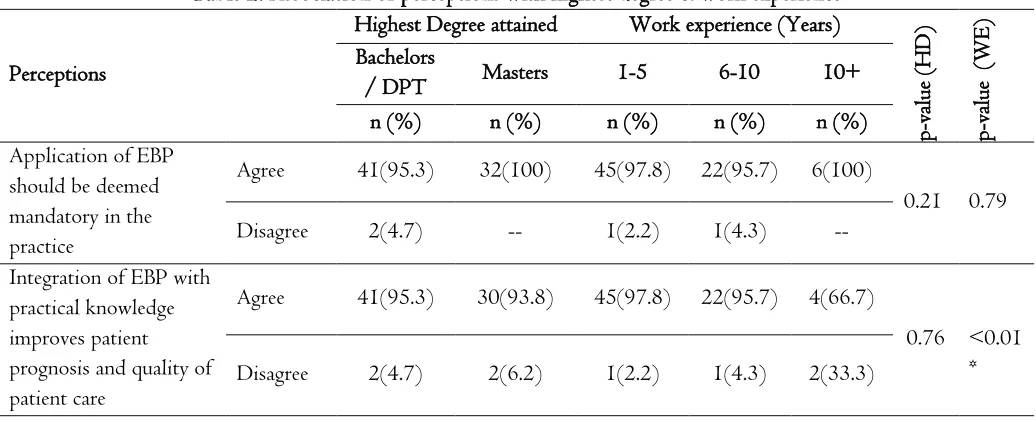
The statistics for the association of Perceptions with Highest Degree and Working experience respectively, showed that, perception on the integration of EBP with practical knowledge improvement gives the significant association with work experience (p<0.01), mostly fresh experience respondent gives the agreement on that question. Perception regarding interest in refining skills also gives significant association with working experience, (P=0.02) 91.3% respondent having experience 1 – 5 years showed their agreement (Table 2).
Table 2: Association of perceptions with highest degree & work experience
Perceptions
Highest Degree attained Work experience (Years)
p-value
(HD)
p-value
(WE)
Bachelors
/ DPT Masters 1-5 6-10 10+
n (%) n (%) n (%) n (%) n (%)
Application of EBP should be deemed mandatory in the practice
Agree 41(95.3) 32(100) 45(97.8) 22(95.7) 6(100)
0.21 0.79
Disagree 2(4.7) -- 1(2.2) 1(4.3) --
Integration of EBP with practical knowledge improves patient prognosis and quality of patient care
Agree 41(95.3) 30(93.8) 45(97.8) 22(95.7) 4(66.7)
0.76 <0.01 *
Increase use of EBP in my daily practice
Agree 41(95.3) 30(93.8) 45(97.8) 20(87) 6(100)
0.76 0.13
Disagree 2(4.7) 2(6.2) 1(2.2) 3(13) --
Interested in refining skills required to incorporate EBP into practice
Agree 40(93) 29(90.6) 42(91.3) 23(100) 4(66.7)
0.70 0.02*
Disagree 3(7) 3(9.4) 4(8.7) -- 2(33.3)
Use of EBP puts unreasonable pressure
Disagree 31(72.1) 25(78.1) 33(71.7) 18(78.3) 5(83.3)
0.55 0.73
Agree 12(27.9) 7(21.9) 13(28.3) 5(21.7) 1(16.7)
EBP doesn’t take into consideration the limitations of clinical setting
Agree 19(44.2) 11(34.4) 18(39.1) 9(39.1) 3(50.0)
0.39 0.87 Disagree 24(55.8) 21(65.6) 28(60.9) 14(60.9) 3(50.0)
*P<0.05 Considered as significant using Pearson chi-square test of independence
*DPT= Department Of Physiotherapy; EBP= Evidence Based Practice; HD = Highest Degree; WE = Work Experience
Table 3 includes the results of the inquiry outcome associated with the highest degree and work experience. It was found that 69.8% bachelor’s attained physiotherapists had access to research publications in comparison to 68.8% master’s attained individuals. 62.8% gave the agreement on workplace support the use of research in practice, 76.7% bachelors stated that they knew about the search engines that were used in physiotherapy, 80.4% fresh experienced said they were confident of their capability to search relevant research to answer clinical questions.
Table 3: Association of inquiry outcome with the highest degree & work experience
Inquiry
Highest Degree attained Work Experience (Years)
p-value
(HD)
P-value
(WE)
Bachelors /
DPT Masters 1-5 6-10 10+
n (%) n (%) n (%) n (%) n (%)
Have access to research publications via professional journals in paper or electronic form
Yes 30(69.8) 22(68.8) 32(69.6) 15(65.2) 5(83.3)
0.92 0.69
No 13(30.2) 10(31.2) 14(30.4) 8(34.8) 1(16.7)
Have access to relevant databases and internet at my clinical facility
Yes 31(72.1) 21(65.6) 32(69.6) 18(78.3) 2(33.3)
0.54 0.10
No 12(27.9) 11(34.4) 14(30.4) 5(21.7) 4(66.7)
Workplace Support the use of research in practice
No 27(62.8) 24(75.0) 31(67.4) 18(78.3) 2(33.3)
Acquired the foundations of EBP as a part of my academic education
Yes 36(83.7) 28(87.5) 37(80.4) 22(95.7) 5(83.3)
0.64 0.24
No 7(16.3) 4(12.5) 9(19.6) 1(4.3) 1(16.7)
Familiarity with physiotherapy search engines
Yes 33(76.7) 28(87.5) 38(82.6) 17(73.9) 6(100.0)
0.23 0.32
No 10(23.3) 4(12.5) 8(17.4) 6(26.1) --
Confidence regarding the capability to search relevant research to answer my clinical questions
Yes 34(79.1) 27(84.4) 37(80.4) 20(87.0) 4(66.7)
0.56 0.50
No 9(20.9) 5(15.6) 9(19.6) 3(13.0) 2(33.3)
*p<0.05 considered as significant using Pearson Chi-Square test
*DPT= Department Of Physiotherapy; EBP= Evidence Based Practice; HD = Highest Degree; WE = Work Experience
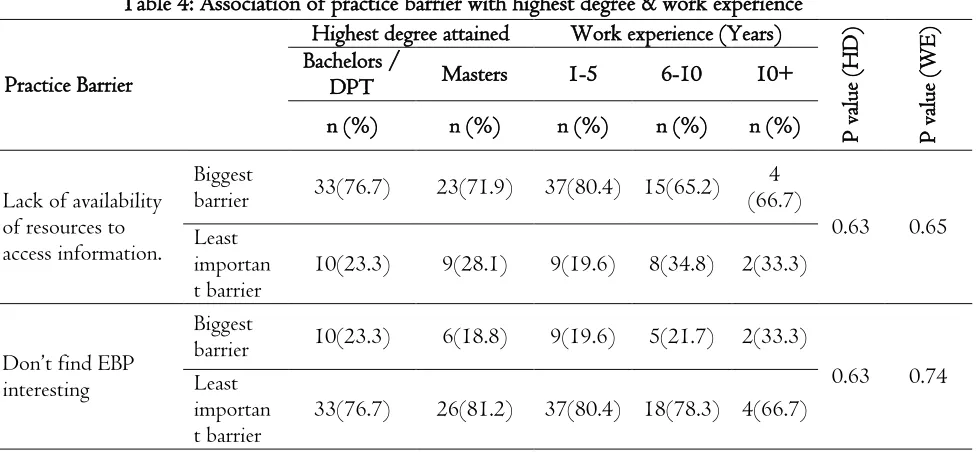
The working experience gives the significant association with difficulty in the application of generalized findings of individual findings to individual patients (P<0.01). 83.3% well experienced responded showed their agreement on this practice barrier. Another practical barrier of poor critical appraisal skills for research literature gives the significant association with highest degree respondent, (P=0.01) 72.1% bachelor’s degree respondents took it as the biggest barrier (Table 4).
Table 4: Association of practice barrier with highest degree & work experience
Practice Barrier
Highest degree attained Work experience (Years)
P
value
(HD)
P
value
(WE)
Bachelors /
DPT Masters 1-5 6-10 10+
n (%) n (%) n (%) n (%) n (%)
Lack of availability of resources to access information.
Biggest
barrier 33(76.7) 23(71.9) 37(80.4) 15(65.2) (66.7) 4
0.63 0.65 Least
importan
t barrier 10(23.3) 9(28.1) 9(19.6) 8(34.8) 2(33.3)
Don’t find EBP interesting
Biggest
barrier 10(23.3) 6(18.8) 9(19.6) 5(21.7) 2(33.3)
0.63 0.74 Least
importan
Insufficient time
Biggest
barrier 27(62.8) 20(62.5) 27(58.7) 16(69.6) 4(66.7)
0.97 0.66 Least
importan
t barrier 16(37.2) 12(37.5) 19(41.3) 7(30.4) 2(33.3) Difficulty in
application of generalized findings of research findings to individual patients
Biggest
barrier 24(55.8) 15(46.9) 28(60.9) 6(26.1) 5(83.3)
0.44 <0.01* Least
importan
t barrier 19(44.2) 17(53.1) 18(39.1) 17(73.9) 1(16.7)
Lack of formal education and training in EBP
Biggest
barrier 36(83.7) 22(68.8) 36(78.3) 17(73.9) 5(83.3)
0.12 0.86 Least
importan
t barrier 7(16.3) 10(31.2) 10(21.7) 6(26.1) 1(16.7)
Poor critical appraisal skills for research literature.
Biggest
barrier 31(72.1) 14(43.8) 30(65.2) 12(52.2) 3(50.0) 0.01
* 0.50
Least importan
t barrier 12(27.9) 18(56.2) 16(34.8) 11(47.8) 3(50.0) *p<0.05 considered as significant using Pearson Chi Square test
*DPT= Department Of Physiotherapy; EBP= Evidence Based Practice; HD = Highest Degree; WE = Work Experience
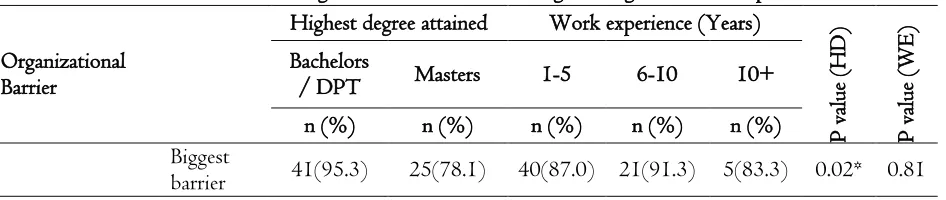
When organizational barrier outcomes with the highest degree and work experience were observed. It was found that lack of time provided by management was gives a significant association with the highest degree attained respondent, (P=0.02) 95.3% bachelor tool it as the biggest barrier, but the working experience did not give any significant association with this barrier, (p=0.81). Lack of support among physiotherapist also gives a significant association with the highest degree attained respondent (p=0.02), 72.1% bachelor respondent agreeing with it as the biggest barrier, but the working experience was found insignificant (p=0.18). Remaining organizational barrier did not give any significant association with the highest degree and working experience, result s were found statistically insignificant with P value more than 0.05 (Table 5).
Table 5: Association of organizational barrier with highest degree & work experience
Organizational Barrier
Highest degree attained Work experience (Years)
P
value
(HD)
P
value
(WE)
Bachelors
/ DPT Masters 1-5 6-10 10+
n (%) n (%) n (%) n (%) n (%)
Biggest
Lack of time provided by management
Least important
barrier 2(4.7) 7(21.9) 6(13.0) 2(8.7) 1(16.7)
Insufficient resources at the facility
(computers, internet, databases)
Biggest
barrier 24(55.8) 22(68.8) 28(60.9) 14(60.9) 4(66.7)
0.25 0.96 Least
important
barrier 19(44.2) 10(31.2) 18(39.1) 9(39.1) 2(33.3) Lack of support
among
physiotherapists at my clinical setting
Biggest
barrier 31(72.1) 15(46.9) 32(69.6) 11(47.8) 50.0 3
0.02* 0.18 Least
important
barrier 12(27.9) 17(53.1) 14(30.4) 12(52.2) 3(50.0) Lack of efforts
and facilitation of the
organization to improvise EBP with clinical practice
Least important
barrier 11(25.6) 9(28.1) 11(23.9) 6(26.1) 3(50.0)
0.80 0.39 Biggest
barrier 32(74.4) 23(71.9) 35(76.1) 17(73.9) 3(50.0)
*p<0.05 considered as significant using Pearson Chi-Square test
*DPT= Department Of Physiotherapy; EBP= Evidence Based Practice; HD = Highest Degree; WE = Work Experience
Discussion
Our study to achieve the goal of finding the barriers to the implementation of EBP in the field of physiotherapy and their association with the highest degree attained and work experience gave significant results. Exploration of this subject was much desired as limited knowledge was available on the barriers faced by medical
professionals on individual and
organizational fronts to establish the protocols of evidence based medicine20-22.
The study also provides detailed information on perceptions and inquiries of physiotherapists regarding evidence based physiotherapy.
A noteworthy practitioner barrier found in the implementation was lack of formal education and training in evidence based
practice and it was consistent with the findings in the international literature
review5. In accordance with a previous
similar study, lack of interest was not considered to be a barrier by a majority of the respondents3.
When the practitioner barriers were associated with the highest degree attained, it was observed that the respondents who held bachelor degree were more likely to consider poor critical appraisal skills as a significant barrier to implement EBP as compared to the master graduates (Table 4). These finding validated further the results of a parallel study which also stated that DPT degree holder’s considered deficient in critical appraisal skills as a significant barrier for EBP implementation
when compared to Master’s degree holders4.
research and evidence based skills during post-graduation studies.
In accordance with the previous studies, lack of time was considered to be the biggest organizational barrier5&7. Time is an
essential element required to implement EBP. If organizations don’t provide time-space, EBP cannot be integrated in practice by the respondents despite having access to research journals (≈70%) which is slightly less as compared to availability of access in
the international study which was 80%4. In
concordance with the study findings of Jette3, our respondents reported difficulty
in the application of general findings of research to individual patients too as it does not take into consideration case to case variations.
As observed in a study conducted on occupational therapists7, our respondents
too held an overall positive impression of evidence based physiotherapy. Parallel to the results conducted in canada4, majority
of the physiotherapists of our study agreed that EBP integration in practice improved the quality of care. Furthermore, the lack of education, negative perceptions about research and physical therapists' role in EBP, and low self-efficacy to perform EBP activities represent barriers to implementing EBP. Moreover, in line with Jette study (2003), physiotherapists with work experience of fewer than 5 years were more interested in refining their EBP skills as compared to other more experienced physiotherapists3. This indicates that fresh
graduates were keener to learn from continuing education and work towards the implementation of EBP. It was also interesting to note that they needed to increase the use of evidence in their daily practice.
It was interesting to note that fresh graduates with experience less than 5 years were more confident in their ability to research and critically appraise the study (Table 5). This puts light on the fact that research related education is being emphasized on and integrated in revised curriculums of the undergraduate degrees.
No studies are void of limitations. The convenience sampling technique could potentially affect the results by selection bias. The sample size of 75 is relatively small and is restricted to just one city of
only one province. Therefore,
generalization of these findings nationally in other provinces is debatable. The questionnaires were equally distributed among therapists from government, semi-private and semi-private hospitals in an effort to reduce any bias but there is a vast majority of physiotherapists working in private out-patient clinics which were not a part of this study and it is uncertain that how similar or different their situations and opinions were from the selected respondents.
Conclusion
Conflicts of Interest
None.Acknowledgement
Authors are grateful to directors of Institute of Physical and Mental Rehabilitation, National Coaching Centre-PSB, Women complex, Naval Academy, The Physical Institute, Sindh Sports Board, DUHS-Sports Complex for their support during the research.
Funding
None.References
1. Maher C, Sherrington C, Elkins M,
Herbert R, Moseley A. Challenges for
Evidence-Based Physical Therapy:
Accessing and Interpreting High-Quality Evidence on Therapy. Phys Ther. 2004; 84(7):644-654.
2. Guides.mclibrary.duke.edu. Overview -
Introduction to Evidence-Based Practice - LibGuides at Duke University Medical
Center. 2015. Available from:
http://guides.mclibrary.duke.edu/c.php? g=158201&p=1036021.
3. Jette DU, Bacon K, Batty C, Carlson M,
Ferland A, Hemingway RD, Hill JC, Ogilvie L, Volk D. Evidence-Based Practice: Beliefs, Attitudes, Knowledge, and Behaviors of Physical Therapists. Phys Ther. 2003; 83(9):786-805.
4. Salbach N, Jaglal S, Korner-Bitensky N,
Rappolt S, Davis D. Practitioner and Organizational Barriers to Evidence-based Practice of Physical Therapists for People With Stroke. Phys Ther. 2007; 87(10):1284-1303.
5. Schreiber J, Stern P. A Review of the
Literature on Evidence-Based Practice in Physical Therapy. IJAHSP. 2005; 3(4).
6. Ploeg J, Davies B, Edwards N, Gifford
W, Miller PE. Factors influencing best‐
practice guideline implementation:
lessons learned from administrators, nursing staff, and project leaders. Worldviews Evid Based Nurs. 2007; 4(4):210-219.
7. Bennett S, Tooth L, McKenna K, Rodger
S, Strong J, Ziviani J, Mickan S, Gibson L. Perceptions of evidence-based practice: A survey of Australian occupational therapists. Aust Occ Ther J. 2003; 50(1):13-22.
8. Scurlock-Evans L, Upton P, Upton D.
Evidence-based practice in physiotherapy: a systematic review of barriers, enablers and interventions. Physiotherapy. 2014; 100(3):208-219.
9. Cimdi C. Evidence-Based Practice (EBP)
in Rehabilitative Physiotherapy. IJAHSP. 2012; 10(4): 1-11.
10. Guyatt G, Haynes R, Jaeschke R, Cook
D, Green L, Naylor C, Wilson MC, Richardson WS users' Guides to the Medical Literature. JAMA. 2000; 284(10):1290-1296.
11. Haynes B, Haines A. Getting research
findings into practice: Barriers and bridges to evidence based clinical practice. BMJ. 1998; 317(7153):273-276.
12. McColl A, Smith H, White P, Field J.
General practitioners' perceptions of the route to evidence based medicine: a questionnaire survey. BMJ. 1998; 316(7128):361-365.
13. Fairhurst K, Huby G. From trial data to
and used evidence about statin drugs in
their management of
hypercholesterolaemia. BMJ. 1998;
317(7166):1130-1134.
14. Retsas A. Barriers to using research
evidence in nursing practice. J Adv Nurs. 2000; 31(3):599-606.
15. Kajermo K, Nordstrom G, Krusebrant A,
Bjorvell H. Barriers to and facilitators of research utilization, as perceived by a group of registered nurses in Sweden. J Adv Nurs. 1998; 27(4):798-807.
16. Heiwe S, Kajermo KN, Tyni-Lenné R,
Guidetti S, Samuelsson M, Andersson IL, Wengström Y. Evidence-based practice: attitudes, knowledge and behaviour among allied health care professionals. Int J Qual Health Care. 2011; 23(2):198-209.
17. Weng Y, Kuo K, Yang C, Lo H, Chen C,
Chiu Y. Implementation of evidence-based practice across medical, nursing, pharmacological and allied healthcare professionals: a questionnaire survey in
nationwide hospital settings.
Implementation Sci. 2013; 8(1):112.
18. Gorgon E, Basco M, Manuel A. Teaching
evidence based practice in physical therapy in a developing country: a national survey of Philippine schools. BMC Med Educ. 2013; 13(1):154.
19. Ghani F. Evidence-based medicine:
Systematic reviews are the best evidence tools for the practice of medicine and dentistry.JLUMHS.2008; 7(1):44-51.
20. Abbas Z, Raza S, Ejaz K. Systematic
Reviews and their role in Evidence - Informed Health Care. J Pak Med Assoc. 2008; 58(10):561-567.
21. Irshad A, Ramzan M, Iqbal M.
Assessment of knowledge about evidence based medicine in medical students and doctors in a Pakistani health care setting. JAMC. 2010; 22(2):126-129.
22. Zaidi Z, Hashim J,Iqbal M, Quadri K.