University of Belgrade, Faculty of Organizational Sciences
Designing a Learning Network Organization
UDC: 005.53:005.94; 005.575DOI: 10.7595/management.fon.2014.0029
1. Introduction
Organizational learning and organizational networks are in the research focus of the contemporary organi-zational theory, as well as common buzzwords of practice in the field. This article will try to relate two con-cepts based on empirical evidence. Organizational learning has been studied by two branches, one mainly theoretical and the other more practical in nature. The first branch focuses on different ways to explain the learning process, holding a common premise that organizational learning leads to organizational changes: Argyris and Schon (1978) insist on including both behavioral and cognitive dimension, Crosanne et al (1999) connect learning to the exploration-exploitation paradigm; Huber (1991) takes the information processing approach, etc. Within the second branch, Senge defined the learning organization as an “…organization where people continually expand their capacity to create the results they truly desire, where new and ex-pansive patterns of thinking are nurtured, where collective aspiration is set free, and where people are con-tinually learning to learn together“ (Senge, 1994), and March (1991) explores organizational learning through exploration and exploitation concepts. After Senge’s book The Fifth Discipline, the concept of a learning or-ganization experienced tremendous growth and popularity. Literature review summarizes in following: the learning organization is a lean, organic structure. It glorifies creativity, innovation and experimentation. It also cultivates information exchange through a dialogue, interaction between individual ideas and a collec-tive evaluation, and interplay of utilization and experimentation. It is proaccollec-tive towards changes within external environment, and builds internal environment which supports various learning processes.
Consequently, the analyses that recognize the existing theories of organizational learning and the recom-mendations of how to built the learning organization as ‘‘far too abstract, and too many questions remained unanswered’’ (Garvin, 2000: 79) have also appeared. Garvin (2000) argues that the existing theory did not succeed in addressing the ‘‘three (crucial) Ms’’of building the learning organization: meaning, manage-ment and measuremanage-ment. James (2003) goes deeper into the question of organizational design of learning organizations, trying to find more a concrete answer to the question on the architecture of the L-form and its contextual design.
Nevertheless, questions still opened for empirical research and an academic discussion are:
• How to design learning organization?
• Which mechanisms of organizational design should be used in order to create learning organizations? • Is there a unique organizational design of a learning organization?
This paper aims to contribute to filling the knowledge gap on practical, non-vague recommendations how to
design a learning organization, usingthe analysis of organizational network structure in the context of
orga-nizational learning. We draw on the importance of orgaorga-nizational design as an enabler of orgaorga-nizational
learn-ing. We usea research case study approach as an empirical background. We apply organizational network
analysis in order to describe how network density, reciprocity, reachability, blocks and cut-points as well as
de-sign efficiency – effectiveness balance can promote support and enable learning. We define practical
impli-cations for managers on how to manage work and knowledge flows in their organizations.
We recognize this gap in the literature, and the need to offer more applicable instruments for managers to use in order to design a learning organization. However, this issue becomes even more complicated when it comes to inter-organizational cooperation. Organizational learning and knowledge transfer represent one of the key reasons for inter-organizational linking in the modern environment. Thus, as Inkpen and Ra-maswamy note (2006: 108)‘‘…even though many studies have argued that the ability to transfer knowledge is a primary source of a firm’s competitive advantage and growth, we know relatively little about how to trans-fer knowledge within and across organizational boundaries’’.
The aim of this paper is to draw on the importance of organizational design as an enabler of organizational learning, and to point to some learning obstacles which are built-in organizations in the process of their de-sign, which, unfortunately, organizational leaders are often not even aware of. We use data from an alliance created between the two renowned media companies as to evidence our argumentation. For the sake of companies’ privacy, we changed the names and use X and Y marks. We apply organizational network analy-sis in order to identify work-flows and knowledge-flows (Borgatti et al, 2002; Krackhardt, 1992, 1994; Burt, 1982) and to explain that traditional understanding of organizational design does not have adequate ana-lytical potentials to answer the questions of how to create intra and inter-organizational design that pro-motes support and enables learning. We define practical implications for managers on how to manage work and knowledge flows in their organizations.
2. Theoretical background
The contemporary theory makes a clear distinction between the concepts of organizational learning and or-ganizational knowledge. Oror-ganizational knowledge is the result of the process of learning, as well as the basis for further learning. Burton et al. define knowledge as “information that corresponds to a particular context”(Burton et al., 2006: 92). Together with information which is a constitutive part of knowledge, trans-ferability of knowledge is often cited as one of its most important characteristics (Cummings, 2001). Argote an Ingram (2000) argue that the ability of an organization to transfer knowledge becomes increasingly im-portant as organizations which are able to undertake this process effectively have higher productivity and higher chances to survive in comparison with those less capable of effective knowledge transfer. Knowl-edge transfer can be defined from different approaches, such as “sharing ideas across boundaries both within and outside of an organization” (Yeung et al., 1999). On the other hand, knowledge diffusion is the movement of knowledge within organization, between its parts and units. Therefore, as Cummings notes (2001: 15) “knowledge transfer is not simply a diffusion of knowledge, but the planned sharing of it across organizational boundaries”. In that sense, knowledge transfer is unconnectedly related to knowledge ex-change, which assumes sharing of information that requires interpretation, or intelligence to fully under-stand and apply.
Nonaka and Takeuchi (1995) also consider learning as a process through which individual knowledge be-comes available to the organization. They recognize four ways in which knowledge converts within an organ-ization: (1) socialization, (2) externalization, (3) combination, and (4) internalization. Nonaka (1991) explains that explicit and tacit knowledge are not necessarily mutually exclusive categories, but that conversion of one into the other is possible. The importance of the analysis of Nonaka (1994) and later Nonaka and Takeuchi (1995) is in that it shows how different learning theories do explain how knowledge is accumulated within an organi-zation, but do not explain how new knowledge is created. Nonaka describes this process through the devel-opment of the spiral of knowledge creation. Furthermore, relying on the the Japanese philosophy, Nonaka, Toyoma and Byosiere (2001: 498) introduce the concept of Ba, and define it as a ”place where knowledge is shared, created and utilized”, ”a framework in which knowledge is activated as a resource”. They explain that Ba does not necessarily mean space in physical terms, but covers a virtual space (e-mail, teleconferences) and mental space (shared experience, ideas, etc.) as well, and the combination of those.
Organizational learning and knowledge transfer represent one of the key reasons for forming strategic al-liances in the modern environment. Even in such cases when companies have not initially entered a strate-gic partnership with the clear aim of organizational learning and transfer of knowledge, the very environment of cooperation among companies possessing different knowledge and skills, different competencies and ways of applying them in practice, opens new possibilities for learning, gaining knowledge and acquiring new skills (Inkpen, 1998). On the other hand, strategic alliances sometimes do not result in the flow of knowl-edge and learning to the expected extent, even when they are formed with the aim to be incubators of new knowledge and a device for the dissemination of the existing knowledge (Muthusamy, White, 2005; Grant, Baden-Fuller, 2004; Inkpen, 1998). Different authors have offered different explanations why an absence of learning occurs in strategic alliances and what the factors limiting alliances to become learning networks are: opportunist behavior of the partners (Zolo et al, 2002, Svejenova et al, 2006), absence of social exchange and social integration of the partners (Inkpen, Tsung, 2005), or the lack of commitment, trust and consulta-tion when it comes to reaching decisions relevant to both partners (Muthusamy, White, 2005; Inkpen, Ra-maswamy, 2006), inadequate absorptive capacity (Inkpen, 2006; Child, 2003; Lyles, 2003). However, the role of organizational design in an inter-organizational context is not directly investigated.
3. Methods and results
Our data was gathered in the leading media company,Y World Service(YWS). The company broadcasts on a global scale, having regional sections, which cooperate with local, national radio stations by broadcast-ing the YWSshows. The company faced a decline in radio listening rates worldwide, and the YWS’s Serbian section was facing the danger of being closed due to lesser global focus on our region after the year 2000 and the decline of the station’s popularity in Serbia. After a detailed strategic analysis, an idea was pro-posed for a joint project with X, a growing Serbian media company which has already cooperated with YWS for a long period, and six former X employees who had to leave Serbia were now working on YWS, secur-ing both informal and formal contacts and positive stance. The Joint Project was to create a broadcast cov-ering both domestic and world news; it brought complete change in the working processes and proved to be very successful. The market research showed that the show hit the target and completely met the need of the audience because publicity of the YWS in Serbia increased by 10-15 times. On the wings of its suc-cess, similar broadcasts were started in Ukraine, Russia and Turkey.
Our quantitative analysis was not only based on a network perspective of the organization design proper-ties, an important part in inter-organizational design (Popović et al, 2012). The network analysis gave us an opportunity to view organizations from the perspective of connections among the organization’s members. The analysis has two basic functions: (1) it represents relationships between actors by quantifying and pre-senting with scheme information flow channels, that are in fact carriers of learning, and (2) it gives us the pos-sibility to construct a flow-chart, which is an advanced form of the traditional organizational chart, applied on an inter-organizational level. This analysis also enabled for us to represent and observe what Nonaka et al. marked as Baand define as ‘‘a place where knowledge is shared, created and utilized’’
not exist. What should particularly be handled with care is the interpretation, because the interpretation de-pends on the question we asked and in accordance with which network was coded. If, for example, we want to investigate the information-flow structure, each position is analyzed from the aspect of its role as infor-mation giver and receiver. In our research we observed the following network measures: descriptive statis-tics, network density, connectedness, reachability, reciprocity, ego-network analysis, structural holes and blocks and cut-points. The application of the network analysis has huge analytical potentials when we ana-lyze an organization as a “learning system”, structured from communication channels (formal and informal communications), procedures and routines, organizational environment which influences communication patterns and information systems.
Figure 1Organizational network graph
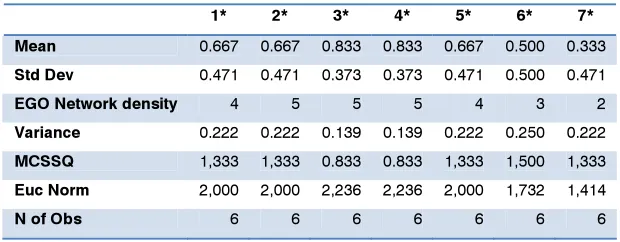
Actors- positions of the Editor in both partners’ organizations are, as expected at the information hubs. The ego-net analysis reports considerably strong values of the total number of participants in this partnership. Up to three positions gain networks larger than 5 (the Editor of Informative Program the X, the Editor of the Serbian section in The YWS and the Producer The Y world service), while other positions report somewhat lower values.
Flows - the analysis of information flows on the basis of network connections shows 42 potential
observa-tions of connecobserva-tions. From that number, 27 observaobserva-tions are present. Having in mind that the relaobserva-tionship between positions is represented with dummy variable taking value 1 if the relationship exists, and 0 if it does not, the mean value (=0.643) represents at the same time the percentage of the present to the possi-ble relationships within the network, implying that only 65% of all possipossi-ble connections are present. These parameters describe a dense organizational network, a feature important for organizational learning.
Structure- The graph representing a joint project organization shows that the network does not contain cut points, so we can speculate on its high connectedness and positions being deeply embedded into its struc-ture. The structure is connected, but relatively uniform distribution of network densities among different nodes implies a democratic structure without much hierarchy.
Table 1:Organizational network measures
*1-Chief YWS; 2-Editor X; 3-Editor YWS; 4-Producer YWS; 5-Producer X; 6-Journalist Y; 7-Journalist X.
1* 2* 3* 4* 5* 6* 7*
Mean 0.667 0.667 0.833 0.833 0.667 0.500 0.333
Std Dev 0.471 0.471 0.373 0.373 0.471 0.500 0.471 EGO Network density 4 5 5 5 4 3 2
Variance 0.222 0.222 0.139 0.139 0.222 0.250 0.222 MCSSQ 1,333 1,333 0.833 0.833 1,333 1,500 1,333
Euc Norm 2,000 2,000 2,236 2,236 2,000 1,732 1,414
4. Discussion: design and learning analysis
The analysis of this organizational network, which delivered good results in the Serbian context, and was replicated in a similar form in several different countries provides a basis for multiple-case analysis of or-ganizational network design and oror-ganizational learning. This structure was aimed to solve a strategic prob-lem of market share decrease through innovativeness. Both strategic and operative goals of two organizations were fit, expressed through the mission of the company Xand the partnership code of Y world service.On the other hand, there were differences in perceptions and symbols. Interviewed during a brain-storming session, employees both the on managerial and non-managerial positions personified the YWS as a middle-aged man in a suit, with a hat, holding a stick in his hand. Contrary to this, the Xwas seen as a young man in casual clothes with a rucksack in his back. However, it was accepted that such bureaucratic image was unfit for changing environment and IT dominated world of media.
As a new “product”, a joint broadcast show was created; it has delivered a high level of innovation needed to improve such stern image. In the context of organizational learning innovation is based on a high level of explorative orientation and interaction between partners. The broadcast show itself demanded intensive con-tacts during its realization, kindling the interaction between individual and organizational learning. The rela-tions of employees from two different organizarela-tions in this joint program, as well as the flow of information and knowledge in an interactive organizational network environment directly influenced the level of knowledge and learning on the individual level. According to Hamel (1991), individual learning becomes collective when there are mechanisms for summing up individual knowledge and when the sum up of the knowledge affects all those who can benefit from that knowledge transfer. The practice of giving regular feedback after the show enabled continuous instrumental learning by summing up important observations. It also bolstered organi-zational change, where structures, relations and practices related to activities proven inadequate were sup-pressed. Changes included the introduction of a new position – producer, and further, the existing job descriptions were modified. The overall structure was made leaner, virtually without a middle level.
The partnership between the two organizations brought a number of benefits to both sides. The Xcompany pursued its basic principles: explorative orientation and innovative program, expanding its offer of popular shows and increasing its popularity further. Secondly, in case of the Xthis cooperation created an oppor-tunity to learn from the Y world service, which is known for the affirmation of an analytical way of reporting and a higher level of the reporters’ independence. TheXcompany benefited from other inputs from the Y world service: the code of behavior, standardization and formalization, unbiased reporting and training on legal matters. On the other hand, the YWS gained in the speed and dynamics totally untypical of their work-ing conditions. All this was enabled by a vivid learnwork-ing activity in accordance with Nonaka’s view. Everyday virtual contacts, telephone communication and interactive adjustments of partners during the show enabled continuous exchange of implicit knowledge. This knowledge was further coded through instructions, guide-lines and operating procedures. Communication technology played a very important role in the functioning of this alliance, virtual meetings were held before, during and after the show, but the dominant technology for communication between network members was still by telephone.
We will use one practice to illustrate organizational learning and knowledge transfer within the organization, as well as de facto internalization of knowledge. A specific way of introducing the journalists, one of the YWS
trademark features became also a common practice of the company Xjournalists on radio and TV shows that were not covered by the joint program. Other, more technical organizational departments also accepted prac-tices related to the joint program. According to the interview with on of the producers: ”The execution of this show initiated changes in the existing operating procedures, and caused introductions of some new standards in the radio shows of the X, so now technicians ask for a show-outline plan in other informative shows as well.”
Conclusion: how to design organization to learn
REFERENCES
[1] Argote, L., Ingram, P., (2000). Knowledge transfer: A basis for competitive advantage in firms, Organi-zational Behavior and Human Decision Processes, 82 (1): 150-169.
[2] Argyris C., Schon D, (1985). Organizational Learning: A Theory of Action Perspective, San Francisco: Jossey –Bass.
[3] Boerner, C.S., Macher, J. T.,Teece, D. J., (2001). A Review and Assessment of Organizational Learning in Economic Theories«, Handbook of Organizational Learning & Knowledge; 89-117.
[4] Borgatti S.P., Everett M.G., Freeman, L.C., (2002). UCINET for Windows: Software for Social Network Analysis, Harvard: Analytic Technologies.
[5] Burt, R.S., (1982). Toward a Structural Theory of Action, New York: Academic Press.
[6] Burton, M.R., DeSanctis, G., Obel, B., (2006). Organizational Design: A Step by Step Approach, Cam-bridge.
[7] Burton, M.R., Obel, B., (2004). Strategic Organizational Diagnosis and Design: The Dynamics of Fit, Springer.
[8] Child, J., Faulkner, D. (1998). Strategies of Cooperation: Managing Alliances, Networks, and Joint Ven-tures, New York: Oxford University Press
[9] Child, J. (2003). Learning Through Strategic Alliances, in Handbook of Organizational Learning and Knowledge, Oxford University Press: 657-680.
[10] Crossan, M., Lane, H., White, R., (1999). An Organizational Learning Framework: From Intuition to In-stitution, Academy of Management Review, 24(3), 522-537
[11] Cummings, J. (2001). Knowledge Transfer Across R&D Units: An Empirical Investigation Of The Factors Affecting Successful Knowledge Transfer Across Intra And Inter Organizational Units, doctoral disser-tation, George Washington University, Washington DC
[12] Cummings, J., (2001). Knowledge Transfer Across R&D Units: An Empirical Investigation Of The Fac-tors Affecting Successful Knowledge Transfer Across Intra And Inter Organizational Units, doctoral dis-sertation, George Washington University, Washington DC
• network density, • reciprocity, • reachability,
• blocks and cut-points,
• design efficiency – effectiveness balance.
[13] Daft, R. Weick, K., (1984). Toward a Model of Organizations as Interpretation Systems, Academy of Management Review, 9(2), 284-295.
[14] Fiol,C.M., Lyles, M.A., (1985). Organizational learning, Academy of Managment Review, 10 (4): 803-813
[15] Garvin, D.A, (2000). Learning in Action: A Guide to Putting Learning Organization to Work, Harvard Business School Press.
[16] Garvin, D.A., (1993). Building a Learning Organization, Harvard Business Review, July-Avgust, 78-91 [17] Grant, R.M., Baden-Fuller,C. (2004). A Knowledge Accessing Theory of Strategic Alliances, Journal Of
Management Studies, January, 41:1.
[18] Hamel,G., (1991). Competition for Competence and Interpartenr Learning within International Strategic Alliances, Strategic Management Journal, 12, 83-103
[19] Hedberg, B. (1981). How Organizations Learn and Unlearn, in Starbuck, W. (Ed.), Handbook of orga-nizational design: 3-27. New York: Oxford University Press.
[20] Huber. G.P. (1991). Organizational Learning: the Contributing Process and the Literatures, Organization Science, 2(1), February, 1991
[21] Inkpen, A.C., (1996). Creating Knowledge through Collaboration, California Management Review, 39 (1): 123-140
[22] Inkpen, A. C., Beamish, P. W. (1997) Knowledge, Bargaining Power, and the Instability of International Joint Ventures, Academy of Management Review, 22: 177-202.
[23] Inkpen, A., Currall, S.C. (1998). The Nature, Antecedents and Consequences of Joint Venture Trust, Journal of International Management, 4 1-20
[24] Inkpen, A.C., (1998). Learning and Knowledge Acquisition through International Strategic Alliances, Academy of Management Executive, 12 (4):69-80
[25] Inkpen, A.C., (1998). Learning, Knowledge Acquisition and Strategic Alliances, European Management Journal, 16(2), 223-229
[26] Inkpen, A.C., Dinur, A. (1998). Knowledge Management processes and International Joint Ventures, Organization Science, 9(4): 454-468
[27] Inkpen, A.C., (2001), Strategic Allinaces (Chapter 15) in Oxford Handbook of International Business (eds. Rugman, A.M., Brewer, T.L.), Oxford Scholarship Online Monographies.
[28] Inkpen, A.C., Tsang, E.W.K. (2005). Social Capital, Networks and Knowledge Transfer, Academy of Man-agement Review, 30(1), 146-165
[29] Inkpen, A., Ramaswamy, K., (2006). Global Strategy: Creating and Sustaining Advantage Across Bor-ders, Oxford University Press.
[30] James, C.R. (2003). Designing Learning Organizations, Organizational Dynamics, 32(1), 46-61 [31] Jaško, O., Jaško, A., & Čudanov, M. (2010). Impact of management upon organizational network
ef-fectiveness. Management – journal for management theory and practice, 15(56), 5-12.
[32] Krackhardt, D. (1992). The Strength of Strong Ties, in Nohria,N., Eccles, R. G. (Eds.), Networks and or-ganizations: Structure, form and action: 216-239. Boston: Harvard Business School Press.
[33] Krackhardt, D. (1994). Graph Theoretical Dimensions of Informal Organizations«, in Carley, K., Prietula, M., Computational Organization Theory, New Jersey:Lawrence Erlbaum Associates.
[34] Maier, G.W., Prange, C., Rosensteil, L. (2001). Psichological Perspectives of Organizational Learning, in Handbook of Organizational Learning and Knowledge, Oxford University Press: 14-34.
[35] March,J.G., (1991). Exploration and Exploitation in Organizational Learning, Organization Science, 2(1), 71 - 87
[36] Muthusamy, S.K., White, M.A., (2006). Learning and Knowledge Transfer in Strategic Alliances: A So-cial Exchange View, Organization Studies, 26 (3): 415 -441
[37] Nonaka, I. (1991). The Knowledge Creating Company, Harvard Business Review, Nov-Dec: 96 [38] Nonaka, I. (1994). A Dynamic Theory of Organizational Knowledge Creation, Organization Science,
5(1), 14-37
[39] Nonaka, I., Takeutchi, H. (1995). The Knowledge Creating Company, New York: McGrawHill [40] Polanyi, M. (1966). The Tacit Dimension, London: Routledge&Kegan Paul
[41] Popović, N., Jaško, O., & Prokić, S. (2010). Menadžment interorganizacionih odnosa-outsourcing, strateške alijanse, merdžeri i akvizicije. Beograd, Srbija: Faculty of organizational sciences.
[42] Senge, P. (1994). The fifth discipline: The art and practice of the learning organization, Doubleday: New York
Receieved: April 2014.
About the Author
Mirjana Petković Belgrade University, Faculty of Economics
Mirjana Petković, Ph.D., is professor at the Faculty of Economics, the Belgrade University (the courses of Enterprise Organization and Human Resource Management). She is the author of Organizational Behaviour with Human Resource Management(3rd edition), the book published by CID Faculty of Economics in 2011, and a co-author of
Organization- design, behavior, human resources, and changes(6thedition), published
by CID Faculty of Economics in 2009. She is also the author and co-author of several monographs and numerous articles in the fields of organizational theory, organizational structure, organizational behavior, organizational design, culture and changes; and took part in many projects as a consultant or project manager.
Ana Aleksić Mirić University of Belgrade, Faculty of Economics [email protected]
Dr Ana Aleksić Mirić is assistant professor at the Faculty of Economics, University of Belgrade. She holds MSci and PhD degrees from the Faculty of Economics, University of Belgrade (PhD in 2009 - “Organizational Learning and Knowledge Management in Strategic Alliances: Organizational Design Perspective”). During her PhD education in
Mladen Čudanov University of Belgrade, Faculty of Organizational Sciences