http://www.sciencepublishinggroup.com/j/ijiis doi: 10.11648/j.ijiis.20180705.11
ISSN: 2328-7675 (Print); ISSN: 2328-7683 (Online)
Methodology Article
Analysis of Operating Mode of Electronic Product Reverse
Supply Chain Based on FAHP
Sun Hui
*, Wang Manfei, Song Zuoling, Yu Hongfei
College of Transportation, Shandong University of Science and Technology, Qingdao, China
Email address:
*
Corresponding author
To cite this article:
Sun Hui, Wang Manfei, Song Zuoling, Yu Hongfei. Analysis of Operating Mode of Electronic Product Reverse Supply Chain Based on FAHP. International Journal of Intelligent Information Systems. Vol. 7, No. 5, 2018, pp. 42-47. doi: 10.11648/j.ijiis.20180705.11
Received: January 3, 2019; Accepted: January 23, 2019; Published: February 14, 2019
Abstract:
As a big country of electronic products consumption, China has entered the peak period of electronic products scrapping. At the same time, the renewal of electronic products has also led to the development of reverse supply chain of electronic products. Many electronic products enterprises have also launched their own reverse logistics, but some manufacturers have blindly implemented reverse logistics without reasonable planning, which makes a large number of electronic products failed. Get reasonable recovery. This paper studies the selection of operation modes of reverse supply chain for electronic products, analyses the status quo of waste electronic products recycling, and introduces three common operation modes of reverse logistics, namely self-management mode, alliance mode and outsourcing mode, and analyses and compares the advantages and disadvantages of each operation mode. Combining with the principles of index screening and index system establishment, the evaluation index is screened and integrated, and the evaluation system of reverse logistics selection is constructed. Fuzzy Analytic Hierarchy Process is used to select the operation mode of reverse logistics for waste electronic products, and the feasibility and practicability of this method are verified by demonstration.Keywords:
Reverse Supply Chain, Reverse Logistics, Waste Electronic Products, Fuzzy Analytic Hierarchy Process1. Introduction
With the development of information technology industry, the use rate of electronic products is getting higher and higher. Although it promotes the rapid development of economy and brings convenience to people, it also brings many potential threats. Electronic products such as household appliances, computers and mobile phones have reached the peak of product renewal, and more and more electronic products are eliminated and scrapped [1]. According to various data analysis, China produces millions of tons of e-waste every year. There are a lot of toxic substances in waste electronic products. If not handled properly, it will pose a serious threat to the living environment of human beings. It can be concluded that China is facing an increasingly serious waste pollution problem [2-3]. Of course, these waste electronic
market competitiveness of enterprises [7-9]. Many scholars have studied the recycling mode of electronic resources waste. Bhat [10] through the analysis of the status quo of the recycling of used mobile phones, it is believed that the government should guide and encourage consumers to participate actively in the recycling of used mobile phones, and at the same time, new recycling modes should be explored. Huang Wan [11] studied the disposal methods of consumers' used mobile phones through empirical analysis, and envisaged the development prospects of recycling enterprises of used mobile phones. Jayant [12] establishes an index model through analytic hierarchy process to study the recycling industry of used mobile phones. The analysis shows that the best strategy is to provide recycling services by third-party service providers. Du Zhiping [13] constructed a mobile phone reverse supply chain recycling model based on the mode of Online to offline (O2O), in which the mobile phone manufacturer is the main recycling agent and multi-party participation. The process design of three subsystems, namely online evaluation, confirmation of payment and co-collection processing, was carried out. Zheng Xiujun [14] combines the current situation of the recycling of waste mobile phones in China, EU and Japan, and puts forward the recycling mode of waste mobile phones in China based on the concept of low input, low consumption, low emission and high efficiency of circular economy. Debabrata Das [15] developed a system dynamics framework of reverse supply chain based on product transformation, and studied the effects of product transformation, collection and remanufacturing on profit level through sensitivity analysis. On the basis of many studies and the actual situation of waste electronic products recycling, this paper uses the Fuzzy Analytic Hierarchy Process (FAHP) to select the operation mode of reverse supply chain of electronic products, so as to provide some suggestions for the recycling work of enterprises.
2. Operational Model of Reverse Supply
Chain for Waste Electronic Products
2.1. Self Run Mode
Self-operation mode refers to the establishment of reverse
logistics system by enterprises alone in combination with the existing forward logistics. Generally speaking, the system includes product returns, recycling and remanufacturing of waste products. Under this mode, enterprises need to bear the cost and risk of system construction, establish a recycling network covering the areas covered by their products, and regularly and regularly recycle to realize the recycling network body. With this system, enterprises can get timely information feedback in the recycling process, so that consumers' habits and characteristics of product recycling can be fully considered in product design and manufacturing, and products that are more durable and easy to recycle can be designed.
2.2. Alliance Mode
Alliance mode refers to the alliance of enterprises of the same type, signing alliance contracts, sharing the costs and risks of network construction, striving to build a wide coverage of the recovery network, centralized recovery of the products of the alliance enterprises through the recovery network, enterprises participating in the alliance sharing recycling equipment, and processing and reprocessing the recycled products. Under this mode, the alliance enterprises should belong to the same type of enterprises, and the products produced should be the same type of products. The Alliance Mode saves the investment cost of enterprises while realizing reverse logistics operation.
2.3. Outsourcing Mode
Outsourcing mode is also called third-party mode. It means that enterprises sign cooperation agreements with third-party companies to entrust the recovery of their own products to third-party companies. At the same time, enterprises have to pay a certain amount of commissioning costs to third-party companies. The recovery of enterprise products is completed by third-party companies independently, and the processed products and components are handed over to enterprises for reuse. Sample enterprises do not need to spend human and financial resources to build factories and develop technology, they can focus on developing their own business and reduce the burden of enterprises.
2.4. Comparison of Advantages and Disadvantages of Three Modes
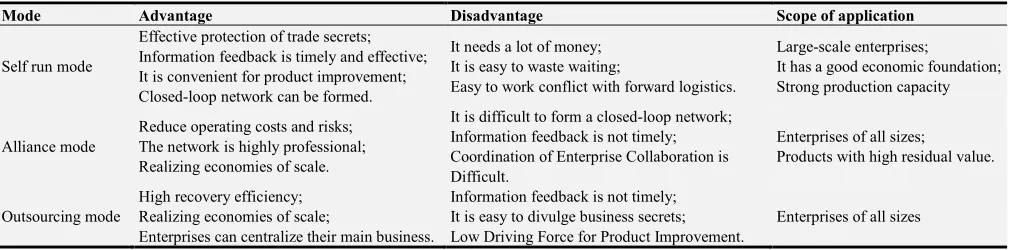
Table 1. Comparison of Three Operational Modes of Reverse Logistics.
Mode Advantage Disadvantage Scope of application
Self run mode
Effective protection of trade secrets; Information feedback is timely and effective; It is convenient for product improvement; Closed-loop network can be formed.
It needs a lot of money; It is easy to waste waiting;
Easy to work conflict with forward logistics.
Large-scale enterprises;
It has a good economic foundation; Strong production capacity
Alliance mode
Reduce operating costs and risks; The network is highly professional; Realizing economies of scale.
It is difficult to form a closed-loop network; Information feedback is not timely; Coordination of Enterprise Collaboration is Difficult.
Enterprises of all sizes;
Products with high residual value.
Outsourcing mode
High recovery efficiency; Realizing economies of scale;
Enterprises can centralize their main business.
Information feedback is not timely; It is easy to divulge business secrets; Low Driving Force for Product Improvement.
3. Establishment of Reverse Logistics
Evaluation System
This paper constructs the evaluation index system of reverse logistics for waste electronic products from the following aspects.
3.1. Economic Factors
Economic factors mainly include operating costs, investment costs and profits. In the operation of reverse logistics, the process of product reprocessing requires product inspection, disassembly, reprocessing, recycling and so on. These processes require a lot of funds and abundant human resources for facilities and equipment. At the same time, all production, sales and recycling activities of enterprises are aimed at creating benefits. Therefore, economic factors are very important for enterprises.
3.2. Management Factors
Management factors include the management of equipment, personnel and information. In order to implement reverse logistics actively and effectively, electronic products enterprises should manage the facilities, equipment and transportation schemes of the whole logistics system. At the same time, they should ensure the management coordination of the processing personnel to ensure the smooth progress of the work.
3.3. Technical Factors
Technical factors include recovery capacity, transportation level and inventory level. It is difficult to predict the time, quantity and location of electronic products recovery. In order to achieve the purpose of cost rationalization and transportation optimization, the transportation capacity of enterprises is very important. Waste electronic products are recycled and transported to centralized locations for warehousing management, providing sites for enterprise classification, disassembly, maintenance, reprocessing and other processes, facilitating the disposal and re-sale of items. In addition, effective inventory management technology will help enterprises save costs and recycle resources, so inventory management is one of the factors in the choice of operation mode. When recycling electronic products, we should not only consider the product types, sizes and specifications, but also consider the application of various processing technologies
for recycled products in the process of reverse logistics.
3.4. Social Factors
Social factors include environmental protection, service quality and customer satisfaction. With the increasing demand for electronic products, a large number of waste electronic products are produced, which not only wastes resources, but also contains a large number of harmful substances to damage the environment. From the perspective of social responsibility and ethics, reverse logistics of electronic products must be implemented. Customer satisfaction is the purpose of enterprise management. The higher the satisfaction degree of customer to enterprise service, the better the formation of customer loyalty to enterprise, and the service quality of enterprise plays a decisive role.
4. Case Study on Operational Mode
Selection of Reverse Supply Chain
Based on FAHP
4.1. Introduction of FAHP
Fuzzy analytic hierarchy process (FAHP) evaluation method is an evaluation method that combines Fuzzy Comprehensive Evaluation with Analytic Hierarchy Process. It is widely used in system evaluation, efficiency evaluation and system optimization. It is a qualitative and quantitative evaluation model. Generally, the factor set is determined by chromatographic analysis. Then the evaluation effect is determined by the fuzzy comprehensive evaluation. Fuzzy method is based on the hierarchical method, which is integrated with each other and has a good reliability for evaluation.
4.2. Operational Mode Selection of M Company's Reverse Supply Chain
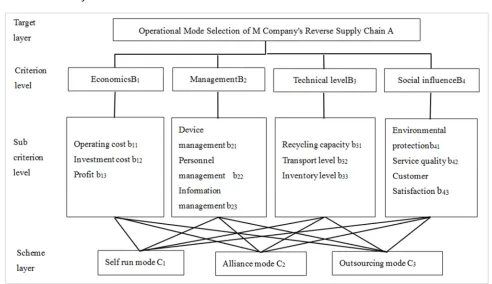
4.2.1. Establishment of Hierarchical Structure
Figure 1. M Hierarchical Model for Operational Mode Selection of Enterprise Reverse Supply Chain.
4.2.2. Constructing Judgment Matrix of Target Layer and Criterion Layer
According to M enterprise reverse supply chain operation mode selection hierarchical structure model, combined with expert scoring, the judgment matrix B is obtained, and the consistency of the matrix is tested.
Table 2. Judgment Matrix of Target Layer-Criterion Layer and Its Processing.
A B1 B2 B3 B4 w λmax CR
B1 1 2 3 4 0.4669
4.032 0.012
B2 1/2 1 2 3 0.2776
B3 1/3 1/2 1 2 0.1603
B4 1/4 1/3 1/2 1 0.0952
4.2.3. Constructing the Judgment Matrix of Sub Criteria Layer
Table 3. Establishment of Judgment Matrix Based on Economic Factors.
B1 b11 b12 b13 w1 λmax CR
b11 1 1/3 1/2 0.1571
3.0536 0.0462
b12 3 1 3 0.5936
b13 2 1/3 1 0.2493
Table 4. Establishes a judgment matrix based on management factors.
B2 b21 b22 b23 w2 λmax CR
b21 1 3 1/2 0.309
3.0037 0.0032
b22 1/3 1 1/5 0.1095
b23 2 5 1 0.5815
Table 5. Establishment of Judgment Matrix Based on Technological Level Factors.
B3 b31 b32 b33 w3 λmax CR
b31 1 1/3 1/2 0.1634
3.0093 0.008
b32 3 1 2 0.5396
b33 2 1/2 1 0.297
Table 6. Establishes a judgment matrix based on social factors.
B4 b41 b42 b43 w4 λmax CR
b41 1 3 5 0.1634
3.0036 0.0032
b42 1/3 1 2 0.5396
b43 1/5 1/2 1 0.297
According to the values of CR, it can be seen that the judgment matrix of each factor has satisfactory consistency.
4.2.4. Sub Criterion Layer Fuzzy Matrix and Comprehensive Evaluation
are expressed by Gi (i=1, 2, 3, 4). Then the comprehensive evaluation of the sub-criterion level is obtained by combining the weights of the fuzzy evaluation of each influencing factor. The vector Di (i=1, 2, 3, 4) is used to express the comprehensive evaluation of the sub-criterion level. The eigenvector is wi (i=1, 2, 3, 4), and Di=wiT
×
Gi.Table 7. Sub criterion Layer Fuzzy Matrix G in Self-Operating Mode.
B v1 v2 v3 v4
b11 0.4 0.2 0.3 0.1
b12 0.4 0.2 0.3 0.1
b13 0.3 0.2 0.4 0.1
D1 0.3751 0.2 0.3249 0.1157
b21 0.3 0.2 0.4 0.1
b22 0.5 0.2 0.2 0.1
b23 0.6 0.1 0.2 0.1
D2 0.4946 0.6652 0.2618 0.1
b31 0.4 0.2 0.2 0.2
b32 0.2 0.3 0.3 0.2
b33 0.2 0.4 0.2 0.2
D3 0.2327 0.3134 0.254 0.2
b41 0.1 0.3 0.2 0.4
b42 0.2 0.3 0.1 0.4
b43 0.2 0.4 0.3 0.1
D4 0.1352 0.3122 0.1892 0.3634
Table 8. Fuzzy Matrix G of Sub criteria Layer under Alliance Mode.
B v1 v2 v3 v4
b11 0.2 0.2 0.3 0.3
b12 0.1 0.2 0.2 0.5
b13 0.1 0.2 0.4 0.3
D1 0.1157 0.2 0.2656 0.4187
b21 0.2 0.3 0.3 0.2
b22 0.1 0.3 0.2 0.4
b23 0.5 0.2 0.3 0
D2 0.3635 0.2419 0.2891 0.1056
b31 0.5 0.2 0.2 0.1
b32 0.1 0.2 0.3 0.4
b33 0.1 0.3 0.2 0.4
D3 0.1654 0.2297 0.254 0.351
b41 0.2 0.2 0.1 0.5
b42 0.3 0.4 0.3 0
b43 0.1 0.3 0.2 0.4
D4 0.2108 0.2582 0.1582 0.3728
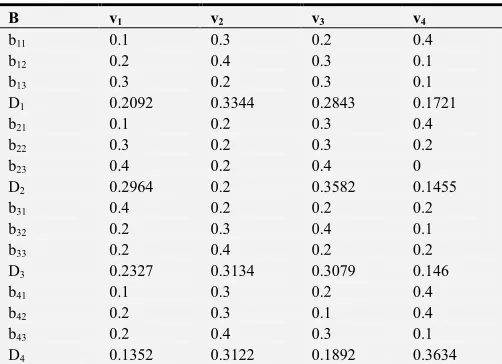
Table 9. Sub criterion Layer Fuzzy Matrix G in Outsourcing Mode.
B v1 v2 v3 v4
b11 0.1 0.3 0.2 0.4
b12 0.2 0.4 0.3 0.1
b13 0.3 0.2 0.3 0.1
D1 0.2092 0.3344 0.2843 0.1721
b21 0.1 0.2 0.3 0.4
b22 0.3 0.2 0.3 0.2
b23 0.4 0.2 0.4 0
D2 0.2964 0.2 0.3582 0.1455
b31 0.4 0.2 0.2 0.2
b32 0.2 0.3 0.4 0.1
b33 0.2 0.4 0.2 0.2
D3 0.2327 0.3134 0.3079 0.146
b41 0.1 0.3 0.2 0.4
b42 0.2 0.3 0.1 0.4
b43 0.2 0.4 0.3 0.1
D4 0.1352 0.3122 0.1892 0.3634
4.2.5. Criteria Layer Fuzzy Comprehensive Evaluation Combining the evaluation of different operation modes with the weight of criterion layer, the comprehensive evaluation of criterion layer is obtained, which is expressed by vector D. The eigenvector is w, and the fuzzy matrix of three operation modes is G=(D1, D2, D3, D4)T, then D = wT
×
G. Thus, the fuzzy comprehensive evaluation of each model can be obtained. According to the fuzzy comprehensive evaluation of the three modes, the results are evaluated by the method of hierarchical eigenvalue, and the evaluation benchmark and the corresponding value are determined. The best is 20, the good is 15, the middle is 10, and the difference is 5, so V=(20, 15, 10, 50), Then the evaluation result S=D×
VT. The evaluation results of self-management mode, alliance mode and outsourcing mode are 16.195, 11.541 and 12.8645 respectively.According to the calculation results, M company should choose self-management mode. This paper chooses the recycling mode of M company's used mobile phone, which is also applicable to the recycling of other electronic products. To a certain extent, it provides suggestions for enterprises to recycle electronic products, and also provides a theoretical basis for the research on the recycling mode of reverse supply chain of electronic products.
5. Conclusion
This paper evaluates three typical operation modes of reverse logistics of waste electronic products in China. Because there are other operation modes in the actual production and operation process, the final evaluation results are not comprehensive. At the same time, the evaluation index system cannot fully reflect the operation of the system, so it needs further study. In order to make the operation mode of reverse logistics of waste electronic products develop better, we must strengthen the policy guidance of the government, the responsibility consciousness of enterprises and the environmental protection consciousness of consumers. At the same time, we must strengthen the research on the recycling technology of waste electronic products so as to make the technology level of recycling of waste electronic products higher and facilities more advanced in our country.
References
[1] Yongqing Liu. Research on Game and Incentive Mechanism between Government and Home Appliance Manufacturing Enterprises under EPR System [J]. China's Circulation Economy, 2014 (3): 85-90.
[2] Jing Hu, Min Zhang. Research progress in remediation technology of heavy metal contaminated water [J]. Guangxi Light Industry, 2012 (2): 78-79.
[4] Dela Torre F. R., Ferrari L., Salihian A. Freshwater Pollution Biomarker: Response of Brain Acetylcholinester as Activity in Two Fish Species [J]. Comparative Biochemistry and Physiology Part C , 2002 (3): 271-280.
[5] Govindan K, Popiuc M N, Diabat A. Overview of the coordination contracts within the forward and reverse supply chains [J]. Journal of Cleaner Production, 013 (47): 319-334.
[6] Das D, Dutta P. A system dynamics framework for integrated reverse supply chain with three way recovery and product exchange policy [J]. Computers &Industrial Engineering, 2013 (4): 720-773.
[7] Ni M, Mo L H. A comparative study on the closed loop supply chain model of waste mobile phones under two recycling modes [J]. China Soft Science, 2013 (8): 170-175.
[8] Yourong Wang, Jie Ma. Recycling Status and Recycling Model of Waste Mobile Phones in China [J]. Economist, 2013 (06): 51-53.
[9] Liping Lu, Chunming Li. Research on Operational Model of Reverse Logistics for Scrapped Vehicles. Sustainable Development, 2018 (01): 53-56.
[10] Bhat V, Patil Y. E-waste Consciousness and Disposal Practices among Residents of Pune City [J]. Procedia-Social and Behavioral Sciences, 2014 (133): 491-498.
[11] Wan Huang, Lina Chen. Prospect and Development of Waste Mobile Phone Recycling Company [J]. Technology vision, 2014, (07): 129-130.
[12] A. Jayant, P. Gupta, S. K. Garg, M. Khan. TOPSIS-AHP Based Approach for Selection of Reverse Logistics Service Provider: A Case Study of Mobile Phone Industry [J]. Procedia Engineering, 2014, (97): 2147-2156.
[13] Zhiping Du, Xiaoqiang Wang. Research on Recycling Model of Mobile Reverse Supply Chain Based on O2O. Logistics technology, 2015 (34): 198-201.
[14] Xiujun Zheng. Discussion on the Resource-based Model of Waste Mobile Phones under the Concept of Circular Economy [J]. Eco economy, 2014 (30): 30-36.