Published online February 9, 2015 (http://www.sciencepublishinggroup.com/j/ijiis) doi: 10.11648/j.ijiis.s.2015040201.16
ISSN: 2328-7675 (Print); ISSN: 2328-7683 (Online)
Analysis of information logistics in order management
process - Focusing on make-to-order small and medium
company
Reakook Hwang
1, Koichi Murata
2, *, Hiroshi Katayama
31
Industry & Strategy Department I, Samsung Economic Research Institute, Seoul, Korea 2
Department of Industrial Engineering and Management, College of Industrial Technology, Nihon University, Chiba, Japan 3
Department of Industrial and management Systems Engineering, Faculty of Science and Engineering, Waseda University, Tokyo, Japan
Email address:
[email protected] (K. Murata)
To cite this article:
Reakook Hwang, Koichi Murata, Hiroshi Katayama. Analysis of Information Logistics in Order Management Process - Focusing on Make-to-Order Small and Medium Company. International Journal of Intelligent Information Systems. Special Issue: Logistics Optimization Using Evolutionary Computation Techniques. Vol. 4, No. 2-1, 2015, pp. 39-48. doi: 10.11648/j.ijiis.s.2015040201.16
Abstract: This paper discusses an analysis of an order management process (OMP) in a make to order production system. An
inquiry process is particularly focused in this study. It is a delivery process of order information in OMP. The proposed procedure of this paper consists of the following five steps; 1) identification of inquiry process in OMP, 2) investigation of identified inquiry process, 3) creation of categories of attributes of identified inquiry process, 4) quantification of characteristic of identified inquiry process and 5) consideration of improvement of identified inquiry process. Through using the experimental result by the proposed procedure, a clarification of the characteristics of identified inquiry processes and a determination of the order of the processes to improve are possible.Keywords: Information Logistics, Make to Order System, Small and Medium Company, Order Management Process, Process
Analysis1. Introduction
Order management process (OMP) is first step for realizing the product to satisfy customer requirement. OMP is considered as first process of order full process (OFP). It is a process which is from receiving orders to having the finished goods delivered. Lin (1998) summarizes main process of an OFP as follows;
Order management, which receives orders from customers and commits order requests;
Manufacturing, which includes production scheduling, material planning, capacity planning and shop floor control;
Distribution, which considers the logistics such as inventory and transportation.
A reduction time for second process and third process has been eagerly tackled with in a production sector. On the other hand, a management for the first process is not focused too much. The reason is that there are many non-standard operations in the process. Examples are a product design with customer and a coordination of detail specification with trial
and error and so on. As the result, it takes many times to proceed with the process caused by inefficient operations and losses in the operations. On the base of the recognitions, the purpose of this paper is a trial of OMP analysis.
For the analysis, a systematic procedure is proposed in this paper. Most of methods used in the procedure are only traditional ones such as role activity diagram (RAD) (Ruth 2004), pairwise comparison (Saaty et al 1994) and quantification theory category III (Takakura 1962, Hayashi and Suzuki 1975, and Hayashi 1993). The idea of the proposed procedure is a combination use of these methods in one analysis flow to realize a systematic analysis of OMP. This paper will contribute a powerful use of them compared with a single use of each one.
On the other hand, an improvement of quantification theory category III is proposed. The method was originally proposed by Hayashi. It is one of the methods of multivariate analysis. The theory is a method of classification of samples based on the similarity of the response pattern with respect to attributes having several items. A response pattern is a pattern of items to which a sample belongs. In this paper, the analyzed data concern the relationship between improved inquiry processes in the OMP and attributes of an inquiry process. Quantification theory category III is a suitable solution methodology because most of the analyzed data are qualitative data and do not have external criteria. In this case, ‘items’ and ‘sample’ mean ‘attributes of an inquiry process’ and the ‘inquiry process’ respectively. However there are a few problems as follows.
The attributes of an inquiry process are not weighted. It is difficult to extract different difficulties to improve a performance of an inquiry process from similar attributes.
It is difficult to extract different difficulties to improve a performance of an inquiry process from similar processes.
In this paper, a model to resolve the problems is proposed by giving weighted-scores to attributes of an inquiry process and a simple case analysis is performed to confirm the utility of the proposed model.
2. Proposed Analysis Procedure
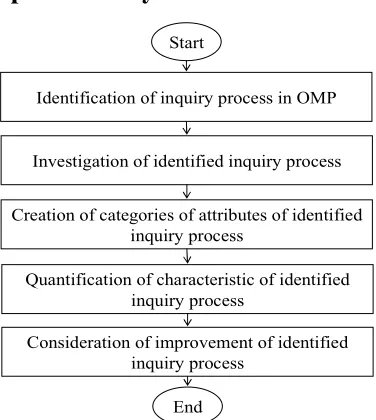
Figure 1. A flowchart of proposed procedure
Proposed procedure consists of five steps as shown in Figure 1; 1) identification of inquiry process in OMP, 2) investigation of identified inquiry process, 3) creation of categories of attributes of identified inquiry process, 4) quantification of characteristic of identified inquiry process and 5) consideration of improvement of identified inquiry process. A detail of each step is described as the following chapter.
2.1. Identification of Inquiry Process in OMP (Step 1)
The purpose of the step is an identification of inquiry processes in OMP. For the analysis, RAD is used. It describes processes in an intuitively straightforward way as a network of activities carried out by agents (Wastell et al 1994). Plural graphs like Figure 2 will be found from the analysis result by RAD. One graph means one inquiry process. A feature of the process is as follows.
One sender and one recipient are in the analyzed process. A sender delivers some information to a recipient and receives processed information from a recipient. A recipient treats information received from a sender and returns processed information to a sender.
Figure 2. Identified inquiry process
1) character information: role in OMP 2) circles: operation on OMP
3) arrows: direction of transmission for OMP
Figure 3. Component of identified inquiry process
A number of inquiry processes and their location in OMP can be clarified through finding the charts in the analysis result by RAD (Ruth 2004). Moreover, but the chart is simple, three kinds of components are included in the chart as shown in Start
End
Identification of inquiry process in OMP
Investigation of identified inquiry process
Creation of categories of attributes of identified inquiry process
Quantification of characteristic of identified inquiry process
Consideration of improvement of identified inquiry process
Sender Recipient
Sender
Recipient
2)-1
2)-2
2)-3
3)-1
3)-2
Figure 3. The first component is a role of OMP by character information. The second component is an operation on OMP by circles information. And the third component is a direction of transmission for OMP by arrow information. However, there is a limit to clarify detail of each identified inquiry process better than this. Hence, detail of each identified inquiry process is analyzed in the next step.
2.2. Investigation of Identified Inquiry Process (Step 2)
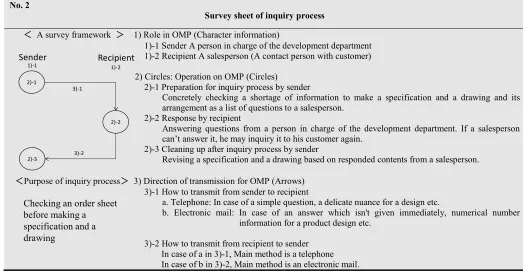
In the step, an identified inquiry process is investigated by the proposed survey sheet as shown in Table 1. The table is systematically designed to realize smooth survey based on the above three components of an inquiry process as shown in Figure 3. In the part of the first component in the sheet, a sender’s attribute and a recipient’s attribute, i.e. a belonging, a position and an operation in charge, are described. In the part of the second component in the sheet, three operations are described; 1) a preparation for an inquiry process by a sender, 2) a response by a recipient and 3) a cleaning up after an inquiry process by a sender. And in the part of the third component in the sheet, how to transmit between a sender and a recipient is described. In addition, in order to understand an outline of an inquiry process, it is important the purpose of an inquiry process is summarized before three components are investigated.
Table 1. Survey sheet of inquiry process
No.
Survey sheet of inquiry process
< A survey framework > 1) Role in OMP (Character information) 1)-1 Sender
1)-2 Recipient
2) Circles: Operation on OMP (Circles) 2)-1 Preparation for inquiry process by sender
2)-2 Response by recipient
2)-3 Cleaning up after inquiry process by sender
<Purpose of inquiry process> 3) Direction of transmission for OMP (Arrows) 3)-1 How to transmit from sender to recipient
3)-2 How to transmit from recipient to sender
2.3. Creation of Categories of Attributes of Identified Inquiry Process (Step 3)
For the step, six attributes is prepared. Their names are ‘combination type’, ‘preparation’, ‘response’, ‘clean up’,
‘transmission 1’ and ‘transmission 2’. A determination of them is systematic. To be concrete, each of them is related to three factors in the survey framework of an inquiry process as shown in Figure 3. ‘Combination type’ is obtained from ‘role in OMP’. ‘Preparation’, ‘response’ and ‘clean up’ are obtained from ‘operation on OMP’. ‘Transmission 1’ and ‘transmission 2’ are obtained from ‘direction of transmission for OMP’. An illustration of each attributes is described in Table 2. And then the final output of the step is categories of each above attributes. A source for creating the output is the survey result of previous step and a relevant literature.
2.4. Quantification of Characteristic of Identified Inquiry Process (Step 4)
In the step, a relationship between identified inquiry processes and attributes of inquiry process is clarified by 0-1 variable. Through the analysis of the relationship data by an original qualification theory category III, the overall relationship, the similarity among categories of attributes and the similarity among processes can be quantified. Table 3 shows a form of the analyzed data. akj is defined as the value of
category k of attribute j. bi is defined as the value of inquiry
process i. σikj is 0-1 variable; If inquiry process i has category k
of attribute j, σikj is 1. If inquiry process i don’t have category k
of attribute j, σikj is 0. i is a suffix of inquiry process, j is a
suffix of attribute and k is a suffix of category. The objective function of the original model is the correlation coefficient between akj and bi is maximized.
2.5. Consideration of Improvement of Identified Inquiry Process (Step 5)
In the step, the order of identified inquiry processes to improve is considered with the improved qualification theory category III. The analyzed data is illustrated from Table 4. Attributes are weighted from the viewpoint of the difficulty regarding performance improvement of inquiry process. Notation of weight j is wj. A weighting is performed based on
a pairwise comparison (Saaty et al 1994) which is one of the representative polite comparison methods. Also, when attributes is weighted, a value of the relationship between inquiry processes and attributes of inquiry process is not 0-1 variables but variables between 0 and 1. For corresponding to the change, the formulation for the proposed model is as the following formula (1) to formula (7).
Table 2. Attribute of inquiry process
Factor of survey framework Attribute Illustration of attributes
1) role in OMP 1)-1 combination type a type of relationship between sender and recipient
2) operation on OMP
2)-1 preparation a operation for making questions from a sender to a recipient
2)-2 response a operation for making responses to questions from a sender by a recipient
2)-3 clean up a operation for processing a design data based on created responses from recipient by a sender
3) direction of transmission for OMP 3)-1 transmission 1 a medium of a transmission from a sender to a recipient 3)-2 transmission 2 a medium of a transmission from a recipient to a sender
Sender Recipient
2)-1
2)-2
2)-3 3)-1
Table 3. Analyzed data by qualification theory category III
a11 ak1 av1
…
a1j akj avj
…
a1m akm avm
Process Attribute 1 Attribute j Attribute m
Category 11 Category k1 Category v1 Category 1j Category kj Category vj Category 1m Category km Category vm
b1 Process 1 σ111 σ11j σ11m
…
bi Process i σik1 σikj σikm
…
bn Process n σnv1 σnvj σnvm
Notation
j
k
a :value of category k of attribute j (j=1,..., ,m kj=1,...,vj)
i
b :value of inquiry process i (i=1,..., )n
ijk
δ
:0-1 variables; If inquiry process i has category k of attribute j,δ
ijk is 1. If inquiry process i don’t have category k of attribute j, δijk is 0. (i=1,..., ,n j=1,..., ,m kj=1,...,vj)Table 4. Analyzed data for weighted-qualification theory category III
a'11 a'k1 a'v1
…
a'1j a'kj a'vj
…
a'1m a'km a'vm
Process Attribute 1 Attribute j Attribute m
Category 11 Category k1 Category v1 Category 1j Category kj Category vj Category 1m Category km Category vm
b'1 Process 1 w1σ111 wjσ11j wmσ11m
…
b'i Process i w1σik1 wjσikj wmσikm
…
b'n Process n w1σnv1 wjσnvj wmσnvm
Notation
j
w :weighting score of attribute j (j=1,..., )m
j k
a′ : value of category k of attribute j (j=1,..., ,m kj=1,...,vj)
i
b′ : value of inquiry process i (i=1,..., )n
ijk
δ
: 0-1 variables; If inquiry process i has category k of attribute j,δ
ijk is 1. If inquiry process i don’t have category k of attribute j, δijk is 0. (i=1,..., ,n j=1,..., ,m kj=1,...,vj)Objective function 2 2 max b a b a C ′ ′ ′ ′ = σ σ
ρ (1)
(maximum correlation coefficient between inquiry processes and attributes of inquiry process) subject to,
∑
∑
= = ′ = ′ j j j j v k k ik m j ji w a
v b 1 1 1 (2)
(value of inquiry process i)
0
=
′
a
(3)(constrains the average values of the attributes of inquiry process)
0
=
′
b
(4)(constrains the average values of the inquiry processes)
∑ ∑∑
= = = ′=
′
m j k v k n i ik a j j j ja
w
T
1 2 1 1 21
σ
(5)(variance of the marginal distribution of the attribute value on
the simultaneous distribution between inquiry processes and attributes of inquiry process)
∑ ∑∑
= = = ′=
′
m j v k i n i ik b j j jb
w
T
1 12
1
2
1
σ
(6)(variance of the marginal distribution of the inquiry process value on the simultaneous distribution between inquiry processes and attributes of inquiry process)
∑ ∑∑
= = = ′ ′=
′
′
m j v k n i i k ik b a j j j ja
b
w
T
C
1 1 1
1
(7)
(covariance between the attribute values and the inquiry process values on the simultaneous distribution between inquiry processes and attributes of inquiry process).
Decision variables
ρ
: correlation coefficient between inquiry process and attributes of inquiry processj
k
a′ : value of category k of attribute j (j=1,..., ,m kj =1,...,vj)
i
b′: value of inquiry process i (i=1,..., )n Fixed variables
j
T : total number of inquiry processes × a number of categories
1
( )
m j j
n v
= ×
∑
3. Case Study for a Characteristic
Analysis of Inquiry Processes in OMP
In this section, the utility of the proposed procedure is confirmed through its application to the OMP of the small and medium company in Japan. They have manufactured machine tool accessories and supplied to their customers who are mainly machine-tool makers. Their different products are
different specifications and they have politely corresponded to each of their customer’s requirements. In other words, their production system is typical make to order system.
The case company considers a time from order receipt to product delivery as shown in Figure 4. In other words, they divide the time into an order management time and a production/delivery time. Up to the present, they have tackled with a reduction of production/delivery time. On the other hand, OMP is not focused. However it becomes necessary to improve a performance of OMP in accordance with becoming higher level of their customer requirement.
Figure 4. A period from order to delivery in case company
Table 5. A part of analysis result of the OMP
Order Process Customer Business department Development department
Manufacturing control department Manager Contact
person
Office worker
Manager Contact person
Manager Contact
person 1. Issuing new order sheet
1.1 Making new order sheet based on customer's inquiry information
1.2 Transmitting new order sheet by e-mail
1.3 Receiving new order sheet by e-mail
…
Table 6. Identified inquiry process
Process No. Contents of each process
1 an approval of an acceptance of new customer order within business d.
2 a request of an offer of information to make a specification from development d. to business d. 3 a request of an offer of information to make a specification from business d. to a customer 4 an approval of an issuance of completed specification within development d.
5 a request of a confirmation of created specification from business d. to a customer 6 an approval of an issuance of completed specification within business d.
3.1. A trial of Identification of Inquiry Process in OMP (Step 1)
Analyzed object is OMP which contains plural sub-processes. Examples are an issuance process of new order sheet based on customer’s requirement, a discussion process of details of the product through making a specification and a drawing etc. and a confirmation process of a final specification by a customer before the product is begun to manufacture. Related departments are a business department, a development department and a manufacturing department. In each department, one manager and one contact person are in charge of one customer order. But two contact persons are arranged in business department. One is salesman which can directly contact the customer. The other is in charge of the
office procedure within the department. Table 5 shows a part of the analysis result of the analyzed object by RAD. Six inquiry processes are identified as shown in Table 6. They are put from an upstream of the OMP to a downstream of the OMP in numerical order.
3.2. A Trial of Investigation of Identified Inquiry Process (Step 2)
Each identified inquiry process was investigated by the proposed survey sheet. As one example, the survey result of the second inquiry process, ‘A request of an offer of information to make a specification from development department to business department’, is illustrated from Table 7. A noticeable point is how to transmit from a sender to a
Order date
A period from order to delivery
Order management time Production/delivery time
Delivery date Date for confirmation of final
specification by customer
recipient in the survey sheet. Namely, different inquired contents have different communication tools. If inquired contents are a simple question and a delicate nuance for a design, a telephone is utilized. If inquired contents are numerical number information for a product design and a request which isn't given immediately, e-mail is utilized. Moreover a communication tool from a sender to a recipient is connected with a communication tool from a recipient to a sender. To be concrete, in case that a method from a sender to a recipient is a telephone, a method from a recipient to a sender is a telephone. In case that a method from a sender to a recipient is e-mail, a method from a recipient to a sender is e-mail.
3.3. A Trial of Creation of Categories of Attributes of Identified Inquiry Process (Step 3)
After details of all identified inquiry processes are surveyed, categories of attributes of inquiry process are established. The result is described in Table 8. Considered attributes is five items of prepared six items. They are 1) combination type, 2)-2 response, 2)-3 clean up, 3)-1 transmission 1 and 3)-2 transmission 2. In the case study, 2)-1 preparation is not considered because it is positively correlated with 3)-1 transmission 1 and a category of the former overlaps with a category of the latter.
Table 7. Example of survey result of inquiry process (inquiry process 2)
No. 2
Survey sheet of inquiry process
< A survey framework > 1) Role in OMP (Character information)
1)-1 Sender A person in charge of the development department 1)-2 Recipient A salesperson (A contact person with customer) 2) Circles: Operation on OMP (Circles)
2)-1 Preparation for inquiry process by sender
Concretely checking a shortage of information to make a specification and a drawing and its arrangement as a list of questions to a salesperson.
2)-2 Response by recipient
Answering questions from a person in charge of the development department. If a salesperson can’t answer it, he may inquiry it to his customer again.
2)-3 Cleaning up after inquiry process by sender
Revising a specification and a drawing based on responded contents from a salesperson.
<Purpose of inquiry process> 3) Direction of transmission for OMP (Arrows)
3)-1 How to transmit from sender to recipient
a. Telephone: In case of a simple question, a delicate nuance for a design etc.
b. Electronic mail: In case of an answer which isn't given immediately, numerical number information for a product design etc.
3)-2 How to transmit from recipient to sender In case of a in 3)-1, Main method is a telephone In case of b in 3)-2, Main method is an electronic mail.
Table 8. Established category of attribute of inquiry process
Factor of survey framework Attribute’s name Categories of each attribute
1) role in OMP 1)-1 combination type
between customer and order company between departments within order company within one department
2) operation on OMP
2)-1 preparation 2)-2 response 2)-3 clean up
- (The category is not covered in this paper.) confirmation and recognition
retrieval and examination additional operation simple operation
3) direction of transmission for OMP 3)-1 transmission 1 3)-2 transmission 2
face to face telephone passing round e-mail postal service
the same category as 3)-1 transmission 1
Sender Recipient
2)-1
2)-2
2)-3
3)-1
3)-2
1)-1 1)-2
Table 9. Example of information richness
Transmission tool Speed of feedback Expression way of information Source of Information
face to face
telephone passing round e-mail postal service
fast
slow
oral + alpha oral + writing + alpha oral
writing writing writing
personal
personal impersonal impersonal impersonal
A category of first attribute is three items such as ‘between customer and order company’, ‘between departments within order company’ and ‘within one department’ followed by a relationship between sender’s organization and recipient’s organization. A category of second attribute is two items such as ‘confirmation and recognition’ and ‘retrieval and examination’ from the viewpoint of whether focused operation is typical or not. A category of third attribute is two items. One is ‘additional operation’ which is an alteration and a revision of relevant materials based on the processed information by a recipient. The other is ‘simple operation’ which is only a reception and a keeping of them. Categories of three attributes up to here are established based on the survey result. Categories of next two attributes are considered based on the following relevant literature. A category of fourth and fifth attributes are five items such as ‘face to face’, ‘telephone’, ‘passing round’, ‘e-mail’ and ‘postal service’. They are founded on a characteristic of information richness (Daft et al. 1984) as shown in Table 9. For example, in case of ‘face to face’, it is useful for urgent inquiry and tough negotiation because a large volume of information is expected to be transmitted and a speed of feedback is fast. In case of ‘postal service’, it is useful for accurate inquiry because document materials are utilized.
3.4. A Trial of Quantification of Characteristic of Identified Inquiry Process (Step 4)
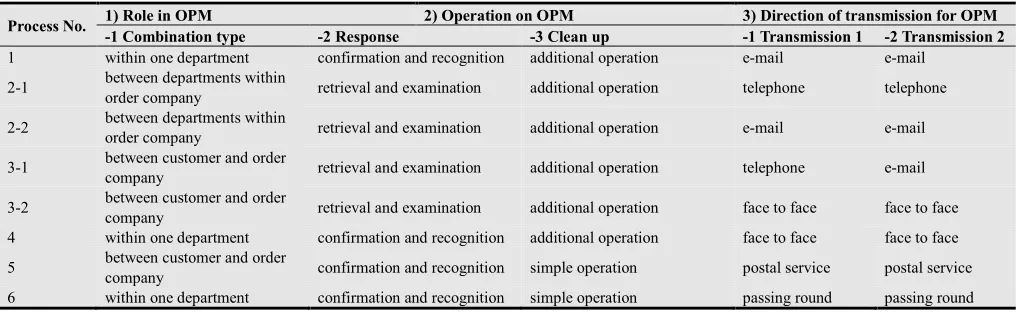
Table 10 illustrates categories of attributes of six identified inquiry processes which are chosen from established items as
shown in Table 8. One identified inquiry process has one category set except second process and third process. The two processes have two category sets because two transmission patterns are extracted from the survey sheet in step 2.
Table 10 is quantified by 0-1 variable and akj and bi are
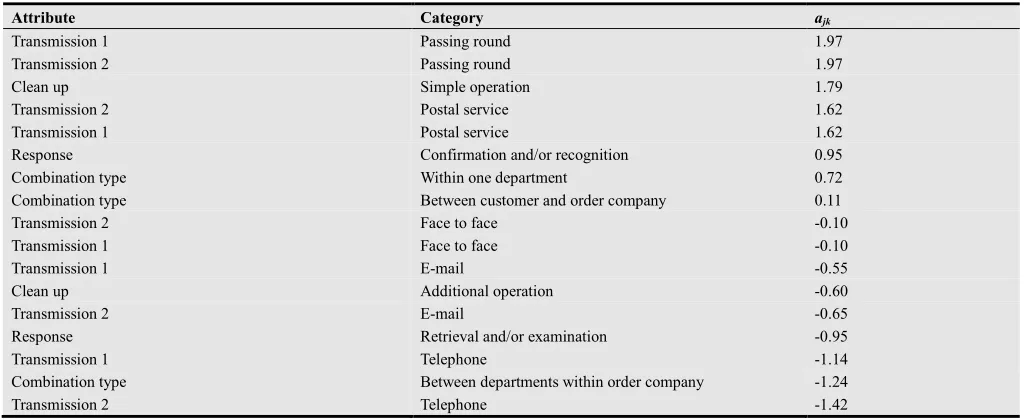
given from the quantified data by qualification theory category III. They are illustrated from Table 11 and Table 12. A coefficient of correlation is 0.87. akj indicates a similarity
among seventeen categories. Five higher rank of akj are one
and over score; 1.97 (passing round, transmission 1), 1.97 (passing round, transmission 2), 1.79 (simple operation, clean up), 1.62 (postal service, transmission 2) and 1.62 (postal service, transmission 1). It will be thought that a common point of five categories is a routine operation. On the other hand, three lower rank of akj are minus one and below score;
-1.42 (telephone, transmission 2), -1.24 (between departments within order company, combination type), -1.14 (telephone, transmission 1). It will be thought that a common point of three categories is an operation including technical decision making. From the above discussion, akj means the
standardization degree of the operation.
Moreover low score process will be guessed as a complicated process from the result of the interpretation of akj.
When the value of bi is actually checked in Table 12, low score
processes are upstream processes in the OMP where many changes of the operation have occurred compared to downstream processes.
Table 10. Assigned categories of identified inquiry processes
Process No. 1) Role in OPM 2) Operation on OPM 3) Direction of transmission for OPM -1 Combination type -2 Response -3 Clean up -1 Transmission 1 -2 Transmission 2 1 within one department confirmation and recognition additional operation e-mail e-mail
2-1 between departments within
order company retrieval and examination additional operation telephone telephone
2-2 between departments within
order company retrieval and examination additional operation e-mail e-mail
3-1 between customer and order
company retrieval and examination additional operation telephone e-mail
3-2 between customer and order
company retrieval and examination additional operation face to face face to face 4 within one department confirmation and recognition additional operation face to face face to face
5 between customer and order
Table 11. Value of categories of attributes of inquiry process (ajk)
Attribute Category ajk
Transmission 1 Passing round 1.97
Transmission 2 Passing round 1.97
Clean up Simple operation 1.79
Transmission 2 Postal service 1.62
Transmission 1 Postal service 1.62
Response Confirmation and/or recognition 0.95
Combination type Within one department 0.72
Combination type Between customer and order company 0.11
Transmission 2 Face to face -0.10
Transmission 1 Face to face -0.10
Transmission 1 E-mail -0.55
Clean up Additional operation -0.60
Transmission 2 E-mail -0.65
Response Retrieval and/or examination -0.95
Transmission 1 Telephone -1.14
Combination type Between departments within order company -1.24
Transmission 2 Telephone -1.42
*a descending order of akj
Table 12. Value of inquiry process (bi)
Process bi
Process 6 Process 5 Process 4 Process 1 Process 3-2 Process 3-1 Process 2-2 Process 2-1
0.44 0.36 0.05 -0.01 -0.10 -0.19 -0.23 -0.31
*a descending order of bi
3.5. A Trial of Consideration of Improvement of Identified Inquiry Process (Step 5)
Table 13 shows the result of the pairwise comparison among attributes. In the comparison, each rating scale has five ranks, 5.00, 3.00, 1.00. 0.33 and 0.20.
Table 13. Weighting score of each attribute
A 1)-1 2)-2 2)-3 3)-1 3)-2
1)-1 2)-2 2)-3 3)-1 3)-2
1.00 5.00 5.00 5.00 5.00
0.20 1.00 0.33 3.00 0.33
0.20 3.00 1.00 5.00 3.00
0.20 0.33 0.20 1.00 0.33
0.20 3.00 0.33 3.00 1.00
1)-1 combination type, 2)-2 response, 2)-3 clean up, 3)-1 transmission 1, 3)-2 transmission 2
The consistency index of above pairwise comparison matrix: 0.12 Rating score:
5.00: Improvement of inquiry process from the viewpoint of attribute A is much easier than attribute B.
3.00: Improvement of inquiry process from the viewpoint of attribute A is easier than attribute B.
1.00: Improvement of inquiry process from the viewpoint of attribute A is as easy as attribute B.
0.33: Improvement of inquiry process from the viewpoint of attribute A is a
little more difficult than attribute B.
0.20: Improvement of inquiry process from the viewpoint of attribute A is more difficult than attribute B.
wj can be obtained through resolving the eigenvalue problem
from equation (8) to equation (10). It is
[ jj]
H = c (j=1,..., )m (= Table 13) (8)
1
5
j
w
A w
w
=
⋮
⋮
(9)
HA=
λ
A (10) Notationj
w :weighting score of attribute j (j=1,..., )m
,
j
c :value of pairwise comparison of attribute j against attribute j (j=1,..., )m
wj of five attributes are as follows; 1)-1 combination type:
0.041, 2)-2 response: 0.257, 2)-3 clean up: 0.096, 3)-1 transmission 1: 0.441, 3)-2 transmission 2: 0.165. The relationship between inquiry processes and attributes of inquiry process is created utilized by the given wj. And then
a’kj and b’j are given by the proposed model. A coefficient of
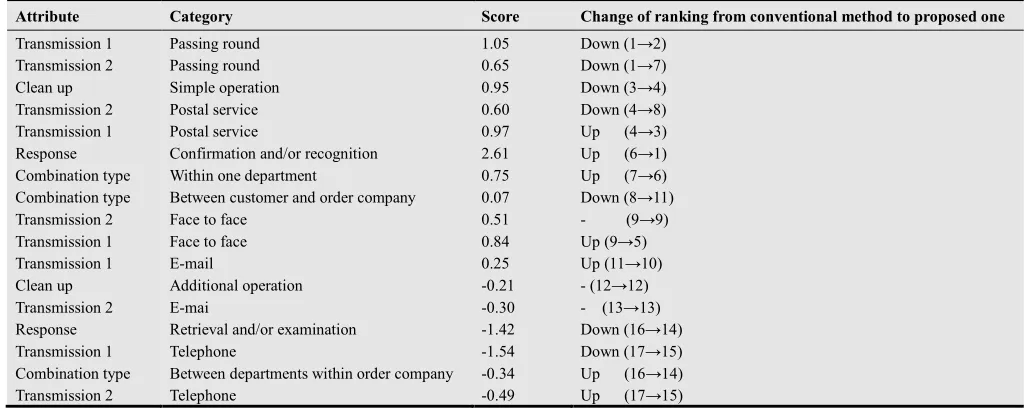
correlation is 0.46. Table 14 and Table 15 are the value of a’kj
and b’j compared to the result by the conventional model.
From the two tables, attributes of inquiry process which has larger of a’kj is regarded as more effective objects of
performance improvement. And inquiry process which has larger of b’j is regarded as more effective objects of
value of ‘face to face, transmission 1’ is changed from a negative number (-0.10 see Table 11) to a plus number (0.80 see Table 14). As the result, the value of fourth inquiry process (0.07 see Table 15) become near the value of fifth inquiry process and sixth inquiry process (0.08 see Table 15) which are attacked without difficulty. Actually, in fourth inquiry process, after a contact person explains the complicated specification to his manager within development department, it may be possible to revise it slightly. However the process is performed by face to face within one department. It is thought that an improvement of the process is not more difficult than the process between different departments.
Under the evaluation mentioned above, the proposed model provides three contributions.
Decision of the order of inquiry processes to improve is systematic.
The difficulty of performance improvement of inquiry process can be quantified by the proposed mathematical model.
Analysis by both of the conventional model and the proposed model is an improved analysis by the conventional model from the viewpoint of a multistep analysis using both non weighting score and weighting score instead of non weighting score as the analyzed data.
Also, it is found that the proposed procedure is effective for an analysis of OMP through the above case study. In particular, inquiry processes are identified in the OMP, the attributes of them are clarified and the characteristics of them are quantified. It will be difficult to realize a systematic analysis of OMP without the propose procedure.
Of course, this paper is just an initial step towards realizing a systematic improvement of OMP. The following three tasks are mainly considered for future study; 1) actual performance improvement based on the result of the analysis, 2) analysis of more complicated inquiry process and 3) improvement of the performance of the proposed model to raise a coefficient of correlation.
Table 14. Value of attributes of inquiry process (a’jk)
Attribute Category Score Change of ranking from conventional method to proposed one
Transmission 1 Transmission 2 Clean up Transmission 2 Transmission 1 Response Combination type Combination type Transmission 2 Transmission 1 Transmission 1 Clean up Transmission 2 Response Transmission 1 Combination type Transmission 2 Passing round Passing round Simple operation Postal service Postal service
Confirmation and/or recognition Within one department
Between customer and order company Face to face
Face to face E-mail
Additional operation E-mai
Retrieval and/or examination Telephone
Between departments within order company Telephone 1.05 0.65 0.95 0.60 0.97 2.61 0.75 0.07 0.51 0.84 0.25 -0.21 -0.30 -1.42 -1.54 -0.34 -0.49 Down (1→2) Down (1→7) Down (3→4) Down (4→8) Up (4→3) Up (6→1) Up (7→6) Down (8→11) - (9→9) Up (9→5) Up (11→10) - (12→12) - (13→13) Down (16→14) Down (17→15) Up (16→14) Up (17→15)
*a descending order of a’kj
Table 15. Value of inquiry processes (b’i)
Process Score Change of ranking from conventional method to proposed one
Process 6 Process 5 Process 4 Process 1 Process 3-2 Process 3-1 Process 2-2 Process 2-1 0.08 0.08 0.07 0.04 0.00 -0.07 -0.02 -0.07
- (1→1) Up (2→1) - (3→3) - (4→4) - (5→5) Down (6→7) Up (7→6) Up (8→7)
*a descending order of b’i
4. Concluding Remarks
One proposal and one trial were presented in this paper. For the proposal, the analysis procedure of an order management process (OMP) was proposed. The purpose of the procedure is
systematic clarification of characteristics of inquiry processes which are delivery processes of order information for accurately catching customer needs in OMP. Also, the capability of quantification theory category III utilized in the procedure was improved. Its technological essence is to obtain the optimal values that enable to obtain the maximum correlation coefficient between inquiry processes and attributes of inquiry process. For the trial, followed by the proposed procedure, the characteristics of identified inquiry processes are clarified and the order of the processes to improve is determined.
Acknowledgements
and their company for their kind support by managing regular joint research meetings to exchange data and ideas and support creative collaboration.
References
[1] Daft, R. L. and Lengel, R. H., 1984. Information richness: a new approach to managerial behavior and organization design.
Research in Organizational Behavior, 4, 191-232.
[2] Hayashi, C., 1993. Quantification: Theory and methodology. Tokyo: Asakura Publishing Company [in Japanese].
[3] Hayashi, C. and Suzuki, T., 1975. Quantitative approach to a cross-societal research: a comparative study of Japanese character Part II. Annals of the Institute of Statistical Mathematics, 27 (1), 1–32.
[4] Saaty, T.L. and Vargas, L., 1994. Fundamentals of decision making and priority theory with the analytic hierarchy process, RWS Publications.
[5] Takakura, S., 1962. Some statistical methods of classification by the theory of qualification. Journal of the Institute of Statistical Mathematics, 9 (2), 81–105 [in Japanese].
[6] Lin, F. R., 1998. Reengineering the order fulfillment process in supply chain networks. The international of Flexible Manufacturing System, 10, 197-229.
[7] Ruth, S. A-S., 2004. Business process modeling: Review and framework. International Journal of Production Economics, 90, 129-149.