http://mojem.um.edu.my
22
(1)
Department of Educational Management, Planning and Policy, Faculty of Education,
University of Malaya, Malaysia
(2)
Universitas Lambung, Mangkurat, Banjarmasin, Kalimantan,
Indonesia
Corresponding Author: Faculty of Education, University of Malaya, Malaysia
Email: [email protected] Tel: +603 7967 5088
ABSTRACT
Much literature on teacher professionalism asserts that teacher performance could be improved through the enforcement of teacher evaluation policy; therefore, we took the task of investigating whether this assertion has much merit in a centralized education system. The school system of Oman was taken as a case. Our study largely employed the qualitative research methodology, which included cross-referencing of data elicited from document analysis, examination of evaluator reports, and interview sessions with different groups of implementers and evaluators. Our study found that policy implementation spiraled down from the top level authority and then caused a pervasive web of chain reactions at the middle and bottom levels. It was found also that implementers’ disposition play a critical role in the dynamics of the evaluation process and in determining successful implementation of the policy. In addition, there were many challenges and constraints in carrying out the policy, but administrators and evaluators in Oman were commendable for taking a bold, positive step toward improving teacher professionalism via performance-based teacher evaluation policy.
Keywords: policy implementation process, teacher evaluation, teacher
professionalism, teacher improvement
E-ISSN NO: 2289 – 4489
SPIRAL DYNAMICS IN THE IMPLEMENTATION OF
PERFORMANCE-BASED TEACHER EVALUATION POLICY IN
A CENTRALIZED EDUCATION SYSTEM
http://mojem.um.edu.my
23
INTRODUCTION
The implementation of teacher evaluation policy is widely thought as a significant tool that has the potential to enhance teacher professionalism and instructional quality. Stronge (2006, p. 3) points out that “conceptually sound and properly implemented evaluation system for teachers is a vital component for successful reform efforts”. Sound quality teacher evaluation system ensures obtaining qualified teachers because “defining and knowing quality teaching is the first step in the appraisal process of teachers" (Andrews, 2004).
Improving teacher performance might not be the only desirable goal of an educational system when it implements teacher evaluation policy. This is because educational systems seek quality assurance through using evaluation to assess basic competence, dismiss teachers for incompetence, and ensure that the 'right' people are promoted to key positions (Kleinhenz & Ingvarson, 2002). Tangentially, the society also will benefit from teacher evaluation policy in the sense that educational institutions, such as schools and polytechnics, will improve the quality of their services.
It appears that there are two dominant approaches for examining implementation process and outputs in the policy arena, especially at the governmental level, i.e. the top-down approach and the bottom-up approach. The top-down approach takes a macro view of implementation by examining the process from the standpoint of the initial policy-maker or the policy itself (Harris, 2007; Matland, 1995; O'Toole, 2000). In other words, with the top-down approach, top-level bureaucrats are largely interested with seeing how well the implementers are in harnessing resources to yield the intended goals and outcomes of a policy. Schematic and systematic procedures, oftentimes, are developed to guide the implementers in executing their job. In addition, constant supervision and monitoring mechanisms are also being put into place so as to ensure maximum success. This is because, in most instances, the implementers are kept in the dark as to what the policy goals, objectives, outcomes, and benefits are. They lack the understanding and direction of the systemic process, and more importantly, democratic participation by the bottom level is not typically encouraged in the implementation design.
In addition, top-downers basically adopt an interpretation that a policy acts as an input and implementation as an output. In Harris’s (2007) perspective, top-down models rely on policy decisions made by the top authority and thus reduce the significance of policy adaptation at the bottom level of implementation. Clarity and consistency of goals are often nebulous, and implementation strategies that are generalized to many policy situations are the obvious features of this approach. Researchers consider Van Meter and Van Horn (1975) and Sabatier (1986) as pioneers in focusing on top-down approaches in policy implementation.
Although top-down authors recognize that “perfect hierarchical control over the implementation process is hard to achieve in practice and that unfavorable conditions could cause implementation failure” (Pülzl & Treib, 2007), they argue that decision makers, in order to assure the worth of the implementation process, should exert a concerted effort in structuring and preparing the implementation programs.
http://mojem.um.edu.my
24
A second perspective is the bottom-up model, which considers the entire network of political actors concerned in a particular policy area and views implementation as a political process of harmony building and cooperation (Pülzl & Treib, 2007). Fundamentally, this approach focuses on the evaluation made at the micro level of policy enactment as well as the local factors that hinder intended policy outcomes (Matland, 1995). The scholars of this approach “rejected the idea that policies are defined at the central level and that implementers need to stick to these objectives as neatly as possible” (Pülzl & Treib, 2007). The classical bottom-up researchers are Elmore (1980, 2002) and Fritzen (2005).
The criticisms of this approach often center on its overemphasis on local decision making. Its critics argue that central policy-makers are able to set broad policy borders and guidelines that provide a needed structure to policy formulation and implementation (Harris, 2007). Sabatier (1986) states that “the top-down approach appears to have a comparative advantage in situations in which: (1) there is a dominant piece of legislation structuring the situation, or in which (2) research funds are very limited, one is primarily interested in mean responses, and the situation is structured at least moderately well”.
Recently, a mixed approach to policy implementation, dubbed by some scholars as “a hybrid theory,” has appeared. “Taking the top-downers’ concern with effective policy execution as their starting point, they blended several elements of the bottom-up perspective and of other theories into their models” (Pülzl & Treib, 2007). Their core argument is that implementation is an evolutionary process in which programs are constantly reshaped and redefined. The conceptualization thus starts from policy inputs defined by central policy makers. At the same time, it also embraces the idea that the inputs will almost inevitably be changed in the course of their execution.
The hybrid theory approach brought two important innovations to implementation theory. According to Pülzl and Treib (2007), the hybrid proponents tried to overcome the conceptual weaknesses of the polarized debate between bottom-up and top-down scholars. Moreover, some hybrid theorists have pointed to important factors that had hitherto received little attention, such as the relationship between policy implementation and the policy formulation process, and the impact of different policy types on the way policies are executed.
CONCEPTUAL FRAMEWORK OF THE STUDY
The conceptual framework of our study was derived by modifying the implementation model by Van Meter and Van Horn (1975), Hill and Hupe (2002), and Fritzen (2005). The modified model assumes that policy implementation encompasses the interactions among several factors leading to teacher performance. Danielson and McGreal (2000) suggest that the main characteristics of a successful teacher evaluation are the recognition of the differences between varying levels of teaching experience, a cooperative culture that encourages inquiry, and a meticulously developed evaluation processes. Shinkfield & Stufflebeam (1996) suggested four categories of attributes of a sound and fair teacher evaluation, namely propriety, utility, feasibility, and accuracy.
As a guide to this research, the main variables of policy implementation, as indicated by Van Meter & Van Horn (1975), are:
http://mojem.um.edu.my
25
ii. Policy standards and objectives: According to Van Meter and Van Horn (1975), clarity of the objectives and standards of a policy are essential to successful implementation. Clear and understandable purposes can be implemented more easily and precisely than a set of vague, complicated purposes. Gornitzka, Kyvik, and Stensaker (2007) asserted that “if general guidelines are the foundation for a reform, the probability is relatively high that different interpretations will make implementation difficult”.
iii. The resources: Implementation process should have sufficient resources at their disposal, and there should be a system of clear responsibilities and hierarchical control to supervise the actions of implementers (Pülzl and Treib, 2007). The resources may comprise human resources, money, or other incentives which may enhance or ease effective implementation.
iv. The quality of inter-organizational communication: The implementation of any educational policy and teacher evaluation policy requires a constant and efficient network of communication to ensure policy goals, objectives, rules, methods, and guidelines are well understood and resources are well utilized by implementers. There bound to be a lot of questions, misinterpretations, and conflicts. There will be multiple array of interactions among different purposes, value choices, and ways of doing things in various localities (Darling-Hammond et al., 1983).
v. The disposition of implementers: The implementers’ attitudes towards the policy are very crucial in policy implementation. Their attitudes are certainly affected by how well they understand the policy, whether they believe it will benefit or harm them personally or the community in general, and the intensity of their acceptance or rejection (Hill & Hupe, 2002). Gornitzka et al. (2007) assert that the disposition of implementers could affect their motivation and attitudes towards implementation of the reform. Moreover, it is a reality that the key persons in an organization can be very influential in determining the success or failure of a reform.
vi. The characteristics of the implementers: Van Meter & Van Horn (1975) offer several suggestions regarding characteristics that may impinge on an organization’s capacity to implement policy. These characteristics are as follows:
a. The capabilities and number of an agency’s personnel;
b. The degree of hierarchical control of subunit decisions and processes within the organization;
c. The organization’s dynamism;
d. The extent to which communication within an organization is “open”, either horizontally or vertically.
e. The formal and informal relationships an organization has with the policy makers or policy enforcers.
vii. The feedback loop: This is significant as it makes a continuous assessment of the entire implementation dynamics. The assumption is that programs may be redesigned both at key intervals in a formal process, and in a more informal, iterative process as local implementers adjust their expectations and behaviours to the actual circumstances that arise (Fritzen, 2005, p. 103).
http://mojem.um.edu.my
26
Duke (1995) “predicts that the evaluation of individual teachers, especially veteran teachers, will concentrate on professional development”. Glickman et al. (2007) suggest that participating through collaboration and teamwork the pair of teachers observe each other, share reflections on practice, and develop professional development plans. In this paradigm, the peer review, peer evaluation, and classroom observation are directed to teacher evaluation policy.
RESEARCH METHODOLOGY
For teacher evaluation policy, the Ministry of Education of Oman encourages evaluators to use multiple sources in gathering data regarding teacher performance, one of which is teachers’ portfolio. The Ministry states that:
“All teachers maintain a Professional Development Portfolio that could provide valuable information for decisions regarding their future professional advancement. These portfolios could indicate the teacher's personal development plans and professional development competencies resulting from training they have had and the results of annual appraisals. This information could form the basis for selecting teachers to be promoted and for determining their entitlement to salary increases “(Ministry of Education of Oman, 2006).
Thus we followed the Ministry’s suggestions, and as a form of data triangulation, our study used multiple ways of obtaining qualitative data. The main method was interview, in which we interviewed selected decision makers, supervisors, school principals, senior teachers and teachers. Purposeful sampling was employed to identify the 43 key informants who participated in the study. We recorded all interview sessions, and later transcribed and coded the data for analysis. All transcribed verbatim reports were given back to the interviewees for them to check the accuracy of what they had said, and the Cohen-Kappa value for accuracy was determined to be around 0.78.
Apart from that, our study used document analysis of reports, policies, and procedures regarding teacher evaluation at the district and school level. We also used other sources of data for investigating teacher performance, such as classroom observation, documents and artifacts related to the responsibilities and duties of teachers, teacher self-assessment forms, teaching portfolios, and student achievement records. This was in accordance with the Ministry’s suggestion that evaluators and supervisors used several data sources for gathering information (Ministry of Education of Oman, 2009).
Apart from formative ways, the study also employed the summative approach, which was also practiced in Oman. Teachers were usually given the performance evaluation forms at the end of the year. They made self-assessment and gave marks to themselves for various categories of tasks and personality attributes. Then the forms were given to their school head for rationalization and standardization, and then to the district evaluators. As a form of validity checking, we also interviewed the evaluators about their competency and the way they rated teacher performance.
http://mojem.um.edu.my
27
RESEARCH FINDINGS
We transcribed all interview data and analysed them into codes, concepts, and themes. Apart from that, we performed cross-referencing and cross-checking with other sources of data to eliminate invalid or inconsistent codes and concepts. The inductive-deductive cycle of thinking constantly happened in our data analysis process in order to derive at the most sensible, logical, and valid codes, concepts, and inferences. We categorized the results according to several themes as follows.
i.
The Social ContextTeacher evaluation in Oman was not set in isolation, but was set in the context of administrative organization and the wider society. It was well acknowledged that teacher evaluation should not be alienated from the context in which it was put forth. This study found that teacher evaluation was contingent on the cultural background of schools, the nature of the social relationship, the purposes being pursued, the individuals engaged, resources and timeframe used, and many other significant factors. Thus, social context was observed as having certain effects on the procedures of teacher evaluation policy in the Sultanate of Oman.
We posed a rather incisive question to the interviewees: To what extent teacher evaluation is affected by affiliation to tribes, religions and gender? All interviewees deny any discrimination of the evaluation results based on the race, religion, tribe or nationality. There seemed to be an acceptable level of objectivity and validity of the teacher evaluation process. Many teachers affirm that there is “no discrimination between teachers based on social rank or economic situation” and “there is no existing bias in our evaluation system based on religion, tribe or nationality”. Teachers confirmed that their actual performance was the only criteria in appraisal. The basis of evaluation was “proficiency and proficiency alone.” One senior teacher aptly says: “I suppose that I am a judge, so I try to avoid any behaviors that cause prejudiced impressions. I treat teachers in equal manner with no prejudice based on gender, race, religion, or social relationships.
In relation to the ultimate goal of teacher evaluation, public awareness on the notion of teacher accountability was quite dismal. Most of the interviewees did not feel that the society was aware of the role of evaluation as an accountability technique or professional development strategy. A school supervisor says “the society is not mature enough to demand for quality in the services provided to their kids in schools”. In corollary, then, the teacher evaluation policy was executed not because of public demand, but due to the necessity by the Ministry for the sake of improving teacher performance and instructional quality—a typical top-down directive.
ii.
ResourcesMajority of the interviewees were satisfied with substantial resources allocated to schools for the purpose of teacher professional development as well as for the purpose of facilitating and supervising teacher’s work. All of the eight case schools in the study had sufficient budget for purchasing teaching and learning materials, and the schools had desktop computers, laptops, printers, television sets, photocopy machines, and digital projectors. Every school has its own resource centre, computer lab, science lab, professional directive room, interaction classroom, language lab, and instructional material room. Moreover, training rooms for professional development of teachers were available. Many school principals pointed out that sometimes training sessions were organized during school holidays.
http://mojem.um.edu.my
28
iii.
Inter-Organizational CommunicationOur research also sought the answer for the question: How do teachers and implementers perceive the inter-organizational communication regarding performance-based teacher evaluation policy? From data analysis, two sub-themes emerged as follows:
a. The Communication Path
An efficient communication network was needed in order to strengthen the top-level administration in planning and implementing policy decisions. One policy-maker says that “the Ministry permanently seeks to streamline and improve work systems to promote intra-Ministry communication.” That entails necessarily opening channels of communication between different stakeholders and the Ministry for executing performance-based teacher evaluation policy.
Investigating this aspect further, many interviewees admitted that it was necessary to have a communication bridge between the policy makers and the implementers at the district and school levels. Some of the channels could be regular meetings with heads of departments in their region, the annual meeting with the general director, and the use of the Ministry’s online portal by which they could communicate with the upper echelon. A school principal relates “too often, very small issues take a long time to be decided because of the lack of communication.”
Many evaluators asserted that reducing centralization and bureaucracy of administration would tend to speed up communication. They believed that the centralization and routine impedes them from taking actions regarding the teacher performance. A school principal argues “how do you want me to employ the evaluation result for improving teaching learning process if I don’t have any power as an evaluator for every tiny thing related to my teachers which I have forwarded to the directorate.”
Responses from school principals seemed to indicate that they lack the power to make decision regarding teacher performance such as rewarding and promoting the high-performing teachers, or sanctioning the low-performing teachers. “Even though we have identified the developmental priorities in our school since we began participating in the System for Enhancement of School Performance, we haven’t seen any improvement in our school from such recommendations. There is not even a response to these recommendations.”
Regarding the micro level communication in schools, most of the interviewees demonstrated satisfaction about the communication and cooperation among teachers in school as well as between teachers and school principal. They believed that the communication between teachers was a vital factor in any success in teaching-learning process. They considered team working, peer review, and mutual dialogue as inspirational initiatives to advance instructional practices, thus, promote students’ achievement. Some teachers say that “actually, we gain advantage from the mutual dialogue with our school mates more than any other way. Considering, some of our colleagues have a very long experience, we value what we gain from them, and we try to socialite their feedback when they visit us in the classroom.”
b. The Coordination between Various Departments in the Ministry
http://mojem.um.edu.my
29
“The Directorate of Supervision and the Directorate of Performance Development have elevatedtheir harmonization regarding the evaluation process. This is the case with some other directorates in the Ministry such as the Directorate of Finance, the Directorate of Planning, the Directorate of Training, and the Directorate of Appraising the Training Feedback”.
This coordination was done through the general committee for executing the school performance development. Indeed, this committee was formed by the Ministerial decree number 19/2006. This decree illustrates the techniques of school performance development. The aforementioned committee headed by the general director of human resource development and comprises heads of the interested directorates. The main responsibility of this committee was “to create harmony between implementation, supervision, and evaluation of the school performance including the teacher performance.” In addition, there were regular meetings between the policy makers in these directorates. Also, with regard to training of evaluators, it was “conducted through cooperation efforts of the directorates.” Moreover, copies of reports were “distributed among the directorates, who should go through the suggestions and recommendations and do the selection of the applicable ones.”
However, many teachers urged that the Ministry and directorates need to reexamine the formative and summative evaluation methods and forms, which must involve teachers and principals in order to minimize discrepancies and confusions.
iv.
Implementers’ DispositionsThe disposition of implementers is one of the significant factors that affect the success of a policy implementation. Implementers may fail to carry out policies because they disregrad policy goals and objectives. Correspondingly, our research also sought to answer the question: What are the teachers and implementers’ dispositions toward the performance-based teacher evaluation policy? The interviewees’ serious concerns came from some issues that impede teachers and implementers from participating effectively in the implementation procedures. The main barrier was centralization of procedures and decisions. Apart from that, data analysis revealed four sub-themes as follows:
a. Administrators’ Commitment
Some interviewees believed that some administrators and policymakers did not do enough to support evaluators in conducting their duties of evaluating teacher performance. An evaluator highlighted the policy makers’ attitude toward the policy of teacher evaluation:
‘I think that the policy makers are aware of this fact but they didn’t do anything about it. I remember in one occasion, one of the policy makers visited us and some evaluators asked him why he did not rely on teacher performance report in deciding on teacher promotion. The policy maker frankly replied that ‘we have some reservations regarding the annual teacher performance report, thus we cannot rely on this report to a large extent.’
http://mojem.um.edu.my
30
b. Dealing with the Low Performing Teachers
Many interviewees blamed the upper echelon administrators for the existence of low-performing teachers in schools. Top-level administrators must be stringent in applying the law and regulations regarding teacher performance, otherwise they should be accountable for the increase in number of low quality teachers and teaching in schools. A principal, however, cautioned that “it’s really, really a tough situation. In our school, it’s so hard to be a good school principal. It is too difficult to protect the low-performing or non-performing teachers for their mediocre professionalism and lack of accountability; and it is hard to deal with them because I have no authority”. Apart from that, evaluators and principals would be subjected to many technical procedures if they rated some teachers as low-performers. One school head says:
“It is very uncommon for a school principal to write a report on any of the inadequate teachers, as this requires the director to supply a whole body of concrete facts, which are usually not available. In addition, the fact that the school principal and supervisor both participate in the evaluation exercise makes it difficult to reach at an agreement that the teacher is weak, i.e. deserving a grade below 50%. In addition, the bureaucratic procedures necessary to complete this process are quite daunting, which makes a principal reluctant to resort to this measure. I have worked for 20 years in the Ministry, and in all those years I can say that I do not know of any teacher that has been given a ‘weak’ rating, for the reasons which I have mentioned”.
c. Overreliance on Classroom Observation
Many interviewees asserted that they wish the system had recognized and adopted other resources in the evaluation mechanism rather than putting much emphasis on classroom observation. Teachers and school heads suggested that evaluation should include teacher self-evaluation, student academic achievement records, parents’ feedback, teaching portfolios, and action research activities. The variety of these tools could lend support to judgments regarding teacher performance and grant the evaluation process the needed trustworthiness.
Some schools have implemented peer coaching programs as the way to improve the quality of teaching. Some teachers had a positive attitude toward peer coaching technique in their school. Many teachers were agreeable to peer observation and mentoring.
d. The Confidentiality of the Summative Report
http://mojem.um.edu.my
31
v.
Amount of Time Allocated for EvaluationTime, as well as other resources, was deemed necessary in the implementation of the evaluation policy. Evaluators asserted that sufficiency of time was critical for a truthful and comprehensive evaluation of teachers. Evaluators— who could be school heads or senior teachers—tended to be busy with their basic office duties, and thus would
evaluate teachers in a hurried manner; consequently, this would diminish their ability to provide feedback to teachers sufficiently. Furthermore, this undoubtedly impeded evaluators from supervising and evaluating teachers properly.
For example, some senior teachers acted as evaluators and resident supervisors for ten teachers, but at the same time they had a heavy teaching load for themselves; thus, they had to run through the pre-observation, observation, and post-observation routine for each teacher under their mentorship. A classroom visit usually consumed three to four lessons. After that, the evaluators had to write evaluation reports. A principal, who was also an evaluator, related to us that:
“In existence of a myriad administrative function, we don’t focus on teacher evaluation; I believe that entails more consideration of time, effort, and money spent for implementing teacher evaluation policy. In the time being, there are recognizable shortages of certain resources”.
District supervisors usually made school visits once a year and they were supposed to make summative evaluations of teachers in schools. It was rather impossible for them to make a fair judgment and evaluation of all teachers in a district. One school principal asserted that “the summative evaluation in most cases takes place haphazardly” and “by relying on their own memory to some extent, the supervisors could not be fair and accurate in their
assessment of teacher performance.”
vi.
Incentives via Teacher EvaluationMany teachers and implementers perceived that teacher evaluation as an acceptable policy because it was linked to the incentive system, i.e. teachers and school heads would receive a professional monthly bonus and an annual allowance if they were valuated with “high performance.” Teachers perceived that the allowance and bonus could be a source of motivation for them to engage effectively in the evaluation system.
http://mojem.um.edu.my
32
SUMMARY OF FINDINGS AND DISCUSSION
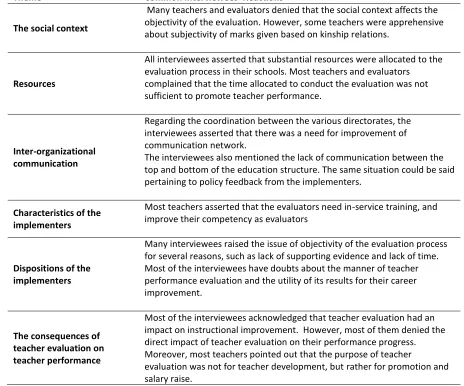
Table 1 below summarizes the emerging themes from the data analysis.
Table 1
Summary of some common interviewees’ reactions according to the emerging themes
Theme Common Interviewees’ Reactions
The social context
Many teachers and evaluators denied that the social context affects the objectivity of the evaluation. However, some teachers were apprehensive about subjectivity of marks given based on kinship relations.
Resources
All interviewees asserted that substantial resources were allocated to the evaluation process in their schools. Most teachers and evaluators complained that the time allocated to conduct the evaluation was not sufficient to promote teacher performance.
Inter-organizational communication
Regarding the coordination between the various directorates, the interviewees asserted that there was a need for improvement of communication network.
The interviewees also mentioned the lack of communication between the top and bottom of the education structure. The same situation could be said pertaining to policy feedback from the implementers.
Characteristics of the implementers
Most teachers asserted that the evaluators need in-service training, and improve their competency as evaluators
Dispositions of the implementers
Many interviewees raised the issue of objectivity of the evaluation process for several reasons, such as lack of supporting evidence and lack of time. Most of the interviewees have doubts about the manner of teacher performance evaluation and the utility of its results for their career improvement.
The consequences of teacher evaluation on teacher performance
Most of the interviewees acknowledged that teacher evaluation had an impact on instructional improvement. However, most of them denied the direct impact of teacher evaluation on their performance progress. Moreover, most teachers pointed out that the purpose of teacher
evaluation was not for teacher development, but rather for promotion and salary raise.
http://mojem.um.edu.my
33
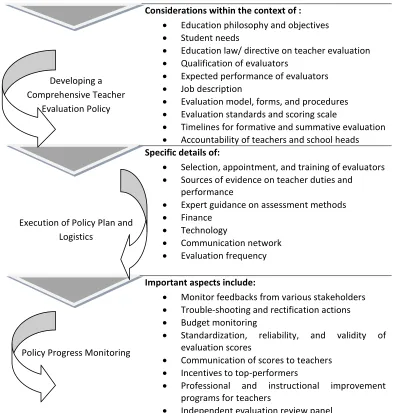
Stufflebeam (1996). Figure 1 illustrates the components and stages of the proposed policy implementation model, which has three phases as discussed in the following paragraphs.
Phase 1: Developing a comprehensive policy of teacher evaluation
A policy should be formulated by considering the socio-cultural context of education of a country. This means paying attention to the general educational objectives and organizational structures such as administrative centralization and school autonomy. The cultural values of the society should also be considered. Apart from that, the ultimate aims and procedures of the teacher evaluation policy have to be clearly defined so that they are understood well by implementers. The policy also needs to establish approaches to integrate two types of evaluation, namely the formative and summative evaluation.
Developing a Comprehensive Teacher
Evaluation Policy
Considerations within the context of :
Education philosophy and objectives
Student needs
Education law/ directive on teacher evaluation
Qualification of evaluators
Expected performance of evaluators
Job description
Evaluation model, forms, and procedures
Evaluation standards and scoring scale
Timelines for formative and summative evaluation
Accountability of teachers and school heads
Execution of Policy Plan and Logistics
Specific details of:
Selection, appointment, and training of evaluators
Sources of evidence on teacher duties and performance
Expert guidance on assessment methods
Finance
Technology
Communication network
Evaluation frequency
Policy Progress Monitoring
Important aspects include:
Monitor feedbacks from various stakeholders
Trouble-shooting and rectification actions
Budget monitoring
Standardization, reliability, and validity of evaluation scores
Communication of scores to teachers
Incentives to top-performers
Professional and instructional improvement programs for teachers
Independent evaluation review panel
http://mojem.um.edu.my
34
Logistic facilities must be provided for the evaluators. These facilities such as expert support, finance, technology, communication networks, and management are very important for ensuring an effective policy implementation. Teacher evaluation policy has to create clear descriptions of the responsibilities of various educational authorities involved in its implementation. Educational actors at each level, i.e. supervisors, school principals, senior teachers, and teachers all play different roles in ensuring the objectivity of performance evaluation, and eventually improving teacher professionalism and quality.
In addition, teacher evaluation policy necessitates the establishment of clear standards and criteria to guide evaluators in carrying out a just and objective performance evaluation. Developing the definition of what is “good teaching” should be the top priority of this task. Most importantly, data collection about the actual performance calls for a careful selection of instruments and sources of information. For example, employing student achievement as an indicator of teacher performance constitutes an obvious challenge; given that student learning is the product of multiple factors such as school organization, resources, climate, and students’ socio-economic background. Evaluation frequency must also be decided and organized according to the kind of evaluation, whether summative or formative, and according to teachers’ needs.
Phase 2: Execution of policy plan and logistics
Based on Figure 1, policy execution entails going through certain identified stages. First, evaluators must be trained and qualified to carry out the evaluation process. Second, teams to carry out evaluation should be formed. Third, data from multiple sources on teacher performance should be collected. With regard to classroom observation, the evaluator should have a conference with the teachers before and after the visit. Fourth, a professional development plan should be cooperatively prepared between the evaluator and teachers. Fifth, the evaluator should follow up to determine the extent of teacher improvement. Finally, decisions regarding the teacher’s career should be taken.
Phase 3: Policy progress monitoring
http://mojem.um.edu.my
35
CONCLUSIONThis study has identified a considerable number of profound issues pertaining to the implementation of performance-based teacher evaluation policy. Summatively, the study has grouped the issues into three main factors that critically influence the implementation effectiveness of teacher evaluation policy.
The organizational factor which includes the degree to which the organization is hierarchically structured, the support and commitment of administrators, and the extent of communication among the implementers and the administration staff.
The technical factor which includes evaluation methods, instructional resources, sources of evidence, the training and expertise of evaluators, and systemic features of the evaluation process such as who evaluates, for what purposes, when and how often to evaluate, how to analyze data, how to make judgments, who make the final decision, and who reports the decision.
The disposition factor which is reflected by the attitude, commitment, and motivation of implementers in implementing teacher evaluation policy. An effective way to ensure the implementers’ satisfaction is to proactively engage them in designing the evaluation plan, management, method, score, report, and incentives. This is democratic involvement and engagement which will make teachers readily accept the policy and the evaluation results.
Finally, the top-down approach is inevitable in a centralized education system, which is commonly found in many countries. The momentum of policy implementation spirals down the system, swirling all kinds of resources, methods, problems, and emotions together in the process of moving toward the intended goals and outcomes. Some policies are fairly successful, while some others ended in failure.
REFERENCES
Andrews, H. (2004). Accountable teacher evaluation! Toward highly qualified and competent teachers: Stillwater, Oklahoma: New Forums Press.
Corbin, J. M., & Strauss, A. L. (2008).Basics of qualitative research: techniques and procedures for developing grounded theory. Thousand Oaks, Ca: SAGE Publications, Inc.
Creswell, J. W. (2007). Qualitative inquiry & research design: Choosing among five approaches. Thousand Oaks, California: SAGE Publications, Inc.
Danielson, C. (2007). Enhancing professional practice: A framework for teaching: Alexandria, VA: Association for Supervision & Curriculum Development.
Danielson, C., & McGreal, T. (2000).Teacher evaluation to enhance professional practice: Princeton, NJ: Educational Testing Service.
http://mojem.um.edu.my
36
reform. Phi Delta Kappan, 76(8), 597-604.
Duke, D. (1995). The move to reform teacher evaluation. In Duke (Ed.), Teacher evaluation policy: from accountability to professional development (pp.1-12). Albany, NY: State University of New York Press.
Elmore, R. (1980). Backward mapping: implementation research and policy decisions. Political Science Quarterly, 94(4), 601-616.
Elmore, R. (2002), Bridging the gap between standards and achievement: The imperative for professional development in education. Washington D.C. Albert Shanker Institute.
Fritzen, S. (2005). The misery’ of implementation: Governance, institutions and anti-corruption in Vietnam. In Tarling, N. (Ed.) Corruption and good governance in Asia (pp. 98-120). New York: Routledge.
Fullan, M. (2001).The new meaning of educational change. New York: Teachers College, Colombia University.
Glatthorn, A. (1995). Teacher Development: In L.Anderson (Ed.) International encyclopaedia of teaching and teacher education (pp. 41-46). Oxford: Elsevier Science Ltd.
Glickman, D., Gordon, P., & Ross-Gordon, M. (2007).Supervision and instructional leadership. Boston: Allyn & Bacon.
Gornitzka, Å., Kyvik, S., & Stensaker, B. (2007). Implementation analysis in higher education. In: Gornitzka, Å., Kogan, M., and Amaral, A. (Eds.). Reform and Change in Higher Education: Analysing Policy
Implementation (pp: 35-56). Dordrecht: Springer.
Harris, M. S. (2007). From policy design to campus: Implementation of a tuition decentralization policy. Education Policy Analysis Archives, 15, 16.
Hill, M., & Hupe, P. (2002).Implementation Public Policy: Governance in theory and practice. London, SAGE Publications.
Kleinhenz, E., & Ingvarson, L. (2002).Evaluating the work of teachers in Australian schools: Vision and reality. Paper presented at the AARE annual conference Brisbane. Rod Chadbourne Edith Cowan University, Australia.
Kvale, S. (1996).Interviews: An introduction to qualitative research interviewing: London: SAGE Publications.
Matland, R. E. (1995). Synthesizing the implementation literature: The ambiguity-conflict model of policy implementation. Journal of Public Administration Research and Theory, 5(2), 145-174.
Maxwell, J. A. (2005). Qualitative research design: An interactive approach (2nd Ed.). Thousand Oaks, Ca: SAGE Publications.
http://mojem.um.edu.my
37
Miles, M., & Huberman, A. (1994).Qualitative data analysis: Thousand Oaks, Ca: SAGE Publications Inc.
Millman, J. & Darling-Hammond, L. (1990, eds.). The New Handbook of Teacher Evaluation: Assessing Elementary
and Secondary School Teachers (pp. 17-32). Newbury Park, CA: SAGE Publication.
Ministry of Education. (2004). National report on quality education in Oman issued to UNESCO. Muscat, Sultanate of Oman.
Ministry of Education. (2006). From access to success: Education for all (EFA) in the Sultanate of Oman 1970-2005: A contribution to the celebration of UNESCO’s 60 year anniversary. Muscat, Sultanate of Oman)
Ministry of Education (2009).School performance development guide.Educational planning and human recourse
development. Muscat, Sultanate of Oman.
O'Toole, L. J. (2000). Research on policy implementation: Assessment and prospects. Journal of Public Administration Research and Theory, 10(2), 263-288.
Pülzl, H., & Treib, O. (2007). Implementing public policy: In Fischer, F.; Miller, G. and Mara S. (Eds.), Handbook of Public Policy Analysis: Theory, Politics, and Methods (pp. 89-107). New York: Dekker.
Sabatier, P. A. (1986). Top-down and bottom-up approaches to implementation research: a critical analysis and suggested synthesis. Journal of Public Policy, 6(1), 21-48.
Shinkfield, A.J., & Stufflebeam, D.L. (1996).Teacher evaluation: Guide to effective practice: Boston: Kluwer Academic Publishers.
Strauss, A. L., & Corbin, J. M. (1998).Basics of qualitative research: Techniques and procedures for developing grounded theory. Thousand Oaks, Ca: Sage Publications, Inc.
Stronge, J. (2006). Teacher evaluation and school improvement: Improving the educational landscape: In J. Stronge (Ed.), Evaluating teaching: A guide to current thinking and best practice (pp. 1-23). Thousand Oaks, CA: Corwin Press.
Sufean, H. (2007). Revitalizing the use of policy cycle in the governance and management of the education system: In Sufean, et al. (Eds.).The whirlwind in educational management and policy. University Malaya Press, Kuala Lumpur.
Van Meter, D. S., & Van Horn, C. E. (1975). The policy implementation process: A conceptual framework.
Administration & Society, 6(4), 445-487.