172
ICT Usage of Professional and Non-Professional Elderly in Workforce
Marlina binti Muhamad
1, Mohd Fazil bin Jamaludin² and Mohd Firdaus bin Ruslan
31,2,3 Faculty of Business Management, Universiti Teknologi Mara
Kedah, Malaysia.
Corresponding email: 1[email protected],3[email protected]
Article Information
Abstract
Keywords
Elderly, Computing, Mobile phone usage, Use behaviour, ICT knowledge.
Information communication technology (ICT) can play a huge role in providing advantages to. However, elderly seem to left aside and far behind from ICT compared to youngsters. On that note, elderly must be considered within the realm of development of current and future technologies. The purpose of this research is to identify the usage of ICT among elderly in Malaysia context. More researches had been done for teenagers and adult but little had been done for elderly people. Various studies had shown that these ageing or greying population are increasing in many developing countries including Malaysia. A set of questionnaires including interview with participants in Malaysia region will take part in this study. This study used a triangulation, mixed method of quantitative (questionnaire) and qualitative (interviews) approaches. The use of ICT, their experience with computer, Internet and mobile phone, and knowledge of current ICT were covered in this study. A hypothesis from the study is developed, where non-professional working elderly are considered illiterate compared to professional elderly. The finding suggests that there is the digital divide among elderly people between professional working and non-professional working elderly in Malaysia. Furthermore, a lack of interest to information technology (such as Internet) means that elderly people experiencing difficulties to ICT. The objectives of this study is to identify the usage of ICT among elderly people in comparison of professional and non-professional and also to analyze their experience with ICT.
INTRODUCTION
173
ICT can play a huge role in supporting older people to lead them in a high quality environment. However, the older population has a slight problem on how they use ICT and they are often left aside from technologies. According to Kontaxakis & Christodoulou (2000) elder individuals show low adjustment to the advent of new technologies compared to younger generations. Many countries worldwide especially developing countries are facing ageing population. TurkStats (2013) revealed that elderly population is to increase to ten percent in 2023. Acilar (2001) mentioned that many citizens of the developing countries have not been able to take advantages of the opportunities offered by ICTs.There are significant differences between developed and developing countries in terms of accessing and using ICT. Boje & Dragulanescu (2003) define the phenomenon as global digital divide where they categorize different types of digital divide within a country such as gender divide, age and also income divide. For this study, the age divide has been the interest of the researchers to look into and close the gap that exists among professional and non-professional elderly. Thus, the importance of the elderly group of IT users cannot be ignored. There is a need that elderly must cope and should be able to adopt technologies like computer, Internet, and new electronic devices like smart phone, ipad and tablet, to name a few.
Therefore, this study aims to investigate elderly’s behaviour between professional and non-professional towards the use of ICT where the term elderly is to refer to people over the age of 59 and at this age, they are retirees in Malaysia.
LITERATURE REVIEW
Motivation of the Study
In general, elderly people do not feel that computers and the Internet are meant for their use or relevant to them (Zajicek, 2011). The non-professional working elderly feel even more so. Zajicek (2011) also add that the elderly people are ignorant of possible benefits of computer use and as a result, they pay less focus on it. The factor that can be related to the experience in computer use is that non-professional elderly people often do not have experience with the use of computer technology. According to Watering (2008) there are two implications where elderly people cannot derive the relevance of computers for themselves from previous experiences. Hence, for the elderly people that require to use computers need to acquire computer skills, which, as Blit-Cohen & Litwin (2004) mention that it, “requires new learning of an unfamiliar mechanism.” Professional working elderly are familiar with those mechanisms compared to non-professional elderly. As for elderly people who are not familiar with computing and Internet experience, if they are willing to learn how to use a computer, they should find a gained access to opportunities in the community for learning computer skills, which according to Blit-Cohen & Litwin (2004) can be a major difficulty related to many factors such as income, education, anxiety and gender differences.
Professional working elderly used e-mail access via their smart phone and computer on daily basis to check important messages. White, McConnell, Clipp, Bynum, Teague, Navas, Craven & Halbrecht (1999) mention that the Internet may provide a novel way to control choices about interactions with others and time use that is not otherwise available, thus providing more autonomy for elderly people. However, Blake (1993) argues that many older people are out of employment and formal education and therefore are unable to learn about or access the Internet either at workplace or place of study.
As remarked by Charness & Boot (2009), “in a very literal sense, older adults may perceive technology differently than younger adults do.” Usually elderly people do not use their mobile phones for normal conversations, except when they really need to call another party and the cheapest way to establish contact is by using a mobile (Kurniawan, Mahmud & Nugroho, 2006). Thus, elderly people will tend to use a mobile phone when it is perceived as necessary.
Income and Education
174
METHODOLOGYIn order to assess the use of ICT of the elderly people, researchers incorporated interview technique.
Participants
The sample of this research consisted of six elderly people (male) aged 59-82 years from the geographical region of the State of Selangor, Malaysia. Three of them are professional working elderly while another three are non-professional working. The study was conducted by personal interview of the researcher, visiting their residence and office.
Data were collected by the completion of interview sessions, consisted of items related to demographic characteristics, the use of ICT and their current level of ICT knowledge. The study was completed by personal interview of the researcher, after having given the necessary information, clearly explained objectives of the survey and ensured anonymity of the participants.
The researchers managed to find non-working elderly (retirees) who lived within the neighbourhood where from one participant led to another one. While for professional working elderly, the sample was drawn from former lecturer who introduced researcher to those retirees who are still working on contract basis at one of the departments in a local university.
Data obtained was analyzed accordingly inside Excel spreadsheet. The data was extracted to Word processor and tabulated in tables. The information collected from the interview was combined with the data in order to discuss further the use of IT.
Sampling Technique and Population
To collect data from the sampling participants, this research used two approaches in selecting a sample for this study which are convenience sample and judgment sample. Although participants were drawn from researcher’s neighbourhood, yet researcher still selected elderly who aged 58 and above nevertheless male or female. Though, the most accessible subjects were dominated by male. Researcher actively selects the most productive sample, which were professional and non-professional working elderly to answer the research question which explained the use of judgment sample. This type of technique was applied with the convenience sampling technique. Though the convenience sample was used, yet the selection of productive sample and the important variable here which is the age of elderly and among retirees were the main reason.
The population that was studied in this research was elderly people taken from Shah Alam region, State of Selangor, Malaysia who achieved respective retirement age where according to 2011 Malaysian age of retirement (58 and above). Participants were chosen based on their demographic data and their background such as education level. Since this was qualitative types of study, the number of participants required range from minimum number of five to eight because only the small number of participants required to analyze especially what is sought was opinions and impressions. Researcher managed to get the moderate number of participants, that was six of them participated in this study.
Method of Interview
To obtain rich information about the use of ICT among elderly, a study consisting of series of interviews was planned. The first phase involves problem identification by collection of related works from journals and papers. The objective was to uncover problems and objectives and significant of this study. Six elderly users consist of retirees aged 59 and above were interviewed.
The second phase involves a data collection where an interview on the elderly use of computer, Internet and mobile phones. During the interview sessions, they were asked question pertaining their experience with computing and mobile phone and their knowledge of current ICT. Questionnaire was use as a guideline of what to ask to participants. The questionnaire consists of all items related to the use of ICT including background data, computer, Internet and mobile phone experience, and their knowledge of IT. The interview conducted was a far more personal form of research than questionnaire. This is due to the researcher who worked directly with participants by visiting them. Researcher also managed and has the opportunity to probe and asked follow up questions.
Finally, the third phase illustrates the tables and pictures of participants based on the data analysis and design tabulated in Excel spreadsheet. The purpose was to show an outcome of data collected.
175
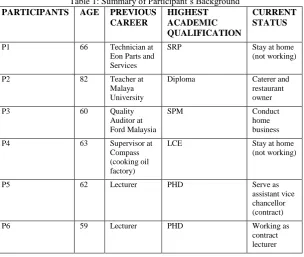
All of the participants are male and their ages range from 59 (the youngest) to 82 years old (the oldest). They are all Malays and Muslims. Technically, they are all retirees. However, two of the elderly are still working and serve as contract staffs in the education field, while the other four are not working anymore. Table 1 summarizes their background information.Table 1: Summary of Participant’s Background
PARTICIPANTS AGE PREVIOUS
CAREER
HIGHEST ACADEMIC QUALIFICATION
CURRENT STATUS
P1 66 Technician at
Eon Parts and Services
SRP Stay at home
(not working)
P2 82 Teacher at
Malaya University
Diploma Caterer and
restaurant owner
P3 60 Quality
Auditor at Ford Malaysia
SPM Conduct
home business
P4 63 Supervisor at
Compass (cooking oil factory)
LCE Stay at home
(not working)
P5 62 Lecturer PHD Serve as
assistant vice chancellor (contract)
P6 59 Lecturer PHD Working as
contract lecturer
Type of ICT Owned by Elderly
Based on the interview and their feedback, mobile phones were ranked as an important tool in their life. The interview indicates that mobile phone is the most preferred ICT tools owned by them. This is due to its easy navigation since all of the participants’ mobile phones are equipped with keypads. A similar research conducted by Mohd Hairul Nizam, Hazrima Hassan & Nazean Jomhavi (2008) where the authors concluded that male elderly people are using a mobile phone at a rate of 60%. Mobile phones with keypads are preferable since they never try to use the touch screen type. Furthermore, larger screen display of mobile phone is also preferred by elderly rather than smaller display.
The main features commonly available on their mobile phones are ‘save contact’ and ‘alarm clock’. The features are gathered based upon the elderlys’ responses obtained during the interview sessions. As for both participants (P5 and P6), due to their working condition, both of the elderly own a Blackberry mobile phone as their second phones and they use it for work purposes. Nokia C3 mobile phone is their first phone and for personal purposes. Besides, they also own a notebook. According to both of them, Blackberry mobile phone is equipped with email application. When they are not in the office, they still can access to their formal email. Although the office is equipped with desktop, only one participant (P6) always brings his notebook. P6 uses his notebook to access Internet by using the Maxis broadband, while for the other participant (P5) he uses the desktop to access Internet. Based on the findings presented, the two (2) participants (P5 and P6) have a strong usage patterns on advanced features of ICT like Blackberry phone, computer and Internet. Four (4) participants (P1 to P4) use computer and Internet but not on regular basis. The computer at their residence belongs to their children.
The Use of ICT
176
P5 and P6 use all the three ICT tools in their daily life. Mobile phone, computer and Internet have become part of their lives. It is noted that the influencing factors on the mobile phone, computer and Internet usage by P5 and P6 is because of their socio economic background.Implications of Findings
Technological changes occur almost each day now in any countries worldwide. New technology innovations have allowed communications service providers to offer fast, cheap, better and currently smarter applications. New technological changes are hope to benefits for all layers of communities including elderly. The continuous of technological innovations sometimes means more difficulties to elderly. They usually become fear of using it. Furthermore, at their effort to use new technologies, elderly may face many difficulties deriving from demographic background such as income, education, location whether urban or rural areas, possible disabilities such as age-related illnesses, as well as difficulties related to the complexity of new technology.
There is a need for elderly nevertheless professional or non-professional working in learning and knowing new technology because the information provided by the usage of ICT allows elderly to become independent and autonomy in order to enhance their mobility and quality of life. Thus, elderly people can also achieve a more meaningful life beside than remain active at work or in their society. Roupa, Nikas, Gerasimou, Zafeiri, Giasyrani, Kazitori & Sotiropoulou (2010) agreed that it is widely accepted the use of new technology by the elderly population has a beneficial effect on their quality of life.
DISCUSSION
Ownership
The survey revealed that all of the participants bought their own mobile phones except for P4. Mobile phone used by P4 is bought by his daughter since it was cheap. It only cost MYR50 for the brand Bluberry CSL. His daughter also taught him how to use the Bluberry mobile phone. Eventually he knew how to use it on his own. While for P2, he asked the shopkeeper how to use Nokia mobile phone before he plan to bought it. When he got home, he asked his children again to show him how and then explore on his own. Although both P5 and P6 owned a Blackberry, the phone is provided by the university to P5. Technically, he did not own it. Since P5 holds a position in the university, he is eligible for a mobile phone in order to be used for official purposes related to his works. The setting-up of Blackberry Curve 9360 mobile phone is done by the Infotech Department of the university. The respective department setup for IBM Lotus Mail application via Blackberry.
In terms of brand, the survey indicates that Nokia is the most preferred brand name among participants. According to P2, due to Nokia early existence in the market and with the user friendliness interface like large keypad and the readable font size have made Nokia mobile phone easy to use. P1 added that Nokia is a well-known mobile phone and easy for him to navigate. P5 commented that he has been using Nokia C3 mobile phone because it was his first phone and contained a large number of contacts.
As for computer and Internet, both P3 and P5 installed Unifi Internet package by Telekom Malaysia (TM). P5 subscribed under his name while P3 subscribed under his daughter’s name and the Internet package belongs to his daughter. It is proven that professional working elderly have that purchasing power. Contrary to P6, he owned and subscribed to broadband modem. P6 made a remark, “broadband modem is easy to carry anytime and anywhere especially during leisure time and holiday getaways”. Not just mobile phone on the move, broadband modem is also on the move. P1 and P4 did not own any computer or Internet connection while P2 was not sure the type of Internet connection he has at his place since it belongs to his son. P2 added that as an old person, he felt that he was “on the other side of the curtain”.
Activity with Technology
Findings of this study shows elderly users who use Internet tend to spend their time with useful information. P3, P5 and P6 use Internet to read online news like Bernama.com, The Star, online Harian Metro and also online Utusan Malaysia. P6 owned 2 Facebook accounts. One for his personal account and the other one is for the unit in university where he works. He runs as an administrator. Besides, P5 and P6 use Internet for mailing and online library related to research and publication. According to P2, although he did not have a Facebook account, he would ask a favor from his son to track his old long lost friend who stayed in Germany. Internet sometimes can do well to elderly when they need it in terms of socializing.
177
participants have more than one reason for using mobile phone compared to the reason for using Internet. All of them have similar purposes including:• making and receiving phone calls, • sending and receiving SMS, • save contacts.
As for games, camera, and listening songs all participants agreed that these are hardly used in their daily usage.
Table 2: Mobile phone usage by elderly
MOBILE PHONE USAGE PARTICIPANTS
USING ICT (N)
Talk 6
Send and receive SMS 6
Save contact 6
Alarm clock 5
Internet and email 2
Games 2
Camera 2
Listen songs 1
Use Behaviour
Professional working elderly fully utilize and know how to use IT in the forms of communication like computer, Internet and smart phone as they frequently use those three ICT tools. In fact, their usage of technologies is no different from that of young adult. For non-working elderly, life after retirement age is considered as a time to stay at home.
As for non-professional working elderly, they said if they are given a chance to try using touch screen mobile phone, then they would like to have that experience as well. Since they have never got the chance to use the touch screen, these elderly think that it is difficult to use it. The outcome indicates that these elderly people are willing to learn new things, however, at slow rate. According to Siek (2008) older people have difficulty with fine motor control task such as clicking a computer. She also found older people performed point and click and drag element slower than young people, although it can be completed with the same accuracy. She continued that the reason for elderly to exhibit reduced fine motor control, muscle strength, and pincher strength is typically associated with old age. While Kurniawan & Zaphiris (2005) add that elderly also probably have less experience in using these input devices than younger users.
CONCLUSION AND FUTURE WORK
In conclusion, this study showed the most significant type of ICT usage by elderly in Malaysia. All of the participants had and used a mobile phone, while only professional working elderly use computer and internet. The lack of functional literacy in ICT was the main reason not to use computer and internet. Education was significantly related to ICT usage. Education levels might be, therefore, an important factor to explain the low adoption of these technologies by the elderly. This is the first step in providing more insights on the use of ICT by elderly in Malaysia. This study also acts as a preliminary study for other researches in future work. It presents results from interview based on questionnaire method beside than literature review. It would seem to be an advantage if the younger members of the family help non-professional elderly to familiarize with ICT tools, thus removing fears of using technologies. Undoubtedly, more work is needed to identify the preference of elderly concerning usability issues and factors that contribute to a successful design of ICT devices such as applications and features.
ACKNOWLEDGEMENT
This paper is under Dana Kecemerlangan of the Universiti Teknologi Mara Cawangan Kedah. The author would like to acknowledge Universiti Teknologi MARA (UiTM) and colleagues for comments, assistance and guidance in writing this paper.
REFERENCES
178
Blit-Cohen, E., & Litwin, H. (2004). Elder participation in cyberspace: A qualitative analysis of Israeli retirees.Journal of Aging Studies, 18, 385-398.
Boje, C., & Dragulanescu, N. G. (2003). Digital divide, Eastern European countries and its social impact, Proceedings of the 2003 American Society for Engineering Education Annual Conference and Exposition. Browne, H. (2000). Accessibility and Usability of Information Technology by the Elderly.
Charness, N., & Boot, W. R. (2009). Aging and information technology use: Potential and barriers, 18, 5, 253-258.
Githens, R. P. (2007). Older Adults and E-Learning: Opportunities and Barriers. Quarterly Review of Distance Education, 8, 4, 329-338.Kontaxakis, B. P., & Christodoulou, G. N. (2000). Third Age People. Edition Beta, Athens.
Kurniawan, S. H., Mahmud, M., & Nugroho, Y. (2006). A study of the use of mobile phones by older persons. Kurniawan, S. H. & Zaphiris, P. (2005). Research-derived web design guidelines for older people, Proceedings
of the ACM SIGACCESS Conference on Computers and Accessability, Baltimore, Maryland, USA. McMurtrey, M. E., McGaughey, R. E., Downey, J. P, and Zeltmann, S. M. (2010). Seniors and Information
Technology: Much Ado About Something?
Mohd Hairul Nizam MD Nasir, Hazrima Harsan, & Nazean Jomhavi. (2008). The use of mobile phones by elderly: a study in Malaysian perspectives. Journal of Social Sciences, 4(2), 123-127.
Mohd Yusof Abdullah, Ali Salman, Norizan Abdul Razak, Noor Fariza Mohd Noor, and Jalaluddin Abdul Malek. (2011). Issues affecting the use of information and communication technology among the elderly: A case study on JENii, 10th Malaysia International Conference on Communications (MICC).
Roupa, Z., Nikas, M., Gerasimou, E., Zafeiri, V., Giasyrani, L., Kazitori, E., & Sotiropoulou, P. (2010). The Use of Technology by the Elderly. Health Science Journal, 4, 2, 118-126.
Selwyn, N., Gorard, S., Furlong, J., & Madden, L. (2003). Older adults' use of information and communications technology in everyday life. Ageing and Society Journal, 23, 561-582.
Siek, K. A. (2008). Mobile design for older adults, Handbook of Research on User Interface Design and Evaluation for Mobile Technology, 1, IGI Global.
TurkStat: Elderly population to increase to 10 pct in 2023. (2013). Retrieved April 16, 2013, from http://todayszaman.com/newsDetail_getNewsById.action?newsId=310272.
Watering, M. V. D. (2008). The impact of computer technology on the elderly.
White, H., McConnell, E., Clipp, E., Bynum L., Teague, C., Navas, L, Craven, S., & Halbrecht, H. (1999). Surfing the Net in later life: A review of the literature and pilot study of computer use and quality of life. Journal of Applied Gerontology, 18, 3, 358-378.
World Population Ageing 1950-2050: Population Division, Department of Economic and Social Affairs. (2010).
United Nations, report retrieved from
http://www.un.org/esa/population/publications/worldageing19502050/. Zajicek, M. (2011). Interface design for older adults, Proceedings of the EC/NSF.