http://www.sciencepublishinggroup.com/j/ijefm doi: 10.11648/j.ijefm.20170506.18
ISSN: 2326-9553 (Print); ISSN: 2326-9561 (Online)
The Experience and Reference on PPP Development in
Germany
Su Guo
1, Huijie Li
2, Yang Guo
3, Ke Gao
11
Department of Finance and Taxation, Central University of Finance and Economics, Beijing, China
2
Zhongcai-Pengyuan Local Finance Investment and Funding Research Institute, Central University of Finance and Economics, Beijing, China
3
Department of Mathematics and Statistics, Central University of Finance and Economics, Beijing, China
Email address:
[email protected] (Su Guo), [email protected] (Huijie Li), [email protected] (Yang Guo), [email protected] (Ke Gao)
To cite this article:
Su Guo, Huijie Li, Yang Guo, Ke Gao. The Experience and Reference on PPP Development in Germany. International Journal of Economics, Finance and Management Sciences. Vol. 5, No. 6, 2017, pp. 327-333. doi: 10.11648/j.ijefm.20170506.18
Received: November 29, 2017; Accepted: December 21, 2017; Published: December 28, 2017
Abstract: At present, Public-Private Partnership (PPP) model is vigorously promoted in China and it is becoming an important
way of government financing. Though the amount of PPP projects in China is enormous, there are a lot of problems to be solved. At the same time, German PPP develops rapidly in recent years though it started relatively late. In the past few years, the number of PPP projects in Germany ranked the third place stably in Europe. Germany accumulates a lot of mature experience in PPP projects, including industry, fiscal and taxation policy as well as the set-up of management institutions. This paper summarizes the current situation and experience of PPP in Germany and provides reference for PPP development in China. To be specific, German governments pay great attention to PPP development and its institutional arrangement. The governments provide preferential taxation and industrial policies for PPP projects. Meanwhile, German governments lay great emphasis on risk management of PPP projects. In fact, PPP projects in Germany are supervised in the way of contract supervision. Besides, the federal government sets a good example for state governments. Last but not the least, project consultants are allowed to participate in public procurement under some certain prerequisites.Keyword: Public-Private Partnership (PPP), Germany, Experience, Reference
1. Introduction
Recently, Public-Private Partnership (PPP) model is vigorously promoted in China. Since 2013, Development and Reform Commission and Treasury Department have introduced lots of policy measures to promote the PPP mode. In the meantime, local governments have issued cooperation guidance on project screening and recommendation. At present, Development and Reform Commission has launched 3764 PPP projects with the total amount of 6.37 trillion. Treasury Department has launched 752 PPP projects with the amount of 1.83 trillion. However, the rate of signing contracts is relatively low. According to PPP center of Treasury Department, the rate is merely 23.8% nationwide at the end of June 2016. In order to promote the development of PPP in China, it is necessary to study and summarize foreign PPP development experience. Take Germany as an example, PPP model in Germany develops rapidly in recent years though it
started relatively late. In the past few years, the number of PPP projects in Germany ranked the third place stably in Europe.
2. The Status Quo of PPP Development in
Germany
2.1. General Situation of German PPP Development
PPP model in Germany started late but developed rapidly. The earliest PPP contracts were signed between 2002 and 2003. Then the PPP market has steadily expanded in Germany in the following years. At present, although German PPP market is not as mature as England, it is more developed than some other European countries such as Denmark, Finland and
Belgium. According to the latest statistics of the European PPP expertise Centre (EPEC), the quantity of German annual PPP projects ranks the third place among European countries for several years.
PPP projects in Germany can be divided into federal level projects, state level projects, municipality level projects and other levels projects according to the initiators’ administrative levels. Furthermore, federal level projects are much more than other levels. According to Partnerschaften Deutschland (PD), the proportion of federal level projects is 38%. Municipality level projects account for 35% and state PPP projects amount to 26%.
Table 1. The general situation of PPP projects in Germany.
Year Quantity of PPP Projects
Accumulated Quantity of PPP Projects
Amount of PPP Projects (million Euros)
Accumulated Amount of PPP Projects (million Euros)
Average Amount of PPP Projects (million Euros)
2002-2003 2 2 64 64 32
2004 12 14 350 414 29
2005 16 30 508 922 32
2006 23 53 594 1,516 26
2007 38 91 1,506 3,022 40
2008 28 119 1,432 4,454 51
2009 26 145 1,187 5,641 46
2010 15 160 384 6,025 26
2011 16 176 1,151 7,176 72
2012 8 184 150 7,326 19
2013 8 192 189 7,515 24
2014 6 198 990 8,505 165
2015 6 204 654 9,159 109
2016.01-08 3 207 75 9,234 25
Average amount of PPP projects is equal to amount of PPP projects divided by number of PPP projects each year. Sources: Partnerschaften Deutschland (Public-Private Partnerships Company of Germany Ltd.)
However, the scale of PPP projects in Germany is usually small. Specifically, more than 80% of the PPP projects worth no more than 25 million euros, and 44% of the projects worth less than 15 million euros. The projects worth more than 50 million euros take less than 20%.
2.2. The Main Models of German PPP
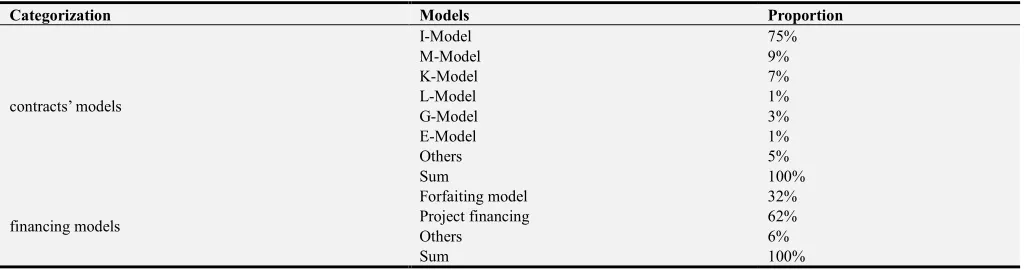
PPP projects can be divided into I - Model (holder model), M - Model (rental model), K - Model (franchise mode), L - Model (leasing mode), G - Model (associated company model)
and E - Model (purchaser model) according to contracts’ models. Specifically, I – Model projects in Germany amount to 75% by August 2016. M – Model projects amount to 9%, followed by E – Model which accounts for 7% of the PPP projects. The proportion of other models is relatively small.
The last categorization of German PPP is financing model. In fact, 62% PPP projects in Germany are financed by project financing, and Forfaiting model accounts for 32%. The source of projects financing is bank loan and issuing bonds.
Table 2. The models of PPP projects in Germany.
Categorization Models Proportion
contracts’ models
I-Model 75%
M-Model 9%
K-Model 7%
L-Model 1%
G-Model 3%
E-Model 1%
Others 5%
Sum 100%
financing models
Forfaiting model 32%
Project financing 62%
Others 6%
Sum 100%
Sources: Partnerschaften Deutschland (Public-Private Partnerships Company of Germany Ltd.)
2.3. The Main Investment Fields of German PPP
The main investment fields of German PPP are
between 2002 and 2014, schools, kindergartens and education facilities account for 38%, followed by recreation, culture, sports and activity facilities, which accounted for 21%. Besides, administrative building projects account for 15% and
transportation projects account for 9%. In terms of the amount, transportation projects rank the first place for its large scale, followed by schools, kindergartens and education facilities.
Table 3. The investment fields of PPP projects in Germany between 2002 and 2014.
investment fields of PPP The proportion of projects’ quantity The proportion of projects’ amount
schools, kindergartens and education facilities 38% 21%
recreation, culture, sports and activity facilities 21% 9%
administrative buildings 15% 11%
transportation 9% 35%
security 6% 2%
medical treatment 5% 14%
judiciary 2% 3%
others 4% 5%
sum 100.00% 100.00%
Sources: Partnerschaften Deutschland (Public-Private Partnerships Company of Germany Ltd.)
According to the annual report 2015 of Public-Private Partnerships Company of Germany Ltd., the total amount of PPP projects on education, administration and leisure in 2015 is much larger than 2014. To be specific, education projects are concentrated in the construction of municipal schools due to the increasing enrollment of full-time school. The proportion of vocational education and training stayed the same as 2014. Besides, the scale of administration buildings was stable. The administration building here mainly refers to state organs and municipal executive buildings. In addition, security projects become a new growth point which includes fire station, emergency service and so on.
3. The Administration and Management
of German PPP
Germany developed a set of management system to standardize the development of PPP projects. The PPP management adopts a strict hierarchical management system. Governments at all levels should be responsible for PPP projects management according to administration power. To be specific, the rights of establishment and approving PPP projects are handed over to all levels of parliament. Audit institutions at all levels should be responsible for post audit of PPP projects. Administrative departments and relevant
institutions should be responsible for supervision and administration of PPP projects.
3.1. Main Administrative Departments of German PPP
3.1.1. Administrative Departments and Related Institutions on the Federal Level
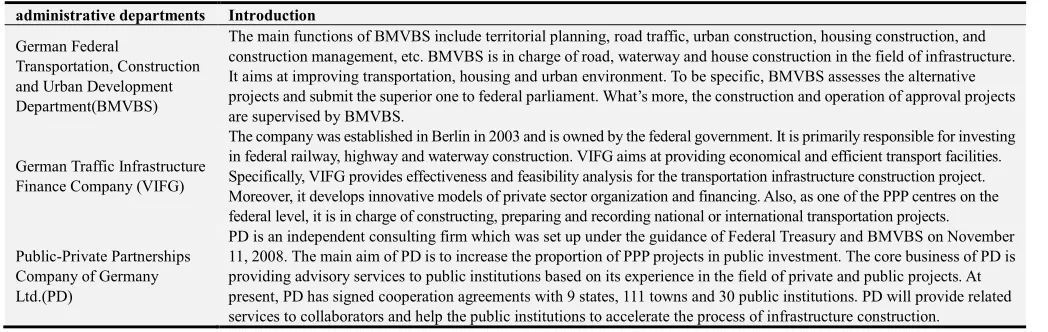
German Federal Transportation, Construction and Urban Development Department (BMVBS) is the main department in charge of PPP projects. The main functions of BMVBS include territorial planning, road traffic, urban construction, housing construction, and construction management, etc. Under the authority of BMVBS, German Traffic Infrastructure Finance Company (VIFG) is primarily responsible for investing in federal railway, highway and waterway construction. What’s more, in order to provide better consultation and service, Public-Private Partnerships Company of Germany Ltd. (PD) was set up in November 2008. PD is specialized in PPP consulting and information service. Not only the federal government, but also the state, municipal government and other public institutions can seek professional advice or consulting services on PPP to PD. Furthermore, Federal Association of Public-Private partnerships (BPPP) is committed to developing the concept and formatting the standard of PPP.
Table 4. The introduction of main administrative departments on PPP on the federal level.
administrative departments Introduction
German Federal
Transportation, Construction and Urban Development Department(BMVBS)
The main functions of BMVBS include territorial planning, road traffic, urban construction, housing construction, and construction management, etc. BMVBS is in charge of road, waterway and house construction in the field of infrastructure. It aims at improving transportation, housing and urban environment. To be specific, BMVBS assesses the alternative projects and submit the superior one to federal parliament. What’s more, the construction and operation of approval projects are supervised by BMVBS.
German Traffic Infrastructure Finance Company (VIFG)
The company was established in Berlin in 2003 and is owned by the federal government. It is primarily responsible for investing in federal railway, highway and waterway construction. VIFG aims at providing economical and efficient transport facilities. Specifically, VIFG provides effectiveness and feasibility analysis for the transportation infrastructure construction project. Moreover, it develops innovative models of private sector organization and financing. Also, as one of the PPP centres on the federal level, it is in charge of constructing, preparing and recording national or international transportation projects.
Public-Private Partnerships Company of Germany Ltd.(PD)
administrative departments Introduction
Federal Association of Public-Private partnerships(BPPP)
BPPP was established on November 4, 2003 in Hamburg. The chief responsibility of BPPP is providing a communication platform for the implementation of PPP projects. BPPP will not compete with any private or public PPP sectors. It is committed to develop the concept of PPP and get a common recognition in all PPP related departments. Only if related departments accept PPP contracts formation and performance evaluation standard, PPP can solve the problems encountered in infrastructure construction effectively. The formation of these standards is based on a comprehensive analysis of the applicable conditions of PPP.
3.1.2. Administrative Departments and Related Institutions on the State Level
There are some differences in setting up PPP management institutions among German states, but the similarities are obvious from an overall perspective. The relative institutions in all the states mainly include co-management departments and organizations on finance, economics, transportation, justice and so on. Take Lower Saxony as an example, it coordinates the PPP institutions via establishing PPP Competence Network. To be specific, the network is in charge of promoting PPP concept statewide. Also, it provides
suggestions on the applicability of PPP as well as necessary guidance for lower local governments.
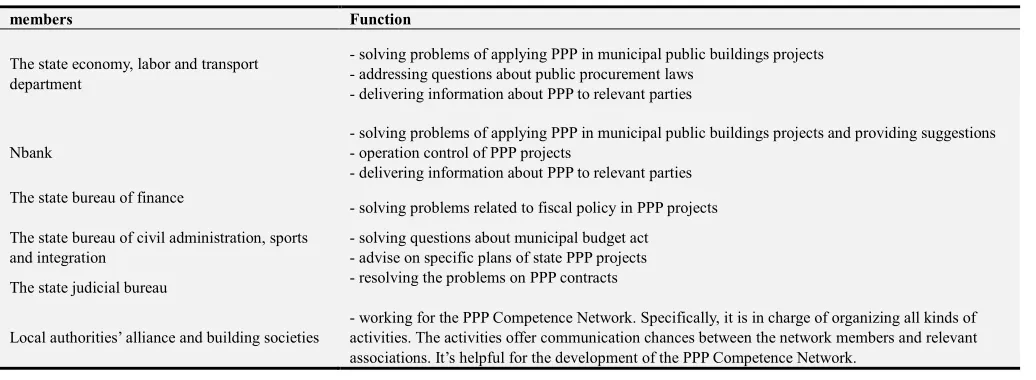
The current PPP Competence Network includes seven members. The members are the state economy, labor and transport department, Nbank, the state finance ministry, the state bureau of civil administration, the state bureau of sports and integration, the state judicial bureau, local authorities’ alliance and construction industry societies respectively. The core of PPP Competence Network in Lower Saxony are state economy, labor and transport department, and Nbank. PPP Competence Network members are responsible for respective functions.
Table 5. The function of PPP Competence Network members in Lower Saxony.
members Function
The state economy, labor and transport department
- solving problems of applying PPP in municipal public buildings projects - addressing questions about public procurement laws
- delivering information about PPP to relevant parties
Nbank
- solving problems of applying PPP in municipal public buildings projects and providing suggestions - operation control of PPP projects
- delivering information about PPP to relevant parties
The state bureau of finance
- solving problems related to fiscal policy in PPP projects
The state bureau of civil administration, sports and integration
- solving questions about municipal budget act - advise on specific plans of state PPP projects
The state judicial bureau - resolving the problems on PPP contracts
Local authorities’ alliance and building societies
- working for the PPP Competence Network. Specifically, it is in charge of organizing all kinds of activities. The activities offer communication chances between the network members and relevant associations. It’s helpful for the development of the PPP Competence Network.
3.2. Related Management System of German PPP
Government will pay compensation to public procurement bidders in certain situation. There is usually an expenditure when bidder making quotation in a bidding. In principle, it is not necessary for German government to compensate the expenditure. But the bidder can ask for appropriate economic compensation if the bidder is required to provide original achievements. The compensation standard must be equal for every bidder participating in public procurement. In general, the standard is set according to the market value of bidders’ effort. In addition, the compensation aims to compensate the bidders’ actual expenditure instead of profit-making.
Group bidders are allowed to participate in the public procurement. The group bidders refer to two or more enterprises participating in the bidding as a bidder. The group bidder submits an offer and fulfills the contract jointly after winning the bid. Generally speaking, it is difficult for small and medium-sized enterprises to participate in public procurement as an independent bidder due to the limited technical level and
financial condition. In this case, combining with large enterprises or other small and medium-sized enterprises is helpful in winning the bid. The policy which permits group bidders participating in public procurement, promotes the development of small and medium-sized enterprises in Germany. In addition, the policy promotes proper competition in public procurement. The effective competition will help to provide better service at lower price. However, the group bidders are required to adopt specific legal forms as necessary. In practice, some purchasing agents require the group bidders establishing a project company when applying for the procurement. The requirement increases the cost of group bidders to some extent, because the cost of establishing project company will not be able to recover once lose the bid.
Federal Budget Act also stipulates that risk allocation should be taken into consideration when doing the economic analysis. In fact, risk allocation involves three aspects. First of all, related principals are required to identify risks correctly. Specifically, the related principals should fully grasp the project information and private tenderers’ information. Then, identify the key risks of PPP project, such as technical risk, financial risk and operational risk. Secondly, figure out the expected losses and do comprehensive analysis on risk probability, probable loss and the tolerance of related principals. At last, design reasonable risk allocation schemes to ensure the overall risk in the PPP project is allocated among the related principals reasonably.
Public sectors are allowed to finance by selling real estate under certain conditions. According to the Federal Budget Act, public sectors are allowed to sell real estate on the premise that it can ensure the completion of federal tasks. In this case, procuring agency in PPP projects can finance by selling real estate. Besides, it provides legal guarantee for buy-back, and also provides the possibility for other forms of financing activities. In fact, Berlin and Mecklenburg have made the first attempt before the introduction of Federal Budget Act, allowing the public sector to sell real estate under certain conditions.
4. The Main Taxation and Industrial
Policies for German PPP Development
4.1. Related Tax Policies on Germen PPP
4.1.1. Provisions on Income Tax Collection Methods Generally speaking, the organizational forms of Germen PPP project companies mainly include limited liability company (GmbH),limited company (AG), joint stock limited liability partnership(KGaA), unlimited partnership (OHG), joint liability company (KG) and so on. Among the types of organization, limited liability companies, joint stock limited companies and joint stock companies are independent legal entities, thus need to pay income tax according toCorporate Income Tax Law. Unlimited partnership and joint liability companies do not need to pay corporate income tax, but partners need to pay individual income tax according to the investment proportion.
4.1.2. Provisions on VAT Exemption for Public Sector Funds
Public sectors often provide some funding for PPP project trustees. The funding refers to as subsidy, allowance, compensation, or grants. According to VAT Law, whether trustees need to pay tax for the fund, depends on the purposes of the raised funds. If a public sector offers subsidy to a private trustee in order to promote the implementation of a certain target and the subsidy dose not correspond to goods or services, then private trustee does not need to pay VAT for the fund.
4.1.3. Provisions on Exemption for Land Purchase Tax As a turnover tax, the object of land purchase tax is the
transfer of real estate. In other words, taxpayers need to pay land purchase tax in a land acquisition, and the tax base is market price of the land. According to German Land Purchase Tax Law, under some certain condition, purchase or repurchase land from a legal person can be exempt for land purchase tax. The legal person refers to governments and public service enterprises here. The premises mentioned above can be summarized as a certain mode. To be specific, a public sector transfers its land to a private trustee. Then, the trustee builds or rebuilds government buildings on the land for public services. After contract expired, the trustees return the land to government. If the above criteria are met, land purchase tax can be exempted.
4.1.4. Provisions on Exemption for Land Tax
As a property tax, the object of land tax is real estate. German landowners have to pay land tax to the local government every year. The tax basis is the value of the property. Generally speaking, for the land used for public services and facilities, if it is not owned by government or other subjects who enjoy tax-free treatment, the land tax cannot be exempted. However, if private real estate is used for public services and facilities, and the private property is transferred to the public sector, then the land tax can be exempted.
4.2. Related Industrial Policies on German PPP
Funding shortage is one of the restrictions for German remote road construction. Therefore, Germany has been looking for innovative financing modes for remote road construction since 1990s. After detailed demonstration, German government finally accepted the model of public-private partnership on remote road construction.
At present, there are two main modes for private sectors participating in remote road investment named model A and F. In part of federal highway sections, the private enterprises can adopt to model A. The funding sources of model A are fiscal appropriation and heavy truck tolls. VIFG pays the tolls to the operators of the corresponding section. For the road exempted for tolls, federal government will compensate the loss of transport facilities. Model F is suitable for tough sections (such as bridges, tunnels and mountain pass) of federal highway. Private sectors can participate in constructing and operating of the tough sections on the basis of Federal Private Road Financing Act. The funding sources of model F are fiscal appropriation and road users’ tolls.
selected by default. When start charging, the private corporations can make changes on charging methods six months before the end of the accounting period. If public law charge method is adopted, the charging standard will be accordance with administrative provisions of the federal states. However, if civil law remuneration method is adopted, the private corporations need topresent the charging standards to state highway construction department. Besides state highway construction department, the charging standards must be approved by German Federal Transportation, Construction and Urban Development Department (BMVBS).
5. The Experience of German PPP
Development
5.1. Governments Pay Great Attention to PPP Development
German governments have attached great importance to PPP development since the very beginning of PPP development. Meanwhile, PPP development was raised to the level of public affair management. The Germany treasury officials stated that PPP is an institutional arrangement that provides better services for the country and its citizens. In other words, PPP is not the mean of government financing during the period of financial stress. In addition, German governments have actively amended the existing laws hindering the development of PPP.
5.2. Governments Focus on Institutional Arrangement
German Government is committed to improve PPP management system and set up related institutions in order to provide comprehensive solutions to design, financing, construction, operation and maintenance services of PPP projects. For the federal government, Transportation, Construction and Urban Development Department (BMVBS) is in charge of the management of the PPP projects. Besides, the federal government has formed a special transportation infrastructure finance company to facilitate PPP financing in transportation field. At the same time, Public-Private Partnerships Company of Germany Ltd.(PD) was set up to provide advisory services to public institutions. For the state governments, most states have established PPP competence centers and even PPP competence networks. These state PPP institutes aim to provide comprehensive help to state PPP projects.
5.3. The Federal Government Sets a Good Example for State Governments
In Germany, federal government plays an important part in PPP development. Federal PPP projects account for 40% of German PPP projects. For one thing, federal government can play a leading role in PPP projects and grasp the PPP development direction nationwide. For the other, most PPP projects are complex and it need a series of supporting measures, professional teams and so on. In the early stage of PPP development, state governments are lack of experience.
Hence, it is difficult for state governments to meet the requirement of PPP development. In this case, federal PPP developed first and promoted local PPP largely.
5.4. Governments Lay Great Emphasis on Risk Management
The governments attach great emphasis on risk management by selecting PPP investment fields rationally and controlling the scale properly. There are a large number of PPP projects in Germany but the amount of a single project is small. German PPP projects are mainly concentrated in schools, kindergartens, education, leisure, culture, sports facilities and activities. Whereas PPP projects on highway are unusual. The main reason is that projects such as schools, kindergartens, education, leisure, culture, sports facilities are smaller and easier than highway. Therefore, it is easier to control risk and keep the projects running smoothly.
5.5. PPP Projects Are Supervised in the Way of Contract Supervision
Contract supervision emphasizes the equivalence of regulatory agencies and regulated enterprises, and it is one of the market-oriented supervision trends. Contract supervision means that regulatory agencies and regulated enterprises sign contracts to clarify the respective rights and obligations of the two parties. Compared with traditional regulation, contract supervision stands for equivalence of regulatory agencies and regulated enterprises, instead of subordination. For instance, German infrastructure service contracts usually contain the clauses such as time limit of operating infrastructure, service quality, limit value of indexes and the final control. At the same time, the contract stipulates that regulatory agencies have the right to check condition of infrastructure, service quality as well as related information. Regulatory supervision mode and behavior are appointed in advance through terms of the contract.
5.6. Governments Provide Preferential Policies for PPP Projects
also get some compensation for the cost during the bidding.
5.7. Market Plays an Important Role in German PPP Development
In recent years, especially since 2014, United States and Europe have been devoting to building smart cities. In order to accomplish the goal, German cities generally choose the Public - Private - Partnership model. Generally speaking, there are two patterns in the cooperation between public and private sectors. The first pattern is that governments put forward long-term macroeconomic objectives and guide enterprises to carry out related research by means of providing fiscal subsidies. At last, governments will choose the suitable partner among the many participants. The other pattern is that large-scale enterprises such as Deutsche Telekom, Siemens and BMW will select one or several cities to participate in a pilot program in order to sell products or service. The cities which qualified or interested in the project will take an active part in pilot competitions carried out by the large enterprises. Therefore, market takes an important role in the process of smart city construction. In other words, governments are in charge of putting forward an objective in a certain period, while market is in charge of the specific details in PPP projects.
5.8. Project Consultant Is Allowed to Participate in Public Procurement Under Some Certain Prerequisites
In general, public procurement departments will hire some companies to deal with consulting and planning of the projects before PPP bidding. The companies are referred to as “project consultant” in German purchasing cases. Project consultants have advantages in getting information compared to general bidders. At this point, it is not affair to allow project consultants participating in project biddings. However, forbidding project consultants to participate in the bid is not reasonable either. Therefore, Germany public procurement regulations stipulate that if the bidder provides consultation or other services before the bid, consignors must ensure the competition is not distorted by the participation of the bidders. In other words, Germany retains the possibility of a project consultant participating in the bidding process in the premise of fair competition. In fact,theregulation is in line with practical situation. For example, a complex project requires highly developed skills. Thus, its contractors are large enterprises which equipped with planning departments probably. The planning departments are more suitable for complex projects than small planning design companies, because planning departments can provide a more comprehensive scheme design. Specifically, the design is realistic and adept at cost control. Hence, allowing project consultants participating in the later bidding in the premise of fair competition conforms to economic principle.
6. Conclusion
The paper summarized the status quo of PPP development
in Germany. Specifically, it introduces the classification, the main models and investment fields of German PPP. In short, German PPP started late but developed rapidly. The reasons for this rapid growth are surely the administration and management of German PPP. Therefore, this paper lays emphasize on the main administrative departments and the related management system of German PPP. Besides, governments provide preferential taxation and industrial policies for PPP Projects. All of the institutional arrangement provides reference for PPP development in China. To sum up, German governments pay great attention to PPP development and its institutional arrangement. Meanwhile, German governments lay great emphasis on risk management of PPP projects. In fact, PPP projects in Germany are supervised in the way of contract supervision. What’s more, the federal government sets a good example for state governments. Last but not the least, project consultants are allowed to participate in public procurement under some certain prerequisites.
References
[1] Marcus Ahadzi, Grame Bowles. Public-private Partnerships and Contract Negotiations: An Empirical Study. [J]. Construction Management and Economics, 2004(22).
[2] Karsten Mause, Thomas Krumm. Public-Private Partnership as a tool of Government: Exploring its Determinants Across German State. [J] German Politics. 2011(20):527-544.
[3] Yisuo Li. Economic research of public-private partnership (PPP) - based on German experience [J].Lanzhou Academic Journal, 2012, 06: 146-154.
[4] Yisuo Li. “project consultant” in public-private partnership: German experience [J]. Economic and management review, 2013(4): 24-30.
[5] Eurasian PPP liaison network. A case study of public-private partnership (PPP) in infrastructure construction in Europe and Asia [M]. Liaoning science and technology press, 2010.
[6] Jian Pu, Hui Sun, Cai Zhang. Chinese logic on PPP [M]. Beijing: China citic press. 2016.
[7] Yisuo Li, Research on public-private partnerships Promotion Act. [M]. Beijing: China democracy and legality press. 2013.
[8] Huiqin Gao, Yunguo Liu, Xia Qi, Hongyuan Fu. Research on the VFM evaluation method based on the international practice of PPP model - taking UK, Germany, Singapore as an example [J]. Project Management Technology, 2011, No 3, vol (9), 18-21.
[9] Tianlong Hu. Establishment of China’s PPP Related Tax System and Lessons Drawn from Foreign Experience. [J]. International Taxation, 2017 (9), 26-30.