COMPUTER SCIENCE & TECHNOLOGY
www.computerscijournal.org
December 2013, Vol. 6, No. (4): Pgs. 467-472 An International Open Free Access, Peer Reviewed Research Journal
Published By: Oriental Scientific Publishing Co., India.
INTROdUCTION
The Possible ways of representing the knowledge while acquiring knowledge from experts are termed as Knowledge Models. The process of knowledge acquisition includes elicitation, collection, analysis, modelling and validation of knowledge. Hence the knowledge which has been acquired should focus on essential knowledge. And it should capture tacit knowledge. It should allow the knowledge to be collated from different experts. Non-experts should also be able to understand the acquired knowledge. Experts are fully engaged
Knowledge Models, current Knowledge
Acquisition Techniques and developments
TRUHSAR PATEL
1and SANJAY THAKKAR
2P.M Patel Institute of Business Administration, Anand, India. P.M Patel Institute of Business Administration, Anand, India.
(Received: October 20, 2013; Accepted: October 30, 2013)
ABSTRACT
The development of intelligent healthcare support systems always requires a formalization of medical knowledge. Artificial Intelligence helps to represent the knowledge in various ways which is a very important part in developing any systems, which in turn leads to precise understanding of knowledge representations. This helps to obtain the solution to the problem very easily. Knowledge engineers make use of a number of ways of representing knowledge when acquiring knowledge from experts. These are usually referred to as knowledge models. Knowledge acquisition includes the elicitation, collection, analysis, modelling and validation of knowledge for knowledge engineering and knowledge management projects. This paper presents an overview of available knowledge models, current knowledge acquisition techniques and also the recent developments to improve the efficiency of the knowledge acquisition process.
Key words: Model, Intelligence, Developing system.
Knowledge models What is Knowledge Model
The result of a knowledge modelling activity is a knowledge model. A knowledge model is a computer interpretable model that specifies the components, the properties and the behaviour of a kind of thing, including various options for variations within the constraints of the definition of the kind of thing. This means that a knowledge model is a specification in terms of data in a database and
not so much a textual description (in a natural language). However, pieces of text are allowed in Gellish English as elements in a knowledge model
Knowledge models help to represent the knowledge while collecting the data from experts. Three important types of Knowledge models are going to be discussed here; they are ladders, Network Diagrams and Tables & Grids.
Ladder
ladders are hierarchical tree-like diagrams. laddering techniques involve the creation, reviewing and modification of hierarchical knowledge, in the form of ladders. In this technique expert and knowledge engineer both refer to a ladder presented on paper or a computer screen, and add, delete, rename or re-classify nodes as appropriate. Various forms of ladders are
Concept ladder
In this type of ladder, an expert categorises concepts into classes, which helps to understand the way the domain knowledge is represented. It shows classes of concepts and their sub-types.
Attribute ladder
By reviewing and appending such a ladder, the knowledge engineer can validate and help elicit knowledge of the properties of concepts. It shows attributes and values. All the adjectival values relevant to an attribute are shown as sub-nodes,
but numerical values are not usually shown. For example, the attribute color would have as sub-nodes those colors appropriate in the domain as values, e.g. red, blue, and green.
Composition Ladder
A composition ladder shows the way a knowledge object is composed of its constituent parts. All relationships in the ladder will have the form of has part or part-of relationship, e.g. wheel is part of car. A composition ladder is a useful way of understanding complex entities such as machines, organizations and documents. Validation of the knowledge represented in this type of ladder with another expert is often very quick and efficient.
Network diagrams
network diagrams include concept maps, process maps and state transition networks.
Tables & Grids
Tabular representations make use of tables or grids. Three important types are forms, frames, timelines and matrices/grids.
Forms
A more recent form of knowledge model is the use of hypertext and web pages. Here relationships between concepts, or other types of knowledge, are represented by hyperlinks. This affords the use of structured text by making use of templates, i.e. generic headings. Different templates can be created for different knowledge types. For example, the template for a task would include such headings as description, goal, inputs, outputs, resources and typical problems.
Frames
Frames are a way of representing knowledge in which each concept in a domain is described by a group of attributes and values using a matrix representation. The left-hand column represents the attributes associated with the concept and the right-hand column represents the appropriate values. When the concept is a class, typical (default) values are entered in the right-hand column.
Timelines
A timeline is a type of tabular representation that shows time along the horizontal axis and such things as processes, tasks or project phases along the vertical axis. It is very useful for representing time-based process or role knowledge.
Matrix
A matrix is a type of tabular representation that comprises a 2-dimensional grid with filled-in grid cells. One example is a problem-solution matrix that shows the problems that can arise in a particular part of a domain as the rows in the matrix and possible solutions as the columns. Ticks, crosses or comments in the matrix cells indicate which solution is applicable to which problem.
Knowledge acquisition techniques
To elicit knowledge from experts many
techniques have been developed. These are termed as knowledge elicitation or knowledge acquisition (KA) techniques. Commonly called as “KA techniques”. The following list gives a brief introduction to the types of techniques used for acquiring, analyzing and modelling knowledge:
Protocol analysis techniques
Protocol Analysis involves the identification of basic knowledge objects within a protocol, usually a transcript. It is used with transcripts of interviews or other text-based information to identify various types of knowledge, such as goals, decisions, relationships and attributes. This acts as a bridge between the use of protocol-based techniques and knowledge modelling techniques. For instance, if the transcript concerns the task of diagnosis, then such categories as symptoms, hypotheses and diagnostic techniques would be used for the analysis. Such categories may be taken from generic ontology’s and problem-solving models
Hierarchy-generation techniques
These techniques are used to build taxonomies or other hierarchical structures such as goal trees and decision networks.
Matrix-based techniques
It involves the construction of grids indicating such things as problems encountered against possible solutions. These techniques involve the construction and filling-in of a 2-dimensional matrix (grid, table). Important types include the use of frames for representing the properties of concepts and the repertory grid technique used to elicit, rate, analyze and categorise the properties of concepts.
Sorting techniques
and those that are relatively small. By naming each pile, the expert gives information on the attributes and values they use to denote the properties of concepts.
Limited-information and constrained-processing tasks
These are techniques that either limits the time and/or information available to the expert when performing tasks. For instance, the twenty questions technique provides an efficient way of accessing the key information in a domain in a prioritized order. The expert is allowed to ask questions of the knowledge engineer who is only allowed to respond yes or no. As the expert asks each question, the knowledge engineer notes this down. The questions asked and the order in which they are asked give important knowledge such as key properties or categories in a prioritized order.
diagram-based techniques
It includes the generation and use of concept maps, state transition networks, event
diagrams and process maps. People understand and apply knowledge more easily and readily if a concept map notation is used rather than predicate logic.
Comparison of knowledge acquisition techniques
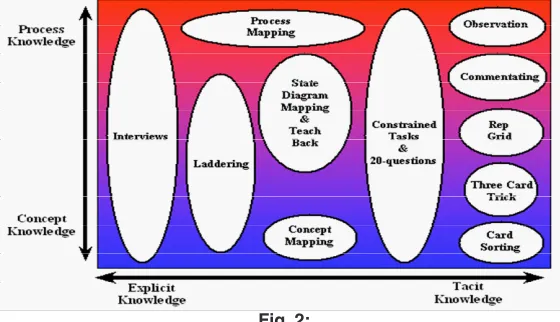
The figure below presents the various knowledge acquisition techniques and shows the types of knowledge they are mainly aimed at eliciting. The vertical axis on the figure represents the dimension from object knowledge to process knowledge, and the horizontal axis represents the dimension from explicit knowledge to tacit knowledge.
Method for applying - KA techniques
This method starts with the use of natural techniques, then moves to using more formal techniques. It does not assume any previous knowledge has been gathered, or that any generic knowledge can be applied. It is summarised as follows.
Fig. 2:
Conduct an initial interview with the expert in order to (a) scope what knowledge is to be acquired, (b) determine what purpose the knowledge is to be put, (c) gain some understanding of key terminology, and (d) build a rapport with the expert. This interview (as with all session with experts) is recorded on either audiotape or videotape.
Transcribe the initial interview and analyse the resulting protocol. Create a concept ladder of the resulting knowledge to provide a broad representation of the knowledge in
the domain. Use the ladder to produce a set of questions which cover the essential issues across the domain and which serve the goals of the knowledge acquisition project. Conduct a semi-structured interview with the expert using the pre-prepared questions to provide structure and focus.
Represent these knowledge elements using the most appropriate knowledge models, e.g. ladders, grids, network diagrams, hypertext, etc. In addition, document anecdotes, illustrations and explanations in a structured manner using hypertext and template headings.
Use the resulting knowledge models and structured text with contrived techniques such as laddering, think aloud problem-solving, twenty questions and repertory grid to allow the expert to modify and expand on the knowledge already captured.
Repeat the analysis, model building and acquisition sessions until the expert and knowledge engineer are happy that the goals of the project have been realised.
Recent developments
To improve the efficiency of knowledge acquisition process huge numbers of developments are happening. Few are listed below
Methodologies
Methodologies provide frameworks and generic knowledge to help guide knowledge acquisition activities and ensure the development of each expert system is performed in an efficient manner. A leading methodology advises the use of six high-level models: the organisation model, the task model, the agent model, the expertise model, the communications model and the design model. To aid development of these models, a number of generic models of problem-solving activities are included. Each of these generic models describe the roles that knowledge play in the tasks, hence provide guidance on what types of knowledge to focus upon. As a project proceeds, it follows a spiral approach to system development such that phases of reviewing, risk assessment, planning and monitoring are visited and re-visited. This provides for rapid prototyping of the system, such that risk is managed and there is more flexibility in dealing with uncertainty and change.
Ontology’s
A second important development is the creation and use of ontology’s. It is a formalised representation of the knowledge in a domain. The main use of ontology is to share and communicate
knowledge, both between people and between computer systems. A number of generic ontology’s have been constructed, each having application across a number of domains which enables the re-use of knowledge. In this way, a project need not start with a blank sheet of paper, but with a number of skeletal frameworks that can act as predefined structures for the knowledge being acquired. Ontology’s also provide guidance to the knowledge engineer in the types of knowledge to be investigated.
Software Tools
A third development has been an increasing use of software tools to aid the acquisition process. Software packages, such as PCPACK contain a number of tools to help the knowledge engineer analyse, structure and store the knowledge required. The use of various modelling tools and a central database of knowledge can provide various representational views of the domain. Software tools can also enforce good knowledge engineering discipline on the user, so that even novice practitioners can be aided to perform knowledge acquisition projects. Software storage and indexing systems can also facilitate the re-use and transfer of knowledge from project to project. More recently, software systems that make use of generic ontology’s are under development to provide for automatic analysis and structuring of knowledge.
Knowledge Engineering Principles and Techniques
CONCLUSION
In Healthcare the emerging use of Knowledge Management Systems has grown widely and the available Knowledge acquisition techniques has to be applied for making the knowledge acquisition process effective and efficient as possible, while building any Healthcare systems. This is an evolving process. Ontology means the basic categories of being and their relations. Ontology’s can be at the semantic
level, whereas database schemas are models of data at the “logical” or “physical” level. Due to their independence from lower level data models, ontology’s are used for integrating heterogeneous databases, enabling interoperability among disparate systems, and specifying interfaces to independent, knowledge-based services. Hence, as more knowledge is gathered and abstracted to produce generic knowledge, the whole process becomes more efficient. Finally often the mix of this theory-driven, top-down approach
REFERENCES
1. http://www.hubscher.org/roland/courses/ hf760/readings/studer98knowledge.pdf 2. http://www.epistemics.co.uk/Notes/90-0-0.
htm
3. http://sourceforge.net/apps/trac/gellish/wiki/ Knowledge%20modeling%20in%20Gellish 4.