A Study of Digital Nativeness and Digital
Productivity: Data from EFL and ESL
Contexts
Arif Bakla
http://dx.doi.org/10.17220/mojet.2019.01.002
[1] [email protected], Cumhuriyet University,Sivas, Turkey, +90 346 2191010- Ext. 4641
ABSTRACT
It is often argued that current generations use digital technologies in different ways than older ones do. In response to the need for research on how younger generations use new technologies, this paper surveys identifiable patterns of technology use in EFL (English as a foreign language) and ESL (English as a second language) learners in daily and academic contexts, with a focus on digital productivity. To collect data, 97 EFL learners and 30 ESL learners were given a survey developed by the researcher. The survey was validated using verbal probing as a cognitive validation strategy. The data were analysed using SPSS 18.0 through descriptive statistics, Welch–Satterthwaite test and correlation coefficients. The results revealed that access to technology is not a significant issue in both contexts. However, although ESL students are better at using technologies in daily life, they are no different from EFL students with respect to producing content for learning. The data also indicated that both EFL and ESL learners produced content using only well-established digital tools, and there is some individual variation within both cohort of students. The findings imply that it could be useful to introduce new technologies into educational context both at individual and instructional levels.
Keywords: Digital Nativeness, ESL, EFL, Digital Productivity, Digital Tools
INTRODUCTION
In the last two decades, debates on whether digital nativeness exists and how to define it have occupied the minds of educational researchers. It was Marc Prensky who first claimed that people born during the digital era are considerably different from digital immigrants raised in a world without digital tools and the Internet. Prensky (2001a) compared digital technology to a language, considering the generation born after 1980 as the native speakers of this language. He claimed that those born before that so-called cut-off point would retain their “accent” no matter how proficient they are in using technology. Prensky (2001) coined the term “digital native” to refer to someone born into and brought up in an environment surrounded by ubiquitous digital technologies (Prensky, 2001; 2010), and his views were adopted by a number of researchers. A wide variety of labels were used to refer to digital natives, people supposedly adept at using new digital technologies, such as the Net Generation (Tapscott, 1998, 2008), the Millenials (Oblinger & Oblinger, 2005) and the Google Generation (Rowlands, Nicholas, Williams, Huntington, Fieldhouse, Gunter,...Tenopir (2008). More creative labels include but are not limited to Clickerati (Harel-Caperton, 2003), Screenagers (Rushkof, 2006) or “homo-zappiens” (Veen and Vrakking, 2006). According to Kolikant (2010), these labels highlight the “affinity and tendency to use digital technology” (p. 1384), and they might differ in their approach to how they view digital learners. For example, although Prensky sees age as the sole identifier of digital nativeness, Oblinger and Oblinger (2005) add “exposure to digital technology” besides
age. Therefore, although these terms might be used interchangeably in some contexts, some of them might actually adopt a different view of who digital learners are.
As earlier definition of digital nativeness (Prensky, 2001) was merely associated with age, such age-based conceptions have been heavily and repeatedly criticized and empirical support was provided to the contrary (e.g., Helsper & Eynon, 2010; Jones, Ramanau, Cross, & Healing, 2010; Oblinger & Oblinger, 2005; Stokburger-Sauer & Plank, 2014; Thinyane, 2010), suggesting that some other important criteria are at work. These criticisms usually depend on the idea that personal differences (skills), access to technologies, quality and the length of engagement with digital technologies are no less important for digital nativeness than age alone (Helsper & Eynon, 2010). It is possible to see even non-users or weaker users of digital technologies in a group of so-called digital natives or similarly, one may encounter highly skillful computer or internet users who fully integrated digital technologies into their daily and academic lives. Therefore, one can hardly identify digital natives on the basis of age alone (Bennett & Maton, 2010; Brown & Czerniewicz, 2010).
Due to such criticisms, researchers suggested other significant constructs that predict digital nativeness besides age (or generation). Gu, Zhu and Guo (2013), for example, identified four constructs that they say are the predictors of ICT (information and communication technology) acceptance; that is, outcome expectancy, task-technology fit, social influence, and personal factors. In another study, Stokburger-Sauer & Plank (2014) found that three dimensions of digital nativeness are expertise in digital media and sophistication in the use of digital and mobile media. They also found that early and enough exposure to digital devices and the Internet plays a significant role in digital nativeness. Similarly, Helsper and Eynon (2010) suggested that age, experience and breadth of use are three predictors of digital nativeness that seem as important as or more important than age. Wiersma (2009) note that although age and experience are easier to determine, breath of use is far more complicated than might be thought. Early exposure is usually thought to be a significant factor in digital nativeness, yet the impact of age might not be that straightforward (Stokburger-Sauer & Plank, 2014). Neither age nor exposure alone can explain digital nativeness because depth and breadth of use is as important as or perhaps more significant than passive use. Furthermore, new digital technologies are participatory in nature, so participation and production could be considered a significant component of digital nativeness. Also, it hardly seems possible to define digital nativeness based on the type of digital technologies used because they are changing so fast that the depth and breadth of use of each technology might be different across the members of a particular generation.
Prensky took the matter one step further in his second article (Prensky, 2001b) and claimed that digital natives’ brains are biologically different because of their extended exposure to digital input. Prensky (2001b) also challenged the idea that human brain cannot change through outside stimulation. A key neurological benefit of being a digital native, Prensky (2001b) argued, is that young learners can learn fast, are good at processing visual and dynamic information and learn through gaming. However, this second idea of “physically different” brains has received as fierce criticisms as age-based definition of digital nativeness. For example, Selwyn (2009) challenges the “technological and biological determinism” that forms the basis of conceptions of digital nativeness (p. 364). Similarly, most researchers agree that considering digital natives as people with a different learning style lacks sound neurobiological support (Wiersma, 2009). Though most research studies considered digital nativeness as an advantage, it might not be so, as some researchers claim that digital natives are not better learners; they are only different. Moreover, digital nativeness can be learned though it might prove challenging for older adults (Belshaw, 2011).
Ongoing debates on digital nativeness characterize digital natives with some features (Eduardsen, 2011) that are usually not possessed by digital immigrants. They are naturally exposed to ICT and they exhibit a strong tendency to use these technologies for communication purposes in their daily lives (Tustin, Goetz, & Basson, 2012). Such people are multitaskers; they study while at the same time doing such activities as chatting, texting, listening to music and so forth. They might be involved in what Gurung & Rutledge (2014) called “boundary blurring” (p. 98), meaning that the line between personal and academic uses of technology are blurred as they are involved in various digital activities in the classroom which are typically done outside the classroom, such as listening to music or texting. They primarily depend information sources in the digital
world while trying to learn something new, such as written and video tutorials, electronic manuals, forum posts, and so on. Their number-one activity that is subordinate to sleep is being online; their connection time is much higher than that of their immigrant counterparts.
Digital natives were born into a digital world which shaped their ways of thinking, behavior and actions (Gu et al., 2013), so they are significantly different from digital immigrants who adopt digital technologies later in life (Prensky, 2001a). While digital immigrants might have difficulty adapting to these technologies (Waycott et al., 2010), natives prefer digital materials to printed ones, mobile devices to computers, visuals and music to writing and hypertext to linear text. So perhaps an important ability of digital natives is to be able to learn new digital tools in a short time. This is because being accustomed to using technology enables a person to adapt to new technologies or changes in older ones in a short time. They also prefer to receive information through visuals before text rather than text before visuals. They also like games and prefer them to more serious tasks (Prensky, 2001a). However, these characteristics are not uniform across the members of the digital generation.
Depending on access to technology, personal characteristics and social environment, members of the so-called digital generation show variation in the extent to which and they use technology and how they do it (Gu et al., 2013; Salajan, Schönwetter, & Cleghorn, 2010). Therefore, considering all members of the younger generations as “digital natives” might lead to ignorance with respect to digital skills, access and attitudes (Facer & Furlong, 2001) and overconfidence in their skills (Bennett, Maton & Kervin, 2008). Such labelling might also lead to disappointment upon seeing lack of enough skills and enthusiasm in using digital technologies. Moreover, there are not only variation across individuals in a group of peers, but there also variation between an individual’s use of digital technologies in daily and academic life or between mere use of digital technologies and producing content by using these tools. Nagler and Ebner (2009) suggest that the Net generation can be said to exist with respect to ubiquitous digital technologies like e-mail and instant messaging.
Proponents of the digital native rhetoric believe that labelling the new generation as “digital natives” has some pedagogical implications (Jones et al., 2010) on the grounds that these digital learners might be unable to use their full potential for learning in the current educational system, which is predominantly led by digital immigrants. Younger generations can easily adapt to the digital world and its components, and they have a natural desire to integrate it into their lives (Waycott et al., 2010). Moreover, a digital native, as Jones et al. (2010) claims, “require rapid access and quick rewards, is impatient with linear thinking and displays a novel capacity for multi-tasking” (p. 722). Digital natives have a short attention span, but if they are taught through games rather than serious instruction, they do and will pay attention to what they are presented (Prensk, 2001b). On the other hand, older generations are not that adept at using or willing to adopt new technologies neither in their daily lives nor in their academic lives. Such a significant difference in the willingness and ability to use digital technologies, as claimed by Prensky (2001), is the greatest problem in today’s educational institutions. That is, digital natives are taught by digital immigrants who are completely different in the way they approach learning and digital technology. Perhaps worse than that, digital immigrants think that the new generation learns in the same way previous generations did. According to Prensky (2001b), however, there are significant cognitive differences between natives and immigrants. Moreover, the changes in the way younger generations learn are irreversible, so it is teachers who must adapt to these changes. Therefore, Prensky and subsequent researchers called for action to change the current situation at schools and offered game-based digital learning as a solution (Prensky, 2001b).
Research on digital nativeness abound, particularly with respect to whether it really exists and how digital natives could be characterized and how they learn (Eduardsen, 2011; Helsper, 2008; Helsper & Eynon, 2010; Jones et al., 2010; Kolikant, 2010; Margaryan, Littlejohn, & Vojt, 2011; Morgan, 2012; Ng, 2012; Salajan et al., 2010; Wiersma, 2009). Gurung (2014) thinks that labelling K12 students as digital learners is “overly enthusiastic” (p. 91). Some researchers (Prensky, 2001b; Tapscott, 2009) consider digital nativeness as appearently innate knowledge, while for others digital nativeness is something that is learned later in life if the person is born into a digital world. Being a digital native might not imply increased levels of use. For
example, in Gu et al.’s (2013) study, it was found that immigrant teachers were using more digital technologies than digital natives. Therefore, they concluded that age might be a significant factor among digital natives with respect to ICT use and versatility of this use. In-class use of ICT was lower than home use, and the amount of use increased as the grade level did (Gu et al., 2013). In short, research findings and on-going debates on digital nativeness indicate that digital nativeness is a complex phenomenon rather than a construct that could easily be explained through a shallow perspective or that could accurately be defined without a deeper understanding. Digital natives are not a homogenous population (Jones et al., 2010; Lee et al., 2014) they usually possess different digital skills. In addition, the idea that they have a different learning style has not received much empirical support (e.g., Margaryan et al., 2011).
Overview of the Study
Students' ability to carry out some tasks and to create something on the Internet is essential for success in digital environments. However, unlike overstated claims about their digital skills, a significant number of the younger people fail to use digital technologies for academic purposes (Rowlands et al., 2008). For instance, a study on undergraduate students at a Chinese university found that although students are digitally capable of entertaining themselves and using social media, their skills do not always support their learning (Kennedy & Fox, 2013). Similarly, the findings of Margaryan et al.'s (2011) study did not lend support to one of the most common claims in the digital native rhetoric that young people learn in radically different ways. They found that young learners utilize traditional technologies adding slight digital flavour, usually when they intend to present something.
So called digital natives basically look for enjoyment in the activities they do in digital environments (Eduardsen, 2011). They are not as good at using digital technologies as suggested by the literature on digital nativeness (Ng, 2012; Selwyn, 2009), particularly at those used in educational environments, and as Oblinger and Oblinger (2005) correctly believe, they may not develop a full understanding of new technologies. Moreover, they seem to be passive consumers of online content rather than active producers (Selwyn, 2009) or they are not involved in content creation processes as much as they are involved in online communication (Jones et al., 2010; Luckin, Clark, Logan, Graber, Oliver, & Mee, 2009) through social media or instant messaging. For example, Bennett et al., (2008) found that 93% percent of the students possess a personal computer, yet only 21% of them upload their own content. Although they use more technologies at home (Gu et al., 2013), some learners also consider themselves less capable in tasks related with information processing in academic contexts. (Kolikant, 2010).
Although digital learners use technology extensively on a personal basis, they seem to lack essential academic skills for learning (Gurung & Rutledge, 2014) or they have limited engagement with technology with respect to doing academic tasks (Selwyn, 2009). Also, their every-day use might be constrained with commonly used digital technologies. This is supported by Margaryan et al., (2011) who found that university students in the UK used a limited number of ubiquitous technologies for both learning, entertainment and communication. Similarly, in another study in the US, students were found to be good at using office software, surfing on the Internet, using email and instant messaging, yet they seemed to fail to use these skills for academic purposes (Kvavik, 2005). Finally, as Kolikant (2010) notes, schools may not support learners in ways to help them use digital technologies for academic purposes, and students think that they are less skilful than pre-ICT generation in information processing, and according to the findings of Margaryan et al.’s (2011) study, they do not expect to be taught through traditional methods.
It is not easy to get to know the nature of how new generations of learners deal with digital technologies in daily and academic contexts as this issue is deeply rooted in personal academic and socio-economic factors (Gu et al., 2013), so there is need for further research (Eduardsen, 2011), particularly with respect to how digital learners utilize technology in their daily lives and how their daily engagement with technology is transferred into learning contexts (Gurung & Rutledge, 2014). In current digital environments, there is much room for “participatory culture,” a term coined by Jenkins (2006). A particularly grey area in digital nativeness that needs investigation is how native the new generation is when it comes to what we
might label “digital participation” or producing content by using digital tools. To date, very few studies have investigated the relationship between the level of digital nativeness and the extent to which digital tools are utilized to produce content rather than being used for mere consumption. Similarly, few studies have investigated how digital learners vary with respect to their productivity (Schradie, 2011). Therefore, the present study aims to investigate how EFL and ESL learners use technology in their daily lives and how they use it to produce content while learning English.
The purpose of study is to investigate if there is a correlation between digital nativeness and digital productivity in language learning and to compare and contrast the EFL and ESL learners in this respect. To better understand how EFL and ESL learners differ with respect to their digital nativeness and what they digitally produce for language learning, the present study has set out to address the following research questions:
•How do EFL and ESL learners differ with respect to access to digital devices and the internet?
•What are the patterns of internet and mobile device use in EFL and ESL learners?
•How to ESL and EFL learners use the Internet and digital tools in their daily lives and in language learning contexts for content-creation purposes?
•What is the relationship between (a) the level of digital nativeness and productivity in language learning, (b) age and digital nativeness and (c) age and digital productivity?
•How do EFL and ESL learners differ with respect to their level of digital nativeness and digital productivity?
RESEARCH METHOD
Research Model
The purpose of this correlational study is to test if there is a relationship between digital nativeness and digital productivity, and how EFL and ESL learners use digital technologies in their daily and academic lives. A correlational study is carried out to explore the association or relation between variables rather than examining their effects on each other (Creswell, 2012). In other words, it does not try to find causes and effects (Dörnyei, 2007). To address the research questions mentioned in the previous section, the researcher collected survey data and analysed them. The survey enabled the researcher to explore the relationship between some key concepts (i.e., digital nativeness and digital productivity) and provided extensive data about digital technology use and productivity in using these technologies for language learning purposes. The participants completed the survey using an online form created using open-source survey software (Limesurvey, 2015).
Participants
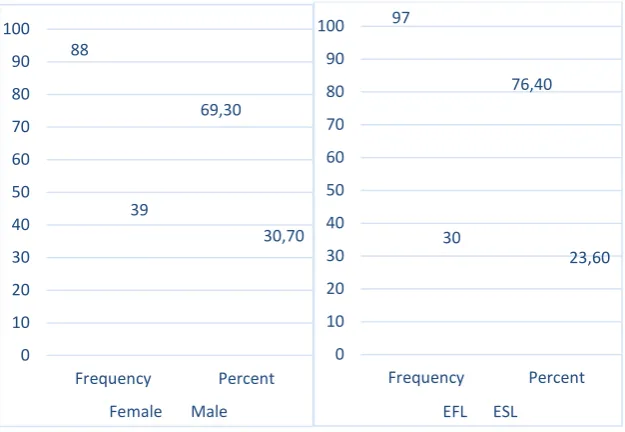
The participants to the present study were 97 EFL learners at undergraduate level in Turkey, 30 ESL learners in a Midwestern US university, two of the latter being graduate students. Figure 1 presents the distribution of EFL and ESL students and their gender.
Figure 1. The distribution of EFL and ESL students and their gender
The participants to the survey were predominantly Turkish-L1 learners of English (n=97), while the second largest group of participants the Chinese speakers (n=18). There was also one participant from each of the following languages: Japanese, Korean, Malaysian, Spanish, and Urdu. There were two participants from both Arabic and Vietnamese. Two of the participants preferred not to state their native language. All of the participants with nationalities other than Turkish were ESL students at the American University mentioned earlier.
Data Collection
The researcher developed a survey to collect data to sufficiently depict what tools the EFL and ESL learners to produce content and to what extent they use them. It was developed using the literature as a point of departure, but the researcher used his own teaching experience as well. The survey helped collect extensive data about the participants and what technologies they used. The survey was basically composed of three sections:
Personal information. This section included such constructs as age, context (EFL or ESL),
gender, native language, device ownership and so forth.
Digital Nativeness. A significant portion of the items in this section were created based on the
twelve categories of activities identified by Helsper, Dutton and Gerber (2009): “fact checking, training, current affairs and Interests, travel, finance, shopping, entertainment, social networking, diary functions, person to person networking, e-government and civic participation” (p. 22). The researcher listed a number of activities that represented the twelve common categories of activities that digital natives do on the Internet mentioned above. This section also included items related with, digital device ownership, autonomy of use (using the Internet without outside limitations, e.g., from a parent or teacher), experience with the Internet and mobile devices and using the Internet as the first point of reference. These items were intended for identifying the level of digital nativeness of each participant. Instead of asking the participants to specify how digitally native they are, the present study used the items above to assess the digital nativeness of the participant. Such an approach obviously produces perception-driven results, but it is important to know how learners
88
69,30
39
30,70
0 10 20 30 40 50 60 70 80 90 100
Frequency Percent
Female Male
97
76,40
30
23,60
0 10 20 30 40 50 60 70 80 90 100
Frequency Percent
EFL ESL
see themselves with respect to digital nativeness as learners' perception might be influential on how they intend to use current technologies for learning.
Digital Production for language learning. The items in this section explored what tools the
participants used to produce digital content. To assess the breadth of use, the participants were asked to specify how frequently they use a particular tool. They were also asked to provide links to their online productions. The digital tools presented here were mostly generic in nature, and as it was the case in Waycott et al.'s (2010) study, the list of technologies that could be used to create content in language learning is by no means complete, yet it might give us clues as to what younger generations are creating on the Internet while learning English.
Validation of the Data Collection Tools
The researcher used cognitive interviewing to validate the instrument used to collect quantitative data in this study. Cognitive interviewing was used to validate the survey used in the study. The first one was verbal probing. As a part of the verbal protocol, 3 students were asked to respond to the survey and the researcher interviewed them. Before the volunteers took the survey, they were given a form with guidelines for how to do screen recording and what to focus on during the think aloud protocol. The think-aloud protocol participants were asked to focus on four potentially problematic issues, suggested by Willis, Royston and Bercini (1991), and each of these were explained in detail in the think-aloud protocol form: comprehension, retrieval, judgment and response. Moreover, the participants were also asked to identify potentially unknown vocabulary. For this study, institutional review board permissions were obtained. Before the students took the survey, they were asked to read the informed consent form, and those students who did not agree to what is written in this form were directly taken to the end of the survey without seeing the survey itself.
Data Analysis
Extensive data were collected about the learners and a so-called digital nativeness score and productivity score were calculated for each learner based on learner-provided data. After the sum of the participants’ responses to the items related with digital nativeness and those related with digital productivity was calculated, a test of correlation was carried out, yet before carrying out the correlation test, the assumptions of Pearson conduct moments correlation were tested. A Shapiro-Wilk’s test (p = .117) along with the examination of their histograms, normal Q-Q plots and box plots indicated that digital nativeness scores were normally distributed with a skewness of .391 (SE = .218) and a Kurtosis .467 (SE = .433). However, the results of Shapiro-Wilk’s test (p = .047) for digital productivity scores indicated that they were not normally distributed although with a skewness of .509 (SE = .218) and a kurtosis -017 (SE = .433). Therefore, Spearman rank-order correlation test was conducted to determine if there was a relationship between digital nativeness scores and digital productivity scores. The EFL and ESL students’ scores were compared using a Welch’s test as it is a robust tool against unequal sample sizes. The correlations between several variables such as gender, age and productivity were also examined.
FINDINGS
This section presents an overview of the findings from the study. The results are presented under the research questions posed earlier.
(Q1) How do EFL and ESL learners differ with respect to access to digital devices and the internet?
ESL students have better access to technological devices, particularly to tablet computers and electronic readers than their EFL peers. Only the percentages of the students with a web or phone camera were approximately the same. For the remaining devices and internet access, the ESL students’ digital device ownership clearly goes beyond that of the EFL students. However, in a global sense, device ownership and access to the Internet do not seem to pose significant problems in neither of the groups (Table 1).
Table 1. Device ownership and Internet access among EFL and ESL learners
I h
av
e i
t (
%
)
I h
av
e a
cc
es
s t
o
on
e (
%)
I c
an
fi
nd
it
w
ith
dif
fic
ult
y (
%
)
I c
an
no
t g
et
it
a
t
all (
%
)
Desktop/Laptop EFL 79.1 6.6 6.6 7.7
ESL 96.7 3.3 0 0
Cell phone EFL 89.9 7.9 0 2.2
ESL 100 0 0 0
Tablet computer EFL 16.7 22.6 16.7 44.0
ESL 37.9 44.8 6.9 10.3
Electronic reader EFL 3.7 15.9 17.1 63.4
ESL 40.7 18.5 18.5 22.2
Webcam or phone camera EFL 86.0 5.8 2.3 5.8
ESL 86.2 6.9 0 6.9
Speakers/headphones EFL 70.2 8.3 3.6 17.9
ESL 93.3 3.3 0 3.3
Internet access EFL 91.9 5.8 2.3 0
ESL 100 0 0 0
(Q2) What are the patterns of internet and mobile device use in EFL and ESL learners?
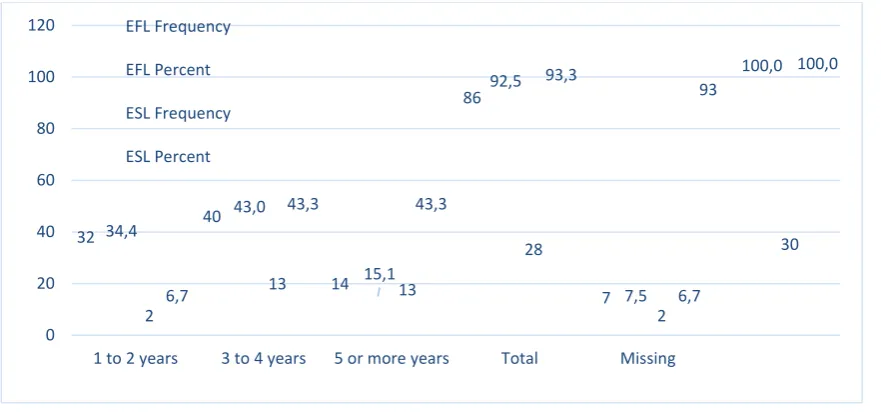
The length of internet and cell phone use is similar across the two groups. Compared with ESL students, EFL students are less experienced users of cell phones. For instance, while 18.3% of EFL students have owned a telephone for 11 years or more, 33.3% of the ESL students have been using a cell phone for the same duration. However, the number of EFL students who have used computers for over a decade is larger than that of ESL learners. In an overall sense, both contexts paint a similar picture when it comes to internet and cell phone use over the last decade.
Figure 2. The length of Internet and cell phone use among EFL and ESL students (based on percentages)
Figure 3. The length of mobile internet connection among EFL and ESL students
6,5 3,3 5,4 ,0
49,5
43,3
30,1
20,0 30,1
46,7 46,2 46,7
11,8
6,7
18,3
33,3
97,8 100,0 100,0 100,0
,0 20,0 40,0 60,0 80,0 100,0 120,0
Internet Use (EFL) Internet Use (ESL) Cell phone Use (EFL) Cell phone Use (ESL)
1-2 years 3-6 years 7-10 years 11 years or more Missing Total
32 40
14
86
7
93
34,4
43,0
15,1
92,5
7,5
100,0
2
13 13
28
2
30
6,7
43,3 43,3
93,3
6,7
100,0
0 20 40 60 80 100 120
1 to 2 years 3 to 4 years 5 or more years Total Missing
EFL Frequency
EFL Percent
ESL Frequency
ESL Percent
Figure 4. Daily internet use among EFL and ESL students
Mobile connection levels were similar in EFL and ESL learners as 93.5% of the former and 93.3% of the latter reported that they have internet connection in their cell phones. The main difference between the EFL and ESL students is that there are more what we might call internet addicts among ESL students than among EFL students as the percentage of the ESL students spending five hours or more on the Internet is more than two folds (20.4% and 43.3%, respectively). The percentage of average Internet users for the two groups is alike (approximately 50%), yet the number of EFL students who use the Internet for a limited time during the day is almost fourfold. In short, EFL students seem to spend more time on the Internet (Figure 4).
Figure 5. How well students understand the language on the Internet 24 48 19 91 25,8 51,6 20,4 97,8 2 15 13 30,0 6,7 50,0 43,3 100 0 10 20 30 40 50 60 70 80 90 100
1 to 2 hours 3 to 4 hours 5 hours or more Total
EFL Frequency EFL Percent ESL Frequency ESL Percent 37 55 1 93 39,8 59,1 1,1 100,0 11 19 0 30 36,7 63,3 0 100,0 0 10 20 30 40 50 60 70 80 90 100
So so Well Missing Total
(Q3) How to ESL and EFL learners use the Internet and digital tools in their daily lives and in language learning contexts for content-creation purposes?
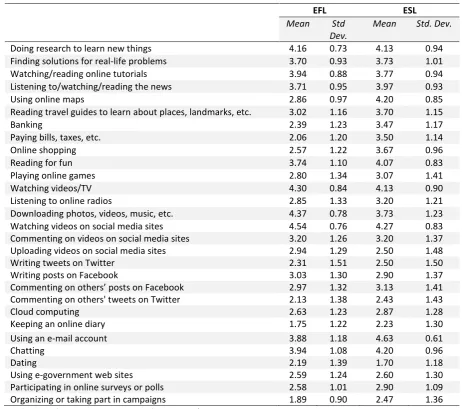
In an overall sense, the average levels of digital technology use were similar for both cohort of students in most items concerning digital nativeness. For some of the items, the mean score for EFL and ESL students were highly similar, while for some others, the ESL students’ mean score was higher than that of EFL students. For example, ESL students did some activities more frequently, such as using online maps, online banking, paying bills, online shopping, listening to online radios, downloading content, keeping an online diary, using an email account and organising and taking part in campaigns. It was these items that resulted in the significant difference between the total scores of the members of the true group of participants. On the other hand, for some other items, EFL students scored higher than ESL students, yet the difference between these two groups for these items was smaller than the difference for the first group of items mentioned above. Examples include watching videos on social media sites, uploading videos on social media sites, dating and so forth (Table 2).
Table 2. The Means of the Items about Digital Nativeness for the EFL and ESL Group
EFL ESL
Mean Std
Dev. Mean Std. Dev.
Doing research to learn new things 4.16 0.73 4.13 0.94
Finding solutions for real-life problems 3.70 0.93 3.73 1.01
Watching/reading online tutorials 3.94 0.88 3.77 0.94
Listening to/watching/reading the news 3.71 0.95 3.97 0.93
Using online maps 2.86 0.97 4.20 0.85
Reading travel guides to learn about places, landmarks, etc. 3.02 1.16 3.70 1.15
Banking 2.39 1.23 3.47 1.17
Paying bills, taxes, etc. 2.06 1.20 3.50 1.14
Online shopping 2.57 1.22 3.67 0.96
Reading for fun 3.74 1.10 4.07 0.83
Playing online games 2.80 1.34 3.07 1.41
Watching videos/TV 4.30 0.84 4.13 0.90
Listening to online radios 2.85 1.33 3.20 1.21
Downloading photos, videos, music, etc. 4.37 0.78 3.73 1.23
Watching videos on social media sites 4.54 0.76 4.27 0.83
Commenting on videos on social media sites 3.20 1.26 3.20 1.37 Uploading videos on social media sites 2.94 1.29 2.50 1.48
Writing tweets on Twitter 2.31 1.51 2.50 1.50
Writing posts on Facebook 3.03 1.30 2.90 1.37
Commenting on others’ posts on Facebook 2.97 1.32 3.13 1.41 Commenting on others' tweets on Twitter 2.13 1.38 2.43 1.43
Cloud computing 2.63 1.23 2.87 1.28
Keeping an online diary 1.75 1.22 2.23 1.30
Using an e-mail account 3.88 1.18 4.63 0.61
Chatting 3.94 1.08 4.20 0.96
Dating 2.19 1.39 1.70 1.18
Using e-government web sites 2.59 1.24 2.60 1.30
Participating in online surveys or polls 2.58 1.01 2.90 1.09 Organizing or taking part in campaigns 1.89 0.90 2.47 1.36 (Based on Helsper, Dutton & Gerber, 2009)
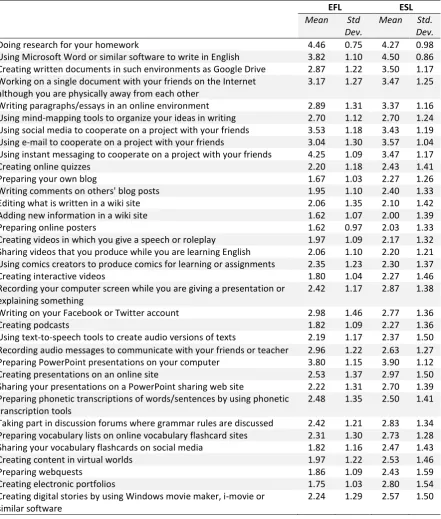
In contrast with digital nativeness, the participants from the ESL contexts produced more content while learning English. However, the difference was quite small for most of the items. As it is apparent in Table 3, the EFL students were better at using social media to produce content for language learning purposes. They also used the Internet to do research for their homework slightly more frequently than their ESL peers. They also used instant and audio messaging to communicate with their teachers. For other items in Table 3, ESL students were found to be more frequent users of these tools to produce something.
Table 3. The Means of the Items about Digital Productivity for the EFL and ESL Group
EFL ESL
Mean Std
Dev. Mean Std. Dev.
Doing research for your homework 4.46 0.75 4.27 0.98
Using Microsoft Word or similar software to write in English 3.82 1.10 4.50 0.86 Creating written documents in such environments as Google Drive 2.87 1.22 3.50 1.17 Working on a single document with your friends on the Internet
although you are physically away from each other 3.17 1.27 3.47 1.25 Writing paragraphs/essays in an online environment 2.89 1.31 3.37 1.16 Using mind-mapping tools to organize your ideas in writing 2.70 1.12 2.70 1.24 Using social media to cooperate on a project with your friends 3.53 1.18 3.43 1.19 Using e-mail to cooperate on a project with your friends 3.04 1.30 3.57 1.04 Using instant messaging to cooperate on a project with your friends 4.25 1.09 3.47 1.17
Creating online quizzes 2.20 1.18 2.43 1.41
Preparing your own blog 1.67 1.03 2.27 1.26
Writing comments on others' blog posts 1.95 1.10 2.40 1.33 Editing what is written in a wiki site 2.06 1.35 2.10 1.42
Adding new information in a wiki site 1.62 1.07 2.00 1.39
Preparing online posters 1.62 0.97 2.03 1.33
Creating videos in which you give a speech or roleplay 1.97 1.09 2.17 1.32 Sharing videos that you produce while you are learning English 2.06 1.10 2.20 1.21 Using comics creators to produce comics for learning or assignments 2.35 1.23 2.30 1.37
Creating interactive videos 1.80 1.04 2.27 1.46
Recording your computer screen while you are giving a presentation or
explaining something 2.42 1.17 2.87 1.38
Writing on your Facebook or Twitter account 2.98 1.46 2.77 1.36
Creating podcasts 1.82 1.09 2.27 1.36
Using text-to-speech tools to create audio versions of texts 2.19 1.17 2.37 1.50 Recording audio messages to communicate with your friends or teacher 2.96 1.22 2.63 1.27 Preparing PowerPoint presentations on your computer 3.80 1.15 3.90 1.12 Creating presentations on an online site 2.53 1.37 2.97 1.50 Sharing your presentations on a PowerPoint sharing web site 2.22 1.31 2.70 1.39 Preparing phonetic transcriptions of words/sentences by using phonetic
transcription tools 2.48 1.35 2.50 1.41
Taking part in discussion forums where grammar rules are discussed 2.42 1.21 2.83 1.34 Preparing vocabulary lists on online vocabulary flashcard sites 2.31 1.30 2.73 1.28 Sharing your vocabulary flashcards on social media 1.82 1.16 2.47 1.43
Creating content in virtual worlds 1.97 1.22 2.53 1.46
Preparing webquests 1.86 1.09 2.43 1.59
Creating electronic portfolios 1.75 1.03 2.80 1.54
Creating digital stories by using Windows movie maker, i-movie or
similar software 2.24 1.29 2.57 1.50
(Q4) What is the relationship between (a) the level of digital nativeness and productivity in language learning (b) age and digital nativeness and (c) age and digital productivity?
The results of Spearman rank-order correlation test indicated the there was a statistically significant moderate positive correlation between digital nativeness and digital productivity rs (123) = .571, p=.001. In addition to this, Spearman rank-order correlation test was carried out to investigate if there was a correlation between age and digital nativeness and digital productivity. The result of the significance testing revealed that there was almost no correlation between age and digital nativeness score rs (118) = .027, p=.772 and age and digital productivity score rs (118) = .044, p=.633 (Table 4).
Table 4. Correlations and Descriptive Statistics
Variables 1 2
1. Digital nativeness –
2. Digital productivity .571* –
3. Age .027 .044
M 90.95 90.23
SD 15.70 24.66
*p < .001
(Q5) How do EFL and ESL learners differ with respect to their level of digital nativeness and digital productivity?
In addition to correlational analyses, two groups of students were compared with respect to their digital nativeness and digital productivity scores. As a robust test used to compare unequal sample sizes a Welch’s test (also known as Welch–Satterthwaite or Welch-Aspin) was carried out to compare the means of the EFL and ESL group for digital nativeness and digital productivity scores. The results indicated that there was a statistically significant difference between EFL (M = 89.04, SD
=14.37) and ESL (M = 96.87, SD =18.28) groups with respect to their digital nativeness scores in favour of the latter, Welch’s t(41.20) = 4.583, p < .001. However, there was not a significant difference between EFL students (M=87.80) and ESL students (M = 97.77) with respect to their digital productivity scores, Welch’s t(37.55) =2.521, p < .001. Similarly, as the number of males and females were unequal, again a Welch’s test was conducted to compare the mean digital nativeness and digital productivity scores based on gender. Although males (M = 93.60, SD = 15.56) scored higher than females (M = 89.76, SD = 15.71) with respect to digital nativeness, the mean scores did not differ significantly by gender, Welch’s t(71.85) = 1.591, p= .211. By the same token, there was not a significant difference between males (M = 92.71, SD = 26.07) and females (M = 89.11, SD = 24.07) with respect to their digital productivity scores, Welch’s t(66.31) =.523, p =.472.
DISCUSSION AND CONCLUSION
One of the most conspicuous findings from this study is that digital technologies are used more frequently in daily life than in academic settings. This was apparent in the results, as the participants in both groups made top scores in the items for several enjoyment-oriented activities that are common in daily life, such as doing research to learn new things, watching videos/TV, downloading photos, videos, music, watching videos on social media sites and so forth (See Table 2). As the significant correlation between the participants’ digital nativeness and digital productivity scores indicated, the participants’ higher digital nativeness led to higher productivity. This could cause us to question Margaryan et al.’s (2011) claim that students lead a “double life,” which is
characterized with “high use of Internet after school and no (or little) use of Internet at school” (p. 1390). The phrase “double life,” according to the results from this study, seems too harsh to be true. However, this finding should be read with caution due to two reasons. First, the correlation mentioned above was moderate and when globally considered, the productivity scores were lower than nativeness scores. Moreover, the aforementioned correlation could be a simple indication of the positive impact that technology use in daily life has on technology use in academic settings rather than higher productivity rates. In other words, even if productivity rates are low, one could obtain a strong correlation between digital nativeness and digital productivity provided that digital natives and digital producers are the same set of people. However, it should be noted that, as the analysis of the survey data indicated, people with higher productivity in academic settings are probably digitally competent users, yet not every digitally competent user is expected to be digitally productive, particularly in academic contexts.
The results also indicated that ESL students were better than EFL students at using digital technologies in daily life. However, they were found to be equal with respect to producing digital content for learning. This indicates that access to broadband Internet digital devices might help students become digital natives in daily life, yet this might not hold true for academic contexts. This finding seems to lend support to those of other researcher (Gurung & Rutledge, 2014; Kennedy & Fox, 2013; Margaryan et al., 2011; Rowlands et al., 2008; Selwyn, 2009).
Another important point is that there seems to be an increase in the rate of the learners who use digital technologies for learning and producing content. A decade ago, for example, Bennet et al. (2008) found that only 21 percent of the students produced their own digital content. This finding indicates that digital technologies keep changing all the time, so it is possible to mention different generations of digital natives and the level of digital nativeness might change from one generation to another within a short time span. This equally goes with producing content for learning.
Those who were born into the Web 2.0 world are referred to as “second generation” or “real” digital natives (Helsper, 2008). Today we might perhaps talk about the third generation as the nature of online technologies keep changing and “semantic web” has long been under discussion. However, although the use of digital tools for production was not as low as that found in Bennet et al.’s (2008) study mentioned above, the breadth of use was an issue in the present study. It seems that the problem lies with the ability to use a plethora of online tools to complete assignments or learn new things autonomously and more importantly produce content by using these tools in academic settings. In the survey, the researcher asked the participants to provide links to the digital content they produced on the Internet, yet very few students in both the EFL and ESL context provided such information, indicating that they were not fully engaged in digital production.
Access does not seem to pose a significant problem today, yet there might be some other factors that are at work such as language proficiency. As a great majority of web pages are in English, low English proficiency students might experience problems, so IT use might be low among them (Ono & Zavodny, 2008). This low use is reflected in productivity as well. Another problem might be that producing content using mobile devices is not practical enough. For example, it usually proves more difficult to write something using a mobile device. However, young people are able to write very fast using a mobile device and today’s technologies allow us to use voice-to-text tools in most cases. Despite these, it might prove challenging for students to use some programs or web sites by using a mobile device, and this in turn might undermine their ability to produce content during language learning process.
In short, as the current empirical research findings tell us, digital nativeness, is not a uniform and one-for-all term; digital natives and immigrants stand on the two ends of a continuum. Therefore, the term digital native defies an easy definition since neither age-based nor technology-based perspectives accurately describe the nature of those learners who might be labelled as digital natives. As the results of the present study indicated, nativeness in technologies used in daily life differs from that in academic life, which adds to the complexity of the issue. Another point is that the differences between the developing world and the developed one seem blurred with respect to various technologies that are seen a must in most countries. This could have wider ranging implications as some transformational movements in education could be based on such easily accessible technologies which will widely be available for a great number of world citizens.
Pedagogical Implications
Both EFL and ESL students are to be provided opportunities to use digital technologies to produce content for learning. Unlike claimed in the digital native rhetoric, students need guidance and exposure to digital world (particularly educational hardware and software). Without such guidance, even if students were highly native with respect to ubiquitous technologies, they could be less proficient with respect to production. Students and teachers might benefit from institutional efforts to introduce new technologies into educational contexts. Once exposed to a new digital tool, young learners can easily adapt themselves to the requirements of new practices in digital world. They could also benefit from being assigned enough in-class or homework assignments that entail the use of technology while producing something to learn English.
Students usually use various tools to produce content when they are institutionally required or the teacher asks them to do it as a part of a homework assignment. This implies that asking students to use certain tools might be highly influential in getting them to use such tools. In this respect, the class teacher and the institution has a certain responsibility to help students get acquainted with new digital tools that can be used to produce content for language learning purposes. Then it is wise to ask students to prepare a homework using a plethora of digital tools. However, it is sometimes not enough to ask learners to use them because they may need some technical knowledge to be able to use some of them. Regularly introducing innovative tools into the classroom might help students obtain technical knowledge and raise their awareness of using technology productively rather than receptively in language learning. Yet, a word of caution here is that it is wise to introduce and digital technology into the classroom if it is worth doing so. In other words, bringing every new tool into the classroom encountered in the digital world probably proves confusing, particularly for the students or it might even prove counter-productive.
Limitations of the Study and Further Research
A particular limitation is that although the researcher surveyed students from both the EFL and ESL contexts, the data collected in this way might be biased to certain extent. Another limitation of the study is that the number of EFL and ESL students was far from being equal to each other, largely due to lack of willingness of the latter to participate in the study. Moreover, the digital tools that young learners might be using are obviously not limited to those included in the second section of the survey (the items related with productivity), yet they might be representative of the tools that are used to create content in digital environments. We should note that it is almost impossible to see a skilful digital learner who uses none of these tools but uses another set of tools to create content because most of the items in the second section of the survey were generic in nature, presenting a cover term supported by typical examples. This basically aimed at uncovering the
participants’ experiences with similar tools of the same category.
Further research on the same issue could be carried out with larger sample sizes especially with respect to ESL contexts. Samples of students’ work produced using digital tools were beyond the scope of this study, so prospective researchers could analyse them with respect to originality, quality, linguistic properties and so on. In addition, factors that affect students’ motivation to produce online content for language learning might be investigated in prospective studies.
Conclusion
This study compared and contrasted EFL and ESL learners with respect to their digital nativeness and their digital productivity for language learning. The findings of the study suggest that both EFL and ESL learners exhibit variations with regard to digital nativeness and how frequently they use certain digital tools to produce content for language learning. In an overall sense, neither EFL nor ESL students use digital productivity tools at desirable levels. It seems that younger generations contribute little to the development of what is there on the Internet despite the ease at which Internet user can produce content. Lack of enough instructional guidance seems to be influential in the learners’ inability to use most tools that are surveyed in this study. Another possible reason for little production for some tools is that such tools are not trendy in the digital world. Raising students’ and instructors’ awareness might be highly influential in getting younger generation to use such digital tools to produce content.
REFERENCES
Bennett, S., & Maton, K. (2010). Beyond the “digital natives” debate: Towards a more nuanced understanding of students’ technology experiences. Journal of Computer Assisted Learning,
26(5), 321–331. https://doi.org/10.1111/j.1365-2729.2010.00360.x
Bennett, S., Maton, K., & Kervin, L. (2008). The ‘Digital Natives’ debate: A critical review of the evidence. British Journal of Educational Technology, 39(5), 775-786. https://doi.org/10.1111/j.1467-8535.2007.00793.x
Brown, C., & Czerniewicz, L. (2010). Debunking the “digital native”: Beyond digital apartheid, towards digital democracy. Journal of Computer Assisted Learning, 26(5), 357– 369. https://doi.org/10.1111/j.1365-2729.2010.00369.x
Creswell, J. W. (2012). Educational research. Planning, conducting, and evaluating quantitative and
qualitative research (4th Ed.). Boston, MA. Pearson Education.
Crook C. & Harrison C. (2008) Web 2.0 technologies and learning at key stages 3 and 4: summary report. Becta Report.
Dörnyei, Z. (2007). Research methods in applied linguistics: Quantitative, qualitative, and mixed
methodologies. Oxford University Press.
Eduardsen, J. (2011). Are the digital natives myth or reality? Aalborg University. Available at: http://projekter.aau.dk/projekter/files/52846629/Final_thesis.pdf
Facer, K., & Furlong, R. (2001). Beyond the Myth of the 'Cyberkid': Young People at the Margins of the Information Revolution. Journal of Youth Studies, 4(4), 451-469. https://doi.org/10.1080/13676260120101905
Gu, X., Zhu, Y., & Guo, X. (2013). Meeting the "Digital Natives": Understanding the Acceptance of
Technology in Classrooms. Educational Technology & Society, 16(1), 392-402.
Gurung, B., & Rutledge, D. (2014). Digital learners and the overlapping of their personal and educational digital engagement. Computers & Education, 77, 91-100. doi:10.1016/j.compedu.2014.04.012 https://doi.org/10.1016/j.compedu.2014.04.012 Harel-Caperton, I. (2003). Clickerati kids: Who are they? Available at: http://www.mamamedia.
com/areas/grownups/new/21_learning/main.html
Helsper, E. (2008). Digital natives and ostrich tactics? The possible implications of labelling young
people as digital experts. Futurelab, Bristol, UK.
Helsper, E. J., & Eynon, R. (2010). Digital Natives: Where Is the Evidence? British Educational
Research Journal, 36(3), 503-520. https://doi.org/10.1080/01411920902989227
Helsper, E. J., Dutton, W. H., & Gerber, M. (2009). To be a Network Society: A Cross-National Perspective on the Internet in Britain. OII Research Report, No 7. Available online at http://www.oii.ox.ac.uk/microsites/oxis/publications https://doi.org/10.2139/ssrn.1323813
Jenkins, H. (2006). Convergence Culture. New York, NY: New York University Press.
Jenkins, H., Clinton, K., Purushotma, R., Robison, A.J., Weigel, M. (2006). Confronting the challenges of participatory culture. The MacArthur Foundation http://digitallearning.macfound.org (January 15, 2009).
Jones, C., Ramanau, R., Cross, S., & Healing, G. (2010). Net Generation or Digital Natives: Is There a Distinct New Generation Entering University? Computers & Education, 54(3), 722-732. https://doi.org/10.1016/j.compedu.2009.09.022
Kennedy, D. M., & Fox, B. (2013). ‘Digital natives’: An Asian perspective for using learning technologies. International Journal of Education and Development using Information and Communication Technology, 9(1), 64-79.
Kolikant, Y. B.-D. (2010). Digital natives, better learners? Students’ beliefs about how the Internet influenced their ability to learn. Computers in Human Behavior, 26(6), 1384-1391. https://doi.org/10.1016/j.chb.2010.04.012
Kvavik, R. (2005). Convenience, communications, and control: How students use technology. In D. G. Oblinger, & J. L. Oblinger (Eds.), Educating the net generation, an Educause e-book publication. Available at: http://www.educause.edu/ir/library/pdf/pub7101.pdf
Lee, K. W., Thang, S. M., Tan, C. K., Ng, S. I., Yoon, S. J., Chua, Y. W., & Nadin, S. S. (2014). Investigating the ICT Needs of ‘Digital Natives’ in the Learning of English in a Public University in East Malaysia. Procedia - Social and Behavioral Sciences, 118, 242-250. https://doi.org/10.1016/j.sbspro.2014.02.033
LimeSurvey Project Team. (2015). LimeSurvey: An open-source survey tool. LimeSurvey Project: Hamburg, Germany. Available at: http://www.limesurvey.org
Luckin, R., Clark,W., Logan, K., Graber, R., Oliver, M., & Mee, A. (2009). Do Web 2.0 tools really open the door to learning: Practices, perceptions and profiles of 11–16 year-old learners. Learning,
Media and Technology, 34(2), 87–104. https://doi.org/10.1080/17439880902921949
Margaryan, A., Littlejohn, A., & Vojt, G. (2011). Are digital natives a myth or reality? University students’ use of digital technologies. Computers & Education, 56(2), 429-440. https://doi.org/10.1016/j.compedu.2010.09.004
Nagler,W., & Ebner, M. (June 22–26, 2009). Is your university ready for the Ne(x)t-Generation? In Proceedings of 21st world conference on educational multimedia, hypermedia and telecommunications (EDMEDIA) (pp. 4344–4351), Honolulu, Hawaii, USA.
Ng, W. (2012). Can we teach digital natives digital literacy? Computers & Education, 59(3), 1065-1078. https://doi.org/10.1016/j.compedu.2012.04.016
Oblinger, D. G., & Oblinger, J. L. (2005). Educating the Net generation: An Educause e-book publication. Available at: http://www.educause.edu/ir/library/pdf/pub7101.pdf
Ono, H., & Zavodny, M. (2008). Immigrants, English Ability and the Digital Divide. Social Forces, 86(4), 1455-1479. https://doi.org/10.1353/sof.0.0052
Prenksy, M. (2001a). Digital natives, digital immigrants. On the Horizon, 9(5), 1– 6. https://doi.org/10.1108/10748120110424816
Prensky, M. (2001b). Do they really think differently? On the horizon, 9(6), 1– 6. https://doi.org/10.1108/10748120110424843
Prensky, M. (2005). Listen to the natives. Educational Leadership, 63(4), 8-13.
Prensky, M. (2010). Teaching digital natives: Partnering for real learning. Thousand Oaks, CA: Corwin Press.
Rowlands, I., Nicholas, D., Williams, P., Huntington, P., Fieldhouse, M., Gunter, B...Tenopic, C. (2008), The Google generation: the information behavior of the researcher of the future, Aslib
Proceedings,60(4), pp. 290-310. https://doi.org/10.1108/00012530810887953
Rushkof, D. (2006). Screenagers: Lessons in Chaos from Digital Kids. Incorporated: Hampton Press. Salajan, F. D., Schönwetter, D. J., & Cleghorn, B. M. (2010). Student and faculty inter-generational
digital divide: Fact or fiction? Computers & Education, 55(3), 1393-1403. https://doi.org/10.1016/j.compedu.2010.06.017
Schradie, J. (2011). The digital production gap: The digital divide and Web 2.0 collide. Poetics, 39(2), 145-168. https://doi.org/10.1016/j.poetic.2011.02.003
Selwyn, N. (2009). The digital native – myth and reality. Aslib Proceedings: New Information
Perspectives, 61(4), 364-379. https://doi.org/10.1108/00012530910973776
Stokburger-Sauer, N., & Plank, A. (2014). Respecting the heterogeneity of the natives: Antecedents
and consequences of individuals’ digital nativeness Paper presented at the Twenty Second
European Conference on Information Systems, Tel Aviv
Tapscott, D. (1998) Growing up digital: The rise of the net generation. New York: McGraw-Hill. Tapscott, D. (2008). Grown up digital: How the Net generation is changing your world. New York:
McGraw-Hill.
Thinyane, H. (2010). Are digital natives a world- wide phenomenon? An investigation into South African first year students’ use and experience with technology. Computers & Education, 55(1), 406-414. https://doi.org/10.1016/j.compedu.2010.02.005
Tustin, D., Goetz, M., & Basson, A. (2012). Digital divide and inequality among digital natives: A South African perspective. African Journal of Business Management, 6(31), 9140-9150. https://doi.org/10.5897/AJBM11.2228
Veen, W. and Vrakking, B. (2006), Homo Zappiens: Growing up in a digital age. London: Network Continuum Education.
Waycott, J., Bennett, S., Kennedy, G., Dalgarno, B., & Gray, K. (2010). Digital divides? Student and staff perceptions of information and communication technologies. Computers & Education, 54(4), 1202-1211. https://doi.org/10.1016/j.compedu.2009.11.006
Wiersma, W. (2009). Digital Natives: Mythical tribe, or savvy youth of nowadays? Available at: http://wybowiersma.net/pub/essays/Wiersma,Wybo,Digital_natives_mythical_tribe_or_ tech_savvy_youth_of_nowadays.pdf
Willis, G., Royston, P., & Bercini, D. (1991). The use of verbal report methods in the development and testing of survey questionnaires. Applied Cognitive Psychology, 5, 251– 267. https://doi.org/10.1002/acp.2350050307